Why You Wake Up Groggy (And How to Fix It) | Muse S Athena Deep Sleep Boost & Smart Wake-Up Review
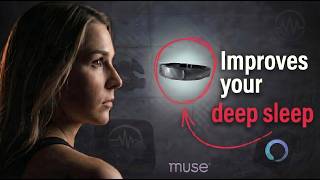
Victoria S. Dorsano reviews Muse S Athena's new sleep features: Deep Sleep Stimulation uses pink noise during slow-wave sleep to extend deep-sleep time, while Smart Wake-Up picks the lightest sleep moment to wake you. Muse measures brainwaves directly, so its deep-sleep data differs sharply from wrist monitors like Whoop, which guess from heart rate.
Chapters
You woke up this morning, you slept 8 hours, and you still feel like you got hit by a truck. Here's something I hear from my clients all the time: I woke up in the middle of the night, felt all energized, but hey, it was 2 AM, so felt like I would go back to sleep. Then next thing I know, my alarm is waking me up and I feel completely wrecked. Sound familiar? Most people assume it's just bad luck, or maybe they just need more sleep. What if the problem is more about what's happening in your brain while you're sleeping and what's happening when you're waking up? That's why I've been testing two new features on the Muse S Athena that are designed to fix both those things. And as a coach who monitors all my sleep data all the time, I have some thoughts. Before I get into the features, I want to give you guys some context so that everything hereforth is going to make a lot more sense. If you're watching this video, you've probably already heard of Whoop. I use Whoop with my clients. I love it for the recovery data, the HRV, the strain readiness score. It does all that stuff really, really well. But here's something that a lot of people don't realize. Whoop, Oura, Garmin, Apple Watch— they don't actually measure your sleep stages. They just infer them, usually from things like heart rate, HRV, and movement. They're essentially making an educated physiological guess. And it's a good one, but it's still just a guess. With the Muse technology being that it has EEG built into it, it's actually capable of reading your brain. And that distinction matters most at two specific moments: during deep sleep and the moment that you wake up. I actually wore both devices, my Whoop and the Muse, on several nights that I was sleeping, and I'm going to show you exactly what I found because the data tells a really interesting story. Okay, so let's talk about deep sleep for a minute because I think a lot of people have a kind of incomplete picture of what goes on when we're sleeping. Your body cycles through sleep stages roughly every 90 minutes throughout the night. You've got light sleep, deep sleep, which is also called slow-wave sleep or stage 3 non-REM sleep, and then REM sleep. You end up going through this cycle 4 to 6 times in a night. Deep sleep happens mostly in the first half of the night, and then REM starts to dominate the latter half of the evening. Both matter, but they just have different jobs. Now here's why deep sleep is such a big deal. Deep sleep, or slow-wave sleep, is where the real restoration happens. Something called growth hormone is primarily secreted during deep sleep, which if you're training and trying to recover from workouts actively, that's a big deal. Your brain's waste removal system, which is called the glymphatic system, it's most active during deep sleep. Its literal job is to help flush out all these metabolic byproducts while you are sleeping. Memory consolidation for facts and events happen during deep sleep as well. And here's something I bring up a lot with my clients, is that deep sleep naturally starts to decline as we age. Now, even though that does naturally decline with age, that's not to say that you can't make the most out of your deep sleep and try to get as many uninterrupted deep sleep cycles. In your later years is possible. Now, the main interrupter to that usually happens with like bad sleep hygiene habits—screens late in the evening, late workouts, alcohol, any type of overstimulation before bed. So the problem isn't always about just falling to sleep and getting enough hours. Again, it's about the amount of deep sleep you can get and staying in those deep sleep cycles long enough. And that's exactly what one of these new features in the Muse is all about doing. And this new feature is properly named Deep Sleep Stimulation, or DSS for short, and it launched through the Muse app and with the Muse devices in around February of 2026. So how it works is that while you're sleeping, Muse S Athena is reading your brainwaves while you are in a sleep state. It's getting that EEG data in real time. When it detects that you've entered into a slow wave sleep cycle or deep sleep cycle, it delivers precisely timed pink noise cues through the app on your phone or through headphones if you're linking it that way. And those cues are designed to help you sustain longer and more stable deep sleep. So the underlying science behind this approach is called closed-loop acoustic stimulation, and it has real peer-reviewed research behind it. What we don't have quite yet is independent validation of Muse's specific implementation of this closed-loop acoustic stimulation. Wow, that's a mouthful. But their internal beta results show about 24% longer slow-wave or deep sleep cycles and more organized deep sleep activity. But I do want to be transparent that those are their internal testing numbers, not independent research studies. Now, the second feature I want to get into is their Smart Wake Up feature, and this one just launched in April of 2026. This one specifically addresses that groggy, truck-to-the-face feeling that we opened with in this video. So here's how their Smart Awake feature helps to combat that. You start by setting a wake window, essentially, and ultimately you say like, what is the latest time you'd be willing to get up at? So for me, most mornings that would be like 6:15. So my wake window, if I was setting it for a 60-minute time frame, would be from 5:15 to 6:15 at the latest. During that time, Muse is actively measuring your brain signals using their EEG technology in real time. When it detects that your brain has then shifted into a lighter sleep stage, meaning you're in a more naturally wakeable moment, it starts the alarm gradually and in not a jarring fashion. And if you never happen to hit that light sleep stage during that window that you set, it's going to wake you up at that latest time that you set in that window. The key thing here that makes Muse a huge differentiator from other kinds of smart alarms on the market is that it's EEG-based. It's using your direct brain measurement to find that light sleep stage, and this is validated by polysomnography, which is basically the clinical gold standard of sleep staging. Now let's talk about the alarm options, because there are a lot of fun different options you can pick to be woken up with. Of course, you can choose from your traditional alarm sounds, different music types, Or you can pick a meditation to wake up to. As of right now, in late April of 2026, as I'm recording this, there are 5 different meditations that you can pick from. Then there's this whole dreaming category, which is pretty interesting, and that consists of gentle sound cues that are designed to help support memory recall from your dreams. Definitely a cool concept. I will say, and this is probably legitimate advice for any alarm system for waking you up, you should probably preview the sound before choosing one, especially if you share a bedroom. I just chose one of the first meditations that popped up. Up as an option for setting the alarm, and it turned out to be a man's voice in the dark at 6 o'clock in the morning. How did you feel when you first opened your eyes this morning? And it, it scared my husband to death. He's like, who is in our room right now? Learn from my experience, because that was a very unsettling moment for him. Okay, so let's get into my personal experience and uses of these features. So with the smart wake-up, I preferred to set my wake window to about 30 minutes just in case you know, for whatever reason I was in a light sleep stage early in the, in the morning hours. Like, I did not want to be woken up at 5 o'clock if I didn't have to get up till 6 o'clock. So, you know, 5:30 to 6, that's fine. I'm somebody who wakes up pretty much at the same time every single morning and usually feels okay. But I do want to say that I pleasantly felt like even a little bit more energized, a little bit more awake and alert when I used the smart alarm feature. And you can see that it actually did in fact wake me up in a lighter part of my sleep stage, which is really cool. Now, because I do not like using this device with headphones and I'd rather play it from my phone speaker, I have decided to opt for more of the music options slash alarm options that are not like somebody's voice, just out of respect for my husband because that freaked him out. But I could definitely see how waking up with like a gratitude meditation or something like that could be really nice too. All right, so my experience with the second feature, the deep sleep stimulation, This one's interesting because I did try to make this happen. However, there were a few obstacles I kept running into, so I do not have good data to share with you guys in this video. Don't bounce yet because I do want to show you my Whoop versus Muse comparison data in the next section, but I want to disclose a little bit about why it was so hard for me to get into the groove of this deep sleep stimulator. So as I mentioned in my previous review of Muse, sleeping with the device feels a little difficult sometimes for me. Now, that is because I have a whole sleep setup with a bonnet for my hair and then an eye mask to block out any light. And then you add in another thing on your head and it just felt like there were so many things on my face at once. I also wear earplugs because I hate sound at night. All that being said, the deep sleep stimulator feature of Muse is best used either with wired headphones or played out loud on the speaker. You can use Bluetooth headphones, but there is a little bit of an audio lag, and that is, you know, significant because we're talking about neurofeedback. It is responding to your brain waves, and you kind of want that to be in sync. Corded headphones, not really an option. I move around a lot in my sleep, and those things would pop off immediately, pretty much. So I do not have successful data to share with you guys, but I'm going to try some different options, a couple of different ways to set this up, see what I can do, because I do really, really wanna try it. I do wanna share with you guys what my experience is. But beyond all that, the pink noise sound itself, I did not find very calming. I didn't love that sound. It kind of sounds like TV static pulsing, which to me did not feel super relaxing. All right, so I learned something new. Quick note I wanted to add in here with the deep sleep boost. You know how I was mentioning that kind of staticky annoying sound? Well, turns out my volume on the Deep Sleep Boost was actually set to be a little too high. So it actually should be set to be almost imperceptible, like whisper quiet. And it should not be something that wakes you up out of your sleep or is disturbing. And I think I had my volume set a little bit too high, so I'm looking forward to actually trying it with the correct volume setting. But I wanted to make sure I added that, this whole section in this video as we're going through and editing it. So I apologize for being a little haphazard, but I feel like it was misrepresented when I was originally filming because, I had it set to the wrong volume. Totally user error on my end, and I will keep you guys posted in a future video what the feature actually feels like in the appropriate volume setting. But now that I've been able to actually sleep with the Muse on my forehead and my whole bonnet and face mask system, now I figured that out, there are some interesting things that I want to share comparing my Muse data with my Whoop data, because I do think that this is really interesting. First, I found that both devices were fairly accurate with the REM sleep. They were usually within about 15 to 20 minutes of each other in predicting when I was in REM. But on deep sleep, they greatly diverged from each other. On one night, Whoop reported almost double the amount of deep sleep than Muse reported. And it turns out that there's a lot of well-documented research on this. Like I mentioned earlier, wrist devices like wrist wearables like Whoop and Garmin and Apple Watch, and even including Oura that's on the finger, they have the hardest time specifically predicting when slow wave sleep is happening. They tend to overestimate it because they're using physiological cues like heart rate and movement that don't necessarily clearly differentiate deep sleep from other non-REM sleep stages like light sleep. They tend to overestimate your deep sleep on average because they are trying to gather that information about when you're in deep sleep from physiological cues, not brainwaves. And those physiological cues do not cleanly doesn't really differentiate very well between when you're in deep sleep and when you're in other stages of lighter non-REM sleep, while EEG technology does. So I'm not flat out saying that Whoop is wrong. Whoop is doing exactly what it's designed to do, and for things like my HRV and my recovery data, I rely on it completely. But for deep sleep staging specifically, the technology is fundamentally different, and the data really, really showed that. So if you are serious about measuring your deep sleep to a higher degree of accuracy, then wearing something like the Muse on your head that's going to measure your brain waves while you're sleeping is going to be pretty important. So that essentially brings me into who is this actually for. If you're somebody who is already optimizing your training and your nutrition and your stress levels, but you haven't really gone deep into how your sleep quality is, and something like the Muse, Essathena, is the next layer to add on, especially if you're somebody who gets enough hours of sleep but doesn't often feel well rested. Now, as a note to other health practitioners and performance coaches like myself, this could be a meaningful tool for you to have your clients use. And then lastly, athletes and high performers. If you are noticing that your body just isn't recovering the same way that it used to, and you're really wanting to capitalize on the deep sleep that you are getting and make it higher quality and just better overall, then this is also gonna be for you. Probably not for somebody who is very sensitive to having things on their face at night because yes, you do have to wear it on your head and it has to be roughly in the same spot. But I will say one of my worries was that it was gonna be moving around and it was gonna fall off in the middle of the night. And once you figure out the best way to put it on, it pretty much stays on, which is nice. And I'm saying that as somebody who moves around a ton in their sleep. Now again, if this is your first introduction video into Muse, I highly recommend checking out my original video because that goes into a lot more of what else you can use Muuse for, because it's not just like a sleep enhancer. It definitely does a lot other things for meditation, stress, brain health, and longevity in general. So it's a really, really useful tool outside of sleep. You can check that out here, and I'll put the link down below in the description. And I also wanna note, again, this isn't something that's going to replace your normal wearable because these things are on you 24/7 and you're getting good device information about your recovery, your heart rate, your fitness levels when you're performing an activity, right? So think of this more as a brain health and sleep health enhancer. Both components can be really great data to act off of, but you wanna make sure that you are the type of person to take that data and actually act off of it. And if you're not, but you would like to be, then reach out to me. That's exactly the type of stuff that we do in our one-on-one coaching to help optimize your health. So. So if you are interested in trying any of these new sleep features or any of the features in the Muse S Athena, then I will drop the link for that down below, and you can use code Victoria S. Dorsano for 15% off. And there's a 30-day return window, so if you try it and it's not your thing, you're not locked in. So I'd love to hear from you guys. Is this relatable? Do you often find that you are getting maybe close to enough sleep but wake up feeling exhausted? Or is there another sleep issue that plagues you? Comment down below. I'd love to hear from you guys and see if there's other videos that I can make on sleep to help you improve your sleep and performance and health in general. Thanks again, guys, for watching. I appreciate you. And if you like this video and thought it was helpful, please, please, please give it a thumbs up. Subscribe to the channel. I greatly, greatly appreciate each and every one of you, and I'll catch you on the next one. Bye!
More from Victoria






3 things you should do to make sure you get the most out of your fish oil #legion
