Your top ACL questions...answered! - Q&A with Physical Therapist, Dr. Kero Abdelmessih
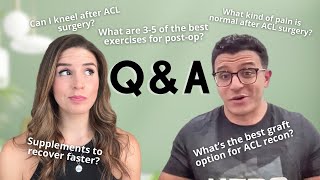
In this YouTube Q&A, host Victoria S. Dorsano interviews physical therapist Dr. Kero Abdelmessih to answer a wide range of viewer questions about ACL and meniscus surgery recovery. Dr. Kero provides evidence‑based timelines (generally 9‑12 months before returning to sport), practical tips for daily tasks (e.g., getting out of bed with a hinge brace), and detailed guidance on graft selection, its impact on post‑operative strength deficits, and when allografts are appropriate. He outlines core quad‑dominant exercises, progression strategies, and how to objectively assess quad strength using load cells or isokinetic dynamometers. Pain expectations are clarified (moderate discomfort 3‑4/10 is normal; sharp pain warrants evaluation). The discussion covers anterior knee pain, joint noises, risk of re‑injury to the repaired versus the contralateral ACL, and the importance of load‑capacity balance. Dr. Kero advises on safe kneeling, deep‑squat mobility, and the role of rate‑of‑force‑development and plyometrics for athletes returning to volleyball. He expresses skepticism toward novel supplements (egg‑membrane capsules, vitamin C, zinc) and emphasizes evidence‑based practice. Communication with surgeons, informed consent, and seeking second opinions when graft choices seem questionable are highlighted. Swelling patterns in the first two months are described as variable and data‑driven. Finally, he shares how patients can access his content (Instagram @kero.dpt) and encourages proactive self‑monitoring (e.g., video analysis) during rehab.
Chapters
Welcome back to the channel, guys. So today I have Dr. Kiro on for a Q&A. We go deep into all of your top questions that you guys have asked about ACL rehab, about the recovery process, about aches and pains, even years down the road after you've had ACL surgery. And I think this is really important to have an expert on to talk about some of these things more in depth than I have been able to on this channel before. So I hope you guys enjoy it. I'm going to keep the intro brief because we go deep into some of your questions that you guys submitted, which were all great questions. Um, but Dr. Kiro answered them so thoroughly and I want to give you guys all the time to listen to the rest of this video. So let's go ahead and dive in. All right guys, so I have Dr. Kiro on for the Q&A portion. Super excited to answer some questions today. How are you feeling, Dr. Kiro?
I'm feeling like a hero today.
Awesome. Love it. Kiro the hero. So thank you guys who, um, all of you guys who have submitted your questions. We super appreciate it and we look forward to getting to all of the answers to these questions. So let's start with the first one. Um, Somebody asked how many, after how many months of rehab can they play sports again after their ACL and meniscus tear surgery? That's a common question I'm sure, right?
Yeah, very common question. So it really depends on the type of sport, but really on average people shouldn't go back to sport or even begin any sort of progression back to sport anytime before 9 months. And the research is pretty solid on that. And again, that's the average. So you might have the freaks who pass all the tests and do all the crazy things at, 6 months. You know, we've had that happen. But then we also have people who are 18 months out and they're still struggling with range of motion and with strength deficits and things like that. So the research is pretty clear, at least in youth athletes, that if you return back to sport before 9 months, you're actually at a 7 times fold risk of retearing either that side or the other side. So you wanna make sure that you're taking at least 9 to 12 months before you think about getting back to sport.
That's huge. And yeah, I think that's really important to cover cuz a lot of people will say 6 to 9 months and that again, that's kind of on the, the fresher side of things if you're kind of like that freak anomaly that gets out on that sooner end of that spectrum. So good thing to clarify on that. All right, so another question we got was how to get out of bed with a knee brace on. It can be complicated sometimes, right?
Absolutely. So this is more like a practical question, and it really just depends on if you have a brace, what kind of brace is it, how early are you talking, are you able to move, are you able to take the brace off? So there's many different ways to go about this. What I'm kind of envisioning in my mind when someone is asking this question is I have a hinge brace on, which is that big brace that has the two hinges on the sides, and they're locked in extension and they're kind of unable to get out of bed. If you have someone to help, that would be great, especially in the first like couple of days where you can have them lift very lightly underneath the heel and have them pull you over the side of the bed so you're able to scoot over and then able to set down the leg pretty lightly. Now, if you don't have anyone to help at all, what you can do is honestly grab one of the Velcro straps itself of the hinge brace lift it up yourself and then be able to pivot with that. Now, we don't want to create any sort of dependence on your hands or other people. You want to be able to do that on your own eventually. And that's why physical therapy is so, so, so, so important after a surgery like that, because you want to make sure that first you have full extension, the swelling is going down, all of that stuff. But you also have the quad strength and hip flexor strength to be able to lift that leg up and off of the bed.
Great point. I did the Velcro strap pull. That was, that was a handy one. A little hand lever. So good point.
Yeah.
So next question I got is, oh, this is a great one. So does the body part from which the graft was extracted determine the degree of stability achieved after surgery?
Yeah, so if we're talking about strictly stability, we're not talking about function, we're not talking about anything else, I don't know that I've seen much research or any research at all or even anecdotally, and anecdotally just means in my experiences with people, that there is like a certain degree of increased stability with a certain graft. There are pros and cons to each of the grafts, and I think that's kind of between you and your surgeon to decide what you want to do. But some common questions that I like to ask the surgeon is what kind of experience you have with different grafts, what are the pros and cons of those grafts. And keep in mind that whatever graft that you take, whether it's a patellar tendon or it's a hamstring or it's a quad tendon or even an allograft or whatever it is, whatever part that they're taking out of, that part is going to become weaker. So not the allograft, but any autograft of yourself. If they take part of the hamstring, the hamstring is going to become weaker. So you need to make sure that you get after those deficits after surgery. If you take from the patellar tendon, that's part of that extensor mechanism through the entire knee, and you got to make sure that that is strengthened and then desensitized to load and, and all these different things. Same thing with the quad tendon. So every single graft has its pros and cons, and you just got to pick the right thing that fits you and surgeon. That's, that's the best fit.
What are 3 to 5 good exercises to include in a workout after surgery? I'm sure that's a very nuanced question.
Yeah. So this is again a very vague question because it really just depends on what time period you are after surgery or before surgery or whatever it is. And everyone is completely different with the type of graft that they have and their pain tolerance and different things like that. It's kind of like 3 to 5 exercises to make me lose weight. It's like a bunch of them can help you lose weight. So the ones that I like to use, especially in the beginning, are definitely quad-based or quad-dominant exercises, which means that you are bringing your knees past your toes. Okay? And I think that's super duper important. So whether that includes squats or lunges or different variations of squats or getting on the leg extension machine or whatever it is, doing those kinds of exercises are gonna be super important. And you can always modify any of these exercises. So whether that's decreasing the amount of weight, whether that's decreasing the amount of reps that you're doing, decreasing your range of motion, you know, all these different things you can modify in order to make sure that that's tolerable for you. And then you build that over time. People think that going into physical therapy, you need to do different exercises every single time you go in. And it's like, no, I'd rather you stick to one specific exercise that we know targets the quads, which is, that's the biggest thing that we go after, after any sort of knee surgery. We wanna make sure that the quads are strengthened again. So once they're isolated and you're able to do exercise exercises with that, you just build on top of that instead of trying to confuse the body and do all these different things and then it ends up you not really going anywhere. So that's my main type of exercise that I would do. And then it really just depends on your goals from there. Range of motion, do you want to strengthen the hips? Do you want to strengthen the foot and ankle? Do you want to strengthen other things? So just, you can go anywhere with this.
What type of pain is normal to have after knee surgery?
Yeah, so this is an excellent question. How I explain it to people is that after surgery, you will have pain and discomfort. You will have pain and discomfort. Those first couple of days you may not have as much, especially if you got some sort of nerve block. But once that wears off, then you will definitely have pain and discomfort. What I tell people is that you do things to your tolerance and you don't worry about the things that people are doing around you. So if you're going into physical therapy or in a clinic and you see a bunch of different people doing different things, even if they're at the same exact phase as you, just realize that there are so many different factors that go into this and that your journey is different than the journey of the person who's next to you, might have done the same exact surgery from the same exact surgeon in the same exact place. Once we pass that kind of initial first couple of weeks and you're over that like extreme pain and discomfort, you should, you will be having some sort of discomfort in physical therapy if they're pushing you hard enough. But again, you wanna have that happy medium where you're not screaming in pain like I've seen that video of like Neymar doing. And then you also don't wanna have zero discomfort at all and you're not being challenged and you don't feel like you're being pushed to your limits. So you want to kind of find that happy medium of things. And if I really had to quantify it, what I tell people is that on a pain scale of 0 to 10, 0 being no pain at all, 10 being I need to be in a hospital right now, that 3 to 4 out of 10 pain is okay. And by pain I mean discomfort. It's like discomfort. You're not feeling, it's not sharp, it's not, it's just a little dull pain discomfort that you're kind of feeling. And that can come along with the swelling. If you're feeling any sort of like sharp, piercing pain with a specific movement or in a specific range of motion, then I would definitely either back off that a little bit more or ask your provider, whoever it is, in order to figure out what that is and to closely monitor that stuff. Now, when we get to the later phases than that, what I tell people is that you want to be having that productive pain. Or when you go to the gym, you want to feel like you're getting that soreness instead of like, ow, this hurts in my knee, or this hurts on the inside of my knee or outside or behind my knee. No, it should feel more of like my muscles are just super fatigued and I feel that productive pain. So that's how I explain it to people.
That's a great question. And do you find that— this is a follow-up to that because I get this, I get people asking me this question pretty regularly. You know, hey, I'm a year out of surgery now. I'm still having like some discomfort. I've increased my activity level, but there's like a pain behind my kneecap or pain on the front of my kneecap or there's pain in the knee anatomically, not just that kind of like muscular pain. What do you recommend for those individuals that are that are having those sorts of issues, what would be a way to take a step back? Or do you recommend that they get another MRI or see their surgeon or their PT again? Like, what would be the next step for those people?
Yeah, so the first question that I would ask as a physical therapist is tell me a little bit more about your activity history and what you've done over the past couple of weeks and some months. Because if they've done absolutely nothing and they've gone into CrossFit or they've gone back to volleyball right away, it's like, yeah, of course you're going to have some sort of pain because your knee, the entire knee doesn't understand what it means to do these things anymore. So that's the first thing that I would delve into. If they tell me they have some sort of mechanism of injury, and what that means is that they fell or they heard a pop or a snap and it's painful or something like that, absolutely, I would go send them for an MRI or an X-ray or whatever it is, send them up to a physician to make sure that nothing is there to rule something out. Now, if it's just like dull pain and it's happening and they, they have progressed over time, what I tell them is let's closely monitor it. Let's add a couple of exercises here and there that'll help that pain. Specifically, I use isometric exercises where you're not lengthening or shortening the actual muscle and then see how they respond to that. If over time they're getting better, then I'll be like, okay, fine, we're on the right path. Even if they are progressing just a little bit, I make sure to objectively quantify that. If they're not getting better at all and things just start, you know, it's, it's worse. And even with rest, it's annoying and all that stuff, then I'll send them over for a referral.
Yeah, and that's a great thing that you mentioned too, because I do find I get, I get a lot of people asking me this question or bringing this problem up to me saying, hey, you know, I went through the PT thing, I started my normal strength training program and I really wanted to increase that and I figured I should go back to maybe doing some of my PT exercises, but man, the PT exercises are hurting now all of a sudden. And it's, they're not understanding that like there's kind of a load capacity to training even after you've been out of that physical therapy for a while. You can't just increase loads so suddenly, whether that is reintegrating a lot of your previous PT exercises on top of your normal routine or integrating a normal routine that you once did before and you're trying to do that now afterwards. So I think it's a really important thing to understand your load and how to gradually increase that. And I don't know if you agree with this or not, but I think these knee rehab exercises are something that you should probably always incorporate in some capacity or the principles of them as a lifelong thing. I mean, your knee anatomically has changed after surgery, right?
Absolutely. Absolutely. Especially within the first like year or so, maybe even longer than that, where people are feeling stiff and they're like, mm, feeling a little painful and things like that. May not be like a tendon issue or whatever it is. Maybe it just, you need a little bit more time to warm up because you've had so much done during that surgery, whatever it may be. So that is absolutely correct. And how I tell people this is that our job as PTs is to prescribe exercise like a doctor or physician prescribes medication. And I've heard this saying before that like the difference between like medicine and poison is the dosage. So if you do too much of something, you're gonna hurt yourself. That's the same thing with any medication that you take. So Tylenol, Advil, you take too much, you're gonna injure your kidney or liver or whatever it is. And the same thing with exercise. You do too much of it, the same thing's gonna happen to you where you're gonna injure yourself. You take too little of it, you won't have enough of a stimulus in order to make a real change. So that's what I tell people. The dosage is really important, and that's why it's so important for you to see a professional in these things to make sure that you're doing the right things over the course of time.
Another question we got was, what is the recovery time for a torn ACL and meniscus? And I think we talked a little bit about that in the first question about when you can return to playing sports, but this is a slightly different flavor of that. So if we're just considering recovery, getting back to, let's say, normal everyday things, maybe not super athletic things, what would you say is a rough timeline if you were to give a timeline to that?
And this is with a meniscus repair, you said? Yeah, so the thing is with meniscus repairs is that everyone thinks that if a surgeon does meniscus repair, That means that it's automatically 4 to 6 weeks non-weight-bearing, and then they're gonna do their normal progression after that. Actually, that's not the case. So during my specialty training, I worked with a surgeon who would tell me that if the meniscus that I repair is small and it's a non-weight-bearing surface inside of the knee, then I would be okay with you weight-bearing right away. But it would go from like partial weight-bearing to full weight-bearing, and it would take the course over like 1 to 2 weeks. So it's not like they need to be non-weight bearing right away. It really just depends on the surgeon. They're the ones that go in there. They're the ones that see what happens with the meniscus. They're the ones that see how big and how complex the meniscus tear is. And then they tell you afterwards, these are the restrictions that I want you to keep to. Now, for— so I would say for most meniscus repairs, what they do is they tell you 4 to 6 weeks they're going to be on crutches, non-weight bearing. And then after that, you can start progressing, you know, getting off crutches, starting to strengthen the quads and starting to do things like that. For the average person, I would say that if they have a meniscus repair and they have that 6-week non-weight-bearing status and they also had an ACL reconstruction, then I would say anywhere within that like 2 to 3, 4-month mark where they start to walk normal, feel normal, go up and down the stairs normal, feel okay. But again, everyone is so different. That's why I don't like slapping timelines on these people because they're like, yeah, well, I'm at 3 months and I don't feel better. And it's like, I don't know what happened in your surgery. I don't know who you are. I don't know what your genetics are. I don't know what your inflammatory cascade is. I have no idea any of that stuff. So every person is so different. And what I look at as a physical therapist is function and the functions that you can't do— going up and down stairs, being able to bend your knee, being able to get to a squat, being able to pick stuff off the floor. That's the stuff that I help you with. So that's really what I love.
Awesome. Yeah, I think that's so important to look at the function over the time because everybody is so different. Like you said, the inflammatory cascades, their propensity to develop more scar tissue over somebody else. There's so much that can, that can vary in that. It's really hard to base a, put a timeline on such a complex healing process for somebody, especially if you're wanting to get such high-level functionality out of the knee if you're an athlete. So, all right. So next question we got is, can I kneel after ACL reconstruction surgery?
Yeah, so that's an excellent question. Some people need that for religious reasons. Some people need to do it for work. They work construction or whatever it is, need to kneel down. And it really just depends on the type of graft that you have and how far out from surgery that you are. So if you have a patellar tendon graft, it's gonna be a lot harder for you. You're probably gonna have much more pain and discomfort. Even a quad tendon graft, you probably will have much of pain and discomfort in comparison to a hamstring graft, for example. It's gonna take a little bit of time for you to kind of desensitize that area. Again, isometrics are huge with this stuff to help you with that tendon area because what they do is for a patellar tendon graft and even with a quad tendon graft, they take the middle third of the tendon They take that out and then that becomes the new graft and they drill their tunnels and then they have the new ACL there. And what they do is that they stitch back the patellar tendon in order to make sure that it approximates, those edges approximate, and then it's a full tendon again. So in order for you to get to a strong tendon again, you need to expose, expose it to higher loads. And people are scared to do that. And that's a problem within our profession as physical therapists is that we're scared to load these people. And if we do load them, we load them too quickly or we do them too soon or too high or whatever it is. There needs to be a progression. Again, the dosage is everything. So if you're comfortable to kneel, that is completely fine. You're not going to damage anything. But I would say that the majority of people are uncomfortable to kneel, especially with one of those tendon grafts, the patellar tendon or the quad tendon graft.
Yeah, somebody who's had the patellar tendon graft, and I don't, I don't know what type of graft you ended up having, but I do remember that phase of things being like kind of prickly to kneel on it. You know, as the, as the nerve connections get back and everything, it feels uncomfortable. It's not not doable. It's just a little uncomfy. So if you have to do it for long periods of time, it's something to take into consideration. Why do I still hear clicks and feel pain a year and a half after ACL surgery? Oh, the clicks. The clicks of the knee. Yeah. Yeah.
I love this question. So I tell people this. This is literally verbatim what I tell people. Do you feel pain with the joint noise? The joint noise being the Rice Krispies that you're feeling inside the knee, the clicking, the popping, the snapping, whatever it is. Do you feel pain? And if it's yes, do you feel pain with every single click, pop, snap, whatever it is? If the answer is yes to that, That is something that a provider, a medical provider, should look at. A PA, a physician, whatever. They should look into that, okay? Especially if there's a mechanism of injury. Especially if they're like, yeah, I kind of twisted my knee going down a step, or I was coming off a curb and I twisted my knee. It was a little bit, but not too much. But I've been hearing some clicking ever since. It might be a small meniscus tear. It might be something that's going on there. But if there's no mechanism of injury and they don't feel any pain with the clicking, snapping, popping, whatever it is, and I say it's okay. Every human being experiences joint noise. If you don't experience joint noise, then I would be concerned, to be completely honest. You've had that person that like they pop their hip or they pop their knuckles or they crack this or they crack that. And the thing is, is what that is, is most likely it's these gas bubbles that are either forming or they're popping inside of the joint. That's really all it is. Sometimes you'll have something like a snapping hip syndrome where you'll have like a tendon that's popping over a bony prominence and then you'll hear that loud, loud pop, snap, whatever it is. And that's still completely normal. If it starts to give them symptoms, then yes, we, we go into it and we figure out what's going on. We evaluate them, assess them, and figure out what we need to do with this. But if they don't have anything, they're like, yeah, I'm completely fine. I just hear some clicking and snapping. I'm like, what do we do for that? Do you want to go for another surgery to check out what's going on inside of there? It's like, no, I don't think anyone does that. I am now 11, almost 12 years after my ACL surgery. I had cartilage damage, I had a meniscus tear, I had, um, ACL reconstruction and they did, they used a hamstring graft. And I went through all that stuff. Until this day, if I'm doing a deep squat, I'll hear the at the bottom. And it's like, this is weird. It doesn't hurt, but it's weird. And I'm like, okay, just come back up. I'm fine. No pain, no swelling, no nothing after the, the session. So as long as you don't have that associated with pain or with a decrease in function, then it's normal. You say, okay.
Yeah. You just won't be a ninja in your near future. People can hear it.
No ninja status for you. No ninja status.
Alright. Another Another question we got was, I'm at the 6-month mark post-op and can run, jump, and pivot, but still don't feel ready. Any tips to feel more ready to handle these tasks?
Yeah, so what I do is I pull the reins on these people and I bring them all the way back and I'm like, okay, let's go through the basics. Do you have full range of motion? Yes. Do you have any swelling? No. Do you have strength? And what I mean by that is, are you, have you been formally tested with strength of your quads? If you have not, you should check that out first. Do it in a valid and reliable way. If you don't do that, I would, I'll tell you that 99.9% of people that come into me and they have full range of motion and they're running, jumping, and doing all these different things and they're like, I'm scared, or I don't wanna do these things, they have a quad deficit. It's that, it's that simple. It really comes, comes down to quad strength. Some people, you'll have that like 0.1% of people that are just like, psychologically not there yet, even though they have their quad strength. And that's fine. And we work with those people. And there are certain things that we do as physical therapists to help them through these, you know, graded exposure. And we do all these different things to make sure that they feel ready. But I would say the majority of people that are feeling that way, it's because they have some sort of quad deficit. So I would check that first. If you feel completely fine in all of these areas and you're okay, then we look into, okay, why are you scared? Are you scared to cut? Are you scared to decelerate? Are you scared to land on a single leg? Why are you scared? And we kind of go into the nitty-gritty of that. But I would tell you it's most likely because you went out to running, jumping, pivoting, whatever, doing all these different things too early, and you should have been formally tested and made sure that you are within a range or a good percentage that you can start to do these things.
I know there's a different— a lot of different methods of testing for quad strength. So what are your preferred methods to make sure that that is an accurate measure of solid quad strength after, you know, doing testing?
Yeah, so I'll tell you the, the thing that you should not be using as a valid or reliable source is you kicking out into a PT's hand. That is so subjective. And for anyone that wants to go back to any sort of sport and didn't have a stroke in their life, then it's, it's way too easy and too subjective for them. Now what I use in the clinic, um, is I have this little load cell that I kind of attach to a leg extension machine, have them in line, and they're pulling that, that load cell. So they're kind of kicking out and that gives me a reading of force either in newtons or in pounds or whatever it is to figure out what's going on there. And I give them certain trials and I make sure they're set up properly so that we can do the same thing next time and that it's reliable. Um, and I do it on both legs and I get a percentage off of that. Now you'll have those people who have their other leg is also weak. So there's other calculations that we can do in order to make sure that we're comparing this relative to body weight. And not to their other leg because they could have had some sort of other injury or whatever it is in their life. And then it's just, it's comparing apples to oranges at that point. The gold standard in the clinic is a very, very expensive machine that kind of looks like a roller coaster seat. It's called an isokinetic dynamometer and it's a fancy word for basically saying that it's able to kind of test your strength at the same speed, both your quads and your hamstrings. You'll, I'm sure people have seen it online before where it's like you sit, you're strapped into a chair, looks like a roller coaster and then you kick out as hard as you can and you pull back as hard as as you can. And you do that for multiple reps. That is the gold standard, standard in the clinic, but it's an $80,000 machine and not many people have access or resource to that. So what I tell people is that honestly, if you're able to get into a clinic that has any sort of— ask for a dynamometer. A dynamometer is basically a device where they're able to set you up and figure out objectively what your strength is in pounds or newtons or kilograms whatever it is, then that is great. If you don't have access to any of that stuff, just doing like a, a single leg like squat test against the wall or, um, a forward step down, a lateral step down, like those kinds of things will be the absolute bare minimum for people to start doing things like progressing to running and things like that. Because I know that some of these devices are expensive. I mean, the device that I got, the little load cell, it was literally, I think it was $150, $200. And I bought it myself. So it's like this stuff is negligible to allow people to return back to sport and to understand where, where they're at.
Awesome. Okay. And it's just called a load cell, like a—
the brand is called Tindec, T-I-N-D-E-Q, and I have no affiliations with them whatsoever. Like no incentive. But that's the one that I used because it was the cheapest and I didn't want to— you can use a crane scale. You can get those off Amazon for like $50 where it's the same thing. The Tindec is like this little small thing and you just attach attach, like carabiners to either side and then you attach like a, it's like a strap around right above the ankle and then another strap that into something solid and they kick out kind of like they're doing a leg extension and they just hold that position and kick as hard as they can. And then that gives me a number and it figures out, okay, what does it feel like? That kind of thing. So, okay. I think it was originally used for rock climbers, like in the very beginning just to figure out like what, I don't know specifically what they used it for. But something like that. And then PTs were like, oh, we can use this for us. And then they started using it and then it became popular and I was like, all right, okay, we're using it and we're doing it.
Yeah. All right. So if any of you guys watching have a PT who's making you kick into their hand to measure your quad strength, tell them to go spend $100, $150, you know, to go in on this, you know, device. It clearly is going to make a big difference in being able to standardize your treatment and make sure that you and anybody else behind you is also gonna get proper care. So very important. All right. Another question we got is any thoughts on using natural egg membrane shell pills?
So I'm not gonna lie, I said I was gonna look into it and I looked into it and my initial Google search for this was that it helps joint comfort. I have zero experience with natural egg membrane shells pills. Like I don't, I don't know what that is. I know they sell them on Amazon. I don't know of any research that goes with that. Basically my answer to this is truly like, if someone wants to message me and tell me more about this stuff or show me some research studies on this, I would be happy to look into that stuff. But what I tell people is that too often people are looking for like, if I wanna lose weight, what are the right shoes for me to be wearing inside of the gym? It's like, just get in the gym. It doesn't matter what shoe you— I don't care if you're wearing like flip-flops or Crocs or like Nikes, it doesn't matter. Just get into the gym, do whatever you need to be doing. Too many people focus on like these like small, like, oh, what supplement should I be taking? And it's like, is that really the issue? Or do you need to be doing something bigger? And that principle is bigger to help your need. So that's the, the, the question that comes up. It's like, why do you want the supplement instead of doing the other stuff?
Yep. That's, I call it majoring in the minors. We don't wanna major in the minors. So we wanna major in the majors and focus all the energy in the things that are gonna make the most impact. And if you are really trying to get like the most optimized approach and you really want to try it, you know, go for it. But at least from what I can find, and this is my approach to supplements, anytime there's anything novel or new on the market, I always say give it 5 years for more research to come out, for more larger bodies of research to come out supporting it, because right now it's so new. So that's kind of my thoughts on, on the newer supplements that come out, especially because you don't, you don't really know until there's just more studies with more people available to take the supplement and standardize that approach.
So yeah, I, I had a whole presentation on this during my specialty training in my residency, and it's basically this concept of a non-specific effect. So it's like when we look at research as physical therapists or any provider, you should be looking at it from a perspective of like, what is the one variable they're trying to manipulate? And is that the specific variable that's actually making a change? So for example, if your knee is swollen after surgery and you rub dirt on it, and then over time it gets better, Is it the fact that you rub dirt on it or is it the fact that you just took a little bit of time after surgery in order for the swelling to come down?
Right.
So we got to figure out, is this a nonspecific effect or is this a very specific effect to the thing? And this is just kind of something that comes out in the PT world. And I'm very skeptical of these things and I like to see the research and the time. And that's just my science background is telling me to do those things.
And in health in general, like aside from PT, I think it's very important to look at all the things you're doing. You know, people tend to be like, oh, I started taking this thing and I started losing weight and it could be maybe these past 2 weeks you've slept more than usual or you've been drinking more water than usual. There's so many different factors that can make a bigger impact than that one thing you might be pointing to. So it always— you always have to— we don't exist in a vacuum, right? So nothing that we're doing or working on healing, whether that's PT or otherwise, exists in a vacuum. We have to consider that we are living and breathing and going through multiple things on a daily basis and eating and drinking different things that can affect our healing outcomes. So that's a really great— I, I love that that's something you studied in depth cuz it's so important in science to understand that and to not extrapolate one single thing and be like, this is the thing that worked. Cuz most often it's a combination of things or it could be just something totally different that actually worked.
Yeah.
So, all right, so another question we got here is about vitamin C and zinc and I'm sure that's probably in the same field of the natural membrane egg membrane shell. I know those two things have been around for quite some time, but I also know a lot of, we get plenty of vitamin C through most of our food and we get zinc through most of our food too. So for the most part, I think those things are covered. I don't know if you have any input on that as well.
No, if anything, I feel like you would probably know more about these things than I would. If people wanna supplement like that, talk to like a nutritionist, dietitian, someone who has a background in these things. And someone who never speaks in extremes. So I spoke about this in, in my portion, but you don't want someone who is like, never take this or always take this. If you, if you listen to someone like that, then you, you wanna make sure you're steering away from those people because it's kind of just like a grab all, whatever I want people to listen to, to what I'm saying.
Yeah. Dr. Steven Gundry who said, if you're gonna eat grapes, you might as well eat Hershey's chocolate. And I'm like, oh boy. All right. So another question we got was, I still feel pain down in my kneecap when I'm walking. 6 months after surgery. Is this normal?
Yeah, so when I— when people ask me this question, I evaluate them to figure out, is it the kneecap itself, or is it the patellar tendon, or is it somewhere like underneath that area, or whatever it is. If it's not the patellar tendon, if it's not any of the, the bursa or the, the sacs of fluid inside of the knee or anything like that, then this kind of is categorized under this big umbrella term of anterior knee pain. Anterior knee pain just means knee pain in the front. That's all it means. Um, it kind of just happens and we gotta figure out what pisses it off and what doesn't. And then it, it is just load versus capacity. So I've done multiple videos and explanations of this, but basically what you're able to take on is your load or your capacity and the load is what is being like put onto the body. Okay? So if the demand of a sport like volleyball, basketball, whatever it is, is a lot and you don't have the capacity for it, you have like a predisposition to potentially injuring yourself. So when it comes to that, all we want to do is we want to increase the capacity as much as possible so that when the load comes, when the walking comes or the going up and downstairs or whatever it is, it's able to match that. And it's not— you already have more than that. So you have more in the tank than what is being demanded of the body. There's many different things that we can do. We can get them on leg extension machines, we can do isometrics, we can do certain squats, we can do hip strengthening, we can do things like that. I think a lot of the times what I've heard, especially recently, I don't know why, is a lot of people are saying they go into the surgeon because they're having a lot of that like front knee pain and then, or some sort of physician, and then they say, oh, your, your patella is, is not tracking correctly. And I'm like, unless you've had subluxations or dislocations, that's not true. Like it's not really a thing. Like you can, there's been multiple studies that show like it doesn't matter or the tracking doesn't change when people's symptoms improve. So it's not a tracking issue. That's going on there. What I would tell people, it's, it's a load versus capacity. That's, that's really what it is. And we want to increase the capacity as much as possible, be able to get you back to the things that you're doing in the tolerable state, and then kind of symptoms kind of improve as a byproduct.
Awesome. So another question we got is, um, are you more likely to reinjure your repaired or your healthy ACL after surgery?
Yeah, I really like this, this question a lot. I kind of spent some time on it, and I tried to look for some research studies on this, and I I couldn't find anything specific. Um, what I would say is that you're probably more prone, just anecdotally, again, this is from my experience and common sense, that you're probably more prone to injuring your involved side, especially if you have some sort of quad deficit. Now you also have those people who work so freaking hard on their involved side that their uninvolved side gets weaker and then they try to do something and then maybe that tears. So again, there's kind of like back and forth of like It could be either side, not really sure. But to make sure that this doesn't happen, just make sure that you pass all your functional tests, you're able to do all the things in physical therapy, you have a proper progression, you're returning to play, and then you're returning to sport and that kind of thing before you really just— you're cleared, okay, go, and then you go and retear whatever it is. So I haven't seen any specific like statistics on that.
What can I do to be able to squat all the way down again?
Yeah, so that's a, that's a really good question. First question I ask people is, why do you want to get down there? Do you want to get down there because your job requires you to get down there, or you want to get into a deep squat because you want to play with your kids, or you want to do something specific, or is it really just you want to tell yourself that you're able to get down there? Regardless of what the answer is, whether it ranges from I just want to do it to like I have a construction job or I want to play with my kids or whatever it is, um, I tell people that this needs to happen progressively. And I think your posts are excellent with this stuff. YouTube videos, your Instagram posts are really good. Because one thing I really admire about like the knees over toes stuff, uh, Ben Patrick and, and his stuff is that he kind of teaches people that your knee's resilient and you need to get it to a point where like over time it becomes more and more and more resilient. And I think people are just scared to get into those positions like, oh, knees over toes, isn't that gonna hurt? And it's like, no, it doesn't do anything. If anything, it protects you from future injury. If you continue to do that over the course of time and then you load it and then you do it without support and then you increase your range of motion, great, awesome. Um, if you're not a gymnast or you don't need to be playing with your kids in a deep squat or you don't want to be doing those things, then okay, you don't need to do that. You can get a little bit past parallel in your squat and that's okay. It really just depends on your goals. But if you really want to get down there, um, over time, like my warmup, my warmup for my own squats, like when I'm doing Gaffi squat day, is that I do bodyweight squats at first. And I know that my chest, my torso starts to lean forward whenever I go like pretty deep down. So what I do is I do a counterbalance. So I take like a 10-pound plate and I press it out as I'm squatting down, and then I'm able to really sit in there. Um, I do that a couple times, and then I just do deep squat holds. So I just, I use the support of the squat rack or whatever it is, and I just sit in that position for 5, 10, 20, 15 seconds, whatever it is. And then like I'll play with my hips, I'll kind of open them up a little bit, I'll kind of just do whatever I need to do for the day. And then I feel like, okay, I've accessed that range, Now let's start to build up my weight. And then I go through my 5, 6, 7 sets of the heavy squats and I'm able to do that. So that's my answer. I think this is a question that I can bring back to you for you to answer.
Yeah. And I, I think you described it perfectly. I mean, it, it really does, you have to kind of gradually bring yourself there and it takes time. And if you're not even close and weren't close preoperative, like if you weren't even close in that range of motion beforehand, like it is gonna take time. I think a lot of people into anticipate it to be faster to get that range of motion in any joint. Like, you know, we're talking about hips and knees when we're talking about deep squat and ankles, to be honest. So there's a lot going on as far as that mobility. So if you were not super mobile in that range of motion prior to surgery, don't expect that it's going to— you're going to be able to get there really quickly after surgery. You have to really gradually move into it and find where that weak link is. Like, it may be your ankle mobility. Limiting you more than your knee mobility. It may be your hip mobility. You really have to figure out where the limiting joint is first to be able to address that. But, you know, if we're talking about ACL and in terms of the ACL rehab, you know, it might just probably be your knee, you know, if you're coming out of surgery. But you have to look at what, what your body was doing beforehand and then, you know, use that comparatively to what you want to do now. I think that's important. And a lot of people look at my range of motion and like, oh my gosh, how are you? How are you so like bendy? How do you get that full range of motion? And I was like, well, I was very hypermobile to begin with before going into surgery. I had a really good range of motion before. Some people don't, and that's just— that's okay. You know, you have to find what is your range of motion that's optimal for what you need to do and what your body's capable of. Because some people— again, I have my own issues that come with hypermobility, and you and I have messaged about that too. So it's not always a blessing.
Yeah, no, completely agree.
All right. So another question we got is going back to the graft option. I think we addressed most of this, but if there's anything else you wanted to add into what option is the best for, you know, graft choice for ACL reconstruction.
Yeah. So the things I look at and I think most surgeons look at, again, I'm not the one that's choosing the graft. I just educate people on the graft choices. Although this is within my scope of practice, the surgeons have way more of a scope within this stuff. So they're the ones that you want to consult on this, on these things. But I would say I look, I take into consideration their age, their activity levels, what they've done before, and what the surgeon has experience with. Because if they've done a ton of quad tendons and then you're asking, you're like, oh, I, but I heard the patellar tendon is the gold standard as of now. I saw some research papers or online or whatever it is, but the surgeon has has done 10 patellar tendons in all of his career. And it's like, even though the, the graft itself is the, the gold standard, it's like the technique is not there. So I would definitely ask the surgeon like, how many of quad tendon, hamstring grafts, how many of the patellar tendons have you done before? What do you have experience with? What are you most comfortable with? I would say that barring any crazy circumstances, you shouldn't be getting an allograft. So a graft from a cadaver. You shouldn't be getting that unless you're above 40, 45 years old, like later down the line, um, just because those have higher failure rates, especially in like youth athletes. So you don't want to use those. Um, but most of the research papers that I've been coming across are patellar tendon, to be completely honest. And again, pros and cons. I don't want to just say an answer and say that is objectively the right answer. Any surgeon you go to that says otherwise is wrong. It's like, no, it's— everyone is so different. But I have been seeing a lot of patellar tendon. Quad tendon is up and coming for sure. But from a rehab perspective, I've been seeing a lot more deficits with the quads when people— when surgeons take the quad tendon as a graft. So again, weigh the scales and whatever tips into your favor, that is what you do.
Now, you brought up a good point about the allograft versus autograft. And, you know, some surgeons, you know, saying in your recommendations being like 40 to 45, I've heard some surgeons and some people come back to me saying like, hey, I'm in my late 20s, nearing 30 and my surgeon's recommending I get an allograft and not my own graft tissue. And, you know, I don't know exactly why, because that seems pretty young to still be going for a different, you know, somebody else's tissue. But again, I know there's personal circumstances, right? Somebody could have a weakened immune system. There could be other things that go into that, that decision about auto versus allograft. But is that what the research is leaning more towards now is more like 40, 45? Because there's been so many surgeons that have been been saying 30 being the cutoff, which feels very young.
Yeah, yeah. So I actually remember the exact presentation that I was sitting in, and the physician or the surgeon who was giving the presentation was— I believe he was one of the head physicians for the Olympic ski team. And he was telling me that, or he was telling the, the general crowd that, like, bar none, like, I don't operate using an allograft unless they're like 45 and over, maybe even 50 and over. I don't remember the exact number that he said, but it was like 40s, 50s. And then he was like, I've— the research is like pretty clear on that. Their failure rates are much higher, especially in younger athletes, and you just don't want to do that to them. The only reason why I would think that people would do that or surgeons would do that is because they've checked every single other body part and there's some sort of deficit within that body part, and that's highly unlikely.
Knee.
So what that means is that they go, they check the patellar tendon, and they had some sort of like degeneration or patellar tendinopathy or tendinosis, tendinitis, whatever you want to call it. They had one of those things. What they typically do, if they can't find it on that knee, they're going to go to the other knee and they're going to check it out and be like, okay, we'll take the patellar tendon from this side and then operate on the opposite knee. But if they can't find anything good and they're like, you know, this is not really good, then they'll do an allograft. Another reason potentially that I can think of is that if someone is just like I want this rehab to go as smoothly as possible and I don't care about sports. I just want to get back. Just, I want to be able to walk and, you know, walk 30 minutes a day and play with my kids and do whatever without, you know, injuring myself or anything like that. Then the surgeon is like, okay, we'll just go with the allograft because they don't have a harvest site, which means they don't have to create like a second hole to get a graft and do all these different things from their own tissue. So they just take the tissue from someone else. Insert it into the person, which may have the possibility of getting rejected. Overall, it's very small, but it does happen. But then the rehab is, is much quicker with those people. They don't have as much pain. They're able to get through things. Their quad comes back quicker because they don't have as much trauma in them.
Great point. So what, what should an athlete do if their surgeon is insisting that they get an allograft and they're relatively young, let's say in their 30s or young 20s or somewhere in that, and their surgeon's insisting that they get an allograft and all the tissue viability checks out, what, what should that athlete do? Do you think that's an option to maybe move over to a different surgeon at that point? Or obviously have the conversation as to why they— the surgeon's vouching for that. But what would be your recommendations from a clinical standpoint?
I would say put a gun to their head and then say, do this.
Great. That's a great option.
No, no. I would have a conversation and ask why. You know, this is your care and you deserve better. And again, everything that we do in medicine overall, whether it's a physician or a chiropractor or a physical therapist, we have to have informed consent. That means that the patient needs to understand all of their options that is presented before them, and then they make the final decision. If they're a minor, that's different. Their parents or their legal guardian has to make a decision. But if they're old enough and they're able to make their own decisions, A good provider is supposed to provide all the options and then they pick and they figure out what's going on. They have the informed consent and doing all these things. I would have that conversation and say, hey, why do you think an allograft is good? I've been hearing this, this and that, and the surgeon should be able to respond. If they're hesitant or they're just like my way or the highway or whatever it is, then I would say definitely seek a second opinion. Again, this is not me. Like I've seen a lot of— I've seen and worked with a lot of surgeons and many people are different, right? They have their reasoning for things and they have experience. And I have a lot of respect for surgeons because they go through so much training. And they do a lot of stuff and they do a lot of many good things by fixing anatomy, which I think is incredible and a blessing in and of itself. But you deserve better as a patient and you deserve to understand why you're doing some things. Even with a physical therapist, I'm not just saying with surgeons, if I'm doing something in a rehab session and you're like, oh, I've seen this, you should ask, Kira, why are you doing this to me? I'll explain exactly what's going on. My, the way that I do things is principles. I don't care about the methods. We can focus on whatever method that you want, whatever. We can do things in many different ways. That's the principles. I want to achieve X. The research and anecdotally, this is what I have seen to achieve X. So this is why we are doing Y, whatever it is, you know, that's how I go about things.
Yeah. Open communication is key, right? I think you always have to have that line of communication with your provider, whether that's your PT or surgeon. And I think people need to know it's okay. It's okay to ask your surgeon and your PT questions. And, you know, if they are a good PT, they'll probably— or good surgeon, whoever it is, they'll probably enjoy the fact that you are engaging in your treatment options. I think that's important. If they slough you off and are arrogant about the fact that you're asking a question, it's probably not somebody you want to work with. Yeah.
So I do want to mention a quick thing too, in that a lot of people, especially that come into my office, they're kind of like, yeah, the surgeon came in for 3 minutes and then left. He did ask, or she did ask for if I had any questions, but, you know, I just got so intimidated that I just didn't. I got flustered and I couldn't ask any questions. I tell them, one, come see me beforehand so we can kind of collab on what questions questions you want to ask the surgeon and to write them down, put them down somewhere, put it in your phone, put it wherever it is. So when you go in and the surgeon is like, hey, I'm here, it's like, okay, I have my questions set. And even though I'm flustered or intimidated or whatever it is, I'm able to ask my questions and able to get the answers for them. So I think it's your phone.
Just hand them your phone.
Be like, yeah, I've been intimidated by surgeons. Like, I've worked with some people where it's like I walk in, I'm like, oh God, like they're not even going to let me ask questions. So ready?
Yes. Yeah. Awesome. All right. So we're coming up on our last few minutes here, but a few more questions to ask. What exercises are best for returning to volleyball after ACL surgery for a high school girl? And I'm sure the answers are going to vary depending on the phase you're in. But do you have any like key exercises that you recommend in certain phases for volleyball in particular, as this person's asking?
Yeah. So once you build up the strength, so once you have the proper strength, there's kind of a second half of the equation that people don't really go to, which is rate of force development. So you can have super high strength, but if it takes you a long time to get to that strength, injuries can happen within milliseconds. So you want to make sure that you have that rate too. So that's slow getting up to that peak strength as soon as possible. And I think with a lot of explosive athletes, they don't really work on those things, and you need to work on that as much as possible. So once you have proper strength and you're able to absorb force correctly, like you're able to go through all those exercises, work on rate of force development. Many different resources that you can go into these kinds of things, but that power, that creates a better, more robust athlete, especially in someone who's playing volleyball. And this includes like jumping, doing plyometrics, true plyometrics, because people think that jumping is plyometrics and that, that's not true. There's like specific things that have to go in order for something to be considered a plyometric. But doing those things, doing it over time and obviously getting dosed properly and making sure that you have eyes on you to make sure that your knee is absorbing force properly. Those are all things that are super duper important over time to make sure that you have.
Absolutely. And if you don't have a professional like with you, something I found really helpful for me was when I was doing my rehab at home or, you know, at the gym was filming myself in slow-mo and different angles and filming my knee in slow-mo and then bringing it back to my PT and being like, here's what I'm talking about. Here's where I'm seeing some deficits or here's where I'm feeling a little weak at this point in this movement and being able to address that. So being a little proactive in what you are feeling and seeing too and filming. I think filming in slow-mo, I mean, our iPhones can do so much, even Androids can do so much these days. So use it to your advantage if you can in your rehab. How often does the knee swell up in the first 2 months after recovery?
Everyone is so different. Again, it depends, the famous, it depends. I would say that most of the time it depends on your activity. So it depends on what kind of activity that you're doing. If you're doing a lot of walking, then you're probably gonna swell up more. If you're doing too much in physical therapy, it's going to swell up more. Um, you might not do anything at all and a random day it's just like, oh, swollen more. And it's like, okay, that's fine. What I tell people is that don't freak out when you have one off day. That's an outlier that it swells up a little bit more. Everything you— I think you've told me this before. Everything is a data point. Data, data, data, data, data. We extract data and then we figure out what's going on with these data. Is, is, is there trends? Is there correlation? Is there something going on? That's what I mean by closely monitoring. So when someone tells me I'm swelling or I feel this or I do this, I'm like, okay, Okay, let's keep a close eye on it and figure out what's going on. Next day they're like, okay, I feel this. And next week they're like, I feel this. If I see a trend, let's intervene. No trends, okay, maybe it's just a one-off day. So everyone is different. Follow the trends and then intervene from there.
Um, I think that's pretty much it. That is all the questions we have on here. So, um, thank you so much for coming on and answering these questions. This is so helpful to have you and dive deeper into some of the questions that I very commonly from you guys watching on this, on this channel. And I appreciate all the questions you guys submitted in. And thank you so much, Dr. Kero, for coming in. Where can people find out more about you and what you're up to? And how can they work with you if they really want extra support in their rehab or to work with you for the rehab primarily? Where can they find you?
Yeah, absolutely. So I post most of my stuff via Instagram at kero.dpt. And that's where I post most of my content. It also goes on my Facebook. So if you want to go there, you can go there as well. And honestly, people that come through, even if you have just a simple question, it's okay to DM me. Like, I don't get to you right away because I'm working with my clients and I have other things that I'm doing. But it's okay if you send me a request or say, hey, I like, I have the specific questions or whatever it is. I'm not just going to shun you and say, oh no, this is, you can't do that. You have to pay $1 million before you come and work with me. It's like, no, it doesn't, it doesn't work like that. I'm here to help.
$1 million?
No, that's, that's only for my standard package. My Of course. Yeah, we go up to a billion. So yeah, I'm more than happy to help. You can consume my content there. If you have any questions, please don't be, don't be afraid to reach out. And I appreciate this as well. So thank you, Victoria.
All right, you guys. Well, thank you so much for watching today's video. I hope you enjoyed it and I hope you got a lot of value out of it. I know this isn't a typical kind of style of video that I normally do on this channel with the Q&A and an expert coming on, but I think it's really important to bring in other experts in in the field, especially when there's more specific questions that come up around, you know, knee injury recovery and all that. So I hope you enjoyed it, and if you did, go ahead and give this video a thumbs up and subscribe to my channel. I greatly, greatly appreciate it as always, guys, and I will see you guys next time. Bye!
More from Victoria






3 things you should do to make sure you get the most out of your fish oil #legion
