Ad creative DO'S and DONT'S: 3 mistakes you can't afford to ignore
Vince Reed breaks down why ads fail: unclear who they're for, weak creative that assumes people watch the whole thing, and copy that's self-focused instead of showing what happens next. Make all three elements work together and the algorithm finds the right people.
Chapters
You see a lot of ads, right?
I do see a lot of them.
We were talking about some ads earlier that you saw that were terrible.
A lot of them are terrible, Mike.
Alright, what makes an ad terrible?
Fundamentals. They lack fundamentals.
Most ads, they have three things and we're talking about the creative aspect of the ads, like what's forward facing, what the person sees the second. They see that ad that pops up on every third or fourth post. Yeah. So number one, it's the messaging.
Right?
So typically this is the part of the ad that identifies who the ad is for. That's typically always just messed up. And then you got the ad creative. Right. And essentially that's like the visual call out. All right. It's basically like the ad is screaming something typically the wrong thing, but it should be screaming out the ideal client. Right. And the third thing would be the copy. The copy is basically the end user, the person running the ad just addressing exactly the outcome of what's going to happen if they click on that button and continue to move forward. And most people have something wrong in those three, all of them. But even one of those things off could cause your ad to just not convert.
Dang, that was heavy.
There's that word again.
Heavy. Why are things so heavy in the future? Is there a problem with the earth's gravitational pull?
That was heavy. You act like, you act like they died. I mean, maybe they did. Look, we're talking about ads here, okay? Talking about ads. We're talking about their livelihood, their business. That being said, they in trouble. They in trouble.
Before we move forward. Get into the details. Hit that like button. You'll enjoy this video. All right, let's keep going. All right, so messaging, break that down for us.
Most of the time the ad messaging is just not clear. Right. So it's pretty much just, you know, an image with a lot of stuff that's really busy or some video that doesn't clearly call out the ad is for. And that's the purpose of the ad. I think what people have to realize is that, you know, specifically on social media and honestly, even on like an ad platform like YouTube, the algorithm is very, very smart. Right. So even you just typing, if you're running ads online, like if that's like the first sentence on the border when people see that if you're running ads, obviously that individual is going to be more engaged. Right. So having an ad that clearly is calling out your ideal user one will help you essentially make the ad optimize faster and help you avoid these clicks. That you don't want. So for example, so like, think of like just fast food, right? So think about all like the different burger joints out there, Burger King, you know, even McDonald's. And then you got in and out, right? And if you're in California, in and out typically, you know, is like the cream of the crop when it comes to fast.
Creme de la creme.
Yeah. When it comes to fast food, burger restaurants. Right. And one of the reasons, if you're just kind of relating it to messaging is I don't know, how many times have you seen like a commercial with like some new burger or some new food item coming out from like one of these restaurants? Make it look juicy, make it look great, right?
Delicious.
You go to that place and you order it. Looks like someone just grabbed that burger, threw it in a bucket of water and told you to eat it. It comes back soggy. It looked like it was this big. You come back, it's like those old school Wendy commercials where it was like, where's the beef? Hello, where's the beef? But you go to in n out, it actually looks like the picture, right? And it's extremely consistent. And you know, some people argue in and out to overrate it, but you can't tell me that it doesn't look like the picture. You can't tell me doesn't taste exactly the same every single time. That is true. Right. So when it comes to your ad messaging, if the messaging is off, then the whole entire ad process is going to be off. And even more long term, it's going to start putting your ad in front of people who think is interested. And a lot of times that can happen by you simply not having a clear message. For example, you could be getting clicks of people that aren't interested at all. And then what is the algorithm think? At least for a short period of time. Whoever those people are that are clicking, let's put it in front of more of those people who aren't interested at all. Right? So if you have a clear message, then again it just helps the overall performance of your ad. And that's why messaging is so important.
You talk about creative, break that down.
So the creative is like what's forward facing? Like typically it's an image or it's the actual video. And one of the mistakes people make is that they assume that people are gonna watch the video, right? It's really wild.
Watch the video.
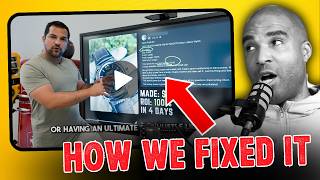
Yeah. You know, it's funny, a lot of people won't watch the entire ad. They'll see just what they need to see just enough of it and then they'll just click the learn more button. So you have to be very careful about what you put on your video creative. So for example, most videos, especially if they don't have a border or aren't clear, you have to be, you know, put some type of text or something on the video because you have to assume that people aren't going to watch it. And not only are they not going to watch it 100% of the time, when the video initially shows up in your newsfeed, it's muted. So you know, if you don't have any type of text or any kind of subtitles, then it just looks like a video playing and people either one scroll through or click before they actually realize that it's for them or not for them. So. And that all affects the overall performance of your ad. So if you'll notice, like with a lot of the ads that we do, we try to tell the story without you even having to watch the video. A lot of people don't do that. So, you know, I know we have a couple ads I'm thinking of here. One is for example, the ad that we run where I'm slapping the brick wall page, right? So, so we're basically saying negative 80%. It says brick wall page and there's a brick wall page and an opt in form right there. And you keep seeing me hit it, right? So if anybody's using a sales funnel or anyone has used a brick wall page before, even if they didn't even listen to the ad, they kind of get the gist of what that ad is all about, right? Another one is like the car ad. The ad where I come out of the car and kind of go into the office. That one for like I think almost eight seconds, we have the call out text on the ad. Then the outcome of how we're going to help them is on the video for a long time and tells the entire story, even if they don't continue to watch the video. So the creative is extremely, extremely important and people often make that mistake.
So for copy, can you explain that?
With copy, obviously that's everything below the ad, right? And you know, typically what I see where people go wrong is they're not listing what's relevant to the user. So for example, that first sentence is almost like an extended version of the messaging, right? Because that's the first thing you're going to see before you click. Learn more. A lot of times people are putting things in that first part of Their copy that isn't even relative or relevant, I should say, to the ad or the outcome. Right. And they do a lot of talking about themselves, how much money they made, success of their business. But at the end of the day, people's attention spans are already short. They want to know what it's about, what the ad is going to do for them, and what's the outcome. Right. They also, they're not listing any type of, like, format of what's to happen next.
But wait, there's more.
Right? So it's just a bunch of, like, information, statistics and things like that.
What they'll get, right?
What they get or what they're. What they should expect after they click. Right. What you want to do is tell them what's going to happen. So, for example, if it's a webinar or you're going to watch a quick video, you should say, when you click on the Learn More button on this video, I'm going to share XYZ and list off those things. So, for example, if I click and I'm not expecting a video, I'm expecting to just buy a product. I'm not confused. Right. So the copy is really your chance to provide clarity to those people who need more information before they take that next step. So the way that I think of it would be like a menu, right? So think about you going into a restaurant, right? The first thing you do is you sit down and you open up the menu.
Right?
Right. In my opinion, the more simple the menu, the better. And I think, what if I were to, like, use this as an example of what people are doing wrong. If you've ever been to a restaurant and there's a bunch of stuff on the menu, and that's just for the sake of this, like, conversation. Say that we're at a barbecue restaurant and you open up the menu and there's like all this other food, like Chinese food and like, other things not relative to, like, a barbecue restaurant. Yeah. You're like, why is all of this on the menu?
Right.
Right. So when you go to copy and there's all this stuff about themselves that they're talking about, confusing stats about the business, not clear of what's going to happen when they actually click. I think you're wasting a lot of that information, like that space that you could be using to really get the person excited for the click. The less you can get a person to, like, have to guess what's going to happen next, the more you can get them to be excited about actually moving forward. Excited about the promise that you're making, the better off your ad is going to actually perform.
So for someone that just needs a little bit more information to break this down, can you do that for them?
I would step back and just, you know, in terms of just thinking about, you know, messaging, you know, thinking about creative, thinking about copy, those three things are like make, make, make a whole, right? It makes the ad the forward facing ad itself, right? Those are the things, the three things that you need in every single ad. And it's almost like anything in life. Like you could be good at a couple things, but if one thing's off, it affects the overall performance of everything. And you know, if you just take like a basketball player like Kobe Bryant, right? If you ever listen to interviews of people talking about Kobe, no one's going to say he was the most athletic, no one's going to say he was even the best shooter. But what they all say is that he was just well rounded in all of the elements of basketball and above average in all of all of the elements. So for example, let's just think about it. So you got mindset, right? There was no one more strong minded than Kobe, right? Then you've got shooting, you got passing.
Okay, he didn't pass.
You know, that's a lot of people think, right? But if you think about the key moments in Kobe's career, and this is actually a good example, think about the game where he threw the Aliye pass, the Shaq, they were down and he made a pass which I don't think very many people would have been able to make. I remember a game specifically like when we beat the Celtics, love beating the Celtics, and he was having an off shooting night, but I think, I believe he led the team in assists, rebounds and steals that game, right? So all of the components of basketball Kobe had, right? And that's the difference between Kobe and that 12th man on the roster, right? So when you think about like your, the ad itself, really focus on those three things. Do you have to necessarily be the best at all of them, but really be conscious of like the end user is getting interrupted. They're seeing my ad. What can I do to be the best in those three categories? And typically you'll start to get better clicks to the next step and eventually the algorithm will just continue to get smarter and they'll be able to identify who you're actually trying to reach. And end of the day, it'll allow you to make more money and create better ads.