Elon Musk Wrecking Twitter OR Social Media Genius? | Vince Reed Podcast #1
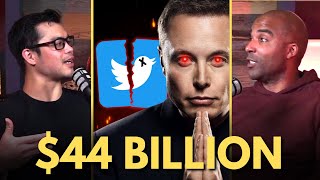
A conversational podcast episode (Vince Reed Podcast #1) featuring Vince Reed with hosts Mike and Connor. The episode discusses Vince's SaaS project (Eboov), entrepreneurship challenges (frustration as proximity to success), Elon Musk/Twitter actions (forced logouts and paid verification as strategic moves), content/legacy strategies (MrBeast, Tupac example), why athletes may excel in business (grit/competition), and AI safety concerns raised by Jeffrey Hinton. The tone is informal, anecdotal, and advisory.
Chapters
Frustrated you are, more disappointed. You are. That's the moment the average person quits business school. You have these professors teaching business, but not a lot of them have company. And then you got people that, you know, failed out of high school that are billion billionaires. Why is that?
What's up, everybody? Welcome to the Vince Reed Podcast here with the main man.
Rebranded.
Rebranded slightly because we've been. We've been talking so much about what's been going on with previous episodes and we wanted to kind of bring in more on what we're doing here.
DM Lightings.
DM Lightings. As you can see, we're upgrading a bit.
We're upgrading only fans blow it up.
Neither confirm nor deny. I don't know what you're talking about.
I can confirm.
I don't know how many fans, but anywho, we got Connor on the ones and twos.
Everyone, I have a mic now and let me tell you, I've waited for this moment my entire life.
It feels really good.
Connor's moving up in the.
In the podcast team one inch at a time.
So with that being said, we're going to dive in here at the Vince Feed podcast. I'm your host, Mike, and we're going to be asking Vince the pressing questions. You know, the pressing questions for today. Well, first off, how you doing?
I'm good. Lakers about to, you know, we're about to do some things tonight.
They're playing the Warriors.
We're playing the Warriors.
Game one.
Steph Curry, we shutting you down. We're taking another ship.
Either way, it's going to be. It's going to be a really good series.
Let's go.
How so? Question one.
Obviously, Eboov, we've been talking about that little by little, but how's that going? What's the process like so far?
Yeah, Eboov, for those of you who are like, what the Heck is an eBove? Stands for entrepreneur, business owner, online video. It's my new SaaS company and it's damn near killing me. So if you find me on the side of the road stretched out, IBOO did it. Sass is no joke, but it's been worth it.
It's so interesting with the process because I remember you were saying that like you were part of or you were kind of like part of this group. What was that? The boardroom group. And you thought you were the only one that was going through, you know, all these business issues and things like that until you gone to the group and then you hear all these other entrepreneurs Talking their own issues and like, wow, you're going through all that.
I'm not the only one crazy. I. It's true. I know people, you know, they see people that are making money and everything on the outside looks all good and warm and fuzzy, but behind closed doors, it's like a hurricane went off. Trust me, I know a lot of these. These people call me in to do their marketing and to come help them with their business and consulting and you get behind the curtain and it is a damn shit show. Yeah, sorry. Sorry for my language.
No, but that's the truth. That's true. It's not like you would see on the Social Network that movie.
Yeah. You know, it's not for my business too. Sometimes behind closed doors, it's a shit show.
Yeah. And it's natural because, I mean, we're all human, but. But as the saying always goes, it's like, it's not how much, it's how much you can stomach and like push through it and like, think effectively, you know, problem solved.
Just gotta withstand it. And here's the cool thing. So frustration and disappointment, that's the world's way of telling you you're closer to the money.
I truly believe that the more frustrated you are, the more disappointing, disappointed you are. That's the moment the average person quits. So if you're the person that figures out the solution, if you're the person that beats down that door and realizes, I mean, that was really frustrating. But now looking back, okay, it really wasn't that bad. That's why. That's the world's way of telling you you're closer to the money.
That makes a lot of sense because it's like, it's like that image or it's like an image I saw on social media and I'm sure most people have seen it. It's the person mining for the diamonds is on. On the top column or on the top row is the person like inches away and you can see the diamonds there on the bottom row. It's the person that actually reached the diamonds because they kept going. And the person on top was already walking away because, you know, they, they were fed up with it. And that goes with business as well. So absolutely, it holds true 100%. So I got the show notes here and we're going to be running through these to make sure we hit most of the points. So obviously, EBOOB News, we got through that. We're going to keep you in the loop. More features coming soon. Actually, one big feature is coming Soon. And it's almost in the works, right? It's in production.
The main feature.
The main feature, it's in production with right now. And.
Well, we don't. They don't know what the features. Connor, they don't know what the feature is.
Okay, he slipped BLEEP that out, but.
You'Re gonna like it. All right. All right.
So don't be up here getting cut.
Hey, look, people want to know. All right, we'll tease it out a bit, but. All right. Trending business news. What's going on? Twitter bug logging people out. And people are saying.
So give them the backstory, what happened.
Okay, so there's this article. It's actually trending on Google right now, and it's about people being logged out of their accounts on Twitter. Well, that's what the headlines all about. And people are, you know, what's going on? Elon Musk, you know, why are you doing this? But you had a good take on this, on why this was such a smart move for Elon.
Yeah, it's so funny. I mean, that was 100% likely done on purpose, in my opinion, and probably one of the smartest moves Elon has made since he's been in Twitter. So if you guys remember, before Elon bought Twitter, he tried to back out of the deal, talking about there were all these bots and fake accounts. Right. And trying to do whatever he was doing to the price. So if you log everybody out and then you force people to log back in, you're instantly able to figure out who is a legitimate user, and you're also able to easily identify the bots. So let's say you log everyone out, and all of a sudden, out of a certain IP address, something happens. A million people log in. Then you can identify who are the. The bad people. Now, why do that? One, obviously, get a good idea of who's an actual user or not. But number two, from an advertiser's perspective, as an advertiser, wouldn't you rather. Even if. Even if it cut Twitter's user base in half, know that the people that you're targeting are legitimate users? Right?
Right.
You can. You can. You know, you can do so much with your resources. And again, this is coming from a guy that's now in the SaaS industry. I understand, like, the importance of understanding your user base. So I just laugh. All these people, you know, Elon gets in there, people are like, there's some bug. It could have been something that happened. But I think that was on purpose, right? To get A good grasp on who's an actual user or not. And I think that's gonna strengthen the company, allow you to eliminate fat that's not needed. Maybe you thought you had 5 billion. I don't know, some crazy number of users comes out, that's half of that. And you were, you know, hiring based on that number. Now you can, you know, be more efficient on so many different levels.
Now, do you think it was a smart move for him to add the payment for the blue check marks?
Yes. That's another thing. One of the smartest things he. He's done. The guy understands. He knows how to make money. I mean, look, now, Instagram copied it, did the exact same thing. So, you know, you. You figured out a way to add revenue. You figured out a way to figure to see who's an actual user in your company. And now you can hire and move and make moves accordingly. That's the Beast, man.
That's true. He has. He has major pool. And he's. He's smart, too. Most people think, like, he's thinking irrationally, but obviously he wouldn't be where he's at if he. If he didn't think. Likewise. So next thing, Mr. Beast on death, you're talking about something you saw. I think it was like, on the Lex Freeman podcast. What. What did you.
Yeah, so I. I love to listen to podcasts and like most entrepreneurs, and I was listening to this one podcast with Mr. Beast, and he was talking about how he did a poll on Twitter, ironically. And I think the question was something like. And I might butcher the question. So if I do, just let me know how bad I butchered it in the comments. But, you know, it was something like, would you accept $10,000 if you knew that a random person that you didn't know would die? And he did it as a joke. He said he did it late at night. He just wanted to see what people would say.
Yeah.
And he thought everybody was gonna say, absolutely not. I would murder someone for $10,000. Come to find out, you know, I guess I don't know if it's just Twitter users or the US in general. Well, I don't know if it was just a US poll, but it was something like 78 or maybe 80 or even higher percentage said that they'd take the money and, you know, pretty much murder people for $10,000. I thought was crazy. Wow. Over $10,000.
I think that. I think part of it is, like that big disconnect that doesn't really hit people. I mean, one, obviously It's. That is not good. Right. But.
Well, I think the biggest. The problem with it, the murder part, is obviously the problem.
Obviously.
Yeah. Like, the bigger problem is the perception that $10,000 is, like, a lot of money.
Right.
It's not. I don't want to, like, say it's not money that you can do something with, but, like, it's $10,000 is not going to change your life. Like, you'll go through it and you'll be back in the same boat. To, like, put a murder charge on your over 10,000 is ridiculous. But what was interesting about that whole interview that he went on to talk about how just that thought makes him think about his own mortality. So he was talking about how he. When he creates videos, he's thinking about that. I don't know if you know this, but he's put out videos of, like, this, you know, ahead of time that's already submitted and ready to launch, like, 10 years from today, 20 years from today, 30 years from today, where I expect I should be, that's gonna be just released. So he said, like, one of his things that he thinks about, which I thought was crazy. Like, he.
He.
This is his words, not mine. Mr. B said you could find the quote that he fantasizes sometimes about, like, his death. Meaning, like, if he found out he had three months to live, that he would then go crazy creating content to where he would just continue to put up, pump out content, like, every day, where his videos would keep coming out years after, after his death. And it just made me think, man, like, that's wild one. Everybody's going to die. But to just like, you know, how you can control your own narrative even past your death with a video.
Well, you were also mentioning before this, it was kind of like Tupac.
Yeah.
With his album.
And that's what I told you when I came in. I'm like, I think that led to the legacy and, you know, the whole mystique of Tupac. So for those of you who are around when Tupac was, you know, in his. In his prime, after he died, I mean, there was like, an album coming out every month and people. And it was relevant. And he was saying things that were happening during that time even though he, you know, had died already. Right. So I think that that element of putting out so much music led to his whole, like, aura. Right?
Yeah.
So when you're pumping out that content, be thinking about that. Right? Be thinking about, like, you have the ability to continue to, like, you know, leave a legacy even past your you know, your existence here on Earth. And that's one of the reasons why the dm. I wanted to do some of those episodes because I think it'll be funny, like when I'm. When I'm gone. Like, my kids kind of go back and kind of see how my whole digital marketing career started and some of the ups and downs that I went through.
Yeah. And you can check that out on the channel. We. We started season two, but we are probably going to go back to it. We wanted to do this format of just like, talking about things and it's easier for you to kind of share DM stories on this show as well, because.
Yeah, I mean, the DM is great. The problem with the DM is that it's chronological. Right. So the stories, if you go back and watch, like season one, it's starting from the beginning. So people were finding like, let's say episode seven, but they'd have to go back to one to really understand what happened. So this setting allows us to kind of just dig into stories, you know, as they come. Yeah, like the one we just shared with you.
So let's hit a couple questions here that I got.
Actually, one of which is you brought this up.
Why are, in your opinion, why are athletes better at business than just scholars?
So, yeah, we were talking about this, right? So business school, you know, these professors teaching business, but not a lot of them have companies.
Right.
And then you got people that, you know, failed out of high school that are billion billionaires. Why is that?
Obviously, I don't have any statistical data behind my theory, but I can tell you that knowing a lot of successful people, I mean, I'm thinking through them all right now, and they all were athletes at some point. They all, most of them were not very good in school. And I think two things. One, they're like, okay, you think I'm not good at school, Then I'll show you in the real world. Number. Number one, I think that people that were struggling in school, they were focused on something else. Like, something else creative, typically, like sports. And in sports, like, it's, it's very competitive. Right, Right. It's. You're. You're dealing with like, it's like killer be killed. Yeah, right. You're dealing with failures. You're dealing with, like, fatigue, and you're gonna, you're tired, but you got to keep working through. So what happens in everyday life? Right? Everyday life, people that just kind of conform through the regular system. They did good through school, but they just kind of were able to get there. People that were failing in school, they were always like, you better keep your grades up or you're gonna be held back. So even though they do just enough, they'd have to battle back.
It's like sink or swim, right?
And then, like, you know, they get into sports. You better get, keep working. You're not gonna play. They're like already building battle back muscles like through their life. Whereas the people that were just smart, they're just smart. Like everything was kind of good for them. I think that there's a natural element of people that are in sports, People that struggled in school that they had to do just enough to just get by. Parents yelling at them, they're grounded, got to pull your grades up. It's like this, you know what I'm saying? And it's like with business, like, you come in and struggle, you gotta fix it, right? And then the person that, like, it was the person that had everything simple, they don't know how to do. That's not a muscle you can just turn on.
It's not. No.
Right, so you're good in school. Everything was great. You know, all growing up and all of a sudden grow a business and you struggle and you fail. Gosh, it's like a fish out of water. Let me just get that good, comfortable job. Let me just work here and have everything good because it feels good. So that's my personal theory on why I think entrepreneurs, you know, the athletes make the best business owners.
That makes sense too, because I think part of it is like, structure. Because in school it's like it's its own ecosystem. And it's easy to just like, go with the flow. This is what's gonna happen this time and this time, this time. But once someone gets out of that and into the world, they're starting their business, there's really no structure, technically speaking, because you kind of have to build your own structure from the ground up. And then that's when you have to be disciplined in order to make sure that it stays growing. But yeah, I get what you're saying, because once they hit Roadblock number one and they don't have those things that they've built in order to get past that, those problem solving skills or like that grit.
It's like, first of all, being competitive is a sport. Like competing is a sport. So, like, you know, I'm coaching my kids in sports and like we did this drill where I throw all these cones all over the court, like literally hundreds of little flat cones, and they have to dribble the ball and that's to pick up the cones and then dribble it back to the baseline. They create a pile. And then at the end, you count all the cones that you, you got and it's a race. At the end of the race, I go around to the kids, I say, count your cones. And then we, whoever had the most wins. And then I asked them, I say, how many of you guys felt like you could have got more? Everybody says yes. And I said, did you guys watch the NCAA championship game? They go, yes. How many of you guys want to play in that game? They all raise their hand. I'm like, if you want to play in that game, the answer can never be more. You have to start building the competitive muscle now. It's not something you can turn on. I know firsthand. I told you my story of my first time running sprints in college. Yeah, running wind sprints. This kid smokes me. I never experienced that before. Like a kid that was so much, that much faster than me until I got to college and I, and I didn't build those muscles. I was just depending on natural God given abilities. And I had coaches eventually. To work harder in college, in high school, you need to work, you need to work harder than weight. You need to work harder in sprints. And when I got to college, I realized what he was saying. And although I had it in me now with the mindset and the personal development skills I have, thinking back at the time, I didn't have those skills, therefore I couldn't just turn that muscle on.
Right.
I just, I didn't have the ability. It's kind of like when you lift weights, you've been working out before, you've been at the gym, right. You know when the lactic acid starts hitting. Right. I guarantee you if you go in your car and you ask yourself, did I have another rep? Your answer would be yes.
That's the point we gotta, that's the.
Point when you have to push.
Yep, exactly. That's so true. Yeah, that is so true. And I, that that applies to everything else in life.
Yeah.
All right, next segment. Actually, the last segment, Connor's curveball. What you got with for us?
All right, ladies and gentlemen, new segment. Connor's curveball. It's a great time. Really excited. So headline, Godfather of AI leaves Google warns of text dangers. His name's Jeffrey Hinton. The man widely considered to be the godfather of artificial intelligence has left Google with a message sharing his concerns about the potential dangers stemming from the same technology he helped build he said he wants to talk about AI safety issues without having to worry about how it interacts with Google's business. And as long as he was paid by Google, he could not talk about AI safety issues at all. So he left. So he can talk about the potential dangers of AI now. To be honest, I think that's kind of wild that the guy that has perpetuated modern AI technology has left the main, one of the big places that's helping push it forward to criticize it and talk about like, hey, we need to slow down and talk about these certain things. I think that's a potential danger for sure. I think that can affect all businesses. I think they can affect film industry, it can affect the marketing industry. He's seeing something going on with AI right now that maybe not too many people are actually noticing. And I know for us, like we talk about AI in like a relative good light, but I think this is something to really think about for sure that the guy that founded AI in the first. Well, one of the best AI developers in the entire world is saying this. He actually quit his job. So what do you guys think about that? How do you think it's going to affect businesses moving forward? Do you think there are any potential real world dangers that we're not even considering in regards to AI because of this? Let me know your thoughts.
That's a loaded question, Connor. Of course I think that there's potential dangers, but I believe that there's potential dangers to everything. That's kind of how I look like you get.
The foods we eat. I think that.
It'S like what's hot today, like what's popular today. Like the world, it's new. So we're gonna always, oh, here are the dangers. Here are the dangers. I just think that the world is full of dangers right now. It just happens to be AI. I believe that AI has been prevalent way longer than right now. Yeah, Like, I think, like to think that this kind of technology, right, that we're all seeing just popped out of nowhere like the world when you've been using AI Autocorrect forever, right? So like to me, I just look at it, like, look, what could possibly go wrong? Like, what's the worst possible outcome of AI? And the worst one that I heard about was something from a guy from. It was from Billy's. Oh, like his class that he had that guy come in from the.
Well, he has his company, Scorpion, right.
So this guy was talking about how with AI you can have little small drones fly into a stadium and the drone could land on someone's head and specifically take that individual out and not others. And he said, this has been around since, like, the 80s.
So I'm just like, okay, I mean.
That'S pretty bad.
That's pretty bad.
But it's been around. So my point is, like, I think that as humans, when something becomes mainstream, like, the natural reaction is to be like, oh, my gosh, this happened. I'm not saying that we shouldn't worry about it, right? But it's kind of like we. And I was just. I can speak for us as Christians, right? The worst that could happen probably, is that. And if that happens, then, you know, it happened. Life goes on better. It was kind of like when I used to be afraid of flying. I'd be afraid of flying on a plane. And this guy, I remember in college, we used to have pride. We take charters where we'd go and we have. We'd have this guy that would do the team prayers or whatever. And like, I remember one time I was like, man, I hate flying. Like. And he was just like. He said the same thing, like, you believe in God? And I was like, yeah. And he's like, well, what are you worried about? If you die, you can do about it, right? Then I was like, he's kind of right. So I always go like, what's the worst that could happen? And I think it's that, right? Okay, baby. Okay. Some guy creates something that says your voice and calls your bank and takes all your money, okay? Then you call your bank and you say, it wasn't you. And they have ways to figure out that it wasn't you. You get your money back, right? Like, it's like, you know what I mean? So, like, when I look at it, outside of me dying, which if that happened, you know, make sure you take care of my family. But I would be in a better place and I'd be chilling up there with Tupac and them.
What'd you say to that, Connor?
That's a good. That's a really good answer. Michael. What's your. What's your thoughts?
I mean, my thoughts are similar. I mean, look, we can only do so much right now. The. The best thing to do is focus on how you can live the best life possible and help as many people as possible and.
Trying to follow your life's purpose as much as possible. And as long as you do that, then there's always going to be things bad happening around you. But, you know, you just got to be aware of that. But you can't let that stop you from your mission in life. And that's really it. That's really it. Everything else will take care of itself from that point on. So I think if you look at yourself or if you look at things positively when it comes to AI, I think it's a positive tool, just like any tool. Like you got a hammer, right? You can use a hammer to do bad things, but you can use a hammer to build great things, you know, buildings and whatever else.
So wise. So, so wise.
I'm just here to facilitate. I know, but that's how it is. That's how it is. And I think that's the way, you know, people should look at it. And I think people are good in general, are good natured and that's should just keep living life, keep living life to the best of your ability. And I think with that we fit all the points, all the points for this episode. I appreciate all of you tuning in. We're going to be putting more of these out there. If you have any questions, anything you would like us to cover on the episode, feel free to put them down in the comments below. And what are your thoughts? What are your thoughts on what we talked about? Because you have an opinion as well. You're a part of, you know, this community. You hopefully you become a part of evoov. You know, if you're a marketer, that will definitely help your life as well. But with that being said, we appreciate you being on here and and make sure to like and subscribe. See you on the next episode later.