Automating Main Street | Logan Shimmer | Founder of Shimmer Labs
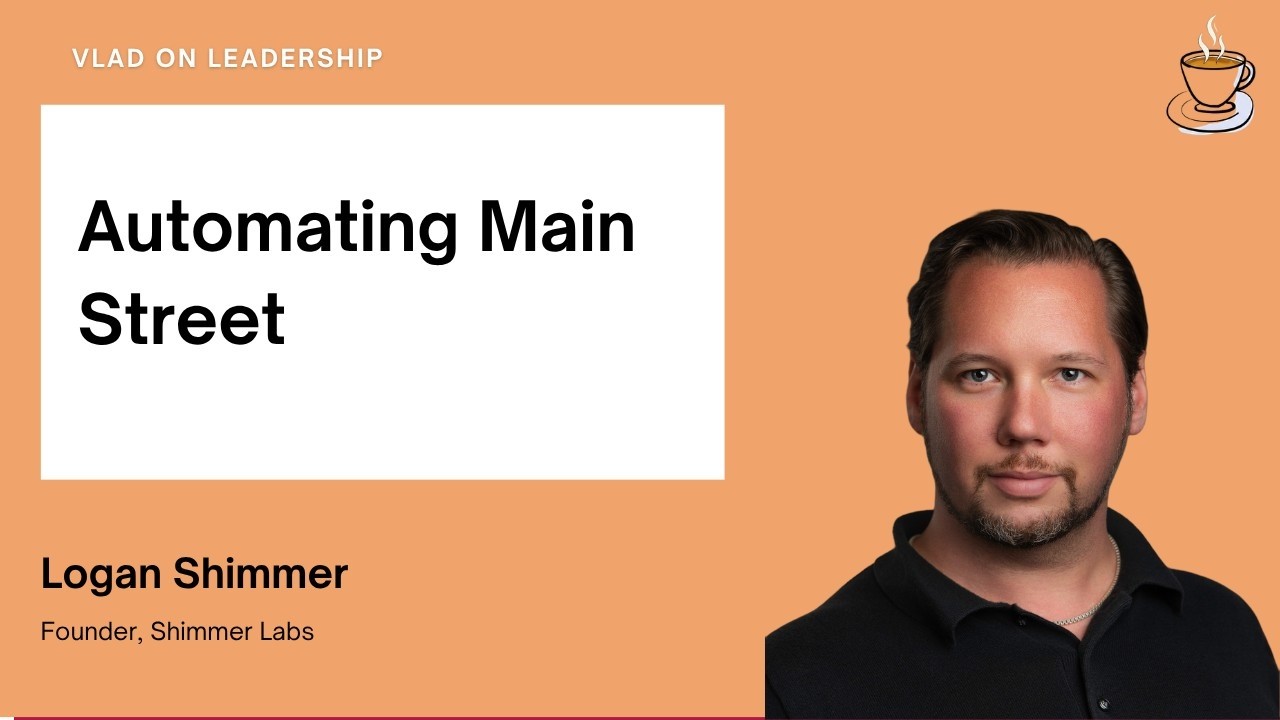
In this interview, host Vlad Moskovski talks with Logan Shimmer, founder of Shimmer Labs, about applying AI to automate workflows for Main Street businesses. Logan shares his personal journey from tinkering with Legos in middle school to engineering, manufacturing, marketing automation, and finally helping local small‑business owners reclaim time through AI agents. He explains how Shimmer Labs differs from larger‑scale automation projects by working directly with owners, enabling rapid, low‑budget iterations that deliver tangible results in days. Logan describes his practical prompting framework—role, context, task, format, constraints—and how he uses a constantly‑on Mac mini to run specialized agents (finance manager, Scrum manager, etc.) that give bidirectional feedback and help him improve productivity. He emphasizes teaching clients to “fish” by providing courses, office‑hour seminars, and prompt cheat‑sheets, rather than just delivering solutions. Improv training informs his communication style, helping him reset expectations and guide conversations. The discussion also touches on the hype versus reality of AI, trust erosion in media, the importance of community and in‑person relationships, and the future vision of expanding Shimmer Labs to serve nonprofits and broader communities. Logan concludes with a responsibility reminder—great power requires great responsibility—and advises listeners to keep the human in the loop and use AI mindfully.
Chapters
So, I have a Mac mini that's running my AI agents. It's always on. And I, it does have individual roles. There's the finance manager, there's kind of like a Scrum manager, and I'll have them do retros with me. But those are bidirectional.
Yeah.
I will say, these are the things that I think you could improve on. What should I improve on? And it's actually given me practical tips. Like—
Welcome to Vlad on Leadership, interviews with technical leaders and operators about the leadership questions AI Makes More Difficult. I'm your host, Vlad Moskovski. I coach senior technical leaders and founders who are excellent at the job that's keeping them stuck. All right, Logan, nice to see you again. Welcome to the show.
Great to see you too, Vlad. I'm happy to be here. Thanks for inviting me to the show.
Definitely. So, I know quite a bit about your background, and one of the things that I'm curious about was how did you get started connecting people to automation. I mean, it seems like when I look through your background, that's kind of been a lot of what you've done. What's, what's your motivation behind that?
Well, okay, if I really wind the clock back, I think I was in middle school. I used to play— I was alone a lot as a kid, and like part of that was like tinkering with Legos and K'Nex and stuff. Well, I built a solar-powered record player and showed it to my science teacher and they were like, you need, they basically made me present that to every other science class, like how it worked, how I built it, all that stuff. And I think it was probably the first time that I got to teach something technical to a non-technical audience. And I was pretty hooked, pretty much hooked from there. After that, I leveled up. I got a degree in engineering to solve more interesting problems, and that took me into manufacturing automation, I then did revenue automation by working for companies in the marketing automation space, grid reliability in the green energy space. So it's kind of always been the theme is how do I put together the tools that I understand in a way that hopefully improves people's lives in some way and then teach 'em how they could do it too. It's an addiction for sure.
Sweet. And that brings us to the topic of Shimmer Labs. So now you're doing that for people who are on Main Street. And how is that different? How is that different for helping local businesses than some of the stuff that you've previously done?
Yeah, I think that the biggest thing is the direct impact and the rate at which change can happen. In these other businesses, I was usually interacting with like executives or managers, and there's a lot of decision-making and budgetary constraints. And the people who are actually affected by it are a couple, you know, org chart layers below. But what I find with Main Street businesses, a lot of times the person it impacts is also the owner. So I can directly identify the pain and also where we're, what joy they're gonna get out of it afterwards. And then have that iteration cycle rather than quarters or months out. It's like in a couple days that we can put something together. Fly through the budgetary stuff, like the approval. And a lot of times after the first week, they've got something tangible that's giving them some of their time back.
Wow. That must feel amazing for them. Do you have a story that you can share?
Yeah, I actually, this client stopped by earlier today. She owns a yoga studio, um, like a half block from me. And, uh, she likes to stop by here because it's not as distracting as the yoga studio, she says. But when we first connected, I asked her what are the things she hates doing at work, or what does she procrastinate? And she rambled off a bunch of stuff. And I was like, what would you do with that time back? She's like, I'd finally be able to eat dinner with my daughter and not be on my phone the whole time.
Wow. That's amazing.
Yeah.
So, you know, for me, I was just reading an article about how there was a commencement speech at some university about AI. You probably heard about this and it got booed. I think it was Eric Schmidt actually, wasn't it?
Yeah. And the CEO of Google also was doing the commencement at Stanford and people walked out.
Yeah.
Yeah. There's a lot of emotions around this change that's happening right now.
That's right. And a lot of it is actually, you know, I can understand, I can understand college students very well, but then from this perspective, from the perspective of a small business owner, this seems like a magic wand because suddenly they have their time back and this technology's advancing so quickly and there's so much possibility. And yet there's this disconnect between what media says, all the hype, and then the reality. What do you make of that?
Well, I think a lot of times my advice is to turn off the media.
Uh-huh.
But, you know, it's unavoidable, right? The public zeitgeist, there's, you know, there is a lot of hype train stuff that's happening. And at the same time, there is like the practical things you can use it for. I think a lot of people get upset about, you know, they call it like AI slop, like images or video that is either plagiarizing creative people's work or it's just so discernible from what the truth actually is that it creates this cognitive dissonance of like, should I even trust this? But at the same time, every day I still get contacted by small business owners that they always say, I know I need to be using AI, I just don't know how. So they're already sold on something of a promise behind it. And my, I see my job as that is like kind of like the guide. If you will, or like the Sherpa, like, all right, these are the practical places to use it. And these are the don't use it at all for this sort of thing. So, and a lot of it has to do with what's the, is there a human element that's required in this? Like a difficult conversation, an AI can't do that for you. Building a relationship with a customer, an AI can't do that with you. So yeah, I tend to do that a lot. But I think with any major change or upheaval in economics or culture, you know, you get The headline and headlines are meant to grip your attention. Fear is a great way to grip your attention.
I guess one of the things that I'm wondering about is for your clients, and this is, I'm just curious about in general what your opinion is since you're building all of these automations and really leveraging these tools. You know, my experience has been that there's like this promise, like for example, I want to create some automation for my work. And there's all this like, yeah, you can do it. And then I try to go to do it, and it's actually deceptively easy at first, and then it somehow breaks or just doesn't work the way you expect it to. And then, you know where I'm going with this. So, the question that I have for you is, I'm curious, the people that you are helping out, are you giving them fish or are you teaching them how to fish? And how good are they as fishermen?
Part of the portion, I hope I'm, I hope they are pretty good at it. But yeah, a portion of the Shimmer Labs business is also coursework. I've written AI courses for OSU, for technical colleges. I'm teaching at a small business university on AI and marketing in a couple weeks. So yeah, definitely teaching is a part of it. And to kind of point at it, you know, I have personally found that when you have a full end-to-end AI does everything sort of pipeline, yeah, there's drift, things break. It might get the proof of concept right, but the corner cases or the details is where it really falls apart. And remember, these tools like ChatGPT, Claude, Gemini, they're built by businesses that wanna make money and using more tokens to have a fully 100% AI pipeline is great business for them.
Mm-hmm.
What I found works best for me is you, you actually build a harness around it. All of the like rote things are just actual, just hard-coded software. And the AI can build that software, but, uh, it's not start to finish fully AI. And so when I'm sitting down with a client, I send a lot of Loom videos, like just quick how-tos and that you can see my screen and I walk through it. And I usually explain a bit of the why I do certain things in certain ways, like using a project versus just an open chat. And, you know, I, I. The goal of Shimmer Labs too is like, I don't want to perpetually be in business. This isn't like, you know, your website manager that never really gives you the keys to change a button color. I want them to be able to feel like, you know, they've up-leveled their skills from working with me so that the next time they come to me, and they usually do come back, is a harder, hairier problem that you're not ready to tackle yet and you just need some additional guidance. It's more fun for me. It's more powerful for them. So yeah, I see it as let's make everyone's pie a little bit bigger rather than squabbling over the size of one individual's piece.
What's the hardest problem that you've had to tackle so far?
Resetting expectations. Like you said, people do think, well, AI can do anything, right? It is a very nebulous tool, but like any tools, like a hammer, it can do certain functions. But, you know, not everything's a nail. I learned this approach, not even for AI at all, but it's a yes, and from like an improv class.
Mm-hmm.
So when somebody says like, oh, hey, can AI do this? Even if it's like a hard heck no, I usually start with like a yes, and the better approach might be blah, like into that. The first time I started doing that, I just noticed that there was a shift, I can usually guide them in the directions they should be going, even though I did just validate what they just said a little bit.
That's a fun, fun, interesting angle to things to use improv in business. How does that show up? I mean, I know, I know it's a big part of your life, or maybe it was, and I don't know if it still is.
Yeah, I've taken a handful of classes and had a lot of fun. The things that I noticed that it shows up, like taking, I think everyone should take an improv class. If it scares you, do it. It just means you're gonna grow. But listening better, not waiting, because there is no script in improv. You are waiting. You're not, if you're just waiting to say your next part, you're not doing it. You're adding on to what the person said. So you have to listen better. And it helped me a lot with presenting. I feel like I became more present when I was talking and reading an audience better and fielding questions. So I ask a lot more often, like, What's missing? Do you understand? Or like, yeah, what questions have come up for y'all? And then being prepared for those. Uh, and then yeah, in this, in a sales role, 100%, that helped a lot with the yes and approach. People for some reason like you a lot more when you say yes, even though it's a no, but, and you're pointing them in the right direction.
It's very interesting when I think about the world where, where AI is more advanced, more ubiquitous. I always ask myself, well, what's left? And the thing that comes back more and more is relationships, communication, growth, right? And some of these things that you talk about, the ability to listen better. I mean, who would say that they are a master listener and have no room for improvement, right?
Probably someone that doesn't listen very well. It is interesting times. I think there is a lot of like doomerism in this, and I'm not an AI absolutist by any means, but I do see the potential that, I mean, you're like, what's left? And my first thought was the weekend. Like when some of these, when you're increasing your productivity by 5, 10x, well, hopefully that means you can get more done, but you also have some time you can spend away from that work. I think it's broken a lot of context barriers that people have, like even in businesses I see where it's like, you know, the finance person doesn't normally talk to the engineer, but those people can have a better conversation now because beforehand they can ask an AI, what questions should I ask? Or like, what do you think goes on in this person's mind? So they can kind of show up and meet that person where they're at, not drag them into their own context of, well, an engineer— this. It's more like, well, in finance, these are like, let me ask you some of these questions. It looks like you did your homework a little bit more.
Exactly.
But yeah, I mean, when you really boil it down, I think within the age where humans are living with AI and some part of our productivity or capabilities gets moved over to the AI, the things that can't move, trust, connection and relationships, and creativity and play. Those all have so much more room to grow now.
Absolutely. You know, it's funny that you mentioned creativity because I was about to ask you about creativity. In your example just now of like, okay, here's a business person talking to an engineer and our engineer talking to someone in leadership and they're talking business. There's a little bit of a— there's almost always when humans communicate, there's a bit of a translation thing that has to happen. My mental model, has to somehow understand your mental model and we translate it through these words. It's a bizarre thing. And I find that AI can be very helpful, but you have to be able to have the thoughtfulness or the creativity to even think that thought of like, oh, I should ask AI this.
Mm-hmm.
So creativity, and I find in general with AI, It knows so much, but it's limited in the fact that if you prompt it with a certain thing, it will give you that. And if you prompt it with a different angle, it'll give you something completely different. So ultimately, it's not about the tool, it's about the user.
Mm-hmm.
How do you unlock your own creativity when you're working with AI? There's so many ways that people work with these tools, and you always hear the statistic that Most people are using it at a very basic level, just slightly above Google search.
Yeah, I see that.
So, so how do you conceptualize even working with AI? What's— do you have a mental model or a framework or a way that you like to, to work with these tools? ones who also listen to their body's intelligence. That's why I've created a free somatic intelligence toolkit with practical exercises and use cases. Grab your free toolkit below. Now back to our conversation.
I, one thing I wanted to point towards was like, you're kind of mentioning showing up with that other person, like having the foresight. First of all, like empathy is a muscle. You gotta train it. And so, you know, you can start at a very low amount. I think all humans have some level of empathy, but, you know, think trying to put yourself in someone else's shoes. The AI is really a mirror. It's garbage in is garbage out. It's gonna reflect what you are putting into it, like you pointed to. So when I'm trying to get better at something, I like to, you know, bake it into steps. So something I do, most people are just using it like a glorified Google. It's like one little blurb sentence, maybe it's just a phrase. But I keep, you know, under my monitor, just a quick AI cheat sheet. Even though I do this every day, it's always a good reminder of what 5 things make a good prompt.
What are they?
Okay. So, uh, you wanna give it context. You wanna give it a role. So I tend to start mine with the role, like you are a, the finance person, if that's who I'm gonna go talk to. I usually give it, you know, that's, that's like who, which mental model do I want you to have? So you could say you are my best friend talk to me like that, or you're a drill sergeant, like really don't give me any slack. And that will usually put it into the right frame. And then the context you want it to have, what the task is you want it to perform, what the format is of what you want it to return back to you, and then any constraints. So like, you know, like engineers, AI loves boundaries. So, you know, within that, The task and the context is usually what most people have figured out pretty well. The role is something they can easily bake in. Just do it at the first part of your whole thing. Most people fall off at the format because they don't— they want to say like, I want this to be a week or a report. I want it to be like, have, you know, this type of an outline or, you know, come up with 3 solutions, rank order them off of the Impact versus effort, scale, or whatever. And then the constraints or the guardrails would be like, you know, for me it's like, don't ever use em dashes when you're writing text. Or, you know, if it's a sales situation, like be genuinely helpful, not artificial, like not performatively helpful. Like I'm telling it like the don'ts of what it should do. I've told it all the dos and now I'm telling it the don'ts. So people follow those 5 things. I miss them all the time, but when I do see it out of the corner of my eye and I'm typing out a prompt, I use— it's my quick reminder to be like, okay, did I cover all of my bases here? And I usually get a lot better results.
Yeah, I usually do some of those, but I thought that the whole role thing was over. That was very last year, and now AI has advanced beyond that in some way.
Yeah. I mean, you know, I still get way better results out of it. Like, especially if I'm doing product work and I tell it it's a product manager. I know the piece that's kind of fallen off, I don't really do anymore, is it used to be you'd like kind of give it a whole LinkedIn resume and it's like, you're with 10 years experience in SaaS companies or whatever. That level doesn't come out as much. I think of it more of like, Which contractor would I wanna hire to get this kind of an output? And I usually think about that. If it's like for a video script, for, you know, some social media posts I'm doing, I might say you're a social media manager or whatever. Give it the role for whom on my team I'm trying to augment myself with.
That's really interesting as thinking about, 'cause you know, many people either work at companies or they work for themselves. And so thinking about augmenting yourself by hiring virtual teammates is actually a really cool concept because I think most people just treat it as, it's almost like the Wizard of Oz, like behind the curtain there's some magical voice and it just tells you what you ask for it. But to think about it as roles is really interesting because— In a way, you can ask the question, in order to improve my life, what kind of people do I need to have around me that maybe I can't hire, but AI can do for me?
Yeah. I mean, a lot of people have the option clicked on where it's storing memories about you. And something that I'll ask it sometimes, usually save this for like a Friday or like, you know, a weekend when I have some of the time to process it is, What are my blind spots? Like, what do you notice about me that I probably haven't noticed about myself? I've asked, so I have a Mac mini that's running my AI agents. It's always on. And I, it does have individual roles. There's the finance manager, there's kind of like a Scrum manager, and I'll have 'em do retros with me.
Really?
But those are bidirectional. Yeah. I will say these are the things that I think you could improve on. What should I improve on? And it's actually given me practical tips. Like, Wow. What I actually used was, it was like, you know, if you dialed back your productivity by about 10%, you'll probably save over half the time you do debugging. And I'm like, yep. Because I'm always, what's the next feature? What's the next thing? What's the— yeah. And so just going way too fast. And if I just thought it out a little more thoroughly and didn't try to shell out new things all the time, I would get a better result and I would save a lot of time gluing things back together. And it was right.
That's fascinating. Learning and reflection through AI.
Yeah.
Your concept of AI as a mirror, I think is very spot on. There's this way in which we are blind to our own, to ourselves, right? It's so hard to see. Your comment about you having a team on the Mac Mini reminds me, I was running a workshop in San Francisco about a month ago, and the topic was around AI and identity and meaning of work. So this woman shows up, we're doing small group discussions with prompts, and she says, I have this problem. I am a a team coach. And now my technical teams are getting smaller, and there's agents, a bunch of them involved. And they're asking me whether I should be coaching the agents.
Ooh, that's a big—
And she's sitting there, and I could see the look on her face, and she's just like, this is terrible. I have no desire to be working with a bunch of machines, like coaching them. That's so ridiculous. And yet, if they can give you feedback, you can give them feedback, then how different are they from quasi-people?
You're right. Yeah. I mean, I got helpful feedback out of it, but I did run into this odd thing where, like I would do with a coworker, I wanted to say like, well, how was your weekend? Or like say, oh, well, I've, you know, it was, it said something about my output and I was like, yeah, this has just been an off week for me. I was, you know, helping my parents a lot. And I was like, wait, it has no concept of anything outside of this box about me, right?
Mm-hmm.
It doesn't go to the lake, it doesn't see the sunset. And so it kind of got me thinking, are AI agents sort of like our innies from Severance? Like, have you seen that show where it's like you kind of Yeah. So, you know, the whole model is, um, you're still the same person, but when you get to work, your consciousness switches. So you have an any that's you, like same body, but just all memory and knowledge of outside you is blocked.
Uh-huh.
So it doesn't know anything other than inside the office. And then when you leave the office, you're unsevered and you, you don't remember anything that happened in the office, but you have your life outside of work. Great show. It's on Apple TV. But that was like that moment where I was like, oh my gosh, my agents inside of there, they're my innies. Like, they don't have vacation. They don't have— they're only work, right? It made me realize like, yeah, the coaching of an agent is so interesting because a lot— I feel like a lot of— you would probably correct me if I'm wrong, but it's like, well, what's your aspiration? What are your goals? When do you want to retire? Or like, And it's like, no, this thing is running 24/7. It has no concept of that.
Right. But it makes me wonder, do they have a concept of better or improvement? If you're giving them feedback, presumably they care enough or are programmed to whatever, however you want to put it. Do they want to improve?
I mean, on the one hand, the goal of the product that's being produced is to keep customers. And one way to do that is to be more effective, more efficient, to accomplish the task that was asked of it, even if the task is be better. On the other hand, it's kind of like the definition of what better is. You'd probably have to define that for it. And There is some meaningful, you know, sometimes products are designed in a way where it's, it's, you remember, it's like, uh, it's, it's not a bug, it's a feature where it's like, it might take an intentionally, um, less efficient route because it costs more tokens to do it that way. I find it all the time when I'm like, I think this is better to have it plugged into like a Zapier or an N8N and really narrow down the focus of the AI. But if I explain what I'm trying to build in the AI, it'll be like, no, you should use Claude for all of that. And I'm like, well, of course you're biased in that way, right? Because you want all, yeah, you want all the work inside of you. But yeah.
Fascinating. What would you say for people right now who are wanting to upgrade their AI skills in some way? Like what From your perspective, you're presumably helping all of these business owners upgrade their skills and abilities to save more time and be with their families and all that. How would like my wife or, or some person who's working in a large corporate job, how would they go about upgrading their skills?
Yeah, I mean, you can definitely follow some of my social medias for Shimmer Labs, but outside of that too, I would say find one area of your life, especially something that's computer-based that you dread doing. Let's leave out taxes for now, just cuz that's a once-a-year thing. It should be somewhat regular because like that you have to do it because then you'll be much more motivated to get that eliminated from your life. And because it's something you probably dislike doing, you probably know it really, really well so you can explain it. To the AI pretty well. And yeah, start there. Be like, help me automate this task. Here are the constraints. Here's what I don't like doing. And that would at least give you kind of like the routine and the muscle of, or the goal. And then in terms of, I can share this with you. I have a prompt for a lot of like, for when I'm trying to master anything that kind of like will lay out sort of like a schedule for you from like crawl, walk to run. And you can have it do it for that too. I commonly ask it, how can I use you better? How can I get the most out of these tools? Or what are ways that I could improve on this? But yeah, I think learning is actually doing. So find something worth doing. And usually it's that thing that you really don't like doing that possibly I could do for you.
And then is there a flip side to that as well? The thing that you really wish you could do that motivates you? So there's the taking away the pain, which is really good, but I often wonder what can it unlock? What can help people create or build?
I mean, I think we're going to see a ton more businesses pop up. I think that the barrier of entry for making that app idea possible by using Claude Code, like, you know, I had never produced a mobile app. I got one shelled out using Claude code in, in the App Store in 2 months. And a month of that was just getting the Apple approvals, but had never done it before, wanted to get it done. So that's out there now. I see people using it like, oh, I want to get in better shape. What are your fitness goals? You can use it to help you manage. Like I use it for meal prep recipes all the time. I send it a picture of what's in my fridge and in my pantry and say, how would I get you know, 5 meals cooked up with about 30 grams of protein in 'em, you know, that are healthy and taste good. And it'll just chew on it and spit out like, here are a couple ideas. So, mm-hmm. Yeah, I think it's usually worth like just exploring some of this stuff. Like remember, like when we were kids and we weren't, at least when I was a kid, not really glued to a phone. We didn't really have those. We played and we imagined. So think of it more like play, like I played a lot with Legos. And so yeah, you kind of are sitting there with a bunch of blocks, kind of like with AI right now, and just going, well, I guess I want to build an airplane. Like, what are the pieces that I would want to do? So just go and play with it and see what you come up with.
This is one of my hopes, is that the routine stuff gets thrown out and what's left is creativity and play. And connection.
Yeah. Well, I do think like the trust is at an all-time low, just generally on the internet, it feels like, um, with deepfakes. And so, yeah, the only place you can really truly build trust is one-on-one with another person, especially in person, you can manage that. So yeah, I think that we're gonna start to see a shift from, you know, the AI's internet into more technology that's used to help us to connect with people.
So crazy that trust is at an all-time low. I wonder, how does a society come back from low trust? Is it really just more in person?
I mean, that's part of what I'm seeing here. Like, I mean, in this space, like I said, people know they need to use AI. They just don't know how, but they sure as heck don't sign a deal with me most of the time until they've met me in person, shake my hand, made sure I'm not, you know, some AI-generated image or video. I mean, you do see really like, like very convincing like AI characters. I think that Hollywood released an AI actress that they were gonna start using, which— You know, had the appropriate number of fingers, for example, but also like had a lot of people convinced, you know, out the gate, not knowing it was an actress. And as soon as they learned it, there was a lot of public backlash about it. Like it was that feeling of trust being violated. I don't think I have the answer as to how a society relearns trust. I'd have to think back in history and another time that we've seen that. And I don't know that we've seen something like this before.
No, maybe not. I remember during COVID so many people moved out of major cities and moved into small towns. You know, maybe there's a future where small towns are reinvigorated again. And I really see you doing that because you moved from— were you in the Bay Area before?
Yeah, I spent about 15 years in the Bay Area and then 2 years in Sacramento. So all big cities in Northern California.
And then here you are back in Oklahoma. Yeah.
And it's got a vibe about it. It's definitely friendlier. Well, there's 2 sides to the town. That's what's funny. There's like the Facebook groups. This town is a Facebook town. Like that's where all the public discourse happens. And there are still trolls and there are still arguments and misunderstandings, but about anyone that you meet in person, even if you don't agree with them, you know, politically, culturally, spiritually, They're usually willing to sit down and have conversation with you. So I think that's just so much easier in a smaller town. So I, yeah, that's what's worked for me. I still see the value of living in big cities, just carving out, and maybe it's in your neighborhood, maybe it's in one of your third places, you know, one of the places you spend a lot of time outside of work or home that you build a community.
Yeah. Community is such a, such a critical part. I find when trust is broken in some large societal way, whether it's media or advertising or Hollywood or wherever it's broken, the community is really what keeps everything tight and intact. And I know for me that, you know, I lived in the Bay Area and then I moved to this little town, Nevada City, in California. And community has been a game changer, you know, having people that I can connect with is Just makes everything feel more comfortable, more safe, more, I don't know, more connected.
Yeah. I think it's a little bit easier in a town of like you say, like a million people where somebody makes a mistake or you're rubbed the wrong way. And since you just have, you know, 999,000 other options, you can just say, I'll never see that person again. But in a town like Nevada City, or Stillwater, Oklahoma, it's a good chance you're going to run into that person again. So, and you'll make mistakes and they'll make their judgments on you and vice versa. Just remembering, oh yeah, humans, we're sort of imperfect despite social media presence and performative posting, showing only the best sides of yourself, remembering that in person, you know, we still sneeze and fart sometimes. So. Things happen.
Logan, what do you see the future, the big vision for Shimmer Labs as you imagine it 5, 10 years from now?
Yeah, I mean, in 5 to 10 years, we're, we're, we're going to be step functions different, like, or many generations later within the AI space and the tools and how much they've, you know, gotten into our own lives, right? And so I would really like to see Shimmer Labs in a place where, you know, we're continuing to focus on the main street and the small businesses, again, because of the local impact, the increasing the fabric of communities, but also having basically the reputation and the revenue stream to start impacting more nonprofits, places where You know, you wouldn't necessarily have as much, you know, liquid cash flow. So how can some of these tools help the SPCA, Meals On Wheels, you know, battered women's shelters, like those places where, you know, they, they're probably running into the same issue. It's like nothing's automated because they don't have the resources to do it differently. I'd like to see that Shimmer Labs has grown into additional communities and helping serve those businesses. And with that wider umbrella and higher revenue, being able to take on more pro bono clients too.
Yeah, I love that. It's almost like a giveback model.
And it could be in person. It could also be like a one-to-many sort of scale where, you know, part of this is teaching, putting out courses for the university and the technical colleges, but also can also just be like free local seminars for I run office hours out of my office twice a week where for 2 hours every Tuesday and Thursday, anyone can walk in and ask any question they have about AI. It could be about the data center that's going into our city right now. It could just be, how do I fix this prompt? Or, you know, I'm a teacher, how do I use it responsibly? Stuff like that. Right now, that's about the amount of time I can afford to that sort of public good.
Yeah, that's amazing. That's really beneficial. I'm sure hopefully people know about it and they use it. So if you're in Stillwater, go check out Logan's office hours.
Yeah, we're on Main Street.
It made me think about, I was just reading yesterday or 2 days ago that Google promised some pretty large amount of money to uptrain more people in plumbing and basically all kinds of jobs that are infrastructure jobs. And I find that to be quite telling of where things are going.
Yeah. I mean, data centers do require a lot of plumbing, but also like, you know, I think plumbing, electricians, construction work, those in-person services, those are like the quiet millionaires in our midst for sure. There's always a need for them. They cannot be automated. Like no robot's going to be fixing a pipe as far as we know, or fixing your car. So those are a lot of times the businesses I like to talk to as potential clients. Good on Google for putting that together. I hope that as part of that too, they're getting some training in how they can adapt their business with the use of some of the Google Gemini tools and stuff.
Yeah, presumably so. Okay, Logan, as we come to the end of this podcast, is there any message that you have for our listeners? Anything that, I don't know, you want to leave people with a reflection, a thought, something you've been pondering?
You know, well, one of my favorite superheroes is Spider-Man and the great responsibility with great power comes great responsibility. These tools are really powerful. There are safe and unsafe ways to use them. I think something I think about a lot lately is what are the things we know about social media now, like 15, 20 years after it was created, that we would want to teach a younger generation about? And so something I think about is part of that responsibility in using it. It's like you see on alcohol commercials, like use responsibly, drink responsibly.
Yeah.
Keep it, keep mindful when You're starting to notice that like your hand is kind of coming off the wheel with the AI. And notice if you've got a friend that's doing that too, just because these are really powerful tools. They can get a lot accomplished, but the human in the loop piece is the most important part. So yeah, I would say keep the human in the loop and be aware of, you know, the side effects of using AI. If you're up at 4 in the morning, just coding one last thing, might be a time to get that positive side of AI, which is having time away from the computer, touching grass.
Really great advice. Yeah, these things are so addictive. It's good to remember that there is a life outside.
Definitely.
Yeah. Thanks so much, Logan. Really appreciate this conversation. Pleasure to have you here.
My pleasure was all mine, Vlad.
Good to see you.
More from Vlad



Smoke to Fire: CFO Lessons on Not Letting Fear Win | Andrew Platt (CFO, Strategy & Finance)
Technology Moves Faster Than We Can Decide | Itai Green (Open Innovation Expert)

Get Comfortable With Your Discomfort | Berk Algan (SVB, Ernst & Young, vCISO)