Get Comfortable With Your Discomfort | Berk Algan (SVB, Ernst & Young, vCISO)
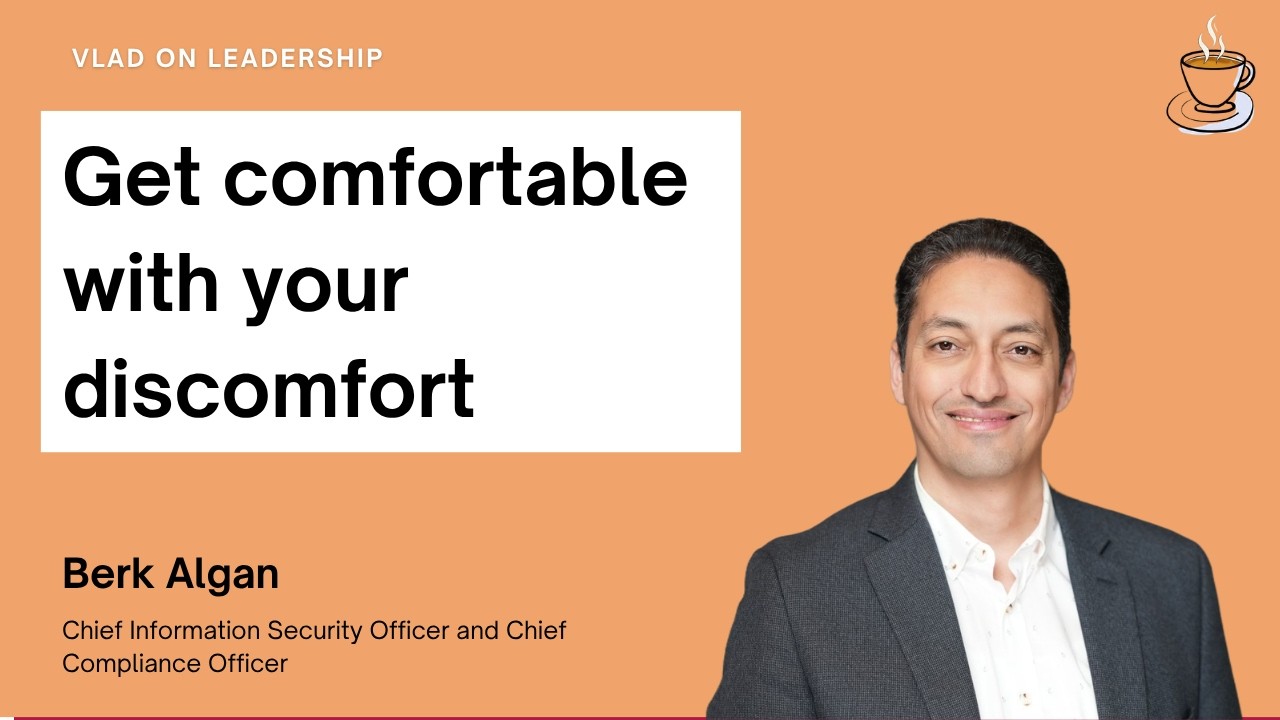
In this episode of Vlad on Leadership, host Vlad Moskovski interviews security and AI strategist Berk Algan. Berk outlines three "waves" of AI adoption: (1) automation of structured, repeatable knowledge work; (2) AI‑driven review of AI‑generated output; and (3) the slower‑moving, still‑human decision‑making layer. He describes a "compression trap" where AI dramatically shortens task time, but expectations expand, forcing workers to produce far more output. The conversation moves to decision fatigue caused by an explosion of tool choices and AI‑generated information, illustrated with a cereal‑aisle metaphor. Both guests argue that metacognition, systems thinking, and building personal "life‑thermostat" frameworks are essential to stay sane. Berk shares his own career shift from a 23‑year corporate trajectory to a fractional CISO business, emphasizing the importance of relationships, early networking, and comfort with discomfort. He offers three concrete leadership advices: get closer to the underlying business problem, protect the right (non‑automatable) aspects of work, and use the feeling of unsettlement as a motivator. The dialogue closes with a call to "get comfortable with your discomfort" as a guiding principle for thriving in the AI‑driven future.
Chapters
The expectation has shifted from you having 2 hands to having, like, 10 hands. The expectations have risen that we have to do more with AI. If you have AI, if you don't use AI, what are you doing? And if you do use AI, why are you so slow?
Welcome to Vlad on Leadership, interviews with technical leaders and operators about the leadership questions AI makes more difficult. I'm your host, Vlad Moskovski. I coach senior technical leaders and founders who are excellent at the job that's keeping them stuck. All right, Berk, welcome to the show.
Thank you, Vlad, for inviting me.
So my sense, Berk, is that you get to work with some interesting innovative companies. And the first question that I have is, you have a clear picture of who AI is hitting. Can you share a bit about what you're seeing for yourself, like how you're interacting with AI and for your clients?
Yeah, happy to do that. I mean, When I started my fractional business about 3 years ago, AI was just coming, becoming more prevalent in our daily lives. So think of like early 2023, and now it's everywhere, right? It is really changing the way we work, changing the way my clients work, and changing the way their clients, their customers work. So I see it in waves, Vlad, and the first wave of AI is really hitting the structured, repeatable knowledge work. So if you ask me about 10 years ago, you have a white-collar job, are you safe, quote unquote? And I would say, you know what, I mean, there's nothing that I'm seeing that will come and hit us. And it did come and hit us in, in a major way. So in my own case, let me give you some examples from my own business. I do security work, and it is a spectrum of many activities. On the repeatable structure end of that spectrum is policy writing, security questionnaire responses, documentation, risk analysis, and things like that. So anything that requires somebody to pick up an Excel spreadsheet or a tool, type in information, or a Word document and start writing a policy, those things are being automated really fast. So where it takes a little bit longer is anything that takes decision-making, and we'll, we'll talk about that. But the first wave is really the structured, repeatable knowledge work that is usually done by white-collar professionals. The second wave is kind of interesting, and, you know, people may or may not agree with this one, is when you create an output Using AI or a human, the second part of that work is to review that work. So a doer is a first person, a reviewer is a second, you know, second level. And that work is also being automated. And it's interesting, right? When you think of generative AI, you can create an AI agent that does the work and a separate AI agent that reviews the work.
Mm-hmm.
There's this concept called human in the loop in AI. I know a lot of people refer to it. That is still there and still important. It's a great and important control for some processes, but in some cases that work could also be automated via AI. So the second wave is the person that reviews the work could potentially be automated away by an agent. The third one is the one that I really don't know how it's gonna shape up is where decision-making comes into play and that's This is where humans are still more involved and need to be involved for many, many reasons. So if you really think of AI as a tool, it is really good in doing something that is told, 1, 2, 3, 4, right? So following steps in, in a process. But once it has to make a decision about something, so am I following this path or that one? It could do things wrong. So those things are not being automated as fast as the other ones, but we will, we will have to see. And certain parts of the business may never be automated, like relationships and being accountable for the output of the, of the AI.
It's very interesting. I'm fascinated with the topic of decision-making because people make decisions in so many different ways, right? And As you talk about decision-making still not being automated, and yet the decisions that people are making now are different than the decisions they were making before. Like, for example, one thing I noticed is that there's just so many more options in terms of what you can do, who you can work with. There seems to be companies sprouting just by the thousands every single day, practically, because literally anybody can just build anything right now. Just about. And so I think decision-making, it seems, is becoming harder because there's just more noise. There's more AI slop. There's non-AI slop, just genuine good stuff, but there's so much of it. And then some of the stuff that you're basing your decisions on has been generated or created somewhere down the line by AI. So do you, I'm just curious, what do you see as the impact of all of this? I mean, are you picking this up in terms of, I'm just wondering, are people having decision fatigue? Are they excited about the decisions they're making? Are their decisions becoming different or better somehow? Like what's going on with decision-making? 'Cause that's an area that clearly AI isn't able to do it, but it's influencing it significantly.
It, it is interesting. I mean, I, uh, I go back to the days, uh, when I was taking my, uh, first marketing class and like before taking that class, I thought having options is a great thing, which, you know, in many cases it is. But think of, you know, uh, think of you going into a grocery store and trying to pick up a cereal and you really don't have a brand in mind and you go to that, um, floor and, uh, that aisle and you see like 200 different types of cereal. And you don't know which one is good. Like you're trying to read the labels, you're trying to figure out which one is the healthiest, less sugar, whatever your criteria may be. It is very similar to that right now. And you can, you can take it from multiple angles, Vlad, right? One angle is what AI tools do I use? Which one is better? Let's say I am a coding person or I'm a software engineer and I'm trying to find the help I need to help me code better. Or I am a regular person who wants to learn coding. I look around and I see, you know, so many different AI tools available to me that could help me code better. So that's one. And 2, because we have AI and we use AI in our decision-making to some extent, even though it might not be automated, we are leveraging AI. It becomes really interesting. I mean, I do, I do some investing. And I use AI for my investing and it's, it's kind of interesting because it gives me so many different options to consider, which I haven't considered before. And it actually in certain cases makes my decision much harder than it was before. So it's an interesting dilemma. The more options don't, doesn't necessarily mean life becomes easier. It might actually become a little bit harder in terms of decision fatigue that you mentioned.
Yeah, your example of 200 boxes of cereal is my worst nightmare.
Right.
I think for me, when I work with, with people, I help them figure out how do you make decisions and what's your criteria, because suddenly something that's completely unconscious and below the surface becomes part of the conscious. And then In some ways, when you know your decision-making criteria, all of that complexity, noise, multiple possible permutations or whatever just becomes far simpler. So I wonder if you use something like that. We won't go there, but just, just, you know. I'm hearing a lot about people being overwhelmed with AI. It's kind of like a multiplier. Like, I like to joke with people that instead of having 2 hands, now AI allows you to have more like 10 hands. And yet, so theoretically, you can do more stuff, right? But then I'm hearing all these stories of people, and I'm sensing some of this just in my own work as well, that it's just leading to overwhelm. It's leading to exhaustion. People are working more instead of less, even though their productivity either actually or perceptually is going up.
Yeah.
Do you, what do you make of this? Do you see this with yourself or some of your clients? And, and what's the conversation like?
Yeah, it, it is, it is really interesting and I'm seeing the same thing. They, I really think about it as a compression, uh, trap. So what I, what I mean by that is, so you have AI, you used to do something in 1 hour, now you can do it in 5 minutes. So it compresses the time to produce a work. But the scope expands to fill the gap. I'll give you an example. Did that make sense?
I think so. Meaning you can do more.
You can do more. Exactly. So you have— you do more with AI, and because of that, you're expected to do even more. So you have time— like, the expectation has shifted from you having 2 hands So having you like 10 hands to your, to your example, look, you know, if you have 10 hands, I would need you to write like 10 things versus 2 things or 1 thing, you know? So it's different. I'll give you an example from my work, right? I, when I first started my career, it would take me about a week maybe to write 1 policy. Let's say it's a security policy. Why? Well, because I would just go online, research it, look at the best practices and so on. Mm-hmm. It would take probably forever after that to get it reviewed and approved, but let's just stick to the writing part. Now I can write a policy that is compared to best practices in like 15 minutes using AI, and it is almost as good, if not better, than what I used to do. Now, in the past, one of my clients or one of my employers would say, Berk, Create that policy a week. It is urgent. We need it by the end of the week. Now they say this: Can you create twenty of them by the end of the week? All you know reviewed and completed everything else in addition to everything else you you know we want you to do. So the scope is now ten x or twenty x. So it actually is more work. The bar. has shifted. The expectations have risen. Now we have to do more with AI. If you have AI— if you don't use AI, what are you doing? And if you do use AI, why are you so slow? Is the question I'm hearing.
Oh man. And the reality is that no matter how many hands you have, you still have one nervous system and one brain.
That's so true.
And nobody, as far as I know, has gotten a brain upgrade.
I didn't.
So, so it's like then the load on the system, on this system, on, on this system, it's just gone up exponentially. And I think that it is not doing humans well. You know, there's already a huge sense of overwhelm and burnout across all industries and Oh my God, I can only imagine that's increasing right now as we're speaking.
I agree with you, but I think I'll add to what I said earlier, right? So you are expected to use AI, check. You're expected to produce more scope, check. To be able to use AI, you need to learn how to use it. So you need to be better in prompting, reviewing, correcting Understanding, you know, the output of AI. So you have to have different skills than you used to have before and produce more work, right? So that mental overload that you're mentioning is, is real, not because you only have to do more work, but you do the work in a different way. I'll give you one more. In many companies that claim to be AI-first or AI-native or going to AI, they don't necessarily do it as fast as they, as they like. Here's what I mean. Think of a process that already exists with non-AI in the company today. The board of directors of that company says we need to automate that process using AI. Do automate it. Here's funding for you because everybody else is doing it. We have to do it as well. And people start working on that new process. Guess what? The same people continue to operate the existing process because the new process is not ready for primetime.
Mm-hmm.
Many companies are really shy in actually putting the AI workflows into production because they don't necessarily trust them. There are many reasons for it. They haven't tested it properly. They haven't done risk management. There is a blocker in the organization. There are reviewers. There are regulators. They haven't been able to put it in production. They need to do it because of the direction from the board of directors. They still have to operate the existing system. So it almost doubles the work. And I'm not even talking about the number of people decreasing in many organizations due to layoffs and whatnot. So you have potentially fewer people Doing double the work, even with AI.
With a higher bar.
With a higher bar.
And so what do you do? Like, I assume some of this you face in your work. What do you, what do you say to those organizations who are potentially creating— it just sounds like a bad situation for their people. Like, I'm really interested in human flourishing. It sounds like humans are not flourishing in those kinds of situations you just described.
This is your area of expertise, so I'm actually curious what you think. But yeah, I'll, I'll give you my, my take on it. I don't believe most people are wired for ambiguity, right? So you give 'em like 2 choices, it's already difficult. You give 'em 200 choices, it's already difficult. On top of it, you give 'em many tools that are new to them, more, you know, more expectations. Higher bar to achieve, and potentially lack of job security. Most people do not deal with those too well. There's fear. Am I gonna be like, okay, you asked me to automate my job. Great. Well, what does that mean for me? Like, are, are, am I losing my job? And more importantly, when am I going to lose my job? So like, if I know I'm gonna lose my job in 3 months, it's certain. I feel less ambiguous. It is bad, it is horrible, but I start looking for a job. I mean, at least I'm gonna start being wired that way. But if there's an uncertain future in which I will lose my job, that actually makes me feel more nervous.
In a world where AI gives us more data than ever, the leaders who stand out are the ones who also listen to their body's intelligence. That's why I've created a free Somatic Intelligence Toolkit With practical exercises and use cases. Grab your free toolkit below. Now back to our conversation. I have a perspective on this, but the image that just came to mind is, you know, if you're walking in the savanna and there's a lion that is following you and you know that it's going to jump you, you can resign yourself to that kind of death. But if someone told you there's a lion that might jump at you at any moment and then you go off for a walk, you're going to be anxious the entire time and it's just gonna be terrible because you have no idea. Your anxiety is just gonna rise and rise and rise. There's no surrender in that situation whatsoever. It's terrible. So here's, here's my suggestion though, is, is something that I'm learning. Had a person on the podcast recently and she mentioned how the thing that saves her, the thing that allows her to turn this all around To move it from overwhelm, anxiety, and burnout increasing, increasing into I am more productive and I'm capable. And the difference for her is she puts on her systems thinking brain and she designs a system around herself to keep herself sane. And when you talked about skills, it made me think of that, and I want to jump into that as the next question. There are new skills that are really important in this day and age for people to acquire. And skill acquisition is a really tricky thing because for me, I know that if I've been doing something quite well, I tend to be in the habit of, okay, I know what I'm doing, I'm competent. Maybe I acquire new information. But a new skill, a new ability, that's a whole thing outside of what I'm used to. And one of my favorite skills for AI is metacognition. And the other one is building systems around myself. So for example, metacognition is— I might have shared the story with you. I read an article about how robotics is taking off and, you know, therefore there's going to be lots of robotics. So immediately my brain went to, aha, What a great investment opportunity. So of course I went into ChatGPT or Claude or whatever, and I said, hey, you know, I think that this is a huge opportunity of investing in robotics. Let's do some research. Let's figure out what are the investment opportunities. And it just took me down this very fun, super great track. And then 30 minutes later, I kind of had an aha moment where I was like, wait a minute, Did I really ask the right question? What were my assumptions? So, I backtracked and I said, let's do a meta-analysis on the initial question and let's find out, is that even the right question? So, that level of metacognition, I caught myself. And there were so many stupid assumptions in my initial hypothesis and prompt that I didn't do due diligence in. And AI was very happy to take me on the ride. So that level of how am I thinking about my thinking is a really valuable skill that I think most people are just like, we don't have that. I think engineers maybe are trained in that or develop it as a must, but most humans do not have meta thinking about their thinking.
I mean, I, I was just thinking about that Daniel Kahneman's book, right? I mean, he, he was the one I think that came up with the systems thinking, System 2 thinking. It's, it is hard people to understand how their brain is wired, how, how their cognitive skills are kind of processing information. And like, I mean, you, you mentioned what you did and what the other fellow podcaster did in terms of system thinking. Most people don't do that. Like most people operate with, you know, more reactively, right? Because it's quite honestly, it is easier. It's just much easier, right?
Mm-hmm.
Fight or flight type of mentality. You see the lion, you run away versus thinking of like, okay, there's a lion. What really happens if I don't run? I mean, it's very hard to kind of Think about all the consequences, all the questions to ask, all the answers that you get. It is it is a tough skill to obtain, but to your point, maybe it's a skill we need more in today's day and age.
Yeah, I think so. I'm curious, how are you? You know what what what systems have you had to develop for yourself?
Yeah, it's actually I I also operated in a spectrum, right? I I started. From a pretty negative place where, you know, all the jobs will go away and will be all horrible to like, oh my God, we're going to be so productive, we can do so much more with so much less. You know, I literally operated within that really wide range of spectrum. And quite honestly, sometimes I fall back to one of the other ends. And, you know, being a human is being influenced by others, right? I listen to somebody that's Speaking so highly about all the benefits of AI, and I feel really, really good. I'm like, oh my God, look at what we can do as humans. And then the other day, you know, I listened to somebody else talking about the doomsday scenario and, you know, I just fall back on my spectrum. But I think the way I kind of came to my own conclusion is we have more capabilities today than we had before as humans. Yeah. And if we also think of it from a corporate perspective, so let's just kind of think of the corporate human, the person that actually does the work in a white-collar scenario, we can do so much more with so much less. I mean, I'm not a coder, vibe coding just like anybody else. I never thought that I would ever do that. I learned a little bit of coding in the past, but never did that. Now I can do it. I can confidently, you know, Do my own websites, do other things. So the way I really think of it, you explained it much more kind of scientifically or systemically, but the way I think about it is being positive about what AI can bring to our daily lives and our professional lives, and that being a net positive even in the case we may end up losing our jobs because there are opportunities for us to create our own careers. I mean, it's never been easier to create your own company, own personal brands. There's just so many things people can do. So really having that positive attitude would be—
So what's your go-to, Berk, when you're yo-yoing between the we're all gonna die and we're all gonna be living the amazing life that billionaires promise? What keeps you I always hear it's like the most positive people are the billionaires for some reason. They're like, life is going to be amazing. You're like, I don't know, are you a little biased? But what keeps you positive? Because I agree with you. I think that we have to make the best of what we have, and there's always a silver lining and lots of opportunities. So what keeps you positive?
I think the history books.
Something you read or you think or you talk to?
I mean, I really go back to history, Vlad. I read about history, I care about history. And we've seen in the history that these inflection points have come many, many times, right? Industrial Revolution, the tech boom, many, many things in between and before and after. And every single major change introduces ambiguity, nervousness, and really people believe something bad is gonna happen. It also happens in the stock markets, right? You know, the bad news travels really fast, but the history really shows us that humans find a way a way to survive and in many cases thrive as a whole. And I really feel that humans will come victorious out of this in a good way. Yes, maybe fewer people, like certain people will benefit more, right? The billionaires and so on. And there's definitely that. But as a whole, I think we're gonna benefit from the advancements of AI. advancements of technology. I really imagine a, you know, a time when we have to work less, potentially, you know, earn the same or more. And quite honestly, one thing that most people don't talk about is if productivity rises this much, the cost of living is gonna come down. It really is supposed to come down, right? If you're producing goods and services at a speed that we've never seen before in human history, We may be looking at a deflationary economy at some point. Of course, not an expert in that, but those are positive takes I've heard, I think about, and I want to keep this more in a positive place versus not.
Yeah, me too. I mean, I think living in fear is never— it does nothing. I mean, I don't think you can live with your head in the sand either. But there's, for me, it's very, very important to notice when I'm in fear and to take hold and to do whatever. There's a million ways to, once you recognize that you're living in fear, anxiety, what to do about that. But the point is that recognition is so important. And that's both from like, in this moment, this week, this year, looking at how, you know, How are you living? I mean, I'm really into life design, and I actually, speaking of vibe coding, had this idea for a life thermostat.
Hmm.
So the idea is, and I'm actually in the process of building this application so that I can share it with people, but the idea is that, you know, as you pointed out, the lies travel or the negativity travels much faster. The fear spreads way faster than positivity. That's just wired into our nervous monkey brain. So I think I had a low point some point this week where I was just like, life is terrible. My life is awful, blah, blah, blah, you know, like just spiraling down. And then I thought, well, actually, maybe there's a lot of things that are going well that I'm just not seeing. And so I started to map out What are the categories, so to speak, of my life that are important to me? And where do I rate myself on a scale of 1 to 10? So for example, health. I'm very fortunate I have good health. My family is really good and they're healthy. So those are all 10s. So I started to map out what are all my categories and then drawing a little diagram of it. And you know, the really cool thing is when I look at this diagram, yes, there are parts of that diagram where I'm scoring low, but then there's other parts where I'm scoring So high. And I look at that, and it gives me hope. And it gives me a sense of gratitude, really, for what I have. And so I think this is something that I want to create for people, because it's easy to go down the negative track. And I think this kind of life thermostat can help you, one, map out what's important to you. And then maybe you're actually doing really well in a lot of areas. Maybe there's one thing that you're a 2 or 3 on, and then the rest, who knows?
I'm really glad you mentioned that. I've done that before with the help of somebody else. It's like a flywheel of key life components, very similar to what you're describing. And similar to what you're saying, like, we usually are doing better overall. Across the flywheel, but there's like one thing that is really dragging us down, be it work or, you know, finances or whatever else it might be. But the rest of it may be really good. Really depends on the person, of course. So being mindful of not only focusing on the negative, just like we're doing in this conversation, not focusing on the negativity that may, that may come from AI or technology, but You know, focusing on the positives that may be coming our way is really the way to think about it because otherwise, uh, it just becomes a very, uh, miserable life, you know, existence for, for us, right? As humans.
Yeah, absolutely. I wanna change tracks a little bit.
Okay.
I know that you've left a corporate career. That's actually true for me too. And I'm wondering, I have this theory, this suspicion that because of everything that we are capable of doing now with these new tools and technologies, there's the potential and maybe even some incentive for people to do just that. You know your job's going to be cut. You're actively engaged in automating your own job. So you take the leap. You start the company. You join the entrepreneurship thing. I'm wondering, do you see potentially this happening? And if so, what do people need that would help them make that leap? Because you made that leap, I made that leap, and I'm just wondering from your own personal experience.
Yeah, no, thank you. It's, uh, it is not easy. It's not easy. If you have spent, in my case, I spent about 23 years in A corporate role on and off. And, you know, just leaving corporate after 2+ decades of, of work is not easy. It's something that I don't take lightly, and I'm sure that nobody else does. But remember, we need to remember that today is better than yesterday in terms of being an entrepreneur. Everybody is talking about the $1 billion company. Only run by a single person. You know, it's either happened or it's about to happen. I mean, it is not that far away for sure. And you know, let's not stick to the numbers, but it is easier to build your own destiny today than it was ever before. It is. You got the tools, right? AI and so on. It is cheaper, right? I mean, think about it. In the, in the past, even to kind of have a website, you need to have a server and whatnot. I mean, it, it is a lot of kind of infrastructure that you need to build. Of course, depending on your business, right? If you're opening a store, it's a different story versus, you know, creating a technology company. It is easier to create. It is easier to excel in it. So people need to recognize that it is doable. So that's, that's number one, like it is doable and you can succeed. One thing that is important to understand is it is all about relationships if you leave corporate, and that, that's something people may not recognize today. So what I mean by that is, so if you're working for a company that has 10,000 people, And you, let's say you're an important person, you know, an important role in that company. You are recognized by your brand, by your title in that company. People say you're the CISO, you're the CFO, you're the director of something. Great. You know, we can come to you with, you know, responsibilities in this area or questions in this area. Great. When you are on your own, they don't know you as that person. You are creating your own brand, and the only way to do it well, in my opinion, is to have the right community and relationships around you. What I've found is every connection I've had for every business opportunity I had came from a connection, from a relationship in a previous life or in the current life. The, the people that I obtained as friends or colleagues In the last 3 years or before that. My advice is get ready to be uncomfortable before hopefully you leave a corporate job. One mistake I observe a lot is people do not do anything until you have— they have to, right? Just like, just wait until the last minute. And those, those people don't do too well. So think of this scenario where you have a corporate job, you're doing really well, but you're exploring potentially leaving a corporate Develop relationships, talk to people, go to networking events, uh, take calls, you know, share information. You're not looking for a job at that point. You're just trying to learn. Call me, ask me about fractional CISO business. Some people do, and I tell 'em all the goods and all the bad. And once you do that, you actually will have a better idea first whether you want to take the leap. And second, when you take the leap, and if you take the leap, you have more connections. So you are not going to go to that person that you haven't talked to in like 10 years, but you're gonna go to that person you just talked like 6 months earlier, getting advice, and you're gonna say, hey, thank you. You're, you're one of the reasons why I left corporate and starting my own thing. Relationships are gonna be the currency of the new world and the old world, probably.
Yeah. What do you know now that you wish you'd known going in besides this relationship piece, which I suspect you already knew, maybe you weren't taking action on it?
Yeah, it is discomforting being on your own. You don't have the structure, you don't have the community, you don't have the timeline that you used to have. So think of like that 8 AM Monday morning meeting, That the whole company attends. You don't have that. You don't have a person to have that with unless you build a team and, you know, have people working for you. So it becomes a different routine. Learning number 1, you have to create your own routine, whatever it is. You know, what time you wake up, what do you do? You know, you spend more time on email or relationship, you go out and network. So you need to be comfortable with the discomfort first. And you create your own routine. Then you need to be out there. You need to be out there more. And I quite honestly, I say I am to blame. I don't do it as often as I should to be out there, like networking events and so on. I'm a little bit more selective, but really need to be out there to make sure that people know who you are, what you do, and then create your connections, leverage your connections.
Mm-hmm. Mm-hmm. Yeah. I will ingest that advice as well. If a technical leader came to you genuinely unsettled, sensing the ground that's under their feet shifting, moving, not knowing where they're headed, what would you say to them? Maybe they're reading too much news.
One thing I thought about this quite a bit, right? One thing that Everybody needs to understand is like what they do only matters in the context of a business problem. Most people are operating too disconnected from that business problem. Think of an engineer that writes a piece of code, not really knowing what that code serves.
Mm-hmm.
Like what business value are you creating by putting that piece of code, you know, whether you're writing yourself or using AI, it doesn't matter. You need to understand what the business problem is and you need to get closer to the business problem even though your operating model is different. Spend the time to really understand the business problem. The business problem could be We need better clients. We need more operational success, better uptime, whatever it is. We need more money. We need to raise money. Whatever you're doing is really feeding into solving a business problem. So my advice number one is really get closer to the business problem and understand it. I know many people, especially in technical fields, that don't read the company's 10-K. Do not listen to the earnings report, do not have any relationships outside their departments. You're in accounting, but you don't know anybody else, you know, outside of your organization. You are in marketing, but you don't understand anything else in, you know, the investing side of the house. You really have to have those relationships in place to better understand the business problem. Number 2, I see time and time again, That people try to protect the wrong thing. Do not protect the wrong thing. Here's what I mean. We know for a fact AI is going to automate certain parts of your business. So let's, let's, let's take a step back. Think of spreadsheets, right? Before spreadsheets, you know, you would just kind of have a blank piece of paper, you write things down, try to calculate. And look, I mean, we're using— everybody's using a spreadsheet today or in some capacity. It automates some things. If you were like, no, we're gonna do this by hand, you would never survive the corporation. Same thing before that with calculators, you know, all the PCs and the Macs, uh, the internet, right? Oh, we're not gonna have an online presence because everything is gonna come through our shops. Well, you know, that's really not working out for you, right? Same thing with AI. Don't protect the wrong things. Certain things are supposed to be automated and they will get automated. Understand what the valuable part of your work is and protect that. So it is not filling out a form. Let's say you're an accountant and you're filling out a form or journal entry. That's not gonna be that important, but understanding how it impacts the financial statements. Is going to be more important. So protect the right thing, not the wrong thing. And finally, what I would say is if you're unsettled, you're, you know, feeling unsettled, it could actually be useful. Like, think of somebody who has job security, who knows that they will never be laid off, never lose their job. So think of like a tenured professor, for instance. Do you think they are more unsettled or a technology worker In today's day and age, use that to your advantage. Do the things that I described earlier. You are unsettled. You have a discomfort. What are you going to do about it? Are you going to build new relationships? Are you going to start a side hustle? Are you going to think of business ideas? Maybe using AI. Maybe you will prompt it into ChatGPT. Hey, I'm a I'm an accountant, but I also have interest in you know something else. What can I do? Give me ten ideas. Are you doing that? So use that to your advantage. Those are the key key things that we can go into additional detail if you want.
Mm-hmm. Mm-hmm. So to recount those, those three are use the unsettledness as a motivator.
Mm-hmm.
And remind me the first two. I already forgot them.
Get closer to the business problem.
Get closer to the business problem.
Don't predict the— don't protect the wrong thing.
Don't protect the wrong thing. That's right.
Use the unsettlement to your advantage.
Getting close to the business problem. This one I have a lot of thoughts about because I see this all the time and especially with technical people, but I think in all functions actually, people tend to become siloed into their thing and they actually take pride. There's a sense of identity around, I am a marketing person. You know, this is what I do. This is what I know, and I'm by the way, I'm super good at this. And I think that that kind of mindset of this is my territory and that is not my territory—that time is gone because we all need to become in some ways very generalist and have maybe our you know how people talk about the T shape. Skills, like there's some things that you're broad in, some things that you're deep in. I want to make a bold statement. I think the thing you should be deep in is actually ways of thinking rather than specific knowledge or skills. Like, are you really good at building systems? Are you really good at metacognition? Are you really good at connecting the dots? Between the different functions, wherever you sit, whether it's engineering, marketing, or accounting. I would say that that is going to be the cutting edge for the people that are going to not only survive but thrive.
I agree with you, and I don't know what the origin is, but my former boss, who I admire, actually calls the Z. shape professional versus a T-shaped professional. Ah, it's like, you know, deep in both, both areas. So that might be a way to go.
Yeah. Yeah. And it's, hmm. Yeah. I've had this idea for quite a while actually of helping people train. It's not even hard skills. It's not soft skills. It's the mindset skills. And this is a tricky one because not everyone's brain is wired for strategy. Not everyone's brain is wired for thinking about systems. And so there's definitely some, let's say, birth talent advantages here, but I think that, that shouldn't disqualify anyone from pushing into those areas.
I agree with you. I mean, look, I— we can give all the advice we want, and it could be the best advice ever, but we know for a fact that certain people are not going to take it for one reason or another. They're going to say, you know what, I'm just not going to take action. And quite honestly, those are the ones that are going to be left behind sooner than later. So there is, there is some negativity there. It's not, this is, this shift in AI technology is not gonna impact everybody equally. That's why if you kind of be more comfortable with your discomfort and take those steps, you're gonna be better prepared for the future.
So I think this is the closing line that I love. Get comfortable with your discomfort.
I like it.
I think that is a good wish for all humanity right now in this crazy time that we're living in. Get comfortable with the discomfort. Don't expect the discomfort to go away. Just get comfortable with it.
It's gonna grow.
Yeah, for sure. Yeah. I love that. Thank you, Berk, very much. Really enjoyed this conversation.
More from Vlad



Smoke to Fire: CFO Lessons on Not Letting Fear Win | Andrew Platt (CFO, Strategy & Finance)
Technology Moves Faster Than We Can Decide | Itai Green (Open Innovation Expert)