Technology Moves Faster Than We Can Decide | Itai Green (Open Innovation Expert)
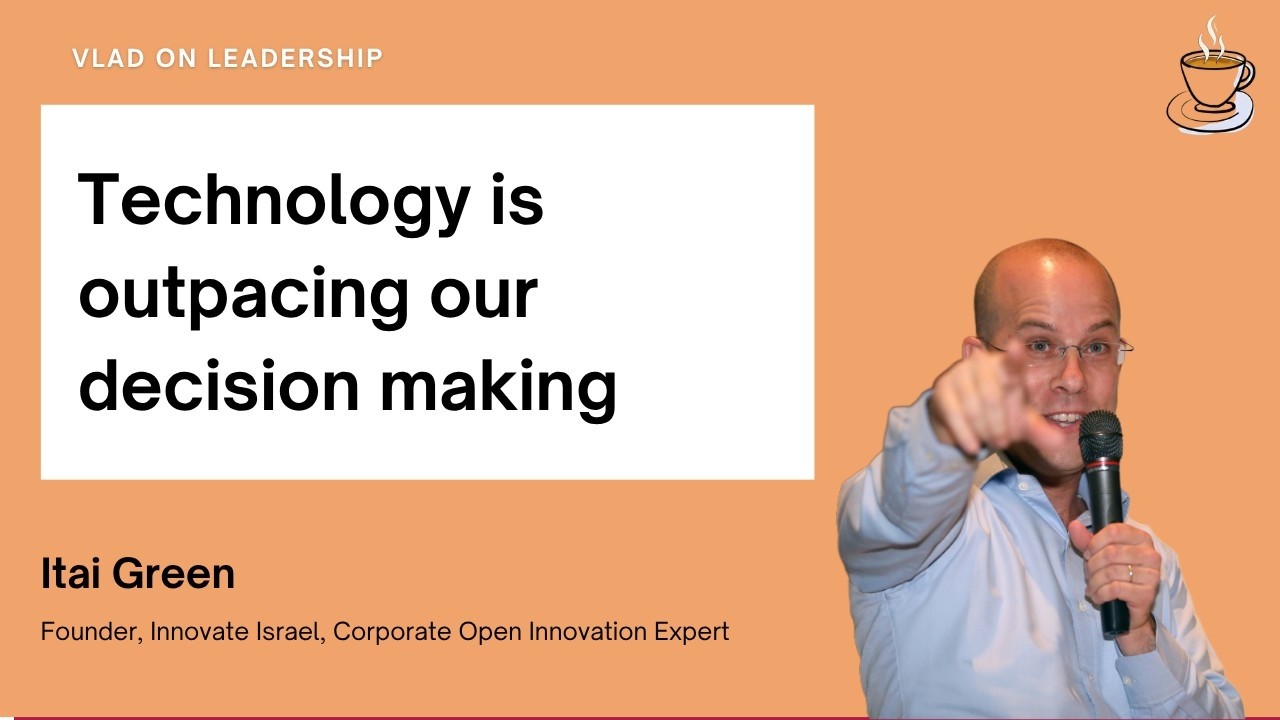
Itai Green, who led innovation at Amadeus, explains why most corporate-startup collaborations fail: 95% of pilot failures come from lack of mid-level buy-in inside the company, not from the startup itself. He outlines a five-step process for faster decision-making and warns that boards still optimize for short-term profit instead of long-term innovation.
Chapters
When they realize, the smart one, that the pace of technological change is faster than the decision-making process, which is very slow in many companies, they have to overcome it. The pace of decision-making in corporates has to be faster than ever. Otherwise, your competitors are not waiting.
Welcome to Vlad on Leadership, interviews with technical leaders and operators about the leadership questions AI makes more difficult. I'm your host, Vlad Moskovski. I coach senior technical leaders and founders who are excellent at the job that's keeping them stuck. Hello, Itay. Welcome to the show. I'm so glad to have you here.
Hi, Vlad. Thank you for inviting me.
Tell our audience, who are you and what do you do in the world?
So after 15 years as an entrepreneur running different startups, I was moving to the other side and was heading the innovation activity of Amadeus in Israel. And then launching actually my own consulting firm and helping giants, big corporations, governments to remain relevant in a chaotic time of rapid change by collaborating with a startup. The methodology is called open innovation. And this is actually what I do, help these giants to keep being relevant or at least to survive in a time which is absolutely a challenge by collaborating with the most cutting-edge technologies and actually help these giants to change their DNA, the corporate mindset, which is most important.
I really love that you're bridging this background of you started in the startup world, then you went to work for the giants, and now you're bringing them together as a bridge.
Yeah, actually, job, part of my job is actually to translate the lingo so each of them would truly realize what the other side is meaning, because in many cases, They're not talking in the same lingo, in the same language, and they're missing. So, and my job, my role is to make things move fast because if you do not move fast these days, you become irrelevant.
Tell me, what is your favorite part of what you do?
The favorite part is to engage the corporate leaders, the corporate C-level executives and mid-level engage into the process. So this is truly what I really like, and this is where I really, I'm really happy to see the results because, you know, to find the startups for the corporates. So those startups that truly solve their pains, that's the easiest part. I mean, 10% of my time.
Yeah.
But 90% of my time is to make these 2 parties engage with each other and move toward the same direction as fast as possible. In order to make it happen, the main challenge is to engage the decision makers, to engage the corporate people. Otherwise, It's a mess, nothing happens, and there's just frustration. So—
What is it that makes engagement so difficult? I mean, are they— I imagine that they're very engaged in their own business. So is it that it's part of it for them to see the value in what the small companies can offer, or is it just they're so full that they don't have time? Like, what is it about engagement that's so difficult? I imagine that you like the difficult challenges, and that's what—
Yeah, of course.
Makes you come to life. So, so what's, what's the challenge there?
Corporate and startups are different cultures, different type of people. I mean, in most cases, most of the corporate people have never spent a moment in a startup, and many of the entrepreneurs have never spent a moment in a corporate. So they're moving in different ways. The sense of urgency is totally different. Corporate people are so busy with their day job and Suddenly you're asking them to stop or to add another task, which is a high priority, and to engage with someone who's totally different. You know, in one of the cases, I gave a lecture to a financial institution and I was pitching to the investors, to the investment division there, investment team. And there were like 70 people there and I was trying to explain them the difference between them and entrepreneurs. And I asked them a very very simple question. When was the last time you haven't got your salary at the 10th of the beginning of the month, at the 10th day of the month? You know what was the answer?
Right.
It's not the 10th, it's the 1st, the 1st day of the month. And I told them, you know, you are speaking now to someone that when I was running a startup, I was not getting paid for a year and more. My employees were not paid for 6 months. I mean, when I was really On the edge, the startup owed me over $250K and they were in shock. What was their answer? The answer, the way they, the answer to that was, are you crazy? How come you didn't cut the losses after $10K, $20K, $30K? And the answer was, yes, entrepreneurs are crazy. They're willing to take risks which you are not willing to take. And this is just a symbol and really example, a little example of the difference between the entrepreneurs that are willing to take crazy risks, crazy, seriously crazy, and corporate people that are paid every month, every first day of the month. And, you know, they have their job. If they do it, everyone is happy. And actually this is true till a certain thing. I mean, these days I think even corporate people start to feel the sense of urgency and they feel like the tech is all around them and the agents and the AI, the GenAI, and everything is like kind of a challenge. and you need to know how to handle it. So I think they start to feel the stress, but not yet like, it's not yet like a star business.
Okay. So in some ways, actually, the AI acceleration, let's call it, is actually making the people that you need to convince a little less comfortable.
I agree. Absolutely.
One of the best things— And that's in your benefit. Yeah.
And these days, I mean, the last 3 and a half years since GPT came to our life, it's different time. And before GPT came to our life, it was more challenging for me to convince the decision makers that if they will keep on doing tomorrow what they've been doing yesterday that brought them to succeed, they thought it's enough. And I told them, no, it's not enough. If you've been doing something, now you have to change it. You have to do better. You have to open your mind. You have to integrate more technologies. It's not enough to continue with the same route, doing the same things that you did yesterday that actually brought you to succeed. These days, it's easier for me or less difficult for me to engage them, to make them convinced, to make them change the way they treat the challenges. I'm talking about the decision makers, but also about the mid-level.
Mm-hmm.
Because the mid-level executives, realize these days that if they will not adopt innovation, if they will not use new technology, they as individuals, as employees, will become irrelevant either at the same company they work for, but also in other companies they will apply in the future. Because these days, no one is going to accept, no one is going to hire an employee that doesn't really work with the cutting-edge technologies, with those GPTs and others, with the cloud and others. So yes, I agree. The sense of urgency now is more than ever, and everyone realized that, the top executives and the other employees.
So, it seems that right now, if people are feeling the urgency, there's a level of attachment within the leaders, an attachment to maybe the way we've always done things, or an attachment to a way of being, or a way of doing, or a way of operating, or an operating model. So, tell us a little bit about What does it take to be less attached to— what's it like for the leaders who need to almost let go a little bit of what, who they are and what they've done?
It's very difficult these days to run a company, to run a corporate. Very difficult because reality requires those leaders to change totally what they used to do and the way they treated, the way they managed. They have to allocate much more time for strategy, for making the corporate engage. For taking decisions in a very short time with respect to the new business model, to the impact of the new business models. We've just seen a few weeks back Salesforce CEO announcing everyone that as of now, Salesforce are going to serve AI agents, not employees. This is dramatic. And the fact that such a CEO was able to take such a dramatic decision to lead such a dramatic strategic change means, really means a lot about him. He's super, super talented, but most, most of the CEOs, most of the leaders find it very difficult to make such a dramatic change in such a short time. But when they realize, the smart one, that the pace of technological change is faster than the decision-making process, which is very slow in many companies. They have to overcome it. The pace of decision-making in corporates has to be faster than ever. Otherwise, your competitors are not waiting.
That's right.
So you will have to react. You have to truly understand the ecosystem and where it really moves. And it's tough. I agree, it's tough. But with the right innovation perspective, I think we can overcome the challenge.
So you're talking about 2 things. You're talking about the speed of decision-making, and you're also talking about spending more time being strategic.
Yes.
I find that the companies that I advise and the people that I coach, both of those things become important. One of them, I feel that I've got a pretty good handle around. The other, I do not. So I want to compare notes to see how you do it with your clients. So for me, the decision-making, speed of decision-making, is a harder one to solve. The one for strategic, is getting people to shift and change what they pay attention to. So, most people in companies are fighting fires, they're being reactive, and we need to shift them into being more proactive and more strategic. So, there has to be some sort of delegation or reprioritization that has to happen. And the decision-making one, increasing the speed of decisions, oof, that's a tough one. In large corporations, I mean, I've worked in several large corporations. I've worked with Kaiser, 250,000 people.
Wow.
Healthcare company, highly regulated. And I've worked at Accenture, 700,000 people. And both of those companies, speed of decision-making was— well, Kaiser was very, very slow. Accenture was faster, but still much slower than most small or startups. So how do you get people to increase speed of decision-making? And it seems that For strategy, you actually have to slow down. So it's like one is speeding up, the other is slowing down. How do you do that? What are some of your systems or tricks?
So I tell them the truth. The sense of urgency is beyond imagination. Every morning we wake up with something new and when they realize, and I have my own way, my own methodology, my own lectures, my own, the way I deliver the messages and show them what surrounds them, I'm always telling them that the ecosystem and the pace of technological change around them in the ecosystem could be a threat or an opportunity. And the way not to be surprised, which is most important, is based on the understanding that they know what's going on around them. They can't be in a position to be surprised. By a new technology or by a competitor that is adopting a new technology or by an entrepreneur that is currently creating, building something in the garage and in a few weeks could threaten their future. I mean, these days, and you know that with technology, which is an enabler, it's not an obstacle anymore. Technology is on the shelf and smart people can take an advantage, use this technology and build something new that will threaten your company. For an example, you can take Base44 that after 6 months with a single entrepreneur was able to build a tool that helps you to build an application or a website or anything in a single line of prompt. So this company with a single entrepreneur after 6 months with raising $0 was able to threaten the position of companies like Wix and others that allows us to build websites. So suddenly you don't need anyone. You don't need a designer, you don't need Wix, you don't need anyone, and you have a website. Wix was smart enough to buy this company in a very fast time, in a very fast decision maker— making. Very fast process. And companies have no other option. And when I show my clients what surrounds them, what is the threat, what is the opportunity, what competitors can do when they adopt new technology before my client does, they understand. I mean, C-level are not stupid. You just need to show them. reality. In some cases, and you mentioned Accenture, Accenture, McKinsey, BCG are all full with the smartest people around the world, right? I mean, analysts and consultants within McKinsey and the like are really smart, but there is one area they cannot help the decision makers, the boards and the CEOs and the C-level. One area, innovation. And the reason is that all those consultants, which are again, are super smart, are relying on open Data, on data that is available on databases, on what they find on Google and GPT. But innovation, the really cutting-edge technology is not online. It's currently developed in the garage by 2 or 1 entrepreneur, 2 entrepreneurs maybe, and you are not familiar with it. And one day you'll be surprised and McKinsey have no clue about them.
Mm-hmm.
With open innovation methodology, if you do it right, You will not be surprised. Why? Because the entrepreneurs, when they are learning the market and they are building the new tool, the new technology, they will knock on the corporate door and would ask for advice, for feedback from the corporate people. And at that moment, you are familiar with the most cutting-edge technology.
In a world where AI gives us more data than ever, the leaders who stand out are the ones who also listen to their body's intelligence. That's why I've created a free Somatic Intelligence Toolkit with practical exercises and use cases. Grab your free toolkit below. Now back to our conversation.
That is not online. They don't have website yet. They are in stealth mode, below the radar. And this is the moment where a great innovation leader should be. This is the position where entrepreneurs are knocking on your door before they do so on your competitors, and they are asking for your advice, for your feedback. This is the best position. It is by far cheaper than hiring McKinsey or Accenture or others. And this is really where they get the most of the value. And I see that all the time. You have to engage as a corporate with the ecosystem in order not to be surprised. The price of surprise might be the end of your business.
So your approach is to give them the reality, which maybe they somewhere along the lines know, but you hammer it in so that they feel it.
Yes. And you know what is one of the, one of the most problematic issues that leads us to, to, to this way that these leaders find difficult to take decisions? They're bored. Their bonuses are based on P&L. The board incentivizes them for short-term period. This is a disaster.
It's the nature of most corporations.
And these boards should change the way they incentivize the executives. They should incentivize them not only for P&L, because P&L at the end of the day is this quarter, the next quarter, the third quarter, but the board is in charge of the future of the company, of the years to come, of the 5 years to come, of the decade. And when you are incentivizing executives only for short-term results, you're not in the right dialogue with ecosystem and with reality and with a threat. You should incentivize the leaders to run pilots. with as many pilots as possible, with the ecosystem, to try, to fail, to fail, of course, also to fail. But, but you know, when you do that in the right way, you have some failures. But if in some cases even one win is the whole difference between living to dying for the corporate.
So Itay, let's say the scenario is you come in, you give this presentation, you say this is a life or death situation you're in right now. You could be surprised. There could be someone 1 or 2 entrepreneurs that are waiting to take away a bunch of your business. And the executives get it in that moment. They have a wake-up call and they say, oh my God, Itay, you are right. We need to be not surprised. We need to be listening more. We need to be sensing to what's happening in the ecosystem. And then they're slow or they're resistant, or maybe there's some structures such as board or whatever else is in place. So then what happens? What's the best scenario and the worst case scenario?
So I'll tell you about the process that really brings great value. Once they realize and they agree with what you've just said, what we do is that I meet all the VPs, the chairman, and the CEO, meet each of them for half an hour to an hour. I gather the 3 most relevant Challenges for the year to come from each and every department. And I meet them, I get the challenges. After a week or two, I get back to them with a list to each and everyone with a list of solutions, technological solutions, in most cases startups that I think are relevant to their challenges to solve their pains. They rank each and every one of the solutions between 0 and 10, 1 and 10. Their level of interest. 10 is the most relevant one. 0 is not relevant. And then I take the 10 startups, the 10 solutions they show the highest interest in, and we set a meeting one day long. An innovation bootcamp starts, of course, who is coming? The VP and the 10 people that are reporting to the VP. And it starts with a 1-hour to 2-hour lecture of mine where I show them what surrounds them, the threat, the opportunity, and provide them with concrete tools. How to truly succeed engaging with startups, with third parties like startups. And then getting into the room, startups, the 10 startups they ranked as the most relevant ones, one after the other, 30 minutes each, 10-minute speech, 20-minute Q&A where all the people in the room are asking questions in order to explore the opportunity, the possibility of a pilot.
Mm-hmm.
And at the end of this day, After they heard about the ecosystem threat and opportunity, got tools, met startups that are relevant to their challenges, they selected them. They selected the challenges, they selected the startups, they are engaged. At the end of the day, they have to take one decision with which out of the 10 startups they want to proceed to a second meeting. And after hundreds, hundreds of Bootcamps alike. You know with how many startups they want to proceed to a second meeting?
Too many. 7.
It's not too many. They proceed to a second meeting. They bring the legal department, the CISO, the procurement, everyone, the legal, of course. And then at the end of the funnel, they end up with 2 pilots, which converts to one integration. When you do that across the company with all the divisions, you change the DNA of the company in a few months' time and you integrate new technologies, cutting-edge technologies. And your people are prioritizing differently working with startups because they truly understand After this process, the sense of urgency, they are engaged, they got tools how to do it right based on a lot of experience of hundreds of corporates. And then you can really succeed, at least to survive, because I agree, we are living in a crazy time for sure, but hopefully also to beat your competitors, not only to survive.
I love this process. Everything about it makes a lot of sense to me from the prioritization to the selection, to the pilots, to then the integration. It seems that there's a lot of places where the process could break down, or there— you mentioned failure, actually. You know, it's inevitable that there will be some failure. Being an entrepreneur and a startup founder, high likelihood of failure, product-market fit, all kinds of things can go wrong, right?
Yes.
So what happens if there's a failure? How do the large companies react to that?
So after 10 years, I can tell you that most of the failures, most of the pilots that were not succeeding, it happened not thanks to the failure of the startup, but due to the not enough commitment of the corporate mid-level management. So this is where, I mean, if the people are not engaged, the mid-level, nothing is gonna happen. You know, things are going to be so, take so long. So the startup would lose an interest in working with a company, would cross the road and work with a competitor. This is what happened. I can tell you that after a decade of running open innovation in so many corporates around the world, the number of startups that failed to deliver was maybe, maybe in 5% of the cases. In 95% of the cases, Where it failed, it was due to the zero commitment from mid-level. And the reason that it's so little with, you know, due to the startup is because when you choose entrepreneurs to work with, it's important to choose those that you can truly rely on. Background check, you have to talk to people that they've been working with. You have to learn about their cash flow situation. You have to talk to their investors, maybe to some clients of them, to truly see whether you can trust them or not, because a corporate and a startup are getting married. This engagement is like getting married. It's not like a supplier. A startup is not a supplier for the corporate. It's a partner. And when you are choosing a partner, either your wife or my wife, or you're choosing a girlfriend or a boyfriend, it's the same. You have to know who are you about to engage with. So you have to invest and I invest a lot of time in that, in minimizing the risk because I would like to minimize the risk. It's important to minimize the risk. Of course, there are gonna be failures and we need to learn from failures, but it shouldn't be an excuse that there is a risk. You know, there is a risk of failing with a startup. Yes, but it shouldn't be an excuse for not trying.
Hmm.
And I apologize for that, to that. We should minimize the risk, of course. And this is— I do that. Of course, it's super important. Super important.
That makes a lot of sense. I'm interested for a moment to talk about the inner worlds of the leaders, the C-suite, the VPs that you're engaging with. What kind of changes have you seen as a result of doing open innovation? I'm just curious. You know, I could imagine someone who's been working in a corporate job for a long time, VP, C-suite, they're suspicious of open innovation. They're suspicious of startups. Maybe it's not even on their radar. And then suddenly they get to have this experience. They become more open. They listen more. In the best of times, what happens to them as an individual?
So, you know, the way I measure whether I succeeded or not within the process is if those C-level executives are approaching me and tell me, you know, Itay, during the weekend, I met friends of mine and one of them is working for a startup. Maybe the solution that they develop could be relevant to our company. So I treat the corporate individuals, the corporate employees as sensors, like sensors for technology. Imagine a corporate, you've been working for a corporate with 700,000 employees, right? It's 700,000 sensors, people that are engaging with others, Maybe with the neighbors, maybe with another parent from the class of your kid, of the kindergarten. Maybe you met someone out there. Maybe you met someone during the weekend on a cafe or in the bar. And they told you, yes, I'm working for this and this startup. Before the process, maybe you didn't, you wouldn't even ask what this startup is doing. But now when there is a sense of urgency in your own corporate and you have to keep your seat as well, you know, your position as well, you would ask. That one, that friend, what are you doing?
Curiosity.
Could it be valuable for, yeah, could it be valuable for my company? And then if it is, they approach me or the innovation leader within the company and tell him, hey, we met this company, maybe that could be relevant for one of our challenges. So this is the mindset change. You open your mind, you are more curious, you know, you have more the fear of missing out, the FOMO, rather than the ego. You know, motivated by ego. That's the opposite. The NIH, they don't invent the deer. So this is really important to have these kind of people and the process, the open innovation process, make people, more people in the company to be more open-minded, which is very, very important. And also modest because we need to know that we don't know everything. We know we don't know everything. And in order to succeed, we need to work with others that know more than we do. This is very important. The only way to overcome these days is by collaboration, by partnership.
I like both of those mindset shifts, curiosity and modesty. If you were to give a lecture or give a talk or give some advice to people who are listening to this podcast that are sitting in positions of leadership in large companies, What mindset shifts besides curiosity and humility do you think they need to adopt to survive and maybe even thrive in this world that's moving faster than ever?
I think they have to nominate someone. First of all, they have to take the innovation into much closer to them. I mean, they have to be more involved in the innovation work around in the company. They have to be more involved and Because innovation is always top-down, so they have to lead it. They have to be the one to lead innovation. This is one thing. The other thing, they have to choose one out of their people to be in charge of the innovation. And the one is one that works within this company. They don't need to hire someone from external, from outside of the company. They have to promote someone that knows the company very well, the best project manager in the company with the best people skill. These are the characteristics of the one that can truly run the innovation. And when this one is getting the support from the leaders, a true support, I think that things would move faster, would move faster in the right direction. And I can tell you that they can not only integrate new technologies in order to survive, but with open innovation, they can also do a lot of money, make a lot of money. How? Once a pilot is a success, it means that the startup solved the corporate pain. It means it solved the same pain for thousands of companies alike around the world. This is the moment also to invest. So my recommendation is not only to enjoy, to become a venture client of those startups, it's also to invest in those that solved your pain. Because the pilot phase is the best due diligence an investor can imagine. And they have this strength. This is really different from VCs or from other investors because they are domain experts. They know what solves their pain. So I think this is really the thing. I mean, invest more time into innovation, bring the right one to the right position as innovation leader, and allocate time and attention to this leader of innovation and truly work with this one and be involved. And once the employees would see that the CEO is into it, everyone would follow.
And I think that there are a number of great examples, including Salesforce, I believe, that has a venture arm to what they do. I think they do this quite well. So this approach of becoming a partner Having the right person in the company be the innovation leader and then investing.
But those CVCs in too many cases are investing in startups that they haven't tested, that they haven't run a pilot with. I would recommend to split the investors, the investments. Some investment could be super strategic, but if it's in your business, try it first. Try it first, run a pilot, 3 months. After 3 months, you reduce the risk dramatically. And this way, the return on your, on the investment is gonna be by far higher. So that's my recommendation. And it's not a lot of money because when you invest in early stage, it's half a million, $1 million, $2 million.
Yeah.
It's not, it's not big numbers for giants. It's really small.
Itay, I want to talk about speed. So a lot of what we've been talking about is the speed at which AI and all of these technologies are accelerating. The thing that I see, to be honest with you, is that speed is also degrading people's attention. It's creating mental strain and stress. It's in some instances creating mental health issues as well. How do we, as, you know, beings with nervous systems and brains that are not used to this level of acceleration and change, what's your opinion on this?
First of all, I agree. I mean, I see the stress on decision makers, on other employees in the companies. The situation is stressful. I mean, there is a reason for that, and I think One of the ways to, to balance the stress is by allowing employees also to work remotely. Corporates allowed employees to do so during the COVID time. And unfortunately, you see, it's different these days.
Yes.
I think the work-life balance is super important because it allows the employees also to think, not only to work, not only to be in stress. And you always need to be in a position that you have time for yourself to think, because once you think, the company would enjoy that. The stress is not something which is good for anyone, not for the individual, not for the company. And I think this is very important and I agree, life is super stressed, but the work-life balance is important. And I hope more and more corporates would allow their employees also to stop for a moment, look around, not just walking, but when you are in stress and you're running fast, too fast, You can't see what happens around you. And in many cases, it's very important. We just talked about it since the beginning, actually, of the podcast. It's very important to realize what surrounds you. So encourage your employees to go to conferences, to go to meetups, to participate in events, to engage with others, to change ideas. It's very important. And this is a little bit more relaxed than the day-to-day only in front of computer fighting with your colleagues. It's different, of course. And we are living in a very tough time. Again, I mean, we can't ignore reality. The pace is really insane, but we can do nothing about it. That's the pace.
Yeah.
We should get used to that. And alongside that, you see many, many companies are firing employees. or laying off employees due to the AI. But I'm optimistic. I tell you the reason. The reason I'm optimistic is because what we've been learning during decades back is that once there is a crisis and people are laid off or fired from their— they start new ventures. They build new startups. They understand what are the challenges. They go to the garage, they build something new, and they build the next unicorns and the next technology revolution. So I think that we are living in a very, very important time for that. During this time, those talents, talented entrepreneurs, people that have just been fired are building the next OpenAI.
I agree with you. I think we're living in a time where creativity is the most important skill. Innovation, creativity.
And execution.
I do, however, think that there has to be something fundamentally that needs to change in society. And that is we've built a society around productivity. You are only worth as much as you can produce. And for me, one of the most positive things about AI is that it produces much more, much faster than any one of us can do. And so my hope is that in society, we start to shift the conversation from production That you are a producer of something. And that's how we measure, do we value Itay or Vlad or not, is how much can they produce to something else. And I don't know what that something else is yet, but that's my hope is because if you are a producer, then the push is, well, now you have a new tool, produce more. Something changed, produce more. Can you produce more? So in a way, it's a very extractive world essentially that we live in, is we are trying to extract production value. And in my greatest hopes, we shift to something else. And I don't know what that is yet. I don't know what the language is, but I wonder if creativity is a part of it.
Creativity is for sure a part of it. And, you know, When GPT came to our life and the agents and so on, we were under the assumption that we will have more spare time, more free time, right? Because we are going to be more effective. We have certain jobs to do, certain tasks to do. We are going to do it in half the time. So half of the day we can go to the beach, right?
How many people is that true for?
Yeah. So practically, It's not the case. I mean, I can tell you that since GPT came to my own life, I work harder. I mean, I produce more, that's true, but I work harder. And I hope, I really hope that what you've just said, so we're going to have this balance and more calm life, more relaxed life, and let the agent win. But, you know, and we can live a little bit without stress and live longer. And, but you know, the nature of the human being is once you have spare time, you think about the next innovation, about the next entrepreneurship, about the next big thing. That's the nature. But I truly hope that, you know, we are gonna have also time for ourselves to develop ourselves and not only work.
Yeah, this is something that I, I've had a lot of success helping CEOs of companies shift from a mindset of, I'm doing this because of stress and fear, moving from that mindset to, I'm doing this because this is exciting to create. And obviously, money and pressure and competition and lots of other things are big, big factors in this. But if you can shift from being fear-driven, To being creativity-driven, suddenly you can put in the same 8 or 10 hours, but you will not be left drained at the end of the day. You will be energized. And you won't have a problem going and spending the afternoon playing with the kids or doing something fun with your friends or with family, because there's no fear or stress. There's no fear of missing out then. It's just the creativity that's pouring out of you that makes you excited, that helps you get up in the morning and look forward to the the next day.
I really hope we're gonna live in such a world, but currently, unfortunately, we are all stressed. Most people, most people are not living. We are all in fear, truly fear, fear to lose our job, fear to lose revenues, to lose profit. I mean, that's, that's reality.
That is an internal shift that every person can choose to make.
And it's difficult for CEOs. And if you can do it, It's amazing.
It's very difficult what I'm talking about. But if they're able to do it, and I've helped a couple of people do this, it's, I'll tell you, life-changing.
I agree, for sure.
Because they might be doing the same job, but they're completely different people doing it.
I agree. If you can do that, it's a miracle. It's truly magic.
So let's go make miracles happen.
Sure, we always try.
Thank you, Itay.
Thank you, Vlad. Thank you very much.
It's a pleasure.
Mine. Thank you. Thank you for inviting me.
Absolutely.
More from Vlad



Smoke to Fire: CFO Lessons on Not Letting Fear Win | Andrew Platt (CFO, Strategy & Finance)

Get Comfortable With Your Discomfort | Berk Algan (SVB, Ernst & Young, vCISO)