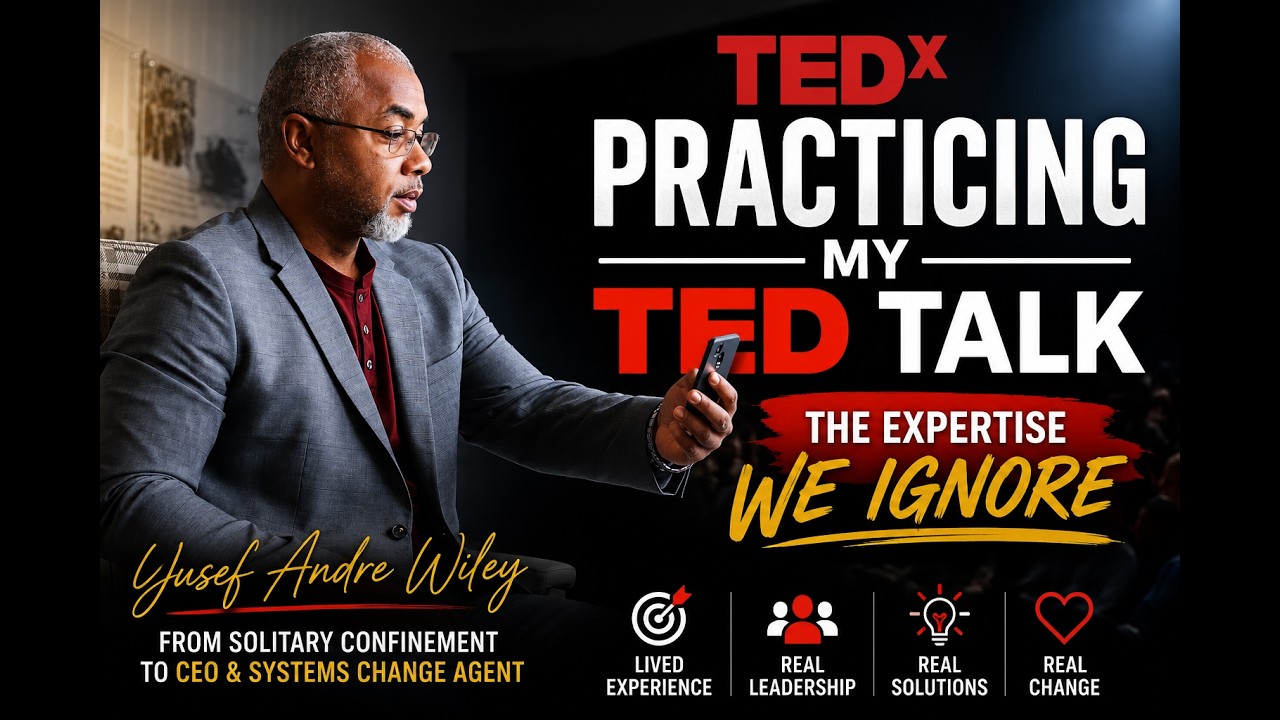
A man sentenced to life at 21 spent 22 years in prison, then built an organization that now employs 105 people and runs multi-million-dollar reentry programs across California. He argues that lived experience in the criminal justice system is America's most undervalued leadership skill, and that those closest to a problem are often closest to its solution.
Chapters
Today my talk is about the expertise we ignore: why lived experience is America's most undervalued leadership skill. At 21 years old, I was sentenced to spend the rest of my life in prison. I end up serving 22 years. Most people believed my story was over before it even really began. What they didn't realize was that prison wasn't just taking away my freedom, it was forcing me to develop something that would eventually become my greatest asset— my experience. Not the kind— you earn in a classroom, the kind you earn by surviving systems, adapting to impossible circumstances, leading through adversity, and learning how to rebuild your life from the ground up. Today, I lead an organization responsible for millions of dollars of government contracts. Today, I lead an organization responsible for contracts that, you know, are serving human beings. Our team served thousands of justice-impacted people across California. Government agencies now invite me to help redesign many of the same systems that once managed every aspect of my own life, which is interesting. That transformation forced me to ask the question that changed everything: Why did I have to become successful before people believed the experience I already had. The real problem. We often believe that the biggest problem is incarceration, homelessness, addiction, or poverty. I don't. I believe the real problem is something much deeper. We consistently ignore lived experience. We trust credentials more than experience. We trust theory more than reality. We build systems for people instead of building systems with people. And because of that, we spend billions of dollars trying to solve problems while overlooking the people who understand those problems better than anyone. When I entered prison, I quickly learned that my name no longer mattered. I became an inmate, a number, a file, C-file. My identity was reduced to my worst decision. For years, people judged my potential by my past instead of my capacity. My people assumed prison was the end of my story. Ironically, it became the beginning. Prison did not make me successful. Let me be clear about that. But inside one of those hardest environments imaginable, a maximum security prison. I learned lessons that many executives spend decades trying to master: discipline, consistency, communication, emotional control, accountability, faith. My Islamic faith gave me structure when life felt chaotic. It taught me that leadership begins with Leading yourself, the inner soul, the inner self. Long before anyone trusted me to lead an organization, I had to learn how to lead my own mind. When I came home, many people still only saw my criminal record. I saw something different. I saw an opportunity not simply to succeed, but to improve the systems that has shaped my own life. Today, my organization employs more than 100 people, 105 to be exact as of today. The majority of our workforce brings lived experience. We operate housing programs, uh, behavior health initiatives, workforce development, and reentry services across California. The same public systems that once supervised me now ask my organization to help solve some of their biggest challenges. That wasn't luck. It was proof. So the turning point, one day I realized something that completely changed my perspective. The system doesn't simply need more funding. It doesn't simply need more technology. It needs translators, people who understand both worlds. People who have lived the problem and learned how systems actually function, people who can translate policy into practice because they've experienced both sides. So what's the solution? The solution— what if we change one assumption? Instead of asking who has the most impressive resume, We also ask, who has the deepest understanding of this problem? Imagine if we treated lived experience as expertise instead of liability. Imagine if hospitals design healthcare alongside formal patients or former patients. Imagine if education systems were shaped by students who struggle. Imagine if justice reform was led by people who actually live through the justice system. The people closest to the problem are often closest to the solution. I'm sure you've heard that before. Three principles. Three. First, lived experiences data. It isn't an anecdote. It is evidence collected through real life. Second, people closest to the problem are often closer to the solution, not because they know everything, but because they understand, they understand what cannot be learned from a report. Third, leadership is not providing you've never fallen or proving that you never fallen. Leadership is proving you've learned enough from falling to help someone else. Connecting to the future. Today, people ask me about artificial intelligence. I believe AI will transform almost every industry. But here's what AI cannot replace: wisdom, empathy, perspective. Artificial intelligence can process millions of documents. It cannot replicate experience earned through surviving hardship. The future belongs to organizations that combine technology with authentic human wisdom, not one or the other, both. So closing, when I entered prison, people saw a criminal. When I came home, people saw a risk. Today, many people see CEO. But here's the truth. I've always been the same person. The only thing that changed was who finally decided my experience had value. So here's the question I want to leave with you. How many extraordinary leaders are we overlooking because their expertise doesn't fit our traditional definition of credibility? Imagine what becomes possible when we stop asking people to overcome their past before we value their experience, and instead recognize that sometimes the very thing society tries to erase becomes the wisdom capable of changing it. Thank you.