Will Ecommerce Survive in 2023?
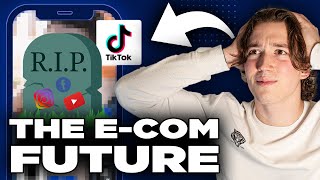
Zach Oldham of Flax explains how TikTok, Instagram Reels, and YouTube Shorts are forcing e-commerce brands to invest in real storytelling instead of ads. Privacy rules and platform risk mean companies need first-party data and presence across multiple channels to survive.
Chapters
Everyone knows that short-form content like TikTok has been taking over the media space, and platforms like Instagram, Facebook, YouTube are losing users to TikTok due to their short-form content. This competition is great for everyone from the consumers to the content producers because it means the platforms need to continue to innovate, especially more established ones like YouTube and Facebook. Today I wanted to discuss how short-form content has disrupted the e-commerce industry and the predictions that we have at Flax as to how this disruption will continue to trend in the next coming years. The first main trend that we've started to see is companies dialing in their content strategies. As big corporations have started to catch on to the short-form wave, they've begun building content and production teams capable of creating high-quality short content. Now, while most of these companies are very late to the game and are likely to take several more years before they fully adopt short-form content into their marketing strategies. We're seeing more and more businesses become content savvy and build content and production teams capable of challenging really, really big creators with their quality of content. This is causing content production to become increasingly competitive, which means that in order to have successful visit videos and successful marketing strategies online, you need to be an expert in short form. You'll have to spend more time developing hooks, creating incredibly interesting ideas themselves and creating more content around marketing materials in general, as you can no longer just have an ad concept and put it into content. Instead, you need to build your content around your ads. This is causing consumers to begin following brands because of the content and the personality that the brand is portraying through their content, instead of just because of the services and the associations that people have with that brand. Typically, you can already see brands like Duolingo, Scrub Daddy, and Nerf adopting these sort of content strategies where their content is looking to build an audience instead of just sell a service. Now, there are two things that I could see happening with this short-form revolution. As brands, companies, and content creators continue to make increasingly high-quality content, the competition and the quality of content in general increases. This leads to a higher barrier of entry and less viral growth across the platforms. If you made a video on TikTok and posted it a few years ago, it was incredibly easy to reach your audience, and it still is, but it's becoming increasingly harder. One potentially concerning fact about this: as more content is produced, more people need to consume it. And if a platform like TikTok or Facebook or Instagram has already hit close to the maximum amount of users in the world that they can possibly bring on, then we start running out of people to actually consume that content. If content production continues to increase, but the amount of people that consume that content is not increasing at the same speed, the amount of people that can actually see each video on average declines, which means that successful videos become harder and harder to achieve. And content competition increases. What this will eventually lead to is companies and content creators that cannot keep up with the quality of content that the rest of the market is creating will eventually go bust. In 10 years from now, if a major corporation does not have content at the core of its business, it's going to be incredibly hard for that business to compete in the market. Our next prediction involves how people consume and retain information in the future. Now, you might have heard that people's attention spans are getting shorter due to these social media platforms platforms and the accessibility of content and information, the next generation is supposedly losing their ability to focus their attention on a certain piece of information. Most people are selling this as an incredibly bad thing. They argue that because people are consuming so much more information so much quicker and also discarding it so much quicker, the human brain isn't as able to focus on a specific task. Now, I believe that our attention spans getting shorter isn't necessarily a bad thing. This is purely theoretical, but I think that humans are getting better and better at consuming more and more information in shorter timeframes and figuring out what is actually relevant to them faster. If you can consume a book's worth of knowledge in 30 minutes, then why wouldn't you? As e-commerce reaches global mass adoption, data policies become stricter and stricter. This is not news to anybody. It could significantly impact the way that businesses advertise. In the coming years. Now, e-commerce is a growing industry, and as more and more people are able to shop online, the industry will continue to grow. Tracking issues such as limited attribution on the advertising platforms make it harder to advertise, but don't make it any less profitable to advertise. Instead, it forces innovation and adoption. Something that we're monitoring quite closely is how all of these data policies are going to affect a platform. Platform like TikTok. TikTok has some wild data collection policies, and there are a lot of theories circulating about the data that TikTok collects. A client and friend of mine, Tuzza, has an interesting theory surrounding how TikTok analyzes whether you like a video. Now, this might be a bit far-fetched, but he believes that TikTok scans your face whilst you're consuming content on their platform to figure out your reactions to certain videos. While data collection usually and hopefully isn't this intrusive, we don't entirely know what the companies are collecting and not collecting when we are on their platforms. While it's unlikely that TikTok is going anywhere as a social media platform, it's good to spread your eggs across multiple baskets and not just depend on a platform like TikTok. If TikTok were to be removed from the App Store tomorrow, it would significantly affect a lot of businesses and a lot of content creators who are not diverse across their platforms. As an example, in my case, over 95, maybe even over 99% of my social media followers are actually on TikTok. That means that if TikTok were to be removed, I would lose almost my entire audience. At the end of the day, platforms come and go, and what you should be focusing on is adapting to the platforms and the trends as they cycle. Now, you might be wondering how we at Flax are preparing for this as a growth agency. For starters, we're accumulating all of the data we have across the millions of customers that our e-commerce business clients have. We're heavily investing in data collection, data organization and data analysis. We're doing this by creating our own software for analytics and decision-making with e-commerce, and we're centralizing the data that we have as much as possible. So what that means is instead of depending on the platforms like TikTok ads for our data collection on our data analysis, we're pulling all of the data that we can into our own databases where we can keep it forever and analyze it for as long as we want. We're heavily investing in learning how we can use the data to predict trends before they happen. On the content side of things, we began building a creative agency at the beginning of this year with a video and production team that will allow us to compete on a more global scale. If you work in the e-commerce space and don't have content production assets, like I previously said in this video, it's going to be incredibly hard to compete in a few years from now. In conclusion, if you want to stay ahead of the curve, the best thing you can do is be diverse with your platforms. Learn the platform's nuances and spend time actually consuming the content on each platform. If you want to go the extra mile, you can actually start creating your own personal brand or content yourself, which is exactly what I'm doing right here. I'd love to hear about your predictions for short-form content, whether you agree or disagree with some of the things I discussed in this video and what you think is going to happen to the e-commerce industry as a whole. You can leave a comment down below, ask me any questions and request video topics. And feel free to book a call with us if you are an e-commerce brand and you want to learn how you can develop your content strategy for the next few years.