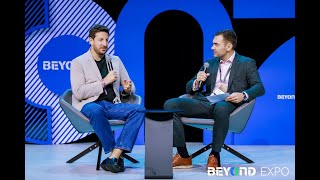
AI Keynote and Panel with Zack Kass - NobleCon20 Replay

Zack Kass argues AI abundance will increase human connection by automating drudgery, while warning that regulatory capture will slow healthcare deflation. The panel covers AI drug discovery, clinical documentation that saves physicians hours daily, and policy frameworks balancing alignment and innovation. Kass predicts edge inference, fusion power, and a post-scarcity world.
Chapters
It is truly a pleasure to welcome you all to Noble Capital Markets 20th annual conference. And I would like to thank each of you for joining us this year in record numbers. To be honest, I wasn't sure how many of you would show up show up after the long Thanksgiving weekend, especially with all the turkey and political debates that likely filled your dinner table. Just three weeks ago, I stood here, right here in this very building, celebrating Noble's 40th anniversary. I reflected on this incredible journey we've had as a company and felt deeply grateful for the outstanding Noble team, our clients, our advisors and our partners who have helped us along the way. I've been fortunate to be part of this incredible journey for 36 years. And while the capital markets have evolved in ways we never could have imagined at Noble, we have remained true to our core mission, serving middle market companies and their investors. And we're still the same company today, steadfast in our commitment to integrity, innovation and the needs of our clients. Now, speaking of change, it has been quite a year, right? With the election results in, we're clearly headed for shifts in the political landscape. These changes will likely have significant impacts on both the economy and the markets. Whether we anticipated them or not, one thing is certain. The business world is evolving faster than ever. If we were to compare the speed of change in our industry to the speed of the election results, it would be much like the elections themselves, unpredictable, fast paced and full of twists. Just like those results, we need to be ready for the unexpected and prepared for whatever the future holds. As we gather here today, I'm proud to say that Noble is stronger than ever in our 40 year history. And I'm confident that the best is still yet to come. With all the changes ahead, it is important, it is more important than ever to stay grounded in our focus, culture and values and to remain unwavering in our commitment to the middle market companies and the investors who rely on us. A special thank you today to Florida Atlantic University for hosting us once again in this incredible facility. We're grateful to the Florida Atlantic Owl community and especially Dan Cropper, the Dean of the College of Business, Fager Wick. Where is Fager? And of course, their entire team for their continued support, leadership and partnership. I also like to extend a heartfelt thank you to our many sponsors and our incredible Noble staff, led by my partner, Mark Pinviddick. Their hard work, especially with the Thanksgiving holiday just last week, has made this event possible and we couldn't have done it without them. So now to kick off NobleCon20 I'm thrilled to introduce our first speaker, Zach Kass. Many of you may know Zach as the person who introduced the world to chatgpt in his role as head of code to market at OpenAI. Today. He's a futurist, a writer, and one of the most sought after AI speakers in the world. He consults with Fortune 1000 companies, helping them navigate our rapidly changing environment. And his work at the University of Virginia focuses on socioeconomic impact of the AI revolution. And his mission is to demystify AI, replacing dystopian narratives with messages of optimism, something we can all use in these challenging times. So please join me in welcoming Zach Cass.
Morning.
Nice lively crowd. Sorry I didn't dress up. Some of you wearing ties. Very nice. Those of you wearing ties, are you business school students? Is that what's going on?
No, I'm kidding.
It looks good. Well, thank you all so much for being here. Thanks for the standing room only crowd. That's very, very flattering. It's nice to be in Boca Raton. I live in Southern California. I live in Santa Barbara, so it's nice anytime I can travel somewhere that feels familiar. Yeah. So we have a full morning and there's plenty to talk about. This is a fun setting because four weeks a year, I spend about four times a year, I spend about a week in Charlottesville where I teach a class at the University of Virginia and do a bunch of research. And we'll talk about all that today. But before I start, I'll give a little context because it's important to sort of my journey, which is I spent 15 years in the applied AI side, so I studied history and computer science at Berkeley and then went and worked for a bunch of AI companies, including OpenAI. But I'd always become fascinated by the history of actually computers and computer science because if you extrapolate, you start to realize that AI is just a stop. There's a whole lot more coming. We have a recency bias, so it's very overwhelming to us. But if you extrapolate, you start to appreciate that this is just the beginning in some respect. And so now I study that. That's basically where I spend all my time. We have a consultancy, we're a research and advisory firm where we spend time with Governments and Fortune 1000s to talk to them about how to plan around policy and socioeconomic impact. And then I write and speak on this idea of what happens next. And today I'll tease a little bit about the book that's coming out. We have two books coming out one in March. I understand Nico's gonna buy a copy for all of you. Yeah. And if you don't get a copy, it means he doesn't like you.
So,
yeah. We have a book coming out in March called the Next Renaissance, which we'll talk about today and I'll tease some of the research from that. Then a book coming out late next year, early 2026, called the next Great Company, where we study how organizations will be redesigned. So anytime I talk to people about where we are, I used to be able to show people visually exactly what AI could do. And I would have some beta version of an OpenAI product, but I could do it visually and that's becoming very hard. And so answering the question, where are we? Is actually now much more of a challenge than simply saying, look at what this app can do, as many of you may know, because now it's actually, it sort of bled across modality into spaces that we can't just demo with an app. Which is an interesting way to think about AI because it's now crossing these new chasms into a much more sort of four dimensional world. And so instead of trying to show people visual representation of what AI can do, I simply say to people, we're building machines that have human intellectual capacity. That's what we're doing. And when you explain it this way, when you conceptualize it this way, it becomes much easier to understand what, for example, agentive AI is. Right? A machine that can do things on your behalf. We'll talk more about that or imagining what olfactory would be like. Now, of course, your app doesn't, your phone doesn't actually have a means, a robotic means of capturing a smell. That's not how Apple designed the current iPhone. But machines can actually interpret smells, right? So we have machines that are capable of things that the robots themselves are not yet designed to do, at least not our personal hardware. And in addition to that, what I try to teach people is something that I think is pretty counter narrative today, which is if I asked most of you in this room, and maybe not, you're a bunch of smart people, but many people on Earth would tell you right now that AI is getting much more expensive, that in fact the cost of AI are inflating all the time. And that is true on a training basis. So that is true with respect to the cost it takes to build the next model. GPT5 will cost, you know, order magnitude, not quite five times more than GPT4 to build. It's very, very expensive to train these next Generation what we call the frontier models. But running inference actually using the model is getting much less expensive. And that's super important. This is the only graph I will show you all day. And this is the only trend that I care about right now. Because we know that the models are getting very good. Now what we need to care about is are they getting inexpensive? Can the world actually access them? And I care about this trend for two reasons. One, if you're worried about a technological hegemony, if you worry about a world where we all pay Sam Altman a tax for the privilege of using his frontier technology, this is the best case against that. This is the best argument that we will actually live in a. In a multi model world is what we call it a fragmented model world, where the cost of models become so low that it effectively becomes a commodity and impossible to tax. And as this trend goes to zero, the models will start to live locally. They'll live on your device. So in fact, edge computing is a really easy way to democratize anything because it means you can access it without the interference of a bad foreign actor, for example. And this is made and sort of WhatsApp encryption. So effective, right? Which is a lot of this information can sort of live at the edge. The other reason this matters, and the far more important reason I actually think is that anytime a critical resource in history has declined in cost this much, let alone this fast, there is a Cambrian economic explosion. Very good things happen when important things get cheap. This is just one of these great things about being human. And it turns out we're really good at making important things cheap. This happened with fruit foodstuffs. This happened with water. This happened with electricity. This is happening with the Internet. This will happen according to this trend with AI. And that's great because people always have this gotcha. Won't AI make the wealthy wealthier and the poor poorer? Not according to the trend that says that AI is effectively commoditizing. And the faster that great models get inexpensive, the more that people can use them for more things. So that's really exciting. The other thing I try to stress to people is that we're much further than most people realize. I hinted at this earlier, but when you use something on your. I don't have my device in front of me, but I always used to do party tricks. I would show people things that the model could do that they weren't aware of, that I had access to, that they had access to. They just weren't sure. Right? I could go outside and take a photo of that auditorium and GPT4O could tell me, hey, you're on FAU's campus. Some people know that we can do that. Many of you would be like, whoa, that's crazy. But now when I show people what's coming, it's mind boggling because the papers are writing incredible, incredible advancements into the category and reasoning models are particularly exciting. Many people don't realize how good the models are now at math, which actually was very hard and we thought was this like incredible frontier. And the models are getting exceptionally good. In fact, GPT4 oh, I think recently won the Math Olympiad, which is, you know, how we sort of measure the best mathematicians, best young mathematicians in the world. The other thing I argue is, you know, we're much earlier than most people realize and this is a little more philosophical. But what I try to help people understand, at least my worldview, is that the world is changing a whole lot now. We're at, we're in this new paradigm where the world is just changing a ton. And that's actually very hard for us to make sense of. One, because of our confirmation bias, two, because our recency bias, three, because of our negativity bias. There's just a bunch of stuff that we are hardwired to sort of reject when it comes to imagining what the future might look like. And it turns out that humans are very good actually conceptualizing our known universe and very bad at conceptualizing our unknown universe. And the way I test this is I ask all the students that take my class at uva, we now open it to the entire campus. So it's like 4,000 students. We asked them all to do one exercise where they describe the modern world to someone in a century between 2000 and 2000 BC. And they scatter. Actually, the scatter is pretty even. It's remarkable with a barbell on 2000 and 2000 BC. And it turns out that after 1900, it doesn't matter what century anyone picked. It's an equivalent challenge. You have to go really far back to be introduced to a problem in explaining the modern world that someone in, you know, 1700 doesn't have. And this is simply to say that something happened circa electricity. Something is clearly going on right now. We are in this incredible new super linear path and we don't necessarily realize it because we're in it. But if you try to explain the moon landing, for example, to someone in 1900, you would fail. Certainly that's in part because we hadn't flown a plane yet that would happen in 1910, three. But 69 years later, the Apollo project, which is crazy, and I'm simply going to argue today we have a bunch of moon landings coming, things that are impossible for us to conceptualize today that will one day sort of be considered obvious to people living on Earth. And so then the question is, if we're building these incredible machines and they're getting really cheap, where are we going? What does this mean? And this is where I spend most of my time. And I will start by saying that many of you probably won't believe much of what I'm about to say, and I'm totally okay with that. I'm not at all offended if you. I would ask that if you think I'm crazy, you wait to tell somebody until I leave. You would not be the first person to get up and leave or yell at me. But I would encourage you to suspend disbelief is more fun. The discussion is definitely more fun. But also, yeah, I spend a bunch of time thinking about this, and if you, if you really think I'm wrong, we can talk more about it. We can talk more about it later. We'll start with the easy stuff. So there's some easy stuff that I think that I, that I. That I feel pretty confident about at this point. The integration phases of the AI revolution. And this is basically how the consumerism, the consumer applications of AI will penetrate our lives. And the first phase is the phase we're in now, which is the enhanced application phase. This phase is very familiar to all of us. It comports to the world we live in. It's quite simple because it's the world that we know. We download apps, we use apps. Now our apps have AI embedded in them, so they're just a little bit more powerful. And when I say a little bit, I mean 20 to 30%. That's what the math is saying right now. A study I did recently with Bain McKinsey study puts productivity gains between 20 and 30% for apps that have AI embedded in them, either partly or entirely. And this is nice because it's a really interesting easy way for AI to sort of slowly and gradually penetrate our lives, where all of the things we've always been doing are now just a little bit 20 to 30% easier, more productive, but it doesn't take advantage of all the things that AI can do. And what's coming next is sort of the big shift, which is agent of AI or autonomous agents. And I used to struggle to explain autonomous agents to people. I don't know why. It's not actually Conceptually very hard. But it is a big leap in terms of what machines, we understand machines can do because we never actually imagine a world where machines take tasks and goals and execute them in sort of an open ended world across apps, across web browsers, et cetera. And I got exposed to this in 2021. I got to work on a product at OpenAI that's now public domain called Tether, which is a set of agentive models that basically search the web and could do anything across a web browser. And so we booked a two week round trip trip to India. And it was fun seeing the model try to figure out like bus routes and if you ever search the Indian web, it's like pretty complicated. And it did it. Then we had to figure out how to. We spent about $10,000. We had to try to figure out how to get it back. We couldn't. Yeah, they were not inclined to return our money. But it works, this technology works. And so I used to struggle. I used to be like, okay, how do I explain this to people? And then Apple Intelligence came along and I was like, oh, it's a Siri that works. That's the easiest way to describe this to people. And I made this joke in front of Adam Chayer recently, the founder of Siri, and he did not like it, but he's fine, thankfully, I'm not worried about him. But that's what it will look like. It will look like a world where you assign a task or goal to the machine and executes that task or goal across a variety of apps and web browser experiences. And then the third phase that that will usher in is the natural language operating system. And this one you have to squint at, but is definitely coming. And this will be marked by two major shifts. One is the personal device that we are used to. We will stop carrying, right? You will stop carrying. You're lugging your laptop and your cell phone around. Those days are probably numbered, which is great because I think it actually is like a pretty inhumane way to live. And we will go to wearing our devices and quite honestly eventually embedding them. But I lose people there sometimes. So sometimes I was trying to test the audience. It felt like we were there, maybe, okay, I'll dial. Pretend you didn't hear that. But yeah, we will wear our devices within the next probably 10. Zuckerberg wants his goal is 2030 meta glass becomes ubiquitous. What you're hearing now and the battle that's being fought, just as a sidebar, is everyone sees this as an opportunity to overtake Apple. And Apple sees this as an opportunity to triple their market cap.
Right.
Because if the device becomes this incredible agent, then Apple should have the competitive advantage. It has the distribution, it has the data. But if the device paradigm shifts, then Apple should have the disadvantage because it is so embedded in the laptop and the phone. And so everyone now, and I mean everyone, is trying to build the next generation of personal computer. The other thing that will happen when this happens, and I'm really excited for this, is that we are going to see a shift from, in terms of how we communicate with our, with our devices. And so the natural language operating system is the easiest way I explain it is the anecdote is I came home the day after we launched ChatGPT to my house. My parents are both doctors, they're smart people, but my mom is very bad at technology. It's just like somehow she butt dials me like four times a week. That's not an exaggeration. And something's wrong with my phone. I'm like, ah, I don't think that's it. We can get it checked out again. But it's fair for her to be bad because it turns out that we design computers that actually require that you learn how to use them. A lot of people are not good at technology because it's not second nature. And you didn't grow up doing something. For those of you who ski, for those of you who speak another language, these are literally second nature tasks because you grew up doing them. You can't imagine not knowing how to do them. But watching someone struggle to learn another language or struggle to learn how to ski reminds you that a lot of things that we do in life are actually hard if you don't learn them young. And this is why technology has created this digital divide. A world where some percentage of the population can participate in the economy and, and some percentage cannot.
Right?
And you have to hope that those people can participate in a services economy or independently wealthy, otherwise they have no prospects. And so it's cute to watch my mom struggle to Google things, but it also is a reminder that there's just a ton of people that don't have access to the economy. And so watching my mom use ChatGPT for the first time was remarkable because here's a woman who had been asking Google full sentences for the last 10 years, wondering why the results weren't good, totally fair expectations. Suddenly she is now communicating in a natural language way with a machine that gets it. And that was a major epiphany. For me, that was a moment where I was like, yep, this is the future. And the future will certainly be one where machines learn how to communicate with us, not the other way around. And again, it points to this world where we will narrow the digital divide and actually create a more inclusive economy, because you won't have to spend a bunch of time learning how to use machines that are the gateway to economic prosperity. So given this, given that, we are basically building a world where we will soon have fully integrated and what I call unmetered intelligence. It's a term that Boris Power, the head of research engineering and I coined it OpenAI in 2022. This idea that, you know, brilliance will basically be free, right? If you at the limit, if GPT5 approaches $0.10 per million tokens, right. It will not cost anything to be very smart. Now, we use intelligence separately from some other things. So I'll come back to that. But if we soon have fully integrated, unimaginated intelligence, what then? What happens then? And there are a bunch of things that we need to start considering. But my argument is that we're about to enter our next renaissance. The first Renaissance was defined by sort of collecting a bunch of ideas from all over the world and accelerating our understanding in many fields. Science, economy, politics, physical competition. We started running faster, jumping higher. A bunch of things started to materially change. And I don't think this will be any different. My expectation is that this renaissance will be defined by this massive expansion in human potential. What one person can do today will pale in comparison to what one person can do tomorrow, and so on. And this is not a hot take. It turns out this has been true for basically forever. It's just going to now happen at a pretty accelerated rate. And if you consider, for example, that our productivity is up 75% since 1995, in the United States at least, what will it be in another 15 years? So then we start asking a bunch of other questions, which is, okay, what will it look like? How will we harness machines in a world where intelligence is unmetered and everything is fully integrated? Will we have a bunch of robots? Will we have a few robots? Will we have the figurative flying car, the literal flying car? What does this all look like? And we spend a bunch of time with governments on this. And it's led me to now one of my three primary studies, which is societal thresholds and technological thresholds. And now I'm teasing something that's coming in the book. So this is all pretty novel. A technological threshold asks the question, what can A machine do. That's all it asks. And a societal threshold asks the question, what do we want a machine to do? What are we willing to let a machine do? And this is really fun. And for most of human history, technological thresholds and societal thresholds moved in tandem, right? We invented a hammer, and then everything looked like a nail, right? We invented a saw, and everything looked like a piece of wood. We just were so desperate to move ourselves forward that tools were sort of adopted as soon as we discovered that they could exist. And so you can imagine discovering fire and just setting everything on fire, just being so excited to burn things. Maybe that's a uniquely masculine urge. But yeah, I could just imagine that quite easily. But then something happens. We enter this. We enter this phase where the world starts to become. We start to move in this post barbarism direction where we have more luxury and less necessity in the tools that we start inventing. And then technological thresholds and societal thresholds stop moving in tandem at some point, and they actually start moving. They start moving a little slower. And one of these great examples is the printing press. And now why the printing press doesn't get adopted is obviously because the institutions necessarily want the printing press to be adopted en masse. Right? There's an interest in controlling the populace. But you can start to see these breaks in things that we discover and things that we want to use. And so then we start asking, okay, what are a bunch of modern and contemporary societal thresholds? And what does that tell us about the future where we have an abundance of things and we can actually start to say, hey, you know what, we don't want this yet, because we figured out how to survive just fine. So how and why does the societal threshold move?
That's.
That's become a really interesting question, especially in a world where the machines are just getting so good. And we spend a bunch of time studying what I think is my favorite contemporary societal threshold, which is the elevator. In 1854, Otis Elevator invents or launches the modern people mover. And it was. It was an elevator that was unique to elevators that we had used previously. Previously because it had a fail safe, a catch that caught the elevator if something broke. Prior to that, we had moved machines up and down buildings and mine shafts, but we hadn't felt comfortable moving people because the failure rate was pretty high and no one really wanted to be on these things. And so we just took stairs and other means to get up and down. And then Otis elevator is like, okay, we can. Now we think we can safely Move people on these things.
And.
And so they build this machine that's empirically safe, and they start selling these machines to every building taller than seven stories or maybe 10. And they're pretty successful. They sell a bunch of them. At the time, we're building a bunch of new buildings. We're in this industrial boom. And then about six months, a year later, the building owners start calling back and they say, hey, no one's riding these elevators. Those elevators. Why not? Well, everyone's afraid they're going to die in them. They're very terrifying to step into the metal cages, etc. The elevator goes, shoot. Well, we've met the technological threshold. We've built a thing that is empirically safe and should be adopted, but we haven't met the societal threshold. No one wants to use them. And so they go back to the drawing board and they come up with ways they think that they can convince people to use the elevator. And they come up with three. The first is they decide they'll put a mirror in the back of every elevator so that when you walk in, you'll be distracted by your own image. The second is they put music in the elevator so that when you walk in, you be a little entertained. And the third is they put an operator in the elevator. They put a physical person in the elevator. 1. To give you the sense of agency that there is a human responsible. So how badly could this go? Right? Yeah, we'll talk about that in a second. And the second is to convince you that if this person's job is to ride up and down all day and. And they have not yet died, then certainly you can survive too. And it works.
It works.
We now ride elevators. We still have mirrors in the back of many, and we still have music in some, although that's phasing out for other reasons I'm not quite sure of. But then that leads to the obvious next question. Because if you giggle at that, and most people do, that's like, oh, that's funny. Can you imagine being so stupid? Then you're like, oh, what's our elevator? Like, what's our elevator? And it turns out we have a ton. We have more elevators than any generation ever, because technological thresholds are just moving so fast now. And we live in a world of abundance, so we have the luxury of saying, nope, not interested in that. And the best benchmark for this, the best bellwether for the modern societal threshold, the modern elevator is the autonomous vehicle, in my opinion. And we spend a bunch of time studying the autonomous vehicle why? Why on earth does this problem exist? And the problem is quite simple. In the United States, about 50,000 people will die on the U.S. roadways this year. Seven thousand of those are children. Yet autonomous vehicles poll at 25% approval. Pretty crazy that the obvious solution to a terrible problem is so unpopular. So that had me sort of first banging my head against the wall and then super interested. So we spent a bunch of time studying it. We started a year ago, which was really cool because it was at a time where cars, autonomous vehicles, weren't yet that good. And we think we've come up with the three reasons that the societal threshold does not move with respect not just to autonomous vehicles, but to AI systems in general. The first is pretty interesting, which is that we love control. This one makes sense to most people. When you say it, they're like, get that. I get that. And this is really present in a lot of ways. Well, one, you can all remember getting your driver's license or your permit and putting your foot on the pedal and turning the wheel and having this incredible rush of adrenaline. And for many of us, the commute is so awful that we sort of have forgotten that sense. But in retirement, many people get into driving fancy cars or nice cars or doing things on a track. That's why people fly planes, nowhere in particular. They just go up in the sky, fly around land, because controlling the plane is a thrill. But if you really want to know how this works, go to Disneyland if you have kids. And watch your kid get on the Autopia ride at Disneyland, which is the ride with the cars around the cement track. This ride is incredible because Disney has tried to close it every year for the past 20 years. It is a blight. It disputes gas. It makes like the employees heads hurt. It sounds terrible, it looks terrible. It's this concrete jungle. It's placed in Tomorrowland, despite the fact that it is anything but futuristic at this point. And yet kids get off this ride thrilled, thrilled at the experience they've just had in controlling this machine. The second reason is that technological thresholds are just moving too quickly. There is an incredible asymmetry of information that exists in the world as it is. 20 times more Americans are afraid of flying than driving. And some of you in this room are probably afraid of flying. Probably none of you in this room are afraid of driving. That's basically statistically how it works, despite the fact that one is very, very safe. Empirically, about the safest place you can be is on an airplane in U.S. airspace. And about the most dangerous place you can be is on the U.S. roadway, right? So there's an asymmetry of information in terms of how we risk adjust and that there are all sorts of reasons for. But that asymmetry of information becomes even more pronounced when you start to consider that technological thresholds are just moving too fast. When we started this study, autonomous vehicles were not empirically better. Today, they are empirically better. And it's not close. In fact, most people don't know this, but 150,000 people in the US will enter will drive material distance. I think it's greater than seven miles in an autonomous vehicle today, 150,000 without material incident. Most people don't know that. Right now most of this is happening in Arizona and California, so it's not distributed evenly. So many of you have never met someone. But I have friends who haven't been in a drivered car in three weeks because they live in San Francisco and they just get a waymo every morning. Pretty incredible. And it's really interesting to consider this when we start to realize that technological thresholds are just going to start moving faster and faster. So it's going to be impossible for us to know exactly when we should and shouldn't accept a machine's help. But the third reason is the most interesting. It's the most important. It's the one we circled red. It's the one we talk to governments about. It's the one we talk to enterprises about. It's the one that you will think about after you leave this session and probably for quite a while, which is that humans have exceptional tolerance for human failure and we have none for machine failure. And this is fascinating because this is the reason that we can observe 20,000 people die on the roadways by drunk driver and go, oh, it's just a cost of doing business. But if a Tesla swerves into the wrong lane on autopilot, you know, we declare the whole thing should be shut down. Get Elon in front of Congress. Let's get to the bottom of this. And that's fascinating because in a world where machines are getting better and better at more and more things that could save lives and materially improve our lives, a lot of our resistance to change is simply going to be that we don't want the edge case, when in fact humans only present edge cases. And what we figured out is there are two reasons I think that this is particularly true. The first. First, when we observe a machine fail, we assume that it is a systemic event, that when a machine fails once, it will always fail that way or many other machines will fail that way, when in fact the opposite is basically true, right? If you can observe a machine fail, you can actually stop the same machine or other machines from failing in the same way basically infinitely. That's one cool thing about machines. And humans of course, possess none of those characteristics. We individually fail in the same way all the time, every day. And many, then all of us around us, fail in the same way because we don't have a shared consciousness. The other reason that this is presenting is really cool and this presents. I mean, there's like so much to talk about here and if we had a lecture, we could do it. But humans have exceptional empathy for each other, it turns out, despite I realize how many have to disabuse some part of your brain that says we are less empathetic than we've ever been. I don't think that's true, actually. The evidence suggests otherwise. But we have no empathy for machines. We have no empathy for machines. And there are basically, you can study this pretty interestingly. There are two athletes at the Olympics that are celebrated when they come home. Obviously the gold medal winner, everyone celebrates, celebrates the gold medalist. The other is the loser. The emphatic loser is a hero often upon return, and with basically one exception, which is Raygun, the Australian breakdancer. Whoever was so bad that people were like, okay, just go away forever. But generally speaking, we love our heart pours out for the loser. Cool Runnings is a film made entirely about a bobsled team that had to carry their bobsled across the ice in the gold medal event. I mean, that's a sure fire strategy to coming last place. And they are celebrated right, like this. You know, we can imagine what it would be like. We love the story when machines break. We're like, yeah, fuck. Good, good, good. There is no empathy. There is no empathy. We almost relish in observing a machine struggle at something that it was supposed to do. Well, I don't have an answer to any of this. We're just exploring at it, we're looking at it, but this is going to be the thing that stands in the way of progress. This is clearly, clearly going to be the thing. So then we started saying, okay, fine, there are going to be a bunch of things that could go wrong and will go wrong and some of those things will matter. We'll call those boogeymen. That's sort of how I look at societal threshold problems. But then there are a bunch of things that we should actually start worrying about because as Optimistic as I am, AI revolution presents some pretty obvious concerns and challenges. And so then we basically have categorized a bunch of things as the ways that the AI revolution will complicate and compromise our lives. And the first thing that I think could happen is my theory of idiocracy. And this is exactly what it sounds like. So if you, if you think you got it, you did. It's the idea that at some point we will build machines that are so brilliant that the value of critical thinking will decline and we will actually observe that we start to devolve intellectually. Now every time I say this, someone leans to someone next to them and goes, we're already there. Like every time. And I assure you we are not. You would know if we were. But also we're just not empirically. Every generation is smarter than the last. If you spend time with Gen Z, the outliers in Gen Z are so much more brilliant than the outliers in prior generations. They have access to tools beyond our imagination when we were this age. And this is just going to persist?
Probably.
But it doesn't mean that we shouldn't consider it. It doesn't mean that we shouldn't talk about it. It doesn't mean that there aren't reasons to concern ourselves. The trend though that we do start to see that I am worried about is my theory of dehumanization. And dehumanization says that at some point there will be a material percentage of the population that is more interested in their virtual reality than their physical one. And when we talk about the de empathy, the sort of loss of empathy in society, I think this is actually what we are pointing to. It's not a world where people can't understand what someone else is going through. It's a world where people are more fixated on, on what is happening outside of their physical realm. And this is a result of, I think a lot of things. Have you read the Anxious Generation or Dopamine Era? We've built these machines that are more addictive than anything we could have ever imagined. And they are having these incredible second order consequences on how we perceive the world. In the United States today, for example, the average American teen will spend six hours, a little less five and a half hours on social media. The average American male between 19 and 23 will spend two and a half hours playing video games today, which is up from an hour and a half in 2021. We thought it was a Covid bump. It's pretty clearly not. We are just more fixated on our virtual worlds than ever before. And I will tell you, for those of you wondering, I don't believe in a lot of policy. I think that it's very hard to unwind. And I think that we should build alternatives instead of enforcing mandates. But if you were going to consider policy around this, banning social media under the age of 18 sure makes a lot of sense. We probably should never have given kids smartphones. And it's becoming increasingly clear that we shouldn't have given them social media. Because as parents, you can look at your kids and go, why are you spending so much time on this device? And then you look at your own screen time and you're like, oh, yeah, we built digital fentanyl, and we just didn't realize it. And this is just something we have to be really concerned about. And I basically advocate aggressively for alternatives. That is the world that I now live in when I talk to governments. You want to be robust to the future. Build a park, right? Build a symphony hall. Build spaces that people want to congregate. Build another baseball diamond. Invest in physical community. Invest in a space where people want to be together. I think that is one of the great unlocks to the future. And quite honestly, why I live in Santa Barbara. I grew up there. My family's all there. But I'm like, this is where, you know, when AGI arrives and I don't have to work anymore, this is definitely where I want to be. The third thing I worry about is job displacement. Who here is worried at some point that AI might take your job? You can raise your hands proudly. I always encourage that. There you go. Thank you. Who here is worried that AI might take someone's job in this room? That is called the zombie apocalypse phenomenon. It says that everyone believes they would survive a zombie apocalypse and their idiot neighbor would certainly die. And it's true. I observe it everywhere. This is universal. I've given a talk in about 30 countries this year. Everyone believes that their job is safe, or mostly safe, but the person next to them is not. I am also worried about job displacement, but I don't worry about it for the reason most people worry about it. There is incredible consternation around the economic consequences of job automation. And if I ask most of you, are you worried about job automation? Your mind would go to this place where we can't work, therefore we can't make money, therefore we can't eat the economic consequences of job automation. And this is, I think, misguided for a lot of reasons. Dangerously so. In fact, we've observed a bunch of industrial revolutions, some small, some big. On the back end of both, there are more jobs, unemployment declines and there are better jobs. Jobs are safer and they pay more. And universally there is economic improvement. Universally, the world gets better economically when we introduce tools into society. Now, there are planetary consequences like global warming to some industrial revolutions, and so it is slightly more nuanced than that. But on an economic basis, the world gets better all the time for basically everyone. And it is very hard to argue otherwise. Now something else happens though, which is the insidious effect of the Industrial revolution has a terrible consequence on our emotional well being. Happiness actually tends to decline following industrial revolutions because even though there is more and better food on the table, something is missing. In some way we are harmed and this is going to persist. The world that we live in now is one where it will get better economically all the time, and we may not actually feel, feel like we are benefiting from it at all. And if you study the recent events like the dock workers strike, what you come to realize, which we did, what you come to realize is all of the dock workers, most of them at least appreciate that there's an incredible abundance of skilled and semi skilled physical job, physical labor jobs available on the market. When you talk to them about why they're striking, what they tell you is their fathers were dock workers, their community is in the dock work, their sons will be dock workers. They are not actually concerned about the economic consequences of the job automation, they are concerned about the emotional consequences. And so the problem that we're facing, pretty clearly the big issue is not a job displacement crisis, it's an identity displacement crisis. And I've circled this bright red. This is just going to be the thing. Every industry is going to face a challenge. In a world where our work changes early and often, it will be very hard for us to not feel aggrieved if we cannot find purpose outside of that work. And as we attach more and more of identity to our job, even if the food on the table gets better and more plentiful, we may just say, this sucks. I miss my job, I miss my identity. The last thing I worry about is existentialism. And I'll make this quick. If I put a wheel on this device and I train on a very simple task, which is to fetch me a bottle of water outside this room. I put it on the ground, I push go, it rolls off and it comes back with a bottle of water. Not one for effect. But sir, may I have your. No, I'm kidding. Comes back with a Bottle of water. I have the water. It's great, no problem. But I don't actually know what's happened outside the door. And it could be pretty bad out there. Could be water spilled everywhere, table flipped over. Some poor FAU student could be huddled in a corner or used to be holding my. I didn't want for these things to happen. I just didn't specifically say to the machine, don't do any harm on your way to getting me a water bottle. We call these unintended consequences. And unintended consequences. In AI have a study there is a pursuit of solving for unintended consequences. It's called the alignment problem. And the alignment problem asks the most important question that we now have to answer in a world where machines are getting exceptionally good and exceptionally cheap, which is how do we train a machine to be effective accomplishing a task and concern itself with the human experience? That's the alignment problem. That's the existentialism problem. And there is a organic allegory for all of you parents in this room. You've raised your children to be brave and capable and effective and cunning. And you've raised them to be caring and thoughtful and compassionate. It's not sufficient to say to your child, always follow all the rules. Always break all the rules. Put yourself first, put others first. These are platitudes that do not raise well adjusted interest in humans. They just don't work. So instead you raise your child on a set of very interesting, complex values that allow them to calculate the cost and benefits of their actions, the millions of which they make every day after about the age of three when they come into their ego. That is the alignment problem. Because when you consider what AI may do on an existential basis, you don't actually, or you shouldn't actually wonder if. If we wake up one day and machines say, you should all be in cages. Now, what we should wonder is if we woke up one day and realized that we have assigned tasks to machines that have terrible unintended consequences that neither we nor the machine appreciated. It will be very hard potentially to unwind things as machines get better and better and more effective and more effective and less and less expensive. That's the alignment problem. That's what we're talking about when we talk about existentialism. It's not Skynet. It's something more nuanced and in some ways more terrifying because it doesn't require a bad actor, right? It doesn't require a bad actor to do something bad with AI it actually could happen in a Very unintentional way. Now I've sufficiently scared you, I'll talk about the last bit, which is how might the AI revolution reduce suffering and increase joy? Am I okay on time? Yeah. Okay, great. I could go a while. In fact, at uva, they have this. They like I figured out recently this is just an aside because I learned this very recently. They weren't telling me, but they were booking the lectures for a half an hour extra and just letting me run over. And I was like, thanks for going extra. And they're like, yeah, no problem, no problem. None of the students were like rushing out of their classroom. And I was like, what's going on here? So then we started studying a bunch of the ways that I think AI is going to make the world a better place. And spoiler alert, I think it's just going to be amazing. The first thing that we talk about, and we talk about it all the time, is this expansion of human potential. What one person can do today will pale in comparison to what one person can do tomorrow. This is a historic trend. This is not a hot take. Think about what would had to have been true for you to live the life you live today. 100 years ago, you would need a ton of people around you. The amount of automation that exists in your life as a result of the tools, technologies, infrastructure that exists today is sort of unimaginable to someone 100 years ago. And this will just continue to be true. And as we expand human potential, right? As we start to imagine a world where one person can do more, you have to start to consider what happens when we unmeter intelligence. And there are a bunch of places in the world where rate intelligence is the rate limiter. And one of them is in scientific discoveries. There are 10,000 people trying to cure cancer. When we're like, oh, I hope they cure cancer. We're talking about like a few people in a room at this point. Like, there's just not many oncological researchers. We don't print these people, right? It's a very small percentage of the population that fit the bill. From a, you know, interest and a capacity standpoint, like the number of fusion researchers, right, is about 500. So what happens if we had 100,000 of these people? What happens if we had a million of these people? What happens if we had an infinite number of these people? And expansion of human potential could answer these questions. Which leads me to one of the things that I think is going to happen very soon and is going to sort of reignite how we think how beautiful the world could be, because we are at an optimism, local minima, I think, and we could stand to use it a boost. We're going to have a wave of scientific breakthroughs and the indicators here are flashing green. This is just not a hot take anymore. In March this year, we split HIV out of DNA. So we know we can remove HIV from the human body. Now, it's a very expensive therapy, but it's possible. In December last year, we discovered the first antibiotic in 60 years. Because of AI, we are figuring out how to do this faster and faster. And by the way, there are just natural trends that are true here. When my father started practicing oncology, he's an oncologist, the survival rate for breast cancer was about 20%. Today it's about 92. We are just getting better at treating things. That's pretty great. That's without AI, right? That's without supercharging our core competencies. So that's really exciting. And that's not limited to bio and life sciences. My expectation is that we will see massive breakthroughs in particle science, material science, and we will solve quantum computing and nanotechnology. But almost certainly we will arrive at abundant energy in the next 20 years. And when people are like, wow, what's, what could be crazier than AI? I'm like, you know, what's crazier than AI? Abundant energy. Fusion energy is wild. And that is not something that we spend enough time talking about. But in a world where we have unmetered energy, lots of really wonderful things will happen. The other thing that's almost certainly going to happen is we will have a massive deflationary event. And this is a very hot take because CPI feels so high right now, although it sounds like they're going to lower rates soon, which is, which is exciting. Maybe they see, see something good on the horizon. But people will tell you that the local cost of goods and services feels higher than ever before. And the reality is that's true, except that it has also never been cheaper to be alive. It has never been less expensive to be alive than it is today. We observe staples that our grandparents or great grandparents would have considered unfathomable luxuries. Right? No one in the United States dies of starvation anymore. Just doesn't happen. In fact, we spend 10% of our wages on foodstuffs. Our generation, on average, our great grandparents generation spent on average 40% of their wages on foodstuffs. There was no room for recreation. There was no room for luxury.
Right.
We lived in basically a barbaristic world for a long time. The average American will travel outside the United States on vacation for the first time in the next three years in our country's history, which is wild. And no one, you know, you don't have to necessarily personally like Ryan and Air and Spirit Air and Frontier air, although I'm sure some of the college students do. But it works to move people around the country at a very, very low cost basis. It's why most people can have access to travel in a way that no one could have imagined 50 years ago. And this will just continue to happen. The cost of goods and services will continue to decline and the world will become more and more livable to the point that I think in the very near future, most people on earth will have access to the basic needs. And we will probably start to wonder how much of our conflict is a result of ideology and how much of our conflict is actually a result of scarcity. And the last thing that happens is I think we have a bunch more time. This is also a hot take. People get very bothered by this sometimes. In fact, I've had people like sprint after me and stop me or email me after. I didn't want to embarrass you in front of everyone. They say, oh, thanks, but I want to remind you. And they start telling me about how they work more than anyone ever has, or certainly anyone around than they ever have. It's usually a white male in it. And look, I had lunch with Scott Adelson, the CEO of Houlihan Loki, the other day, a big private investment bank. And even he's like, look, our associates, our analysts work 80 hours a week. They used to work 110. Technology is making us more productive. And so what I have to remind people is that in fact, we are working less than we have in a long time. The average work week in 1960 was about 57 hours. Today it's a little less than 45. So people are working less. Some of that is that we have a two income household. The other thing that I ask people to do and sort of the response that really gets people people's goat is I ask to see their screen time. I ask someone to see their screen time. And the response you can imagine is sort of like, why? Why? Why do you want to see my screen time? What, what does that have to do with anything? And I'm like, well, it has a lot to do with it, but I understand why you don't want to. And the reason that someone doesn't want to show me their Screen time is because no one wants to audit their own addiction to their screen device. That is not a comfortable thing to do in a world where we're constantly telling our friends, you should put your phone away, or telling our children, you should put your phone away and spend more time with family. And then we go, oh, shoot, it's bad. And so one of my theories is that we've actually conflated work with just addiction to the device and that we have basically built this device that we designed to make our lives more productive and instead has sort of captured us in this time prison, where we end up losing a ton of valuable time to it. And so one of the pieces of advice, and then we'll sort of break
to
the panel, is to actually just be much more deliberate with your time. A lot of people, this is counter narrative to people, but I'm like, look, one of the ways I think you can be very robust to the future is by building a much more deliberate relationship with your device where it is truly a means of productivity and not a means of escapism, not a means of dehumanization, not a means of entertainment. Find those things elsewhere. And I, and I say this especially to young people. Especially to young people, because the greatest risk in this world is that we build these, like, incredible, you know, cathedrals of abundance, and then we just find ourselves just staring six inches in front of us at all times. We have a couple minutes. Do we have. Do I have a couple minutes, or do you mean to break one more? Yeah, one minute. Yeah. All right. I'll move. Really? Sorry, I do this every time. I'll move really fast. How you should prepare, and I'll speak to this quickly. One, prepare for tremendous change. The world is going to move faster tomorrow than it did today. Two, embrace adaptability as a strategy. One of the things we talk about with Fortune 1000. Fortune 1000 CEOs always talk about the fact that their culture is why they were able to adapt. Our culture allowed us to change. I'm like, yeah, that's nice, except it doesn't actually account for the fact that everything is going to change faster and faster. The wavelength, the period between major events that change paradigms used to be 1,000 years. Well, it used to be 10,000 years, then I went to 1,000, then I went to 100, then it went to 50. Now it feels like it might be 10. AI, then fusion, then quantum. Simply saying our culture will allow us to keep up is actually neglecting the fact that the only thing you probably should prepare to do at this point is change. The most interesting thing a business may now actually be able to do is. Is update. Is update to new information. And that critically means in challenging your people to learn how to learn. Because in a world where a business says our culture allows us to update, but everyone in the company says, I am this thing, I am good at this thing, and this is the thing I will do, it actually means that you probably won't change because you have a bunch of lieutenants, you have a bunch of decision makers who are anchored to the fact that their job is a thing. In a world where their job changes and they have decided they can't cannot learn something new, you are probably dead in the water. And so we challenge companies and individuals to learn how to learn. Young people ask me all the time, what should I study in college? And I have a very disappointing answer for them and their parents. It does not matter. I don't care. You shouldn't either study something you love, because the act of exploring novel ideas with peers in an interesting setting is probably the most interesting thing you can do as a young person in building your neuroplasticity. Don't study something because you think it's going to make you a bunch of money. Study something because you think it will help you study more things in the future. Find a basis for intellectual capacity and intellectual curiosity, assuming that whatever you study is going to be obsolete in five years. And then you will go on and study many more interesting things in life. And the last thing I say to people is this. This is the favorite. This is my favorite thing. We spent a bunch of time talking about this idea of my theory of negative space. AI is negative space designing around things that AI cannot do. Everyone asks me, what will OpenAI do next? No one asked me, what will OpenAI not do next? There's a bunch of things that we think AI may not be able to actually solve for. And they exist. That negative space exists between humans and machines in our most humanistic qualities. I am convinced of this. It's not just because I'm optimist. It's not just because I'm a humanist. It's because this is what we are observing. There is a reason we have all gathered here physically. I could be on zoom in the comfort of my living room. You could be too. We are here because there is something about this experience that is uniquely and immutably human. And that, it turns out, might be the most critical thing in a world where intelligence is unmetered. How we make each other Feel may be the currency. In fact, I think it will be the currency. And so when I tell people about optimizing for humanequality, what I remind people is that in a world where you can be anything, be adaptable, be courageous, be curious, be wise, be empathetic, it turns out that all of these things are going to be very hard for machines to replicate, at least in the sense that we want them to. Right. Can they emulate our qualities? Yes. Do we want them to?
No.
Right.
This is a societal threshold issue. In the same way that you will probably not care if a hologram of me talks at you in the same way that you do. If I talk at you, there is something about our most humanistic qualities. And that brings me to my favorite theory, which is that in a world where AI becomes abundant, it is very likely that we become a more humanistic world, not less. That we actually find ourselves more connected to each other, because we will likely automate the drudgery and the computational cruft that has actually infiltrated our lives and driven us apart, such that we can find more time to be together. The last thing I'll say is the future is great. If you don't believe this, it's probably because you are overexposed to negative information and underexposed to positive information. This is just a part of the blight of the news media system. In fact, the world gets better all the time empirically, in sort of almost every direction. And I can help you work through this after this lecture, but I would just remind you that that the evidence suggests that you would rather be born today than any day in history. And tomorrow that will be true. And yet, for a lot of people, it's very hard to believe that. And so one of the things I will say is spend time challenging people around you to consider this world. If I can be a source of optimism for you today, that is great. And my challenge is tomorrow and the next day be that source for someone else. We have a newsletter that we, I think bi weekly. I won't sell you anything. We just talk about the ways in which the next renaissance is coming. Thank you all so much. Give it up for Zach. Thank you, Zach.
I appreciate it. We're going to have a panel now. We're going to discuss some topics. Obviously, we're all told that AI can destroy civilization and we need some guardrails. And how many people out there believe Zach's optimism about A.I. are you all optimistic about A.I.
nice. Yeah, that's nice.
How many are scared? Yeah. All right. There's a few out there. All right, well, we're going to introduce a panel and we're going to try and attack some of the issues that are out there, maybe some concerns as well. The first panelist I'm going to introduce is Alicia Morris. She's the CEO of Synergist Technology. Synergist stands at the forefront of AI governance and compliance. Their affirmed platform is purpose built to manage AI governance and compliance. They enable organizations to productively monitor AI policies and assets, detecting compliance and model risk before they escalate, thereby empowering their clients with complete visibility and control over their AI systems. And so we welcome Alicia to the panel. I also want to introduce to you John Cohen. John is with ServiceNow is a large software company that develops cloud computing platform to help companies manage digital workflows for enterprise operations. In 2018, number one on its most innovative companies. In 2023, Nvidia, the world's second largest company, announced a partnership with ServiceNow to bring AI services to major corporations. John is the head of life sciences industry go to market at ServiceNow. Welcome, John.
Thank you.
Vin Singh is the CEO of Bullfrog AI. Bulfrog AI leverages artificial artificial intelligence and machine learning to advance drug discovery and development through collaborations with leading research institutions. Bullfrog AI uses casual AI in combination with this proprietary EF Leap platform to analyze complex biological data, aiming to streamline therapeutics development and reduce failure rates in clinical trials. So welcome, Ben. Appreciate you joining the panel today.
The way that we're going to work
this is I'm going to ask a question of each of the panelists and to kind of get you to know a little bit about their take on some things. And we're going to. This is going to be a very free flow discussion. And so if you have questions, feel free to raise your hand and we'll go ahead and address your questions as well. So I'm going to first turn to Alicia. Alicia, what advice do you have for people? People just beginning the AI journey.
Yeah, thank you. And Zach, that was a great presentation. Thanks for the insight there. I think for us, it's a world where it used to be, when you were choosing IT decisions, it used to be a couple people in the room and smart people in it, maybe the cfo. But today with AI and the risk it carries and the inevitable efficiencies and gains and things that can be had, there's a lot more people that need to be in the room. And so for people starting the journey, I think, you know, a really Solid group of people that understand the ROI that you can get out of an efficiency gain of an AI system, the risk that you're willing to take, and some of these humanistic values that organizations need to consider before implementing it. We've started maybe in the wrong spot. A lot of people started with a bot, a chat bot, and maybe went off the rails and even maybe Google didn't get it right with Gemini. So we have good intentions. But I think if you don't bring many people into the room, those intentions can be not well considered by many people. So I think a lot of people think that to start with policy and governance and those sort of guardrails makes sense in a world today where you need to consider many different aspects.
Thank you. And John, I was just wondering, AI techniques and machine learning can analyze large amounts of data more efficiently and accurately and, and traditional methods. I was wondering if you could talk about how AI can accomplish these tasks and what it may mean for like patient care and from maybe the drug perspective. If you can give us your thoughts.
Yeah, thanks, Michael. The massive transformation that's sort of happening in the drug discovery space for computer aided drug discovery is rapidly accelerating the identification of biomarkers and new drug candidates so that the probability of getting life saving treatments into development faster is a reality. The challenge we see in biopharma and medtech is that the downstream processes are often as inefficient as they've been for the past 30 years. So imagine we've got this goldmine of high potential therapies coming to fruition, but we now need to transform the way we develop and commercialize drugs. And then so the last piece is back to the provider and the patient experience within clinical development. Those investigators and the subjects, volunteers for the trials. Optimizing their experience comes down to processing so much information to inform them, to get their consent, to get them enrolled and then retained in the trials. And so we think that AI agents are going to help improve that experience so the trials can be populated faster, patients can be retained, and that the endpoints can be reached sooner. So all good things.
Thank you. And Ben, there have been significant advancements in drug therapies and cures. I know Zach mentioned this about in his presentation Hard to Treat Diseases. AI promises to advance drug discovery and development. I was wondering if you could just talk about how AI is helping to address the high cost of bringing a drug to the market. And how do you anticipate this will change in the future? And thirdly, if I can just slip this in there Are lower cost of pharmaceutical development just a matter of time?
Yeah, well, that's a lot. So it takes 10 to 15 years and one to $2 billion to develop a drug. You know, most drugs fail because the wrong target is selected, and that's the first step in the process. And that's where bullfrog AI plays. So, you know, it is a long, complicated process. You know, ultimately, you know, we're hearing a lot of exciting things going on in the world of drug discovery and development. But how do you define success? Success is going to be approved drugs that work.
It's.
It's too early to say whether or not, you know, I think we're headed in the right direction. Clearly we're able to make the discovery process much faster, much less expensive. So there are, you know, good things are happening. But, you know, interesting stat. Less than 10% of drugs entering phase one will actually make it to the finish line. So that number's. That number is going to go up for sure. How much? It's really hard to say. Might double, triple, maybe 5x. But we need to wait to see what happens. You know, the jury's still out, but a lot of positive indications. Clearly big advantages in time and cost savings. And the other thing is the ability to look at very large, complex data and make these discoveries. We're getting better and better at doing that and using technologies like what Zach worked on with OpenAI. We use other techniques and technologies as well because what we do is heavily on the computational biology end of things. So you need to incorporate, it's an ensemble approach, really, to solving the problem problem.
And Zach, in your presentation, you talked about deflation. And I was just wondering if this, this how you see this is the first step is probably in the life sciences area with pharmaceuticals and things like that. Or do you. Are, you know, as. As Vin was suggesting that it can bring down the cost of these drugs
and drug development, sadly, due to regulatory capture. I would bet that that's one of the last industries to. To experience. I mean, you could basically track deflation across a perfect plot of government regulation. The more deregulated a sector is, the more IT experiences deflation because of tools. The more regulated a sector is, the more IT experiences inflation. And the amount of regulatory capture that exists in health care means that it will be very hard to imagine a world where drugs are miraculously a lot less expensive tomorrow, which has nothing to do with the cost of building the designing the drug or selling the drug and everything to do with other more insidious factors. But I do expect that we will live in a world where everything becomes cheaper, including therapies, including healthcare, and you're already starting to see the effects. So I don't think it's fully appreciated in the market yet. But a material percentage of primary care physicians in the United States are using some sort of AI assistant to do note taking. And I recently did a bunch of studies with a set of primary care physicians using an app called Freed, and they reported an average of 3 hours of time savings a day because they were no longer staring at a notepad taking notes. And in fact, I learned about this app. This is how quickly apps are moving. Because my primary care physician, I walked into his room, I don't know if he knows what I do, and he was like, can I record our conversation on this app? I said, absolutely. And we finished and I got an immediate response. A follow up with a full chart, basically, next steps. CC'd specialist that needed to be CC'd and scheduled a follow up. He lifted not a finger. And so I was like, okay, Dr. Thrash, what are you gonna do with this time? And he's like, well, I'll either see more patients or I'll spend more time with my family and friends. So that makes primary care physician a more interesting job. So now we should see a return to people actually studying it because we have a negative replacement rate of primary care physicians, but also you can just see more patients. So we now are increasing the supply and this is just going to be true everywhere. I think that we are more likely to see deflation in categories that are less exposed to regulatory capture, where like major breakthroughs in part particle sciences or just the reduction in the amount of human hours are required are going to have material implications. You can imagine this being particularly true in things like professional services.
I want to turn next to the risks because. And turn to Alicia. Organizations, I just wonder how are they successfully navigating the risk of AI? And if you can, if you just give us your thoughts, how they're doing that.
Yeah. So, you know, the incredible efficiency gains that AI can give you present some challenges. Obviously there's some things that you can stomach as an organization and those risks are maybe something you can test even internally with your own employees. I think the other side of the coin is those unintended consequences. And you know, the people that are developing AI, you know, the best of their ability. Right. And good. I was, I always reflect on my time at Apple. You know, I was working on the Siri app that captured a physician in office dictation there are not a lot of physicians 10 years ago that wanted that to happen. But I think, you know, when I was talking to the engineers, describing what we needed to get done in terms of requirements, and it's like a blank stare out from the engineers. None of them had been to the doctor in five. They're young, healthy folks and they just hadn't been to the doctor. So the experience and the bias that you have or don't have, the lack of worldly knowledge, all the things that go into someone that's developing AI, they're not intended to be a holistic solution. So I think the risk that you have to decide after you've procured your AI, after it's in development, is one that you have to continuously monitor and then reassess. So today the world may be less interested in something, environment or DEI or something like that because of some factor. And you need to reassess that as an organization, even as an individual. Are you going to allow your kids or a school, can you research with AI? There's a lot of question around that and it's perplexing to me, but I think those risks need to be weighed. So the people I see doing them, implementing AI successfully and at scale are really assessing those risks constantly and really creating them as opportunities, not necessarily stopping because of the risk.
And Zach, I was going to turn next to you on a bigger picture basis. We have governments now, you know, California, even the federal government trying to put guardrails on AI by coming up with legislative solutions. And what are your thoughts about regulating AI at this point? Do you think it's too early or do you think that these things need to be set in motion? Now, what are your thoughts?
Yeah, I think. I think we should start having really interesting policy conversations. Man, my media training tells me to. I have very little faith at this point in most regulatory bodies to actually policy the right things. Most of the things that happen when we observe new industries develop, the first pieces of policy are almost always special interest for obvious reasons, which is the lobbyists arrive first, influence group think, and then we start to see policies get passed. That or there's some ideological pursuit, as we saw with the EU AI Bill. That's going to have terrible economic consequences on eu. Make no mistake, it will. You know, if they could, they'd go back and redo gdpr. They can't, because they don't. You know, relinquishing power is not something that that body wants to do, but it will. The EU AI bill will have a k Curve economic impact on Europe relative to the US and Middle east and Southeast Asia. I'm basically certain of that. That's not to say that we shouldn't policy things. There are things that we should policy. And when we advocate, when my advisory advocates with governments on policy, we basically talk about alignment, explainability and bad acting. Those are the only three things that should be discussed. Everything else is special interest or unnecessary. And alignment. There should be international alignment standards. Right now the industry is self regulating, but they should organize. The second is there should be explainability standards. Explainability is still hard, but we should. For context, explainability basically says can a model explain to you a decision that it's made? Humans are incredibly inexplicable creatures. We go about our day making decisions that like we cannot explain to anyone. In part because we can't actually appreciate our own biases. Like our brains are filled with memories that we can't access, probably for our own sake. But like we make decisions, we go about the world believing things because of these memories. And even if we could access all these memories, we would never admit to someone what our full bias was. Was because that's just inappropriate. Like that just is not how the world would work. Well, but machines can and should admit their full bias, right? It's not about limiting bias in the machine, it's actually about explaining the bias. And we should set policy guardrails to basically say if you are doing the following things, for example, making lending decisions, the machine should meet these explainability standards. And then bad acting, we should policy bad acting. We should make it terrifying for bad actors, low resource bad actors in particular to use AI to do bad things. And the US has extradition laws with India and other hotbeds of financial low resource financial crime. And we should ramp up the efforts to catch criminals trying to use AI to exploit holes in society because that will have that will start to tear at societal fabric. High resource bad actors, Bond villains and nation states, those are actually much harder to police and they already have it turns out, weapons of mass destruction. So I actually sleep easy knowing that we're not really introducing a new attack vector. But we should definitely make it scary for low resource bad actors to do bad things with AI. Gotcha.
And you mentioned this in your presentation and you also just touched on it and I'm going to turn to John. Looking ahead, what impact do you believe agenic AI, which is AI that acts more independently have on pharma R and D and the commercial operations? Which is wondering if you could touch on that.
Yeah, Such a great question because you think about just before this revolution in generative AI, years have gone into machine learning and robotic process automation and, and process analytics and workflow automation. There's still so much potential to improve the jobs being performed in customer service and research and development and manufacturing. But the multiplier effect that's going to really boost those productivity savings is be able to start to introduce these agentic AI workers into the value chain. And the thought though, is that not to replace the humans, but to make them more productive. You can start to imagine, say, on a quality team that has to investigate every defect or problem with a batch of drugs in drug manufacturing, having agentic AI as a quality technician on the team who handles work, consults their manager and cooperates with their co workers, both digital and human. So that's going to be a massive transformation, transformational benefit. And I think this, in Zach's example about the human in the elevator, you know, there's also the human and the driver in the car, the pilot on the airplane, the surgeon at the robotic surgery. Right. I don't know that we should expect to see those humans removed from the loop anytime soon. In fact, the augmenting and multiplying the productivity of those humans, probably in the intermediate term, but there's that idea that humans and the agentic AI working together for better outcomes, lower cost, greater productivity.
And Ben, I'm going to turn it back to you, obviously I was wondering if you can talk a little bit about the next big breakthrough with respect to AI in the pharmaceutical industry. I was wondering if you could just touch on that for a little bit.
That's a good question. You know, there's so much going on across the entire product life cycle. But I think the big breakthroughs will be the molecules, the drugs actually designed using AI. And you know, we need some success stories and we will have some, I think, but that's going to be a really big deal. And when that happens, I think you're going to have a lot of excitement and confidence in what happens in the pharmaceutical industry going forward. And I think that will lead actually ultimately to lower cost drugs and it'll lead to drugs that actually work for us. So a true precision medicine approach to drug discovery and development. Right now, a lot of drugs that are approved today don't work for at least half of the people. That has to change. So the entire healthcare infrastructure is inefficient, there's tremendous waste. And I think that's going to be the real breakthrough that changes this industry.
So I'M going to go back to Alicia. I was kind of hoping that you would have jumped in on the government regulation component.
Yeah.
And so I was wondering if you could talk a little bit about the use of open source models like ChatGPT being used within organizations and maybe if you want to give your perspective on AI regulatory space.
Yeah. So I think, you know, there's obviously you could have the use case that kind of runs the gamut of what's being used in the organization and, you know, desktop email rewrites or, you know, kind of searching or researching types of things. Those are what I'll call benign, you know, use cases. There are high risk ones. You know, we're responding to some of the requests for the DoD in drone, you know, recognition, computer vision. And so, you know, it could literally run the gamut. And that's what makes AI so special. But it also makes it so nuanced in how you need to view your, you know, your models and your risk and your tolerance. And so I think every talk I give it is around this is different and it doesn't need to be that different, but it has to be a little bit because you have this scale and risk that can kind of go off rails. So I think from a policy perspective, I do agree with Zach. In a lot of instances, I don't think you're going to get away from it. And we saw a bolus of, you know, 700 bills and last year being proposed. We see the EU AI act, you know, and then Singapore and many countries, you know, have their own versions of this. It's just how I think the first iteration of something, a technology like this, comes about. But I do think that kind of tails off and we figure out what really matters. But I don't think, you know, there's any industry that's going to escape the type of policy or legislation that is going to be in the next, you know, five to 10 years. So again, you know, your view of, you know, what's right and what's wrong for your organization, you know, understanding your biases, intended or otherwise, I think is going to be the name of the game going forward because there's just going to be so many options to use AI in ways that we don't know today that could really change the face of your organization and even the revenue that it's able to bring in. Lots of possibilities.
Zach, in your presentation, there was one line that you talked about that was really surprising to, to me, and you were talking about abundant energy and what we've Always heard about AI is this tremendous amount of computing power and energy usage that you need to use AIs and have these data centers and so forth. I was wondering if you can just expand a little bit about what your thoughts are in terms of the energy needs for the computing power of using AI.
Yeah, I mean there's no question that we're running up against a constraint. The reality is the compute requirements for the next generation of frontier models is so great that we're going to need to build a many exaflop supercomputer in order to train, for example, GPT 7. But the reality is, and I talk about this a lot is at some point there is a diminishing model return. There's a point at which the frontier matters less. And we, you know, we're not there yet, but we might be there fairly soon. A world where like, you know, you don't care if you're on 5G today, for example. And in fact the more luxurious a world becomes, the more the frontier matters less. And in fact every generation's greatest privilege is an honor is to pass their staples or their luxuries as staples. And this sort of moves things so quickly that we may not care when GPT7 arrives. So it may not actually matter that the rate of model development slows slightly on an energy basis. The great savior of energy is probably going to be the CPU and is going to be the fact that most of the model inference will move to the edge and that will probably relieve the data centers tremendously of, of the requirements to power the inference. So when you pick up your phone, you use ChatGPT, it hits a data center in the future that will probably happen locally. And the CPU is very efficient, that phone is very inexpensive to charge. And my expectation is that will be one of the ways that we solve for energy. And then the last thing that's true is we're just going to have fusion energy in 20 years. I, I cannot assure people of this any more confidently. And so we're talking about a relative slowdown, but not a material one.
And we're now in that process of at least looking to build more nuclear power plants.
It sounds like, I mean everyone's now like oh, we should never have shut these things down in 70s by the way, talk about societal thresholds. Like you know, if you study non AI related societal thresholds, you have to look at nuclear, you have to look at GMOs, you have to look at CRISPR examples of technologies that we've invented that we just are afraid of for various reasons. And obviously the hand wringing example is nuclear because we're like, oh man, we wouldn't have burned trillions of tons of coal if only we hadn't shut this project down so quickly. And we are going to be faced with the same question with AI the reality is spinning up these stage 2 and 3 nuclear plants is interesting, but it's, it's not actually the thing. Right. It's the thing is going to be a major science, a major particle science breakthrough.
I'm going to stop there and see if there are any questions out here for our panel. And if not, I'm going to continue to ask questions. We have one over here.
Talk about the inflation.
I'm curious.
You hear a lot about the fact
that we've got
populations that are decreasing across the. How AI upend that model that you need to have population growth in order to have economic growth. Yes. And AI will likely. Man, I don't want to lose you all. Okay. So my bold prediction is that AI is the counterbalance. Everything happens in this weird, incredible evolutionary convergence. Like somehow our population is declining at the exact same moment. Did we invent a way to supercharge every human on Earth?
Right.
So like something incredible is happening in the sequence of events in our experience. And almost certainly that this will be an amazing way for us to jettison past this population collapse issue. Especially in a world where the services industry is going to be so affected. Right. I talk to many elderly who are like, I can't believe AI is coming, is going to take our livelihood away. And I'm like, who do you want to wipe your butt when you're older? Because the population that was going to do it is disappearing or doesn't want to do this job, doesn't want to do the nursing job. These jobs have become less interesting. And so we are facing this incredible service industry collapse that AI will almost certainly solve for in an incredible way. But the other thing that will happen is in a world where we have a more abundant and sort of opportunistic livelihood, where we can sort of choose your own adventure, which is already being realized. Just so we're clear, I mean, it's already here in most of the developed world and it will arrive soon. In the rest of the world, people may be more inclined to have children. And moreover, I will tell you that the artificial womb has not been priced into this calculation yet. But I am certain it may bother you. And I'm not here to offend anyone. I don't have an opinion on this. But it is almost certain that in a world where women can opt out of the actual pregnancy experience, but opt into motherhood, that we will have a new resurgence in birth rate. And so we're lowering the cost. And you can be offended by this, but it may actually be one of the great jettisons back into population growth. And if you fast forward enough, what you realize is the reason that Elon and these great thinkers are talking about Mars is because they're sort of looking forward a thousand years to a world where we have 40 billion people on Earth and land may actually start to feel scarce again, which obviously is not, if you're on it. Malthus was wrong, obviously very wrong. Dangerously so. But we probably are destined for more stars than Earth.
That's fascinating. We have another question. Go ahead.
More planets.
Zach, I like your slides. I have one more suggestion to put another topic into this. It's called intellectual isolation. So, and I wanted to develop this around the paradigm of human health because we have a lot of experts here and I can tell you, I'm a clinical trial developer, I do a lot of trials. But I have to tell you, you know, to a four month increment in survival is not the happy point. It's not a breakthrough, you know, for humankind, I can tell you that. So I also mentioned recently Forbes had a meeting on future of healthcare. Then, you know, in New York City, about a thousand participants and yes, there were only about five doctors among the group except for, you know, 10 technology people, drug developers and others. But the bottom, what I want to say is we have to learn from each other to drive these new developments here. And sometimes you have to listen also what physicians are saying, what their patients want. So, you know, when you develop something that you know, a new drug, even a new target, and I agree with that, that's what we need. But if they don't make you feel better, if the wellness piece doesn't come into this, you know, just simple stuff like reduction of obesity, eating less, eating better, you know, behavioral changes. How do we bring those dimensions together? And I think that will make the breakthrough in human health, not just the target itself.
Yeah, so I'll take, I'll start. There are a couple points that we've been talking about here. The deflation point and affordability and then the trust, societal trust with governance and guardrails. Right. So in this question, part of the answer is that democratizing personalized medicine, getting it to the point where you would trust an AI to have access to your family history, your medical history and then be able to surveil what's in the safety databases, the reported incidents and outcomes, and see who would be micro targeted for the combination of those therapies, best outcomes, the lowest adverse effects and so on. So I could see getting to a world where that just becomes natural, where you're not just using a blunt instrument to match an approved drug or a therapy or regimen to a broad population, but to really bring it to the individual, get the best overall combination of effects.
And then if I can turn it over to you just to follow up a little bit on that, I was just wondering, has AI led to any insights on treatments or new information on diseases that were previously not well understood? I mean, if you can just talk a little bit about maybe the. That are we starting to see signs that there are breakthroughs and things that we haven't seen before?
Yeah, I mean, so you know, there's definitely work going on with rare diseases and you know, a topic that we haven't discussed at all, but I think is really important here is data. Okay. It all comes down to the data. Data is critical, availability of data. The good thing is, I think more and more high quality data, very rich, robust data is being generated because it's more affordable to generate that data. So it's becoming more routine. I, you know, our company doesn't operate in the rare disease space, so I'm not really aware of any real breakthroughs. It's not something we're following. But you know, I've heard about efforts in that direction and I think progress is being made for sure. Especially when you think about what I said earlier. You're taking a personalized or precision medicine approach that makes sense when you're talking about rare diseases, very small populations, genetic mutations and things like that. So yeah, I think optimistic for the future.
Thanks. Ben, there was a question over here.
Go ahead.
Yeah.
So you painted a very optimistic picture with eai.
I have actually three questions. One question, your idea of society look like.
What do you perceive as the biggest problems of humanity currently? And third, how would you imagine AI solving something?
No simple questions. It's all in your book, right?
Some of it I. Well, I'll just. Yeah, I appreciate the question quite a bit. I sort of fantasize about a world where we don't work, quite frankly. So let's speak in as simple terms as possible. I think that the pursuit of happiness is probably the most important thing that an individual can do to the extent that they are not a psychopath. Because that obviously comes at Often grave danger to someone else. And so in a world where we reduce scarcity, you sort of give people an opportunity to choose their own adventure in the pursuit of their own happiness. So creating optionality for every human that aligns with some ultimate planetary success seems like a really great world to live in.
The
ways in which that world plays out are pretty unobvious to me. I mean, you know, I don't think we. I don't think capitalism probably makes sense in 100. I mean, I will just admit I'm a free marketer. I think that we should let the market decide most things. I'm not sure the market will decide that Capitalism makes sense in a world of fusion energy and quantum computing, where the cost of goods and services have declined so much that pricing things actually becomes quite hard. Yeah, I'm generally a firm believer in the power of community, friends and family and physical space, ideally outdoors, and the extent to which we can move people there. But I also am not. I'm pretty honest about the fact that I think humans are still very early in our journey and so confining ourselves to a single planetary experience also feels pretty silly. And saying that like we should solve, you know, solving for society that in a constraints that we know today make no sense sense, because it'd be like asking a caveman what they think the world should look like eventually. It's just, how could I. I can't possibly know. So, you know, the simplest terms are the easiest ones for me. But I will tell you, I think I have every expectation that we will, that we will spread our wings, so to speak, and explore other planets and probably eventually other solar systems. You know, is the universe infinite or not? We may find out one day. Maybe not, but I've never been more religious in my life. I will tell you that I've never been more interested in exploring the philosophy of being alive. Especially as I consider if it's all simulation anyways. But, you know, it turns out it doesn't matter anyways. It actually doesn't really matter. I'm not going to change my behavior, but I do really, really pine for a world where every human who's not a psychopath, ideally we've, you know, crispred it out of the gene pool or something, has the choice to choose how they, what, what happiness means to them and how to. And how to seek it. And ideally we've created a world that optimizes or happiness in physical community. And how will AI drive us there? Well, pretty clearly by reducing the amount of computational cruft that is necessary in order for us to bring produce the goods and service that are necessary to create a world where everyone has what they need. And if you can automate most of the assembly lines of the basic necessities, then you no longer have to fight for things. Which actually brings me back to this gentleman's point, which I think is a good one. Although I will tell you, I spent a bunch of time, both my parents are doctors. I spent a bunch of time with clinicians while I was at OpenAI. And the thing about the Western clinician is they have no appreciation for a world where someone cannot see a doctor. Doctors in Santa Barbara will tell you that we will never automate surgeons because obviously if you can see a doctor in Santa Barbara, you don't want to automate your surgery. And then I am struck by the fact that they haven't considered the fact that most people on earth simply get sick and die. And so it's easy for us to say, well, we should consider how the patient wants to interact with their doctor, when in fact most people cannot see a doctor. And so my interest is in actually figuring out, okay, fine, it's true that like on the margins there may be some like, you know, awkwardness here, but in fact we should try to democratize most of the things that everyone in this room considers to an extent a staple. Great education, great healthcare, we all have access to many. Most people do not. Let's democratize those things and then, and then, and then solve for the knock on consequences.
With more than 6,000 small and micro cap companies listed, if you're looking for the next Apple, then ChannelCheck truly is the orchard. It's an investor community where you can access independent Wall street research, advanced market data, balanced news, corporate videos and podcasts. You can even register to attend in person and meet the management staff series lunches. And to be part of the preeminent annual small and micro cap investor conference, noblecom. And here's the best news since Channel Check is sponsored by the featured companies premium membership requires no investment. It's absolutely free, so check it out. Log in today, find out why Channel Check is North America's leading source of research on the companies that just may change the world.
It.
More from Zack


Anchor Your Mission, Adapt Your Methods: Thriving in an AI-Driven World (w/ Zack Kass)
AI Will Change Your Life Faster Than You Think, According to Former OpenAI Exec Zack Kass