AI Revolution EXPOSED by Zack Kass | YourStory
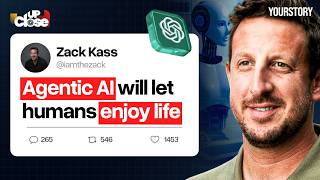
Zack Kass, an AI thought leader, discusses how AI is reshaping jobs and industries. He breaks down the phases of AI development and weighs the ethical questions that come with it.
Chapters
Is AI going to become a creature or is it a tool? And then giving humans an identity in an online world where you don't know who is a bot, who's a human. So what are your views on that?
I think that identity is important in a world where it becomes easier to masquerade as someone and that there is going to be incredible amounts of technology invested in making sure that you are you based on your voice and your biometrics.
But there are of course, a lot of people who look at it differently, who are afraid of AI, and there is obviously a lot of talk about how it will influence jobs.
I think it's very misguided. When we introduce new technologies, the world gets better on an economic basis. For many people who are now economically benefited, the loss of their identity as a result of the change in their job causes exceptional emotional harm.
Welcome to a brand new episode of Up Close, where we have a very special guest with us today. And I'm excited to be chatting with Zach Kass, who is of course, an AI thought leader and authority on applied AI and a futurist. Now, we all know, of course, that the past two years to 18 months, there's a lot of buzz around AI and it is all the rage, more so with popular tools such as Chat GPT now out in the market. So who better to get Up Close with than Zach, who also most recently served as OpenAI's head of Go to Market and was responsible for their business partnership. So great to have you on the show, Zach.
Good to be here. Thanks for having me.
My first question to you, of course, now you've been in this domain of AI and machine learning for close to 15 years now, essentially worked in this space much earlier than it mattered to the rest of the world.
So.
So you've seen the transition from statistical machine learning to neural networks with, of course, as you said, you know, the transformer being the groundbreaking architecture there. Tell us a bit about this evolution to AI as we see it now. How did we get here to the GPT era?
Well, I would start by saying I think that AI mattered to the world before we realized that it did. So I think the important distinction here is that we now live in a world where AI is far more accessible than it ever was and it is easier for people to actually appreciate what it can do because previously it was sort of controlled in environments where it had a profound impact on our life in demand. Forecasting, serving ads, planning businesses. But it was pretty limited to a select few. And that concentration of power had Some profound impacts. The distribution of this technology now is, I think, what we're starting to see. The democratization of it is, I think, a very exciting advent that gives everyone a chance to realize, okay, this is, in fact, exceptional technology. It's almost indescribable. I've become more religious in the last 10 years, in part because I'm more committed to community than ever. And I moved home to Santa Barbara, where I grew up, to spend more time with my friends and family, but also because it does strike you, if you stare at this long enough, that we really are very early in the human experience and that we have so far to go, and that, in fact, you sort of connect with this prehistoric version of yourself, which is staring at the stars with incredible amounts of wonder. Because the transformer is exciting, for sure, but we can assume that it's not the last AI architecture. And in fact, quite arguably, it's like, you know, the first. And, you know, this sort of presents the, you know, the question that I guess is impossible to answer now, which is, where are we on the human experience? And the advent of AI? The speed at which this has moved suggests that we're just very early.
Let me talk to you about, you know, your sort of experience and time and work at OpenAI and how that sort of shaped your deeper understanding of AI's potential scale and impact on business.
So when I started in AI, which is now almost 16 years ago, as you mentioned, statistical machine learning was the prevailing science. It worked if you had exceptional amounts of money and exceptional amounts of data, which is why Amazon, Facebook, Google, a few others could harness it and do incredible things with it. And so we knew it was possible. What we could not figure out was how we could make it better and less expensive, how we could improve the commercial viability. And OpenAI, among many other things, taught me what happens when you build commercial, viable technology. What's particularly interesting about OpenAI, in terms of the lessons I learn, and I remind everyone of this, is that we built GPT3 in 2020, and we built GPT 3.5 in 2021. And by any arguable measure, GPT 3.5 was much better than GPT3 in a way that I thought was going to ignite the world around AI. But it didn't. And in fact, it was almost more muted than GPT3 because people were like, oh, this is it. Whereas GPT3 was at least exciting for the scientific community. 3.5, I think, felt to people like, oh, what have you done for me lately? In Actuality, when we built ChatGPT, it was built on GPT 3.5. It was a, it was if it was a fine tuned GPT 3.5 model aligned slightly to dialog. And the fascinating thing about this is it is the reminder that the application layer matters, that the science alone is not what is interesting. And so what we started to, then what I started to explore is this idea that the business applications are not actually maybe the hardest part, that the impact that AI will have on businesses is of course tremendous. But we mentioned this earlier, the hard part is going to be how can businesses actually figure out how to adapt these things to the technologies that they currently have, the debt that they have accrued as a result of simply operating in a world without this technology. And so the obvious answer now is in a world of sort of unmetered intelligence where AI is getting very good and very inexpensive, how is a business constrained on an intelligence basis? What would it do if it could, if it had a million smart people? And that's an interesting question to ask, but it's just as interesting to say, what does a business have to update in order to be able to harness this technology? And so I got to spend time at OpenAI staring at these two problems, staring at both. Okay, here are all the cool things you can do with this technology and here are all the ways that your business will actually have to fundamentally change in order to make use of this. And that's why we do what we do today, which is building a research and advisory firm to actually help the world organize this change in paradigm.
Where are we on the evolution of AI? What phase is it? Just the tip of the iceberg. What else do we have left?
So phase one, the phase that we are in today is what we call the enhanced application phase. And it's easy to understand because we've basically taken the world we live in, the app world, where your phone and your computer have applications and we've injected AI into them to make them better. And the productivity gains are about 20 to 40% we think, which is great. I mean, that's, that's going to have a profound impact on the world and economies, but it doesn't take full advantage of what AI can do. And the next phase that we're moving towards is the agent of AI phase. And the agenda AI phase will be marked by a world where we assign tasks and goals to AI agents and they execute those tasks and goals across applications. And whereas I think the enhanced application phase will actually flame out pretty quickly because agentive AI is going to be so much more productive. Agent of AI will stick around for a while because among other things, it actually is necessary to have a massive hardware change before we enter phase three. And so you can imagine a world where for the, for maybe the next, you know, from 2027 to 2035 or a little bit thereafter, we continue to carry our devices like our computers and our phones. We just don't go into our apps and our web experiences as much as Right, because we can tell our devices what we want it to do. And then that leads us to the. To the natural language operating system. In that phase, you have to squint out a little. But I describe it to my mom in a very simple way, which is I think we will go from carrying our devices to wearing them. So we will put our phones and our laptops in a cabinet for the final time, and we will probably put on a pair of glasses or a watch or an earpiece. And the other way that it will change is we will stop having to learn how to use machines. Machines will be self evident, and we will enter a world where machines know how we want them to communicate with us and vice versa, which will massively reduce and probably obliterate the digital divide. Right. This idea that many people in the global economy cannot participate, not just because they don't have skills to do so, but because they don't know how machines work. Right. They can't actually harness the technology that's necessary to participate in the digital economy. And I think the natural language operating system will be this incredible new equalizer on the global playing field because it will allow everyone then to sort of participate in the economy, to take a.
Step back on where you are. You know, you were head of go to market at OpenAI at a very exciting juncture, you know, in big tech. Why did you decide to move on? You're now traveling the world speaking to people, speaking to enterprises. What made you make that switch and what brings you to India?
The switch was driven largely by a desire to want to be in Santa Barbara. So I grew up in my hometown and I spent a bunch of time telling people that AI would drive us to a world where we could work less. Especially in this gentic AI phase, productivity will continue to improve. And so in a world where we work less, what will we do? We might recreate more. And I said, okay, so everyone should just pursue their passions. Well, my passion is time with friends and family. So I said, I want to move home. So I moved home and then decided, okay, I'LL solve the rest from there and started supporting companies with this problem that I was describing, which is not what can the technology do, but what is required of your company to actually make use of it. And those rules are going to shift a lot, especially as we enter this next phase, this agentic AI phase. And so the work we do now is actually supporting large organizations, Fortune 1000 companies and governments with research and advisory and consulting services to, to explore the question of what happens next and how do you make sense of it, which it turns out is something that we are all interested in, be it your listeners, my mom, you know, the Fortune, Fortune 1000 CEOs. And so I'm in India meeting with one of our large clients, an Indian financial services company who is going about a pretty massive digital transformation and now exploring what in fact it means to make AI sort of the centerpiece of it.
Great. Now, how do you believe India as a country should look at AI? Because we are a very diverse country. We do have a huge unorganized sector on one side as well, multiple languages, and we have a whole host of startups working in the AI domain. But we do have our tech thought leaders giving us the opinion and the advice that instead of going after, you know, building these large language models and our own indigenous LLMs, India as a country should focus on being the global leader in use cases, AI use cases, and actually, you know, real world applications, practical solutions, driving innovation. Do you agree to this? What is your view?
Yeah, I agree with this. I think I have two. I have two beliefs that I hold pretty firmly that support this theory. The first is that the research will commoditize. I think that the race to build AGI, the superintelligence itself, is not actually where that prize is shared. The prize that may not be shared is actually the distribution of the technology, the application itself. And I mentioned this with my lesson learned. ChatGPT was built on a software. It was built on research that had been out for six months. So the first great enhanced and enhanced application but had been on the market was powered by a technology that had been on the market for six months. No one else built with it. It's just this reminder that the application layer matters. And so if India is focused on the application layer, it may find itself winning the biggest prizes, which is actual distribution of the technology. And then my message to the Indian government, to Modi himself would be, we should actually be considering the importance of adoption. It is not sufficient to say India will build the software that is necessary to power India. It is actually necessary to say India will adopt. India will be the preeminent adoption leader in the world in AI, such that our small medium businesses and our enterprises are supercharged by this technology. That, to me, I think, is how India will truly supercharge the economy.
Right now. Looking at what we have been exposed to so far and the applications out there, a lot of it, of course, is around generative AI. Tell us a little bit more about the other forms and applications of AI, specifically in the B2B space as well, and some of the most successful users of AI in certain fields.
So you won't hear me use the term generative AI and I don't know why this is true, but OpenAI never used it and you won't actually hear OpenAI ever use it unless something dramatic changes. It's just not a term that's used and it's actually not a term that's used in the industry. So if you go to neurIPS, the largest ML conference in the world, you actually don't hear any scientists using the term gen AI. And it's simply a reminder that generative AI is actually a marketing term that was created to help people make sense of what was happening. But in fact we're simply talking about an AI architecture, the transformer that is expanding what is possible. And the easy way that I try to describe this to people, in the way I would describe it to my mom or the CEO of a Fortune 1000 company, is we are building machines that have human intellectual equivalence and that AI is capable of doing that more and more from a robotic standpoint, from a knowledge work standpoint, etc. And the paradigm now is no longer a question of will AI be able to smell as well as you, it's when. And so the industries that are adopting this technology today are basically doing so with like the current framework in mind. How do we take text and turn it into more text? Right, so obvious implications here are in financial services, education worlds that are basically text based. And there are incredible implications already. But we are starting to see as the technology improves, video, speech, image, that more and more industries are saying, oh, in fact this does have an implication on me. And one of my favorites right now is everyone points at the knowledge work industries, professional services in particular, and says, look at all the incredible change and automation happening here. And I am particularly fascinated by traditional industry right now because it is in traditional industry where we feel so much pain in the cost of the goods and service. And healthcare in particular is my favorite. And we are already starting to see AI have a massive, massive change in how healthcare works. And when anyone talks to me about this AI winter, the false dawn, I remind them that first of all, AI is being used today to make incredible improvements in bio and life sciences research. Already. Already the industry is teeming with excitement. We discovered our first antibiotic in 60 years a year ago, basically today, because of AI, in March this year, researchers removed HIV from DNA. So we split HIV out of DNA. We have therapy that can do it thanks to AI. It's very expensive. And because we've gotten so good at treating hiv, it's not, as, you know, it's not as important to the world, but it is possible now. And bio and life sciences implications are just beginning. And we were finding more targets. We are building more molecules, we are folding proteins, it is coming. And then you apply to that the fact that AI is going to have a massive improvement in patient care itself. The number of primary care physicians in India pales in comparison to the number of people who need primary care. So India has two options. It can either tomorrow print a bunch of new doctors, which is not possible because doctors take many years to train, or it can find ways to create more scale in the doctors. And that's what this next wave of the AI models are able to do, which is they are exceptionally good at speech, speech to text and text to speech. Lowering language barriers and massively improving productivity for people who spend time in an environment like this. Think about if you're a doctor, if you're a primary care physician and you can now record your conversation with your patient, send follow up notes to your patient 20 minutes after their meeting. With next steps and scheduling automated, suddenly, you can now see twice as many patients in the day. And so the, the implications on traditional industry are here. They are here. And it's just now a matter of, as we mentioned earlier, creating systems that actually allow for the adoption of it. And some of that's on a regulatory basis, which I'm sure we'll talk about in a second. And some of that's actually just on a human change basis. How do we help people realize how important it is to our experience as humans that we figure out how to make ourselves more productive?
But we did of course mention the cost as well at some point and that really is a grouse for many. I want to talk about some of the challenges that you actually face in helping these large enterprises adapt and thrive to this whole AI change process. What are the challenges you face there? Because it is a novel technology. Cost is a Big factor. How far are we from AI actually becoming more accessible and cost efficient, more consumer facing AI like we have, you know, the Internet and the mobile on our fingertips.
I think that AI has become more accessible faster than basically any technology ever. I mean, the rate at which the costs are declining now in these models is remarkable. GPT4 was $60 per million tokens when we launched it. Today it's less than $3. That is a, that is an exceptional order of magnitude decline and that's cost. That is equivalent for GPT4 models. Right? So this is true for Claude, this is true for Gemini, this is true for llama 3.1. We've just made these models exceptionally cheap to run, which is why I don't actually see cost being an issue with the enterprise anymore. And for the most part I actually think that AI has become exceptionally accessible to most people in the world. It's true that GPT4 or ChatGPT costs $20 a month, at least in the United States. But it's also true that GPT 3.5 or standard ChatGPT is free and very good. Very good. Internet didn't get this cheap anywhere this quickly. And frankly, the idea that the Internet won't be more expensive than AI in a couple years is also something I just disagree with. My prediction is that this, eventually it already has started to commoditize and that it truly commoditizes, that it almost utilitizes to the point where we treat it like a water bill. Most people don't think about it, they just pay for it in small increments on a monthly basis as they contribute to their, their SaaS providers or their agent providers.
You know, how many years would it take for the cost of AI to come much further down, say like, you know, 70% lower than what it is currently.
I mean, GPT3 when it came out was $14 per million tokens. Today it's, I think it's less than a cent per million tokens. Moore's law is dead. We have broken Moore's law. These machines are much faster and much less expensive than traditionally considered possible. The architecture is improving and in fact, I think it's not long before GPT4 equivalent models run locally on the device. I think it's very likely that we have edge compute for GPT4 equivalent models pretty soon, which basically makes them tax free. And then all you need to pay for is the cost of the to power the battery and the cost of the device itself.
Right? So you know, you're essentially now in this new position and role. Also looking at the socio economic impact of AI, and today, there's nothing that AI will not impact. But there are of course, a lot of people who look at it differently, who are afraid of AI, and there is obviously a lot of talk about how it will influence jobs. So what is your sense of that?
So when I, if I were to ask you or your listeners, you know, are you concerned about job automation? Are you concerned about the effects that AI may have on work? The answer would almost certainly be yes. And the answer would be yes. And if I said why, the answer to that would almost certainly be the economic consequences, right? There's a bunch of consternation about if we automate work, what will we do for jobs and therefore, what will we do for money? And therefore how will we put food on the table? And my response to this is I think it's very misguided. I think it's very dangerous to fixate on the economic consequences of AI because there's a ton of evidence, mostly historical, but also current, that suggests that industrial revolutions have a profoundly positive economic impact on the world. Universally, empirically, when we introduce new technologies, the world gets better on an economic basis, right? Wages often go up, but even if they don't purchase power does because deflation occurs. Jobs get safer, jobs almost certainly, almost get more plentiful, right? The global unemployment rate continues to fall. But there is something that also happens during industrial revolutions, which is that there is a period of discontent following them, because for many people who are now economically benefited, the loss of their identity as a result of the change in their job causes exceptional emotional harm. And despite someone feeling like they can observe that there's more and better food on the table, they feel a sense of loss that they cannot overcome. And so this net harm, the emotional aggrievement, is the problem. And when we talk about the risk of job automation, when I talk to companies and governments about this, what I emphasize is the risk of identity displacement. It's the world in which our work is changing so much and so frequently that it will be very hard for anyone, anyone in this room to consistently say, this is what I do. I specialize in this thing. Because that thing will change such that even if we wake up tomorrow feeling much wealthier than we do today because the cost of goods and services have come down, we may simply feel hurt that the thing that we have, you know, aspired to our whole life is now no longer a possibility, right? In America, we call this the American iDream and the American iDream is not actually an economic idea. It's an emotional one. And this is the hard part, because I don't think there is an obvious answer to this. I mean, the panacea is one in where we don't actually assign too much of our purpose to our work. Right. The true panacea, which, you know, given that we're in India, is a far more Buddhist take on the world, which is that actually, you know, your. Your enlightenment doesn't come through hard work. It actually comes through no self. Yeah. Sacrifice and simply being with yourself. The Judeo Christian world views it slightly differently. Right. We are fixated on how much we can work to achieve some. Some greater outcome. But I. But I think that there is something truly remarkable about this idea that the hard part really will be emotional.
Yeah. And it'll be interesting to see what humans really do with this existential crisis that they're faced with, you know, so we'll come back to that in a bit. I want to also talk about the current, you know, big update we spoke about, Agent of AI, which we're sort of getting into that phase now. How different is it from the traditional AI systems right now in terms of autonomy, in terms of decision making, goal setting? You know, like, probably how scary is it now? Because we're seeing SaaS companies, traditional SaaS companies, now becoming AI first. They're launching Outcome as a service, in a sense.
Some of that's marketing speak. Technology always serves good actors and almost always serves good outcomes. The reason for this is that there are more good actors in the world and they are better resourced and agent of AI, you know, for all the things that could. For all the weird things that could happen. Right. Imagine a world where it is very easy for someone to do something bad and you could sort of imagine what that bad thing might be. It is just as easy for a good actor to stop that person from doing something bad because we now have access to this incredible technology. I am, I welcome agent of AI. Today I spent two hours doing mundane work that just didn't serve me or my clients or my brain. It wasn't interesting work. It's just work that has to get done. And most of it was just moving information from one place to another because the information lives disparately. When machines can do that, I will use that time to read or rest or talk to my wife or explore India. I would love to have been walking around outside during this time. I think most people are in this boat. I think most people will welcome a newfound time in their day, as long as they can relieve themselves of this idea that they are somehow losing something because they no longer do this task. By the way, a lot of people hate the task that AI promises to automate and still finds, incredibly, an incredible amount of upset that they won't have to do it anymore because it's this loss of this identity in the work they do. Yeah.
When you flip it that way, you know, it.
We study the autonomous vehicle, and the autonomous vehicle, I think, is this remarkable thing, because, you know, when you ask Americans, do you like your commute? Yeah. None. None. True. I mean, there are some, and they live in a suburban area, and they drive 10 minutes to their office, and they talk about how they get to drop their child off at school, and it's this time to listen to a podcast and reflect. Everyone else hates it, but when you talk about autonomous vehicles, people talk about losing freedom. Yeah, no, that's. That's un American. Cars are important to America. It's. It gives me freedom. But you just said you hate your commute. What if you could do something else while you do it, while you. While you go to work? And Elon is pressing the world to reconsider if a car is meant to be driven at all. And, of course, it comes with incredible backlash for reasons that we can talk about, but it is a really remarkable thing to consider that a lot of the things that we hold near and dear are things we actually deeply resent.
Yeah. So coming to the trajectory, then, of how AI is evolving, the AGI phase as well, the artificial general intelligence, where we're looking at AI perform on par or surpass human potential. How far are we from achieving AGI?
I think AGI arrives in 2030, maybe by 2030, maybe 2029. I picked 2020. For the record, I picked 2027 while I was at OpenAI. It still feels possible, but when I say 2027, then people sort of freak out. And the reason that I started giving a more conservative number is the following, which is AGI is so loosely defined that it is mostly a sound bite. Right. It is mostly a thing that people use to describe some outcome that will be probably very hard to measure scientifically, but not very hard to measure societally. And so what I mean by that is the indicators of AGI will be certainly deflation and novel scientific enhancements, novel scientific discoveries. We may wake up one day, having debated forever if we've achieved AGI, to realize that we've cured cancer, cured neurodegenerative disease, and the cost of goods and services have come down 60% in industries that are not heavily regulated. Now, I use that asterisk because regulation is one of these incredible forces of cost inflation. But to the extent that we allow the markets to sort of behave, we may wake up one day and realize that it's actually very, very inexpensive to do most things. And that may actually just be the point where we say, okay, we probably achieved AGI. I'm sure there will be an incredible amount of hubbaloo, hubbabaloo about whether or not we've arrived there. I mean, people will write extensive long papers and lots of tests and who knows? But critically, I think we are very close to a world where we start making fast major scientific discoveries and meaningfully reduce the cost of goods and services.
Right? So that also brings me to the question of the ethical considerations and how much we should prioritize that. Because as AI of course gets more autonomous, there is a lot of concern about misinformation, about deep thought fakes, about personal data and information. So how do we arrive at systems that really align with human interests and values?
Okay, so I mean, there's so much here. First I will say I think there are so many laws in the world that govern how you and I can behave and how companies can behave. I don't think we need many more laws. I will start by saying that I think there's this innate interest in the government to quickly pass policy on things that feel new, when in fact the rules around which we operate are pretty clear. And things like drones introduced questions around like, you know airspace, you know, what can you do in a shared space. But the reality is we're pretty clear on how we should all behave in society. What AI introduces that does feel new are three things. The first is alignment. We have to pass standards by which everyone agrees a model meets when it comes to whether or not it can understand the consequences of its actions vis a vis the human experience that matters. That is a novel concept that should be policyd. And there are tons of ethical concerns around how we do it right and how we policy it right. The second is explainability. It is critical that we build models and that we use models that meet explainability standards, meaning they can explain how they arrived at a decision when those decisions have life threatening or critical outcomes. Home mortgage, brain surgery, pick a thing. High impact decisions should be very explainable because if they aren't, we will live in a black box world that could unravel pretty quickly and cause an incredible amount of distrust. And the third is Bad acting. And so this goes to deepfake and misinformation. There are rules around what you can and cannot do in the media. There are standards by which media companies are held, and there are standards, quite honestly, by which individuals are held. How you can represent yourself, how you can represent information. Passing a bunch of new standards may not be important. What is important is enforcing bad acting very punitively when AI is involved. And so what I mean by that is simply, in a world where we don't let media companies lie, you're held to standards by a regulatory body. It becomes imperative that we actually start saying to everyone who is held to these standards, if you use AI to do bad things, we will take extra special measures to penalize you. And there are lots of examples in the world for this. Obviously the extreme examples are if you're, you know, if you're a bad actor caught with uranium or plutonium, you're treated like a terrorist, right? This is one of these things where we say we don't even, we don't even want you to think about building a bomb. So we're just going to arrest you as soon as you have the means to do so. And my point is simply now, instead of fixating on all the things that AI could break, simply decide that those who do bad things with it will be punished. And that way we get out in front of the ways in which AI may or may not be misused and actually simply say, it is more dangerous now to be a bad actor than ever before, especially if you are trying to harness this powerful technology.
Right? So who really is held accountable then? Is it the individuals? Is it the developer? And how have you seen the regulatory landscape evolving? Are we looking at international cross border government collaborations? What sort of frameworks are out there at the moment?
First, I think that the idea that we will have some big international standard is lofty, but probably not likely, right? I mean, for all sorts of reasons, it seems very unlikely that a bunch of nations tomorrow are going to get together and say, this is our clear standard for AI alignment, at least at, you know, they don't tear down shortly thereafter. It is very important, therefore, that I think that we start to arrive at directional understanding. And so instead of saying, you know, this is the ISO or the, you know, international standard for something that the regulatory bodies in financial services globally say, this is what explainability looks like, right? Or this is what alignment looks like. And we are starting to see this at these major conferences where the industry itself is actually starting to form ideas around what alignment standards look like and what explainability standards look like. And that's critical because in a world where we make fun of policymakers and regulators for moving too quickly around things they don't know anything about, the industry ought to tell them what to do here. And so I think it is incumbent on the industry, on the experts in the industry to actually help people understand what alignment is, what explainability is.
Now, there is, of course, this debate about humanizing AI right, by giving it a conscience. Do you think that is something that is out there or a possibility in the future?
I think that humans have long assigned metaphysical and spiritual properties to technology that we don't understand. And I think it's actually quite simple that maybe AI will just be a tool. Humans are unique. We have souls, we have. We have experiences that are sort of indescribable, metaphysical, truly spiritual that AI probably will never have. And that's fine, right?
So there's this, you know, like, is AI going to become a creature or is it a tool? And then there is this whole call for human protocol. We've got Sam Altman also building this, you know, crypto coin world where it is all about giving humans an identity in an online world where you don't know who is a bot, who is a human. So what are your views on that?
I think it makes a lot of sense. My position on this is that we should probably use something like blockchain to create a ledger of truth. I am less fixated on this idea of who is human. I think that identity is important in a world where it becomes easier to masquerade as someone and that there is going to be incredible amounts of technology invested in making sure that you are you, based on your voice and your biometrics. That seems very valuable and very reasonable. And that's a great way to use AI to combat deepfakes and misinformation such that when you're, you know, you call a friend, they don't have to wonder if it's you or someone spoofing your voice. Totally valuable. Whether or not, you know, proof of human, proof of humanity is actually. It will feel dystopian if we've arrived at that place. I think. And I. And I'd rather we not. My optimism is simply rooted in the fact that the world gets better all the time. And if you. You don't have to look very far to find incredible evidence that in fact the humans are good, that we are aligned, and that we continue to move forward because that's how the human experience has worked. And the onus is on someone to prove that in fact, we are at the peak of civilization, because the thousands, tens of thousands, hundreds of thousands of years prior to suggest quite the opposite, that in fact, we are just beginning an exceptional ascent into something much greater. And so I just use historical precedent. I'm also an optimistic person, but it seems very evident to me at this point that people come out. More people come out of poverty every day than basically ever before, and that rate will continue to improve. And my expectation, as for the predictions, is that we live in a world that is almost unrecognizable in 50 years, right? Where if I said to you today we'll cure cancer, you'd you sort of laugh at me, but I think we will. Or neurodegenerative disease, or if I said everyone will have access to exceptional education, exceptional healthcare. These are laughable ideas because we consider these things luxuries. But I will remind everyone that at some point on Earth, everything we experience today was considered an unfathomable luxury, and we now treat them all as staples.
Thanks so much for coming, Zach.
More from Zack



Anchor Your Mission, Adapt Your Methods: Thriving in an AI-Driven World (w/ Zack Kass)

AI Will Change Your Life Faster Than You Think, According to Former OpenAI Exec Zack Kass