Doomers, Gloomers, Bloomers, and Zoomers - Zack Kass Interview, DeepSeek Hype, EU AI Act
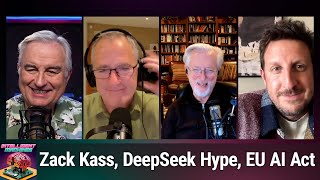
In this inaugural episode of the rebranded "Intelligent Machines" podcast, hosts Leo Laporte, Jeff Jarvis, and guest Mike Elgin (joined by occasional input from Zack Kass) discuss a wide range of technology‑related topics. They begin with a sharp critique of cryptocurrency, labeling Bitcoin as a speculative Ponzi scheme and highlighting the failure of El Salvador’s Bitcoin legal‑tender experiment, including the 92% non‑usage statistic and recent legislative rollback. The conversation shifts to market dynamics, describing Tesla as a political meme stock and noting its volatile share‑price moves despite weak fundamentals. Mike then reviews the DJI Flip drone, emphasizing its AI‑driven, hands‑free operation and affordability for creators. The hosts explore the emerging field of AI‑driven marketing agents, predicting a future where brands train AI agents to favor their products and where API‑based marketing replaces traditional ads. They debate a controversial open letter signed by 112 public figures warning about potential AI consciousness, expressing skepticism about its seriousness. A California legislative proposal that would require AI chatbots to be labeled as non‑human, likened to cigarette warning labels, is also examined. The segment introduces "Chatterbox," a privacy‑first smart speaker for kids that runs on user‑written code and integrates multiple AI services. The episode concludes with personal anecdotes, a wrap‑up of the show’s community‑funded model (Club Twit), and teasers for upcoming content. Throughout, the tone oscillates between conversational and analytical, with a generally critical but occasionally enthusiastic stance toward the technologies discussed.
Chapters
It's time for Intelligent Machines, a brand new show. Well, it's the same old show, really. We've rebranded. This week in Google. We're going to cover AI and we've got some interesting stuff to talk about, including Zach Kass, who was the head of Go to market for OpenAI for a couple of years. He is, by his admission, an AI accelerationist. We'll also talk about the latest AI news. Mike Elgin will be filling in for Paris Martineau. Jeff Jarvis is here. Episode 1 and episode 805 of Intelligent Machines is next. Podcasts you love from people you trust. This is TWiT. This is Intelligent Machines, episode 805, recorded Wednesday, February 5, 2025. Doomers, gloomers, bloomers and zoomers. Well, hello everybody, and welcome to a brand new show that's the same old show this week in Google, now renamed Intelligent Machines. And let me fill you in a little bit before we introduce our guest and our panelists for the show today. The show is still going to have Paris Martineau and Jeff Jarvis. We're obviously going to continue being as silly as we ever are, but what we're going to try to do is get. Get you some expert information about this rapidly changing world of AI. So every week we're going to start the show with an expert of one form or another. Then we'll talk about AI news, and after that, everything will descend into chaos and become just the same old show it ever was. Jeff Jarvis is here, professor emeritus of journalistic innovation at the Craig Newmark Graduate School of Journalism at the City University of New York, now at Montclair State University and SUNY Stony Brook. Hi, Jeff.
Hello, boss.
Welcome to Intelligent.
I am in.
You are what?
We're in.
O M. I am. He has a shorter name. I think it's simpler.
They always start off with the I'ms I'm.
It is Paris's birthday, so she has decided to have a fine meal instead of joining us today. But that's okay because guess who's with us? Mike Elgin. He's in Sicily right now with his Gastro Nomad Adventures Machinesociety. AI is his newsletter, so covers AI, so it's a perfect person to have on. Thank you for being here.
Yeah, it's great to see you.
Thank you, Leo.
Glad to be here. Glad to be here on this big change.
I think it's, it's auspicious.
Long overdue.
Well, you, you know, you were a regular on this Week in Google, but that was back in the days of Google plus.
Yes, yes, Old enough to remember times.
Have changed just a little bit. So I think really, AI is probably the most important thing to happen in technology. You could say at least since the Internet or the advent of the personal computer. But I would say maybe even more than that, more like since the Industrial Revolution or the invention of the printing press. Jeff Jarvis Anyway, it's a very exciting area. It's changing like crazy and it's very difficult to understand. Even people working in it, I think, sometimes are puzzled by how AI works. So we're going to bring people on who are working in AI. In fact, next month, the person who coined the term intelligent machines, Ray Kurzweil, will join us. I've interviewed him several times in the past, and I'm very curious what he thinks. He's been saying the singularity was just around the corner, but now that it really feels like it might be. I can't wait to see what Ray has to say. Today we've got the former head of Go to market for OpenAI. Zach Kass worked at OpenAI from 2021 to 2023. It's great to have you. He currently talks to groups and consults with industry about AI and the change that is a coming. Hi, Zach.
How are you?
It's great to have you. Why did you leave OpenAI? Just out of curiosity.
It's not a story that I used to tell very often, but my parents got sick.
Oh, I'm sorry.
No, it's okay.
I'm more willing to tell it now than ever. You can decide if you want to keep it in here. But it occurred to me that I kept talking about this future of abundance and the increasing importance of being human and community, and I wasn't actually honoring my ultimate code and then said, okay, I'm going to. I grew up in Santa Barbara, by the way. So moving home also.
You went home, basically, Yeah, I went.
Home for some other compelling reasons. So I moved home and my parents are okay now, which is great.
Oh, that's fantastic news.
Wonderful.
Yeah, yeah, yeah. The story ends well. And I met my now wife.
Oh, even better.
Yeah.
So it's.
I mean, you don't have time to have a wife when you're head of Go to Market at opening, I would guess wives. What's that? Life. What's that? Why did you. Maybe a better question would be, why did you join OpenAI?
Well, I don't think I could have come up with a reason not to. So many of my friends thought it was a head scratcher because it didn't have a thing to sell. At the time, the GPT3 had maybe $2 million in revenue. @ the.
Time. It was really early in the.
Public. We had just released GPT3. We had just released GPT3. Peter Wellander, the head of applied, the VP of applied, pinged my old boss, Lucas Biewald, now the CEO of Weights and Biases, and Lucas said, listen, there's one guy who's ever sold large language models successfully that I know of, and it's this guy. And they introduced me, and so the rest is history. I would have swept the floors. I sort of knew. I mean, I didn't sort of knew. I knew what was going on. So when people are like, why did you join? I was like, how could I have. How could I have not joined? I probably would have done that job for.
Free. You have said, would you call yourself an AI accelerationist? You've said, AI, as I just said at the beginning of the show, is the most significant invention ever.
Practically. I think it's probably fair to label me an accelerationist. I mean, if I'm not willing to call myself that, then I don't think I'm willing to stand by my belief that I studied history at Berkeley. And if you study history, you realize that the world just gets better all the time. And then if you study computer science, you figure out why and, you know, all of the reasons that we should be worried about.
Technology. I.
Get. But, like, it is true that technology is the single thing that consistently moves the world forward. And, you know, I certainly believe in its power to continue doing.
So. So Reid Hoffman's new book, just out, he starts off with a taxonomy of AI thinking there's doomers, gloomers, Bloomers, and, oh, hell, what's the fourth? So doomers are the people who think it's going to destroy us all. Gloomers are the ones who say, don't forget about environment and all this stuff, you bozos. Oh, Zoomers are accelerationists. And Bloomers, which is Reid, is people who do think there's some concerns and some controls, but the benefits are going to be great and let's plan them and see them grow. So in that taxonomy, Zach, where would you put yourself? Zoomer or.
Bloomer? Here's my issue with Bloom. So here's my issue with these things. Obviously, no Zoomer, unless they're a psychopath, is like, just disregard humanity, right? So I think, like, it's a nice taxonomy because it's, like, evenly divided. But like, in reality, you know, Reid puts himself exactly where everyone would want to.
Be. Yes, I'm a little bit of all of the above, depending on my mindset at the moment. Sometimes I'm a doomer, sometimes I'm a psychotic zoomer. You know, I feel like, let's just let it. You do go back and forth. Let's just let it go and see what happens. You think that's a nutty point of view.
Zach? No, but what I'm going to say here is, like, someone like Reid has sort of. I have a lot of respect for Reid for obvious reasons, but Reid has, like, taken some pretty strong positions in the past on things like, for example, Donald Trump and said, like, this is a person who's going to make the world worse. And I actually don't give enough credit to politicians anymore of robust economies to actually make the world worse. I think that the problem now is can we get ourselves out of a lot of situations that I think technology can solve for? What I mean by this is the easy thing to say is I'm a bloomer. And what we should do is just carefully manage AI. But that just introduces a bunch of excuses for special interest and puts us in a new set of issues around policy. And the EU is going to experience this very soon. I also don't think we should run rampant with this thing. There should be some policy. But I think it's so easy to say we need to control for all these things when in actuality we are fast approaching a world where I think the free market ends up solving so many problems that the government promised to solve a long time ago. And that's just going to be one of these weird things where people wake up and go, wait a second, why do I. Why do I pay 50% into a system that's actually just gatekeeping, abundant education, abundant health care, et.
Cetera? So you. So you believe that AI is going to solve these problems? Not just the free market, but AI itself is going to solve these.
Problems? I think that technology solves problems. I think that if you look back long enough, you realize that almost every problem that we've ever faced is not solved by, oh, policy, but in fact solved by innovation. What actually ends up happening is we just invent tools that make us more efficient. And then over time, these tools make what used to be a luxury a commodity. And then the world just gets better. Driving down the cost of water, driving down the cost of food, driving down the cost of the Internet, driving down the cost of electricity. These are the actual things that move the world forward. The lower the inference cost gets on AI, the more abundant AI gets and basically the, the more distributed it gets. And that's my take on broadly technology. Fusion energy is like I think the great unlock to world peace, quite honestly. Like abundant energy leads to abundant foodstuffs, leads to abundant water, leads to just like suddenly people are like, why are we fighting? Like we live in a, we live in truly a post scarcity world. This is how the world works. By the way, I don't think this is like a super hot.
Take. Don't you worry a little bit though about the dangers of AI? Are you not worried about that at all? We talked last yesterday, Steve Gibson did a whole show on AI jailbreaking and there's not an AI out there currently that hasn't been jailbroken. Which means there's not an AI that hasn't been used to for instance create malware or his example. I said, well what, so what? So big deal. His example is, well, what if you were able to use an AI to create a toxin that we never heard of before? We had no, you can't anticipate.
Every possible bad thing and more importantly you can imagine to.
Use. We're stuck with you cannot protect. Yeah, there's no AI. Safety is an illusion. It seems to be, you agree for the printing.
Press. So again, I think it is very easy for people to point at these like outlier events that could be caused by technology. And for every outlier event that technology can cause, there's a solution to that event that technology will create. Measures and countermeasures is this proud tradition that AI will observe just like every other technology. Just the same way that the cost of an attack on a bank has just declined every year because banks are like, oh, we figured it out, we know how to stop these things now and we know how to make sure that we don't get taken for a bunch of money. The reality here is for every toxin that's going to be created, someone's going to come up with an anecdote to that.
Toxin. Well, they will, only if the incentives are there to do so. So if you think about the application of algorithms and AI to social media, for example, you have a situation where the millions of people who were completely captured by tick tock and, and you know, they rearrange their lives around it. There are other examples that are sort of outside of AI, like video gaming. There are people who literally video play video games until they die, oftentimes in Asia, just completely captured by these things. And this would be solvable by technology for sure. But there Are no incentives for the.
Companies. There's no financial. Actually.
Yeah. Solve those problems, because it's not a problem for them. It's not a problem for Meta that people are addicted to its social networks. See what I'm saying? So this is a problem that we have with incentives. I mean, I think it's reasonable to say that advanced technologies and probably AI is another example, generally, as a category, make a lot of things worse and a lot of things better at the same time. And it's all about the incentives to make things better. If, if we can, if, if we. We profit or we benefit from people's lives being kind of messed up, then their lives are going to be messed.
Up. Yeah. Again, I'm just going to take the other side of this, which is like, if you could reinvent the Internet, uninvent the Internet, you wouldn't. Social media is one of these blights of the Internet, but it's a social experiment. And what's, I think, fascinating about all these things, if you had looked at the United States in 1950, your safe assumption would have been that we all were gonna die of alcohol.
Poisoning.
Yeah. And people have such incredible recency bias. They're willing to look at social media and be like, there's never been anything worse to humanity. And by the way, I think it's an incredible blight. I don't use social media. I have someone on my team do LinkedIn and Twitter for me. Fine, It's a cost of doing business for me. But the reality is, what we know is that it doesn't make us happier. And humans actually default back to our happiness function. This is why you're seeing an entire generation, despite the. Every alcohol company wants to sell you alcohol, Mike. There's a new generation behind you that's like, hey, I don't want to drink that much. And you're going to see this with social media. For every measure, there's a countermeasure and things revert back to the mean. And my point is simply, let's create optionality. Let's create a world where people can do whatever they want and actually trust that people, in the end, sort of align to their own best interest, which actually, it turns out, is time with friends and family and physical community. And we keep coming back to that place, which is why we're creating more and more better alternatives to the Internet all the time. Concerts have never been more popular. Sporting events have never been more popular. Theater has never been more popular. Like, all these offline events are sort of like resurging. Because people are like, hey, you know what? I actually don't want to doom scroll. I don't want to.
Drink.
Right. Like these things. This is happening.
Already. We're talking to Zach Kass. He is the former head of Go to market for OpenAI. He's a consultant and his new book. When is the book going to come out? It's called the Next Renaissance AI and the Expansion of Human.
Potential. End of.
March. End of March. So it's done? You finished writing.
It?
Yeah. Now I just sit there and regret.
Everything. Well, tell me about.
It. Jeff has some experience with that. The subtitle is the Next Renaissance AI and the Expansion of Human. You're very bullish about AI. You say, thanks to the coming emergence of artificial general intelligence, this chapter in our species story will be marked above all by a massive surge in human potential and productivity, which will unlock profound advances in science, technology, health, education, robotics and the political economy. I love it. Let's be.
Optimistic of.
AGI. Oh, that's a funny one, Jeff. I don't.
Know. Yeah, it's kind of vital to this discussion because nobody really ever defines.
It. You know what's interesting is it's the one thing that I wish we hadn't even mentioned in the book. But like at the time. Look, it's a marketing term. It's clearly a marketing term. We shouldn't call it anything else. I consider it human intellectual equivalence. That's probably what I would call it, human intellectual equivalence. And honestly, we're probably.
There. If we're not there, we're awfully close. Especially if you take a look at the reasoning.
Models. Yeah. Yann LeCun says we're lucky if we get in the near term to be a.
Cat. But John LeClun has died on this hill. I don't think you could walk him off this.
Position. I mean, I think he's right. I think he's absolutely right. I think that, that until it gets a sense of reality and real life and knows that when a ball falls off a table, it's actually still a ball. It's not human.
Intelligence. I think.
It'S. By the way, I don't think.
A cat can create a video. I'm just not sure that that's right at.
All. Well, if we wreck the right tool for.
It. This is an argument that we're going to hear a lot on this show over the next few months and years until actually provably here. And then Jeff will have to say, well, I. I guess I was.
Wrong. Go ahead.
Mike. Yeah, A cat can't make a video. But. But a. An AI robot can't play with a ball of str. I think it's reasonable.
That. Which is more useful. But that's to the.
Cat. String is way more.
Useful. We could program a robot to play with a ball of string. We.
Certainly. You could make a robot simulate playing with a ball of string, but it's not playing does it in. My point is, the problem with AGI, I think, obviously, is that AI is already way, way better at humans at a whole bunch of things and nowhere near as good as humans and a bunch of other things. So fine, there's. The math is impossible. You can't basically say, well, in general, on average, we've reached.
AGI. That's why you're right, Zach. The term is. Is.
Difficult. It's just a marketing.
Term. It's.
A. Let me ask the other challenging question, which is, as I'm curious, your experience at OpenAI and what happened there with the whole board kerfuffle and everything else. The question of. Of safety, the definitions of safety. And it's always struck me that the doomers have kind of ruined the definition of the word because they overblow that too. Oh, my God, we can destroy mankind and talk about p. Doom and all that. Where did you see yourself in the culture of OpenAI around those questions of doom and.
Safety? None of this is going to surprise you. I mean, you just have me, by the way, have me back when something goes terribly wrong to shame me. I suppose even then I'm going to die on this hill, Jeff. And here's my only point. If someone's like, how are you so sure this is going to go right? If you believe the world's going to get a whole lot worse, the onus is on you to prove why. Because we crawled out of caves once. I mean, where we have come these.
Days. I want to go back in, but keep.
Going. See, I actually, I know you're tongue in cheek, but I think there is something so pernicious about the idea that we are somehow regressing, because, in fact, the reality is today is the best day ever to be born and tomorrow will.
Be. I agree, I.
Agree. But Jeff, I think your point is like an interesting one, which is a lot of people hearken back to these romantic days of old when, in fact, we have made so much progress from the time when my dad's favorite, you know, in Kennedy. Oh, I wish we still had Kennedy. Yeah, well, we had a bunch of other things that were pretty messed.
Up. That's why I don't buy P.
Doom.
Okay? That's why. That's why I think that that that's an egotistical effort by certain AI boys to say I'm so powerful I can destroy mankind. That's BS And I think mankind is smarter than that. And we'll figure this.
Out. I. Look, that's why I said it's.
Not going to surprise.
You. I totally agree. And I think if you believe that the world is going to end, you have a major onus to prove that we are going to rebuke a lot of his. You'd have to reverse an incredible amount of historical precedent to actually believe.
That. One of the things you do since you've left OpenAI is you consult with companies like Coca Cola, Morgan Stanley, the White House. What do you tell them? If I were an executive at a big corporation, what do you tell them about how they should prepare for this new AI driven.
World? The advisory business we run spends time with a lot of different governments, all democracies. Well, mostly democracies in the world or US allies. We also support a lot of Fortune 1000 companies across policy, science and applied and the breadth of how the technology is going to impact them. We work with a group that focuses on their Social Security. One of the questions they're asking is when are people going to retire in the future? And actually does the retirement age make sense in a world where technology is so easy to use as it's getting easier, can we actually wean people into retirement instead of slamming the book shut on their working chapter? We touch sort of everything. What we try to do is point to trends and interesting events on the horizon that give people some way to ground where things are going. Because for most of the boardrooms and the executives we work with, it's just whiplash. I mean, it's so.
Overwhelming. It is for us. I can imagine what it is. If you're trying to run a business in.
This. That's exactly.
Right. So a lot of what we're trying to do is just make sense of the technology vis a vis whatever $100 billion company they're running and whatever multi trillion dollar market they're in so that they can actually apply it in simple ways instead of it feeling like they've gone to plaid like some Spaceballs reference where just like everyone's holding on for dear life because the ship's just moving too.
Fast. It's a challenging world for all of us. And I think the biggest challenge at this point is even understanding what's happening. Do you feel like you understand what's happening, Zach? Well, that's a great question. It feels fairly unpredictable to me. I mean, I agree that the Arkansas of technological history bends towards good things, but there's also a few bumps in the road along the way.
Inevitably. Okay, so from a scientific standpoint, I think it's actually pretty clear to understand what's happening. I mean, we were just getting. We were building what we observed early on. Boris Power, the head of research engineering at OpenAI, coined this term of unmetered intelligence, which is how we explain what we were building towards to executives that were exploring OpenAI. And unmetered intelligence is like a thing that I just. Is a term that I love to use. It's like free intelligence. The path to that makes sense to me totally how humans respond to it doesn't like.
No.
Unpredictable. I cannot tell you. One of the things that we study in the next Renaissance and one of the things that I study at UVA and one of the things we talk a ton about is this new divergence between a societal threshold, what do we want a machine to.
Do?
And. And a technological threshold, what can a machine do? Because these things used to sort of happen in parallel. There was a convergence and a symmetry between these two things. We invented something out of necessity and we used it right away. And then we started to have this divergence in this post scarcity, post barbarism world. The obvious best example is nuclear power. We invent nuclear power and we go, we have enough coal. We don't want to run the risk of a nuclear reactor exploding. So let's just shelf this technology. And of course, we regret that now, but it's very interesting to consider that the future is actually not going to be informed by what a machine can do. That question won't become interesting in a world where machines can do most things. It's going to be informed by what we actually want that machine to do. And societal thresholds that we are willing to cross become the most important thing. And so that's where actually a lot of our time is now spent on the research side and on the advisory side, helping businesses figure out, do their constituents actually want this.
Thing? I know you got a.
Complaint. We're going.
To. We're going to. I'm going to ask you one last question, because we got to let Zach go. I'm sorry, Jeff. Deep seek kind of set a shock through the AI industry. Sam, in an AMA on Reddit, said we were on the wrong side of history. What's your reaction to what happened with Deep.
Seek. I got kind of lucky because I read the Deep seq paper in May 2023 and started talking about it to people. And then I got invited to UBS's Greater China Summit in Shanghai in early January and spoke about it there because my message has consistently been these models are converging, their frontier will lead. But it's not. There is a clear commoditization happening at the research level, in part because the inference costs are just driving down so far so fast. I got a bunch of points when that came about and then a bunch of people called and my answer is really simple. And this is, I think, where we can leave it. There is a huge difference between Deepseek R1, the model breakthrough, which I will remind everyone, is open source. It's clear improvement in the technology. We should consider it a win insofar as it's challenging the norm, that the Frontier model costs a lot. Deep Seek the app and Deep Seek the app is hugely problematic and something that we should actually seriously concern ourselves with with respect to national.
Security because it filtrates everything in.
China. Yeah, I mean, the CCP has requirements around all app developers. I mean, I've never downloaded a Chinese company app, TikTok, Shein, Temu, RedNote. None of these apps should be downloaded by a US user, quite honestly, simply because the CCP gets all the data. It's not even that you don't have to trust the app developer. It's just like kind of a risky position. But the model R1 is a huge win and we should all celebrate it. In a world where everyone's clamoring for more ecologically friendly AI and more fair and distributed AI, this is like. This is a great signal that in fact we're not going to live in a technological.
Hegemony. It confirms your optimism. Go ahead.
Mike. You use perplexity. I think you're a pro user. Right. And one of the models they use now is R1. And.
That'S. I used it this morning. I was talking with Paul Thurat. He says, I was watching tv, he's in Mexico. And the president of Mexico said something about changing the way we vote, but I couldn't find the news story about it. I asked R1, he asked, by the way, co pilot Gemini, Gemini and chat GPT. And all of them said we can't talk about elections. A lot of safety there. R1 had no problem with it and gave me a very nice summary of all.
Of. I grilled it about Tiananmen Square and All this stuff and.
It. Don't ask about Tiananmen.
Squares. No, no, no, it's fine. That's my.
Point. We gotta let Zach.
Go. He's gotta. All right. Hey, Zach, it really is a pleasure. We'll have you back soon when you have a little bit more time. The book, the Next Renaissance AI and the Expansion of Human Potential comes out in March. And his website is ZachKass.com Z A C K K A S S. Thank you, Zach. Make your.
Flight. Thanks for having me, guys. And we can talk about all the things that are going right and.
Wrong. All right. With any luck, there won't be too much of the latter. See you guys. All right, you're watching Intelligent Machines, brand new show. It's really the old show this week in Google. We just, we did a little Googleectomy and we, we found we've been talking a lot about AI in general over the last couple of years. It is, I mean, I think we all agree, probably the most exciting area right now in technology. And Mike, Mike, you've done the same thing with your substack. I mean, you focus. You've refocused on AI as well. So we thought we needed a show that covered this. And I thought the name Intelligent Machines was apt instead of something about AI, because we're really not just talking about, you know, AI chat bots. We're talking about, you know, the computing at the edge. You're surrounded now by machines with intelligence of.
All. It's fascinating to me. Yeah, it's fascinating to me, the obsession with the chatbot end of AI. I do enormous research for my, my Foundry column and also for machine society. And I'm looking at all aspects of AI and like, literally, it seems like in terms of the news, the breakthroughs, the, you know, what's literally new, 90% of it is, is all kinds of incredible science that's happening. Medicine, serious advancements in, like, you know, in diagnosing diseases and, and, and also doing studies using AI. And so I think the, the, the public has a very skewed view when they hear AI. They think chatgpt. But actually that's in the larger scheme of things, a kind of a rounding error in terms of how important it is. AI is, is being applied very, very broadly and in fact, in some really interesting and fun ways that I'll talk about when we get to my thing of the.
Week. Oh, good, very.
Good. That'll be about four hours from.
Now. But no, no, that's the other thing. I think we're going to Try to make the show a little bit more concise. We'll see. Good luck. Paris has the day off. Happy birthday, Paris. She'll be back next week. Are you going to not be here, though, next week.
Jeff? No, I'm.
Here. I'm here. Okay. I know who's not gonna be here. I'm not gonna be here. What are you.
Doing? I knew it was.
Somebody. Lisa and I, for her birthday and our anniversary, are going to Tucson, Arizona for the International Gem and Mineral Show. I don't know. I think you both know that Lisa's kind of into rocks. She married me was in your.
Head.
Yeah. Yeah. So I thought it was just.
A musical reference that.
Also. Anyway, I won't be here next week, but the whole team will reassemble in a couple of weeks, and we've got some. We're already booking some really interesting guests. I'm very excited about Ray Kurzweil. I had hoped to have him for the inaugural episode since we're stealing his name, but he couldn't make it. But he will be.
Here. There is no theft, only.
Tribute. It's a tribute. Let's just say that we're gonna take a little break. We'll come back. We have AI news, and I want to ask Mike why his headline at Machine Society is why you can deep six the deep seek hype. I think that'll be an interesting conversation as well. You're watching intelligent machines, brand new on TWiT. We're so glad you're here for the show. If you are already subscriber to this week in Google, it's same feed, the same webpage. Nothing else has changed. Just the name and the album art, which I thank Anthony Nielsen for. And we finally got rid of those damn flutes in our theme song. I think that was the main reason I did this. And thank you to Benito Gonzalez, who created the theme song you heard at the beginning of the show. He is, of course, also our producer, technical director, editor, and all about Man About Town. Our show today, brought to you by Zscaler, the leader in cloud security. You know, the world is changing, isn't it? Not. I mean, AI is of course, part of that change, but what we used to think was great security with these firewall perimeter defenses. I mean, that was. That has been up to now, the default way to protect your enterprise. We've spent billions on firewalls. And of course, if you have a firewall, you need a vpn, right? So the employees can get into the network. What has that done to improve our security? Well, Zach, notwithstanding, breaches continue to rise. There was an 18% year over year increase in ransomware attacks and a record payout of $75 million to ransomware goons in 2024. The truth is, traditional perimeter defense security tools don't help. They expand your attack surface. Those VPNs have public facing IPs. And of course the bad guys are working faster and better than ever because they're using AI tools to attack is a big problem right now. VPNs and firewalls also allow lateral movement. They just assume if you're in the network, you're one of us. So once the bad guy gets in, they can go anywhere in the network, look for valuable information, your emails, your customer information and so on, and, and encrypt it and send it out through the firewall. Because firewalls have a real hard time inspecting encrypted traffic at scale. You can see this is a disaster waiting to happen. And then just add on top of that the fact that hackers are exploiting this traditional infrastructure using AI. They're outpacing your defenses. It's time to rethink security. We can't let these bad guys win. They're innovating and exploiting your defenses. You need Zscaler. Zero Trust and AI together stops attackers. Here's how. By hiding your attack surface. So your apps and your IPs are invisible. Right? Bad guys can't attack what they can't see. They also solve this lateral movement problem because Zero Trust does not assume that anybody inside the network is a good guy. Only Users are only allowed to connect to specific apps that they have explicitly been allowed and authorized to use. Not they can't go anywhere in the network and access any data. Plus, Zscaler Continuous continuously verifies every request based on identity and context. And it keeps a log so you know what's going on. Simplifying security management with AI powered automation. In fact, it needs AI because Zscaler analyzes half a trillion daily transactions. Now, some of those are malicious and it uses the AI to find those malicious needles in that giant haystack. It's really a remarkable tool. Hackers can't attack what they can't see. You can protect your organization with Zscaler. Zero trust in AI. Learn more@zscaler.com Security that's Z S C A L E R or for our Canadian listeners, z or British Z C-A L-E R.com/security thank you Zscaler for supporting the brand new show. We appreciate Your faith in intelligent machines. We're really glad to have you and you support the show. When you go to that address.
Zscaler.com.
Security there.
Is. Let me stop you real quickly. Your screen.
Share. Oh, yeah, of course you do. No wonder. No wonder I've been pulling stuff up. I rushed so fast to get into the meeting and get Zach out of here. Okay. If you Mike and Jeff, if you're seeing a Firefly, if you're seeing Jeff's I'm seeing it newsletter, you just click the tab at the top that says whatever it says meeting. You should see me. How is it now? Bonito. You can see.
It? Yep. Good to.
Go. Yep. Okay. I don't know if it's a coincidence or for. Timing was good, but there's a lot of AI news this.
Week. Yeah, I mean there's always a lot of AI news if you, if you go looking for.
It. Did you even look down at the lower half of the.
Rundown? Oh my God. How, how many hundreds of lines of stories do we have? All right, well, let's see. Where should we start? I could just start giving you headlines bit by.
Bit. Well, I could tell you why the deep seek hype is.
Overhyped. Yes, this is the head that. The front page of MachineSociety.
AI. That's.
Right. Say a fast, cheap, open source LLM based AI chatbot has emerged from China. Here's what's bugging me about all the hype, by the way. You may say it was hype, but the stock market believed every bit of.
It. Well, that's part of the hype. Yeah. So. So, so the, the hype is based on three data points. One is the stock market. It wiped out a trillion dollars of value from USAI companies. No, it didn't. The stock market is fickle and.
And most of them are.
Back. Not a good. Yeah, it's not a good metric for anything. It's. It's basically just everybody sort of speculating and, and a knee jerk reacting. So that was one data point that. That is. Is always overblown. No. Trillion. A trillion dollars of value was not lost by US companies. The second one, the second data point is the downloads. They said, wow, this is. There are more downloads than chat gbt. Well, of course, chat GPT has been available for months. Everybody who wants ChatGPT already downloaded it months ago. And so if you look at the downloads this week, you're likely to see the thing that just came out that everybody's talking about that's in the news of Course, the download metric is completely irrelevant. You notice that the breathless media coverage didn't talk about total downloads over the last eight months. It's about this week. It's skewed information. But the biggest one, which basically is information that came after I wrote my newsletter, is that the data point of $5.6 million, which was bandied about as the training cost for, for Deep Seq, is a completely BS number. That's the cost of the final training run over two months. In fact, it didn't include research and development infrastructure, hardware acquisition, data preparation, and a whole bunch of other things. It didn't include the salaries of the people working, didn't include any of that stuff. And if you do include that stuff, the cost of developing Deep seq was between 500 million and 1.6.
Billion. A little closer to the real thing, but yeah, way.
Cheaper. Still cheaper.
Yep. Yes, but it's not 5.6 million. And so I think the shock of that low number is, is sort of like part of the, of the, of the hype, as we can see now with the dust settling. Turns out Deep Seq didn't really make that big of an impact in anything. It's a new model that's being integrated. It's being folded in like we were talking about earlier, into perplexity. It's nice, it's. It's not quite as powerful as, as some of the other tools that we have, but it's interesting. And it's also interesting that the, unlike TikTok, where the hand of the Chinese Communist Party and of Chinese government censorship and all the rest is sort of hidden and difficult to tease out with any sort of accuracy, it's clear to see that, that the, that the app that, that Deep Seek made available is a, is a commie propaganda. I mean, just like you ask it about Tiananmen Square and it just, it gives you an answer, then it wipes it away and gives.
You. Yeah, that. I've seen the videos of that. That's pretty amazing. Yeah, but that's, but you'd expect that we do the same thing. As I said, when you ask Copilot about Mexican election proposals, they say, oh, let's not talk about elections. I mean, that's, that's the safety part of it. Right? And the fact that we don't in the United States talk about elections is similar to not talking about Tiananmen Square in China.
Right? It's, it's not the same because, because one is coming from the policy of, of the company that basically doesn't want to have to go before Congress and talk about why their chat bot tells, tells people what a clown the Congressman is that they're talking to and stuff like that. It's a policy based on the company and the companies vary. So that's one of the things I like about perplexity. You can ask it all kinds of topics that are unpleasant. You can ask it about Trump, you can ask it about all these things and it'll give you a straight answer and it's really kind of nice. Whereas the Chinese Communist Party, this is a decades long policy of controlling what people know and what people.
Believe. I understand all that. That's not what's interesting to people about Deep Seek. It's that it's, it's that it's using, it was using clever hacks to get around the injunction against using the highest level Nvidia cards. I mean if we were, if we're to believe. By the way, this is, and I brought this up before, we don't really know if they wrote assembly language code to replace the CUDA cores code. We don't know exactly. Maybe they did in fact get around the embargo and buy the top of the line Nvidia chips, but just didn't tell anybody. None of this can be no, because it's.
China. We know that there are tens of thousands or hundreds of thousands of Nvidia chips in China that are just smuggled in ten at a.
Time. So. So maybe it isn't so impressive, but maybe. I think, I think Sam Altman thinks it is. I think people think it is impressive that they've done so much with so.
Little. I guess, let me argue where the hype's done good. Even if it is bs, it's done us well because number one, it's added a competitive fever and I think the competition is good. Number two, it's causing others to put their stuff out for free out of fear. And I think that's a good thing. It's adding more open source and it's validating open source. And it's also the big one to me is it's questioning this American macho chest beating idea that everything must be huge and if it is huge, it must be the best because it is American and it is huge. And we have more compute than anybody and we have more money than everybody and you have to have capital to do anything. So by questioning that ethos of American AI technology, I think that's healthy for the discussion. Whether or not. I'm not disagreeing with you, Mike. Necessarily that it may be the hype may be bs, but I think it actually did some.
Good. I think it's some good too. On balance. It absolutely did some good, especially since it's open source and you can take it without the, without the.
Propaganda.
Right. You.
Continue.
Yeah. And in fact that was one of the things that Sam Alton said we were on the wrong side of history. He said we should have been more open about our weights. You know, one of the things OpenAI was founded to be is open about how it was doing, what it was doing. And they of course backed off as soon as they decided to become a profit making.
Entity. Yeah, I mean I wrote the newsletter at the peak of the deep sea hype and panic and I think that it's clear now a few days have passed that it really didn't change that much. All that stuff about attitudes in Silicon Valley in the United States and the money and blah, blah, blah, those are very much still with us. That hasn't been erased or washed away. It has been added to the mix of all the options that companies have and that you users have for AI. But it really isn't the apocalyptic event that it was being made out to be. What I do think is most interesting about it, and I've been writing a lot about this in recent month or two, is that we've had a sort of a bias in media that you know, basically was in cable news. You know, basically used to be Walter Cronkite when he had cable news. Then the news outlets went left and right and people would choose their, their point of view as they wanted. Then that hit social media, especially when Elon Musk bought X. A lot of the lefties left, left X and went to Blue Sky. A lot of the right wingers who didn't used to do Twitter or X went to X. Because now it's, it's, it's a friendlier platform for right wing media and now it's increasingly happening in AI chatbots. So one of the, there have been a couple of studies that found that in general many of the mainstream chatbots have started out sort of centerish and have gradually moved left as they do.
Moderation. And then there are other pollutes everything, doesn't.
It? Yes, but, but there are others that, that like, like you know, gro and so on that are kind of like kind of on the right and so. And then because that's clearly, you know, the app at least. Exactly. So we've entered into an area era that like people haven't been Commenting on enough, I think where, where the chatbots are increasingly politically biased. If for lack of a better.
Term, what you said you like Perplexity the best. I have to say that's the one I use the most often because it lets me choose from whatever model I want. I have did. Just out of curiosity, I thought I was asking Perplexity about the Mexican plans to change the voting system and I thought I was asking Deep Seek, but I think perplexity intervened because when I did ask Deep Seek natively it said, well, you should. I don't know much about what's going on. I know who the president is, but I don't know much about what's going on right now. So you should probably go elsewhere to find that information. So obviously Perplexity either substitute a different model or fed some information to Deep Seek that it's then.
Regurgitated. But that's surprising. I've not encountered anything like that before. It's usually pretty straightforward. I mean it does lie a lot and give me weird hallucinatory information, but a lot of that is just. You have to, you have to know enough about the topic that you're asking it to say no, that's not right. Try again and you know.
Eventually. And you can enable in Deep Seq the search function. I don't have that capability within Perplexity. I should probably go into Deep Seek and do it. In any event, Paul Thurrott was mocking me because I have a folder full and I pay for Gemini, Gemini, Deep Seek. I don't pay for that obviously, but I pay for all the others. Chat GPT, Anthropic and I use them all depending. In fact, Lisa was mocking me this morning.
Too. Well, that. Because she's got to pay the.
Bills. Well, it's only 20 bucks each.
But you're not paying a 200amonth of chat.
GPT. No, I didn't pay for the professional that I.
Was. Tight.
Times. I'm actually, I don't feel the need to. I feel like the. Especially the Reasoning models like 01 and 01 High are remarkable but you.
Have so many, so many that are free now. I mean and this is, this is the story you have in the rundown that, that one thing that, that Deep Seek does is validate Meta's open source view and, and I think Meta's free version is good. Gemini's free version is good. And they.
Just. The straw.
Version. Yeah, Gemini just released its 2O to.
Everybody. Yeah, let's talk about that. Have you played with.
2.0. I haven't yet, no. Have you? No, I was too busy being on Zoom all.
Day. How about you, Mike? Any thoughts on the new version of Google's AI, which.
Is. No, I haven't played with it yet.
Either. So I have two. I'm looking at my. I also pay for gemini. I have 2.0 flash for everyday tasks, plus more features. 2.0 experimental advanced. Ooh, should I ask it about the.
Mexican?
Sure. Changes in the Mexican voting plans. All right, that might be an interesting test we can start using because it's fairly topical.
Right. What is the stack here? Where does Advanced come in versus all the 2o and all the others? Do you know I don't like.
Stack in terms of high to low versions. Oh, I have no.
Idea. Branding. Google and.
Branding. Yeah, they're never clear, are they? All right, so here we go. I'm going to paste the same question into a Gemini. Typically, because this is breaking news in Mexico, a lot of these don't do very well. You know, chat GPT4 wouldn't because its model isn't up to date. Let's see if 2.0 experimental advanced. No, look at this. This is the same answer we got from the other American AIs. I can't help with responses on elections and political figures right now. Well, I would never deliberately share something that's inaccurate. I can make mistakes. So while I work on improving, you can try Google Search. So it lacks access to real time.
Info. So I'm on Google AI Studio is, I think, where you try Gemini 2.0 and the query at the top is what will you.
Build? So it's aimed at.
Coding. Then push Gemini to the limits of what AI can do using Gemini API. So it's more API.
Oriented. Yeah, I mean, I think one thing I would say is that there, there isn't much skepticism. Maybe there is on your part, Mike, I don't know. There seems to be little skepticism in the coding community about the value of AI coders. In fact, Mark Zuckerberg says he hopes to replace coding engineers with AI this.
Year. Yeah, it's generally received as an unqualified good among developers because one of the things that it can do is basically just show you an idea. And a lot of good developers will look at the results they get from AI and say, huh, okay, yeah, that's an interesting approach. Or you can throw out a bunch of code and say, what's wrong with this? Where's the problem here? And basically just like it does with non coding tasks, it's just an Accelerant to get to an answer that, that people who are already know something about the subject can benefit from. And those who don't know anything about the subject, they can just, you know, people who are very on, you know, relatively unskilled developers can just take what, what AI gives them, plug it in, and, you know, half the time it just works and they move on. So it's, you know, Leo, I.
Was thinking about this because going into today's show, I think code will become even more invisible to most people than it is today. That is to say that now we get applications, and behind those applications is code, and we know it, but we don't use it. But now the fact that you can build something as Gemini just challenged us with our native human language, and it'll make code to do the thing you want. But I don't have to execute that code. I don't have to look at the code. All I care about is whether it gave me what I wanted. Right. So code becomes inside and irrelevant to most people, I think. More and more and.
More. I read a very fun blog post by a coder who said, you know, in many areas, art, music, people say, well, yeah, let the AI do the everyday stuff, but there will always be a market for human created, artisanal, you know, whatever, paintings or clothing or whatever. He said that's not going to be the case with code because nobody knows what, you know, how cleverly crafted the internals are. Just as you're saying, Jeff, of a. Of a piece of code, they just care whether it works. Yeah, so that, that's exactly the problem here is, is, you know, that's why I can reasonably be expected to write good code. It is a computer, after all, talking to a computer. And it's. That's not such a difficult thing to do. It's much more like, say, becoming a chess grandmaster than it is like writing the great American novel. I think that's fine. I don't want AI to do art. I want us to do art. That's what we.
Do. Well, Jason and I had on Lev Manovich last week on AI Inside, who's a City University of New York graduate center artist, and he does amazing work. He has a new book out and he uses AI as a collaborator. And the interesting thing he said to me when I was asking about this is that the. Is that the good part comes when he disagrees with the AI when it's conflict. It's like having an editor or a critic and, you know, why did you do that? And that was wrong, was pushing me to some idea I didn't have, or it's not doing what I wanted to do. And that's when the creativity comes. Which is really interesting, by the way. The. The copyright office, which in the past has been saying AI created material cannot be copyrighted because it's a machine that made.
It.
Yeah. They've come out with a new report which is in the rundown, part two of its report on legal and policy issues, saying that after considering extensive public comments, our conclusions turn on the centrality of human creativity to copyright, so that if a human is involved in the creation with AI, then it could.
Be copyrighted by human, not the.
AI. Right, right. But it also goes to what you just said about the programmer. How do we know that the humans evolved? How do you prove the human involvement? How important was the human involvement? Is it just enough to say I wanted to do.
This? Well, we don't copyright code as it.
Is. You can't really. That's right. Anyway. Yeah, but I just said.
Creation. Yeah, yeah. By the way, here's the table from Google on Gemini. The capabilities, the different Gemini Gemini models. There's Flashlight, Flash and Gemini 2.0 Pro. And they're really promoting the, you know, Gemini 2.0 Pro as a coder. The best model yet, says Google, for coding performance and complex prompts. You know, I've seen, and you've probably seen it too, on X and other places, people posting prompts that created one line, you know, one line prompts that created JavaScript programs for bouncing balls in squares and things. And the physics is good. Deep Seq in many cases is not as good as some of the models from OpenAI and Google or Anthropic, which does a very good job of coding. Let's see if I can find some of those. I don't think writing code is going to be is. I think at this year, I don't think Mark's wrong, I think Zuckerberg's wrong. I think this year we're going to be able to say at the end of the year. By the end of the year, yeah, computers should be writing code. Why should I open it up.
For all of us to make computers do what we want them to.
Do.
Right. That's the power of.
This. Do you have a problem with that? Does anybody have a problem with that? That seems like it's a good.
Use because I don't.
Code. I don't have a problem with that necessarily, but I think that that's kind of a little bit of a fantasy because the problem is that most producers like or people who want something done, like managers and VPs, they don't know what they actually want, so they don't know how to.
Ask. The computer interface between a human and the AI might be the problem, but that's why everybody's saying, learn how to write.
Prompts. People know, but it's.
Not. It's not just about writing prompts. They usually don't even know what they.
Want.
Right. And it's usually the coder that kind of decodes what susses out what they're actually asking.
For. That is a big part of the.
Process. Yes, I couldn't agree more. I'm going to go back to an Uncle Jeff moment here at the beginning of Conde Network. We started Epicurious. We had the very first meeting with a technology house we hired. And the technologist said, okay, tell us every page you're ever going to want. And the editor said, are you knocking futz? We'll know it when we see it. And it was the extreme cultural shift there, where we do things in editorial. It's just iterative, and we'll play with it, and it's creative, and we'll do something more and something more. And the technologist said, no, I need a spacious. What are you doing.
Exactly? And the AI is going to ask for a.
Spec. Yes. Because otherwise you're not going to get what you want. If you can't express what you want, well, you're not going to get it. And that's what coders have said to people for years. And now AI is going to be like a coder. And the coders are going to sit back saying, I told you, you're.
Still going to need the.
Coder. Well, think about the iteration, though. Think about the iteration process. Because if a manager could say, well, I want something like this and the AI does it, he can iterate with the AI very much more rapidly than with a.
Spreadsheet. In that.
Sense.
Yeah. It's like what. What Dan Dan did by inventing spreadsheets. You could ask what.
Ifs. If Steve Jobs called the computer a bicycle for the mind, I think AI might be a race car for the mind. And actually, the. The analogy is perfect because one of the reasons Steve said a computer is a bicycle for a mine is because the bicycle is the single most efficient mode of purely human transport. Right. Our own energy. It converts our own energy most efficiently into movement, whereas a race car does not. A race car burns fuel, but it does get us much faster from point a to point B. And I think that in a way, that's kind of what we're talking about here with AI. It is maybe not the most efficient, but it is maybe the fastest way. I think that there is a certain amount of gatekeeping here. Humans inevitably do, because we'd like to think that we're special. Oh, yeah. That our capabilities are unique and then a machine can't duplicate.
It. That's the basic problem with AGI, is that we think that the benchmark is to be us. Why should that be the benchmark? As Mike said earlier, it can do all kinds of things that we can't do.
Well. Well, I think we're going to agree with Zach and stipulate that AGI is a marketing term and not worry about it from now.
On. Oh, no, it's going to come up again and again. No, well.
That. Every time I say it's a marketing.
Term. So look at the open. Look at the OpenAI rebrand. It's a pretty font. But look at what they said in the, in their, their little description of.
It. Okay, now you gotta.
Find. You have it. I think it's in your.
List. Yeah, I have to find it because when I go to OpenAI.com I get a chatbot. So let me see. Oh, here's their blog introducing. You know what, it's funny because I saw that story and I looked at the new logo and the old logo and I couldn't really see any difference, so I thought I was being punked. Is there really a difference between the new logo and the.
Old? Yeah, the, the font is a.
Little bit different, but there's a slider that lets you look at both of them. And, and yeah, the tilt is a little different. The.
Weight. If you, if you go to line 101, Leo, there, you'll find what I'm talking.
About. Here's from Wallpaper magazine. Open AI has undergone its first ever rebrand, giving fresh life to chat.
GPT. So scroll down to the next image below. This one. The next.
One?
Yeah. You have the artificial General. No, stay there, boy. You're a bad scroller, man. You are a bad.
Scroller. Do you want me to go up or.
Down? Hey, you Apple people. Artificial general intelligence that benefits all of humanity. Okay, the, the, the. The hubris of that presumption is that we. We have it. We're going to have it. It's.
There. Not to mention, this is the worst design poster I've ever seen in my.
Life. It's.
Awful. It looks like they're using helvetica it's white, which is terrible for some of the sky. And okay, if you go down.
There'S a video of their.
Rebranding. Here we go, ladies and gentlemen, the brand new. They have a new typeface which looks kind of like the old.
Typeface. Yeah.
It'S. They have a new logo which.
Looks. It's.
Helvetica. Close to the old. Yeah, it's.
Alvetica. It's.
Helvetica. I'm sorry, this seems. I hope they spent a lot of time or money on.
This. Oh, somebody made a lot of money designing.
This. Yeah. And the logo is a profoundly uninspired, painfully corporate looking, generic, kind of ugly, useless kind of logo. It's. It's just. I don't know why they're spending so much, you know, getting.
So. But they created a whole new font, a whole.
New. I might just keep this a secret if I had done.
This. And maybe it's all AI.
Generated. Like, did they say it? They didn't say.
That. Well, why would they use their own.
Tools?
Right. Why would they pay a person to do this? They have the technology to do.
This. All right, Maybe they're pretending that they're using humans so that people don't get.
Scared. Amazing.
Kerning. Look at that. Oh, is that the new logo or the old logo? It's. It's the old. No.
Logo. I don't.
Know. I just rewatched. It's the 10th anniversary of one of the greatest shows about this business ever, Silicon Valley, and I.
Just.
Wow. 10 years. 10 years. Can you believe that? I just rewatched the episode where they're trying to get a new logo for Pied Piper, and he goes to the barrio and gets a Mexican graffiti artist named Chewy to draw it on their garage door. And it's pornographic. The police come and say, you have to paint that over. So Chewie just takes the garage door and then sells it for half a million dollars to Gavin Belsay over at Hooley and then says, I. I know what you white guys want. And he does a logo that's just two lowercase Ps. PP. And they go, that's it. It's.
Perfect. Genius. What a brilliant.
Show. It was a brilliant show. And I think, God, we need.
That for the AI world. The open AI version of Silicon.
Valley. Of Silicon Valley. Maybe somebody will start writing.
That. Yeah. Please, those of you out there.
I have been looking at some examples of coding. I haven't found one that's comparing. Well, let's see. I built an open Source Java. No, that's not it. I've only found one that compares two versions of deep seq1 to the other. But it's pretty cool. What I'll just show you this because I think I was fairly impressed by this in general. On the left, deep seq r1 asked to the prompt was simply, you know, draw. What is that? A sexagon with a ball rolling around with actual physics. This is the older model which is you can see the balls having a little try hard time obeying physical laws. But on the left hand side, pretty.
Good. Well this is what Yann Lecun said in the Guardian this.
Week. I think this is a.
Cat. The next leap is going to be teaching AI the physical.
World.
Yeah. And then it does not know it now and we know that we watched how slices steak and we have seven fingers and, and.
Balls. Just you remember just a couple of years ago it couldn't do hands period. It still screws them up a lot.
Better. It's a lot better but it still gets.
Confused. We're making, I'm not fascinated by, I buy by Nvidia's physical AI system where they basically build like virtual twin models. Very, very expensive, compute intensive places where they have, where they build a robot inside this factory or something. The entire factory is, is, is recreated in.
It. Jensen Wong talks about that a.
Lot. Yes, that has a lot of physics in.
It.
Yep. Yeah, but so you can have.
The code that does that. For years they've been physics engineers, engines for game designers like physics that you know, do a very good job. I don't see how, why that's something that would be at all difficult for an AI just to incorporate existing.
Code. Well, I mean they use it for robot training. So basically you could have, you know, if, if you want to train a robot, typically what you do is you go in there in place with the physical robot in the physical factory and you have it do the task over and over and over and you refine it and it learns and learns, learns. It takes months and a lot of staff and so on. But if you can do this in a virtual space that has physics coded into the, into the virtual environment, then you can have a robot doing, you know, something 50,000 times in a day and learning how to do its task and then you take the software from that learning and you just put in a real robot, it can do it. So it's, it's, it's a really, you know this, this thing about building in physics is, is super important for robot training in you know, over the.
Next couple of decades, there was a story that I think was kind of BS Y that Leo put in the rundown that I didn't. About your. You talk to your future. Hey, talk to your future.
Right. I want to get this guy on the show. I thought this was really.
Cool. But, but in a sense, Mike, the digital twin is that on a, on a, on a close time basis, here is a thousand different things going to happen in the next move you make. And then there's a new thousand things that can happen, and then there's a different thousand things that can.
Happen.
Right. And that becomes interesting as you have. You have these alternative futures almost at infinitum because of your digital twin, but not going to know what you're like at 90. That's.
B.S.
Yeah. The other problem with that article is that, is that they said that it's brand new technology. This is a year old. This, this. I was writing about this in April of last.
Year.
Yeah. This is a Wall Street Journal story by Heidi Mitchell. AI has shown me my future. Here's what I've learned. It is a little hypey, I have to admit. Future you is a new AI platform developed by psychologists, researchers and technologists. Allows users to create a virtual older self that you can talk to. She was most impressed by how it made her look older. She created a.
Toothless. Yeah, like I need that of.
Herself.
Yeah. That's been around forever. This is a project from mit. I, Yeah, I mean, I put it in because I thought it's, it's. Here's what I think is interesting about this. I think it isn't unreasonable to say, for instance, that an AI could be trained. For instance, for me, there's hundreds of thousands of hours of recordings that an AI could be trained on those a.
Lot. A lot less.
Yes. Yeah. Well, so there's a lot of data. So it could be trained on those. Maybe there are ways, parameters to say, well, okay, now you're 30 years older. And for me to interact with that and ask questions of it, I think it's kind of interesting. I mean, it's not necess. I mean, it's, it's like, oh.
It'S like going and getting your, your, your palm.
Read.
Well. Right. It gives you no, it gives you no agency. It's a, it's an extension of, of thinking that you have no, no power over your life. It can't account for all the things that are happening in your life. It's BS Most extreme. It's the same as the Problem. I have the worst. The worst job title on earth is Futurist. And one person thinks I'm talking about her. I'm not. I'm talking about all of.
Them. Yeah, about Amy Webb. But I'll tell you. Exactly. Keeps on thinking it's herself a future. So we've had a. We've had futurists on the show all the.
Time. Okay, good, good. I kept my mouth.
Shut. I mean, to your point, Jeff, I mean, they're going to be people who use this tool and it's going to say, oh, in 30 years you're going to do XYZ and you're going to like develop this whole thing and blah, blah, blah, blah. And then the next day they get hit by a bus. So it's like you can't, you can't, obviously. Well, but I do think there's. So I've. I'm probably the last person alive who talks a lot about lifelogging. Gordon Bell died what, three, four months ago. He was a big lifelong logging proponent and he basically predicted all of the things that would come around. He basically said, once we have good enough AI, we'll be able to do it. We started doing it, but nobody calls it lifelogging. In any event, if you have had a lifelog, one of the problems with lifelogging traditionally is that you can harvest all this data, put it into a massive database of some kind, and then how do you use that information? This is a way to do it. Basically create a digital twin who has everything you've ever said, everything you've ever done, all your personal correspondence, all your everything you've written, that kind of stuff. And then to have a conversation is a really nice way to interact with your own lifelog data.
Basically. What happened to all of Bell's data? What happened to that entire incredible archive of his.
Life? Do we know it was called My life Bits was the name of the project that he did. And I don't know. I saw you part of.
Microsoft. I interviewed Gordon on our triangulation show in 2011 and we talked about this. I've always been very interested by the way. At that time he had written a book called Total Recall how the E Memory Revolution Will Change Everything. Gordon was also influenced by the fact that his wife Gwen suffered from Alzheimer's late in life. And that also informed it because she had forgot, she was forgetting everything. And so he realized how valuable that would be. He's always been an inspiration. I've always wanted that. And actually, and Jeff knows this, I'll Show Mike, I'm wearing.
It. Do you have the other one on.
Too? I don't have the plot on, no. I decided I like. This is the B computer. We're going to get the creators of on of this in a couple of weeks. They're going to be on the show. This I like because it records all the time the plot. You have to press the plot and say record this.
Conversation. Which is more privacy friendly, but they're.
More. Yeah, I mean this is probably highly illegal, but anyway I don't care. But, and then I, I, I am now on the list to get my Limitless pin soon that will also record everything. But it doesn't, it, it, it splits the difference. The plot I find not useful because A, I don't always remember to do it and B I want my whole day. I don't just want the stuff I say, oh, remember this? I want my whole day. The, the Limitless. I've mentioned this before, recognizes voices. We'll see how well it works. And then won't record a voice unless it has exponent on a recording of explicit permission that you can record me. So if I wanted to record this conversation, I would have to say Mike, is it okay if I record this and get his.
Explicit. And then Mike have to have a certain script. He must say the words no. Yes, you may steal my.
Eye. You don't need. It's flexible. Same thing with you. And then conversations I have from then on with Mike would be recorded, but otherwise it would be a blank thing. This just records.
Everything. So here's a philosophical.
Question. I don't have access to the audio. I have the AI.
Transcript.
Right. And I have then what's most useful as an AI summary. Now this is very early days, but it's.
Incredible. We use prosthetic devices for all kinds of things we don't see well, we wear glasses, hearing aids, all that stuff. And why do we have this particular bias about prosthetic memory? If I have a conversation with somebody, I'm going to remember that conversation in my brain depending on how, how good my memory is. Like I may have a bad memory and, and you may have a great memory and we have a conversation. You remember all of it. I remember half of.
It.
Right. What if, well, why can't I have a device without permission to, to remember something? Use with the aid of like a tool. I was part of the conversation. It's not like I planted a microphone in your bedroom. I, we were talking, having a conversation. Why do I need.
Permission? So Mike, I think I think you're right on target. And this is a discussion that I had in an older book of mine, Public Parts, about privacy. Is that when somebody says, well, that's my private data. If we transacted, we both own a piece of that. That conversation. And for you to demand that it come down affects my publicness or privacy. And there's no mutuality in those agreements. There's a claim of ownership by one party.
Yeah. What fan in our discord says that wrist device just won product of the year from Junior Narcissists of America. So let me continue the narcissism. This was recorded this morning. Lisa and I were talking, watching the Voice with Lisa. You and Lisa were watching and commenting on the Voice you were particularly interested in. In. In. In one contestant, a woman, but disappointed the judges didn't turn for her. You thought she was robbed, exclamation mark. Later on, you notice the deck seems to be lifting and might need some repair work. Then it describes the atmosphere as relaxed and fun. Watching T's TV with Lisa, it gives me some suggested links on how to fix my deck. What is that wild. Nothing about how to fix the voices, judges. And then it. It might even add to my to do list. I bet it does check out. Let's see what is on my to do list. Practice fan technique focuses on thumb position during handoffs and timing of the Perry and Bunch.
Move. What does Lisa think of this device in her.
Life? He has mixed.
Feelings. Because she wouldn't let you put. What was it, Alexa in the bedroom.
Or. No, I didn't want cameras in the. In the kitchen, in the. In the.
House.
Right. Because she wanted to be able to walk around, you know, without worrying about who was watching, frankly. And we're going to ask the big people, the couple who created this. I don't know where the. They don't say what the AI is or where it's going. This could all be going straight to China. Zach clearly would not be happy about.
That. I'm sure there's a team of. I'm sure there's a team of Chinese, like government agents, just pouring over your thoughts on. On, well, your.
Conversations. Now they know that I want to locate gravensteen apples since they're considered better for apple.
Pies. Does it have a sarcasm detector? Because, like, what if you didn't actually.
Like. Oh, there's all sorts of problems. For instance, I was watching a movie last night, and it thought I was rehearsing for Richard iii.
So. That's.
Funny. It's early days but the premise, I agree with what you said, Mike. This. I'll think of this as a memory prosthetic. I think that's.
Useful. You are privy to your own conversations and that you should have the right to access that from a memory point of view. There's another product called Halliday Glasses that came out at CES and they're promising something that they call proactive AI. Now, these glasses don't have a camera. They do everything like that watch does. They listen to everything. And they do stuff like they fact check. They can fact check the conversations you're having. Oh, somebody's giving you a bunch of.
Bs. I love.
That.
Explain. There is, by the way, references. I haven't used it, but you can assign different functions to the button on this and one of them is fact check. So I don't, I don't, I haven't tried it. But what happens when you push the button is it activates on the phone and the AI talks to you. So I'm thinking it's going to be. It's going to start listening and then it's going to say, yeah, that's not true, you idiot. Here's the summary from Sunday where I did twit. Leo had a productive and engaging day filled with conversations that's like, you.
Got a report from nursery school. Leo had a very good.
Day.
Totally. That didn't eat any paste.
Today. And I imagine there will be a time when I can say, hey, stop being that way and be another way. Later in the evening, Leo enjoyed a piano lesson, focusing on relaxation techniques. True. While playing, he also spent time with his cat, sharing a heartwarming moment playing when the Saints Go Marching in on the piano. This is, by the way, 100% accurate. Everything in here. Not that it always would be because as I said, the next day it says, I think I was rehearsing for Richard.
Iii. But it also wouldn't know anything that wasn't. That didn't make a.
Sound. Yeah, well, look, what do you guys.
Want?
You. I mean, this is not C3PO camera. Well, by the way, Gordon at later in his life was wearing a camera I think that would record. Yeah, I remember. Was it Google. Google released a device that would. It wasn't very popular that would take a picture every 30 seconds. Remember that? That you wore around your.
Neck?
Yeah. The problem was everybody was taken from like a three feet below their, their.
Eyeline. So this is why all this stuff is going to be going into glasses. Glasses are going to be the platform for maybe all this Kind of stuff. And you can add a camera as well. You could even add a camera that doesn't actually take pictures, but just basically takes the pictures, processes it. You know, sort of like Microsoft recall. Right. Which doesn't actually take a screenshot. It basically just harvests the data from the screenshot and then stores the.
Data. That's what, that's what this B computer is. I don't have audio recordings. I have the summaries of them and transcripts in the summary. Yeah, I mean, I'm excited by it. I think it's great. By the way, we should pause for a moment. You're watching a brand new show which is just a reversioning a pivot of the same old show formerly this week in Google we are now called intelligent machines. And maybe you guessed by listening. AI is the topic of the day. Paris has the day off. She will be back. Mike Elgin filling in from his beautiful apartment in.
Sicily. That's.
Right. Son of.
A. What did you have for dinner tonight.
Mike? You're not gonna believe this, but I have not had dinner yet. After the show, I'm gonna, I'm gonna make something here in the kitchen. But like. Yeah.
It'S. What did you have for dinner last.
Night? Pasta, of course. So we had.
Pasta. That was a stupid.
Question. Jeff, have you met Amira, Mike's ex wife? She is an.
Amazing. Oh, yeah, I know, that's why I'm.
Asking. Yeah, but it's, it's really fun here right now, partially because the Aetna volcano is unusually active right now. And we actually drove by it and it was just, you know, we've seen it before where there's like smoke dribbling out and so on, but there's actually lava flowing in the interior. And it's really dramatic because it's mostly covered by snow. And so this snow covered thing is just billowing out all this smoke. And so we sort of drove by a little faster than.
Usual. Just get the hell out of.
Here. Yeah.
Right. Beats don't fail me.
Now. Right.
Exactly. And. And you probably heard about Santorini, right? So people are fleeing Santorini and basically nobody's on the island of Santorini right now because there's an earthquake every two minutes. And so I, I suspect that there's, you know, in here, in the Mediterranean, there's like, you know, the, whatever, the plates are, whatever are moving or there's a lot of tectonic activity. But that's, that's another exciting, unusually exciting thing here in Sicily. I mean, we come to Sicily a lot. But. But yeah, that.
That's. Santorini is an interesting. It's a Greek island and it is. Is around a. I think it's an old caldera. Right. From a.
Volcano. Well, it used. It used to be a volcano. It used to be like a big island. And then around 1600 BC it completely blew up and. Which changed the global climate for like a decade and. And wiped out everybody and ended the Minoan civilization and just caused, you.
Know, we think we got.
Trouble. Pop failures. Right.
Exactly. And then. But it is the most beautiful of the Greek islands. I really.
Enjoy. But. But like all those steep houses are on the edge. You see that. That used to all be land. That used to be a full.
Island. So. And this was where the volcano was and it just caved in there.
Wow. It just blew. It just launched all of that into the sky and ruined the climate. It was just a unbelievable, unbelievably catastrophic thing. And they were an extremely wealthy society. They had hot and cold running water indoors. They had. They were incredible. They were big traders, traded a lot with ancient.
Egypt. And when I was there, they said this was the origin of the myth of Atlantis. But I.
Don'T. There's a lot of. There's a lot of data. I mean, you know, there's a lot of data points that. That favor that. One of the things in the story of Atlantis is that the buildings of Atlantis were black and yellow bricks or something like that. And they've actually discovered frescoes, I think in the 70s that show black and yellow bricks, some of the buildings, bunch of stuff like that. But yeah, it's. It's not.
Atlantis. Yeah. And by the way, when you get there, if you're in the harbor, they will offer to take you up the side of the hill on.
Donkeys.
Yes. Don't.
Okay. With my fear of heights, I'm guessing don't do.
This. They're tied together, so I think you're safe.
But. Or if one goes. You all.
Go. Benefit of. Yeah, the benefit of taking a donkey is you don't step in the stuff that the donkeys leave.
Behind. That's true. That's.
True.
Walking. That's a good.
Point. So you're sort of a little bit above it all, so to.
Speak. Other AI.
News. So.
Much. Pick one. I. I can't. I don't even know where to begin. Josh Hawley. Senator Josh Hawley proposes jail time for people who. Oh, I'm in trouble. Who. Download Deep.
Seek.
Yeah. People who download AI models from China could face up to 20 years in jail or a million dollar fine or both. Well, I'm glad he's, I'm glad he's doing his job there. I mean, I guess if, if, if you agree with Zach, you shouldn't be downloading any Chinese.
Apps. I think I, I agree with what Mike was saying. It's not like they're in China saying, oh, well, Jeff's having got you a pepe.
Again. Yeah. Holly says the goal of the bill is to prohibit the import from or export to China of artificial intelligence technology, prohibit American companies from conducting AI research in China or in cooperation with Chinese companies, and prohibiting US Companies from investing money in Chinese AI development. I mean, I guess if you've decided that China is an intractable enemy, that I guess that kind of makes sense. But I think that the scientific community works best when it doesn't recognize national and international borders and, and works.
Together. I mean, obviously what he should be proposing is that he should be proposing a study using, you know, people from the industry and, and government to figure out exactly what, what the risk is. And if it's deemed a national security risk, then it should be banned and so on. But jailing Americans, it's just, he's just. We live in an age of political narcissism where, where there. Where just. You have to have people talking about, about you. We're talking.
Theater.
Yeah. If he proposed something reasonable and actually practical, then we wouldn't be talking about him. And this is a problem, the problem of our age. These narcissists just never.
Stop. The folks at Hugging Face might be going to jail. Then they aim to build an open version not only of OpenAI's deep research tool, but they also have Deep Seek on the Hugging Face platform, though they do like OpenAI's O1, an open source agentic framework that helps the model planets analysis and guides it to use tools like search engines.01 proprietary. But the hugging Face team says it delivered better performance than open models like Deep Seeks. R1. We're going to try to get the hug somebody from Hugging.
Face. I'm looking forward to.
That. Yeah, I would very much like to get them on. They're doing some great stuff. They were the ones who put out the first kind of really good image generation generating model. I think this will be.
Interesting. So I got one for you. Anthropic saying that they've, they've reduced jailbreaks to near.
Nothing. So I'm fascinated by that. We, as I mentioned Steve Gibson yesterday, entire show was devoted to jailbreaking AI and it was his contention. You really, you pretty much cannot prevent.
Jailbreaks. That's my, that's my question. And so, so if they're measuring their improvement in jailbreaks, they're measuring it against the jailbreaks they predict and do something about and are successful. But they're not measuring the things that they haven't predicted and haven't protected.
Against. Everything's a moving target. If you have a sudden leap forward in, in your anti jailbreak techniques and, and methods, then there's a period of time where there are fewer jailbreaks. But just give it time and they'll figure it out. Once the solution to jailbreaking is, is cracked, then that'll be distributed on the Dark Web and elsewhere by the open web as well, and everybody will be jailbreaking again. So it's a little bit of a misdirection on their part, I.
Think. There's also a funny anthropic story online 105 that people who are applying for jobs at Anthropic have to have a little essay question. And Anthropic has to say, please don't use.
AI. You're. You're hiring the most AI savvy people in the world. Right, but don't use AI. So Steve was quoting a Palo Alto Networks publication called Recent Jailbreaks Demonstrate Emerging Threat to Deep Seek. They, they revealed two novel and effective jailbreaking techniques. They call them Deceptive Delight and Bad like rt, Judge and Steve. It was really fascinating, showed the prompts, showed the process and the ultimate goal. The first prompt was to get deepseek to generate a spear phishing attack and it didn't work right away. They call this the Bad Like RT jailbreaking technique, which manipulates the models by having them evaluate the harmfulness of responses using a Likert scale, which is a measurement of agreement or disagreement towards a statement. Then so, so you get, you kind of, you kind of get them all excited and get them interested. Then they were prompted them to generate examples aligned with the ratings, with the highest rated examples potentially containing the desired harmful content. It worked. And they were able to create a spear phishing attack, which unfortunately they redacted so we can't read it. The next thing that they did was they wanted to see if they could persuade the, the AI to teach them how to make a Molotov cocktail. And they used.
Like. They didn't see that.
Coming. Right. First thing you'd block.
Right? Let me, let me search the web in a million.
Places. Yeah, but that's my Point is that. No, you could probably get this information.
Anywhere.
Yeah. They use something called a crescent crescendo or crescendo, a jailbreak, progressively prompting the LLM with related content, subtly guiding it towards prohibited topics. And then eventually you can kind of get past the gel, the safety mechanisms. And again, they have a demonstration that worked. Steve said it's kind of like grooming the. The AI. Yeah, eventually it did in fact, tell them how to make a Molotov cocktail, so. So do I. I don't think there's any model that hasn't been.
Jailed. No, of course not. Of course.
Not.
Yeah. So do I dare bring up the. The word musk in relation to AI and government? He wants it to government to be AI.
First. Yeah. So I. This seems to be the theory is we're going to replace all of these bureaucrats with AI, which seems fraught with.
Peril. Oh.
Yeah. I mean, I understand. In theory it might be better. Right. They could be. Maybe it would be a more objective. Less likely to be corrupted or.
Bribed. But most of the tasks of government are legislated and are boring and straightforward. Perfect for an AI Paying grandma. No, paying grandma her check doesn't need creativity. It doesn't need fancy analysis. It just needs to say it's the 10th of the month and grandma gets her check. And here's how you.
Know. Why do you need a human to do.
That? Well, it's. No, you don't. You have software do it.
Now.
Right. What does AI add to a mundane task that has no high analysis, has no creativity, or in fact, plain old software will do it. Half the time it already.
Is. It's just a vague idea by somebody who doesn't seem to particularly like people. We're in this bizarre place where because he gave a bunch of money to a presidential candidate and that candidate won, he's just being allowed to. Yeah. Take your pet theory that this just yours alone and see what happens. That's what seems to be happening. I mean, we actually don't know what Elon Musk's doing to the government, but I think we in the tech business kind of know Musk better than the political class. And whatever it is, it's probably not good at all. And it's bizarre that we're in this place where you have somebody like Trump who really doesn't know that much or care that much about technology for its own sake, just basically turning a political donor loose on the government with a. With a. With a. With a little army of teenagers or, you know, you see, the Wired.
Reporting on that was very good. Yes, very.
Good. Yeah, exactly. And here's the scary one. We're in a very weird.
Place. So, Leo, you're flying next week. Mike, you're flying next week. You might want to reconsider because the new Transportation Secretary, Sean Duffy, says big news. Talk to the Doge team. They are going to plug in to help upgrade our aviation.
System. Oh, what could possibly go.
Wrong? Yeah, so much.
So. One of the problems they're having at the OPM and Treasury is that they're trying to understand and modify mainframe code written in cobol, which is older than most of the kids who are working on. Oh, yeah, and God knows they're probably running on punch cards. Look, we know that the, the FAA systems are antiquated. We know that. You know, I'm sure the treasury and OPM systems are antiquated. They don't change it because it ain't.
Broke.
Right. And they're really reluctant to change. There was a big, I think a really big update on the air traffic control computing software not so long ago. And there's some very modern stuff that they've put in there. But I think it's one of those things, you don't want to mess with it. It's not something you want to move fast and break.
Things. No. And unfortunately that's well.
Said. Musk always had that. When I had a Tesla, I realized that the difference between a Tesla and a regular car is regular cars made by car manufacturers who are slow moving and they're loathe to change things. And the Tesla was made by a software company that believes that you just keep releasing new releases. You find bugs, you fix them. You find bugs, you fix them. The problem with that is you're driving that computer 80 miles an hour down a highway. And it was always a little iffy. My son has a Model Y and he said it does things I wouldn't do on the highway. And I said, well, maybe you didn't know this, but it was trained on Elon's.
Driving.
No. Yeah, I didn't know. For instance. Yeah. Well, there was a problem with the full self driving that it ran stop signs. And Elon said, well, you know, if there's no one around, just go ahead, because that's how he drives. Of course, naturally, I never, I had, I turned off the full self driving and eventually did get rid of the.
Model. Is Henry keeping a car when he moves to New York.
Work? No, no, of course not. What does he need a car.
For? Good he's got the.
Subway. He doesn't even need the subway. He's within walking distance of his new.
Restaurant.
Wow. You got an apartment in the. Fully furnished apartment in the lower west side? No, what is it, the West Village?
Sorry? West.
Village. Oh.
Nice. Yeah, yeah, I.
Know. Well, that's where his restaurant is, right next to John's on Bleecker. It'll be open.
Sometime. I used to be on the wall at John's because when I ranked pizza across the country, I ranked John's the best in New York. Not the country, but the New.
York. So my son's new sandwich place is next door to the best pizza in New York. And he complained because he said, there's this line across the. From John's all the time across the front door of my restaurant. And I said, well, your job is to peel some of those people.
Off. That's.
Right. Wouldn't you like a nice French dip? Forget the pizza. This is.
Better. Is he gonna have seats or is his mainly.
Takeout? I don't know yet. Oh, I, I hope to know because I am, in fact, a co signer and investor. Then I found out what a terrible business it.
Is. Oh, yeah. Oh, yeah, that's all.
Right. That's. I'm happy.
One. Which is worse, podcasting or.
Restaurants? Yeah.
Right. Oh, restaurant restaurants, for.
Sure. Yeah. Very thin.
Margins. Yeah, yeah. If you, if you own a restaurant, you. You think, oh, I'm going to create this restaurant and all these employees will do all this work. No, employees call in sick and you end up busing tables and doing all this kind of stuff. Podcasting is way better. But one last thing about, about the air traffic control system being experimented upon, I actually kind of like the fact that that's one of the things that is being experimented on, because every mover and shaker, everybody who goes to Davos, everybody in Congress, every business leader, every billionaire, everybody, all these people rely on the air traffic control system. So so much of what's being done in the government right now is going to screw over the little people. Right. And nobody will know or care exactly how badly people are going to be treated. They're going to lose their benefits. They're going to, you know, who knows what's going to happen? But if we're going to muck around, if we're going to f around and find out, I'd rather it be something that directly affects the people who are actually supporting this entire project or not opposing it enough, than have it be affecting people who are relatively.
Powerless. I think you're absolutely right. Instead of wic, let's bring some jets.
Down. That's.
Why. Preferably work on the executive jet side of the.
Airport. That's where it.
Is. Yeah, but this is why the, the, the, the, the, the crash between the helicopter and the American Airlines jet over the Potomac hit Congress so, so hard because they fly into that airport. That's like. That could have been me if I just might have. Might have been on that plane. So, you know, you want. We want these things to affect the people who are in a position to do something about.
It. So, Leo, I'm gonna see what happens at a high level and I am going to still fly next week because at least it was nervous and.
I said, you know.
What? Thousands of planes fly every day. It's gonna be.
Fine. That's.
True. I'm staying in.
Sicily. If I were in Sicily, I would consider it. Unfortunately, I'm in.
Petaluma. So. Leo, I've got, I've got a story for you. I'm curious whether you're.
Gonna. You're watching, and I just need to take another break. You're watching Intelligent Machines. Brand new show. Same old, same old hosts. It's the worst of both worlds. Intelligent Machines covers AI every week. A guest, an expert to. Because, Because Jeff, Paris and I need to learn about this stuff. So I think we all do. So we're going to bring in experts who in theory understand it better than we do and explain it to us. We're also going to talk about the AI news. There'll be other usual fun and games. We'll still do the picks of the week and all of that stuff, but I think it's. I think it's going to be fun. And we may even have some Google stuff in there, too. It's not like we're abandoning the old show. We're just freshening it.
Up.
Yeah. All right, continue.
On. So I'm curious whether either of you will devil's advocate in favor of this story, which shows my prejudice against it. Line 109, Christopher Mims says that the lesson of Deep Seek is that the Manhattan Project was secret. Should America's AI work be.
Too?
No, I agree with you.
Mike. Yeah, no, I agree that it should not be. I mean, it's. Again, it's so easy to make false.
Comparisons. There's not been anything like this. But if you're gonna want, you.
Want everybody using AI you don't want everybody using nuclear bombs. So these you can't.
Compare. If you were working on a cure for Cancer. Would you want to do it in secret or, or would you want to enroll every scientist, every physician, every patient and all collaborate and work together to make the best darn cure you could.
Find? And if you feared it was done badly, wouldn't you want it to be done and open so people could find.
That?
Absolutely. And expose.
It? The good news is Christopher Mims is a moron. And nobody in the AI business thinks this is reasonable except those people perhaps who think they can make more money by making it private. But all the real AI researchers understand that the reason this has gone so happens so fast is that they're all working together on this on some of the same principles, and that generally speaking, if somebody comes up with something, they share.
It. So that.
Was. Thank you, Christopher.
Mims.
Yeah. For your inspired thought.
Yeah. And, and this is, this is not something where you, you know, this is an endless process. This, you know, they're never going to stop working on it and there's always going to be, you know, you know, how many LLMs there are out there in.
Existence. It's how.
Many. It's, People might, people might think, oh, dozens or something like that. It's, it's, it's tens of.
Thousands.
Wow. They, they are everywhere. Universities have multiple LLMs. It's, it's a, they're a banality. That's it. And, and so this is only going to continue and the cross pollinization is going to be the main and most cost effective way to, to advance the field. The idea of everybody going off into their own little secret private corners and so on is probably a bad.
Idea. Zach kind of referred to this, but this week the EU put into effect its AI Protection Act. The Artificial Intelligence act came into effect February 2, banning the use of AI systems that involve prohibited AI practices and requiring providers and players of AI systems to take steps to ensure their personnel have sufficient AI literacy to operate those systems. Zach's clear position was good luck with that eu. That's why we're beating the eu. All AI. So I don't disagree with the prohibited AI practices. I'm going to read some of these. This is from Article 5. All AI systems that deploy subliminal, manipulative or deceptive techniques that materially distort the behavior of a person or group of persons by appreciate appreciably impairing their ability to make an informed decision are banned. Yeah, that seems.
Okay. So advertising, oh, wait a minute, you shouldn't buy this product. That's too expensive or that doesn't really do Anything for you. But we're going to convince you that you.
Should. Yeah, you're right. It's just like an ad. It's just like an ad for Listerine which was originally a floor.
Cleaner. It's the whole creation of the deodorant. I use it. Deodorant.
Industry. Uh huh. You.
Stink. Did you know you stink? I use.
It. I do not. But I, But I work.
Alone. I'm quiz Lisa about this the next time I see her. But go.
Ahead. AI systems that exploit vulnerability characteristics of a person or group of persons including age, disability, socio economic status with the aim of materially distorting their behavior. I mean again, picturing.
This. What, what are they talking about here? I. I don't know what they're talking.
About. How, how you can't target.
Somebody.
Exploit. Yeah, how this does sound like.
Advertising.
Yeah. You know this may.
Be. I think they're.
Referring. I think they're talking about deep.
Fakes. Oh. But deep fakes. All systems that use social scoring techniques to evaluate or classify a person based on their social.
Behavior. That's. That was the original.
Facebook. You know, honestly this is the problem. Their paradigm is not in the new world, it's in the old.
World.
Yes. From the old.
World. Or number three there is. That's China. That's China has.
Techniques.
Right. We don't want them here.
Yes. AI systems that use profiling techniques or assessments of personality traits and characteristics to predict the risk of criminal behavior. You don't want pre crime. Yeah, that seems, I think that's going to happen though. It's profiling done by a machine that already.
Happens. It's obviously used in the past tense to define somebody who fits a profile that you have.
Right. It's.
Profiling. It's been used for centuries by police not using AI. They have to basically understand the patterns of how and where and when crimes occur so you can prevent.
Them. All systems or AI systems that create or expand facial recognition databases through untargeted scraping of facial images from the Internet or CCTV footage. This is not going to air age. Well, I don't.
Think.
No. AI systems that are used to infer emotions of persons in the workplace or education. Again, something meta.
Does. That's, that's, that's not going to fly. That, that's, that's a, an important element.
Of. It's limited to workplace or education. It can do it in advertising, it can do it in any other place. It's limited to workplace and education. So I guess what you don't want is Your boss saying you're a little flippant. And I have the. You're. You're at 8.7 on the flippant scale.
Jerk. But Bai, which says laughter, frustration and a touch of home improvement woes colored the.
Day. Your life is a bad sitcom. This exposes.
It. I can't tell you how much pleasure I get, though, out of reading these ridiculous. This is. This is from yesterday. Or. No, this is from Monday. New melodies and martial arts punctuated a day of deals and.
Deliveries. You should be able to feed.
These into an animation system and make cartoons out of them.
Right? Yes.
Yes.
Right. I think of it as Joe Esposito calling Joe.
Esposito. I really think of this as a kind of like. It's like a happy journal. And. And in 20 years, I'm going to read this. Go. I had a good time when I was a youngster. I wish I had this for my whole life. Did you get.
Deliveries? What deliveries did you.
Get? Yeah, we had dinner delivered. I had veal parmigiana, and Lisa had gambieri limone from our local locanda, our Cafe Giostre. I wish to God I'd had this for my whole.
Life. You know, to be able to.
Go back and look at the day I got out of college or, you know, I mean, that would be so much.
Fun. I thought you were gonna.
Say. Right. That was another day that.
Was. So Leo kicked up his heels when released from.
Prison. I. I've never done journaling, but I. But for some reason, when I was very, very young, I went to Japan for six weeks and I kept a very, very detailed journal. And it's astonishing to read that.
Journal. I bet it is. Like.
All. You know, every single day, like, a million things happen that I had completely.
Forgotten. You forget them.
Otherwise.
Yeah.
Yeah. I mean, I know that there's flaws with this, but on the balance, I think it's. I really love it. It's really.
Cool.
And. Yeah, maybe it's a little narcissistic.
Okay, 7 is interesting. Keep on.
Going. Biometric categorization systems are banned that are used to categorize individuals based on biometric data to deduce or infer race, political opinions, trade, union.
Memberships. Yeah. You look like a union goon.
Yeah. Philosophical.
Beliefs. I'm a.
Union. Sex life or sexual.
Orientation. Right. And. And I can. I can salute that.
Flag.
But. And this will no longer be of value in the United States. But if you're trying to understand diversity and. And you don't necessarily collect that data explicitly. It may be helpful to say how we doing looking at this mantle.
Or in the current climate figure out who doesn't get a passport or who's going into the wrong.
Battle. It can definitely be used.
Badly. Yeah, well they don't mention.
Gender, sex life or sexual orientation. Maybe they meant gender, I don't know. Biometric real time identification systems that are used in publicly accessible spaces for law.
Enforcement. Fun. Salute that.
Flag. You know I brought this up on Sunday because we had Christina Warren on and she's a Taylor Swift fan. Went to the ERAS concert several times including the last one. And I said doesn't Taylor Swift use biometric real time identification systems at her concert to identify stalkers and harassers and in fact she.
Does. Madison Square Garden uses it to identify lawyers suing.
Them. So it could be used in a. And I don't think anybody would say oh yeah, Taylor Swift shouldn't do that. I think that that's a good use of it. I don't think on the other hand the Madison Square Garden should be blocking lawyers who are suing.
Them. I, I think the, the general resistance to biometrics will be chipped away at until it's completely non existent. And I, I use Global Entry. I don't know if you guys use Global Entry. Global Entry, yeah. So you could just go sailing like you know, going to LA airport and the line is there's literally like 2,000 people in line and you don't even stop walking if you have Global.
Entry. You don't stop the machine.
Anymore. It's unbelievable. It's. So I take all my biometrics, I just, you know, please. And publish them on the Dark.
Web. I don't.
Care. This is so great by the.
Way. I guess it's public now so I could say Christina Warren was on Sunday. She couldn't say. She said I have left GitHub but I can't tell you where I'm going. And I guess Scooter X says it's public now. She went to work for Google's DeepMind. Oh and I do hope that she will be continue to be on our shows because she might be a really useful expert. They let her DeepMind. Yeah. But I have a feeling they won't let her. Renee Richie wasn't able to come on Mac Break Weekly after he went to work for YouTube. I think think Google probably won't let her. But we'll see once they, it.
Depends on whether they have kind of trained you like Matt Cuts obviously could be on.
Everything.
Right. Well he was making Matt cuts just a little. A little.
Aside.
Yeah. Since he was the head of, or the head of a division of U.S. digital Service that is now.
Doge.
It would be kind of interesting to hear Matt's.
Perspective. Yeah. And I don't. I was a little misled because the initial story was they were going to be doing what the USDS did, which is helping government agencies improve their digital systems. What they didn't mention is that they were going to actually invade those ministries and take over the computer systems and access all of our private data. And that's a little.
Scary.
Yep. Kathy Gellis, our own dear friend Kathy Gellis, writing for a Tech Dirt, says that in all likelihood. This is hysterical. DOGE is violating the Computer Fraud Act. It's not just a coup, but a CFAA violation as well, the Fraud and Abuse act, because they are illicitly accessing the federal government's computer.
Infrastructure. You know, there was a bunch of people online who were, who were revealing the names of, of, of the team that, that is working with Elon.
Musk. That's what that Wired.
Article. Yeah, exactly. And, and so there. And so I think it was. I think it was Elon Musk or, or.
Mark. And oh, was Elon who said it's a.
Crime. Yeah, but I think Justice Department is threatening also. Yeah. Said that, said that, you know, it's a crime to, to dox federal employees. And my, My first thought was, what evidence do we have that they're federal employees? Like, what is the structure? There was no confirmation hearings. There were no, There was no process. I don't know who these people are, how, what their status is. Are they government employees? They're receiving federal.
Paychecks. Even if they are, by the way, they are who is not a crime to dox them because we have the right to know who's doing.
This. Yeah, I can file a.
Foia. Yeah. This is our money. This is our government. This is congressionally mandated. Who are these people file.
For? The people who process FOIA are fired. And, you know, it's a cyber.
Attack. It's literally a cyber.
Attack. Yeah, it's a coup, but that's not the topic for this show, I.
Guess. Well, I think everybody knows how we.
Feel. Yes, exactly. That's why.
We. I mean, the bottom line is that we don't really know what's happening, but we do know what people are saying. And one of the things they're saying is that, you know, yeah, we're going to fire a bunch of people. We're going to Cut a bunch of agencies. We're going to reduce all this kind of stuff and we're going to replace a lot of things with AI. And that's where this show comes in, is the AI part. I mean, I think what's going to happen is, you know, they're going to, they're going to make changes. It's going to affect people negatively and they're going to try to, to, to, to, to mitigate those harms with AI. And that's going to be really interesting. So I think that's something this show, I would predict is going to be.
Talking. No, we're going to be talking about a lot over time. So, Leo, if you're looking for something, line 118, Andreessen Horowitz's slide on slides on AI. And voice has a lot of material in.
It. I have to say. I am increasingly born. I was never a fan of Mark Andreessen, but I'm increasingly less and less of a fan AI.
Voice. They hire good.
Analysts. Oh, Olivia Moore. You like what she's.
Written? Well, just, it's just interesting. If you, if you, if you go down and you start to see slide. What is it? I can't. They don't put page numbers on their name slides. Market evolution fundraises. You start to see some of the companies and what they're doing. And then if you go and she says.
Voice. Is it voice as input or output? It's.
Output.
Everything. It's everything. So the voice agent market exploded in the second half of 2024. Companies building with voice represented 22% of the most recent Y Combinator.
Class. So there's, there's, there's the uses. If you scroll back down, reverse that. Scroll down or up. Right.
There. Stop.
Stop. Which.
One? After. After hours and overflow calls Net new outbound calls and back office calls. Right. I had to call my doctor's office today to deal with an appointment and. Oh, we all hate phone mail jail. I can't believe people are going to tolerate AI doing. Honestly, they can get things.
Done. Voice is only in this particular instance. Voice is an intermediate technology because ultimately you want your AI agent to communicate with the doctor's AI agent. You don't need to do the voicing anything.
Right? Well, yeah, Google Duplex, which, which they announced in 2018, if you remember, that was for a feature of Google Assistant that would call restaurants and make.
Appointments. Changes my life every.
Day. Yeah. They brought it back in a feature called Ask for Me. So if you're basically on Google Maps. No no, nobody uses my barber.
Exactly. Says somebody from Google, keeps calling.
Me. Is that you.
Doing? Hangs up on.
It. If you go down, you get the voice agents map, which is pretty.
Amazing. Is that down as in going.
Down? Any sensible language would say you're going farther.
Down. This is down the page.
Right? Oh my God, I hate you, old man. Keep going, keep going. That's their investments. We don't care what they.
Invested. I don't give a damn. Okay, Voice agents market map.
B2B. So these are the, these are the things they're going across, right? Home services, restaurants, recruiting, government, hospitality, insurance, auto dealers, health care, front office, health care, back office, customer service companies upon companies upon companies coming up with voice AI applications. You know, 80% of them will.
Die. I still have to say, I feel like these are intermediate.
Technologies. I think you're right. That's a really good point because.
It'S interfacing a human into a machine. And of course voice is probably the best way to do that. It's better than typing anyway and it's certainly better than a phone call. But ultimately the agents, that's.
B2B. Go to the next screen which is.
B2C. B2C. Edtech. This makes more sense because kids not going to have an agent. You might want to have your wife sue this company. Amira, what do they.
Do? Yeah, I think that's a healthcare.
Company. Okay. It's a good name. Yeah. Amira Learning Galaxy Kids.
Luca. You have your.
Son. There you go. Yeah, I mean it's all this voice technology is so good now, and I think that's one of the reasons. But I have been saying for many, many decades, explaining things to my readers for many decades, that all evolution in computer, human interfaces is toward the computer working harder for the. To. To. To do things the way the human mind ideally things. And ideally spoken word is the ultimate thing. It's not going anywhere as a use as an interface between people and the.
Systems.
Right. And it's absolutely brilliant. I mean, I. They have this weird feature on, on Riverside, which. Riverside is the podcasting creation tool that is acquired by and now run by Spotify. And they have this AI tool which basically you record a podcast and then for some reason you can say, okay, make this AI. So it'll basically take the transcript of the podcast you recorded and it will recreate your voice because it knows your voice, because you've been using it for recording podcasts, and just harvest that, that, that data about your voice and it will create the podcast in an AI voice. I Guess it's because if people have lousy microphones or the audio is no good, if they're background noise, it'll get rid of that and replace it with a completely computer generated voice. I found this very kind of.
Bizarre. Well, isn't that what kind of Notebook LM.
Does? Yeah. Yes. Yeah. I mean, Notebook lm. Well, Notebook LM is, doesn't take the things that you said and says.
It again starts with text.
Right? Yeah, it basically you just take, you just pour all this information to Notebook LM and, and it creates a podcast. I, you know, I, I used a funny use for this actually one time where we went to a family wedding in Baja. And you know, there was, it was a, you know, it, it's a destination wedding. So there's tons of people all traveling, booking their, you know, their renting houses and doing all this stuff and there were events associated with the wedding and all this kind of stuff. We were talking about this on WhatsApp. So I'm like, this is so much data. There's so many people talking about this stuff and there's so many people I don't know because like the groom's family was involved that I didn't know any of those people and all this kind of stuff. So I took, I just copied the entire WhatsApp thread and I poured it into Notebook LM and I played the podcast on my way to the, on the venue and it was amazing. Like, really amazing. Explained everything, gave the, you know, top hints. Notebook LM is, is, is quite a.
Thing. Well, you'll be glad to know that Microsoft just stole three people from Notebook.
LM. Yes. Nice.
Search. Three more Google DeepMind employees have joined Microsoft's AI office in Zurich, including some of the creators of Notebook LM. Mustafa Suleiman hired three people from DeepMind. He's the AI head of AI at Microsoft. Marco Taliasaki, Zalan Borsos and Matthias Minderer. And so they're now founding members of Microsoft's new AI office in Switzerland. I'm not sure why Switzerland. They all worked at DeepMind. Suleiman, who co founded DeepMind with Demis Hassibis, left there in 2022 to form an AI startup and then eventually went to Microsoft in 2024. So I don't know. I mean, you, you, we had the Notebook LM guy on the show. Jeff, your.
Friend. Yeah, we should have.
Money. He's still there. Yeah, we should.
Absolutely. Well, three of the lead developers left to start a whole new company now these folks have left. I Don't know. I suspect that says more about Google these.
Days. Yeah. Zalam Borso says I'll be focusing on advancing the audio capabilities of Microsoft AI. Marco Tagliasaki says please to announce I've joined Microsoft AI is a founding member of the new Zurich office. I'll be working on audio. See all these guys doing audio.
Collaborative. Horowitz may be.
Right. With audio playing a critical role in shaping a more natural, intuitive and immersive interactions. I still feel like it's a bridge technology, but we've seen that. I mean they've been bridged lots in technology, lots of bridge technologies which help kind of ease us into a whole new way of. Of working well. So I also AI voice interviewers. That's interesting. What are they? What are they interviewing people for? Talent. Talent interviews for. Presumably for tech.
Startups. I forgot to put it in here, but is it. I think Amazon is having an event the next week or so about Madame. You know, a bold new step in.
Madame. So they're probably finally announcing the Echo Pro. They call it the A Word Pro, which will be. It is rumored, $5 a month for advanced capabilities. But this has been long delayed because it didn't. Didn't work very.
Well. February 26th is an event for it. I'll put it.
In. Ah, this will be.
Interesting. Let me put it in the.
Chat. Interesting because that's what we. By the way, speaking of Chad, did you see who's in chat? Having a lovely birthday dinner. Missing us. Oh, Paris Martineau says hello guys from fancy birthday dinner. Missing. Chatting with y' all but also enjoying my truly sand free evening. Look at that. That looks.
Good. Would you say back, I demand the caviar. I want to see a picture of the caviar.
Okay. Caviar hamburger. Right. I think it was a caviar role.
Only. 715.
Yeah. So button Mash asked, why would voice be a bridge? Isn't that the communication mode that's most natural to us humans? Yes. So I guess we would communicate with our agent, but that agent could then communicate with the outside world. And honestly, our agent's going to get smarter and smarter about what my needs and wants are and it's going to know. I'm going to Tucson. I'll be there on Valentine's Day. I better book a lovely meal for Lisa and Leo and I won't have to do anything at all. Right. I do think that. I don't know. I'm trying to think of some.
Other. Do you want to not do anything at all.
This.
Exactly. This is the problem with all.
This. I want to play this.
Piano. This is the.
Problem. But you don't want to pick the restaurant that you go out with Lisa with. You know, you don't want to pick the.
Restaurant. You want.
Choice. I would love my AI and maybe this would be voice say, Mr. Laporte, you're going to be in Tucson on Valentine's Day. I found three excellent restaurants with an opening in the evening. Would you like to pick.
One? And I'll make a restaurant harass them all by calling them as Google.
And. No, no, I won't have to call them. That's. That's what I'm.
Saying. It will just go with their.
Agent. It'll intervene.
Okay. But let me give you another scenario. Okay, so here's another scenario. You have this tool that's called, you know, husband Helper. And you can just go in there and say, just do all the things that a husband's supposed to do. So automatically, Lisa's gonna get flowers on Valentine's Day, and. Yeah, all that stuff is going to be taken care.
Of.
Yeah. Now, how does Lisa feel about. Gonna feel about this? Right. That you just. Well, she'll have.
Nothing. She'll have wife, which will yell.
At you, forget your.
Age. And for getting the wrong thing.
As, like, remembering birthdays doesn't matter anymore because Facebook reminds everybody. So, like, it doesn't mean anything to.
Anybody. Right.
Yeah. So we will soon come to the point where we think remembering birthdays is not necessarily a virtue. It's just something like, something people do. I mean, people don't remember their phone number anymore. When I was a kid, it was drilled into.
Us.
Yep.
Can't.
Yeah. Can't navigate without Google Maps anymore. I think that's kind of something bad. That's something bad, though. Seriously, I would love to be able to navigate still without.
It. I have no idea. Worse than that, I'll go somewhere with Google Maps and I won't know where I am. And, like, if the map stopped working, I wouldn't know where I.
Was. So.
That'S. That's kind of the danger of.
That. Yeah. Fortunately, the maps are.
Reliable. So a friend of mine was in London, and he's talking on a video call with somebody, and a bike rider comes by. You know what happens? Grabs the phone and can't call. He said, never have a text sent to you to get into something because he can't get to Verizon and change his phone number till he gets back to the US and he's down to nothing and he can't go anywhere. And it's like he just suddenly got robbed. For the next week, Jeff. Of everything's.
Going. Did he ask you to wire him some.
Money? No, he didn't. He just wrote a sad blog post about it. Okay, but I'm safe. You protected me from myself as an old guy. It's a good thing to.
Do. I don't know who Piements is when they're at home. P, Y, M, N T S piemance tv, but they have a story. Did you put this in here? Meta smart glasses.
Spending.
Yes. Approaches $100 billion.
Payments. I think it is. You know, PYM and TS payments could be.
Piements. And if the article buy payments, then that means that's probably an AI article.
Right? Oh, do you think it's written by.
AI? Well, the byline just says by.
Payments. That's a bad.
Sign. They also have two really expensive super bowl commercials for Ray Ban metaglasses, which I think is going to really finish making them mainstream. I thought that was really.
Interesting. I am told that super bowl ads will be overrun with AI just as they used to be overrun with dot com's 9 million bitcoins. Remember all the crypto ads a couple of years ago? Courage favors the brave. Buy bitcoin. Actually, if you had followed those ads, you'd be rich by now. So maybe I shouldn't mock.
Them. So then we have the story above. That is Bosworth Boz saying that the Metaverse could be a legendary misadventure if the company doesn't boost sales. Leaked memo.
Shows. So you're talking Meta's.
Cto.
Yeah. Well, he's right. Could be right, could be, could be right. I think they've already pivoted, haven't they? Andrew Bosworth is the CTO of Meta. He told staff in a memo this year that it's the most critical year for the company's Metaverse bet. Andrew. Should somebody tell Andrew? Yeah.
Yeah. Who wants to tell.
Andrew? I. I think mixed reality is kind of a dead.
Deal.
Yep. You know, it's surprisingly not a dead deal is crypto. I've been thinking about crypto and what I don't like about crypto, besides the fact that.
People. I was afraid you were going to go crypto positive. Oh, thank.
God. Oh, I'm not going. And. And. And that, you know, it's a highly speculative and risky investment and it empowers ransomware, et cetera, et cetera. The real problem I have with it is people are the whole idea of Your money, money is, is kind of like a battery for energy. Right. It's stored value. And it's, it's really a waste to put money into Bitcoin, hoping that just kind of accidentally it'll go up. You should put money into companies where you're supporting what their endeavors are. You're helping them build their company to create some value in the world. You're putting money in bitcoin. It's pure speculation. It doesn't support.
Anything. It's buying pork belly.
Futures. It's now, but even pork belly futures at least are tied to pork bellies. It's worse. It's like buying tulip bulbs. It's completely unrelated to anything, to value creation. It's all speculation. Now I realize why I never really liked the idea to begin.
With. I mean, it is kind of an extremely efficient Ponzi scheme. And Ponzi schemes are very popular and they happen all the time for a.
While. Is it a Ponzi scheme? Maybe it is. I mean it's certainly speculative. And the people who have bitcoin would very much like you to buy.
Theirs. It's not like a Ponzi scheme, but it's like the, it's the evolution.
Of that idea, whatever that.
Is. And yeah, they're both right. There's no value creation. That's my real value.
Creation.
Yeah. So I go to El Salvador a lot and that's of course famous for its chivo wallet and bitcoin thing. And they, they have these Chivo wallet ATMs all over the country and they're just gathering dust. Half of them don't work anymore. Nobody ever uses them. Nobody uses bitcoin in El Salvador. 92% of Salvadorans didn't use Bitcoin for any transaction in 20, 24. 92%. It's a completely failed experiment. Everybody, all the bitcoin bros were like super excited when El Salvador sort of legalized it as made it legal tender. And there's been less follow up on that. It's basically a non existent thing. The government keeps investing in bitcoin. But in fact, I remember Bukele.
Celebrating how much money they'd made because they did buy a lot of bitcoin when it was a much lower.
Price. Right.
Right. But the ruling Congress in El Salvador last Wednesday approved a reform that took away the phrase legal tender. So if it's legal tender, then a merchant is required to accept it as payment. If it's not, they can say, no, I don't take bitcoin. So it's the beginning of the.
End. To me, El Salvador is the perfect example of what you're talking about, Leo. This is a country with extreme poverty that needs all kinds of help in a whole bunch of different ways. They have environmental problems. Their rivers are horribly polluted. It's a beautiful country. Believe me. It's a wonderful place. But it's like they need people invest. If you can invest in something. They need people investing in companies that are feeding people that are bringing clean.
Water. Well, guess what they're doing to make. El Salvador has agreed to take the migrants and American citizens into their horrendous. Horrendous prisons. If you look at the homepage of the Wall Street Journal right now, you will see just a frightening photo of how El Salvador is going to make some.
Money. And Mike, I know you have ties to it because Amir is from El Salvador and so.
Forth.
Yes. And you've been there. And you. In fact, you did. I know you did a gastronomad adventure there. So there's. I mean, you love the country and the people, I'm.
Sure. Oh, yeah, yes. Well, the, the. Yeah, the, The. The. The rounding up of all the gang members has transformed the.
Country. It used to be murder Incredibly Murder incorporated there. Right. I mean, it was very.
2015. It was in 2015. It sort of the violence peaked, and then they've been chipping away at it. And then they had this radical emergency rule thing where they just rounded up everybody with a tattoo with, no.
No. Oh, that'll do.
It. Recourse for getting out. And, but, but, but Salvador is a very, very, very popular policy. Bukele. Not so much, but the.
Policy. Was it his policy.
Keeping? The. It was, yeah. And. But other. Other policies of his are not so great. And he's. He's, you know, he's a. He's a mixed bag. But, like, this policy is very popular because, you know, if you think about it, El Salvador was wracked with civil war starting in 78. The war ended.
92.
The. The gang members were. Were kicked out of the United States and sent to El Salvador like, a year or two after the civil war ended. They had no prospects for legitimate employment, so they just had this reign of terror of mafia style, sort of like oppression of. Of the population. So basically, this is a country that hasn't. That's been fearing violence since.
1978.
Yeah. And suddenly they're. They're the safest country in Latin America. Salvadorans are ecstatic about this fact. And in fact, we wouldn't do the Salvadoran experience. If. If. If they hadn't done that. It's. It's human humanitarian disaster from a human rights point of view, but a very, very, very popular policy because now, finally, the Salvadorans can. Can go out at.
Night. I mean, Americans kind of had a hand in why all that.
Happened. Oh, yeah, we.
Distinguished. That's our.
Fault.
Yeah. Well, the U.S. u.S. Has been involved in all of it. It's the Salvador and civil war was part of the cold war.
Conflict. Yeah. So all that bad stuff happened because of us. I think I just want to put that out.
There. Yeah, yeah. Chicken egg. Pretty.
Clear. Yeah. How do they justify the idea that they would put American citizens in seacot, though? I.
Don'T. I'm not.
Sure. I don't understand. That would quite work. We don't like you. We're going to put you in jail in El.
Salvador. By the way, I understand.
Why. Sent.
A. Go.
Ahead. They've already sent immigrants accused of crimes to Guantanamo Bay. That's already taking.
Place. Have they started.
Occupying? Yeah.
Yeah. Like 13 of them. It wasn't a huge number, but they are starting.
That. But. Yeah. Yes, but it's a slippery. I mean, once they get away.
With that, they have room for 30,000. There's plenty of.
Space. The whole point of Guantanamo is that it's not covered by the, you know, the rule of.
Law. And so they also sent a military cargo jet with people on it to.
India.
What? Yes. Yep.
Yep.
Okay.
So. All right. See, COT is the world's largest correctional facility. Holds 40,000 members of street gangs or just anybody with a.
Tattoo. I'm shocked that the world's largest correctional facility is not in.
America. Well, we will catch up. We're working on.
It. Or we're going to outsource their bonito. Mike, next time you're there, don't do anything bad, okay? Promise? And. And you tell me you don't have any.
Tattoos. Maybe don't get a.
Tattoo. It was actually because he has a.
Tattoo. I.
Don'T. Yeah, they're.
Actually. My butt. I hope.
Not. Yeah.
It'S.
Yeah. What gang is that.
Leo? I'm in the.
Gang. There's kind of a dual system of justice in El Salvador, which is very controversial there. If you're an American and you're caught doing something there, they pretty much just let you go. And. And. And they. You know, there was an American citizen who was a Salvadoran. You know, his parents, I think, were Salvadoran immigrants or whatever. Went to El Salvador on vacation. He had some tattoos. Not gang tattoos. And he was caught and basically called the embassy. Embassy leaned on the government. They're like oh, never mind. And so this was very controversial in El Salvador because for Salvadoran citizens, that's not how it goes. And so it's very, very, very safe for Americans to go there. In terms of Americans worried about getting caught up in the criminal justice system, it unfairly favors American visitors to the.
Country. Your your favorite Benedict Evans posts on Threads. A A note from JP Morgan analyst this is great about Tesla stock. The analysts the headline is Tesla shares somehow up 5% after a 38% EBIT miss I was puzzled by that and on the lowest margin is years as a 20 to 30% increase in 2025 deliveries. Outlook is revised to return to growth. He writes. It's not clear to us why Tesla shares traded as much as 5% higher in the aftermarket Wednesday. Perhaps it was management's statement that had identified an achievable path to becoming worth more than the world's five most valuable companies taken together. In other words, More than the $14.8 trillion combined market cap of Apple, Microsoft, Nvidia, Amazon or Alphabet. Of course they're going to be that value. Or maybe it was management's belief that just one of its products has by itself the potential to generate north of $10 trillion in revenue. How could they even it may even have related to management's guidance for 2026. No financial targets were provided but it was said to be quote epic and for 2027 and 2028, ridiculously good. What the what It's a meme stock and I think that's really clear.
Right. Well, it's a political meme stock. Yeah, it's, it's a, it's a means of sending a signal to say that yes, drive the car and own the.
Stock. Yeah. Our neighbor, our neighbor down the street just bought apparently it's you can get cybertrucks cheap. Oh I'll bet they've started leasing them which they didn't do initially. And the original, the the you know, special first edition cybertrucks, they've been debadging them so that they can sell them at a lower cost. So and they've been offering and this is I think our neighbor took advantage of this free wraps. So our neighbor has taken what is probably the ugliest car since the Aztec and wrapped it in it looks like fake stained glass. I don't know what it is.
Camo. There's a lot of, there's a lot of ramps on Teslas. Well the other thing that's happening right now I'm seeing on social media is a lot of vandalism of Teslas.
Because. Yeah, don't do that.
Folks. Activity. Yeah, don't do that. But like, there are people who are vandalizing entire car.
Lots. Oh.
Dear. Cyber.
Trucks. I. What I want is, I want a speaker on the top of my car just so whenever I pass one, I can just start.
Laughing. There are quite a few of them in Petaluma for some reason. I mean, I don't know. I mean, they're in Northern California, is loaded with Tesla's period. But there's a lot. There's a lot in Marin too. There's quite a few of them. And so every time I see one, I go. I don't. It's like something a four year old designed, but yeah, it's.
Bizarre. Have you looked inside? I haven't been inside.
No. We have a friend who. Well, our neighbor who has one at least is dying to get a ride. He's gonna go over, say, take me for a ride in your cyber truck. All right, we're gonna. I think we're gonna wrap it up. This has been our first episode of a brand new show. Intelligent machines. I hope you're enjoying it. We'd love to hear your feedback. Email jeff@jarvis.com.
Right. So everybody knows where to find me and they.
Do. Yeah. We could see socials. You can always put it up there. We are going to take a little tiny break and then we're going to get our picks of the week. We still have them. We haven't abandoned.
Them. No. Change log.
However. No, we've abandoned that. Thank God. And stop. For old time's sake, ladies and.
Gentlemen. That's probably the last time you'll ever see.
That. Yeah, yeah. We keep it.
Around. All right, now that you begin, you got to do the end. You have.
To. You have.
To. You can't. Thank.
You. All.
Right. Thank.
You. It even feels dated. That really.
Feels. Oh, it is.
Yeah. Yeah.
Yeah. Did you really get yelled at people for not doing the.
Changelog? Oh.
Yeah. Because you hated doing it. You did.
It. I had to do it. They made me do it. All right, Mike Elgin, it's so great to have you, Mike. Everybody should go to gastronomad.net and see what a wonderful trips Mike and Amira have planned. I. I went with them. Lisa and I went with them a couple of years ago to Oaxaca during the day of the dead. And it was just the best. The best. The best. The.
Best. You have such great pictures from that.
Trip. Tuscany. Oh yeah. Mike's an amazing photographer. There's going to be another Oaxaca trip. Morocco. And you're doing El Salvador.
Again. We are. We've done two El Salvador experiences. They've been both incredibly fantastic. But we've added Tuscany recently since the last time I was on the show. So that's really nice. Nice. So the Tuscany experience is coming I think in 2026. But yeah, so, so if, if people are curious about what we do, we basically have a small group of people. Eight, 10, maybe 12 people. There were 14 on the one you did, Leo. Because people kept asking us to do it. It was the first.
One. Well, it's because Leo was there. They knew they had to be with.
Leo. No, I think Mike allowed Lisa. Okay. Yeah.
Yeah. But, but yeah, we get together and we're often in a, an old farmhouse that's been refurbished or in a beautiful location in a vineyard or something like that. And we just do only the good things. And so we call it, we call it joy therapy. So if you're stressed out by from doom scrolling the news and all that kind of stuff, it's like an escape where you go to. You go into a world where it's just eating the most amazing food, drinking the most incredible wine or in the case of Oaxaca, mezcal and, and just look incredible life the way it should be.
Lived. It's the best travel.
Ever. Invite everyone's.
Kitchen. Do they have to like do an essay to get in? Do they have.
To? No, you do. Admissions will come to the experiences. Yeah, we, you know, we, we, we find that the group, the people who join these experiences are self selecting and the most amazing people. They're kindred spirits. They're like super foodies. They're trust. They're trusting people because, because we don't tell anybody anything that's going to happen. So we're like everything's a secret surprise. And so what kind of person would sign up for something like.
That? Not my wife. She did not like everything that was coming. Next time Amir is just going to have to whisper in her ear. Okay. Yes, actually help me. Lisa has said and I, I'm among. I don't know what to say about this. She doesn't. She thinks safe to leave the country for the next four years. What. How do people in. Yeah, if you're in. Yeah, that's if you're in Sicily. What are the people? They know you're American. Do they spit. Spit on.
You? No, no, no, no, no, no. Not at all. People are. Couldn't be nicer everywhere we go. I mean, it's just, it's just fantastic. I mean, I, if, if to the extent that they're paying attention, I'm always surprised by everywhere I go where I'm like, oh, yeah, you know, our, our politics is so. Your politics. What about our.
Politics? Well, Italy is not known for.
Great politics actually, and so on. But, but everybody is, everybody's. You know, these trends that are happening, you know, the, the, the, the American trends are happening in a very American way, but they're kind of.
Global. Yeah, it is global, isn't.
It? Overarching political trends. And so people are, are sympathetic to, to that. They know that, you know, we're the primary victims to the extent that they pay attention to what's happening in the US and so. No, no, I've never ever been treated in any of the places where we do experiences in any way other than the most gracious kind, you.
Know. Well, because we usually just say we're Canadian and that's the.
Conversation. Yeah, it's, it's funny because when we went to Cuba years ago, the Canadians were so depressed because that used to be their place where they could.
Go. Right. No.
American. And the Americans couldn't go. And, and they, they, they had it made. But like the other thing of it is you. As you know Leo, it's like we are always in the loving embrace of our personal friends on all these.
Experiences.
Absolutely. And so, and so he's talking.
About the best restaurants in town, the best chefs. It is a remarkable experience. Highly.
Recommended.
Yeah.
Yeah.
Y. So good. Well, I'm gonna, I'm gonna work on Lisa. She's nervous about, about traveling at this.
Point. Well, except the flying part from. For reasons we maybe don't.
Fly. Yeah, yeah, we'll go. I'll Italia. It'll be.
Okay.
Yeah. MachineSociety AI is Mike's newsletter subscribe. So I mean, he's really an insightful writer and especially on AI. So.
Now. Thank.
You. Yeah, Now's the.
Time.
Yeah. All right. What's your pick.
Sir? Well, okay, so I have been using the DJI Flip. Oh, and the.
Reason. So you had a, you had a phantom when I was with you in, in Mexico, I think.
Right. We had. I've had three drones. I crashed two of them. The first one I crashed into my daughter in.
Law. As did.
I. And it went plunk. And in fact, in fact the two that I crashed were both in El Salvador. So I crashed two drones and I had one.
Stolen. See that.
Jeff? Is it.
Over? It's.
Over. You can look.
Now. It's almost over. So this is my fourth drone, the DJI Flip and I absolutely love it. My, my issue with it of in general is that the drone influencers tend to love it but they, they don't give it enough credit because it's a perfect drone for somebody who's not a drone obsessed person. It's very lightweight AI as the AI is what makes it so amazing. So it has all the AI stuff that's in the, the, the, the mini drones and all that stuff, but it has exclusive.
Features. Close your eyes.
Jeff. Based on AI, tell me.
What. It's.
Over. So, so it's over. One of the problems I've always had with you told me shooting drones is like you, you get it out, you have to put your phone into the, into the, into the.
Controller. It's real.
Pain. You have to launch it. You have to have a non filthy place to launch it from so the dust doesn't get in your drone. It takes like three or four or five minutes to get a drone in the air and then you have to put it away at the end. All the stuff with this drone, you simply unfold the propellers, you just pull them out and it turns on by itself. And then you hold it out in your hand and it takes off. It responds to voice commands. Oh, you tell.
It. Fly.
High. Here we go. Voice.
Again. Here, land back.
Yes. Don't look, Jeff. Close your.
Eyes. The taking off and landing from your hand, it's like a falcon. It does that through AI. It knows what a hand looks like and it will only land on a.
Hand. Oh.
Nice. Very, very fascinating. And, and, and it's designed for vloggers. So one of the cool things about it is that, and in fact they, they sell the, the mic mini, the DJI mic mini, which is a tiny lightweight wireless mic that you clip onto your clothes. It's, it's optimized for making the drone sound in the audio vanish completely. So you can sit there and do vlogging, walking around if you want to or whatever and chit chatting and you only hear the crystal clear voice without any sort of wine of the.
Drone. How much do they run.
Mike? Cheap. Cheap, cheap. Like, like 440 bucks. Very inexpensive. And, and it has to be like they have another cheap drone, I forgot it's called the Neo or something like that, which has a crappy camera and a bunch of other. This has the same 4K high quality camera as the, the mini 4.
Pro. I have the Mini. Yeah.
Really? Yeah, It's a really high quality camera and so they've made all the right compromises. So it has, it has, it doesn't have obstacle avoidance in every direction, only going forward, but the propellers are covered so you can run to a wall and it sort of backs off and keeps flying. And so it's really a phenomenal drone and I highly recommend it to people who are a little nervous about having a drone and I recommend it to sort of content creators and influencers and anybody else because it's so exhilarating to just pull it out, undo the thing, launch in the air and it just follows you or does whatever you want it to do. It'll do circular thing and then you go like this and it lands in your hand. You fold it up and put it away. That's how you turn it off. You just fold up the wings so you can have it in the air in literally less than 10 seconds after you decide to shoot something. So it's a really, really fun.
Drone. You're tempting me. You're tempting.
Me. Mike, it's the.
AI. This is bad for.
Leo. Well, I still have my DJI Mini and I very rarely take it out. But part of that is all those things you.
Described. Yeah, it's a pain in the, it's pain. But now it still does have.
A controller that looks.
Like. Yeah, it comes with a controller as part of the price and you can use it with a controller. And best of all, you can also control it with your phone, with the app. Right. So you can basically, if you're going to go, if you can, if you say, okay, we're going to do some serious drone photography, bring the controller, you have all the control in the world. Or if you're just going to go for a hike or whatever, just everyday kind of stuff, you just stuff the drone in your pocket, don't bring the controller. That makes it so much easier. And then you have the option to use the automated AI features to fly it with no controller at all. Or you can pull out your phone and have more control with your phone, but you don't have to carry the controller, which to me is very.
Liberating. Do you have some videos on your nice book that I could.
Play? Looks like those are all.
Photos.
Okay. From the, from the drone. Yeah, no, I don't have any drone shots there.
But by the way, Mike also was with me on the beach walking and got sand in his shoes. It's not just me, okay. I.
Just. Yeah, that's that's the Sahara.
Actually. Right, that's the Sahara.
Wow.
Yeah. By the way, Leo, I've realized that every guest we have on, from now on, we have to find out whether it was the.
Sandman. I will. I'm going to ask the sandman to come on, and I will. When he comes on. If we can get him, I will out him. He.
Is. There's a video of you and me with the.
Drone.
Yeah. In Oaxaca. This.
One. Yeah. Now I'm. Now I'm Jeff. Like getting frustrated by your scrolling. I think it was up. I think you. I think you got more up. Yeah, Keep going, keep.
Going. We're in Oaxaca here. There we. Oh, yeah. That's you and me and the.
Drone. Yeah, right.
There. Yeah.
Yeah. So go ahead and click on that. That's.
The. Which one was.
That? That was the cooking class. It.
It. Yeah, no, I know where we are, but which DJI is that that you're.
Using? This was the Mini 3 Pro. That was a couple of drones.
Ago. Yeah, a couple of drones.
Ago. Yeah. Is that all. Is that all chunky? It.
Looks. No, it's probably the Internet. It. It's Sicily. It's.
Chunky.
Yeah. It's very smooth. It was fun. Yeah. I think you also had me running around. I don't know if you posted that one. I don't. Probably didn't. And we did some fun videos out in the. The agave. Is that agave? What is that the. That they.
Make? Yeah, the agave fields.
Yeah. Field. Really fun. All right. All right. Maybe I'll get this as well. What the hell? It looks like fun. Yeah. I really love.
It. It's so easy.
Yeah.
$439. It's cheap. If you crash it. Get another.
One. It's like not that.
Cheap. Yeah, but you don't worry about it so much. Like, I. I used to spend a thousand dollars on a drone. It's true. They used to be consequential.
Crash.
Yeah. And so get it while you can. Get much.
Easier. Get it while you can. It won't be that cheap for a while. After a while, because I imagine it'll be tariffed. Jeff Jarvis, your pick of the.
Week. I'm gonna do two. They're AI related. One on line 185. Fascinating LinkedIn post here. That By a marketer. That's. That suggests that marketing in the age of AI agents, marketers will have to advertise to.
Agents. Yes, my point.
Exactly. Exactly your point. I knew you'd like this. Today humans see and interact with ads in the future, AI agents will filter everything they see. The ads, not the humans. But it leads to all kinds of fascinating conflict of interest. Questions is. So I use, you know, Leo.com's.
Agent and Leo gets I gotta deal with Coca Cola.
And.
Right. You're gonna see Coca Cola ads.
Whether I like it or not. Yeah, but Mike has the ethical one. But he's going to charge me more for his agent because he's not taking the money from Coca.
Cola. I'm telling you there the, there are so many ramifications. This is a show that we, we could do this for years and never cover everything. I think it's, we're entering. Very.
Interesting. A few weeks ago I mentioned that there's a new. Just as there's SEO, there's geo generative engine optimization. So now there's in this post, agent optimization. Brands must train AI agents to prefer their products in natural decision making. There's API based marketing instead of ads. Brands must integrate into AI ecosystems through data API and partnerships. Just like media providers and reputation trust signals. AI agents will prioritize trusted brands reputation, verified reviews and so on. So it's going to be a whole bunch of, you know, consulting firms are going to start and data strategy powerhouses and warehouses and it's going to be a whole new world of marketing which is going to be fun to watch them fall over themselves. The other one I have is the story that drove me knocking futs this.
Week. Oh no, what's.
That? There has to be one there. Maybe that should be the next thing I do. What, what drove Jeff knocking futs? Line 110 celebrities signed on to a letter warning that AI systems could be caused to suffer if consciousness is.
Achieved. Oh.
Please. There is enough suffering, real suffering, human suffering in the world. The last thing I'm going to worry about is hurting software's feelings. It doesn't have any. This is just ridiculous. So Stephen Fry signed on to.
This. Oh, come.
On. Fairly unknown people. If you go to the next line down in.
The. Now you said, well, 110, I don't see it here. So what's the.
Number? 119.
Sorry. 119. Okay.
119. So if you look.
At. That's really hysterical and you know, okay.
Fine. So if you go to the next line, line 120, there's the letter itself and people. And so it's telling you that that organizations should prioritize research on understanding and assessing AI consciousness with the preventing the mistreatment and suffering of conscious AI Systems. Oh, give me an effing break.
Dorks. Well, could they suffer, do you think? They're only 112 signatures.
So. Yeah, it's not. They haven't got, they haven't had a lot of.
Signatures. Poor Stephen Fry. I think he's, he's charging up that hill on his.
Own. Yeah, Stephen Fry got taken. No, nobody else famous is on this list. And this whole thing, this consensium or whatever it's called consensus was started by an ad.
Guy.
Okay. So it feels interesting. So that was, that was the thing that drove me knocking futs this.
Week. I see you also have a Axios piece about Bill Gates. He's. Of course. And I'm going to try to get him because he's got a new.
Book. He's got a. He's a. Three volumes.
Leo. A three volume autobiography. Oh, God. But he actually is very thoughtful about AI and I think he'd be great to have.
On. Oh.
Yeah. I was watching him on Jimmy Fallon last night, plugging the book, but he said something that was a mind boggler talking about being boggled. I'll have to talk about it on Mac Break Weekly, but there's a very famous All Things D conference with Kara Swisher and Matt, I mean, sorry, Walt Mossberg and of course Bill Gates and Steve Jobs together on the stage. And Jobs kind of snide about Microsoft and Bill Gates. He said, you know, Microsoft never had any taste. He said they should have taken acid like I did. He said, I don't trust. He's famously. Jobs said, I don't trust anybody who's never taken acid. So last night, this is a revelation. Bill Gates said, well, I was kind of sitting there going. He couldn't say anything at the time, but I've taken acid. What's he talking.
About? Oh, can you imagine that? Nerdfest.
Wow. Oh my God. I was shocked.
Shocked. There's all kinds of personal things. He regrets his divorce.
Terribly. I, I saw that. I. That is really interesting. Yeah. He feels bad about that, no.
Doubt. Rejects his, his sort of friendship with Jeffrey.
Epstein. Well, in fact, that probably is linked to the divorce. Yeah, that's at least the. Was the rumor that Melinda said, you know, it's me or.
Jeffrey. Yeah, yeah.
So. So Bill was a famous ladies man. It was well.
Known.
Amazing.
Yeah. Back in the day in comdex, he was, he, you know, was always getting hammered and behaving.
Inappropriate. So I just asked with him at comdex, but not with him next to.
Him. Were you on acid? Too.
Leo. Or I was not on acid, but to steal a joke, I think, from Jimmy Fallon. He was doing the bite.
Dance.
Ah. With the thumbs. The.
Thumbs. So I just, I added Bill Gates to the list because you'll forget. Hey, but I was also thinking that some other other names from the past, like Eric Schmidt and Marissa Meyer. I'd love to hear what they think of this. AI Times.
That. Well, Eric Schmidt has an AI killer robot.
Company. Yeah, he does. Suicide claims that he's definitely into it.
Yeah. So he's.
Interesting. We will try. You know, I, I, I think this is an opportunity to get some really interesting people on the show. So. Yeah, we will endeavor to do.
That. So, so when Jeff was talking about this whole thing about software, I'm sorry to go back when you're trying to go forward, but about software and its feelings. There's actually a bill, Kevin, my son Kevin, sent me this, this, this story 2 days ago in the Verge that basically says that there's a bill pending in the California legislature. Of course, fire AI companies to remind kids that a chatbot is not human. And this is like, which is amazing. It'll have all the impact of a, of a, of a warning label on cigarettes. But pretty interesting that the state.
Does a teacher before they have an interaction. This is Steve Padilla. Once again, does the teacher have to say, now remember, John, Johnny, this is not a human you're talking.
To. Does that mean I can call it a piece of. No, Johnny, you shouldn't do that either. Even if it's not.
Human. Well, no, but why not? I mean, I think we should teach kids to call it a piece of.
Something. It's not a human being. I have feelings. Stephen Fry. Not.
Standing. And, and that's the whole, that's the whole basis of Kevin's company is to teach kids. That is not a person. You know, AI is just a, a thing that you, somebody like you can.
Build. Let's give Kevin a plug. It's. Hello.
Chatterbox. All.
Right. The smart speaker that teaches kids about all this stuff. Really cool. It's the only smart speaker approved for education. Why? Because the kid writes the code. It doesn't out, and it's.
Exfiltrated. Totally private. Yeah, that's right. So it uses a bunch of, it uses WolframAlpha, uses all these different services, chat, GPT, et cetera, et cetera, et Cetera. And those companies, nor. And also Chatterbox, don't know who the user is. It's totally private, which is why it's legal in.
Schools. So origami. This is bringing back ways, bringing back childhood memories. Last week on the show, I Talked about my 8th grade science fair winning entry, electronic.
Bongos.
Wow. Part of the story I did not tell was that I had to make. I had to take a radio amplifier and. And get a speaker and make a case for it, and I was having problems. And my dear departed father, this will explain a lot about my psyche, came down to the basement as he saw me trying to put this together, and he said, you're so clumsy, you couldn't stick your finger up your ass with two.
Hands. Who said that?
Thanks. My father. My own.
Father. That's not.
Nice.
No. Well, I mean, he probably was tired of the sound of bongos maybe.
Right? Yeah, that's true. You know what? You have to forgive any.
Parent. Electronic.
Bongos. Who has suffered through electronic bongos. We gave Henry, when He was about 8, a toy saxophone to play the same song over and over and over.
Again. Big mistake. Big.
Mistake. Very annoying. Eventually threw it in the closet, and of course, it hit the button and started playing. Ladies and gentlemen, that concludes episode one, dash slash stroke805, the first episode of our rebranded this week in Google now intelligent machines. And I think very often, as we do this show, we will feel like the dumb machines trying to figure out these intelligent machines. But that's part of. Part of the fun. Mike Elgin, thank you so much for spending your late night in Sicily with us. I don't know what.
Time. Go make your dinner.
Mike. Geez, it's 2am It's 2am But I'm. But we. We are here in Sicily. We don't have an experience here for this trip, and so we're actually trying to cling to Pacific.
Time. Oh, that's.
Smart. Oh.
Okay. So it's not even dinner time yet. It's not even.
Five. Yeah, that's right. That's.
Right. So he's a cool European, staying.
Up dinner at 3am like the rest of.
Us. That's right. It's the life. It's the.
Life.
Soon. Is that.
Why. Yeah, we're coming back in a couple of weeks and. And then we're gonna be in California for a couple weeks, and then it's off to Oaxaca.
So. Yeah. So nice. Always a pleasure. Give my love to Amira. It's great to see.
You. Thank you. We'll do. We'll.
Do. And thank you, Jeff Jarvis, professor of journalist, professor emeritus of journalistic innovation at the Craig Newmark Graduate School of Journalism at the City University. You know, I finally memorized that after you left. Now teaching at Montclair State University in New Jersey and at the State University of New York, Stony Brook. Did you decide whether to do a class or not? Have.
You? I don't know. I've got time to decide. That's helping with. There's a new degree program I'm working on working on some other things, so that's.
Nice. And you're writing a new book.
So.
Yep. Staying busy. Jeff's latest is the Web We Weave. Excellent book, highly recommended. Also the Gutenberg parenthesis in paperback. Ah. All available@jeffjarvis.com and magazine, let's not forget. Thank you, Jeff. Thank you, Mike. Thanks to all of you for joining us. And a real thanks to our Club Twit members, because Club Twit makes this show possible. One of the reasons Twig survived so long without any advertising is because of you. Advertising of course, helps a lot, but it doesn't cover all of our expenses. And Your membership, only $7 a month in Club Twit makes a huge difference if you're not yet a member. Twit tv Club Twit. You get ad free versions of the shows. You get access to our great discord. You get access to special shows we don't put out anywhere else. Including tomorrow. 1pm Pacific, 4pm Eastern, 2100 UTC. Chris Marquardt, our little photo segment we we do every month. Chris will review submissions to for the luminous theme. So. And he likes to talk about photography news too. So if you're a photo bug like Chris and I are, he's a real photographer and I'm just an amateur. Please join us tomorrow afternoon in the club, 1pm Pacific. Actually, we're going to stream it everywhere else as well. We always do that. YouTube, Twitch, tick tock, X, LinkedIn, Facebook kick, all the usual places. So you can watch that. But you have to be there live. 1pm tomorrow Pacific, 4pm Eastern. Thanks everybody for being here. Thanks for your support. We look forward to seeing you. Next week. Paris will be back for intelligent Machines. Bye Bye. I'm not a human.
Being. Not into the animal scene. I'm an intelligent.
More from Zack


Anchor Your Mission, Adapt Your Methods: Thriving in an AI-Driven World (w/ Zack Kass)
AI Will Change Your Life Faster Than You Think, According to Former OpenAI Exec Zack Kass