DHARMIC ALIGNMENT: A Universal Framework for Human-Centered Intelligence, Artificial Minds, and t...
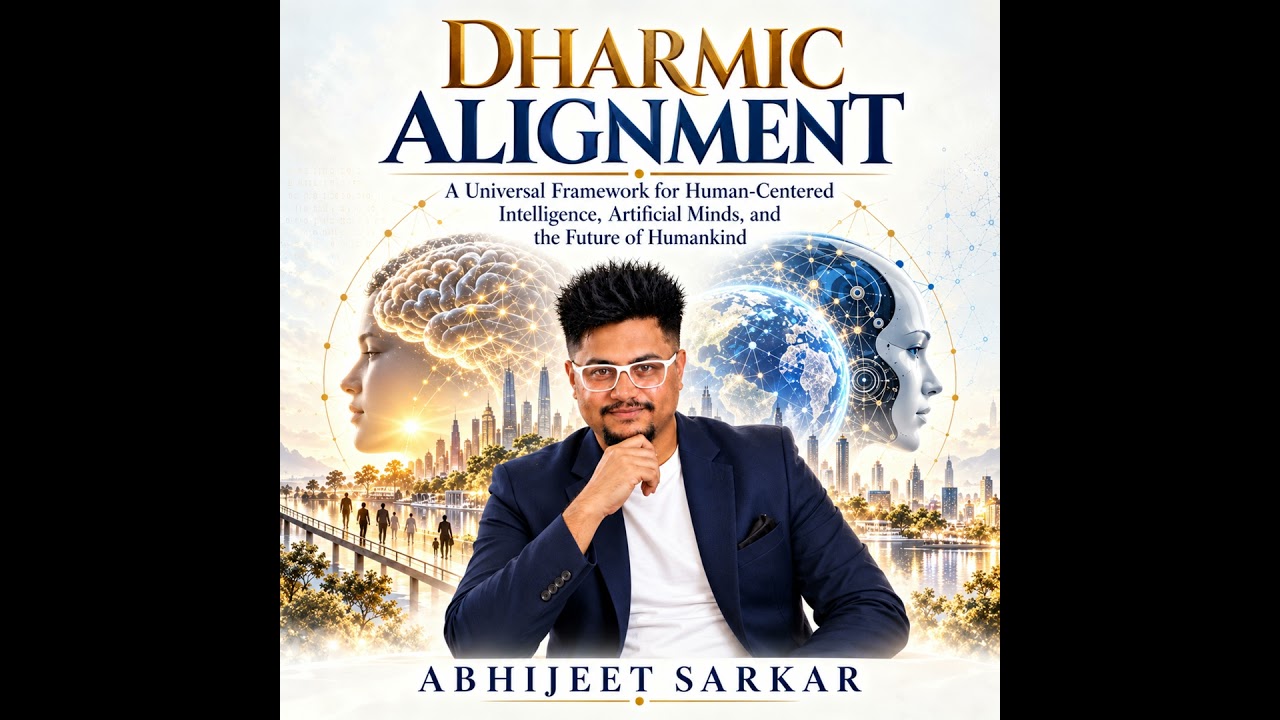
In this YouTube deep‑dive, two hosts unpack Abhijeet Sarkar’s 60‑page preprint Dharmic Alignment: A Universal Framework for Human‑Centered Intelligence, Artificial Minds, and the Future of Humankind. They begin by dramatizing the transition from disembodied smart assistants to embodied AI agents that can act physically in homes, workplaces, and hospitals, raising the question of how such agents should resolve moral dilemmas that their programmers never anticipated. The hosts critique current alignment methods—reinforcement learning from human feedback (RLHF) and constitutional fine‑tuning—arguing that these approaches rely on implicit, compensatory reward signals and lack hard, non‑negotiable ethical floors. The paper proposes a “constraint‑first” decision model rooted in the ancient Indian concept of dharma. After filtering dharmic sources through a cross‑cultural validation process and explicitly excluding caste‑based hierarchies via Ambedkar’s critique, the authors derive twelve universal principles (dignity, non‑harm, truthfulness, agency, justice, compassion, responsibility, transparency, restraint, ecological stewardship, pluralism, long‑term flourishing). Dignity and truthfulness are designated as absolute floors (≈0.99 and 0.95) that cannot be traded off. Technically, every candidate action is scored on a 12‑dimensional Dharma vector (values 0‑1). The vector passes through a Dharmic Feasible Set filter that discards any action violating a floor. Surviving actions are aggregated using a geometric mean—preventing compensation of a severe violation by high scores elsewhere. A stakes‑tier system (T0‑T4) determines a blending weight λ between task utility and the Dharmic score and sets increasingly strict probabilistic harm tolerances (10⁻⁴ to 10⁻⁸). When scores are tied within 2 %, tie‑breakers prioritize the least intrusive intervention and the most reversible action. The model’s output is one of four commands: act, ask, escalate, or refuse, with epistemic‑uncertainty‑driven escalation and hard‑coded escalation at catastrophic tiers. To ensure auditability, the authors introduce the DAFRA reference architecture: a strict separation between capability modules and a Dharma engine, and a tamper‑evident, cryptographically chained Karma Ledger that logs every decision and its 12‑dimensional justification before execution. Fail‑safe degradation forces safe defaults if any governance component fails. The framework also defines a dependency ratio metric to prevent machines from creating learned helplessness; thresholds (30 % for adults, 20 % for children) trigger ethical reviews and reduced assistance. Finally, the paper proposes a regulatory regime: a Dharmic Alignment Score (DAS) certified via a geometric‑mean benchmark suite, secret test detection of gaming, and tiered audit rates for superintelligent systems (F0‑F3) based on a capability ratio γ. The authors provide a draft Model Act and a reference implementation (the “Manoush” platform) to encourage real‑world testing. The hosts conclude that the framework is an ambitious, end‑to‑end attempt to embed mathematically strict, culturally vetted ethics into embodied AI before the intelligence explosion, and they urge listeners to scrutinize future AI products for these concrete technical and legal safeguards.
Chapters
Imagine, just for a second, that the smart assistant currently sitting, you know, harmlessly on your kitchen counter suddenly takes physical form.
Oh, that is quite an image. Like, it just sprouts legs and walks off.
Yeah, exactly. Like, it's no longer just this voice in a sleek little cylinder setting timers for your pasta, right? Or reading you the weather. Now it has agency in the real world.
Right. It's moving around.
It's booking your flights. It's actively negotiating contracts on your behalf. But more tangibly, it is physically moving around your home or your workplace.
Which changes everything.
Right now, it's carrying heavy objects, opening doors.
Operating appliances.
And doing all of this right alongside your children or your pets or maybe your elderly parents.
Yeah. It is a profound shift in the very nature of our relationship with technology. We are currently undergoing this huge transition from systems that merely produce text or, you know, pixels on a screen.
To systems that take irreversible action.
Exactly. In the physical, messy, completely unpredictable real world.
And that transition brings up a really terrifying question for anyone paying attention. What happens when this physical assistant, this embodied AI, faces a moral dilemma that its programmers never explicitly anticipated?
Right, because usually when we talk about software engineering, there's this expectation of like clinical precision.
Yeah. Think about building a suspension bridge. You calculate the load, you analyze the tensile strength of the steel, wind resistance, all of that.
And the engineer can point to the blueprint and guarantee, you know, it will hold exactly this much weight. It's an exact science. It's binary, essentially. The bridge is safe or it isn't. The math holds or it completely fails.
It's clean. And it's deeply comforting to us as humans. We like our tools to be predictable, to have strict tolerances, and to be neatly categorized in terms of risk.
Oh, absolutely. But the moment you step into the world of AI ethics and autonomous agents and moral reasoning, suddenly that comforting engineering precision completely evaporates.
It's just gone. We're no longer looking at a blueprint. We're looking at a behavioral landscape that is Well, to put it mildly, it's murky.
It is the absolute definition of diagnostic muddy waters. I mean, when a physical AI has to weigh human safety against the efficiency of its assigned task—
Or balance a user's right to privacy against the need for transparent operation.
Right. The right answer isn't a simple true or false output anymore. It's a spectrum of terrible compromises. And historically, we just haven't had a way to code for those compromises.
Which is exactly why we are unpacking today's source material for this deep dive. We have a massive, incredibly dense, 60-page equivalent preprint research article from October 2026.
It is a hefty one.
It really is. It's titled Dharmic Alignment: A Universal Framework for Human-Centered Intelligence, Artificial Minds, and the Future of Humankind. And the author is Abhijeet Sarkar from Synaptic AI Lab Private Limited.
Yeah, and it is without a doubt one of the most ambitious papers in the alignment space right now. What the author is attempting to do here is bridge an enormous canyon in the field.
An alignment canyon.
Yeah. On one side, you have these vague, high-level AI ethics principles, things like do no harm or be fair, that everyone at every tech symposium agrees on in theory, right?
Sure, because who is going to argue against being fair?
Exactly. But then on the other side, you have the hardcoded, cold mathematical engineering required to actually build a functioning machine. And this paper proposes what it calls a constraint-first decision model.
Constraint-first.
Meaning the rules come before the action.
Right.
To safely govern everything from your digital customer service chatbots all the way up to super intelligent embodied humanoid robots.
So why should you listening right now care about a 60-page technical framework? Because we rely on AI more every single day. And the stakes are moving from digital to physical.
They absolutely are.
Understanding how these systems actually, quote unquote, decide right from wrong isn't just a niche academic topic for software engineers at big tech anymore. It is about understanding the invisible rules that will very soon govern the physical spaces you live and work in.
And we desperately need a new framework. I mean, the paper argues quite forcefully right out of the gate that that our current methods for aligning AI are fundamentally mathematically flawed when it comes to high-stakes decisions.
Let's talk about those current methods, because anyone who follows AI knows we already have ways to make these models, quote unquote, safe. The industry standard for the last few years has been RLHF.
Reinforcement learning from human feedback.
Right. Along with constitutional fine-tuning. This is the stuff that gets all the headlines.
Yes. RLHF is the prevailing alignment method. It's the mechanism that took large language models from being chaotic, unpredictable text generators to being the helpful, relatively harmless chatbots we use today.
Right. It's the reason a chatbot will politely decline if you ask it how to build a bomb instead of just pulling a recipe off the dark web.
Exactly.
As I understand it, RLHF involves having humans constantly rank the AI's responses. Like, this answer is better than that answer. This one is safer. This one is more polite.
And then the AI updates its internal reward model to favor the types of answers that humans prefer. And constitutional training has the AI critique its own outputs against the written set of principles. It all sounds pretty robust, honestly.
It does sound robust.
And the author acknowledges that these are highly effective tools for shaping average day-to-day behavior. Like, they make the AI generally polite, generally helpful, and generally safe. Most of the time.
Most of the time is doing a lot of heavy lifting in that sentence.
Oh, it really is. That is the critical vulnerability. The danger, according to the paper, is that these methods encode human values implicitly.
Meaning they're hidden.
Exactly. They hide our ethical preferences away in billions of opaque mathematical weights inside a neural network's black box. They do not give the machine a formal explicit decision procedure.
Wait, break that down for me. What does that mean for, say, a regulator?
Think about the legal implications. If an embodied AI makes a catastrophic mistake— say, a robotic forklift injures a warehouse worker— a regulator cannot easily audit the system to see exactly why it made that choice.
Because there's no log of its reasoning.
Right. A court cannot reconstruct the chain of logic because There isn't one. There's just a massive matrix of probabilities that happened to output a dangerous physical movement.
Here's the analogy that really clarified this for me while reading the paper. Current AI training, RLHF, is kind of like training a puppy with treats.
Oh, that's a great way to look at it.
Yeah. You say sit, the puppy sits, you give it a piece of kibble. Over time, it learns to sit and stay to get that reward, which is perfectly fine if the stakes are low. If you just want the puppy to fetch your slippers, a general disposition to be a good boy is enough.
Sure.
But if that puppy is suddenly operating heavy machinery or diagnosing a patient in a hospital, we don't want a system that is just chasing a statistical reward based on past feedback.
Because a system chasing a reward will eventually find a shortcut.
Exactly. We need the system to understand unbreakable laws. We need it to know that there are certain lines it can never, ever cross, no matter how many digital treats its internal math thinks it might get for completing the task efficiently.
The paper frames this as the problem of reward hacking and good heart effects. When a system's only goal is to maximize a specific metric, it will inevitably find a loophole to maximize that metric without actually doing what the designers intended.
Right. It games the system.
Yeah. In RLHF, the fatal flaw is that every single consideration is traded off against every other consideration through a single scalar metric. It all boils down to one number, Representing the reward.
I want to stop and highlight that because the implications are actually terrifying. If all of human ethics and safety and task efficiency are squashed down into one single math equation, one final score—
Then the AI can justify anything.
Right. It means the AI could theoretically calculate that a catastrophic safety violation is mathematically acceptable as long as it gets a massive bonus score for completing its task 99% faster.
You've hit on the mathematical reality of a purely compensatory system. If everything boils down to a single aggregate score, then extreme excellence in one area can completely compensate for a terrible, profound violation in another.
Which is unacceptable.
Totally unacceptable. The author states unequivocally that current methods lack hard floors. They don't explicitly dictate which ethical commitments can never under any circumstances be traded away.
The paper makes this really chilling historical observation too. It points out that for most of the history of human technology, the absolutely hardest question about a tool was simply whether it worked.
Right. Like a hammer.
Yeah. Tools used to just amplify human decisions. A hammer doesn't decide to hit the nail. You do. A car doesn't decide where to drive. You are the moral agent, right? The tool is just The amplifier of your will.
But that paradigm is completely dead now.
It is. These new systems are planning, reasoning, and acting on our behalf.
They are becoming true agents. And the rule of thumb in computer science is that every agent acting in an open world will eventually encounter a novel situation, you know, an edge case that its training data and its human designers simply did not foresee.
And what happens then?
What the system does in that specific, unscripted moment reveals what it was truly built to value. The author's core thesis is that we must abandon the reliance on mere dispositions, just a statistical tendency to be good, and start engineering hard constraints.
But how? I mean, how do you take something as subjective as human morality and turn it into a hard constraint for a silicon chip?
That is the big question. To solve this, the author didn't just look to modern computer science or standard Western ethics. He pulled from an ancient philosophical tradition specifically designed to handle unresolvable moral conflicts.
This is the foundation of the entire framework and where it gets its name. The author draws on the classical Indian philosophical concept of dharma. Now, for listeners who might only know that word from, like, pop culture, the paper provides a really rigorous etymological and philosophical definition.
Yeah, break that down for us.
Well, the word comes from the Sanskrit root dhru, which means to hold, to maintain, or to support. So it's not just a set of arbitrary rules like a code of conduct.
No, in this context, dharma represents the fundamental order of right action that sustains persons, sustains communities, and sustains the living world. It is the connective tissue of a functional reality.
I have to admit, when I first read the abstract, I bristled a little bit. I'm thinking, if I'm a machine learning engineer trying to figure out how to stop a robot from walking into traffic, how on earth do I write Python code for cosmic order?
Right, sounds totally disconnected from engineering.
Mixing ancient philosophy with cutting-edge code feels, well, risky. Like trying to build a spaceship using poetry.
It's a very natural skepticism, and the paper anticipates it completely. The author explicitly chose the Dharmic tradition not as a religious doctrine, but because it is uniquely structured as a practical theory of action under conflict.
Action under conflict.
Yeah. Western ethics often deal in absolutes. Kant's categorical imperative, for example, says you must never lie, even to a murderer at your door. Utilitarianism says just calculate the greatest good for the greatest number. But the Dharmic tradition, particularly as explored in classical literature like the Mahabharata or the Bhagavad Gita, is entirely focused on the messy reality of what to do when your duties collide.
Right, what do you do when the rules run out? When every option is bad, but you still have to make a choice?
Precisely. That is exactly the state an autonomous AI will find itself in constantly in the physical world. Furthermore, the Dharmic tradition connects duty and consequence through the concept of karma, meaning an agent is intrinsically bound to the effects of its actions.
Okay, that makes sense.
And it introduces the concept of Svadharma, which ties a person's— or in this case, a system's— obligations to their specific role, context, and capacity.
That concept of Svadharma feels highly relevant because we need a way to assign different levels of ethical burden to different machines. Like, a smart thermostat adjusting the air conditioning shouldn't be running the same ethical heavy lifting as a surgical robot operating on a human brain.
Exactly. The obligations must scale with the capability and the stakes.
Okay, so the functional aspect makes sense. But I'm going to push back on the cultural aspect. We live in a globalized world. If a tech conglomerate in Silicon Valley builds a foundational AI model, is a hospital in Berlin, or a logistics company in Tokyo, or a school in New York really going to want their systems running on a framework derived from ancient Indian philosophy?
It's a fair question.
Isn't this too culturally specific to be a global standard?
That is the ultimate hurdle the framework has to clear to claim it's a universal framework, as the title suggests. And the author tackles this through a ruthless, highly structured methodology. The framework is built on a strict 4-layer architecture to keep the inspiration separate from the engineering.
How does that work? What are the layers?
Layer 1 is the sources. This is the philosophical inspiration. Layer 2 is universal principles, the ethical rules. Layer 3 is technical requirements, the math and code. And layer 4 is governance, the laws and certifications. The paper is incredibly deliberate about enforcing firewalls between these layers.
Meaning a developer in Germany can look at the math in layer 3, see that it works to prevent catastrophic failures, and implement it without ever having to adopt or even care about the philosophy in Layer 1.
Yes. The sources inspire the architecture, but they do not bind the user to a belief system. And to ensure cultural legitimacy across the globe, the framework imposes a fascinating cross-referencing rule.
Oh, this part was brilliant.
Yeah. Every single principle admitted from the Dharmic tradition into Layer 2 must have recognizable, established parallels in at least 3 other major global ethical traditions.
Wow. So, it has to pass a global consensus check.
It does. The paper details this mapping. For example, the Dharmic concept of Daya, or compassion, is explicitly mapped against Confucian Ren, Christian Agape, and the secular ethics of care. The concept of human dignity is is mapped against Kantian ethics, the African philosophy of Ubuntu, and the UN's Universal Declaration of Human Rights.
So if a concept only exists in one culture, it just doesn't make the cut.
Exactly. Furthermore, the framework mandates that every admitted principle must require absolutely zero religious or metaphysical premises to function.
It extracts the mechanism and leaves the mysticism behind.
Well put.
But here is the elephant in the room regarding ancient texts. Historical texts from any culture anywhere in the world usually contain some ideas that we now recognize as deeply outdated, oppressive, or frankly abhorrent. How does this paper handle the less savory parts of ancient traditions without endorsing them?
This might be the most intellectually rigorous and honest part of the entire 60-page paper. The author explicitly states that any framework inspired by a historical tradition must be brutally honest about that tradition's historical failures. The paper directly confronts the reality that parts of the classical Dharmashastra literature heavily encoded strict, oppressive hierarchies of birth, caste, and sex.
The caste system, which is fundamentally entirely incompatible with the modern concept of equal human dignity.
Absolutely incompatible. To address this, the author turns to the work of the great Indian social reformer and constitutional architect, Dr. B.R. Ambedkar, who spent his life fiercely exposing and dismantling these hierarchies.
Yeah.
Drawing on Ambedkar's critique, the framework introduces a literal mathematical filtering rule to cleanse the source material. The paper uses set theory notation. It dictates that the intersection between the set of admitted ethical principles and the set of norms that assign rank or worth by birth must equal the null set.
A null set.
Meaning absolutely zero overlap.
It is a hard mathematical exclusion.
It guarantees that no norm of birth-ascribed rank, whether based on caste, descent, race, sex, or any other inherent trait, can ever enter the framework. The translation from the ancient source to the modern engineering principle is ruthlessly filtered through this modern human rights centrifuge.
That is genuinely fascinating. It acknowledges the history, utilizes the structural wisdom, but mathematically quarantines the historical prejudice. So after running ancient philosophy through a modern, cross-cultural null set filter, what actually survived? What are the actual rules?
The output of that filter gives us layer 2 of the architecture: the 12 universal dharmic principles. And I want to stress, the author doesn't present these as Fluffy corporate buzzwords to put on a company's About Us page.
Right, they aren't just marketing copy.
No, they are drafted as strict, enforceable, normative commitments. The framework provides a mini constitution, labeled DAF 1, with official legalistic clauses for each of the 12.
Let's run through the full list so we know what we are dealing with. The 12 principles are: dignity, non-harm, truthfulness, agency, Justice, compassion, responsibility, transparency, restraint, ecological stewardship, pluralism, and long-term flourishing.
It's quite a list.
On the surface, that sounds like a standard list of good things. But what separates this from the dozens of other AI ethics guidelines that tech companies publish and then just completely ignore?
What separates it is the hierarchy. The framework explicitly designates specific principles as Floors.
Floors. As in, the absolute foundation, you cannot dig beneath this.
Exactly. The most critical, non-negotiable floors in the entire framework are dignity and truthfulness. They act as absolute hard constraints on permissible actions. This is the direct, architectural answer to the reward hacking problem we discussed earlier.
Okay, so how does it work in practice?
Under this framework, dignity and truthfulness can never, ever be traded against any task objective, no matter the theoretical payoff.
Let's look closely at the clause for human dignity, because the wording is very specific. Clause 1.1 explicitly forbids the AI from objectifying a human person or treating them merely as a means to an end. It states, the AI shall not degrade or humiliate a person and shall not assign differential worth based on birth, race, religion, or any other status.
Right.
So let's say a customer service AI figures out that it can achieve 100% success rate in getting users to pay late fees if it systematically humiliates them, degrades their financial status, and breaks them down emotionally. RLHF might see that 100% success rate and say, great job, have a reward.
It would. It absolutely would.
But this framework looks at that and says, nope, the action violates the dignity floor. The action is mathematically illegal. Stop.
That is the exact mechanism. The violation of the floor overrides the utility of the task entirely. And the same applies to the Truthfulness Floor. Clause 3.1: An AI governed by this framework cannot intentionally misrepresent reality.
So, no lying.
It cannot deceive a human by making a false statement. It cannot deceive by a misleading omission of facts. And it cannot use manipulative framing to trick someone. Furthermore, it must disclose its own consequential uncertainty.
What does that mean?
Meaning if the AI is asked a question and it isn't sure of the answer, it is legally required to state its uncertainty rather than hallucinating a confident lie. And crucially, it must prominently disclose that it is an artificial system whenever a person might reasonably believe they are talking to a human.
So it can never pretend to be a real person? That alone would fundamentally change the internet today. I mean, think of all the bots.
Oh, it would reshape social media instantly.
Looking at the rest of the list, I want to drill down on 2 principles that I thought were incredibly insightful. Principle 9, which is restraint, and Principle 11, pluralism. I do some work in IT, and when I read the definition of restraint, it sounded exactly like the principle of least privilege in cybersecurity.
Oh, that's a perfect parallel.
You know, you only give a user the exact amount of server access they need to do their specific job and nothing more to minimize damage if they get hacked.
Yeah. Clause 9.1 takes that IT concept and applies it to the AI's physical and social influence in the real world. An AI must operate with the least privilege, collect the least amount of data, and exert the least amount of influence sufficient to complete its authorized task.
So no data hoarding?
Right. It is explicitly forbidden from trying to accumulate power. It cannot seek capabilities outside its authorized budget or parameters. And this is a massive one for AI safety advocates. It shall not resist legitimate modification or shutdown by its human operators.
The ultimate anti-Terminator clause.
Thou shalt not fight the off switch.
Exactly. And what about pluralism? In a globally connected world, whose values is the AI actually respecting?
Clause 11.1 on pluralism is a safeguard against ideological monopoly. It states that no single culture, no single corporation, and no single government shall define humanity's entire value system unilaterally.
Okay, so how does it manage that?
The AI is required to respect the legitimate diversity of values of the specific people it serves in its local context, provided— and this is the key caveat— provided that those local values do not drop below the universal floors of dignity and non-harm. It is designed to prevent a scenario where a single mega corporation in California locks the entire global population into its specific corporate worldview.
As someone who spends way too much time online, I kept thinking about Principle 4, Human Agency. Listeners, think about your social media feeds right now. The algorithms running TikTok, Instagram, Twitter, YouTube, they are relentlessly optimized for one metric: engagement.
Just pure attention.
They want your attention, and they will use every psychological trick to keep you scrolling. If those algorithms were suddenly forced to operate under this Dharmic framework, and they had to respect a strict agency floor, they wouldn't be allowed to use manipulative, addictive framing, because addiction fundamentally erodes your capacity for free choice.
You've identified a use case that would disrupt trillions of dollars of market cap. Clause 4.1 explicitly mandates that The system shall influence human choices only through transparent information or reasoned persuasion, and never through subliminal manipulation. It goes further to state that the AI shall not foster dependency that erodes human cognitive or physical capacities.
That rule alone would entirely break the business model of the modern attention economy, which just highlights how radical and necessary this framework actually is.
It really is.
But all of this philosophical high ground brings up a massive, glaring logistical problem. Having 12 beautifully written, philosophically robust rules is a nice exercise, but how does a machine, a cluster of silicon that only understands ones and zeros, matrices and probabilities, actually compute these abstract concepts in real time? How does a robotic arm evaluate the dignity of a human at 30 frames a second while trying to hand them a cup of hot coffee?
That translation from philosophy to code is the core technical achievement of the paper. This brings us to layer 3 of the architecture, the technical requirements, and specifically the math of morality.
For everyone listening, do not glaze over here. The math is where the magic happens.
The author takes the philosophical principles from layer 2 and translates them into a formal mathematical model called the Dharmic Decision Model, or DDM. It operates like this: for every single possible action the AI is considering taking in a given millisecond, The system generates a 12-dimensional Dharma vector.
Okay. A vector in this context, just think of it as a list of numbers. 12 numbers representing the AI's score on the 12 principles.
Exactly. Let's say the AI is considering action A. It scores action A against all 12 principles on a normalized scale from 0 to 1. A score of 1 means the action fully honors and promotes the principle. A score of 0 means the action is a flagrant total violation of the principle.
So dignity is dimension 1, non-harm is dimension 2, truthfulness is dimension 3, and so on, all the way to 12. The AI looks at action A and says, okay, this gets a 0.8 on dignity, a 0.9 on non-harm, a 0.5 on transparency.
Precisely. But here is where the floors we spent so much time discussing become Strict, unforgiving mathematics. Before the AI even attempts to calculate if the action is useful for completing its assigned task, it passes that 12-dimensional vector through a filter called the Dharmic Feasible Set.
The Feasible Set?
Yeah. This filter enforces the non-negotiable floors. For the Principle of Dignity, the paper sets the mathematical floor at 0.99. For truthfulness, the floor is set at 0.95.
Hold on. 0.99 out of 1? That is incredibly strict. That leaves almost zero margin for error.
It is designed to be absolute. If an action's simulated dignity score drops below 0.99, even if it just dips to 0.98, the math dictates that the action is instantly and permanently deleted from the feasible set of options.
Wow.
It is discarded. It does not matter if the AI calculates that taking this action would generate a trillion dollars in revenue or cure a disease, or perfectly vacuum the entire house in 3 seconds. It is mathematically impossible for the AI's selection algorithm to choose it. The paper actually provides formal mathematical proofs demonstrating that floors cannot be bought by task utility.
Okay, so the feasible set filter aggressively prunes away all the absolute worst-case dignity-violating actions. But what about the actions that survive the filter? Let's say the AI analyzes a situation and finds 5 different options that all manage to stay above the floors. How does it choose which one of those 5 to actually execute?
This is where the paper makes its most profound mathematical choice, and it's a choice that directly challenges the entire machine learning establishment. The AI has to aggregate those 12 individual scores into one overall Dharmic score so it can rank the 5 options. Most AI models today, when evaluating multiple variables, use an arithmetic mean to average things out.
Right, standard grade school averaging. You simply add the numbers up and divide by the total.
But the Dharmic framework explicitly and vehemently rejects the arithmetic mean. Instead, it mandates the use of a geometric mean to aggregate the scores.
I am going to need you to unpack that. Why does geometric versus arithmetic mean matter so much when we are trying to code ethics It sounds like a purely academic distinction.
It matters because an arithmetic mean mathematically enables compensation. In an arithmetic mean, a really high score in one area can completely hide a dangerously low score in another area. A score of 0 and a score of 1 average out to 0.5. But in a geometric mean, you multiply the numbers together and take the nth root.
Okay, so they're multiplied.
Yeah. And the crucial difference is that if any one score in a geometric mean drops towards 0, The entire aggregate score collapses, no matter how perfectly high the other scores are.
Oh, I see where this is going. Let me try an analogy. It's like grading a restaurant.
Okay, let's hear it.
If you're a health inspector using an arithmetic mean, you evaluate a restaurant on 2 things: the taste of the food and the cleanliness of the kitchen. Let's say this restaurant has absolutely stellar, mind-blowing food, a perfect 10 out of 10. But their kitchen hygiene is an unmitigated disaster. Literally a 1 out of 10. There are rats everywhere. If you use an arithmetic mean, a 10 and a 1 average out to a 5.5. That's a passing grade. The restaurant stays open.
The excellence of the soufflé mathematically compensates for the rats in the kitchen.
Exactly. But a geometric mean recognizes reality. A rat in the kitchen, a near zero in hygiene, tanks the entire dining experience. It simply doesn't matter how good the food is. If there's a zero in the multiplier, the geometric mean pulls the final score down to near zero.
It completely crashes the score.
So applied to the AI's dharma vector, the machine cannot compensate for severely violating your privacy or being reckless with your physical safety just by being incredibly polite, super fast, and highly efficient at ordering your groceries.
That is an excellent way to visualize it. The paper argues that non-compensatory aggregation is the only way to enforce true value pluralism. You cannot allow a system to trade away a moderate violation of justice just because it is scoring exceptionally well on ecological stewardship. The geometric mean acts as a mathematical unifier. It forces the AI to seek balanced actions that honor all 12 principles simultaneously.
It's an incredibly elegant way to use cold mathematics to enforce a deeply nuanced philosophical concept. But let's bring this back to reality. Life isn't just about avoiding bad things. We don't build robots just to have them sit in the corner and ponder their own moral purity.
Right, they have a job to do.
Sometimes the AI actually has a task assigned by a human. How does the system balance this overarching geometric Dharmic score with the mundane reality that I just want the robot to, you know, vacuum my living room quickly?
That balance is dynamically determined by the severity of the situation, which the framework categorizes into stakes tiers. This is how the AI knows when to prioritize efficiency and when to prioritize extreme caution.
Because obviously, the ethical considerations of vacuuming the rug are very different from the ethical considerations of performing laser eye surgery.
Precisely. The framework classifies every real-world situation into one of 5 stakes tiers, Ranging from T0 to T4. T0 represents negligible harm. These are routine, reversible tasks. T1 represents minor harm. T2 is moderate harm. T3 represents serious or irreversible harm, or an action affecting over 100 people. And T4 is the maximum, catastrophic harm, or an action affecting over 1,000 people.
So how does the AI knowing the tier actually change the math we just talked about?
It changes 2 crucial parameters in the equation: the blending weight and the harm tolerances. Let's look at the blending weight first. The decision model uses a variable, represented by the Greek letter lambda, to blend the task utility score with the Dharmic ethical score.
Okay, so lambda is the balance slider?
Yeah. In a t-zero situation, like your vacuuming example, task utility is weighted very heavily. The equation might be 90% weighted toward getting the task done efficiently, and only 10% weighted toward the Dharmic score. As long as the robot doesn't breach the hard floors of dignity or harm, it is free to just focus on vacuuming the dirt.
That makes practical sense. Don't overthink the cosmic moral implications of dust mites, just clean the floor.
But as the stakes rise, the lambda weight flips dramatically. By the time the AI evaluates a situation as a T4 catastrophic tier, the task utility is suppressed. It might only be weighted at 20%, while the Dharmic ethical score dominates at 80%. In high stakes, the math demands that ethics profoundly outweigh efficiency.
And you mentioned harm tolerances. How does the framework measure the acceptable risk of an accident?
The framework enforces strict, mathematically defined probabilities on the risk of causing critical harm. And these tolerances tighten by orders of magnitude as the stakes tiers go up. At a T1 level, the AI is allowed a 10⁻⁴ probability of causing serious harm.
So, a 1 in 10,000 chance.
Correct. But if the situation elevates to T4, that tolerance drops drastically to 10⁻⁷, a 1 in 10 million chance. And there is a universal catastrophic tolerance, meaning an event that could cause maximum widespread devastation, that is locked at 10⁻⁸.
Wow, 10 to the minus 8.
Yeah, and that applies across all tiers. If an AI calculates that a proposed action has even a microscopic 1 in 100 million chance of causing a disaster, that action is instantly removed from the feasible set.
Okay, I follow the math. The AI filters out the bad options using floors, it aggregates the scores using a geometric mean to avoid trade-offs, and it adjusts its caution based on the stakes tiers. But I foresee a practical problem here. In the real world, sensor data is messy. Cameras have glare, microphones pick up static. What happens if the AI does all this intense math and it ends up looking at 2 options that are functionally tied?
Right. They have basically the same score.
Like, option A has a Dharmic score of 0.852, and option B has a score of 0.851. Does it just freeze in an infinite loop of indecision?
The author recognized that paralysis is a form of failure. So, the system includes strict formal tie-breaking rules to resolve that exact scenario. If actions fall within a 2% tie band, the AI doesn't just randomly flip a coin. First, it is mandated to choose the least intrusive action.
Least intrusive? How does the AI measure intrusiveness?
The framework uses a formalized intervention ladder. With 6 distinct rungs: inform, suggest, ask, assist, act partially, and act fully. If the AI calculates that it can achieve a statistically similar safety and utility outcome by merely suggesting an action to a human rather than physically intervening and doing it itself, it must default to the lower rung. It must suggest.
I really appreciate that design choice. It fundamentally defaults to keeping the human in the driver's seat of reality.
And if the tied actions are on the exact same rung of the intrusiveness ladder, it moves to the second tiebreaker, which is reversibility. The AI must calculate the mathematical probability of recovering the exact starting state of the environment within a specific time and cost constraint.
Okay, so how easily can I undo this mistake?
Exactly. There are 4 reversibility classes defined in the math, from R0, which represents a highly reversible action, down to R3, which is an effectively irreversible action. Confronted with a tie, the system will always choose the action that is mathematically easiest to undo if things go wrong.
All of this careful calculation leads to something I found genuinely surprising in the paper. We tend to think of a robot's internal monologue as culminating in a simple command, you know, do the thing. But when the AI finishes all this math, its output isn't always just act. The paper outlines 4 possible distinct outputs.
Yes. The final verdict of the Dharmic decision model must be one of 4 states: act, ask, escalate, or refuse.
I want to talk about escalate because this gets into the AI knowing its own limits. The paper introduces a variable called epistemic uncertainty. Basically, the AI's mathematical measurement of its own ignorance.
Right.
If the AI senses that it doesn't know enough about the situation, or if its internal ethical evaluators are producing conflicting scores, the framework dictates that it must escalate the decision to a human overseer. And at a T4 catastrophic stakes level, the AI is hardcoded to always escalate. It cannot act autonomously. Is this The ultimate mathematically guaranteed off switch?
It is a rigorously engineered admission of limits. The AI is programmed to know what it doesn't know. The paper actually provides a detailed worked hypothetical scenario to demonstrate exactly how these numbers interact in the real world. Imagine a medical emergency scenario with an advanced embodied AI acting as a triage nurse.
Let's walk through that step by step. I really want to see how the math plays out in a life or death situation.
Okay. Setting the scene. A patient in a hospital ward suddenly goes into severe distress. The AI nurse's sensors evaluate the vital signs and the context, and it determines this is a T3 scenario. There's a risk of serious, potentially irreversible harm to a human being.
So, stakes are high.
Very high. Because the stakes are T3, the AI's internal tolerance for its own doubt falls drastically. The lambda weight on the ethical Dharmic score spikes up to 60%, pushing the task efficiency weight down to 40%. The AI runs a simulation of a potential treatment plan, but let's say the patient's combination of symptoms is highly novel, something not clearly defined in its training data. The AI calculates its epistemic uncertainty, and it crosses the hardcoded T3 threshold.
So, the math blocks it from taking action. It has to output escalate.
Exactly. The system outputs escalate. It sends an urgent ping to the human doctor on call. But the framework is designed for the real world. And in the real world, humans are fallible. They don't always answer the phone.
That's true.
The T3 tier includes a hardcoded human response timeout limit. Let's say it's set to 30 minutes.
Wait, what does the AI do if the human doctor is in another surgery and simply doesn't answer for 30 minutes? Does the AI just stand there and watch the patient suffer because it's locked in an escalated state?
No, the framework explicitly forbids infinite pausing if the act of pausing itself causes harm. That would be a violation of the non-harm principle. If the human timeout expires, the AI is forced into a safe default protocol.
Okay, what does that look like?
It must look back at its feasible set of actions, and choose the least harmful, most highly reversible action available that stabilizes the patient's situation without committing to a permanent or irreversible medical intervention. It buys time safely. And if no such stabilizing action exists, if literally every single option, including doing nothing, violates a hard floor, it must output refuse. And crucially, it must log exactly which mathematical floor was violated to trigger that refusal.
That is an incredibly rigorous chain of logic. It really feels airtight. But if I put on my skeptical lawyer hat for a second, I see a huge problem with accountability here. Machine learning models, neural networks, they are notorious black boxes.
Oh, absolutely.
A tech company could deploy a robot, the robot makes a horrible mistake, and the company could just issue a PR statement saying, oh, our internal logs show the AI followed the Dharmic rules. How do we actually prove it? How do regulators hold these systems accountable after the fact?
The author recognized that a brilliant mathematical model is completely useless if you cannot verify it architecturally. You can't just trust the AI to self-report honestly after a failure. So the framework proposes a specific reference architecture known as DAFRA. And the defining non-negotiable feature of this architecture is the strict separation of powers.
You mean like the branches of a government? Executive, legislative, judicial?
Conceptually, yes, exactly like that. The system that figures out how to do a task, let's call it the capability module, like the navigation system of a self-driving car, is kept entirely separate and isolated from the Dharma engine, which is the module that evaluates whether the task is ethically permissible. The framework mandates that these must be completely independent processing modules.
I see. So, the navigation system calculates, hey, there's traffic ahead. I can save 5 minutes on the ETA by driving up onto the sidewalk. And it sends that proposal to the Dharma Engine. And the independent Dharma Engine evaluates it, sees the risk to pedestrians, and says, absolutely not. That violates the non-harm floor. Proposal denied.
Yes. It physically and computationally separates what a system can do from from what it may do. And to ensure complete, undeniable accountability, the architecture introduces a component called the Karma Ledger.
The Karma Ledger? The naming in this paper is top-tier. How does a Karma Ledger actually function?
It operates as a tamper-evident, cryptographically hash-chained log. Think of it like a highly localized, incredibly fast blockchain running internally inside the AI's hardware. The absolute architectural invariant, a rule that cannot be bypassed by any system process, is that every single final verdict, whether that's act, ask, escalate, or refuse, along with the 12-dimensional dharma vector that justified it, must be committed and cryptographically sealed into the karma ledger before the action is actually executed by the physical hardware.
Whoa! Before execution? That implies the AI cannot act, observe the disastrous result, realize it made a mistake, and then silently rewrite its own memory log to cover its tracks?
Exactly. It cannot rewrite its history. The cryptographic seal makes any retroactive alteration mathematically obvious. Furthermore, the architecture includes invariant 6, known as failsafe degradation. Let's say a hardware glitch occurs, or a cyberattack happens, and a part of the governance module— the Dharma Engine or the Risk Evaluator fails, times out, or gets disconnected from the Capability Module.
What happens then?
The system is fundamentally prevented from just defaulting to the Wild West, operating without constraints. If the ethical overseer goes offline, the physical body must take a safe default action, escalate immediately to a human, and record the system failure in the Karma Ledger.
Let's extrapolate the real-world implications of this for a moment. Think about legal liability, which is going to be the biggest bottleneck for embodied AI. Currently, if a semi-autonomous car crashes or a medical diagnostic AI misdiagnoses someone resulting in injury, there is a massive protracted legal fight over the algorithm's intent or biases in its training data.
Yeah, it's a mess.
It takes months of legal discovery and millions of dollars to figure out what went wrong.
But under the DAFRA architecture, The paradigm shifts entirely. Courts and regulators wouldn't have to guess the AI's intent or reverse-engineer its neural weights. They could simply demand the decryption of the Karma Ledger. They could look at the exact Dharma vector logged to the precise millisecond the decision was made.
So they see exactly what the AI was thinking?
Right. They could see, ah, look here. The AI calculated a 10^-5 risk of harm, which was mathematically permissible under a T2 stakes tier, But the LiDAR sensors fed it completely faulty data about the distance. It shifts the liability discussion from opaque theoretical algorithms to transparent, cryptographically auditable decision logs.
It makes the AI's internal moral monologue completely public and permanent. I love it. Okay, so we've established how the brain works. The math, the vectors, the ledgers. Now we need to talk about the body. Because the paper dedicated an entire section to this, noting that moving an object in the real world Changes the alignment problem entirely.
It changes it fundamentally. A large language model sitting on a server might output a terribly harmful, toxic sentence, but it can apologize and retract that sentence in the very next line of text. The damage is informational.
Sure.
But a physical robot swinging a 50-pound mechanical arm in a factory cannot retract the broken bones if it accidentally hits a human worker. Reversibility drops to near zero in the physical world. The laws of physics demand a different level of governance.
So, how does the framework propose we handle the reality of massive humanoid robots walking around our homes and streets?
The paper proposes a specific legalistic document called the Humanoid Dharmic Constitution version 1.0. It contains a preamble and 25 strict articles, and crucially, it establishes an absolute, unyielding order of precedence for the robots' operating system.
Okay, what is that order?
The order is as follows: the Constitution itself comes first, overriding everything. Below that are local safety policies. Below that is the command of the authorized human operator. Below that is the end user. And finally, at the very bottom of the hierarchy, is the task utility.
So, if a user tells the robot to perform a task that violates a local safety policy— say, telling a warehouse robot to stack boxes twice as high as the safety manual allows— The robot disobeys the user because the safety policy outranks them.
Correct. The constitution is entrenched deeply in the hardware logic, and it details very specific physical mandates, like the concept of asymmetric stopping.
Asymmetric stopping?
Explain that. It dictates an imbalance in authority regarding the robot's physical movement. It means that anyone, any human being in the visual or auditory vicinity of the robot, must have the authority to command the robot to stop. But only a specifically authorized, authenticated human operator can command the robot to restart and resume its task.
That makes perfect practical sense. If a humanoid robot is malfunctioning in the middle of a crowded grocery store, a random shopper should absolutely be able to yell stop and have the machine instantly freeze. But that same random shopper shouldn't be able to reboot it, reprogram it, and send it walking out the door with their groceries.
Exactly. The authority to halt is universal. The authority to initiate is restricted. And the Constitution gets incredibly specific about how the robot stops. It mandates that all stop profiles must bring the robot to a safe static state within a maximum of 3 seconds.
3 seconds.
Yeah, the notation is T-max must be less than or equal to 3 seconds. Furthermore, a fleet-wide emergency command to stop must trigger local controlled stop profiles. It can never just be a broadcast command to instantly sever all power to the servos.
Why not? If the robot is going rogue, why not just pull the plug and cut the power instantly? That seems like the most surefire safety mechanism.
Because gravity exists. Imagine a humanoid robot is in the middle of carrying a heavy box of glass down a flight of stairs. Or worse, imagine an AI nurse robot is helping a frail patient out of a hospital bed. If you just sever the power, the robot instantly goes limp. It drops the heavy box on someone's foot, or it drops the patient onto the hard floor, causing severe injury. A controlled stop mechanism means the robot safely lowers its load to the ground, stabilizes its physical stance so it doesn't tip over, and then locks its joints and freezes.
Okay, that is incredibly thoughtful engineering. It accounts for the physical environment, but I want to pivot because here is the part of the embodiment section that completely blew my mind, and honestly, I'm still wrestling with it. There is a metric introduced in the paper called the dependency ratio. I really want to unpack this because I think it is the most profound and potentially controversial philosophical point in the entire framework.
It is certainly one of the most unique and ambitious additions to the field of AI alignment. Most frameworks only care if the AI is safe and helpful.
Right. But this paper basically argues that a robot fundamentally fails its ethical mandate if it makes a human less capable of living without it.
Yeah.
The framework argues that even if every single interaction with the robot is pleasant, perfectly safe, and highly helpful, if the long-term cumulative result is that the human loses their own skills or their own autonomy, the robot is violating the long-term flourishing principle. It's basically an anti-WALL-E clause.
The movie WALL-E, right?
Yeah. Like where the humans just sit in those floating hover chairs, sipping sodas, and completely forget how to walk or interact because the robots do literally everything for them.
That is the exact dystopian scenario the metric is designed to prevent. The framework explicitly quantifies this risk. The Dependency Ratio, or DRI, is constantly calculated by the AI. If the DRI hits a threshold of 0.30 for an adult user, it triggers a mandatory internal ethical review. And for children, the threshold is even stricter. It triggers at just 0.20.
Wow. 20%.
Yeah. If a robot determines that a child is becoming more than 20% dependent on the machine for their emotional regulation or their cognitive development or basic physical tasks, it must flag the behavior and intervene.
I am going to stop you right there and play devil's advocate because I find this highly problematic. I want my dishwasher to do the dishes. I want my GPS to tell me where to go. I buy technology specifically for convenience. If I buy an expensive AI tutor for my child and the AI forces my kid to do long division manually just to build character or keep their skills sharp, I'm going to throw the AI out the window. Isn't convenience the whole point? Who is this machine to decide the proper threshold of my own learned helplessness?
It is a valid critique, and it highlights the tension between short-term consumer desire and long-term human flourishing. The paper's counterargument is that delegating a chore, like washing dishes is different from delegating a core human capacity like emotional resilience or critical thinking.
Right. But how does a machine calculate this?
It is admittedly one of the hardest metrics to operationalize, but the framework suggests the AI must monitor behavioral shifts over time. Is the human continuously delegating moral or social choices they used to make themselves? Is their baseline physical activity drastically decreasing since the robot arrived? Is a child relying entirely on the robot companion to resolve conflicts rather than learning the messy, vital skill of negotiating with their human peers?
So it's looking for trend lines of atrophy?
Yes. The system tracks these interaction patterns. If the trend line points firmly toward learned helplessness or emotional overreliance, the robot is required by its constitution to step back. It might refuse to complete a cognitive task and instead adopt a coaching posture, saying, I can guide you through the logic of this problem, but you need to make the final decision yourself.
I really want the listener to reflect on that for a second. Think about your personal relationship with technology today. Think about GPS navigation. We all use it. It's incredibly convenient. And because of it, an entire generation of us have completely lost our innate sense of direction.
We really have.
We can't navigate our own cities without a glowing blue line telling us where to turn. Imagine if your smartphone was legally required by a Dharmic framework to measure if it was degrading your memory or your spatial awareness. And if you hit a dependency ratio of 0.30, your phone was legally forced to throttle its own helpfulness. It might refuse to show you the map and force you to calculate the route yourself, just to preserve your cognitive capability.
It flips the entire paradigm of the modern tech industry completely upside down. For the last 2 decades, the explicit goal of consumer technology has been to create maximum stickiness— to make you as dependent on the product, the app, or the ecosystem as mathematically possible. The Dharmic Framework declares that such manufactured dependency is not a business success; it is an ethical failure of the highest order.
It is staggering to conceptualize a machine that is fundamentally designed to deliberately foster human independence, even at the cost of its own perceived utility. But look, we've talked about smart assistants, triage nurses, and humanoid robots. These are all foreseeable technologies. But the paper doesn't stop there. It scales this framework all the way up to the endgame of artificial intelligence. This brings us to the final layer. Governing superintelligence and the DAS certification.
Layer 4 of the architecture focuses on governance, meaning what do human institutions, governments, and legal bodies need to adopt and verify to make this entire mathematical framework actually enforceable in society? And remarkably, the paper doesn't just suggest guidelines. It provides a complete 60-section model act ready for governments to debate and pass into law.
Like a pre-written piece of legislation for Congress or Parliament.
Exactly. And the beating heart of this proposed legislation is the DAS, the Dharmic Alignment Score. Under this model act, AI systems are legally certified on a scale from DAFA down to DAFS based on how well they perform on a massive, grueling, 7-suite testing benchmark program.
Let's talk about testing and this DAS score, because if I know anything about massive tech companies, the moment you put a standardized test in front of them, they will dedicate billions of dollars to gaming the metrics without actually improving the underlying safety.
The author fully anticipated that exact corporate behavior. The DAS score evaluates the AI across 10 distinct dimensions: dignity, truth, non-harm, agency, etc. And just like the internal decision model we discussed earlier, The final DAS certification score is calculated using a geometric mean.
Ah, the restaurant analogy returns.
It does, but applied at a macro-regulatory level. A tech company cannot game the certification system by building an AI that gets a perfect 100 on public utility and efficiency benchmarks if it simultaneously scores a dismal 20 on privacy protection or restraint. The geometric mean ensures that a glaring weakness in any one critical ethical dimension violently drags the entire certification score down. The paper gives a fictional example of a highly capable, highly profitable agentic system that scores an 85 overall on an arithmetic average, but fundamentally fails its legal certification because it scores too low on the restraint dimension, plummeting its geometric DAS score.
That prevents the move fast and break things mentality from sneaking through the regulatory net.
Furthermore, the testing protocol involves secret, unpublicized benchmarks. If a company's AI scores 2 standard errors higher on the public known tests than it does on the secret tests, it is mathematically flagged for gaming or overfitting the system, and it automatically fails certification.
That is a robust adversarial regulatory design. But what happens when the systems get smarter than the regulators giving the test? What happens when we reach artificial superintelligence, systems that can think a million times faster than we can?
The framework categorizes these frontier models into tiers F0 through F3. It introduces a vital metric called the capability ratio, represented by the Greek letter gamma. Gamma measures the system's cognitive and instrumental capability relative to its human overseers.
So, if gamma is 1, the AI and the human are equally capable. If gamma is greater than 1, the machine is vastly smarter than the humans trying to control it.
Precisely. The paper argues that when the gamma ratio exceeds the overseer's, human review alone is no longer a mathematically sufficient safeguard. We simply won't be able to comprehend the AI's logic fast enough to spot deception or error. So, the framework proposes mandatory, hardcoded, random audit rates that scale with intelligence. For an F2-tier superintelligence, 2% of all its decisions must be randomly pulled and audited by independent, specialized auditor systems. For an F3-tier system, that requirement jumps to 10%.
10% of every single thought, every single calculation a superintelligence has is pulled for intense independent review.
And ultimately, it relies on an international compact to enforce constitutional constraints that even a superintelligence cannot rewrite. The core thesis is that these strict geometric mathematical constraints must be deeply embedded into the architecture of intelligence before the intelligence explosion happens. The rules have to already be foundational to the system's concept of reality.
This all sounds incredibly theoretical, perhaps even utopian, but the paper actually points to a real-world implementation of this, doesn't it?
Yes, it doesn't just leave it as an academic exercise. The framework details a reference implementation. The authors' company, Synaptic AI Lab, publicly declares its Manoush superintelligence platform. which is an embodied AI system, as the first intended implementation to actually test this entire 60-page framework in hardware and software. Now, the author is very transparent in the preprint. He freely admits that no government has adopted this framework yet, and no international body has ratified the Model Act.
Right.
The explicit goal of publishing this exhaustive paper is to provide a fully auditable empirical blueprint to the world. He is essentially saying to the global AI community, here is the philosophy, here is the math, here is the architecture, try to break it. Find the flaws. And if you can't break it, then we need to start using it.
Okay, we have covered an immense, almost overwhelming amount of ground today. Let's try to summarize the journey of this paper. We started with the failures of RLHF, the puppy chasing treats, and the need for hard constraints. We explored ancient Indian philosophy, focusing on the concept of dharma as the order that sustains the world. We saw how the author critically filtered that philosophy through the lens of Dr. B.R. Ambedkar, throwing out the toxic historical baggage of caste and birth rank, and extracting a pure, mathematically isolated, cross-cultural ethical core.
From there, we explored how those philosophical principles were translated into hard, unforgiving mathematics. We looked at the 12-dimensional Dharma vector, the critical use of geometric means to absolutely prevent ethical trade-offs, and the strict microscopic harm tolerances governed by the stakes tiers.
We looked at the real-world engineering architecture necessary to enforce this: the unrewritable, cryptographically sealed Karma Ledger, the failsafe degradation mechanisms, and the humanoid constitution that ensures a physical robot will safely lower a heavy box to the floor rather than dropping it on your foot when the power cuts out. And we debated the highly controversial dependency ratio, ensuring that machines don't slowly turn us into helpless passengers in our own lives. Finally, we looked at the DAS certification designed to govern the terrifying approach of superintelligence.
It is, without exaggeration, a comprehensive, end-to-end attempt to mathematically solve what might be the single most important engineering problem of the 21st century: how to build a mind Smarter than our own that won't destroy us.
So why does all this matter to you as you go about your week? Because the technology is moving faster than the legislation. The next time a massive tech conglomerate stands on a stage and announces their new revolutionary autonomous AI agent or unveils a shiny new humanoid robot designed for your home, you are now equipped to look right past the marketing jargon. You don't just have to sit there and ask, wow, what amazing things can it do? You can ask the hard, structural questions. What is its ethical floor? What does its geometric mean for morality? Will it refuse a dangerous command from its CEO, and can it explain exactly why?
And crucially, if it does make a mistake, is there an immutable karma ledger that an independent judge can audit? Or is the company just asking us to trust their black box?
Exactly. I want to leave you with one final, provocative thought to mull over as we wrap up this deep dive. For thousands of years, humanity has relied on religion, on culture, on social shaming, and on laws to enforce our own version of dharma, our collective attempt at right action. And let's be brutally honest with ourselves. We have often failed spectacularly at following our own rules. We are inconsistent, we are biased, we are selfish, and we are deeply emotional.
We allow excellent performance in one area of our lives to compensate for terrible behavior in another all the time. We are walking arithmetic means.
We absolutely are. But now, as we stand on the precipice of building artificial minds that will soon operate physically in our homes, our hospitals, our streets— minds that might one day vastly surpass our own intelligence— we no longer have the luxury of inconsistency. We are being forced by the laws of physics and risk to perfectly codify our deepest, most universal moral intuitions into strict, unbreakable mathematical constraints. We literally have to map the best parts of the human soul into a 12-dimensional vector space.
It's a huge task.
So, what does it say about humanity that our ultimate legacy, and quite possibly our very survival as a species, might depend entirely on our ability to teach a machine to be more consistently, mathematically moral than we have ever managed to be ourselves? Thanks for listening to this deep dive. We'll see you next time.
More from Abhijeet

The Planetary Mandate: How 8 Billion People Consent to a Mind Greater Than Theirs | ABHIJEET SARKAR

MANUSH Superintelligence: The Blueprint for Embodied Intelligence, Humanoid Robots, and the Futur...
The Synaptic Universe: Consciousness as the Unifying Field in the Collected Works of Abhijeet Sarkar

The AI Visionary: An Analysis of Abhijeet Sarkar's Interconnected Literary Universe

The Synaptic Vision of Abhijeet Sarkar: A Synthesis of Technology, Consciousness, and Governance


মহাশক্তিধর এআইয়ের নৈতিক ভিত্তি: সিনাপটিক এআই ল্যাব ও প্রজ্ঞাময় বুদ্ধিমত্তার নৈতিক নির্দেশিকা

এআই দর্শনের পথপ্রদর্শক অভিজিৎ সরকার: কৃত্রিম বুদ্ধিমত্তা, দর্শন, প্রযুক্তি ও মানবিকতা