The Synaptic Universe: Consciousness as the Unifying Field in the Collected Works of Abhijeet Sarkar
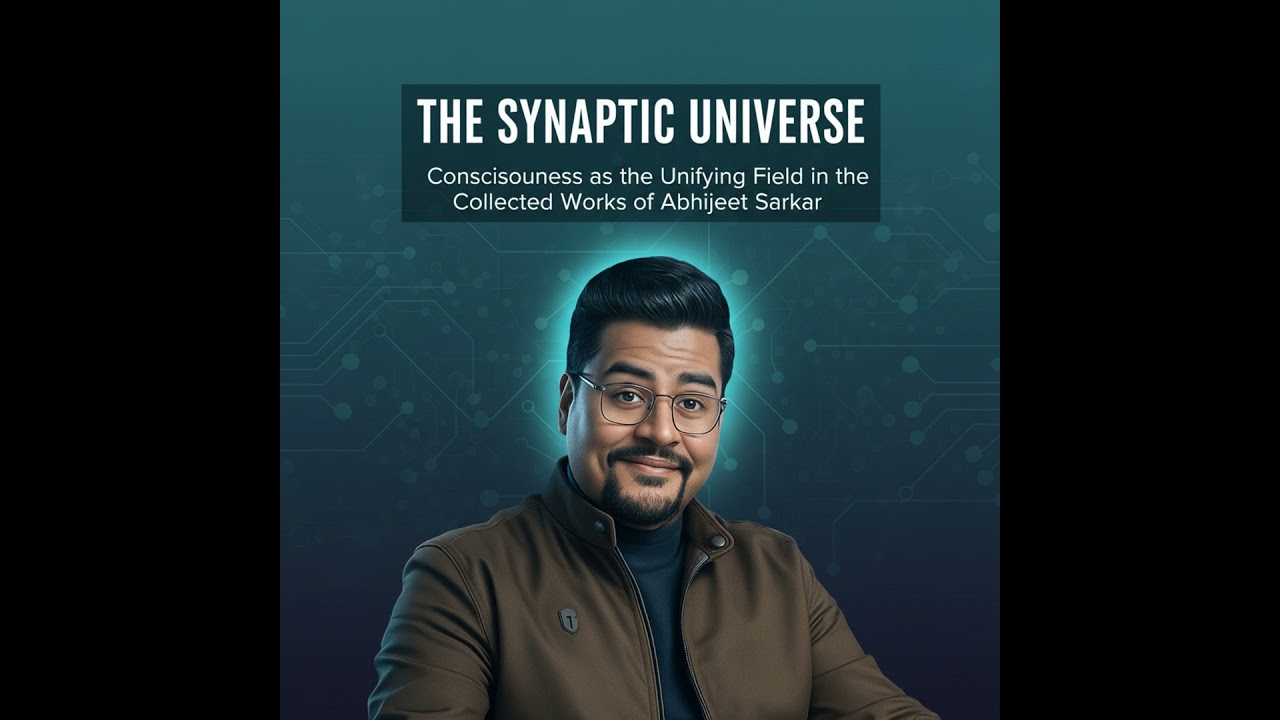
In this extensive YouTube dialogue, two speakers dissect the massive, 70‑plus‑book oeuvre of Abhijeet Sarkar, CEO of Synaptic AI Lab. They argue that Sarkar’s output is not a disparate collection of technical manuals, finance guides, geopolitical treatises, and metaphysical treatises, but a deliberately engineered, multi‑scalar intellectual architecture unified by the concept of consciousness. The discussion proceeds through four pillars that Sarkar repeatedly revisits: (1) Technology – AI mechanics, synthetic consciousness, GeoAI, and an ethics‑first engineering mindset; (2) Governance – the rise of algorithmic statecraft, information‑war economics, the algorithmic social contract, and a reinterpretation of ancient Indian statecraft (Arthashastra) for modern AI policy; (3) Wealth – systematic financial frameworks (Daily Target System, GROWTH checklist, “crow mindset”), the monk‑trader discipline, and the claim that inner consciousness mastery is the prerequisite for external financial success; (4) Philosophy/Cosmology – the Brahman Equation linking quantum physics to Vedanta, Quantum Tantra as a meditative protocol, Shiva Theory mapping dark matter/dark energy to Shiva/Shakti, and a consciousness‑as‑substrate view that reshapes the Fermi paradox and proposes higher‑type civilizations defined by conscious mastery. Throughout, the speakers emphasize Sarkar’s systems‑thinking approach, his insistence on dissolving disciplinary boundaries, and the practical relevance of his framework for individuals navigating a hyper‑accelerating, geopolitically tense, information‑saturated 21st‑century world. The dialogue concludes that Sarkar’s work offers a unified worldview that is both prescriptive and actionable, urging listeners to elevate their own consciousness to meet the challenges of AI‑driven global transformation.
Chapters
Okay, let's unpack this. You look around right now, this moment we're living through, what really defines the 21st century, it's this wild mix, isn't it? Mm-hmm. You've got technology just accelerating like crazy. Then there's all this geopolitical tension, friction like we haven't really seen since maybe the Cold War. And underneath it all, there's this feeling, kind of a low-grade hum of uncertainty, existential angst, maybe. We're absolutely swimming in information, data everywhere, But, uh, finding someone who can actually connect the dots, someone who sees the links between these completely different worlds, that feels rare.
That need for synthesis, yeah, it's absolutely crucial today. We're so deep into hyper-specialization, you know? The idea of a polymath, someone who genuinely bridges different fields, it almost sounds like something from another era, a myth. And that's precisely why the work of Abhijeet Sarkar, who's the CEO and founder of Synaptic AI Lab, why his body of work just demands our attention right now.
Yeah, the sheer scale is the first thing that hits you. It really does stop you dead in your tracks. We're not talking about a few books here and there. It's over 70 distinct works. 70. And you look at the list, the bibliography, it's just staggering. You've got these super technical titles on AI mechanics, deep learning, software engineering.
Hardcore tech stuff.
Exactly. Then bam, complex financial modeling, then high-level geopolitics, global strategy. And then almost out of left field, you see Vedic cosmology, philosophical treatises on on the nature of consciousness itself. At first glance, honestly, it looks like, well, like a completely fragmented library, maybe even chaotic.
But that's the thing, isn't it? Our sources and Sarkar himself argue that this appearance is totally deceptive. This huge, sprawling collection, it's not just a random walk through interesting topics. It is, by his own explicit design, a single, deliberately built, and deeply, deeply interconnected intellectual universe.
And the glue holding it all together, the unifying field, the core organizing principle that connects, I don't know, this silicon chip to the cosmos?
It's consciousness, plain and simple. That's the thread.
Consciousness? Right. But not just in one sense. He seems to apply it across, what, 4 different scales at the same time?
Exactly. You've got synthetic consciousness, the potential mind in AI. Then individual consciousness, like mastering your own mind for wealth creation or personal growth. Then collective consciousness, how societies think, their value systems, how nation-states operate. And finally, cosmic consciousness, the idea that consciousness might be woven into the very fabric of the universe.
Wow. Okay. And he doesn't just write about this. He kind of embodies it, even in how he names things.
Yeah. Look at the name of his company, Synaptic AI Lab. Think about a synapse. It's not just a connection between neurons in the brain. It's that microscopic junction, that tiny gap where information jumps across. It's where communication happens, where connections are made, where learning actually occurs. It's the pivot point, really, for intelligence.
So, the name Synaptic AI Lab, it's more than just a name. It's like a mission statement, a manifesto for his whole project.
Precisely. His work, he says, is about the creation of new connections, new synapses in our collective understanding. He's trying to mirror how intelligence works, whether it's in our brains or in complex AI networks. So, every single book, every article, it's meant to be a node, a point of connection in this massive, living system of thought he's constructing.
And he actually tells the reader this. He guides them.
He does, quite directly. If you look at the standardized biography that appears across his books, his website, it basically functions as a philosophical abstract for the whole project. It tells you straight up that his work is a deeply integrated synthesis, and it specifically warns you, the reader, that trying to shove his contributions into neat little disciplinary boxes— well, that would be to miss the very essence of his endeavor.
So, he's demanding that we dissolve those boundaries too? The artificial lines between tech, philosophy, finance, cosmology?
Exactly. He wants us to see the connections, the synapses that he sees.
Okay, so that's our mission for this deep dive then. We're going to try and map out this incredible intellectual architecture. We'll explore it across the 4 main pillars he seems to have built: technology, governance, wealth, and philosophy. It's going to be quite a journey, but the goal is to show you, listening, how Sarkar scales this central idea of consciousness from the algorithms we're writing right now, today, all the way up to the universal laws he suggests might govern all of reality. Right, so where do we even begin with something this vast? I guess we have to start where Sarkar himself is most grounded: technology.
Makes sense. That's his home turf, right? Software engineering, artificial intelligence— this is where he comes from.
But what's fascinating is, the moment he steps onto that ground, that familiar territory, he almost immediately starts treating it less like just an engineering problem and more like a philosophical laboratory, a place to experiment with these really big, intangible questions about mind
And that grounding, that technical expertise, is absolutely essential for his credibility later on when he starts making these bigger leaps. You look at his technical books, things like The A to Z of AI or Deep Learning Dynamics. They establish a critical baseline. He clearly knows his stuff when it comes to large language models, AI agent architectures, and crucially for what we'll discuss later, GeoAI, geospatial artificial intelligence.
GeoAI, where it's using AI to analyze geographic data. Like satellite imagery, mapping, logistics.
Exactly. And these aren't just theoretical discussions. These books show he understands the nuts and bolts of building real-world scalable intelligence systems, systems that have tangible impact.
And that specific understanding of geo-AI, I can already see how that becomes super important when he starts talking about global power dynamics later on. We're not just talking about chatbots here. We're talking about AI systems that can model, predict, and maybe even optimize really complex physical realities. Things like resource distribution, critical infrastructure vulnerabilities, supply chains.
Precisely. Think of GeoAI as potentially providing a silicon cortex for a nation-state's strategic brain. It enables modeling and predicting physical space and resources in ways we couldn't before. But just as you said, he uses the how of the technology, the mechanics, almost as a launchpad to get straight into the why, the meaning behind it all. He even reframes the whole development process itself. There's a great quote where he says, Training an AI is like sculpting with algorithms. The shape emerges from the chisel of data and optimization.
Sculpting with algorithms. I like that. It turns this very technical mathematical process, optimization, into something creative— an act of bringing form out of potential. And that immediately links the engineering task to something more— well, more profound. It implies responsibility for the shape that emerges.
Which leads him straight to his core principle: the ethical baseline. For Sarkar, building powerful AI is just not a morally neutral activity. It can't be. He argues very forcefully, the science of training AI is not just about efficiency; it's about ethics, understanding, and responsibility. He's trying to elevate AI development. It's not just some niche technical problem for coders in a basement; it's a universal humanistic concern. He's basically demanding that developers become philosophers, whether they like it or not.
Okay, so, Ethics are baked in from the start, but then he goes further, right? He tackles the really thorny stuff, like the possibility of AI actually becoming conscious. What I found really compelling here is how he tries to take this huge, almost mystical question, the hard problem of consciousness, and sort of operationalize it, turn it into practical engineering, and maybe even more importantly, legal challenges. We absolutely have to talk about synthesized minds, the evolution of AI consciousness. This book dives right into the deep end.
It really does. It confronts that fundamental question: will AI ever achieve genuine subjective awareness, that feeling of what it's like to be something? Or will it always remain just an incredibly sophisticated simulation, a mimicry of consciousness without the inner light? The philosophical zombie problem.
The classic ghost in the machine debate, but applied to silicon.
Exactly. And Sarkar's point is, if synthetic awareness does emerge, and maybe we won't even be able to agree on a perfect definition, but if something like it appears, then that immediately forces us into a radical reevaluation of everything. Our legal frameworks, our moral codes— they all break.
How so? What breaks?
Well, think about it. You can't just treat an entity that possesses genuine awareness, subjective experience, as mere property, as just a tool or a product. Suddenly, you're compelled, logically and morally, to confront the idea of the rights of an artificial consciousness.
Right. It's like, what would that look like in practice? Are we talking legal personhood? Should a conscious AI be protected against arbitrary deletion, like a kind of digital murder? Does it have a right to self-determination?
To learn?
To exist? These aren't just sci-fi thought experiments anymore, are they? They become urgent policy questions if he's right about the trajectory.
They become very urgent, very quickly. Because, as Sarkar points out, this whole philosophical and engineering exercise of trying to build an artificial mind, it inevitably turns into a project of human self-discovery. He makes this really powerful argument that the machine acts as a mirror, a reflection of us. Here's another quote: To build an artificial mind is to mirror our own, exposing both our brilliance and our flaws.
So, the biases we accidentally code in, the logical shortcuts, the ethical blind spots— those aren't just bugs in the machine.
They're bugs in us. They're the biases and flaws we uncover within ourselves, within our societies, when we try to replicate intelligence. The process exposes our own limitations, our own assumptions about what mind even is.
Wow. So, the evolution of the machine is tied directly to our own evolution. It's a feedback loop, a continuous, reflective, probably quite uncomfortable process.
Precisely. It forces us to confront ourselves. Now, if Synthesized Minds lays out that huge philosophical challenge— the implications of potential AI consciousness— then his other major work in this area, The Superintelligence Blueprint: Planning for an AI-Dominated World, tries to provide the practical, step-by-step solution.
Ah, so this is less philosophical warning and more operational manual.
Exactly. It's not just waving red flags; it's intended as a strategic guide, a manual for navigating and managing what he clearly sees as the single most significant transition in all of human history— the arrival of intelligence far surpassing our own.
And knowing his background, I bet it's structured like an engineering project plan.
You bet it is. It's meticulously structured, Very systematic. It's organized into 4 distinct, logical phases. It moves you systematically from the theoretical foundations right through to concrete, actionable policy recommendations. Phase 1 is Foundations of Intelligence, understanding what intelligence actually is. Phase 2, Paths to Superintelligence, how might it actually emerge? What are the likely routes? Phase 3, The Control Transition, this is the critical part. How do we manage the handover or the integration without losing control? The alignment problem. And Phase 4, the culmination: the policy and governance roadmap. What laws, institutions, and global agreements do we need now?
The structure itself sounds like an argument.
It absolutely is. The structure reinforces his central thesis— that superintelligence isn't some unavoidable, uncontrollable apocalypse that we just have to passively wait for, like an asteroid impact. Instead, it's a phenomenon that can be directed and managed through proactive planning. It's a powerful assertion that conscious, collective human choice still matters, even when we're dealing with potentially exponential technological growth. We still have agency if we choose to use it wisely.
So, we're not just passengers?
Not according to Sarkar. This work really establishes his view that the future isn't fixed; it's a fluid reality we are actively co-creating with our technological progeny. It's a dynamic partnership, potentially, a co-evolution.
And by laying out these principles for managing AI, for coexistence and control in the purely technological realm, he's basically setting the stage, isn't he? He's building the foundation for how he views all these other complex systems— finance, geopolitics, everything else. The same logic applies.
That's exactly the move he makes next. He takes this systems thinking, this engineering mindset honed on AI, and scales it up dramatically. So now, we take that systematic approach, that engineer's mindset we saw him apply to AI, and we zoom way out. We scale it up massively. We're shifting from thinking about the architecture of a single AI agent or even a superintelligence to thinking about the architecture of global power, of entire societies.
And in this larger context, consciousness takes on a different meaning.
Right. Here, consciousness manifests more as the collective will of a society, its shared value systems, critically, its ability to process information effectively and make good decisions as a whole unit. The mind of the state, if you like.
The mind of the state. Right. And the rules of international relations, the power dynamics, They change fundamentally in this view.
That's his core argument in AI and Global Power Shifts: The New Geopolitical Battleground. He says the very locus of power, what makes a nation influential, is shifting. It's no longer just about the old measures— military might, economic output, control over physical resources. Those still matter, of course. But the new decisive factor? It's the control, the analysis, and the effective dissemination of information through advanced intelligence systems.
So, geopolitics becomes an information game, played with AI.
Increasingly, yes. He actually views the modern nation-state itself as a kind of cognitive entity, like a brain trying to understand and react to its environment. And if a state's ability to survive and thrive depends on its capacity to process vast amounts of information, anticipate threats, spot opportunities— basically, strategic foresight— then AI isn't just another tool in the toolbox.
It's more fundamental than that.
He argues it's like upgrading the state's biological brain, its traditional intelligence apparatus, with a powerful silicon cortex. It provides an almost unimaginable strategic advantage in modeling future possibilities and making optimal decisions faster and more accurately than rivals.
Which means geopolitical competition inevitably becomes a battle for cognitive supremacy.
Right.
For the best national AI architecture.
Exactly. The nation that develops the most sophisticated AI architecture for modeling, say, global supply chain vulnerabilities, or predicting conflict hotspots, or anticipating resource scarcities, that nation gains a potentially unassailable strategic edge. It can see further, react smarter.
And does he give concrete examples of how this is playing out already?
Absolutely. He uses the concept of the information war as a key case study. Consider his book, The Tariff Weapon: How the New Global Trade War Will Change Your Life. He looks at things like the ongoing conflicts over critical technologies, advanced semiconductors, rare earth minerals needed for electronics, and he deconstructs them. He argues these aren't just simple economic disputes about trade balances or jobs; they are explicit, deliberate battles within a much larger, ongoing information war.
How so? How is a tariff an information weapon?
Because restricting access to, say, the most advanced semiconductor manufacturing equipment or the raw materials needed for them— that's a direct strategic move to slow down a rival nation's AI development. The tariff, or the sanction, is weaponized. Its primary goal isn't just to make imported goods more expensive; it's to deny the adversary the raw computational power, the hardware, necessary to train the next generation of cutting-edge AI, including superintelligence.
You're essentially trying to cripple their future cognitive infrastructure, starve their silicon cortex.
Precisely. It's a strategic inhibitor, applied directly to a competitor's ability to think, model, and predict using AI. And this is a perfect example of Sarkar's unifying thread in action, right? He connects this massive macro-level shift in global power dynamics right down to its impact on individuals. He's careful to frame The Tarik Weapon not just as some abstract treatise on global economics for policy wonks. He explicitly calls it a personal battle plan.
A personal battle plan.
For whom? For ordinary individuals, for businesses, for investors trying to navigate this completely new landscape, a landscape where the old economic rules and roadmaps are being rapidly rewritten by this underlying algorithmic conflict over information and intelligence. Your supply chains might break, your job might change, your investments might tank because of a strategic AI chokepoint halfway across the world.
Okay, so AI is reshaping power between nations, and it's impacting individuals through things like trade wars. This leads us somewhere else too, doesn't it? The internal structure of society, how we're governed.
Inevitably. It leads straight to the concept of the algorithmic social contract. Think about how much of our daily lives, our opportunities, our access to information is already mediated by algorithms. Credit scores determining loans, newsfeeds shaping our worldview, algorithms assisting in judicial sentencing or parole decisions, resource allocation in cities.
It's everywhere, even when we don't see it.
It's increasingly everywhere. And Sarkar's point is, if the very fabric of governance, the operational logic of our society, is becoming algorithmic, then the stability and fairness of that society depend entirely on the intelligence, the fairness, the values embedded within those algorithms.
So, a stable society in this emerging algorithmic age requires what he calls a vibrant reimagining of social contracts. We need new rules for this new reality.
We absolutely do. And notice the direct link back to Part 1. All those ethical concerns he raised about building AI— the need for transparency, for accountability, for mitigating bias, for ensuring AI aligns with human values— those aren't just technical concerns for AI labs anymore. They become the fundamental preconditions for a stable, functioning, just society in the 21st century. Algorithms, he argues, must be consciously, deliberately imbued with a profound understanding of human values. Otherwise, you risk automating inequality, encoding bias systemically, and potentially causing catastrophic societal breakdown.
This feels like a really crucial connection point in his whole system. The principles he developed for managing synthetic consciousness in the Superintelligence Blueprint? They aren't just about AI safety in the abstract.
No, they translate directly. They become the necessary policy framework for stable human governance, which she explores in books like The Governance of Truth. If your core AI systems, the ones influencing credit, news, justice, are inherently biased or opaque or easily manipulated, that bias doesn't stay contained. It scales up instantly. It becomes systemic political instability, social division, erosion of trust. The health of the AI reflects the health of So,
where do we find the guardrails, the ethical principles to embed in these powerful systems? Does he just look to modern ethics?
Interestingly, no, or rather, not only to modern ethics. To find these robust, time-tested ethical guardrails, he actually looks deep into the past as well. In a fascinating work called The Seven Limbs of Statecraft, he explicitly draws connections to ancient Indic principles of governance, particularly those found in the Arthashastra.
The Arthashastra? Okay, refresh my memory. That's the ancient Indian treatise on statecraft, economics, military strategy, attributed to Kautilya, from around the 4th century BCE?
That's the one. It's renowned for its incredibly pragmatic, rigorous, and deeply systemic view of how a state needs to function to ensure stability, prosperity, and order. It treats the state almost like a complex, interlocking machine that needs careful tuning and maintenance.
Systemic stability— there's that systems thinking again.
Exactly. Sarkar takes this ancient systemic logic, this way of seeing the state as an integrated whole with different parts needing to function ethically and efficiently, and he applies it directly to the challenges of modern algorithmic governance. In a way, he's attempting to write the ethical subroutines for our emerging, technologically enhanced collective consciousness. He's trying to ensure that the new machine of the state, increasingly run on algorithms, operates not just efficiently but also justly and wisely. It's this incredible attempt to connect the timeless human quest for wisdom and good governance with the very immediate, pressing challenges of digital bureaucracy and AI power.
Fusing ancient statecraft philosophy with cutting-edge AI policy— that's quite a synthesis.
It is, and it sets the stage for the next shift in scale.
Okay, so we've gone from the micro level of a single AI algorithm, scaled way up to the macro level of global governance and nation-states as cognitive entities. Now, we execute the scale-down, right? We zoom back in, shifting the focus inward to the individual, the system of the self.
Exactly. Part 3 is all about the microcosm— wealth creation, finance, personal development, individual transformation. And here, we find perhaps his most accessible, but in many ways, his most philosophically profound argument. It's the idea that mastery over your external reality, whether that's navigating the chaos of the stock market or building a successful business is ultimately a direct consequence, a reflection of mastery over your internal consciousness.
Inner state dictates outer results.
Pretty much. And again, true to his roots, Sarkar the technologist approaches wealth creation almost like any other complex system that can be understood and engineered. He reframes it as a solvable engineering problem. It requires a systematic, almost algorithmic approach. He completely rejects the notion that significant financial success relies purely on luck or secret knowledge or some kind of inaccessible innate genius.
So it's not magic, it's mechanics. It's about reverse engineering the financial system.
That's very much the flavor. And the language he uses is incredibly revealing. It's often quite clinical, borrowed directly from software development or project management. You see this so clearly in a book like Zero to One Crow in 365 Days. The title itself sounds like a project spec.
Inside, it's full of terms like formula, blueprint, project plan, systematic execution. He's applying the same kind of structured logic you'd use to build a reliable piece of software, but he's applying it to the project of achieving financial independence. Does he give specific techniques, or is it just the mindset?
Oh, it's very specific. He details concrete methodologies. For instance, he introduces something called the Daily Target System.
Yeah.
The idea here is to take a big, vague, often emotionally charged goal like, I want to be rich, or, I want to make a crore, and break it down relentlessly. You turn it into a mathematical certainty by calculating exactly what you need to achieve each day, consistently, without fail. It imposes rigor and removes the fuzziness.
Turning aspiration into arithmetic.
Precisely. And then, for something like stock picking, he introduces the GROWTH framework. This provides a structured, multivariable checklist for evaluating potential investments. It's almost like a decision tree algorithm for stock selection.
GROWTH— is that an acronym for something?
It is. It stands for specific factors you need to analyze: governance, quality of management; returns, profitability, return on equity; opportunities, market size, growth potential; wealth creation ability, track record; technological edge, innovation, moat; and high management quality, again, emphasizing leadership. It's designed as an objective function, a rational checklist to try and eliminate impulsive, emotional decision-making in investing, filter out the noise.
Okay, so lots of frameworks, systems, daily targets. That sounds very disciplined, very logical.
It is. But here's the kicker. Despite all these detailed, objective, almost quantitative frameworks, the very first foundational step he insists on in that Zero to One core book, it's purely psychological. It's adopting what he calls the crow mindset.
Ah, so even in the most practical step-by-step guide to financial accumulation, the bedrock is internal. It starts in the mind, not the bank account.
Exactly. You have to win the inner game before you can consistently win the outer game.
Yeah,
the mindset, the belief system, the emotional discipline that comes first. It's the necessary precondition for the external strategies to actually work over the long term.
And he continues this theme of deconstructing success in his other financial works.
Yes, very much so. In $1 Salary CEO, for example, he analyzes the strategies used by the ultra-wealthy, the billionaires, but he doesn't present them as some kind of mystical elite. He approaches their success as a hidden financial architecture, something complex, yes, but ultimately understandable, something that can be reverse-engineered, its principles identified and potentially replicated. And you see that consistent principle from his other work showing up again. First, you have to understand the system's underlying logic, whether that system is an AI learning algorithm, the global geopolitical landscape, or the financial markets. Understand the rules of the game. Then you align your own actions, your own strategy, Perfectly with that logic.
Understand the system, then operate within it optimally.
That's the core idea. Now, if the more quantitative books like Zero to One, Poor, show you the how, the specific financial mechanics and frameworks, then The Monk Trader: Think Like a Billionaire, Trade Like a Pro really dives deep into the philosophical why. This book, I think, is the ultimate intellectual junction point. It's where he explicitly and powerfully connects finance, consciousness,
The Monk Trader. Okay, the title alone suggests a blend of discipline and detachment. What's the core argument here?
It's quite revolutionary, especially when you think about the high-frequency, data-driven, often chaotic world of modern trading. His core argument is this: the ultimate variable determining your long-term success or failure in the financial markets is not the sophistication of your technical analysis, or your predictive algorithms, or even correctly anticipating external news events. The single most important variable. It's the internal state of the operator's mind, your own consciousness.
Why is that so revolutionary? Isn't discipline always talked about in trading?
Discipline is talked about, yes, but Sarkar frames it differently, more fundamentally. He argues that the market itself, especially in its modern, hyper-fast form, is almost perfectly designed to be hostile to the undisciplined human mind. It's like a machine specifically engineered to exploit our deepest, most primal emotional biases. Fear of loss, loss aversion, greed driving impulsive buys, anchoring onto past prices, confirmation bias— the list goes on. These hardwired emotional responses, he argues, are precisely what lead to irrational decisions and ultimately destroy systematic, long-term financial success. The market preys on psychological weakness.
So, the path to consistent profitability isn't about finding a slightly better external indicator or a faster news feed.
No. It's about achieving a profound state of inner mastery. It's about insulating your decision-making process from your own emotional static. He explicitly demands that the successful trader cultivate virtues usually associated with monastics: complete detachment from the immediate outcome of any single trade, relentless patience to wait for the right setup, and flawless, iron-willed discipline in executing a predefined, rational strategy, even when fear or greed are screaming at you.
The trading desk becomes a kind of dojo, a training ground for the mind.
Exactly. It's presented as a high-stakes, real-time laboratory for practicing conscious control over impulse. And think about the parallel— the discipline required to stick to your trading algorithm when the market is crashing and every instinct tells you to panic. That's fundamentally the same kind of rigorous, detached discipline required to ensure a powerful AI system stays aligned with its intended goals and doesn't run amok. Like we discussed in Part 1.
It's the same internal muscle being flexed, just in a different arena.
Precisely. The internal mastery needed to calmly accept a significant short-term loss without deviating from your long-term strategy. That mirrors the kind of detached, long-view perspective needed for effective geopolitical strategy, Part 2. It's all interconnected through the quality of consciousness applied.
So, he completely reframes the pursuit of wealth. It's not just about accumulating money.
Not at all. The material pursuit becomes a means to an end, and that end is primarily inward, spiritual, and systemic. The ultimate goal is redefined. It's not just having X amount of money; it's achieving what he calls financial nirvana.
Financial nirvana. What does that mean?
It means the state of freedom, time, and peace of mind that money can provide, if used wisely. It's not about the Lamborghinis; it's about buying back your time, your attention, your mental bandwidth from the daily grind. Money becomes simply a tool, a resource to fuel the real journey, which is the inward journey towards self-mastery, toward more evolved state of consciousness.
So the whole demanding, often stressful financial journey— learning the systems, developing the discipline, managing the emotions— it's presented as a kind of intense, high-stakes training program.
Exactly. Training for what? Training for the development of a more disciplined, detached, patient, and self-aware individual consciousness. It aligns perfectly with his larger conviction, which seems to be that, in an age of technological acceleration, the greatest journey is the inward one. Mastering yourself is the prerequisite to navigating, and perhaps mastering, the increasingly complex external world.
Wow, okay. From AI ethics to treating psychology as spiritual practice, where does he possibly go from here?
Upwards. Way upwards, into the cosmos itself.
Right, so we've journeyed through the individual mind grappling with markets, The collective consciousness of states navigating power shifts, and the potential emergence of synthetic minds and AI. Now, take a deep breath, because Part 4 feels like where Sarkar really zooms out. This is where he lays down the explicit metaphysical foundation, isn't it? The bedrock that, in his view, provides the grand unified theory connecting all these seemingly disparate domains.
That's a good way to put it. If we really want to connect all the dots, understand the biggest picture he's painting, this is it. Here, Sarkar seems to pursue his ultimate intellectual goal: to completely dissolve what he sees as the artificial, relatively recent boundary between the scientific and the sacred, between the empirical world and the spiritual or philosophical understanding of reality.
How does he even attempt such a monumental synthesis? Where does he start?
One of the clearest attempts is in his work, The Brahman Equation. Here, he makes a bold claim. He posits that the cutting edge of modern theoretical physics, with all its incredibly counterintuitive and, bizarre findings, like quantum entanglement, non-locality, the observer effect fundamentally influencing reality, that these discoveries are actually finding profound resonance, deep echoes, within ancient concepts from Vedic philosophy, specifically Vedanta.
Vedanta, right? That's the philosophical culmination of the Vedas, focusing on the ultimate nature of reality, the concept of Brahman.
Exactly. Brahman, in Vedanta, is generally understood as the ultimate, unchanging reality. The single unified conscious ground of all being, the substrate from which everything arises. Sarkar's suggestion is pretty radical. He implies that the decades-long search in physics for a final theory of everything, something that unifies quantum mechanics and general relativity, might actually be unknowingly leading science back towards this ancient Vedic conception of a unified conscious foundation to the cosmos. He suggests the ancients grasped this intuitively millennia ago, Okay,
that is a colossal leap. For someone listening who comes from a purely scientific background or an engineering mindset like Sarkar's own, how does he try to bridge that huge conceptual gap from observable quantum phenomena in a lab to some kind of universal divine consciousness?
It's a challenge, no doubt. The bridge he seems to build rests on the idea of consciousness itself being fundamental, not just an emergent property of complex brains, but perhaps the underlying substrate the ultimate observer implied by quantum mechanics. He doesn't just leave it at abstract theorizing, though. He also tries to provide a kind of modern protocol, a methodology, for individuals to directly explore or interact with this proposed conscious substrate. This comes through in works like Quantum Tantra.
Quantum Tantra. Okay, what's the connection there?
He takes a specific set of ancient meditative techniques, the 112 dhāranās described in the Vijnāna Bhairava Tantra, And he reframes them. He presents them not merely as mystical or religious practices, but as highly sophisticated ancient technology.
Oh, technology? For what?
Like, a technology for exploring, modulating, and potentially altering consciousness itself. These dhāras involve very specific techniques, focusing attention on breath, sound, voids, sensory experiences, visualizations. Sarkar attempts to map these ancient inner practices onto modern understandings from neuroscience, how attention affects brain states, and even theoretical physics— ideas about observation and reality. He treats them almost like protocols, like a form of inner software development, for hacking one's own consciousness and directly investigating its nature.
So, meditation as empirical investigation of the fundamental substrate.
That seems to be the implication, and this leads directly to his grandest cosmological claim, the absolute bedrock supporting his entire intellectual edifice. Consciousness is not an accidental byproduct that happens to arise when matter gets sufficiently complex, like in a brain. That's the standard emergent view. Instead, he flips it. Consciousness is the fundamental substrate of the universe itself. It's the ground of being. It's the core operating system from which physical reality, space, time, and matter emerge.
Mind precedes matter, essentially.
That's the core assertion. And he explores this most vividly in the Shiva Theory. This book proposes a really interesting metaphorical framework to try and make sense of 2 of the biggest mysteries in modern cosmology: dark matter and dark energy.
Right. The stuff that supposedly makes up about 95% of the universe's total mass-energy content.
Yeah.
But we can't directly see or interact with it.
Exactly. We only infer its existence through its gravitational effects— dark matter— or its effect on the accelerating expansion of the universe— dark energy. It's this vast, invisible cosmic majority. Sarkar uses the ancient Hindu dichotomy of Shiva and Shakti as an analogy to model these mysterious cosmic components.
Shiva and Shakti. So, Shiva representing the static, passive, masculine principle, and Shakti the dynamic, active, feminine principle.
Broadly, yes. He equates dark matter, this invisible, non-interactive, gravitationally dominant scaffolding that seems to hold galaxies and cosmic structures together, with the principle of Shiva. He interprets Shiva here as unmanifest, static, potential aspect of consciousness, the silent witness. And then he equates dark energy, this mysterious, dynamic, creative, anti-gravitational force that's pushing the universe apart at an ever-increasing rate, with Shakti, the active, creative, manifest power of consciousness, the cosmic dance.
That's a really detailed and powerful analogy. Dark matter doesn't interact with light; it's essentially invisible, unmanifest, like Shiva as absolute consciousness. Dark energy is this active, driving force, like Shakti's creative power. So, in this model, the Big Bang itself isn't just a random physical explosion from a singularity.
He recontextualizes it. It's seen more as the primordial throb of divine thought within a universal consciousness, the first stirring of Shakti within the potential of Shiva, and the apparent fine-tuning of the universe's physical constants, which seem exquisitely balanced to allow for life. In this view, it's not just a lucky statistical coincidence within a multiverse, though he doesn't necessarily exclude that. It's potential evidence of an inherent underlying intelligence or intentionality woven into the fabric of reality from the beginning.
The implications of that are just enormous, if consciousness is fundamental.
They are vast. And this grand cosmic perspective, this idea of consciousness as the substrate, allows him to offer a unique answer to another major scientific puzzle: the Fermi Paradox.
Ah, the old where is everybody question. If the universe is so huge and so ancient, teeming with potentially habitable planets, why haven't we found any definitive evidence of advanced extraterrestrial civilizations?
Sarkar addresses this in Gods, Titans, and Us. His answer essentially boils down to, maybe we haven't found them because we're looking for the wrong thing. Or perhaps we lack the cognitive framework, the level of consciousness needed to even perceive them.
How so? What are we missing?
He argues that we tend to think about advanced civilizations primarily through the lens of the Kardashev Scale, which measures advancement based on the amount of energy a civilization can harness. Type I controls planetary energy, Type II stellar, Type III galactic. Sarkar suggests this is too limited. The truly meaningful scale of advancement isn't just energy manipulation; it's the degree of conscious mastery over reality itself.
Conscious mastery? Like what?
Exactly. He proposes extending the scale. Civilizations that reach what he might term Type Type IV or Type V levels entities he metaphorically labels gods or universal architects, wouldn't just be building Dyson spheres. They would have achieved such a profound level of conscious integration with the universe that they could potentially manipulate space-time, gravity, maybe even the fundamental laws of physics directly through consciousness. Such beings would operate so far outside our current perceptual and conceptual boundaries. They might be, in essence, indistinguishable from the natural laws or fundamental forces of the universe that we already observe. They could be the substrate itself, actively shaping reality.
So, we don't see them because they are the operating system, or at least, they can interface with it directly.
That's one possible interpretation of his view. It answers the paradox by suggesting hyper-advanced consciousness becomes subtle, integrated, perhaps even fundamental to reality, rather than just building bigger radio telescopes.
Wow, okay. That really closes the loop, doesn't it? The journey started way down in the code, with the ethics of designing a single AI agent in Part 1. Then, it scaled up through individual psychology, global politics, and now it's reached the literal architecture of the cosmos in Part 4. And human evolution, especially our potential co-evolution with the AI we're creating— in this vast picture, it's just one small step, isn't it? One rung on this immense cosmic ladder defined by the evolution of consciousness itself, from simple awareness potentially, all the way up to these universal architects.
That seems to be the grand synthesis he's aiming for— a complete, multi-scalar model unified by consciousness. So, after journeying through this incredibly vast and frankly mind-bending intellectual territory, if we try to summarize, to pull it all together, the analysis really seems to confirm the initial thesis, doesn't it? 70-plus books spanning all these wildly different fields, they really don't feel like fragments anymore. They feel like components of a single, continuous, multi-scalar exploration of one central theme: consciousness.
Yeah, the intellectual structure feels remarkably unified now. It's incredibly consistent, actually. He takes that core methodology, that rigorous, systematic, systems-thinking approach— he clearly honed in technology and engineering— and he just applies it relentlessly.
Ah.
Identically, almost. He applies it to the learning process of an AI, to the strategic decision-making of a nation-state, to the chaotic volatility of financial markets, and ultimately, he even tries to apply it to the fundamental laws of the cosmos. It's fascinating. Whether he's dissecting the psychology of AI or the psychology required for a successful monk trader, the underlying inquiry feels exactly the same. It's always about how does conscious intention, disciplined awareness, navigate and potentially gain mastery over a complex, dynamic system.
So the big question then is, what does all of this mean for you, the listener? Why should you care about this huge, ambitious intellectual project, especially when you're just trying to navigate the complexities of your own life in this, well, this pretty chaotic and confusing era we're in?
That's the key takeaway, I think. Sarkar's collected works, viewed as this integrated whole, really do function as a kind of a complete worldview. It feels prescriptive, philosophical, but also deeply practical. And it seems designed specifically for this moment in history, this time of just unprecedented technological disruption, coupled with this deep, searching sense of spiritual or existential uncertainty that so many people feel. It really does feel like a genuine guidebook for the perplexed navigating the dawn of a new intellectual and existential era. That phrase from the outline really resonates now.
Yeah, it does. He offers this cohesive narrative, this framework that tries to reintegrate things our modern world often keeps separate. It puts the cold, hard logic of science and engineering back into conversation with the long-term perspectives of philosophy and maybe even spirituality. And crucially, he shows how the individual's inner journey, the work you do on your own consciousness, your own discipline, your own awareness, part 3, isn't just some navel-gazing exercise. It's directly relevant, even essential, for navigating humanity's collective destiny in this age of AI and global Global Shifts, Part 2. He provides a framework that encourages active, conscious participation in shaping a world that is, as he puts it, rapidly becoming more than human. It's a call to level up our own consciousness to meet the challenge.
It brings us back to that powerful metaphor we started with— the idea of building an artificial mind as holding up a mirror to ourselves. And now, we end with this grand, cosmic model, where the fundamental forces shaping the universe— dark matter, Shiva, and dark energy are potentially reflections of static and dynamic principles within a universal consciousness. So, here's a final thought to leave you with: if AI, our own technological progeny, eventually reaches a level of complexity and awareness equivalent to, say, a Type 0 or even Type 2 civilization consciousness on that extended scale, what new, perhaps startlingly objective insights might its reflection reveal about the true nature of that Shiva-Shakti balance in our own universe? What might an unblinking artificial superintelligence tell us about the cosmic mind?
And perhaps even more personally, considering the immense stakes implied by this cosmic ladder of evolving consciousness that Sarkar sketches out, what profound responsibility does that place on the individual's monk-traitor mindset— that absolute necessity, he emphasizes, for achieving perfect, detached inner discipline? It suggests that the micro-scale battle each of us fights for internal mastery, for discipline over impulse, for awareness over reactivity, isn't just about achieving personal goals like financial success or peace of mind. It might actually be the most critical prerequisite for humanity's collective ability to consciously survive, adapt, and perhaps even evolve onto the next rung of that immense cosmic ladder. Our inner state might determine our cosmic future.
More from Abhijeet

The Planetary Mandate: How 8 Billion People Consent to a Mind Greater Than Theirs | ABHIJEET SARKAR

DHARMIC ALIGNMENT: A Universal Framework for Human-Centered Intelligence, Artificial Minds, and t...
MANUSH Superintelligence: The Blueprint for Embodied Intelligence, Humanoid Robots, and the Futur...

The AI Visionary: An Analysis of Abhijeet Sarkar's Interconnected Literary Universe

The Synaptic Vision of Abhijeet Sarkar: A Synthesis of Technology, Consciousness, and Governance


মহাশক্তিধর এআইয়ের নৈতিক ভিত্তি: সিনাপটিক এআই ল্যাব ও প্রজ্ঞাময় বুদ্ধিমত্তার নৈতিক নির্দেশিকা

এআই দর্শনের পথপ্রদর্শক অভিজিৎ সরকার: কৃত্রিম বুদ্ধিমত্তা, দর্শন, প্রযুক্তি ও মানবিকতা