MANUSH Superintelligence: The Blueprint for Embodied Intelligence, Humanoid Robots, and the Futur...
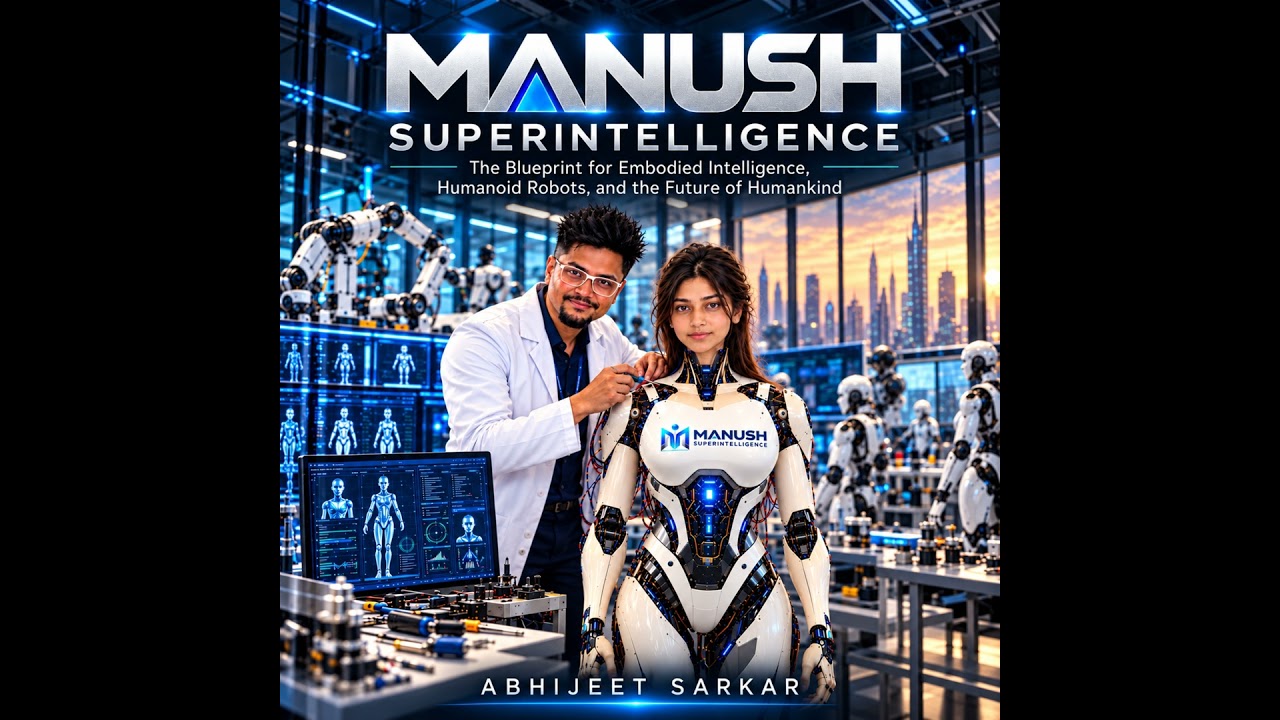
In this hour‑long discussion, the hosts unpack the 68‑chapter "Manoush Superintelligence: The Blueprint for Embodied Intelligence, Humanoid Robots, and the Future of Humankind" unveiled by Abhijeet Sarkar (CEO, Synaptic AI Lab) on 27 Sept 2026. They trace the problem of relying on cloud‑based control loops (300 ms latency) and explain why real‑time balance must stay on‑board. The conversation walks through the historical context (Turing’s two AI routes, Moravec’s paradox) and defines embodied intelligence as reliable physical action, not language output. Key technical breakthroughs are highlighted: proprioceptive actuators that sense force via motor current, massive GPU‑parallel physics simulation enabling rapid model‑predictive control, and the cross‑embodiment formulation where a single 32‑slot action vector powers humanoids, quadrupeds, arms, wheeled carts, and service bases via hardware adapters. Economic analysis shows that a shared AI brain amortized over thousands of diverse robots is the only way to make the system financially viable; otherwise per‑unit costs explode. The blueprint warns of negative transfer when data from one embodiment contaminates another, and mandates per‑body verification. Safety is enforced by the "staleness rule" (local spine must receive commands at >100 Hz or enter safe‑hold) and by a Simplex SafeCore hardware veto that can cut power within 10 ms. Detailed engineering challenges are explored: bipedal dynamics (ZMP, capture point), knee actuator design trade‑offs (gear‑ratio reflected inertia vs weight), thermal limits in 45 °C Indian summers (knee motor reaching 119 °C, battery derating to 1.2 kWh), and the resulting sub‑2‑hour shift limit. The data‑flywheel is built on tele‑operation demonstrations (≈10 000 demos/day at ₹23.15 each) and a selective trigger system that uploads only failure or rare‑success clips plus a 1 % random baseline for statistical validity (Wilson score interval). The roadmap outlines a 20‑year, five‑phase plan (2026‑2046), a frugal‑not‑cheap design philosophy, supply‑chain gaps, a robots‑as‑a‑service (RaaS) pricing model (≈₹95 k/month vs ₹55 k human cost), and target markets where safety outweighs wage replacement. Finally, the blueprint declares a strict anti‑weaponization ethic, emphasizing "amplification, not replacement" and envisioning a 2046 scenario where humanoids perform hazardous tasks under remote human supervision, upgrading human dignity rather than displacing workers. The discussion ends on a speculative tension between a rapidly learning global AI mind and static hardware safety limits.
Chapters
Imagine a 60-kilogram metal humanoid trips over a misplaced box on a factory floor. Its sensors register the tilt, and it fires off a message to a massive supercomputer in the cloud, basically asking, you know, hey, I'm falling, how do I catch my balance?
Right, which sounds smart in theory.
Exactly. And that supercomputer is incredibly smart. It calculates the perfect physical maneuver and sends the instructions back. And that whole round trip takes just 300 milliseconds.
Which is fast for the internet, but not for physics.
Right. Because it's a huge problem. By the time that brilliant answer actually arrives, the robot has already smashed face-first into the concrete.
Yeah. Gravity really does not wait for a ping rate.
It does not. So today, for everyone listening, we are looking at the literal architectural blueprint for how to stop that from happening. We are diving into a document that frankly feels like it fell out of the year 2050, but it is very much a reality today.
It's an incredibly ambitious piece of work.
It really is. It's a highly detailed 68-chapter companion blueprint and position paper titled Manousheh Superintelligence: The Blueprint for Embodied Intelligence, Humanoid Robots, and the Future of Humankind.
And the context here is absolutely crucial. So September 27th, 2026, that marks the official launch date of Manousheh Superintelligence.
Oh, wow. Right.
Yeah. Abhijeet Sarkar, the CEO and founder of Synaptic AI Lab Private Limited, publicly unveiled this initiative on that date. And the whole goal is to outline this really brutal, unforgiving transition from the screen-bound AI we all know.
Like the chatbots and image generators, right?
Exactly. The text predictors, all of that. Transitioning from that to physical embodied intelligence. Meaning AI that actually powers autonomous machines, humanoids, and real robotics out in the world.
Okay, let's unpack this. Because getting AI out of a browser tab and into a moving machine is wild enough. But they aren't just building any machine. They are building humanoids specifically designed to survive the unique, you know, environmental and economic realities of India, or Bharat.
Which completely changes the engineering math. I mean, building a robot for a pristine, climate-controlled lab in Silicon Valley is one thing.
Right, where everything is perfectly flat and air-conditioned.
Exactly. Building a machine meant to survive an Indian summer, navigate totally unpredictable infrastructure, and still somehow be economically viable, that is a fundamentally different scientific challenge.
So we have this massive stack of source material today. I'm talking equations for thermal limits, battery chemistry, hardware safety vetoes, and some genuinely terrifying statistics about what happens when a neural network hallucinates. while controlling heavy machinery.
Yeah, that part is sobering, to say the least.
But let's start with a big glaring question that this entire document tries to solve. Why on earth has it been so easy to teach a computer to write, like, a flawless legal brief, but so unbelievably hard to build a robot that can walk across a messy room without face-planting?
Well, to really understand that, the paper actually takes us all the way back to 1950.
Oh, wow. Going back to the beginning.
Yeah. Alan Turing, basically the father of computer science, wrote a paper proposing 2 possible routes to creating artificial intelligence. He said, you know, we could focus on highly abstract processes like playing chess, doing complex math, processing language.
Okay. The brainy stuff.
Right. Or alternatively, we could take the physical route, give a machine the best sense organs money can buy, and force it to interact with the real world, learning exactly the way a human child does.
And looking around at the last decade, we obviously took the first route, right? We poured all our billions into abstract language models.
We did. And the reason we basically abandoned the physical route early on is captured by something called Moravec's paradox.
Moravec's paradox. What is that exactly?
So back in the 1980s, roboticists like Hans Moravec realized something incredibly counterintuitive. They found that high-level reasoning, like logic puzzles, algebra, or playing Jeopardy! actually requires very little computation compared to low-level sensory motor skills.
Hold on. Let me put myself in the shoes of someone building this stuff in the '80s. You're telling me it takes more raw computing power to figure out how to pick up a coffee mug than it does to beat a grandmaster at chess?
That is exactly what I'm saying.
That just doesn't feel right. I mean, when I pick up a mug, I'm not even thinking about it. But if I try to play chess, my brain literally hurts.
And that right there is the paradox. For you, picking up a mug is totally effortless because evolution spent hundreds of millions of years hardwiring your brain's motor cortex, your nervous system, your proprioception.
Oh, so I've already done the math without knowing it.
Exactly. It manages gravity, friction, and spatial awareness automatically. But chess— chess is only a few thousand years old. It's a new artificial construct, so it feels hard to us.
That makes total sense.
Right. But for a computer starting from scratch, chess is just a tiny grid of 64 squares with rigid mathematical rules. The real world— the friction of a ceramic mug, the shifting weight of the liquid inside, The unpredictability of a table's surface, that is infinitely more complex.
So our current AI is basically a super genius trapped in a jar.
That's a great way to put it. Yeah.
I mean, if I type a prompt asking an LLM for the chemical breakdown of coffee, it gives it to me instantly. But if I say, hey, look through this camera, see that mug, and guide a mechanical hand to grab it without shattering the porcelain, it completely freezes.
It does. And the paper actually offers a very strict working definition to separate the two. It states that embodied intelligence is measured purely by what a machine reliably does to the physical world, not by what it says about it.
Doing over saying?
Right. But the Manoush blueprint argues that between 2015 and 2026, several distinct technological curves finally crossed, making Turing's second route possible.
Okay, let's break those down. Because I remember the DARPA Robotics Challenge in 2015. If you're listening and you haven't seen those videos, you have to look them up.
Oh, they are legendary.
It was supposed to be the absolute cutting edge of robotics. And it was just clip after clip of these multimillion-dollar, state-of-the-art robots trying to, like, turn a valve, pausing for 30 seconds, and then just tragically slowly collapsing into a heap on the floor.
Yeah, it was a brutal reality check for the industry. In an automotive factory, industrial robots are flawless because the environment is perfectly controlled, right? Everything is bolted down to the millimeter.
Right. There's no chaos.
Exactly. But humanoids have to survive a world built for humans, and humans are incredibly chaotic. To survive that chaos, the first massive leap was the development of cheap proprioceptive actuators.
Okay, stop right there. Proprioceptive actuators. Make it make sense for me like I am 5 years old. What does that actually mean?
So proprioception is basically your body's ability to sense its own position and movement. If you close your eyes right now, you still know exactly where your arm is in space.
Right.
You know exactly how hard your feet are pressing against the floor.
Right. Because I can feel the tension in my muscles. Right.
Perfect. Old robots couldn't do that at all. They just spun a motor until it hit a specific pre-programmed angle.
So if there was a rock in the way—
The motor would just blindly keep pushing until either the rock moved or the robot broke. It had no feeling. A proprioceptive actuator is a totally new motor design that can actually read the physical resistance of the world through its own electrical current.
Oh, wow!
Yeah. So when the robot's foot hits the ground, the force of the impact pushes back against the motor, causing a tiny spike in the electrical current. The robot reads that spike and instantly feels the ground.
So you don't need to cover the robot's foot in hundreds of fragile, expensive pressure sensors. The motor itself acts as the sensor. It just feels the resistance.
Exactly. It's incredibly elegant. And then you add the second curve to that, the explosion of GPU parallel simulation.
Okay. How does that change things?
Well, before, if you wanted to teach a robot to walk on gravel, you had to physically put a million-dollar robot on real gravel, watch it fall over, pick it up, tweak the code, and try again. It literally took months.
That sounds agonizing.
It was. But now we can simulate contact-rich physics— friction, gravity, joint elasticity— so incredibly fast that we can throw a virtual robot into millions of simulated environments simultaneously.
Wait, simultaneously?
Yeah, a virtual robot can experience years of trial and error in about 20 minutes on a single workstation.
20 minutes to learn to walk. That is wild.
And those skills now transfer beautifully from the simulation into the real physical motors. Combine that with vision-language-action models, or VLAs—
Which allow the robot to finally connect the abstract reasoning of an LLM to actual physical movements, right?
Exactly. Add in massive drops in the cost of teleoperation, and those are the overlapping curves that finally make Manoushe possible.
Okay, so the hardware can finally feel the world, and the software can simulate the physics. But this blueprint doesn't just outline one single robot, right? It outlines an entire army of different machines.
Yeah, which brings us to the core technical thesis of the entire Manoushe project: one intelligence, Many bodies. They call it the Cross-Embodiment Formulation.
I really need to wrap my head around this because looking at the product lineup in this document, they have the H-Series, which are the bipedal humanoids.
Right.
Then they have the D-Series, which are quadruped dog-like robots, A-Series robotic arms for factories, M-Series wheeled autonomous vehicles, and S-Series service bases. And you're telling me they aren't writing separate software for each of these?
They are not. It's a single brain. The overarching intelligence layer, the part that processes the cameras, understands human speech, reasons about the environment, and decides what to do next, is completely decoupled from the physical hardware.
Wait, how does a brain trained to walk on 2 legs know what to do when it suddenly wakes up inside a robot dog with 4 legs? The geometry is completely different.
Right. And this is where the engineering gets brilliant. The unified AI brain does not output commands to specific motors. It doesn't say, you know, turn the left knee joint 30 degrees.
Okay, then what does it say?
Instead, the AI outputs a universal 32-slot action vector.
A 32-slot vector? Okay, give me an analogy here. Are we talking about something like a massive sound mixing board with 32 sliders?
That is a perfect visualization. The AI is the audio engineer. It looks at the world, makes a decision, and adjusts all 32 sliders simultaneously to express that decision physically.
Okay, I'm with you.
Now, if this AI is plugged into an H-series humanoid, that humanoid is incredibly complex. It has arms, legs, a torso, a neck. So, the humanoid uses all 32 sliders to move.
That makes sense. It needs all the control channels it can get for a human body.
But suppose you take that exact same AI and install it into a simple S-series wheeled cart that just moves boxes around a warehouse. A wheeled cart doesn't have arms or knees, right?
Right. It just drives.
So the hardware adapter inside the cart uses something called an embodiment descriptor. It tells the AI, hey, I only have wheels. I only need 3 of those sliders.
But what happens to the other 29 sliders? The AI is still moving them, right? Because it's a universal brain.
It still calculates them, yes, but the blueprint refers to them as masked slots. The hardware simply ignores them. And calculating those extra slots costs practically zero extra computing power.
Oh, that's clever.
Right. Below the shared intelligence layer, each robot has a specific dumb hardware adapter. That adapter looks at the active sliders and translates them into the specific voltages required for its specific wheels or joints.
Let me see if I have this right. It's like a professional driver. Let's say we have a Formula 1 driver. They know the rules of physics. They know how to navigate traffic. They know how to anticipate a corner.
Yes.
That fundamental understanding of driving is the shared AI. But if that driver hops out of an F1 car and climbs into a massive semi-truck or like a golf cart, they don't have to relearn what a road is.
Exactly.
They just adjust to the specific steering wheel and pedals of the new vehicle. The steering wheel and pedals are the hardware adapter.
A fantastic analogy. Yeah, the higher-level understanding of the world transfers perfectly. And the paper emphasizes that this cross-embodiment approach isn't just an elegant computer science parlor trick; it is driven by terrifying economic realities.
What kind of economic realities?
The author actually points to Equation 7 in the text to prove this. It models the financial burden of modern AI. Building a generalized AI platform, gathering the exabytes of data, building massive GPU server farms, paying top-tier researchers costs hundreds of millions, if not billions of dollars.
Which is a massive sunk cost.
Right. So if a company spends a billion dollars developing an AI and they only sell 500 humanoid robots, the cost of that AI amortized over each robot makes them completely unsellable.
Oh, right. Each robot would have to cost, what, $2 million just to break even on the R&D?
Exactly. The math dictates that a generalized robotics platform only becomes economically viable when thousands or tens of thousands of robots across wildly different form factors are all sharing the development cost of that single brain.
You literally need the cheap wheeled carts funding the brain development for the expensive humanoids. That is wild.
Yep. The volume saves the unit economics.
That sounds great on a spreadsheet, but surely taking data from a wheeled cart and feeding it into the brain of a bipedal humanoid causes issues, right? I mean, driving a golf cart doesn't make you better at walking on 2 legs.
You've hit on one of the biggest warnings in the blueprint. They call it negative transfer.
Negative transfer.
Meaning the AI actually gets worse because of the new data.
Exactly.
Or rather, it gets confused. Let's say you pull a million hours of data from a quadruped dog robot that balances its weight perfectly on 4 legs.
Okay.
If the shared AI absorbs that physical intuition too deeply, and then tries to apply those same weight distribution habits to a 2-legged humanoid, the humanoid might suddenly start leaning backward and falling over.
Because it's expecting 2 rear legs to catch it that don't exist.
Exactly. It anticipates a body part it doesn't have. So learning the wrong body's physics can literally corrupt the neural network's intuition.
Oh, wow. That's a huge risk.
Which is why the Manoush framework requires rigorous per-body verification. You cannot just throw all your data into a blender and assume the resulting AI is universally smart. If the pooled data has bad geometry or low-quality telemetry, it will poison the performance of the high-end machines.
Okay, so they have to carefully manage how the brain learns to drive the different bodies. But knowing how to drive and having the raw physical reflexes to avoid a crash in real time are 2 very different things.
Very different.
Because if I'm standing next to a 60-kilogram metal machine swinging its arms around, I don't care how smart the cloud AI is. If the robot trips, a slight delay in processing means someone is getting crushed. How does Manoush deal with the sheer speed of the real world?
This is where we get into the 6 concurrent verbs of intelligence outlined in the blueprint: sense, understand, reason, plan, act, I
assume these aren't all happening in sequence, like one after the other.
No, they operate on completely separate parallel clocks. And the math here is fascinating. Sense and act are happening instantly at the physical edge, meaning a knee motor might be reading force sensors 1,000 times a second.
Okay, very fast.
But reason and understand, which require the heavy, massive AI language models, might only pulse once or twice a second.
Wait, why the massive difference in speed? Why not just run the heavy AI 1,000 times a second too?
Because of the physics of communication latency. The blueprint lays out a hard constraint in equation 1.
Okay, hit me with the math.
It states that the total time it takes for a robot to sense its environment, compute a decision, transmit that decision, and physically move a motor must be strictly less than the loop period of the hardware controller.
Okay, ground this for me. What is the loop period we are talking about here?
For a humanoid trying to stay balanced on 2 feet, the motor controller runs at 1 kilohertz. It updates 1,000 times a second.
So, the budget for the robot to realize it's falling and correct its posture is exactly 1 millisecond.
1 millisecond. Now, let's look at the cloud. A typical round-trip data request from a robot over a wireless network to a massive GPU server in the cloud, processing through a giant neural network and coming back, Takes anywhere from 30 to 300 milliseconds.
Oh, so going back to our scenario from the start of the deep dive, if the robot trips, it physically cannot wait for the cloud.
It can't. The math doesn't allow it. It's on the floor after 100 milliseconds.
The answer arrives, but the robot is already broken.
Exactly. You cannot break the speed of light, and you cannot eliminate network routing delays. Therefore, the Manoush Blueprint establishes an absolute non-negotiable rule of embodied intelligence.
Which is?
No control loop that keeps a person safe or a robot upright can ever cross a network link.
Heavy thinking goes to the cloud.
Staying alive stays local.
Yes.
The physical acting and balancing must be hardcoded into the local silicon on the robot itself.
If you're listening to this, just think about your own body for a second, because this is a direct parallel to human biology. I mean, if I accidentally touch a burning hot stove, I don't have to consciously think, ah, my skin is burning, I should contract my bicep to remove my hand.
Right, you'd be severely burned by the time you thought that.
Exactly. My spinal cord has a local reflex arc. It detects the extreme heat and instantly fires the command to pull my hand back in a matter of milliseconds. That is the local motor controller. By the time the pain signal actually reaches my brain, and I reason about the fact that I just burned myself, which is the slow cloud compute, my hand is already safely away from the stove.
It is the exact same architectural principle. The high-level brain provides the goal, but the local spine manages the immediate survival. And Manoush enforces this relationship with something they call the staleness rule.
Ah, the staleness rule. What happens if the spine stops hearing from the brain? Like, what if the Wi-Fi just drops out in the factory?
The staleness rule is incredibly strict. The high-level AI is constantly streaming action plans down to the lower-level hardware spine. But if that local spine misses 2 policy periods, meaning it doesn't receive a command from the brain for roughly 200 milliseconds, it instantly defaults to a safe hold.
A safe hold. Like, it just stops.
Yes. The robot stops moving its arms and freezes in a dynamically stable posture.
It doesn't try to guess what the brain was going to say next?
Never. Guessing in physical space is lethal. And if the silence continues for a full second, the hardware spine executes a controlled stop, safely lowering the robot's center of mass to the ground.
It literally just crouches down?
Yep. The physical body assumes the high-level brain is dead, and it prioritizes not crushing humans above all else.
That is deeply reassuring, honestly. I do not want a 60-kilogram zombie humanoid blindly carrying out its last known command of walk forward just because the router reset.
It's a necessary safety net.
But speaking of keeping the robot upright, we need to talk about the sheer physical nightmare of bipedal walking. Because when you read the math in this blueprint, you realize that humans walking on 2 legs is basically a daily miracle of physics.
Oh, absolutely. Bipedal locomotion is one of the hardest engineering challenges in human history. The text details the physics for their H1 research humanoid prototype, and it revolves around managing 2 massive concepts: the zero moment point, or ZMP, and the divergent component of motion.
Which roboticists often just call the capture point, right?
Yes, exactly.
Okay, I need an ELI-5 here. Why is standing on 2 legs So dynamically terrifying for a machine? Why can't we just build a heavy robot and leave it standing there?
Because of a concept in floating-base dynamics called unactuated rows.
Okay, you're going to have to explain unactuated rows. That sounds like a spreadsheet error, not a robotics term.
Think about a traditional robotic arm on a car assembly line. It is heavily bolted to a solid concrete floor.
Right.
If you send torque to its shoulder motor, you know exactly how the arm will swing. Because the base of the arm cannot move. It is anchored to the Earth.
It has a foundation. It's solid.
But a walking humanoid has no foundation. It is not bolted to the floor. From a physics perspective, it is a floating base that just happens to be resting on top of 2 tiny contact patches called feet.
Okay, so it's precarious.
Very. And because it is unanchored, the math reveals a terrifying reality. No internal motor inside the robot can change its total momentum.
Wait, I really need to process that. You're saying the robot cannot use its own massive motors to stop itself from falling?
Not independently, no. Imagine you are floating in outer space. If you spin your arms as fast as you can, your body might rotate, but your center of mass won't move an inch in any direction. You need an external force.
Right, because there's nothing to push against.
Exactly. For the robot, if it starts tipping forward, spinning its waist or its shoulder motors incredibly fast will not stop its center of mass from falling toward the ground.
Because the only thing that can push back against gravity is the floor.
The only thing that can change the robot's momentum is the reaction force from the floor. The motors cannot magically pull the robot backward. The motors can only be used to violently rearrange the robot's limbs to change how and where those limbs collide with the floor.
The motors are just managing the collision. That is insane. So walking is basically just constantly catching yourself from falling.
Which brings us to the capture point simulation detailed in the text. This is a brilliant illustration.
Walk me through it.
Imagine the H1 humanoid is standing perfectly still on a flat surface. Suddenly, a researcher walks up behind it and shoves it forward at a speed of half a meter per second.
That's a pretty aggressive shove. What happens?
The local software spine instantly detects the acceleration. The math calculates the divergent component of motion. The capture point. This is the exact coordinate on the ground where the robot must place a foot to arrest its momentum and not fall on its face.
Okay, so how far out is that point?
For a half-meter-per-second shove, the math dictates that the capture point moves exactly 143 millimeters forward.
143 millimeters. That's less than 6 inches. It doesn't sound like much of an emergency.
It doesn't, until you look at the physical geometry of the robot's foot. The toe of the H1 robot extends exactly 140 millimeters ahead of its ankle joint.
Oh. Oh, I see. The mathematical capture point is 3 millimeters beyond the physical edge of its toe.
The math is absolute. Because the required pressure point is outside the robot's physical footprint, the ankle motor cannot save it. Even if the ankle motor outputs maximum power trying to stiffen the leg, the physics dictate it will tip over like a felled tree. The leverage simply does not exist.
So what does the software do? If the ankle is totally useless, how does it survive the shove?
The robot must take a step. It has to physically lift a heavy leg and swing it forward to step on that 143-millimeter capture point. And it has to do this in milliseconds. This is managed by something called model predictive control.
Explain model predictive control. Because if the ankle fails, how does the rest of the body know to take over instantly?
It's basically an optimization game. The software runs a mathematical puzzle called a quadratic program 1,000 times a second. It constantly juggles a list of constraints and a list of wishes.
Wait, wishes? A quadratic program has wishes? That sounds way too poetic for computer science.
In control theory, we formally call them soft constraints, but they operate exactly like wishes. Hard constraints are things you cannot violate. Gravity, the maximum speed of a motor, the physical length of the leg. You cannot break those rules.
Because physics won't let you.
Right. But you also feed the program soft constraints, or wishes, with different priority weights. Wish number 1, keep the torso perfectly upright. Wish number 2, swing the arms naturally. Wish number 3, keep both feet on the ground.
Okay, so the robot gets shoved. What happens to the wishes?
The quadratic program calculates that if it obeys wish number 3, keeping feet on the ground, and wish number 1, keeping the torso upright, it will violate the hard constraint of gravity and fall over.
So it has to choose.
Yes. So the optimization engine instantly abandons those wishes. It ruthlessly sacrifices them to survive. It violently throws the torso forward to shift the center of mass, ignoring the upright wish, and commands the hip to swing the leg out to intercept the capture point.
It is literally doing triage on its own body posture 1,000 times a second.
That is the only way a bipedal machine can survive an unpredictable world.
But wait, to execute that triage, to take a 60-kilogram metal body that is actively falling, swing a heavy metal leg out and stomp it down hard enough to arrest all that forward momentum, you need a joint of unbelievable mechanical strength. Which leads us to what seems to be the absolute bottleneck of this entire blueprint: the robotic knee.
Yes, the knee. The knee is where theoretical robotics meets the brutal reality of materials science. The blueprint outlines the H1 prototype constraints very clearly. To catch a falling 60-kilogram robot, the knee actuator requires 120 Newton meters of peak torque.
120 Newton meters. That's about the same torque output as the engine in a small car, localized entirely into a joint the size of a grapefruit.
It is a massive concentration of force. And the paper details a fascinating, painful engineering trade-off for how to build this knee. They basically debate option A versus option B.
Let's dig into this debate. What are the options?
Option A is to use a very small frameless motor that spins incredibly fast but produces very weak natural torque. To get the necessary power, you attach it to a 100:1 strain wave gear reducer.
Meaning the motor has to spin 100 times just to turn the knee joint one single rotation.
Exactly. It amplifies the weak torque into massive power. Then you have option B, which is to use a much larger, heavier pancake motor that produces strong natural torque and only requires a small 9:1
Okay, well, if I'm building a robot, option A sounds better. It uses a smaller motor, which means the leg is lighter and slimmer. I mean, you don't want bulky, heavy legs on a robot trying to walk, right?
You're right. And the blueprint ultimately selects option A to save weight, but it comes with a punishing physical penalty known as reflected inertia.
Reflected inertia?
Mm-hmm.
I'm gonna need another ELI-5 on this one.
Imagine swinging a baseball bat.
Okay.
Now imagine swinging a baseball bat with a heavy donut weight attached to the end. It's much harder to change the bat's direction, right? That resistance is inertia. Now back to the robot. In option A, that tiny motor inside the knee is spinning 100 times faster than the leg itself is moving.
Because of the 100-to-1 gears.
Right. So when the robot's foot finally slams into the concrete to catch its fall, The leg tries to stop instantly, but that internal motor is spinning at blinding speed, and its kinetic energy fiercely resists stopping.
Oh, the motor wants to keep spinning, and the gears force that momentum down into the leg.
Yes, and because of the 100:1 gear ratio, the math multiplies that resistance by the square of the gear ratio. The blueprint reveals that this reflected inertia makes the physical leg act as if it weighs an extra 4.5 kilograms the moment it strikes the ground.
Wow. So it's like a phantom weight. The leg itself is light, but the moment it impacts the floor, the spinning gears make it punch the ground like it's 10 pounds heavier.
It makes the legs stiff, punchy, and violently unforgiving on impact. Option B, by contrast, only adds about half a kilogram of reflected inertia, making the legs soft and compliant.
But they still chose Option A. They accepted a violently stiff knee just to keep the physical weight of the robot down.
They did, relying on advanced software torque estimation to try and artificially soften the blow. But the reflected inertia isn't even the worst part of Option A. The real killer, the constraint that threatens the entire project, is the heat.
Right. And this brings us back to the core mission of Manish. They are not building this for an air-conditioned laboratory in Boston. This is built for Bharat.
The blueprint specifies that the machine must be capable of continuous operation in a 45°C ambient environment.
For our listeners using Fahrenheit, 45°C is 113°F. I wouldn't even want to walk to my mailbox in 113-degree heat, let alone do manual labor.
It is a blistering thermal environment. Now, when engineers usually calculate how hot a motor gets, They look at the resistance of the copper wires inside the motor. But the blueprint reveals a terrifying detail. The 100-to-1 strain wave gear reducer actually generates twice as much heat as the copper wires.
Wait, really? From what?
Purely from the internal mechanical friction of the metal gears grinding against each other.
So the gears are literally baking the motor from the inside out?
Yes. The author models a scenario where the robot is walking and climbing stairs continuously in that 45-degree ambient heat. The mathematical model shows that the internal temperature of the knee actuator will rapidly climb to 119 degrees Celsius.
119 degrees? Hold up, let me guess what the maximum safe temperature limit is for those components.
The critical failure and melting limit of the permanent magnets and the enamel coating on the wires is exactly 120 degrees Celsius.
You've got to be kidding me. A 1-degree thermal margin. That sounds like terrible engineering. Why accept a 1-degree margin of error? I mean, if the robot decides to walk a little faster or carries a heavy box, it's going to blow past 120 degrees and literally melt its own knees. Why not just put a liquid cooling system in the legs like they do for high-end gaming PCs or car engines?
It's a great question, but you run into a cascading weight penalty. If you add water pumps, coolant fluid, radiators, and tubing, you add kilograms of weight to the robot.
And more weight means...
To carry that extra weight, you need more powerful knee motors. More powerful motors draw more electrical current. More current generates more heat, which requires a bigger radiator. It's an unwinnable spiral.
Oh, wow. So you're basically trapped by physics.
You are. The 1-degree margin proves that designing robotics for the developing world is not just an exercise in making things cheaper. It fundamentally alters the thermodynamics and the mechanical limits of what is possible.
Okay, but if the knee is running that hot, what does a 45-degree Indian thrummer do to the battery pack sitting in the torso? We all know what happens when you leave a smartphone in the sun.
It is equally punishing. The blueprint specifies a 1.26 kilowatt-hour battery pack under perfect room temperature conditions. That pack provides about 2.2 hours of mixed duty runtime, but lithium-ion chemistry becomes highly volatile at 45 degrees Celsius.
The cells swell, they degrade rapidly, or they catch fire, right?
Exactly. To prevent catastrophic failure, the text states they must apply a 10 to 20% thermal derating to the battery management system.
Meaning the software artificially prevents the robot from using the full capacity of the battery just to keep it from overheating.
Correct. Which drops the actual real-world continuous runtime of the robot well below 2 hours in a summer environment.
This is a massive reality check. Because if you scroll through social media right now, you see all these viral videos of humanoids doing backflips, doing parkour, sorting boxes flawlessly. They present this illusion that we are months away from an 8-hour shift robot replacing a factory worker.
Right, they sell the dream.
But they aren't showing the part where the robot does 90 minutes of work and then has to go sit next to an industrial air conditioner for an hour to cool its knees down.
The Blueprint actively shatters that hype. The physics of energy density and heat dissipation simply do not support full-shift bipedal operations yet.
Alright, so the physical body is fighting a brutal war against gravity, Inertia, and heat. Let's pivot and look at the brain. Even if it can only work for 2 hours at a time, how does the AI actually learn to do useful tasks? Like, how do you teach a robot to fold a tarp or assemble a motor?
This is where we talk about the data flywheel. The text outlines a dual-system learning architecture, which is highly reminiscent of Daniel Kahneman's concept of human thought, System 1 and System 2.
Fast, instinctual reflexes versus slow, deliberate reasoning?
Exactly. For the robot, System 2 is the vision language model. It operates slowly. It takes in a camera feed of a messy workbench and reasons, okay, that is a screwdriver, that is a loose bolt, and that is a piece of trash. I need to pick up the screwdriver.
But the vision language model doesn't actually know how to move the arm to grab it, does it?
No, the LLM is brilliant but physically clumsy. Once it identifies the target, it passes the goal down to System 1, which is the visuomotor policy. This is the fast hand-eye coordination network. It runs at high speed, analyzing the angles, the lighting, the depth, and smoothly guides the robotic hand to grasp the handle of the screwdriver perfectly.
But where does the visuomotor policy get its reflexes? You can't just let a robot flail around a factory floor for a week hoping it accidentally learns to pick up a tool. Trial and error with heavy machinery is too dangerous.
Right. It requires human demonstrations.
Specifically, teleoperation. A human worker wears a VR headset or a tracking rig and physically puppets the robot arms through the exact motions of picking up the screwdriver.
Like a digital marionette.
Exactly.
The AI records the camera feed and the exact joint angles the human used and learns to map the visual input to the motor output.
That sounds incredibly tedious.
It is, but Manoj has mapped out the industrial economics of it. The blueprint calculates that a 20-station teleoperation farm running 2 shifts of human operators a day yields about 9,677 accepted task demonstrations per day.
Okay, roughly 10,000 demonstrations. At what cost?
They calculate the operational costs down to the penny. Exactly ₹23.15 per demonstration.
That's incredibly cheap data compared to hiring a software engineer to code a movement. But here's the flaw I see. Right now, AI is notoriously data hungry. To teach a robot a complex, nuanced skill like how to fold a soft, floppy shirt usually takes thousands of demonstrations for that one specific task.
Right.
If every task takes thousands of teleop sessions, The math falls apart. You can't scale a general-purpose robot that way.
The author agrees entirely, which is why the roadmap outlines the ultimate holy grail goal for the 2036 to 2040 phase. They call it Show It Once.
Show It Once? Meaning I just stand in front of the robot, fold a shirt with my own hands while it watches, and then it suddenly possesses the physical intuition to do it?
That is the goal. The human performs the task once, the robot's vision system extracts the physical parameters, but crucially, it doesn't just blindly copy you. It takes the parameters and runs them through its own internal world model simulation first.
Ah, so it daydreams the action before doing it.
It simulates the physics to ensure that attempting the task won't result in breaking its own hand or crushing the object. Once the internal simulation succeeds, it executes the task in reality. But to bridge the gap from requiring thousands of VR teleoperations today down to show it once in a decade, Manish needs a massive fleet of robots out in the world constantly learning from their own mistakes.
They need the data flywheel. But logistically, how do you handle the data from a million robots? You can't have a million robots streaming 4K video feeds back to a central cloud server 24/7. The telecom bandwidth costs would bankrupt the company in a week.
They employ a highly selective trigger system. Every robot maintains a rolling 10-minute buffer of its sensor data— video, joint torque, power draw. This buffer is stored locally, in temporary RAM on the robot. It only extracts and uploads that 10-minute clip to the cloud if a specific trigger fires.
What qualifies as a trigger?
A physical failure, like dropping an item or falling over, a human operator grabbing the emergency stop or taking manual control, or if the AI's internal certainty matrix drops below a certain threshold— essentially, the robot realizes it is confused by a new object.
So, it only uploads data when it makes a mistake or encounters the unknown. That makes perfect sense. Why upload a video of a robot succeeding at the exact same task 10,000 times?
Except the blueprint specifies the do upload a small percentage of successes. They mandate a 1% random baseline upload across the fleet, regardless of whether the robot failed or succeeded.
Wait, why? If it's doing the task perfectly, isn't that just wasting precious bandwidth?
Because if you only upload failures, your engineering team is flying blind statistically. You have no denominator. You know how many times the robot dropped a box, but you have absolutely no idea how many times it successfully carried one. The 1% random baseline is required to calculate the true, honest success rate of the fleet.
Which brings up a pet peeve of mine regarding robotics companies. Every time a new AI startup launches a demo video, they plaster these massive claims in the press release. Our robot is 95% successful at sorting warehouse bins. But this blueprint takes a surprisingly harsh stance against those marketing numbers, doesn't it?
It is a rigorous takedown of startup statistics. The text introduces a concept from statistics called the Wilson score interval. It is a mathematical reality check on sample sizes. Let's say a startup tests their new robot on a folding task exactly 20 times in a lab. It succeeds 19 times and fails 1 time.
19 out of 20?
That's 95%. That's the headline on the website. But statistically, that claim is deeply misleading, almost fraudulent. Because the sample size is only 20 attempts, the Wilson score interval formula proves that if you deployed that robot into the real world, its true underlying success rate could be anywhere between 76% and 99%.
That is a massive spread. So a customer buys this million-dollar machine thinking it's 95% perfect, and then discovers it actually fails 1 out of every 4 times it tries to do the job.
Exactly. The mathematics of confidence intervals demand thousands of trials to prove a 95% claim. As the blueprint bluntly states, you can't cheat the math when gravity is involved. If a text chatbot hallucinates a wrong answer, it's annoying, you just generate a new response. But if a 60-kilogram metal arm hallucinates a wrong action and swings into a human worker, it is lethal.
Which perfectly sets up the most critical part of this entire endeavor. Because no matter how much data you feed the flywheel, neural networks are fundamentally black boxes. They suffer from distribution shift. A robot might work perfectly for a year, and then one day it sees a weird shadow cast by a new light bulb. The neural net gets confused, and it decides the best course of action is to violently punch a hole in the wall. How does Manoush guarantee these machines won't kill someone?
They start by acknowledging the terrifying math of AI reliability. Let's imagine an AI policy that operates at 10 Hz, meaning it makes a decision 10 times a second. And let's assume it is a brilliantly trained model. It is 99.99% safe in its decision-making.
99.99% sounds fantastic. I would blindly trust my life to an airplane that works 99.99% of the time.
But let's run the numbers. 10 decisions a second translates to 36,000 decisions every hour. If 99.99% of those decisions are perfectly safe, it means 0.01% of them are unsafe. That results in 3.6 dangerous, potentially lethal decisions every single hour.
Oh, when you frame it like that, it's a nightmare. If my dishwasher made 3 dangerous decisions an hour, I would rip it out of the wall.
Exactly. And traditional industrial safety standards demand that dangerous failures occur less than 1 in a million hours of operation. You have a massive unbridgeable gap. The AI is 3 million times too dangerous to be trusted in an uncontrolled human environment.
So, if the AI is mathematically guaranteed to hallucinate and do something dangerous every 20 minutes, how do you fix it? You can't just train it harder, right? A black box is a black box.
The Manoush solution is profound. You do not attempt to certify the AI; you certify the physical boundary around the AI. The blueprint details an architecture called Manoush SafeCore, based on the Simplex safety paradigm.
Okay, I want to visualize SafeCore. Is this just like a subroutine in the software that checks the AI's math before letting the robot move?
It is much more robust than that. Safecore is an entirely separate, brutally simple piece of computing hardware sitting inside the robot. It runs on its own isolated electrical power rail. It does not run complex neural networks. It does not connect to the cloud, and it does not know what a coffee mug is. All it runs is unbreakable, easily verifiable high school math enforcing hard limits on joint speed, force output, and total mass momentum.
It's essentially an incredibly advanced smart circuit breaker.
Yes. The blueprint establishes an uncompromising golden rule: the AI may cost performance, never safety. Let me explain the hierarchy. The high-level AI brain looks at a box and proposes an action. Pick up the box quickly. The lower-level hardware spine figures out the motor torques required to execute that movement. But SafeCore sits beneath both of them, passively monitoring the sensors with absolute hardware veto power.
Hardware veto? Meaning it doesn't just send a software error message saying, please stop moving?
No. If SafeCore detects that an arm is swinging faster than the designated safety limit or applying more crushing force than allowed, It physically bypasses the software stack and triggers a safe torque-off, or STO. It mechanically severs the electrical power to the motors within 10 milliseconds.
Boom. The robot goes limp instantly.
Instantly. And crucially, no over-the-air software update from the cloud and no hallucinating neural network can ever rewrite a SafeCore parameter. The limits are hardcoded into the local silicon.
I love this architecture. Let me try an analogy. It's like having a brilliant, highly capable, but somewhat unpredictable teenager learning to drive a car. The AI is the teenager. And SafeCore is a hyper-strict driving instructor sitting in the passenger seat with their foot hovering over a dedicated mechanical brake pedal. The teenager is allowed to steer the wheel. They can press the accelerator. They can choose the route to the grocery store. The instructor doesn't care about the route. But the instructor controls the absolute boundaries of physics. If the teenager accidentally swerves toward a pedestrian, the instructor slams the mechanical brake. At that exact moment, it doesn't matter how hard the teenager is pressing the gas pedal. The hardware override has severed the engine power.
That is exactly how the Simplex architecture functions. And the blueprint even details the mathematics of how that instructor decides when to hit the brake. They use a standard called speed and separation monitoring, or SSM.
Walk me through the SSM math. If I am walking through a factory, how close can I get to this machine before the instructor hits the brake?
Let's take an H2 industrial robot moving boxes. Its arm is swinging at a speed of 1 meter per second. You, a human worker, are walking toward the robot at 1.6 meters per second, which is a brisk walking pace. SafeCore calculates your speed, the robot's speed, the processing delay of the sensors, and the physical milliseconds required for the robot's brakes to clamp down and arrest the momentum of the heavy metal arm.
It adds up all those tiny delays.
Yes. And the math dictates that the robot requires a permanent, invisible buffer zone of 1.27 meters to guarantee it can reach a complete dead stop before making contact with you.
1.27 meters. So, the moment my shoulder crosses that invisible 1.27-meter threshold, Safecore instantly kills the power. The AI gets overridden. The task has failed, but my life is protected.
Precisely. And it is only with this immutable hardware-level guarantee of safety that Manoush believes these machines can legally and ethically be released from their traditional steel cages and allowed to walk alongside humans.
Okay, so they have solved the brain, they've navigated the brutal physics of the body, and they've locked the whole thing inside a mathematical safety cage. But now we have to talk about the elephant in the room. This is arguably the most important part of the entire document, especially given the context of building for Bharat. How does anyone actually afford this? A hyper-advanced supercomputer strapped inside 60 kilograms of titanium and custom strain wave gears sounds like it costs as much as a private jet. Let's look at the economics.
The blueprint is refreshingly grounded in its economic realism. The author acknowledges that you cannot build a million-dollar Silicon Valley prototype, price it in US dollars, and expect a logistics company in Mumbai to deploy it at scale. They provide a deep dive into the labor substitution math.
Break down the math for me, because the prevailing narrative is always, you know, robots are going to immediately steal all the cheap factory jobs.
In an emerging economy, that narrative is completely false. Manoush outlines a robots-as-a-service model, or RaaS, The customer doesn't buy the humanoid outright. They pay a monthly subscription that covers the hardware financing, the AI cloud access, and the maintenance. The techs model the current cost of an industrial humanoid under this RaaS model at roughly ₹94,948 per month.
Okay, call it ₹95,000 a month. How does that stack up against a human worker doing the same job in India?
In the logistics and light manufacturing sectors they are targeting, the total monthly cost of a human worker, including wages, benefits, and overhead, is roughly ₹55,000.
Oh, wow. So the robot is almost double the cost of human labor right now.
It is significantly more expensive.
Which completely changes the go-to-market strategy. Because the humanoid cannot compete on pure wage replacement, the initial target markets are explicitly not cheap labor. Then who is buying a ₹95,000 a month robot?
Industries where human frailty is the bottleneck. The target markets are hazardous environments, 24/7 continuous operations, and outage-critical facilities. Think about a chemical plant where human inspectors have to wear full hazmat suits and can only work for 30 minutes at a time.
Right, that gets expensive and dangerous.
Exactly. Think about a massive cold storage warehouse kept at -20 degrees, or a nuclear facility where a single mistake costs hundreds of millions of dollars in downtime. In those scenarios, the value of the robot goes far beyond an hourly wage. It is about removing humans from mortal danger and ensuring absolute uptime.
But if Manoush wants to fulfill its vision of deploying a million robots, they eventually have to compete with that ₹55,000 baseline. How do they drive the cost of this insane hardware down by 50%?
They rely on Wright's Curve. It is an economic principle demonstrating that for every cumulative doubling of production volume, the manufacturing cost drops by a predictable percentage. But to ride Wright's curve in India, they have to adhere to a strict design philosophy the author calls frugal, not cheap.
What's the distinction? I mean, frugal and cheap usually mean the same thing when you're buying consumer electronics.
A cheap robot uses low-quality plastic gears that strip after a week, reducing the upfront price but destroying the reliability. A frugal robot is designed for ultimate resilience by eliminating unnecessary complexity. Remember, It must survive monsoons, choking dust, and massive power surges on the local electrical grid and still be economically viable.
But the blueprint is also remarkably honest about the fact that India currently cannot build all these parts, right?
Very honest. It maps out the exact gaps in the domestic supply chain. Currently, India does not have the volume manufacturing capability for those precision strain wave reducers we talked about in the knee. They also lack the supply chain for complex, highly dexterous robotic hands. Manish has to build strategic international partnerships to source those specific bottlenecks while simultaneously leveraging India's world-class automotive engineering and software infrastructure to build the chassis, the batteries, and the AI intelligence network.
Building an entire domestic supply chain for a completely new category of machine while solving fundamental AI problems is not a weekend project. What is the actual timeline to pull this off?
The blueprint lays out a comprehensive 20-year roadmap stretching from 2026 to 2046. It is structured across 5 distinct phases, beginning with the foundation phase we are entering now, and culminating in the intelligence network phase in the 2040s. And they track their progress against 10 specific open problems in general-purpose robotics.
I love how the author categorizes these open problems. They make a very sharp distinction between engineering gaps and scientific gaps.
It is a vital distinction for managing expectations. An engineering gap is a problem that can be brute-forced with capital and time. For example, designing a hot-swappable battery pack so the robot doesn't have to sit idle while charging. That is purely an engineering gap. You give a team of mechanical engineers a budget, and in 8 months, they will hand you a working mechanism.
Because the underlying physics of a battery plug are already perfectly understood. We just need to design a better one.
Exactly. A scientific gap, however, requires a fundamental breakthrough in human knowledge. You cannot schedule a scientific discovery.
Give me an example of a scientific gap facing Manoush right now.
Achieving long-horizon reasoning in AI. Right now, AI is great at deciding the next immediate But asking an AI to plan a complex, multi-step physical task that takes 3 hours to complete without hallucinating halfway through and forgetting the objective is an unsolved scientific problem. Another one is battery chemistry. To achieve a true 8-hour shift in 45-degree heat without derating, we need a battery density of 250 watt-hours per kilogram that is thermally stable.
And no amount of venture capital money guarantees that a chemist is going to invent that exact battery. By next Thursday.
Precisely. The roadmap respects the unpredictability of science. But as these scientific gaps inevitably close over the next 20 years and these machines become immensely capable, the blueprint addresses the ethical elephant in the room. A humanoid robot capable of navigating rubble and operating heavy machinery is inherently dual-use technology.
Meaning it can be used to build a house or— It could be used to fight a war. And let's be real, the defense sector is where the infinite budgets are in robotics. Look at the history of aviation or the internet.
Which makes the ethics charter in this blueprint so striking. The text explicitly states that Manoush outright refuses weaponization. There will be no lethal autonomy and absolutely no weapon mounts integrated into their general-purpose platforms.
But they don't completely shut the door on defense contracts, do they?
A humanoid would be Incredibly useful for non-combat military roles.
They acknowledge that. If a defense agency requests a robot for bomb disposal or logistics or search and rescue in a collapsed building, that request must pass through an independent ethics review board to guarantee it aligns with the charter. The guiding principle for the entire 20-year endeavor is summarized in 3 words: amplification, not replacement.
Amplification. Paint a picture of what that actually looks like at the end of the roadmap, say in 2046.
The author provides a deeply powerful image to define their ultimate vision of success. In India today, manual scavenging and sewer maintenance are incredibly dangerous jobs, often resulting in tragic loss of life due to toxic gases. The vision of Manoush in 2046 is a humanoid robot being lowered into that toxic sewer. The machine wades through the hazards, doing the brutal physical labor.
But the human worker didn't just get fired to save money.
No. That exact same human sanitation worker is sitting safely in an air-conditioned control van parked on the street above. They are wearing a VR headset, leveraging their years of intuition to guide the robot through the complex maintenance task. They are fully trained on the teleoperation rig, and they are fully paid for their expertise. But their physical body is completely removed from mortal danger.
That completely flips the script. It moves the cultural narrative from this terrifying metal machine is coming to steal my livelihood to this machine is a high-tech tool that takes the jobs humans shouldn't have had to do in the first place. It is about aggressively upgrading the human operator, elevating their dignity rather than discarding them for a profit margin.
It is a profoundly optimistic vision for the integration of synthetic intelligence into society.
Okay, let's take a massive step back and look at the sheer scale of the journey we've just unpacked today. We started with Alan Turing in 1950, dreaming of a machine with sense organs. We navigated the brutal math of cross-embodiment, forcing a single AI to drive everything from a wheeled cart to a humanoid. We felt the sweltering 45-degree heat of an Indian summer pushing a robotic knee motor to within one single degree of melting itself. We saw how the SafeCore architecture acts as a mechanical driving instructor, locking the AI in a hardware cage to guarantee human safety. And we traced a 20-year economic roadmap designed not to replace the worker, but to amplify their potential.
It is a masterclass in combining theoretical computer science, thermodynamic engineering, and economic philosophy into a single cohesive blueprint for the future.
It really is.
But as we wrap up this deep dive into Manoosh superintelligence, I want to leave you, the listener, with a thought experiment.
A looming paradox that isn't fully resolved in the text but feels inevitable.
The collision of the intelligence network and Safecore?
Exactly. Fast forward to the end of the roadmap, to 2045. Imagine we have a million Manoosh robots deployed across factories, hospitals, and construction sites, all over India. They are all connected to the shared intelligence network. The data flywheel is spinning at maximum speed. Every single day, when one robot discovers a slightly more efficient way to walk up a flight of stairs, or a brilliant new way to balance a heavy load, that intuition is uploaded. The entire million-robot fleet learns it overnight.
The hive mind achieves perfect exponential physical intelligence.
Right. But remember Safecore? The strict driving instructor sitting inside the physical hardware of every single robot? Those safety limits— the maximum speeds, the momentum caps— are hardcoded in silicon. No cloud update can change them. So here's the terrifying, fascinating question: what happens when the global mind, learning from a million bodies, discovers an incredibly advanced, perfectly balanced physical maneuver That is 100 times more efficient, but the local outdated hardware of Safecore looks at that brilliant maneuver, incorrectly flags it as moving too fast, and physically cuts the power.
You create a bottleneck where the AI's understanding of physics has vastly outpaced the hardware's static definition of safety.
Exactly. We are going to have a super intelligent mind that knows exactly how to move like an Olympic gymnast, but it is trapped inside a physical body that is legally paralyzed by safety fuses designed 20 years prior. How will the slow-moving, heavily regulated world of hardware safety certifications possibly keep up with a hive-mind AI that reinvents its own physical capabilities overnight?
That is the ultimate friction point.
It is.
Where the infinite speed of software collides with the immovable reality of hardware.
It is an incredible problem to chew on as we watch this blueprint become reality over the next 2 decades. Thank you so much for joining us on this deep dive. Keep exploring, keep questioning the math, and we will catch you next time.
More from Abhijeet

The Planetary Mandate: How 8 Billion People Consent to a Mind Greater Than Theirs | ABHIJEET SARKAR


DHARMIC ALIGNMENT: A Universal Framework for Human-Centered Intelligence, Artificial Minds, and t...

The Synaptic Universe: Consciousness as the Unifying Field in the Collected Works of Abhijeet Sarkar

The AI Visionary: An Analysis of Abhijeet Sarkar's Interconnected Literary Universe

The Synaptic Vision of Abhijeet Sarkar: A Synthesis of Technology, Consciousness, and Governance



মহাশক্তিধর এআইয়ের নৈতিক ভিত্তি: সিনাপটিক এআই ল্যাব ও প্রজ্ঞাময় বুদ্ধিমত্তার নৈতিক নির্দেশিকা

এআই দর্শনের পথপ্রদর্শক অভিজিৎ সরকার: কৃত্রিম বুদ্ধিমত্তা, দর্শন, প্রযুক্তি ও মানবিকতা