Carta's Peter Walker on Mastering Business Storytelling for LinkedIn and Beyond
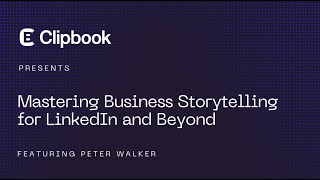
Peter Walker, Head of Insights at Carta, explains how to build an audience on LinkedIn through data-driven storytelling. Post at least three times a week with high-quality charts, stay consistent with your authentic voice, and measure success by inbound messages, not likes. He built Carta's insights practice to create brand awareness with founders before they need a cap-table solution.
Chapters
Alright everybody, let's get started. Happy Thursday. Welcome to today's webinar discussion hosted by the team here at ClickBook. We're really excited, so we'll go ahead and jump right in. Peter, you ready to do this?
Let's do it.
Absolutely. Awesome. We'll start with a couple of quick introductions. Introduce myself, Adam Joseph, founder and CEO here at ClickBook. I am really excited to be your host today. At Clipbook, we're an AI research and analysis platform for communications teams. And today's topic for discussion is mastering business storytelling for LinkedIn and beyond. And we're really excited to have Carta's own Peter Walker join us on the webinar today. And listen, if you are an entrepreneur, if you're a VC, if you're anybody who's on LinkedIn in the tech entrepreneurship startup space in any way, shape, or form, You have probably seen Peter's, I'm gonna kind of joke, unless you've been living under a rock for the last few years, you've probably seen Peter's content in some fashion. Peter is a leader in data-driven storytelling and is the head of insights at Carta. He's a LinkedIn top voice, over 130,000 followers. He is the go-to leader for startup insights for founders, investors, and tech insiders more broadly. He built Carta's insights practice really from the ground up. And he's got great insights for us on a number of topics we're really excited to dive into here. So we were, I think, are ready to jump in and hopefully have a great engaging discussion. For audience, just a quick reminder, please drop your questions into the Zoom Q&A. If you have any questions, thoughts, comments, please drop them in there. We're able to see those. We'll answer them as we see them. So Peter, welcome. Would love to start with, take us through the life story. How'd you end up at Carta? What brings you to the work that you do today?
Yeah, absolutely, Adam. Thanks so much for having me. So I joined Carta 4 years ago. Before that, it was all tiny startups. I actually spent, as we were talking about before, a lot of time at this company Public Relay, which did media intelligence for the Fortune 500. So I've spent a lot of time talking to wonderful PR and comms pros about data. And I had also started a company in college before that. So it was all about small, tiny companies for me. And my background is in a weird mix of data visualization and analysis on one end, marketing and brand on the other. And the marriage between those has been the theme or thread throughout my career. And then the sort of experience that immediately predated Carta, which is a bit of the impetus for what I'm doing now, I was working at this startup, 2020 hit, everyone was really worried, the pandemic was starting. And I just got on Twitter for the first time. Which I don't know if I recommend for everyone, but it was good for me at that moment.
Twitter circa 2020 was a dark place.
So I had no experience with it before, so it felt, I guess that was the water. But yeah, it was not, maybe not the best choice. And then I get on there and I just start putting out, I was finding datasets, visualizing them and putting out charts and graphs on COVID. And that took off a little bit. And then very quickly, The Atlantic Magazine got in touch and they said, hey, do you want to come help us run a visualization team that's doing exactly this for their, what they called their COVID tracking project? So that was—
you were doing this— sorry, Peter, you were doing it for fun. Like you were just posting, you just saw that— what sort of— sorry, I just want to dig in for a second there because that's really interesting.
It was, yeah, just for fun. We were all cooped up in our houses. It was late March, early April 2020. Everyone was really worried and all I had been doing was building charts and graphs for 10 years. So I was like, if I can find the right dataset, I think this can be helpful to people or just help me understand what's going on. And so it started, there's these two journalists at The Atlantic. Robinson Meyer and Alexis Madrigal, and they had been collecting testing data from state-level and municipal websites. And at that point, the CDC had no national database of anything and wouldn't for a long time in a useful fashion. So it started with tests and then cases and then all sorts of different data that they were— this group of effectively volunteers came together on a Slack channel. We got a little bit of funding from this outside source in The Atlantic. And it was like, okay, go to town, try to make sense of this data as much as possible. And so when I joined, it was probably 25 or 30 people in a Slack, and it became 150 people in a Slack over the next couple months, literally dedicated completely without pay to just figuring out what was going on. And the whole goal was to explain things in a way that non-technical, non-scientific audiences could understand. So that was the goal. And data viz is obviously a gigantic part of that. And I guess I was plucked from Twitter because I had been dropping into Alexis's comments on his journalist pieces and being like, hey, you've left this out, or here's a chart that shows that. And he was like, yeah, this guy's annoying enough that maybe we should bring him in to help us with the charts.
I love that. And this is completely organic. So you're just having fun. You're a data visualization guy.
Literally. But then everything is happening. Completely organic. It was wild. And then I got in those things, and I met a bunch of very close friends now. There's a piece of this that was the insight that I took with me. So there are two things. One, I think just to give credit to CTP and the people who ran it, the initial point of the whole project was to shut down as soon as the CDC was good enough. We did not want to do this work anymore. And I think that orientation is actually incredibly rare. There are a ton of nonprofits and NGOs and etc. who probably have effectively done the mission that they set out to do and they still exist. When they shouldn't. So I was really proud of us and Alexis, Aaron, and Jessica and all the people who ran it to just say, look, as soon as this is good enough, we will shut this down. And so it took about a year, but then we ended up closing the project. And as the project was closing, it was very clear to me that the thing that we had built was incredibly useful for public health. But the concept, which is if you have a dataset that is dense enough, and interesting enough, there's effectively an infinite amount of charts and graphs and ways to explain it that you can create, and people will always come back for more. And I was thinking about it in terms of startups because that's where my experience had been. So I made a list of startups with data assets that I thought were really super interesting. And obviously, if you're familiar with startups at all, Carta is the central hub in the ecosystem. We manage one in every two, maybe even more than that, cap tables for startups in the US. So like basically at least 50% of the venture-backed companies in the US use Carta. So I pitched my job to, or I pitched a job that didn't actually exist yet to the CMO at the time and was like, hey, I think you have a data asset that deserves better explanation. And I think I can be helpful there. And it was 2021 and everything, everyone was hiring like crazy and things were up and to the right. So they let me join.
Yeah, that's amazing. What I love about this so far is just the agency and volition you had to, during the pandemic, to see that, hey, like, there's a need for being able to parse through, and at the time, really complex data. Yeah, from municipalities, from states, from federal data sources. There was a question how quickly the data was actually coming out, and people were— you were hearing things in the news, and it was just like a really volatile, complicated time. And, you know, nobody knew what was happening. So it just— to be like, hey, I'm gonna try to do my best here and put some stuff out and be thoughtful, and then for it to get picked up, I just— I love that. That's so cool.
It was fascinating. And I think one of the other points on that is there was a change generationally. Why, if you look back at this, and I don't want this to turn into a political conversation about the failures of the CDC, which I think is an amazing institution and there's so many amazing people who work there, but the problem that they were having wasn't that they didn't have the right scientists in place. It was that they were failing on communication. They didn't understand that this was the first kind of pandemic, certainly, but even really major health scare that had happened in the social media age. And that is very different. The level of communication needs to be different. The speed of communication needs to be different. And that sort of always-on mantra that we had at CTP, where we were publishing charts at all hours of the day, all the time, because that's when the data came in and that's when we were— so we were trying to be at the level where the flow of conversation was going. And Twitter is a terribly fast place. That, I think, was what was missing from some of the more conservative agencies where it was like, we're going to put out a white paper every 2 months. That's not even close to enough to actually help people what's going on. So that, that orientation of speed is something that definitely influences the way we work at Carta for sure.
And of all the people at the time during the pandemic, they were putting out data, they were trying to put out data, like obviously your data broke through in a pretty interesting way. What was it about your approach at the time doing this completely organically, I have this image of you sitting on your couch with a beer in hand at 7 PM, just like cranking out these graphics or something. Like, what is it about like your work then that started the Cut career?
It was more 2 AM in my loft and my wife being really mad at me. Yeah, exactly. But we'll go with the nicer image. I think it's, I don't know, it's tough for me to say exactly what happened, but I do think that one gets back to the speed point, which is just shots on goal. If you can create one piece of content a week, congrats, nobody cares. Or put it another way, you're very reliant on that one piece of content breaking through. If you create 7 pieces of content a week, great, you have 7 times as many chances to hit a vein of interest. So there is something to more being better as long as the quality bar can remain high. So it's about creating the system that allows your quality to remain high and your consistency to be impeccable. And then the other thing is just, I think that there is a baseline problem with a lot of charts and graphs. They're difficult to read. They try to make too many points. There's no clear titling. There's like very basic— any data viz people can like look at a bunch of what's available online and be like, if I don't get the takeaway in 3 seconds, then it's not a good chart. Yeah. Or as long as I'm in the core audience for it.
Yeah. And I want to dig in a little bit more to your tactical advice on the actual mechanics of getting this type of data out as a storyteller. But before I do, you, so, you know, you're heading into 2021, you get a meeting with the CMO of Carta and Carta's starting to, it's like an institution. It's a big growing business, massive venture success story. It became like the, the operating system for cap table management and beyond. So you just, you were just like, hey, I'm just gonna pitch this idea to the CMO. And they're like, sold, let's do this. Tell us more about that conversation. How did that unfold?
I can't take credit for that conversation. It's mostly Jane Alexander, who's the old CMO at Carta, who's a close friend. She was the one who recognized that this really had merit. I had gotten an introduction to her through someone at COVID Tracking Project. And yeah, we went out for a drink at a wine bar in San Francisco and I was just I don't know. I think what really was exciting to her probably was the enthusiasm. I was like, one, I know startups. Like I have, I'm on Carta. I understand your world. There's no need to teach me about the industry. And two, this data thing, this like, this asset that you're sitting on. I think the way that I would really respect Jane is that she wasn't just thinking about, hey, how do we take all the data and monetize it? Which I think is the first thing that many companies think. They go, we have a lot of proprietary data. How do we make money out of that? That's not a bad way to think, but I do think it's limiting in some ways. I think many more companies would stand in good stead to say, we have a proprietary data asset. How do we build brand with that and become the go-to default source of information for people in our industry, which is effectively the one-liner for my job, make Carta data ubiquitous. And that orientation does two things that are very helpful. One, I'm not selling. I don't truly care that much if someone who reads my LinkedIn post buys Carta that day. I just want you to know and like us and to have a positive association with Carta because we've already been helpful to you as a founder, as an employee, as an investor. That's number one. So I get to do this work from a very customer-oriented perspective. And the second is that it frees you up to think about all the different ways that this content can be used. We'll talk about LinkedIn. Obviously that's like a default channel, but podcasts, talks, annual general meetings for investors. I create tons of decks and interactive visuals and YouTube. And it's— this is a content— it's not, it's not one channel. It is effectively a content factory within your company that just churns out really interesting stuff. And that's a big advantage.
So what was— for Carta, what is the business objective of your work? Like, so there's a brand and marketing engagement. There's also something about How do you engage founders? How do you engage funds? What are the insights that you deliver them? Getting them on your platform? So I'm curious, just from a business intent perspective for Carta, how are they thinking about the function?
I'd say it's in— it's evolved a little bit, but at the core of it, it's two things. The first is, how do we make every single person in startups aware of Carta and positively inclined to us before they need us? So I'm effectively priming the would-be future, just starting out founder group so that when they're looking for a cap table, they don't even think of anyone else. Of course they're gonna go with Carta because they've already been reading our stuff, learning from it, using it to build their companies. So that's number one, basically like before the top of funnel, right? General awareness for the 95% of buyers that are not buying right now, but could be later on. Yeah. The second, and I think underrated and important version of insights, a reason insights is very useful to a company, is we are a gigantic feedback gathering mechanism. I am talking to founders and investors. I will speak to founders and investors in a formal setting 6 times this week. I talk to accelerator partners, I talk to law firms, we talk, we give data to everyone in the ecosystem and in return they give us questions and those questions are gold. They tell us what we should be building. They tell us what we should be focused on. They tell us what the worries of founders are. They tell us, oh, investors are really concerned right now about liquidity. How do we explain secondary markets to people who don't understand them? There's, there's something so wonderful about being deeply embedded into the thought patterns of your ICP. And data allows you to do that without, again, always hawking your product. I'm not selling, I just want to help. And so I'm allowed in places where sellers are not allowed.
Yeah, that's great. And I can say I consider myself like a power user of Carta data. And I have even, and exactly as you described it, even before I became a founder, you just see this stuff on LinkedIn, right? It becomes, it just takes up some mind space. And then when it comes to the little decisions early about how you actually do the work, and if you're making a decision about, okay, you're hiring your first 1 or 5 employees, how much equity do you give? What's normal? What's like the ranges? Is it, is 10% normal or is 5 bps normal? And like, what is just actually the data-driven answer. So I was joking earlier with the team that I think Carta and Peter's LinkedIn insights have saved me like multiple points of the company because it's just rationalized the discussion you have with investors, with advisors, with team members and so on. So I think that's really cool.
Yeah, that's awesome.
So that's the topic. Yeah, no, it's mission accomplished. I mean, it's really awesome. Yeah. So take us through. Journey of— I want to talk about LinkedIn a little bit specifically. And also just, I'm like, speaking of power users, I'm a like power user of LinkedIn. I'm on it constantly. I'm looking at, I'm engaging our clients through LinkedIn. I'm looking at things that are happening in the industry more broadly in AI. You're a LinkedIn top voice. I imagine at some point you were not a LinkedIn top voice. So talk us through like, you know, how do you actually get to the point where, hey, I've got a big audience, we've got a big platform. People are engaging, we're adding that kind of value.
Yeah, no, I did not. I was not a top voice when I came into Carta for sure. So the day that I joined, I probably had— I hadn't even flipped on the creator mode on LinkedIn, so I just had connections, maybe a couple thousand connections or something. I don't know. Weirdly, when I— when we were doing that initial pitch with Jane, me being like a public face for the data was not initially part of the pitch. I didn't even think of that. That was something that happened serendipitously. So we've been doing this work at Carta. We've been producing big reports, et cetera, for about 6 months. It was working, but it wasn't working as well as I thought it could. And I, again, I think the missing piece there was consistency and frequency. And so if you're only doing this through, say, a company account, the company account is going to be pulled in 1,000 different ways. They have so many masters to serve. So it's not going to be a focused stream of data content, for instance, or one type of thing.
And the second is, so you spent months, sorry, before you go into the second, you spent months just working on the company account and you were like, this is just not working. So we've gotta change strategy.
I'm not, I wasn't even like putting out that much stuff over social. I was building these big PDF reports for long quarterlies, et cetera, which is something that we still do, but I don't think is the right way for most of this data to come out into the world. There, there were, we tried a bunch of stuff effectively in that first 6 months. Some of it was working, some of it wasn't, but none of it was taking off that way you can really feel something take off.
Yeah.
And so then the second thing that is true about LinkedIn and all social platforms is they just favor people. They're much, much more likely to take off if you are a person rather than a brand. Not to say brand accounts don't matter, but they don't go viral the way that people can. And you get the advantage if you're a person of you can talk to people like you can respond in the comments the way that you should be as a human being or, oh, asking interesting questions, etc. You can really nurture the audience that you're building and make them feel as though they have a personal connection to you because they do. I have met, no joke, thousands of people that follow me on LinkedIn and some of them are now friends and we talk all the time and it's a great sort of audience feedback mechanism. So I think if you're doing this work, one of the things that's very clear to me is that it has to come from a person. It can't come from a brand. Who that person should be, should it be your founder? Probably if you're a small company, but it also takes a ton of work, right? And you're gonna have to do it a lot. So building an audience on LinkedIn, couple planks that are just must do. And it is, I will say, I would say probably slightly harder now than it has been for a couple reasons. One, LinkedIn got more crowded, way more crowded. Lots of people creating on LinkedIn that weren't 2 or 3 years ago. And the second is that it's the algo is like moving a little bit more towards an interest graph the way that X or other platforms have it. So the follower count matters a little bit less. It still matters, matters a little bit less than the actual quality of each post. So some things go viral off of very small accounts. Even big accounts can have not as much engagement as you expect. It's a little bit unpredictable these days. I still think it's by far the best place to invest your time if you're working in a B2B for sure, but basically any company. Like LinkedIn is a way better use of time to, it is more valuable for me to be known on LinkedIn than it is for me to be known any other platform, basically.
Yeah.
Okay. So 3 things that matter for LinkedIn audience building. The first one, very basic, but it's very basic because people don't do it, which is consistency. Show up 3 times a week minimum. More is better. Anyone who tells you more is not better is not right. If you can show up 7 times a week, not more than once a day is not good. So once a day, you basically, the advantage of LinkedIn over a platform like Twitter, Twitter, you can put out literally hundreds of tweets a day and it doesn't really affect how each of those individual tweets do. If you put out 10 LinkedIn posts a day, the 10th one will have way less engagement than the first one. Like it just degrades over time. So you really get one shot a day. Which is lovely. Use it. Show up. Show up every single week. Don't miss weeks. Schedule posts. It is so silly to me where people like want to invest into this as a channel and then they don't actually invest. And the investment is in time and effort. That's, that's the number one thing.
Yeah. So we've talked about consistency. You've talked a bit about the bite-sized data content that you're putting out. Yeah. Obviously working with the personal individuals opposed to the company account. I'm curious, a lot of our audience members, a lot of our clients are communications professionals working with a CEO, right? Working with an executive director of a large nonprofit or a government agency, whatever it might be. So you've, you're working with your CEO, you're working with your principal, you're working with them on the content. How do you, what is the best engagement style that you'd recommend for, hey, making sure the principal is actually getting that content out there? Is it Hey, you need them to actually just do it themselves because that's the sort of intimacy and the authenticity that you want to come through. Or is it like, just, hey, just give us, give me the keys to the account. I'm going to post, we're going to rock and roll and just go from there.
Yeah, it's a really nuanced question and it comes back to the context that you have to set, which is who is your principal first and foremost? Are they the kind of person who is going to be actively excited about this? So upfront, I gotta be honest, if you're working with your CEO, for instance, and they evince no interest at all in this, I wouldn't do it. It sucks because you're going to miss the channel, and the channel is very useful. But the amount of time wasted, time and effort you will have to spend every week to get them to pay attention or do something or comment or care at all. If they're not bought in, it's not worth doing.
Yeah.
Second, you can write for them as long as you write the way they write. And here, actually, LLMs can be pretty helpful, where if you have a corpus of your CEO's information and you train it with your AI writing, write the post, run it through the LLM that you've trained on their writing style and see whether or not it fits and then go and show it to them and say, does this feel like something you would write? That's definitely worthwhile. You want it to have a voice that is theirs. The problem with AI is not that it's not a good writer. It can be. The problem is it doesn't have, it isn't able to bring their experience to bear on something that is pretty obvious. So if you're writing about a piece of data that's in the ecosystem, the CEO would be like, oh, of course I saw this 2 years ago when I was raising my seed round. But the AI won't know that. And again, so that's on you as the subject matter expert to pull that information out of their CEO. So I know people who do this kind of motion on LinkedIn where there's a weekly meeting between the writer and the executive, and the executive just brain dumps everything that's like most top of mind for them right now. And then they write and then they go back and then they have a little edit session.
Yeah.
On the whole though, it would be better if this executive was doing this themselves. It's such a ridiculous ask because execs are pulled in a thousand directions. I totally get it. The people who I follow on LinkedIn who are founders, I know they're writing their own stuff, most of them, because they— that's what it actually is like exciting to them. They want to get these— this information out to the world. We can talk about whether or not they use data graphics. That's a different thing. But at the core of it, you need the interest, you need the interest from the exec. And if you can't be certain you're going to get it, you're just going to waste a ton of time.
Yeah, I'm going to get a big I told you so from my marketing team in about 35 minutes for That's for you, ClickBook marketing team. That's for you.
Yeah.
Yeah. So I think a lot of folks who are on LinkedIn, like they post content, even if they are somewhat consistent, the content doesn't really quite perform. It's like doing okay. Sometimes it hits, most of the time it doesn't. Take us through the content factory that you have in your head. Like what, how do you start with the, okay, I want to have an idea. I'm going to write it. I'm going to edit it. I'm going to schedule it. Just take us through. What is the mental checklist that you go through to put something out there?
Yeah, I'm happy to walk you through the way that I think about content, maybe even show you a couple things as well.
Let's do it. Yeah.
Here's how it starts. So again, one of the advantages of insights is that I am speaking to this audience group about the world that they live in, not about what Carta can give them. It is implicit that this is useful data from Carta. But I am not telling them, hey, our launch product is free until you raise a million bucks. I'm telling them seed rounds are going down and it's gonna be more difficult for you to fundraise. Here's why. Yeah. And those, that distinction really matters. So I think one of the reasons why some content doesn't work is because it unconsciously or consciously is just too product focused. It's too product focused.
Yeah.
It's too specific. It's not about the world, it's about the company. And that's what I mean for brand accounts. Brand accounts have to do that stuff and it's still valuable to do because You might get one lead out of that, but it is almost guaranteed not to have the broad reach that you want because I'm sure that QuickBooks is releasing amazing features this month, but like how many people want to read a feature release? Not as many. How many people wanna read about Adam's last sales call and how he closed a really big deal? More, more people do. But that's a difficult, that's a content stream that is super crowded. There are a lot of founders out there telling me how they closed their last big enterprise deal, right? It's all over the place on LinkedIn. Again, this is why I'm biased here, but that data content really stands out because it is not as common. How does this work? I come into the Carta data warehouse. Effectively, we'll just walk through some of the systems. I'm pulling data from Snowflake into Tableau, which is our visualization platform. In Tableau, I'm building a bunch of charts and graphs. I have a whole list of questions people have asked me that I can turn to if I need inspiration. Or I just came, I woke up that day and I was like, I've been thinking about this part about SAFEs for so long, let me write a cool piece about SAFEs.
So either way, you're keeping a running list of questions. So you're talking to your customer and you're keeping a, what are the types of things that they're, you're doing like customer research, you're talking to them, you're hearing what they're asking about.
And I don't need to set up external calls. They tell me in the LinkedIn comments, I have hundreds of questions from LinkedIn comments going, Hey Peter, this was interesting. Great example. I'll put out data on what are valuations for Series A companies. And the most of the responses that I'll get will be, Peter, that was great, but what about for companies in the Midwest? Or what about for companies in my industry? Great. Two new graphics. Cut it by geo, cut it by industry.
Awesome.
I'll put those out and they'll say, actually, you showed me the median, but can you show me the full distribution? Because the median isn't that helpful for me. Another graphic, like all of those things. Every time you get a question, it's a potential new starter kit for you.
Yeah.
Then that guides about maybe 30 to 40% of the things we create. Another 30 to 40% is personal interests. Like, what do I care about? What does Carta care about right now? What are the things that we're talking about internally? So it's a mix of both.
Just infinite number of ways to cut the data, infinite number of questions. How do you actually prioritize? Hey, this is what I'm posting tomorrow. Friday, June 13th. Okay, this is the one that I'm gonna put out.
I would say it's like a combination of influences. The first is what is on the Carta roadmap? Hey, if we have a big product release for fund admins on like finance for venture funds, what data in the week before that launch can I go ahead and play around with that's gonna be interesting to that persona? So matching the content to the Carta calendar is definitely a part of why we build things. Another part is newsjacking. This is tough. I think it's actually very hard to do well where you recognize a conversation that's going on in headlines of tech press or on Twitter and you say, oh, our data can contribute to that conversation. My best example was there's always fights between VCs about whether you should live in San Francisco or Miami. It's a really dumb fight. You should live in San Francisco. It's obvious you're building a startup. But every time that happens, I have a little chart ready to go that's, hey, this is the percentage of capital going to Miami every year. And so you just drop that into a Twitter thread when two VCs are fighting and they go, oh, okay, cool. Now I know the answer. That is not a good use of time most of the time, because most of the time you're not going to build it fast enough to be in the flow of conversation and you're just going to miss the moment. So I don't— I actually don't recommend newsjacking that often. But when you have something, it can work. And then the last part is personal interest. I am meeting with these founders and investors all the time, and I can see from them what are the big topics they're worried about? What are they saying in person that they're not saying generally online? AI is the obvious one. When you talk to founders and investors, everyone's very excited about AI, and then you get them behind closed doors and they go, I don't know, this feels kind of like a hype bubble. Are these valuations justified? Are all this— is all this money going to be wasted? I don't know. And so cool. I can help with that or I can at least make content about it. So there's a ton of ways to get influenced here. I also think that again, going, taking a step back and saying, are each of these pieces of each of these graphics important?
Yes.
But the most important thing about them is I get another shot tomorrow. Cool. You, you built something, it didn't latch on. Oh, you get another shot tomorrow. I'm not too worried about the performance of any one graphic. I care that the system that I've created behind the scenes can create good-looking, important content at faster and faster clips, cuz then I can just use it in more and more places.
How do you decide between moments where you leverage data very actively versus tell a story, use another type of visual? Maybe an anecdote from a conversation you had with the founder. How are you weighing, hey, we want to be data-driven, we want to leverage our assets versus, oh, there's a bit of a different type of story to tell.
I do much more of the data content because I think it's easier to differentiate, but I do think that it has to wrap up in a story. So there are times where we put out content that is just, hey, been hearing this, can't prove it with data, but I've been hearing this all the time across the ecosystem. What I'm hearing is a nice, like, kind of framework for some of this content, especially if you're an exec in a specific industry. I think what I'm hearing is often very useful. It's why people go to conferences. It's why people go to events. They just want to talk to other people and hear what the scuttlebutt is around the industry. So that matters. The other way to think about it is not what I'm hearing, but what I'm hearing is blank and it's wrong because. So oftentimes, the best thing that you can do is to say, everyone seems to be talking about X is either not true, or X is unimportant compared to Y. And that framing is very helpful if you're looking to increase engagement on social platforms, because you will get both sides of people in the comments. That's what you want. You don't want to court controversy, just to do it. But, you know, some of the stuff that I've put out that has gotten a lot of play, if you can say, if you can look at commonly held wisdom in your industry and prove it. Proving it is good. Disproving it is better. That is a great framework for more content.
That's great. So posting consistency, the nature of the content, it's cutting, it's maybe controversial. What are the other tactics that really powerful LinkedIn voices leverage? Is it, hey, I'm texting my post to my friend group, I'm getting my team to comment on it. What are the other growth hacking tactics that folks should be leveraging?
Oh man, we can have a long conversation about what people are doing that I find annoying and like not great. So that like engagement potting for one, whereas a group of creators will get together and they just commit to commenting in the first 30 minutes anytime any of them post. So annoying. And you can see it so obviously if you just spend time on LinkedIn and these people are just showing up all the time and the comments are like, great post. Yeah, completely useless. The real way, and this is, I'm speaking from a complete place of privilege, so ignore my advice if you choose. The real way to gain an audience that cares about your content is to comment on their stuff thoughtfully. You should be, if you care about your building a LinkedIn audience for yourself, you should have 20 to 25 people that you explicitly follow on LinkedIn in order to comment on their things with real thoughtful, substantive information. Yeah, because the vast majority of comments are thanks or how cool, whatever. If you comment and say, Adam, I really appreciated this story. I actually had something that went differently the other week. Explain what went differently the other week. Like, how would you handle that situation? Boom. You are— you're doing two things. One, one, people will read your comments and say, oh, what a thoughtful person. That happens a lot. Second, Adam will read your comment and go, and especially if you've done this 2 or 3 or 4 times, your content will start showing up in Adam's feed. So you can prime your content into specific people's feeds by commenting thoughtfully on their stuff. Yeah, that's great. Then you just— this is the annoying part for most people because there isn't really one way to get across the LinkedIn algo, it just happens. And I'll be completely honest, when I started doing this from a personal account, it took 4 months, maybe even a little bit longer before I had hit what I felt was a real inflection point in followers. There was a bunch of times where I thought I was producing good-looking content and it got— no, nobody cared. So you have to inure yourself or like somehow numb it to be like, oh, nobody cared about that. I don't care. Great. No problem. I have another shot. Cause it will happen. It's just bound to happen.
Yeah.
Yeah. Even now, some of my stuff is, doesn't like some of the stuff that I spend the longest amount of time on doesn't get what I expect it to. And I'm annoyed by it for a minute or two. And then I go, okay, it happens.
It's there.
Yeah.
It's funny though, cause when those moments break through, it can be so powerful. I've been making a stab as a regular LinkedIn poster here and there, probably not level of consistency as I should be, as I, as I've learned today. But you like spend like an hour on like this one post that's going to go viral and you're just like, oh, this is going to be the one. It's going to make you famous. Boom. And then it's 10 likes and just falls flat. And then half of your college friends text it to you making fun of you. And it's okay. That didn't work. But then it's, we do a, here's a top 10 PR and communications pros to follow on LinkedIn. Right. And you realize, okay, top 4, 4 of those are from the top 10 PR firms in North America. Some of them are clients there. And then all of a sudden the CEO of the firm is texting you being like, this made me like, I had added like 400 followers because of this post. This went about kind of viral. Like this was, you know, a big moment. So it's got this stochastic kind of, okay, what's just some type of science. Things just happen when it, the way it happens.
And you need to be very clear with yourself about why you care about getting an audience on LinkedIn. If you want to have the biggest audience possible, I can write you scripts that will make you have tons of followers. Who don't give a shit about who you are, what you do. Like getting just random people following you on LinkedIn because you're good at memes or you're good at curating. There's a ton of this in VC where the VC influencer, influencers will go and take an old talk from Steve Jobs 10 years ago and be like, it's about, it's the iPhone launch from 2007. And they'll go, we miss this. Or like, where is this in tech today? Amazing. Cool, cool posts. Probably will get you some followers, probably a bunch of impressions. Will that get you invited to anywhere to speak?
No.
Is anyone following you because you post the dopest memes expecting like real intelligent content out of you? No. Now if you do that once in a while, and then the rest of your stuff is substantive and thoughtful and whatever, That can work, but you just gotta know why you're doing it. Cause I, like, to me, if you're talking about metrics and how to track your LinkedIn, obviously everyone tracks impressions, everyone tracks followers, everyone tracks engagements. Those are useful. They're mostly lagging indicators, but they're useful. The stat that I judge myself against is inbound DMs, non-sales inbound DMs. And the non-sales thing is important cuz everyone gets sold to all the time.
Yeah, I was gonna say, yeah.
Uh, and how do you know that? I never respond to sales inquiries on LinkedIn, so I will download— you can download all of your inbound messages from the platform and then just X out any ones you haven't responded to because those are all sales and respond to everyone else. And there you go. Then you're tracking over time. So then you have month over month, how many people are reaching out with questions about my content, with ideas for new content, with thoughts about speaking invitations, with whatever.
Am I making it with an invite to a webinar with, with Klippa, whatever it might be?
Exactly. So am I making an imprint such that they actually take an action? That to me is a win. And there's very little impressions are variable. Engagements are variable. Even followers these days are more variable than you'd want them to be, but making people take an action. That's a, I think that's a good key step.
Yeah. Well, how specific? Should folks be about who they're actually trying to speak to. Yeah, you take a— if you're a consumer brand, right, you could be speaking to 100 different ways to think about your audience, right? It could be like, we're trying to reach investors, we're trying to reach obviously our customers, right? Like women aged 20 to 30 in North America, in the US, who have an interest in X, Y, and Z. Or you can think about your employees and other kind of key reputational stakeholder groups that you might be engaging. So how precise versus broad should their audience be thinking about their end audience?
Yeah, that's a really difficult question to answer because it depends a little bit on the maturity of the audience. I think the general advice that you'll get from most people is narrow it down as much as possible, right? Like, you should be always speaking to— in our case, it would be you should be speaking to a founder who's between a pre-seed and a seed and is this kind of person, all that. I think that's, I think that's good as a, the reason it's good is not because it's useful forever, but because it's a forcing function for your writing so that you are a better writer for that person. So you can put yourself more easily in their head and say, what do they care about? And if that's useful for you, then Godspeed. That's awesome. As you get a little bit of audience though, it's really helpful to be known to the people around your person as well. So who do founders talk to? They talk to their investors, they talk to their lawyers, they talk to their CFOs, they talk to their HR people. Carta can be helpful with data content to all of those audiences as well. So like some of my stuff is now geared towards the executive finance team or the executive HR team, and that is useful for them to say, bring that to the founder. I cannot tell you the number of times, and this is another reason why I love the graphics. Because they're so shareable. You're unlikely to screenshot a text post from someone on LinkedIn and show it to someone else. You're very likely to screenshot a graphic and say, hey, Peter from Carta just said this thing again. Maybe we need to recheck our equity pool, whatever. Like that stuff, I can't track that you're doing those screenshots, but I know they're happening. And that's really great.
Yeah, that's amazing. Peter, this has been great. I want to jump into the next round of the discussion here. We call this the Derek lightning round at Clipbook. And for our audience members or clients of ClickBook, they've probably heard us say the story in some way, shape, or form that every communications team, every PR team, public affairs team has some poor 22-year-old intern or associate named Derek. And poor Derek, we love Derek, and at ClickBook we worship at the altar of Derek because he is the poor soul in so many different companies, firms, agencies, nonprofits who's really left with some of the most routine, most painful tasks. And at Clipbook, we're an AI research and analysis platform. We exist in part to enable Derek to be 20 times better at, at their job. And so just to channel Derek, we wanted to ask you, do a quick lightning round, ask you some of the questions that 22-year-old intern Derek might ask you if you were on the Zoom today. So you ready to jump in?
Let's do it. Sorry, Derek. Apologies to your life.
Yes, apologies, Derek. We're rooting for you at the end of the day.
We care about you, but it's going to be a tough couple years. Yeah.
Yeah. It will. So we'll start weirdest DM that you've gotten in LinkedIn in reaction to some of your posts or content.
I can't tell you the real weirdest DMs that I've gotten, which are frankly—
Keep it PG.
I'll be honest and say the DMs that I get for Carta content are nowhere near as weird as the DMs that I used to get for COVID content in 2020. That was horrendous. That was my— it was a minefield. I think consistently the weird question that I get all the time is from Saudi officials who want to fly us out and have a 15— It's weird how people will do speaking events and then you'll dig in, the speaking event is 10 to 15 minutes, but they want to take you to Saudi Arabia to do it. I don't know. It seems like a very odd use of money, but it happens probably every month or so.
Wow. That's— I have so many questions I want to dig into, but I'll peel back that onion later. Yeah. What is the most intern-y thing that you've done, even as a senior leader in business?
So many things. The number one is, and this seems like something that should be solved with LLMs, but I'm still doing it by hand occasionally, is like data entry all the time. So there'll be a group of things that I want to talk about on Carta, and the data will be 80% complete, and I am manually filling in the zip codes on other 20%. There is so many random little things where I have most of the dataset, but the rest of it requires me to go and do like back and forth Googling or talking to ChatGPT about stuff. I assume that's going to go away eventually, but right now I'm not above doing a ton of data entry for the work.
Got it. Good to know that you could be a LinkedIn top voice and you're still sitting there cranking some good old-fashioned data entry. So you should—
if you care about it, you should. That's the other thing about LinkedIn. People can recognize if you don't do your own stuff. Build your own stuff for sure.
Yeah. Love that. Who are your favorite LinkedIn profiles? Who do you follow? Who do you like? I just really love their content. Besides Adam Joseph from ClickBook, Peter, of course. Yeah. Besides, besides that.
Yeah. The entire ClickBook team as number 1, number 2, number 3, all the way down the list. Kyle Poyar, who is a VC now. I think his firm is called Augment, but he's a fantastic resource on pricing and like, how do you think about pricing and packaging for software products, really in-depth stuff. His stuff is always fantastic. Who else do I love? Charles Hudson, who's a VC in the space who does a wonderful little podcast and has every so often will write newsletters.
Precursor Ventures, right?
Charles.
Yeah. Great guy. Yeah.
Yeah. Thomas Tungens, who's a legend who runs this VC firm. And then I listen to a lot of people on pods, so I'll find them on LinkedIn, but then I'll listen to their pods. Beezer Clarkson at Sapphire Ventures is one. Sorcery, Molly O'Shea is another. There are some really cool people who I think are transitioning from mostly written to mostly speaking. And I, for some of them, I really like it. For some of them, I wish they wrote more still, but we'll see.
Oh, I love that.
Okay.
Last question for you, Peter. What's one myth about startups or venture capital that you just wish you could just erase from everybody's memory and just bust that myth once and for all?
Ooh, so many, so many that are damaging, I think, to the ecosystem. Here's one that maybe the VCs won't love. There's this talk all the time about VC funds. And if you are top quartile, which means you are better than 75% of funds, and people use that mark and they put it in all their pitch decks and whatever, and they go, we are a top quartile fund. Top quartile means absolutely nothing. One, you don't know what metric they're judging it off of most of the time. Two, you don't know where they got that data. And three, and most importantly, just because you're better than 75% of VC funds does not mean that you are a good investment for LPs. And so this focus on we just cleared this little bar, and now we're in the 76th percentile, so we're crushing it. It just doesn't make any sense. Are you making real money for VCs or for your LPs? Are you not? That's what matters. And most of the time, top quartile is not good enough.
Is the top quartile ROI positive just from a pure Like, from a perspective on average, or ROI positive in terms of dollars back?
Yes. But ROI positive versus investing in the S&P? No.
Really? Yeah. So they're just barely clearing cash flow. They're cash neutrality and investment neutrality. Got it.
Okay. In some ways, people talk about 3x. You want to be a 3x fund. So if I give you $100 million, I want $300 million back over 10 to 12 years. The number of funds that are actually 3x funds in every vintage is Single digits, single digit percentages. Um, it's very— VC is a really weird business that most people should not be in. And when it works, amazingly well.
Yes. Awesome. Peter, it looks like we're just out of time. This was such a treat. Any final plugs or words for the audience before we hop off here?
Yeah, absolutely. One, if you're interested in Carta data, you can get it on carta.com/data. All of our stuff lives there. And two, if you have questions or if you're thinking about spinning up an insights team or wondering, hey, does my company have enough data to do this kind of thing? Shoot me a DM on LinkedIn. I really love helping people get those teams off the ground. I think it's going to be a new wave of marketing and I would love to see your stuff in the LinkedIn feed soon.
Awesome. Peter, thank you again so much. This was a great conversation. Really appreciate it. For all of those who are on this call, if you're part of a communications team, a media team, a public affairs team, reach out to the team here at Clipbook anytime. We're at clipbook.com. Happy Thursday and thank you all for joining.
Thanks so much.
More from Adam
The Changing Role of the CCO in the AI Era: Lessons from BCG's CCO Russell Dubner
From Public Service to Private Enterprise: How Leaders can Navigate a Cross-Sector Career
From the West Wing to Hollywood: How Top PR Strategists Shape Public Perception with Eric Schultz