Modern PR Mastery: Michael Kempner’s Blueprint for Building Iconic Brands
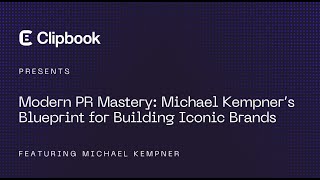
In this 2025 Clipbook‑hosted webinar, Adam Joseph interviews Michael Kempner, founder and CEO of MWW, about his three‑decade journey from political staffer to founder of one of the world’s most successful independent PR agencies. Kempner recounts his early career in Washington, a stint running a liquor‑filled chocolate company that taught him the realities of CEOs, and the organic evolution from solo consultant to a $5 million‑plus firm that now supports over 200 clients. He shares the core philosophies that guide MWW – a simple "if it makes sense, do it" rule, hiring smarter people, curiosity, empathy, and a trust‑plus‑relevance framework for reputation. The conversation covers how MWW differentiates itself through fearless, client‑first service, early adoption of digital and social media, fast‑follower innovation, and a pioneering AI/LLM analytics platform that monitors brand representation across search engines, Wikipedia, Reddit, and news outlets. Kempner outlines the next‑generation challenges for communications: AI integration, audience‑centric media planning, and the shift from transactional to reputation‑centric work. He offers practical advice on crisis preparedness, risk‑taking, and whether brands can remain apolitical. The session ends with a light‑hearted “Derek Lightning Round” where Kempner reflects on intern‑level tasks, ideal film portrayals, a bridge mascot symbolizing trust and relevance, and memorable campaigns for Smithfield, Tyson, Red Lobster, Continental Airlines, Subaru, and others. Throughout, he emphasizes purpose‑driven communications, authenticity, and the need for agencies to empower clients to sell internal change.
Chapters
Hello everybody. Happy Tuesday and welcome to today's webinar discussion hosted by the team here at Clipbook. We're really excited for the conversation today, so we'll go ahead and jump right in. Michael, are you ready?
I'm ready. Thanks for having me.
Awesome. We'll start with some really quick introductions. To introduce myself, my name is Adam Joseph and I'll be your host today. I'm the founder and CEO here at Clipbook. We are an AI research and analysis platform for communications teams. Since our launch a couple of years ago, we've grown to support over 200 companies, firms, nonprofits, government agencies all over the country. So again, glad to be your host today. Today's conversation is one that I'm particularly excited about. Our topic today is Modern PR Mastery: Michael Kempner's Blueprint for Building Iconic Brands. And of course, we're really thrilled to welcome the man himself, Michael Kempner, to join us for the conversation. If you've been in PR world and communications world, you've probably heard of Mike Worldwide, MWW, 100 different places. It is one of the most successful independent PR agencies, one of the most successful PR agencies across the world and really recognized for integrating communication services for many of the world's leading companies and brands. Michael Kempfner, who's joining us today, is the Mike in the MWW, uh, Mike Worldwide. He's the founder and CEO, a true industry icon. With over 3 decades of experience building iconic brands for top global companies. So he's been decorated left, right, and center, you know, some of the industry's highest accolades from PRWeek's PR Professional of the Year Award in 2015 and 2010, and was also inducted a couple of years ago in 2020 into the PRWeek Hall of Fame. So we're in for a really insightful, engaging discussion. To our audience who's joining us today, just as a quick reminder to please drop your questions into the Zoom Q&A function, drop questions, comments, any reactions there. We do see those in real time. We'll, you know, love to answer those as we get to them. So Mike, you know, really to get started here, we have a big topic today. Before we jump into some of the, you know, the topical exploration that we'll do in a moment here, you know, you've had just such an amazing career in PR and communications. So I want to just maybe start from the top, like, take us through your career path. Where did it all start?
You know, it actually started when I was a kid where, you know, there was no Mark Zuckerberg or Elon Musk or Adam Joseph when I grew up. You know, every kids wanted to be a pilot or a fireman or a policeman or astronaut might've been the big one. But as a kid, I had this odd obsession with politics. And even as a very young man growing up at the height of the Vietnam War, Watergate, civil rights. And so as a kid, I wanted to get into politics. And so that was a passion of mine that led me to going to school in Washington, DC and spending almost 10 years in politics from being a chief of staff to a congressman, to special assistant to a governor, uh, deputy finance chair of the Democratic National Committee. So I did that for just about 10 years. And, uh, actually while I was in school, uh, I went to school at night and learned a lot about strategic communications, uh, how to see around corners, how to anticipate trends, how to understand data. And how to communicate, obviously to get people that to support you, wanna vote for you, do all those things that you do in politics, at least in those days. But after a decade, and I'd been doing it full-time since I was 19, after a decade or so, or a little less than a decade, you know, it was, it was time. I was burnt out and it was time to do something else. Yeah. And it's kind of hard to be burnt out when you're 26, but I was burnt out when I was 26 and I frankly didn't know what I was going to do. So I took a job of all things being president of a chocolate company and it was liquor-filled chocolates. They were illegal. So if you ever saw the little chocolate bottles full of liquor that are particularly popular in Europe, they were illegal in America. And I knew nothing about running a business, but I was hired because I knew how to change state laws and the federal laws. So I changed 30 state laws. I changed the federal law to make these products legal in America.
Yeah.
And which was very exciting. Introduced a category, did the advertising, the packaging, the public relations, everything you could think of in a product launch. Even frankly, running the factory. I built 2 factories, learned about slotting products in a supermarket. And oddly, all of those experiences were actually very helpful in starting this firm because you, you had a real sense of what real CEOs and real presidents and real people, what they had to go through to both create and sustain a business versus something that was theoretical and working in a PR firm.
Yeah. So why that?
Why that? Yeah.
Why, why that? I mean, was it, you just, you know, loved chocolate and loved her?
It's more nefarious than that. When I worked in politics, I knew that if I stayed close to a handful of people, when it was time to leave, one of them would gimme a job. And so I stayed close to a handful of people and they all sort of offered me a job. But I took a job with the chocolate company because it was different. It was exciting. I was gonna learn how to run a business and it was super hard, you know, and to me, the, the most interesting work is consequential and impossible to do. So this was, I don't know if it was consequential, it was consequential to the company, but it was impossible to do. 'Cause it was little old me up against, in those days was the Mars Company spending millions and millions of dollars on lobbyists to try and stop me because they had a monopoly in Nevada. And there's a great luxury into not having any fear to being a kid, to not knowing what you don't know. So we just kicked their butt everywhere we went. But after, the fun part of the introduction and kicking their butts and doing the government affairs and winning all over the place. It was really running factories and that was not interesting to me. So after a few years, I left with them in a consulting contract with no intention of starting a public relations firm. Now to understand, I had never been in a PR firm in my life, not in the bathroom, not in the elevator, not in the lobby, nowhere. Now I had done a lot of political consulting, so I understood the basic tenets of StratCom, but I didn't know anything about being a PR firm. But I had all these relationships in New Jersey. I had been legislative director for Congressman from New Jersey. I ran a campaign for Congressman from New Jersey. I was special assistant to the governor of New Jersey, all again before I was 22 or something. And. So I had all these relationships and people would call me and ask me to do things for them. Government procurement, lobbying, PR, kind of the mix of, of kind of anything you can think of that would be in and around what I knew from politics. And they'd pay me. And I'm thinking, wow, you know, like I didn't even know what a client was, you know, decided people paying me to do stuff. And again, I never looked for a job in my life because every job had led to the next job. And for those of your viewers, there used to be this thing called the want ads. So there was no LinkedIn. You would look at the New York Times on a Sunday. The want ad section was probably 50 pages, and you'd go through it. And anybody who wanted to hire somebody, they advertised there. And I'd circle those ads and with the intent of applying on Monday. Monday would come and I would never apply. So before you knew it, I had these 10 people paying me and I said, you know, this is a business. I can do this. I couldn't be a stuff company. I had to actually be something and I had to start getting serious about what that was going to be. It looked and felt most like a PR firm and that's how we started.
Yeah. And at what point did this turn from, you know, I'm Michael, I'm doing contracts on my own and I'm just kind of doing stuff to I'm creating MWW, you know, and like, we're a firm, we're a business, I'm hiring, I'm scaling, I'm, you know, systematizing the actual processes in the firm. Like, at what point did it become, hey, I'm not just a contractor, I am an entrepreneur, or not a consultant, or not a consultant, I'm an entrepreneur?
You know, it happened relatively quick, but I wouldn't say I knew it was happening. So when I look back on it, I had a lot of philosophies, but I didn't know they were philosophies until later on in my life. I had always been an entrepreneurial kid. In my neighborhood, I was always selling stuff and building, and that was part of the nature of who I was. And so pretty quickly, I understood that to be successful, that my instincts would only carry me so far. Right away, I put all the money back into the business. I hired people that knew what they were doing because I didn't. And I learned a lot from the employees I hired. I learned a lot from my clients and I learned how to really run a business. And we grew very fast, you know, almost overnight we were somebody of substance. And, you know, and part of it was that there's a great, again, luxury in knowing what you don't know. And so since I didn't grow up in the business, I was not encumbered by, I guess, the way you always did stuff. You know, I didn't even know the way you always did stuff. So I just did what made sense. You know, today I have a philosophy and actually run the business on a very simple philosophy that's hard to do, but simple. And that is, if it makes sense, do it. If it doesn't, don't. Now, that's how I ran my business even back then, but I didn't know it was a philosophy. So I would look at my clients or the people that were paying me money, and I would say like, what makes sense? And people would say, you can't do that. I'd say, why not? They'd say, well, because you're not supposed to. I said, why aren't you supposed to? Because you can't do it. I said, well, why can't I do it? I said, well, I'm, we're just gonna try this. It was all legal, ethical, and we just did what made sense. And, you know, and people that had hired firms and they were still trying to solve their problem 3 years later, we'd solve it in 3 weeks. I knew a lot of people. I was well connected. I hired some really smart people and we just went out and did what made sense. We were very successful very quickly and grew rapidly. The next most important piece was, but truly, you know, this is an era before computers. You know, there was barely fax machines in those days if people even know what a fax machine is. You know, I had one red IBM Selectric typewriter and a desk, and which I'd stolen the typewriter from my job before. And, well, it was sort of like I actually stole it from politics, brought it to the chocolate company, and then, and then took it again. Yeah.
And I, that thing's going to follow you around, you know, so, you know, but most people have never even seen a typewriter, probably except in the movies.
And so I literally, you know, it sounds like something out of a movie, but I actually figured out whether we're making money, losing money, how much money I needed, literally on the back of a napkin or back of a piece of paper. I had these 10 clients, they're paying me this much money, it equaled X. I had these expenses, it equaled Y. If I was billing more than I was, than my expenses, I was having a good year. But I didn't know much about P&Ls or balance sheets or finance. I was just this. Guy from politics who was bringing in more money than he was putting out and doing great work for our clients. But the big change was when I was about $5 million, which took maybe a year and a half or something to get there. I hired a CFO. I hired somebody who knew more than me, and he was instrumental in helping us turn it into a real business, understanding profit and loss, understanding billing and billability and all the things that come with that. And that was really our first stage in growing up. I mean, the one thing that was important, and again, still a philosophy today, I always wanted to hire people that were smarter than me. So I might have a big ego, but not when it comes to that. I always figured if, if they weren't smarter than me and if they weren't better than me at what they were doing, then I'd just do it myself and keep all the money. But I knew that was not a, that was not a prescription for success. So even from day one, I hired people that were better than me, and the CFO was a material change to how we became an adult company.
Yeah. You know, it's funny, the dynamic you're describing, that progression, right? From politics to working at a company in a for-profit setting to then going from in-house to, you know, I'm on my own, I'm a freelancer, I'm consulting, right? To then I am launching a firm like that is You know, I'm actually looking at some of the attendees in the call. This is a very similar dynamic for many of the attendees that, you know, might be thinking about building their career in the segment. I guess, what advice would you have for them at every one of those steps from making the jump into a company, from, you know, the in-house to the, you know, to operating independently or starting a firm or joining, you know, an entrepreneurial firm? What advice would you have for each of them?
Well, on the first one, you know, would be, you know, working both in politics and working at the chocolate company, learn everything you can. Don't just do your job. I mean, the fact is you're sitting there where you got really smart people. You're getting a virtual MBA, you're getting a virtual law degree. I mean, how can you learn everything there is to learn about the business you're in, but also the business that you may be in later on? So I've always looked at everything I've done And I worked hard doing it, so I wasn't looking so far down the road that I wasn't doing a good job in what I was doing. But I always looked at every job I had or everything I did as how it was going to set me up for the next thing. You know, I always had a vision of success in my head and a vision of what that would look like. Now, that changed a lot over the years as the world changed, as I changed, as my business changed, as my family changed. But I, I always had a vision of success and I, and I do think that if you don't know what success looks like, it's pretty hard to get there. And even when I, you know, so I would never really be nervous in a room because I had already visualized myself in that room. So whether I was talking to the president of the United States or the CEO of a Fortune 10 company, whether I was in the Oval Office or I was in a boardroom, mentally, I'd already been there. I'd visualized it. So, by the time I got there, it was easy. I had already done it in my own head. So, I never was particularly nervous about that because of my ability to look and think forward. As far as starting a business goes, I mean, I was somewhat lucky. There was really no risk. I had no wife, no children, no mortgage, or maybe a little mortgage. And and I'm in my 20s. So if I failed, I'll just go get the job I didn't apply for. So, you know, there wasn't a lot of risk. I never really had to start the company. It wasn't until I had these 10, 12 clients where now I had something to lose that I actually understood there was risk. But at the beginning it was, let's try it. If it works, fantastic. If it doesn't, not. So it does get harder. To take risk as you get older, as you get more responsibilities, children, a mortgage, you know, private school, you know, whatever, you know, else are your expenses. So I think it's important to understand the difference between the risk I took and the risk other people might take. Yeah. So you have to understand, you know, so there's a lot to it when you're building a business. Every penny you spend is a penny out of your pocket. I mean, literally, literally a penny out of your pocket. And, but if you don't spend that money and if you don't hire people, you'll never grow. So how do you learn to get comfortable with risk? How do you learn to understand calculated risk? How do you learn to understand the payback of an investment or risk? Because if you don't spend the money, you'll never grow. I mean, one of the hardest things to do when I, we've bought many agencies over the years and, or we've brought in people from other agencies. It is very easy to get people to follow the rules. That's the easiest thing in the world. It's very hard to get them to break the rules. People are not comfortable taking risk. And part of that risk is people are not comfortable spending money. And, um, and so it's easy to get 'em to save it. It's very hard to get them to understand how to spend money to allow you to make more money. Yeah.
So you look at your firm, right? Going from, you know, the Mike Show to hiring your first staff to hitting your first $5 million. And, you know, and growing, you know, considerably since. What is it about your work with clients that differentiated you, that made you as trusted partners to them, that made them successful in their earned media efforts and their broader communications efforts? And in part, I want to ask this because you look at— there are a lot of firms that don't get to your scale, that don't succeed, right? That kind of remain that one person, you know, kind of doing, you know, work on their own. Like, what made you different?
I think the most important thing is Well, there were many things, but one was that I didn't take any money at the beginning. And again, I had that luxury so I could go, I could hire people, I could make mistakes, I could do a variety of things and my income was not dependent upon it. I had this very odd and unusual financing mechanism, which I would never recommend. I was in a really bad car accident and, um, and even though my parents had terrible insurance and I only got $30,000, I was hit by a drunk driver. The $30,000, that would be, you know, the equivalent of $100,000 or $150,000 today. So I was able to live on that just fine for the first couple of years. So every dollar, you know, part of the problem is every dollar I could put into hiring people, which then freed me up to go out there and find more clients and freed me up to go out there and service my clients.
Yeah.
Clients again were impressed by how aggressive we were. About how we had, we were fearless, that they always knew and felt we were doing the right thing. And two of the core qualities that I'm, I still preach today are curiosity. You know, we were always learning the new, new thing. We were always learning a better technique and a better way to do something and a faster way to do something. And empathy. You know, I understood that my clients, they had, you know, I, I would put myself in their shoes. And understand what they were going through and what their responsibilities were to their organizations, to their families, to their communities. But it was really the fearlessness and the honesty and the transparency and the relationships I was able to build with my clients. And, you know, and people ask me often, like, how do you get clients? Well, there's a, it is a kind of a simple but almost ridiculous way to get clients. Clients beget clients. To get clients, you have to have clients. And so, you know, how do you begin that flywheel? Because everybody wants the case study. Who have you done it for? Like me. I don't want, you know, everybody wants to be first to be second, you know, no one wants to be first to be first. And so how did you, so it was getting those clients that allowed me to get more clients.
Yeah, absolutely. And you started the firm in like the '80s, right?
'86.
'86. Okay. So 39 years ago. In the course of that time, communications has changed, I mean, 100 different ways, right? From you think of the creation of the internet to the creation of social media and the availability of the internet and social media to TikTok, new platforms, information space becoming more fragmented to, you know, even AI now and, you know, the ways that Brands are thinking about LLM search visibility and everything in between, right?
Yep.
You have grown and created a dominant firm across multiple bounces of the ball in the way that communications has changed, um, which means in my mind, right, means that your firm is adaptable. It's innovated in particular ways. It's changed the way you engage clients. You know, what does that look like in practice? How did you foster a team that could really grow with the industry and its many, many changes over the decades?
Curiosity is a key. Again, we talked about that, but curiosity is a key. We've always, personally, I've always spent time not just studying my peers, but studying other great companies, other great leaders, you know, watching how people walk, how they talk, what services are they offering? How are people buying? So part of it is that, and this is pre, again, pre-internet when I started, but then it became the internet. There was no, YouTube. There was no way to learn things except ask people, talk to people, or read a magazine, go to the library. And so, but we were always on the leading edge of every change. I wouldn't call us on the bleeding edge of every change. We are more of a fast follower. But when I say fast follower, we were definitely in the upper portion of the industry in moving and experimenting with new techniques and ways to do things. When, you know, we had one of the very earliest internet practice, I don't even know what they were called in those days, but social media practice in those days, you know, we didn't really know what we were doing. The people we hired sort of knew what they were doing, but you know, the old expression is, you know, in the land of the blind, the one-eyed man is king. And so we had somebody who knew more than other people. And so the commercialization, you know, it started out where this was just a business where you got media. And again, earned media is still the tip of the spear, but what earned media looks like today is very different. I mean, you would get it in magazines, you'd get it in newspapers, and it was actually fun in those days. You'd have to go down to the New York Times at 3 o'clock in the morning. Yeah. And when the paper would come out, for the first truck to deliver it, you'd grab one, but there was no fax machine, so you grab one mostly to make sure they had spelled your client's name right so you didn't get in trouble. Um, you would cut it out, you would take a glue stick, and you'd glue it on a piece of paper, you'd make a copy and mail it to the client.
Uh, and it was called the clipbook, by the way.
Yeah, correct, it's called the clipbook, that's right. Yeah, and how you measured your success to a large degree was something we used to call the thud factor. So we'd meet with the client once a month, we'd take all the clips, we'd put them in a book, clip book, and if it made a big thud on the desk, you had a good month. You know, um, there wasn't really measurement as much in those days. It was very subjective. It was really a quantity game. But then obviously through the internet, and we used to have something called a blogging practice because people were afraid of blogs and And so we were very early on in creating campaigns in social and digital media. But again, recognizing that earned was still the most important. But again, but what was earned was beginning to shift. Then the internet gets highly commercialized. What is considered to be modern media shifted. This is even before the platforms. People started reading magazines online. Print was going out of business. And it began to shift on how you would pitch and look at a story and how you would create the early days of, very early days of creating content. And then that goes through content creation, influencers, name it. But again, we were always on the leading edge of whatever was new in technology. We'd want to be part of it. And then we figure out which of these new things were actually something clients wanted or something that had value and which were just, you know, pitch candy or were just pretty fun objects that didn't really do anything. Like, you know, like Second Life, which then became Web 2.0. And I always thought that was stupid. And so, and so we played it, we did it. I didn't spend a lot of money on it because I thought there's no chance people are going to live in, at least in my lifetime, in virtual worlds. But then obviously through AI, and we were one of the very earliest firms to start investing in AI, to start learning AI, to get deep into AI. And again, that came from a combination of my curiosity, the curiosity of my employees, the curiosity of my clients. And to me, it's always been about how do we provide faster, better, cheaper solutions to our clients. And since the beginning, how do we provide faster, better, cheaper solutions to our clients? And then how do we provide, you know, more precision in our recommendations? You know, and at the beginning it was based on sort of just art. And then as time came on, it was a combination of art and science. So what is kind of the human element, but then became data. This is even before AI. And now with AI, there's reams and reams of data, which has its own problems. Like which data do you look at? Which data do you believe? But by having the right data tools and the right AI tools now, it allows us to create great insights. We're insight obsessed. And that insight allows us to create greater precision in our recommendations to clients with, and greater measurability, which then if we're smarter in our client recommendations, then the probability of outcomes is stratospheric. We're gonna be able to really have a, a significant ability to predict outcomes and have a greater probability of outcome. And in an era where, you know, it's tough to be a marketer, you know, there's a real crisis of confidence. Again, too much data. You know, they don't have the same AI tools we have. Very few companies are giving their internal people the budgets or the manpower to use these AI tools. They don't have necessarily the same level of data scientists and analysts and strategists that we have. And so, and then obviously you make a mistake, the consequences are very high. You know, you likely lose your job, your stock price goes down, all sorts of issues today. You know, mistakes today have big consequences where upside You get patted on the back. Downside is you lose your job. And so it's our job to help our clients get past the crisis of confidence and give them the precision and predictability that gets them at least closer to certainty.
Yeah. And with that, let's say you're talking to a client, they're looking at 2026 and starting to think about their strategic plan for 2026, right? Comms is changing. In 100 different ways, they're thinking about some of the active changes in the industry. I mean, what are the 2 or 3 major changes that you're anticipating, big dynamics that are gonna shape the industry over the next year?
Well, obviously, you know, anybody's gonna use AI, AI. So again, but it's about what's your hypothesis and how to use it. Just like other people, we ran to AI without even knowing what we were gonna do with it. You know? So it's really important to understand your hypothesis and how you're gonna use it and what you're gonna do with it. And again, it's gonna impact every part of your business. You know, the first thing we did here was not even a client-facing tools. It was how do we run our business better? It was creating our own data lake internally so we can run our business better. And then we went to a variety of AI tools for how do we service our clients better. And again, we're only in the first hour of the first dating when it comes to this. So obviously, you, you know, there's new solutions every day, like QuickBooks, you know. So how does QuickBooks come from nothing to frankly beginning to dominate an industry, um, when you couldn't even existed a year or two ago? Yeah. So there's a variety of those things. One of the biggest and most challenging pieces of what we do and how clients need to think differently is what is the modern media ecosystem? What is the new top tier? Because if you look at consumption studies and you look at out of 1,000 people, how many people in Gen Z read the Wall Street Journal? The number is zero. I mean, not one, it's zero. And so there's still too many boardrooms and executives and marketers who are still thinking, you know, a legacy media mindset. Today you've got to be creating programs that are audience-centric. Where is your audience? What are they reading? What's influencing them? So, and it changes all the time. I mean, what an influencer is today and how you use influencers is very different than how you used them 2 or 3 or 4 years ago. How do you target them? Which is the right influencer? How do you use data and technology to make those decisions? How do you use content creators? How do you use earned media? What do you do with the earned media when it happens? But brands need to understand that where do their audiences live and what influences their audience versus having a good time because you just got a big article in Forbes or somewhere else. Now, I'm not suggesting legacy media isn't important. It is. I often say you have to give the client what they want and what they need. What they want is a bunch of legacy media that makes their board and their CEO happy. What they need is probably some legacy media, but it definitely is audience-centric. What is your audience reading and what's gonna impact them? The other thing that's critically important is that firms need to understand being transactional is just not going to work anymore. More. Yeah. It's reputation, reputation, reputation. And it, you know, reputation creates your brand equity. Your brand equity creates your brand love. People today don't buy on feature sets. They buy on brand love. They buy on reputation. They buy on brand equity. They will spend more money for a product and a company they believe in than less money for a company that is against their values, is against, is not a good corporate citizen, does not show up right in their world and what they believe in. And so, so how do you deal with reputation? And particularly in an era where everything is red or blue. And so how do you, so how do you continue to work on your brand equity, your reputation equity? And to me, it's really, it's a simple formula. It's trust plus relevance equals reputation. So trust, why should I trust you? There's 20 other people out there selling a similar product or selling a similar service, or so why should I trust you? And why are you relevant to me? I can trust you, but you're not relevant. You can be relevant, but I don't trust you. So we take a look at it in a very simple methodology, and that is Trust plus relevance creates an ironclad reputation. And again, and you know, you have to understand that authenticity is the gold standard. People can see inauthenticity, they can smell it 20 miles away. You have to be authentic to your brand, to your consumers, to your stakeholders, and particularly to your employees as a core stakeholder.
Absolutely. And one of the things you touched upon is what is the position, the importance of traditional earned versus you know, the long list of other media assets that a brand might engage with. And there's a lot of discussion now around how does earned impact LLMs, GEO, you know, LLM search visibility. So I'd love to hear, you know, what are you advising clients on in terms of the intersection of those two? What should be their focus? How are they thinking about it? What's your advice to clients at this stage?
I mean, it was interesting. I was at a board meeting for a board I sit on this morning, and they were talking about they were getting their first group of consumers signing up for their product from ChatGPT. And so, and from the LLMs. So I would, there's very little I would argue today more important than having your LLMs represent your brand properly. It's not just bad versus good, which is obviously critically important, but does it tell the brand story in the way you wanna tell it? We have an extraordinary AI tool that can analyze across 50 different LLMs, recognizing there's only a handful that really matter, but against your competitive set, against any competitive set you want actually. And it will measure you for a whole series of reputational markers. And it will not only tell you where you stand. Based on what the analysis of your LLMs are, where do you stand against your competitors, but it'll also tell you exactly where the information is coming from. And today it's coming from a couple of places and it's coming from your Wikipedia page. So all of a sudden Wikipedia is, you know, people had, were not spending a lot of time on that, but Wikipedia is back and stronger than ever. Reddit, which a lot of companies don't pay attention to, is a huge impact, at least today in LLMs. Earn media, and then you can even analyze which earned media, whether it's the New York Post or the LA Times or some obscure website. You know, in my business, there's a, there is a variety of, I don't wanna call them fake lists of PR firms, you know, ranking the best firms. But I can tell you, I never heard of the top 10 agencies. It's a pay for play. But even those pay for plays are having a big impact on the LLM. So what is your strategy around those. To understand what your LLMs are saying, it needs to be monitored in a 24/7 environment to understand where the information is coming from. And then how do you make sure that your brand is coming across the way it needs to come across in an LLM world?
Yeah. To that end, you go into the different earned media channels and the owned channels, right? They're being referenced to the LLMs. I think there's still a fundamental question even preceding that, which is What is the narrative, the actual brand content that you're bringing to each of those channels? So I'd love to hear from you. I mean, Mike, you've been part of telling the stories of some of the most pivotal brands in the country and in the world. What are your core philosophies when working with the clients and how to shape their brand narrative?
Well, yeah, I mean, so I'll go back to trust and relevance. So it all comes from there, but it's authenticity. You know, the fact is that Purpose-driven communications, understanding reputation as a currency, the belief that truth and transparency drive influence. Those are all core parts of my philosophy and the philosophy of this agency. You know, I mean, your reputation isn't just what you say it is. It's how you show up in the world. It's what others say about you when you're not in the room. It's built on substance, accountability, action, not just a narrative polish. What are your strategic principles? You know, what is your purpose? Purpose as a business imperative. I know we live in a world where, you know, people look at purpose now as a bad thing. DEI, sustainability. The reality is that it may be a bad thing in the national conversation and national discourse. But the reality is it still matters a lot to your stakeholders. So anybody who thinks by getting rid of D&I, anybody who thinks by getting rid of purpose, by getting rid of sustainability, that they're gonna be helping their brand is fooling themselves because these are the things that still matter most to your stakeholders. It may cause you a problem with the current administration, but from a stakeholder point of view, how you treat your employees is still the number one way they judge a company. You know, what's your sustainability strategy? What do you do for society? How do you, how do you show up in ESG? These are all things that matter deeply to companies. So what is your purpose as an organization? You know, we, you know, we champion an earn-first philosophy. You know, building influence through credibility than necessarily control. You know, in a world of skepticism and information overload, earn trust through storytelling, advocacy, and engagement almost always outperforms paid impressions. You know, you can't buy authenticity. You have to go out there and earn it.
And I would love to hear, and no need to name names, but If you could tell us the story of how you've worked with one of your clients to really have that big brand impact moment or that big brand narrative moment, we'd love to hear if any come to mind.
Well, I mean, there's a couple that come to mind, and I'm happy to talk about them. I mean, and, you know, we do everything from reputation management and crisis to consumer marketing, influencers. So it's a broad swath, but a couple. I mean, one that really comes to mind was during, if you Recall, we were representing Smithfield in those days, you know, the major pork producer and protein producer. And if you recall, they had a factory in the Dakotas where everybody came down with COVID And so it had a huge impact on the food supply of the country. So Smithfield was at one hand was getting beat up because what was happening at their factory. But at the same time, they were delivering more food and more protein than anybody else in the country at the risk of their employees, at the risk of the drivers, at the risk of the supply chain to keep America fed. So we spent a great time on that in the protein space. Tyson Foods.
For our audience members, I mean, Smithfield is like a $10 to $15 billion revenue business. It's one of the largest in the category. So this is like a pillar if you eat pork or you're gonna have pepperoni on your pizza or whatever, like there's a good chance that this, it could—
Without Smithfield, there's no food supply. Yeah. Another one was Tyson, where Tyson want, didn't want to be a chicken company anymore. They wanted to be an innovative agricultural business. Now innovation in food is actually not looked upon very positively. No one wants their food innovated. And so how did we help Tyson go from chicken business that had significant environmental problems to a leading innovative food manufacturer.
Yeah.
So that, those are just a couple of them. I mean, another more— And how did you do that?
I mean, what were, what were the, the key parts of that strategy to the extent that you can share?
Well, it was creating a strong master narrative. It was taking a look at a strong stakeholder mapping exercise. Understanding what was the issue for each of these stakeholders. And again, as in many cases, what one stakeholder wants actually contradicts what another stakeholder wants. And so it was creating a unified master narrative around their story. It was a understanding messaging by stakeholders, and then it was putting together an omnichannel multi-strategy plan. To go out and sell the new messaging. You know, another one we did recently was Red Lobster in their bankruptcy. Red Lobster.
Michael, you're making me hungry with all these examples. Yeah.
Yeah. Red Lobster went bankrupt and we did this fantastic campaign with Flava Fave that you would not think you'd use in coming out of bankruptcy, but we did. Yeah. And it was incredibly successful and it's written about as one of the great crisis communications plans of all time. You know, so I could give you examples in, like I just have in crisis. I can give you examples in consumer marketing, you know, pick one and I can be happy to wax on poetically about important campaigns we've done.
That's funny. I didn't have Red Lobster and Flavofav being on my, like, bingo card for this discussion, but love it. Also, just a reminder to our audience members, if you have questions, use the Zoom Q&A function, drop them as you think think of them, we're happy to, to get into those. So one audience member, to that end, Michael, had actually asked, looking at some of these companies that have kind of been doing the same thing for a long time, right? Maybe a decade of just traditional earn, traditional story, to now, hey, the information space is changing. We have to do all these different omnichannel approaches. We're thinking about LLM visibility. We're thinking about, you know, maybe even new narratives to reflect the business. Tactically, how do you get the client to transform themselves and to innovate and to really move their strategy along when they've been maybe sometimes, you know, stuck in their old ways?
Very difficult. The fact is that often the firms are ahead of their clients in how to impact stakeholders. And again, we talked about a crisis of confidence. So sometimes it's very difficult for people to have the courage to move it forward. Many times they have, you know, CEOs or bosses that are stuck in a different era. So part of our job is to bring that data. Part of our job is to bring data visualization. Part of our job is to bring tools and to help educate our clients, but also to arm our clients so they can go to their bosses and their bosses or their boards and explain to them why a different strategy or a different execution is critically important. So it's our job to help our clients sell up and teach modern communications.
Yeah. So to really engage, to have a really clear business case to engage the stakeholders you're talking to, empower them to make the case internally to accelerate change within the—
That's correct. Yeah. But that's the— I would argue that's the single biggest issue in our business today is that it's very, it's often very hard to get our clients to do what's in their own best interest. Because at the end of the day, all we want to do is be successful for our clients. You know, we want to do great work, but it's often hard to get clients to do what's in their best interest. So it's, it's our job. To keep trying to teach them about things they didn't know they needed. So how do we— often clients don't know what they need because they're not, they may not be as well informed. Remember, clients are, it's very hard to be an internal communications person. You're just spending all day long taking the incoming, and that's what a PR firm can do for you. They're not spending all day long taking the arrows of the incoming. They have the opportunity and the time to think outside of the day-to-day crisis du jour or activity du jour and begin to think about different and broader ideas to impact stakeholders.
Yeah. So another question from the audience is around Tylenol and every— all the news around Tylenol in the last several months. They've been through a lot in the past and survived. Given just all the dynamics in Tylenol, like, what advice would you give them for how to get to the next bounce of the ball. Andrew, who's asked this question, has also asked, you know, how do you recommend clients deal with that unpredictability in politics or maybe these moments where all of a sudden, hey, we're in the national spotlight, it's maybe for reasons we're not too thrilled about, you know, any advice to Thailand at all? We'll also mention, Michael, if you want to recuse yourself from this question for whatever reason, also happy to.
No, no, I'm good. I'm good.
I'm good.
First off, the companies that make the greatest mistake are the companies that don't prepare for a crisis. Because if we live in a permanent crisis, it's not a question of if, it's when, and it might be every day. So the fact is that in the world we live in today, there's a crisis an hour. And so if you're not prepared, now you may be prepared for your IT, you may be prepared for your treasurer, but so many companies say, oh no, we got this, you know, and, and they will not spend the money to be prepared, you know, and I say all the time, you can give me, you can spend the $50,000 today to be prepared for a crisis, or you can spend the million dollars when you have the crisis. Yeah. And for my business, it's better to get the million dollars, but for them it's better to spend the 50. So I would actually rather them spend the 50 and not pay me the million. So one is being prepared and understanding and being ready to act at a moment's notice because something is going to happen, whether it's being name-checked by the president, whether it's employee malfeasance, whether it's something on the internet. I mean, you know, Cracker Barrel's a perfect example. So Cracker Barrel, you know, like I woke up and thought to myself, who cares what their logo looks like? I couldn't, I couldn't imagine people cared pro or con. Well, we found out today or yesterday that 60% of it was bots. So it was, um, so how do you really get a sense of what is happening and understand the tools at your disposal to understand the crisis? Also, sometimes things may appear to you as a crisis, but they're not really crisis to anybody else. And so you need to understand what is a crisis and what not is crisis. Tylenol's in for a tough ride. I mean, they just got sued by Texas today. It's all part of you know, this maha movement that frankly half the country believes it and the other half doesn't. Again, I would, I would go back to what I said, understand how do you message to each of your stakeholders and continue to message. Tylenol is gonna have to look at influencers. They're gonna have to look at other ways to communicate. They're gonna have to bring third-party influencers involved who are gonna be able to fight back. You know, at the end of the day, I don't think people are going to be all that impacted by this. But again, there are, in a world where 50% of the country has a totally different worldview, forget about politics for a minute, has a totally different worldview than the other 50% of the country because they're getting their information source from a totally different place. So part of it is also to understand that, let's just put out, say, the faith-based community, they have their own media ecosystem. And so if you're trying to influence the faith-based community by talking to a bunch of New Yorkers, that's not gonna work. Yeah. So it's to understand that what, you know, the different media ecosystems that have impact on different stakeholder audiences across the United States. But Tylenol will get through this, but they're going to have to look at some non-conventional different ways of approaching reputation rehabilitation.
Yeah, no, that's, that's really thoughtful. I'm curious, last question before we jump into our final round here. Yes or no, can brands be apolitical in 2025?
Yes. Again, you know, it is not a brand's obligation to speak out on every social issue. I mean, they're businesses. Now it is their obligation to live their values, but unless it's core to your value, I would argue you shouldn't speak out, you know, and then what you say internally, you can talk to your employees, but you don't have to say it externally. So again, if you really understand your values and what you stand for, speak out on those issues because they are consistent with your brand. I would not be speaking out on things that are not consistent with your brand or not consistent with your values. But no, I, I believe you can be apolitical in this environment with understanding there'll be some bumps along the road. Great.
So Michael, I wanna jump into our final kind of round for the discussion today, what we call the Derek Lightning Round. Here at Clipbook, we'd like to tell a story that's probably— I know it's familiar to you, Michael, probably familiar to many of the folks on this call. That every communications team, PR team, public affairs team has some poor 22-year-old intern or associate named Derek. And at Clipbook, we love Derek, we worship Derek because he is the poor soul who gets stuck doing a lot of the day-to-day research, daily monitoring that, you know, on one hand is really important for the brand and the other is just a really painful, you know, time-intensive exercise. And we at Clipbook really exist in parts or almost entirely to support, you know, poor Derek. So, you know, the, the next set of questions we have, we're going to really channel that 22-year-old associate Derek and his energy with a few questions in a lightning round format. So I'll go through these in pretty rapid order here, Michael, if you're, if you're ready.
Ready.
All right, first thing, what's the most interny thing you've done in your career, even as a senior leader?
So I was an intern. So the fact is I started out life as an intern, and I made copies in a closet. My desk was a cardboard box. I'm sure I probably some like delayed lung cancer from this. And the, and then I ran errands back and forth to Capitol Hill when it was 100 degrees outside. Your foot would sink into the asphalt and all I had was one really thick wool suit. And so that the most interny thing I've ever done is being an intern.
Yeah, that's funny. I was gonna say maybe it was swiping the fax machine or the typewriter from the, that was way past.
That was actually a highlight.
Yeah, right, right.
But I'll tell you though, something that, that, you know, that as Derricks go away, you know, the one thing I see often is that the Derricks today— when I started, and this again, this is very like old man stuff— everybody started by making copies and kind of sweeping the shop floor. So our base and our understanding of the business, we really understood it from the very bottom up. Today, people don't want to do Derek work, and Derek is actually learning a lot while he is making those clips. And if he chooses to read the clips to understand why he's getting the clips, you know, why the clip matters, but Derek doesn't want to be Derek anymore. And so if you, you know, so, and plus We have the ability to be, to be able to be faster, better, cheaper for our clients by having the Derricks of the world do much more value-added work and less kind of repetitive work.
Yeah, 100%. If there was a movie about your career, who would you want, like which actor to play you?
I think everybody would probably want George Clooney because he's George Clooney. So the, and you know, and I do kind of like associate with Michael Clayton, but I would, um, I'd maybe John Hamm, cuz John Hamm has got that intellect understanding of the modern marketplace, but he's still got this kind, empathetic everyman in his soul. So maybe John Hamm or Jeff Daniels, who seems to have a real north star and does things cuz of the right thing to do versus doing them because they're popular. So maybe a Jon Hamm, Jeff Daniels mashup with George Clooney as the, as the overriding star.
Nice. I love that. I'm not going to run down the Don Draper, Mike Kempner, Michael Kempner analogy here, but—
Well, except that Don— my favorite quote is from Don Draper, and that is, second place is tied with last. So that's my favorite Don Draper quote.
That's funny. If MWW had a mascot, what would it be and why?
I think it might be a bridge, you know, with one side being trust, the other side being relevance. And it's really our job to help clients meet in the middle of that bridge, but also use that bridge as a way to go from client or issue or person to stakeholder.
Yeah. Love that. That's very wholesome. I love that answer, Michael. I was expecting like, I don't know. I mean, ours at Clipbook is Derek, so we need somebody in Derek costume.
A mole rat or something. Yeah.
Right. A naked mole rat. Like, possible or something. Exactly. Okay. Last question. What's the most memorable, fun, quirky campaign or brand that you've had the opportunity to work with?
And I wouldn't call it— well, I would call it both fun and interesting. Continental Airlines, which doesn't exist today, but it became United Airlines, but at the time was the, one of the biggest airlines in the country. And they hired us when we were only 10 or 12 people. So the things we did for them and the size and the scope from introducing new airport terminals to new routes to new first class to all sorts of crises. And I would say that One of the highlights of my career was also one of the lowlights, and that was Continental Airlines had a kind of a mini crash at LaGuardia Airport. Now, the good news is nobody got hurt. And so, um, and because of a screw maybe this tall sticking out of the runway, the plane did not go off LaGuardia, did not go into the bay. So that little screw saved that plane going into the bay. But it was in the middle of a massive snowstorm and nobody could get there except me and, uh, and my team. So typically you'd hold down the fort until the people from the airline could get there and take over. But for 2 or 3 days, no one could get there because of the massive snowstorm. You know, we had to see how good we were. When you, when you, when you're in an event like that, we think we're great, but we're about to find out. And, um, and not only did we survive, but the airline continued to prosper.
And I imagine that says so much about the trust your client had in you to be able to QB that from the ground during a moment like that.
Oh, I, I, I would hope so. And I would think so. And we had developed that, that level of trust. But, you know, it's also fun to represent Dairy Queen or Subaru or, you know, we did one of my favorite things we ever did was Subaru's all about love, right? That's their, that they're all about love, brand love, just love for their stakeholders and, you know, and animals and particularly dogs and Subaru owners over-index to dog owners. Well, we found out that there was no standard for dog harnesses like there is for seat belts. And so we actually created the campaign, the NTSB, and we created the first standard for dog harnesses in the world. And, which was right to Subaru's brand, but an incredibly exciting and fun and important thing we got to do as an agency.
Yeah, well, terriers and shepherds, you know, German shepherds everywhere. Thank you for that.
So that's why we're here.
Well, it looks like we're right out of time. Michael, this was such a treat. Thank you so much for joining us. Before we run, we have a final plug for those of you on this call. If you're part of a media team, public, part of a public affairs team or in comms and PR, our team here at Clipbook would love to meet you. We are an AI research and analysis platform. We're there to support the Dereks of the world. We automate your desk research with a high degree of comprehensiveness and precision. Reach out anytime at clipbook.com. Reach out to me personally, adam@clipbook.io. Again, thank you all so much for joining us and have a fantastic afternoon.
More from Adam
The Changing Role of the CCO in the AI Era: Lessons from BCG's CCO Russell Dubner
Carta's Peter Walker on Mastering Business Storytelling for LinkedIn and Beyond
From Public Service to Private Enterprise: How Leaders can Navigate a Cross-Sector Career
From the West Wing to Hollywood: How Top PR Strategists Shape Public Perception with Eric Schultz