Trump’s White House Return: What Comms & Public Affairs Leaders Need To Know
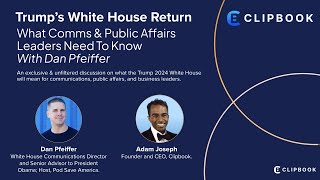
Former White House Communications Director Dan Pfeiffer explains how the 2024 election reshaped political messaging. Voters now live in fragmented digital ecosystems, making long-form audio and short-form video essential, while traditional broadcast TV has lost its grip. Pfeiffer warns that AI tools need human judgment and flags YouTube and Bluesky as underused platforms for reaching voters.
Chapters
Dan, good to see you. Hello, everybody. Happy Tuesday and welcome to our discussion here hosted by the team at Clipbook. We'll start with some quick introductions. I'll introduce myself, the topic, and of course, Dan. To introduce myself, my name is Adam Joseph. I'm the founder and CEO at Clipbook. At Clipbook, we're an AI research and analysis platform for communications teams and public affairs teams. Since our launch about 2 years ago, we've grown to support over 200 different companies, firms, advocacy organizations, nonprofits, government agencies across the country, many of whom are on this call today. So shout out to some of our clients that are joining us. The topic of our discussion today is Trump's White House Return: What Comms and Public Affairs Leaders Need to Know with special guest Dan Pfeiffer. Now, really, there are two reasons that I'm really excited for today's discussion. The first is the topic itself. We have an absolutely fascinating, timely topic for discussion. Today marks exactly 2 weeks since Election Day. Believe it or not, it's only been 2 weeks. A lot of comms professionals are feeling a lot of uncertainty and volatility in our space. And many of us have been wondering what really works in communications anymore. What doesn't work? Where should we invest our time, our energy, our capital, and our efforts? Now, during this session, we'll strive to really unpack the moment. We'll do our best to focus less on litigating the particulars of the election itself and really more on tactical, practical learnings for communications and public affairs professionals. So that's the first reason I'm excited. The second, and honestly the most important reason I'm excited today, is that we have an absolutely electric guest joining us. I probably can't think of anybody better in the world than Dan Pfeiffer to speak to the topic at hand. In addition to being one of the most influential voices in American politics, Dan has operated really at the highest levels of government and communications. He's had a storied career in politics, probably too many accolades to really mention. But notably, Dan served as White House Communications Director under President Obama during President Obama's first term and during Obama's second term served as senior advisor for communications and strategy, a portfolio and a role that he took over from Obama chief strategist David Axelrod. You might know him as the co-host of Pod Save America, which if you're on this Zoom, there's a good chance that you've listened to Pod Save America at some point. Positive America, which averages 1.5 million downloads per episode. Also, I'll mention on a personal note, Dan is a good friend, mentor, advisor, also an angel investor in Clipbook. So again, I, I really can't think of anybody better to join us today. Dan, it is great to, to have you.
It's great to be here, Adam. We're living in wild times right now, so this, this should be a fun conversation.
Yeah, we've got a, a nice, light, simple, uncomplicated topic to unpack here. Uh, but maybe we can just jump right into it. Maybe tell us where are you calling from? You know, in the last day or two, what's really been on your mind? What are the types of questions that you're asking yourself as a communications professional?
Well, I'm in the Bay Area of California, which is where I escaped to when I left the White House 9 years ago, where I live with my wife and my 2 young kids. A lot of people after this election disconnected. Some of them took social media off their phone. They've stopped watching cable news. They have forsworn the news for a while, at least to sort of process what happened. I have, in a very unhealthy fashion, done the opposite. I have just swum as deep in the muck as possible. I have been reading everything I possibly can, reading all the polls, reading all the takes, reading all the analyses, trying to, for myself at least, unpack what happened and where we go from here. I've worked on a bunch of campaigns, more losing than winning. And the one thing that is true is that you learn a lot more from the campaigns you lose than that is That is not solace for what folks on my side are feeling right now in any way, shape, or form. But whenever you win a campaign, you think everything you did was right. And when you lose a campaign, you can at least spend some time thinking about what went wrong. And then for the Democratic Party, at least, the shifts in this election among key segments of voters were so significant in this election, in particular, but particularly over the last 8 years, that it is— we have some pretty big questions to be asking ourselves about how we chart a path back from the wilderness.
That totally makes sense. And putting that content back on, you know, in retrospect, I mean, what are those learnings? What are the biggest learnings that you have from 2024?
You know, we're still answering some of the questions, but it is a notable fact that for much of my career in politics and really the gold standard of any media opportunity you could ever possibly get is a 60 Minutes interview in October that comes after a highly viewed NFL game. Donald Trump turned that down. He did not one single mainstream media interview for the last several months of the campaign. He did only partisan media and podcasts and did no local TV, no local press, did not do drive-time radio other than a handful of conservative hosts. He made no effort to reach out of what you think, what is commonly understood to be the GOP base. And so what does that tell us about communication strategies? And I am One of the things that I am struck by, that this has been a trend that's been going on for a while, but I think it really came to bear in this election, is the biggest gap in politics is not between right and left per se, it's between people who consume political news for a living and those who don't. And what became very clear is that Democrats have a great capacity to reach people who opt into news, right? In a Data for Progress poll on Kamala Harris, one, people who consume a great deal of news, by 6 points. People who consume a lot of news, she won 3 points. Trump won people who consume a little news by 7 points and people who consume no news at all by 19 points. A big question is how do we reach those? You know, people on my side are not reaching those less engaged voters in any way, shape, or form. But someone is, and it's not us. They are getting some information, some, you know, images or viewpoints about who each party is, and it has been negative for Democrats and at least somewhat positive for Republicans. And that is a giant yawning gap. And I think it requires everyone who works in political communications and probably communications writ large to revisit the basic building blocks of how we build a communications operation.
So what are the pieces that constitute the, what are the new building blocks of the gold standard as it exists in 2025? I mean, you know, one of the big macro shifts that I think we've seen in the last year or two, even longer than the last year or two, is a broad shift from broadcast TV spend towards other digital channels. It's a really complicated story, right? You have YouTube, Twitch, X, Truth Social, Snapchat, TikTok. Now you have, uh, Bluesky, which is, you know, skyrocketed to, I think, 20 million daily active users in the last couple of weeks. 4 in 10 voters are under the age of 30 are getting their news primarily from TikTok. Looking at this fragmented digital landscape, I mean, what is the playbook heading into 2025?
I think it's to understand the limits of a traditional press strategy, right? That simply a lot of what, if you're doing macro communications, right? If you were doing something where you're trying to influence an influential audience, right? You're trying to pass a bill on Capitol Hill, you're doing business press where you're trying to, therefore there is still a lot of value in some of the traditional tools, right? If you're trying to pitch your company, and to a bunch of investors, there's no better place to do it than the Wall Street Journal, for instance, right? Or various business press or CNBC. If you are in tech and you are trying to do a funding round or whatever else, or do a product launch that's going to target highly engaged users, the New York Times, a bunch, Kara Swisher's podcast, whatever it is, Scott Galloway, those are places where you can do those things. If you're trying to reach the broader public, there's just real limits to what you can get. And so that's one. Two is we have to recognize there are limit— very real limits to paid advertising. Now, those limits probably are— just think about the person who gets their social media news from TikTok and their primary streaming service is Netflix. You have no capacity to reach that person with a paid television advertisement. We've now reached a level of massive inefficiency in televisión advertising where you're basically just looking for the biggest audience possible without any real sense of who that audience necessarily be, which is why most of the big spend was on football games, right? College football and NFL games are the only places where you're getting upwards of 10 to 20 million people watching an event at one time. And that audience is often dispersed nationally. And then I think the media gatekeepers and who actually You know, has influence with people is very different now, right? Because we just have to recognize that the traditional media is, doesn't reach as many people as before and is distrusted by a lot of folks. And so you're really looking at influencers. I think that's sort of the term of art we're using for people, but media personalities, right? We just have to expand our mental definition of what a media personality is. You're really trying to reach people where you have. The audience has a parasocial relationship with the media personality. Because they may not trust an institution of the New York Times, the Washington Post, CNN, but they do trust Joe Rogan or—
Pod Save America.
Super. Or Pod Save America or Theo Vaughn or all these other people. And then the last thing I think, which is this is primarily true for political communications and certainly in a presidential campaign, but I think it is applicable because it's so much harder to reach for people, you need a media strategy that I like to refer to as everything everywhere all at once. You gotta do everything. You gotta do the traditional stuff, you gotta do non-traditional stuff. You gotta be interesting all the time. You gotta say things to make people pick up. You gotta be willing to go on Rogan, go on Theo Vaughn. You gotta go on, go do something with Hasan Piker, even if he disagrees with you on certain things. You have to be able to talk sports or food or movies or TV and just, you have to be interesting in as many places as possible to reach people.
Yeah. And to your point, you mentioned a lot of podcasters in particular. I mean, I have to ask about the role of podcasts in particular in 2024, kind of looking to 2025. Over 100 million Americans are listening to podcasts at least monthly. There was a ton of coverage, especially later in the race, around how President Trump had really reached into some of these different pockets of constituents, of influential figures, the manosphere, so to speak, to, you know, primarily through podcasts to engage that way. I mean, there's also, I don't know how many dozen headlines really questioning the Harris campaign's decision to not appear on the Joe Rogan podcast. You know, I don't want to necessarily litigate the particulars of that decision or anything like that. But I guess, you know, the broader set of considerations here around the role of podcasts in reaching voters and consumers more broadly, you mentioned some of the numbers around the NFL or, you know, some of the broadcast TV. I mean, you look at Joe Rogan, 12 million daily downloads, Call Her Daddy at 2 million, Pod Save at 1.5. Compare that to traditional TV where you have, you Hannity at 1.1, Bret Baier at 2.5, Matto at 1.3. I mean, these are comparable, you know, numbers, right? In a very particular way. So, you know a thing or two about podcasts. So what do you make of all this? You know, what are your takeaways?
Yeah, I think the future, at least the near-term future of media, is long-form audio and short-form video. And those two intersect in podcasts because you can look at the download numbers and we often look at the the Spotify or Apple Podcast download numbers, but people often forget that YouTube is the world's biggest podcast platform. The Trump interview on Rogan had like 46 million YouTube views within a couple, within a day or two of it happening, which is obviously bigger than anything. Now, some of that is obviously international, so it's not all just a domestic audience, but it's obviously a massive footprint.
It's like, it's like the Super Bowl. I mean, it's like on that order of magnitude. Yeah.
And what people, people also don't recognize, a lot of people who, they just like, well, it's You know, you get, you know, Alex Cooper gets 2 million downloads and Brett Baier gets 2 million views. So same, same. But what goes viral on TikTok and Instagram are podcast clips. It's the video clips, which is why they're all done on video, much to my personal chagrin on every Thursday when we record the podcast. But is that those clips go and more importantly, even the algorithms are feeding them to people who do not necessarily listen to the podcast and they are seeing. So there's this, all these downstream effects. Where you reach people who aren't necessarily subscribers or regular listeners of your podcast. Podcasts are something that work in our busy time. You can put it in when you're going for a run, you put it in when you're going for a walk, you can listen to it while you're doing the dishes, you can listen to it while you're cleaning the house, driving in your car, all those things. Prior to the pandemic, the primary way that people listen to Pod Save America, and you could see this in the downloads, was during commute times. If you didn't get the podcast out by 5:00 PM Eastern, you were going to suffer on your downloads because people They want to download it for that car ride or that subway or bus ride home. That changed during the pandemic where people started listening all the time. It became sort of background noise as you were doing your everyday things. You can't really do that with cable TV. You certainly can't wash the dishes and read the New York Times, right? You can't go grocery shopping and, you know, catch up on Matt Al or Nicole Wallace, but you can do that with a podcast. So it fits in our daily lives and there And people just, because we're in their ears all the time, people have, they, you know, you just, it's a, it develops a very close relationship between host and listener. Um, and because in part, 'cause it's also so informal, like I remember, uh, this was way back, uh, 8 years ago now, but when we first started, this was back when we were doing, before Pod Save America existed, we were doing Keeping It at 1600, which was the precursor podcast on Bill Simmons's Ringer Network. I was walking down the street in San Francisco and a guy came up, came up to me and asked me how Hawaii was, 'cause I had just come back from my honeymoon in Hawaii. And I was like, do I know this person? Did we go to college together? Did we work together? You work something in the administration. And then I realized about 5 minutes in the conversation that he was just a podcast listener who knew, 'cause you talk about your life in a podcast about that relationship. And so in a play, in a media time when people are desperately seeking trust, they do have it with, you know, it also exists for, you know, Twitch streamers, YouTube personalities as well. But that trusting relationship with the host makes the impact of an appearance there much more so than if you were on a cable news broadcast, for instance.
Now, for those in the audience that are representing elected officials, kind of key executives in a nonprofit or an advocacy organization, whatever it might be, I think a lot of work is being done in the last year or two to really equip the communications team itself to execute strategies that are optimized for long-form audio in some way, shape, or form, for short-form video in terms of the platforms they're engaging on. I mean, you take President Biden when he was the nominee. I mean, I think he joined TikTok in like early 2024, right? Like these are new muscles that the organizations are really building. So I guess as these teams are learning to execute a new set of operations, I mean, what advice do you have for them as they're being nimble, as they're kind of starting to expand to some of these new platforms?
I think the most important piece of advice is to be willing to take risks. Risk aversion is the core trait of most politicians and therefore most communications professionals. You get in trouble for things going wrong much more often as a press secretary or communications director than you get kudos for things going right. But in this day and age, the media moves so fast that problems go, they burn fast, but they burn quickly. And you just got to be out there, you got to do things, you got to try it all. This is something that Barack Obama was very, very willing to do. That's why he sort of did a whole bunch of things that no one else had done before. There are some politicians who are very good at it on the Democratic side, like AOC, Pete Buttigieg. It's not just age. Bernie Sanders has been willing to do lots of things that— so it's not purely generational that other politicians wouldn't do, but it's just like, you got to take risks, you got to try things, you got to be out there. And then the other thing is authentic. Like whatever is authentic to you is your best thing. You don't have to copy anyone else. It's like, what, what outside of politics do you like talking about? Would you be talking about in your normal life with your friends at dinner or at a bar or whatever else? Is it sports? Is it movies? Is it TV? Is it food? One of the best pieces of content that Kamala Harris ever did was in the primary, her primary campaign when she did a cooking, she went, she did, she cooked an Indian meal with, uh, Mindy Kaling. Like she is very passionate about food. If you've ever heard, there's this very great clip that made the rounds on, uh, on the internet of her and she was doing a, doing like satellite interviews with the IFB in her ear. And she was having a conversation with the, I guess the host waiting for it to start about how to cook a turkey and the best way to do it. And so it's just like, what is that thing that you, that your boss is interested in talking about and can talk about passionately and authentically, uh, with some knowledge. And find places for them to have that conversation. Because like, to get— people inherently distrust you if you're a politician. Like, you are starting at a deficit. So to try to get to a place of parity where you can actually convince people something, they have to try to begin to understand you as a human. And so find those ways that people can do that.
It's funny that you mentioned the Mindy Kaling video. If you ask my, my very Indian American parents, uh, what do they know about Kamala Harris and you know, early 2023, that's like the first thing they mentioned. And mind you, my mother also had a lot of opinions about how she was making the doses that she was making.
That's good. That's the controversy you want.
That's American politics at its best. I would love to shift gears a little bit to internal employee communications and how organizations are really navigating some of the choppy waters here. I think there's broadly an increasing pressure, for example, a company CEO or a nonprofit leader you know, in their communications team to really proactively engage on social and political issues. Um, I mean, even after this election, we saw tons of public statements that were being put out by various entities, uh, you know, whether it's Jamie Dimon publicly congratulating, uh, President Trump on the victory. You know, many large companies actually released internal communications directly to staff. A senior professional services executive actually told me he was running a multi-billion dollar professional services firm, had said that they had actually released a statement to internal senior leaders at the company but didn't do anything publicly, didn't do anything to all staff, and really just reminding their senior staff to really be empathetic to folks that, you know, elections are a heightened time, heightened time of emotions, and it's kind of a complicated, complicated moment. I think this is part of a larger trend. Universities' presidents are making statements about Israel and Palestine. You have, you know, sort of a lot of this type of pressure. So How should communications leaders navigate this? When do they say something? When do they keep quiet? Has the playbook changed?
There's been an ebb and flow here. I think after, you know, sort of basically after Trump was elected through maybe last year, there was real— most entities were putting out statements on a whole host of things, right? Gaza, the election, bills passing. And even when those things were not directly related to the mission or business of the company. And I think that has backtracked a little bit. You've seen fewer entities, companies, universities do that in the last year or two, but in part because of blowback, right? Blowback, what happened with Disney in Florida, the university presidents who were hauled up before Congress, some of whom ended up losing their jobs over how that went.
Yeah.
And I think there is no exact right answer to this. It depends on the company. It depends on the workforce. Company, organisation, depends on the workforce, it depends on the issue. Is it something directly tied to your company, your future, your mission, your workforce? I think it begins with managing your workforce and talking to them and listening to them and understanding where they are, but also perhaps being firm as to we have to— and then being empathetic, right? We should be empathetic and listen because there are people, if Trump actually implements some of the things he's talked about on immigration and mass deportation, that's going to have real impacts on the families of some of people's employees or students at universities. And Finding a way to be empathetic to that and understanding of that, but also recognizing the limits of what it is you can actually do. What power do you actually have as an organization or company to influence what's actually happening? And does whatever actions you take actually move the ball forward or not? And then you have to ask yourself that question. Are people really waiting on the statement from the online pet supply company on this bill or not? If the answer is yes, we actually have influence here and you want to make a decision to utilize it and you have a chance of success, that is good. If you're making a statement for statement's sake, I think that ultimately just work backwards from what actually moves the ball forward.
Are there any companies or organizations, institutions that you thought had a really effective response to the election results?
No, I think most people really try very hard to not get involved this time. I think if you are somewhat the— I think it's a little overly transparent when you very clearly wanted the other side to win and are now very worried about being the subject of some sort of vengeance or disfavor in the Trump administration. And therefore now you're putting out the statement. I think you are— I think you look inauthentic to your employees and your customers, and you're certainly not getting off any sort of enemies list based on that statement. I don't have an example of someone who did really good. I think sometimes just it's better to just put your head down and do your job as opposed to look for attention in these things.
Totally makes sense. Shifting gears again, I want to talk about AI. Communications leaders navigating new technology broadly is not an entirely new phenomenon, right? Whether it's the creation of the, I mean, broadcast TV or the internet or email or social media, whatever it might be. With AI, it seems that there's broader and more important inflection point, that it could be quite a paradigm shift in many ways. You know, for many communications teams, this is the first election cycle, you know, where they were using ChatGPT maybe on the daily in some way, shape, or form, generating content, using it as an assistant to write a press release, or starting to use other tools. Of course, Clipbook among them. Also externally, a lot of evidence that the creation of some of these new gen AI tools are really further eroding trust in what consumers, voters, constituents are really seeing on different social platforms. Dan, how is AI changing the landscape for communications professionals? What is the role that you're starting to see AI play?
It is likely going to change everything for communications professionals. This is the first real technology change automation that affects people in the creative communication space. There are a couple of ways I think to think about it. One is it can superpower what we do in a lot of ways. By using an assistant, using it to generate content that is optimized with data to be most effective. Like, like to put this in the perspective of a campaign, right? A campaign is ingesting all of this data, polling data, voter data, email response rate data, right? A, B, C, D testing of emails. And how can we then use all of that data in a very easy way to optimize everything that goes out the door? So that's one. Second is in politics, there is a lot of work where, and this is one of the reasons why, where Clipbook is very helpful. Prior to Clipbook, you had a lot of overqualified people spending their time doing the clips every day. Now those people can go do something else. You have the same thing with a lot of pretty basic content generation, talking points, bear press releases, some, you know, fundraising emails that where even if the AI is not generating it on its own can massively speed up the process, um, and optimize the final output. And so we should use that. The, the other thing I think is we should be very cautious about not letting us try to do things on the cheap. Politics is both arts and science, and you, you need human beings to make sure that it's right. And by doing the cheap means not hiring people that you should be hiring and trying to offload your tasks on ChatGPT or Perplexity or whatever else. And so we should not do that. Second point, this is mainly more for content generation companies, is that people should really learn, a lot of these media companies could really learn some lessons from the mistakes the newspapers made in the early days of the internet and handing over your content for free or for a nominal fee to train these LLMs is probably going to end up being one of those mistakes that you will greatly regret. Because you will find yourself, you will work your way, unless you were offering very real value, like high-end journalism offers people or very good writers or those sorts of things. If you're in the schlock business and you are, you're quickly going to be replaced by AI and you're probably speeding the path by letting them become better makers of online schlock based on your online schlock.
Yeah, absolutely. I mean, one of the fascinating things about AI is that the pace of play of innovation is so rapid. I mean, every few months OpenAI releases a new model. You know, I mean, you look at some of the new venture capital activity in the space, it's moving fast. And sometimes in communications, our ways of working don't necessarily move as fast as that might, you know, be required.
Right.
So, you know what? Well, I guess one, I just want for you to sort of challenge the assumption. Are communications professionals adopting AI with the appropriate level of pace? Should they be moving faster, slower? To what are the ways that they can appropriately incorporate AI into some of their day-to-day workflows, you know, as it really disrupts all of these massive industries?
You know, I think it is for the most part, the answer is probably no. People aren't utilizing it. Political communications tends to move behind technology because the decisions are often made by people one generation behind the technology. Right. That is always every person on this call who was a young person on the digital team or press secretary trying to explain to the campaign manager, chief of staff, or member 20, 15, 20, 30 years their senior about what TikTok is, or before that, what Snapchat is, or before that, what Twitter is, or why they, why we need a Facebook account. You know, and AI presents the same sort of thing. They don't know it, they don't trust it. So people should use it more is my guess. I think it's going to vary by different entity and different, and you know, where there's enough sophistication to do it. There were some really interesting things happening at the presidential campaign level. Using AI and some of the Super PAC stuff that was very useful. But I think one way in which people could use it is these bots are very helpful ways to test your assumptions and to test your content and to look at something that you've written or a sentence or a paragraph. I use it all the time for my newsletter message box. I will often just I will upload the entire thing I wrote and I will ask for 10 headlines that, you know, with a prompt that gets to who my audience is and that would lead to engagement. And I bet I use the actual headline they suggest 1 out of 20 times, but it's a thought starter, right? Where I'll like combine 2 of them or whatever else. And I think that that is a useful way, you know, especially if you're a communications person, you're sitting there staring at a blank screen a lot, trying to figure out how you're going to make the press release about the LIHEAP grant seem interesting. Having something, have a a very smart automated chatbot that you can bounce ideas off of is, I think, a good way to just like get the process moving.
I mean, in full disclosure, the way that we came up with the title for this event, this webinar was in part thanks to GPT and some conversations with GPT. So yeah, I very much have an appreciation for that. You know, as communications professionals out there pitching stories, creating content, managing social media channels, Oftentimes it's really hard to unsee the matrix of communication strategy when you see it in the wild. Like you see a headline in the New York Times or you see a social video and you think, oh wow, like that was part of a very particular type of strategy from a team that is executing something. And, you know, I'm curious, kind of looking at 2020 in retrospect, also looking into heading into 2025, which public figure, which brand, which organization do you think is just really crushing the comms game? Like you can just see, wow, like this organization has seized the matrix, they're punching way above their weight?
I mean, this is a painful thing for me to say, but it certainly was the Trump campaign. They knew who their audience was, they knew how to reach their audience, and they made a relentless effort to reach that audience without any regard for the traditional norms. When you work in political communications, you end up doing a bunch of dumb shit because you feel like you have to, right? I used to call them cocktail party interviews when you live in DC and just like, I cannot run into this CNN host one more time and have them bend my ear. So we might as well just knock it out, right? Or if you work in the White House, the most annoying reporters who come up to your office because they can walk into the press office and talk to you will come up and they bug you and bug you and bug you and just like, fine, we'll do it. The Trump campaign did not do that. They did not feel any desire to adhere to any of the norms about who you talk to. They blew off a 60 Minutes interview. Like that, I mean, that's a wild thing to do because they thought they could, it would not reach everything. They knew their path to victory was reaching lesser engaged voters. You know who does not watch 60 Minutes? Lesser engaged voters. So they spent that time on Theo Vaughn or Barstool Podcast or whatever else. So that's one. I think the person on the Democratic side who has the most advanced sort of understanding of the modern communication sphere is AOC. She just, she understands the value of authenticity. She does it all. She is, when she wants to make a point that influences her colleagues on legislative or political strategy, she goes on CNN or MSNBC. When she wants to reach young people, she plays Madden with Tim Walls on Twitch. She is just out there and she is just like herself and how she does it. You know, there are like obviously Pete Buttigieg is very good. Gretchen Whitmer and Josh Shapiro did a bunch of really smart things. John Fetterman in his 2022 campaign ran a great, really executed a brilliant strategy. But really, for the person right now on this election cycle who probably did the best job, it was probably AOC.
So with AOC, do you think that is the principle or do you think there's something about the way that the communications team is executing, you know, reaching into some of these channels? I mean, I know after the election, She did a lot of Instagram Lives, did a lot of direct-to-camera, hey, I'm talking to constituents, I want to hear from you. Think of that strategy versus press releases and traditional broadcast TV. So I would love to just double-click what are the tactical things that you saw her do that you thought were really effective?
I think it was the livestream stuff, going on Instagram, talking directly to people, thinking about ways to make that more interesting. Like when she asked the people who voted for her and Trump in her district, which was not an insignificant number, or voted for Trump and a Democrat, why? And then hosting all of those and letting people see them. Like that was a very smart way to get content. It's just being really authentic. Like there's a successful communicator is always a marriage between a smart, aggressive communications team and a principal who was willing to do things. And that's clearly what is happening in that shop, right? My job was made so much easier by the fact that Barack Obama was willing and talented, right? And he could go on, Jimmy Fallon and wrap the news, and he could go on, he could do his NCAA March Madness bracket live on ESPN. He could also sit down with 6 New York Times columnists and talk philosophy, right? Like, it doesn't work, right? You can't pull— what works for AOC is not going to work for, you know, pick your random member here. But I think it's both a smart team and a willing and talented communicator and a principal.
On the flip side, uh, this one might be, uh, hopefully a fun one, might be a little bit of a mean one. We'll, we'll take a bit of a risk, but which entity do you think that you're seeing, whether it's public figure or comms team, that you just think are, oh, like, they're just like missing the, missing the mark here. They're failing. Just, you know, this is like kind of painful to watch. What does that look like? What are some of your takeaways from, from that?
I don't know that I can pick a specific figure. Some of them could be your clients, so I don't know if we wanna do that. Right.
Or maybe a moment, right? I mean, sometimes really impressive communicators have really bad moments. They handle something really poorly and you learn something from that, but they rock and roll.
I'll give you an example from my own career. In the White House, when I worked for Barack Obama, particularly in the early days, we wanted to do as many different interesting things as we possibly could. And this is aging myself here, but a real target audience in the 2000s was NASCAR dads. NASCAR was the fastest-growing sport in America. It was huge. Barack Obama was obviously not a natural NASCAR fan, but ESPN wanted to broadcast their NASCAR show from the White House because we were doing an event with clean cars. So it's like you got ESPN broadcasting, I think the first ethanol-fueled car or something was going to be involved in NASCAR or something else. We were going to have it at the White House, a little thing here. And I had the— what I thought was the brilliant idea of, well, obviously Barack Obama should go on ESPN and talk to NASCAR, right? NASCAR fans like that. That seems great. Like, that's an audience we don't reach normally. Problem was Barack Obama knew nothing about NASCAR, had no interest in it, couldn't speak about it for a long period of time. Like, we briefed him, but he couldn't talk about any sort of authentic, real way in the interview. Was he— he navigated it, but I would say it was not a home run. And the lesson for me is you have to be interesting in a way that's authentic to yourself. And so if you were just like out trying to talk to as many people as possible without thinking about, you know, what it is you can talk about and what's a good spot for you, then you will make mistakes like that.
You know, it's funny kind of thinking about evaluating 2024, 2025 communication strategies. I mean, one of the people that I've really respected as a communicator is Detroit Lions head coach Dan Campbell, who has taken the team from being like— and I'm from Michigan, you know, longtime Lions fan. Taken the team from being like an 0-16 team, like just really a struggling franchise, one of the worst franchises in NFL history, to now being the best in the league. Right. And part of what is really energizing the city and his fans and, you know, the team more broadly is just the pure authenticity with which the guy speaks. I mean, go on TikTok, you'll see every— after every single game, you'll see his locker room speech. He's out there. He's like super amped up. It doesn't hurt that he's like 6'5" and 260 pounds and just kind of a visual sight, but he's like crying, he's energized, he's riled up, the team is super excited. And this isn't a guy who has, I imagine, a lot of like professional media training. He's not doing, you know, interviews on 60 Minutes and the New York Times, whatever it might be. He's just, he's literally just talking very authentically to his team and to friends. So yeah, I mean, I think it's really, I think a lot of these new formats are, you know, the communicators really have to lean in more into authenticity, direct conversations, kind of as you described.
The Dan Campbell example is interesting because he just— he knows what his brand is. It is authentic to him and he lives it in every way, shape, or form, right? It is in his locker room speeches. It's in his response to wins, his response to losses. It's in how he coaches, just always being aggressive. And so that sort of brand consistency and authenticity works very well for him. And like, it has helped him when, when the Lions, you know, have made mistakes, right? When they went for it again, you know, on 4th and 15 or whatever it is against Dallas at the end of last season. But because he had— that was something that was consistent with his brand, it was better than if it seemed like he was making a random decision. Like, you can interpret everything Dan Campbell says and does because you know who he is. And I think that that should be the goal for all politicians.
Many of the questions leading up to the discussion today, probably the biggest question that we received from our audience members is, you know, there's a lot of noise there are a lot of constant news cycles, especially now as Trump has, you know, become president-elect heading into 2025. Consumers and voters feel a lot of media fatigue. I mean, how do comms pros actually break through all of the noise and deliver impactful messaging?
You just got to do everything right. There is no singular breakthrough moment. You're not going to know. You're not going to plan it, right? There's no on the whiteboard, this is my breakthrough moment thing that ever works, which is why you just have to do more than you— than has ever been done before. Always be talking, always by doing things, always be reaching out. There's just like, that is the nature. We live in an attention economy. It's almost impossible to get attention. This is not just in politics, it's in business, it's in Hollywood and celebrities. It's why every movie is a sequel or something or a remake of something because it's impossible. People don't expect that they can get people's attention to tell them about something new. And so you just got to be out there all the time. There is no shortcuts here.
Another question from the audience. This one's from Jessica. Why did Joe Rogan, quote unquote, beat Oprah, Taylor Swift, Beyoncé, and Lady Gaga? What does that say about mega celebrity influencers? And I think Jessica actually brings up a really good point here, right? Where, you know, it's not like Democrats didn't engage influencers. They had a number of high-profile influencers and celebrities that were part of their ecosystem. I mean, Taylor Swift, gosh, is one of the most influential figures in the world right now. So how do you compare, you know, which influencers to engage, their relative their impact on, you know, some of these, you know, some elections and more broadly?
I mean, the Rogan, Taylor Swift, Beyoncé thing is like really a conversation for basically the Democratic and Republican presidential nominees and no one else, right? Like, that's, that's not the sort of conversation that a person, you know, is having in their day-to-day comms. I think the way to think about it is who is the audience of the influencer? Is it people we don't— we can't reach otherwise, right? And I think look, if Taylor Swift and Kamala Harris had sat down for a conversation that would have been filmed and uploaded on YouTube, that would have blown the doors off the internet. The Beyoncé moment got huge attention for the campaign in a time when it's really hard to get attention. And those clips went incredibly viral. Right. So it's not— it's like we can't say that because Donald Trump went on Rogan and won and Kamala Harris didn't go on Rogan but hung out with Beyoncé and Taylor Swift or Bruce Springsteen or whoever else, that that's why she didn't win. It's much more complicated than that. And it doesn't— it doesn't mean that one strategy worked better than the other per se. But what I do think that Rogan— it goes back to what I was saying about Trump's campaign— is that Rogan just very specifically reached a group of people that were pretty hard to reach any other way and that Trump needed. And that that's sort of the— that's sort of the strategic matrix to apply to any sort of influencer or media decision.
To that point, what are the platform spaces that are you think are being underinvested in for communications and public affairs teams that, you know, might otherwise be making decisions to prioritize other more traditional platforms?
I think, I mean, it is YouTube. People do— we, we talk about TikTok all the time in politics, who's doing what on TikTok, what the trends are, should it be banned, not banned, all of that. We talk about, you know, a decade talking about Facebook all the time. We spend all this time on Twitter, which basically no one uses. And we never talk about YouTube. And YouTube is the— it is TV for most people under a certain age. It is where most people spend their time online. It's the largest podcast platform in the world. It's one of the largest music platforms in the world. And we spend very little time cultivating relationships with YouTube influencers, with putting up our own content on YouTube, building YouTube followings. As a Democratic Party, we don't— we have done a very poor job of that, with some notable exceptions. And so I think YouTube is the biggest place that is underdiscussed and underutilized.
Why is that? I mean, why the blind spot to YouTube? I mean, you know, comms professionals are smart. They see the data, you know, they see it in action. They might, you know, watch football games or sports clips or video game clips on YouTube, whatever it might be. Like, is there, is there something about just the ways of working that has made it really hard for comms teams to break through on YouTube?
It's more labor intensive than filming a TikTok with your phone or posting on Twitter. And so you need a real strategy for it. You need to in the media, part of it is we are, we sort of, we work backwards from what the media talks about. The media is so Twitter and TikTok heavy in what they talk about, particularly Twitter. And so it's just, it's just, it's just never talked about. And so it gets less, less attention. And so less, less of it gets done. For a long time in a very smart way to avoid the scrutiny of a lot of the other social media platforms. They don't get hauled before Congress in the same way that Mark Zuckerberg and Twitter did before Elon Musk owned Congress, but it is like, it is where most of people are getting like, that's how most people watch TV. They have YouTube on their actual television and that's what they're watching.
David in the audience wants to dig in a little bit more on Bluesky, uh, especially just given the last couple of weeks. I mean, we have, you know, gone from, you know, up, up now to 20 million, uh, daily active users. You know, is this a platform that we should be investing in early? What is the future of Bluesky?
It's always worth— we've had this conversation in the last 2 years about Mastodon, Threads, Post, now Bluesky. I think it is— so I don't know what the future holds. I think it is always worth trying out a new platform early to see if you get that escape velocity, right? If you're one of the first few people who builds a following on a platform that takes off, you are going to have such a first mover advantage over everyone else. So I don't know what the downside would be if you are an organization or a politician to get a Bluesky account, get on there, get active, build up a following and see if the thing really does blow up. And if it does blow up, then you, you're ahead of the, ahead of the game.
I have another question from the audience. This one's from Earl, really on how to best leverage surrogates in the modern comms sphere. You know, what does that look like in practice? What sort of missed— what was missing, if anything, from 2024 and the presidential campaign, but also looking forward for advocacy organizations, government agencies, you know, and their surrogate strategy more, more broadly.
You have to work backwards from what your— your— who your audience is and what your end goal is, right? Are you trying to influence legislation? Are you trying to persuade the broader public of something? Are you trying to reach a specific audience in the broader public? If your goal is to— we want to change public opinion on oil subsidies or sugar consumption, or pick your issue— like, you're not going to change broader public opinion by booking a bunch of surrogates on cable news. There's no downside to it, but That's just not how you do it. If your goal is to get Congress to do something about it or to influence the administration to do something about it, and I'm using administration nonpartisan broadly here, there's probably a set of specific strategies of how you reach the Trump administration. But then, you know, these high engagement platforms like cable news, the daily tip sheets like Axios and Playbook, et cetera, Semaphore, whatever, Punchbowl are pretty valuable places to work. But it really depends on who you're trying to reach and what you're trying to accomplish.
We're going to jump into a little bit of a fun lightning round here. At Flipbook, we like to tell a story that's probably familiar to some, some on this call, that every communications team, every PR team, every public affairs team has some poor 22-year-old intern or associate, we always joke, named Derek, who has the very unfortunate task to do a lot of the day-to-day research that media monitoring that supports a lot of the core work of the communications team. So at Clipbook, we honestly, we worship Derek because he's the poor soul that, you know, really gets stuck doing a lot of this work. And also at Clipbook, we exist in part to support Derek and his workflows. So this next set of questions, Dan, is we're going to channel Derek's 22-year-old energy and ask him a few questions that Derek might want to ask you. So are you ready to jump in?
Sure.
Who is your favorite fictional communications director or press secretary?
I think I am required by professional obligation to say Toby Ziegler because he was White House communications director when I was. You sort of have to do that. I am of the West Wing generation, so I think there can be no other options there.
Dan, this is the only question that you've answered incorrectly. The correct answer was CJ Cragg.
I felt obligated. Here's why I felt somewhat obligated. That would be my runner-up as press secretary. But very nicely, when I became White House communications director, the day I got the job, Joe Biden happened to be meeting with Richard Schiff, who played Toby Ziegler, and Joe Biden brought Richard Schiff to my office so he could basically say, "You're a communications director. You're a communications director," which was very cool, but I think Richard Schiff thought was quite awkward. But so therefore I was obligated to give the nod to Toby Ziegler.
Fair point. Very fair point. Second, imagine you're talking to Derek, the 22-year-old intern. Maybe he's graduating from, you know, American University this spring, taking his first job as a Hill intern. What advice are you giving to Derek?
If you can work your tail off, right? But politics in particular, Capitol Hill and campaigns, campaigns even more so, are en, are oftentimes pure meritocracies where there's too much work and not enough people. And so if you can pick up something and run with it and do it well, you can advance very, very quickly. And so if someone asks you to do something, take it, right? Even if that is to go get coffee, right? It's as disrespectful, as annoying as that seems based on the fact that you probably just graduated college, go do it. Get to know people. Just like you have a shot when you're incredibly young to do a bunch of stuff and work your tail off. If this is really what you want to do, if you really want to make it in politics or in communications, you can rise the ladder quickly just by being a hard worker, a good colleague, and willing to take on any task no matter how mundane it seems. Love that.
Third, Jake Paul and Mike Tyson, big fight this last weekend. Thoughts? I mean, what does the fight, all of the pageantry around that, really say about communication strategy, about marketing, about our politics?
Well, the fact that so many people watched it that Netflix's stream crashed, I think just tells a couple of things. One, we have no monoculture in this country anymore. We don't all watch the same shows or anything. It's all around big events. It's the only time we break out of our algorithmically curated information bubbles. And that's why football has gotten bigger over time when even people thought the NFL would sort of go away a few years ago and is now really the biggest thing in American culture. They like events that generate conversation. And I don't like— it's not a purely replicable strategy for communications professionals, but it is the sense— but I do think it's worth noting that these sorts of big events that are interesting and weird and controversial get attention. And that's sort of what, you know, interesting, weird, and controversial is sort of the coin of the realm in the internet age. And you should think about ways in which You can be those things if you want to get attention for your boss.
Okay. Fourth, Pod Save America co-host Jon Lovett was on Survivor recently, somehow lasted fewer rounds than Mike Tyson versus Jake Paul. If we were to put you on Survivor, Dan, how would you fare?
It would be impossible given the way the game works to do worse than Lovett since he was the first person voted off. But I definitely do not think I would have done better. So.
Okay, fair enough. Last question. I know that you were on Jimmy Kimmel last week. I was at last week, two weeks ago. Great episode. If you haven't watched that, uh, for folks in the audience, highly recommend. How does a webinar with Clipbook compare?
Actually, Clipbook is much better because we agreed to the Jimmy Kimmel thing obviously long before the election. And therefore I would say one of the first things I thought of when I woke up Wednesday morning was, holy shit, we have to go be on national TV to talk about this election. Jimmy Kimmel was great, ended up going fine, but I was dreading every second of it. I've never dreaded working with clip books, so there you go.
I appreciate that. I'm curious whose idea it was to bring the bottle of bourbon or whatever you guys had with you.
We basically have been carrying it with us nonstop since about midnight on Tuesday night. So it was coincidence, I guess.
Yeah, that's funny. Well, yeah, it's 11 a.m. in— I guess now 12, 12 p.m. in California. It's a little bit early for bourbon. Before we run, I have two final plugs. First, at Clipbook, we mentioned Derek earlier. For those in the audience who have a poor Derek on the team that is currently suffering doing manual research for you and your organization, or if you wish, wish you had a Derek really supporting you with your research needs, then please reach out to Clipbook. We're an AI research and analysis platform. We automate your desk research and media monitoring with an amazing degree of comprehensiveness and precision. And since you joined this webinar, if you sign up for a Clipbook demo before December 1st, we'll give you a month free when you purchase a subscription. So that's the first thing. Second is after the webinar, we'll send an email to sign up to Dan's Substack, Message Box, one of the top newsletters in American politics. I read it myself. If you use the link that we send in an email after this, you'll get a month free of Message Box as well. Dan, any final thoughts?
No, just, this was a great conversation. This is, we're obviously living in very interesting times for communications professionals. It's a time of great transition. And so we'll continue the conversation.
Well, Dan, thank you so much. From all the attendees, really appreciate you joining us this afternoon. Thank you, everybody. Have a great week. Keep an eye out for a couple of emails from us. Also, let us know your feedback, your comments after the webinar, who we should host next during the next discussion. Happy Tuesday and have a great day.
More from Adam
The Changing Role of the CCO in the AI Era: Lessons from BCG's CCO Russell Dubner
Carta's Peter Walker on Mastering Business Storytelling for LinkedIn and Beyond
From Public Service to Private Enterprise: How Leaders can Navigate a Cross-Sector Career
From the West Wing to Hollywood: How Top PR Strategists Shape Public Perception with Eric Schultz