Ken Spain’s Playbook for Leading Through Regulatory and Political Turbulence
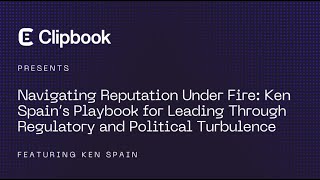
Ken Spain, CEO of Narrative Strategies, walks through his playbook for managing corporate reputation in volatile political and regulatory environments. He built his approach from campaign politics: speed, message discipline, data on your audience. For 2025-2026, watch AI regulation, data-center power demands, trade tensions, and DEI backlash.
Chapters
Hello everybody. Happy Tuesday. Welcome to today's webinar discussion hosted by the team here at ClickBook. As always, we're really excited for the conversation today. So we'll go ahead and jump in. Ken, are you ready to do this?
I think so. Thanks for having me.
No, thank you. We'll start with a couple of quick introductions. Also, we'll just start by saying my voice, I lost my voice over this weekend during my bachelor party of all things. So I'm going to If I like pause for a second to clear my throat or whatever it might be, my apologies. But also last webinar before the big wedding in a couple of weeks, which is always fun. Anyways, to start with some quick introductions. To introduce myself, my name is Adam Joseph. I'm the founder and CEO here at Clipbook. I will be your host today. At Clipbook, we're an AI research and analysis platform for communications teams. Since our launch a couple of years ago, we've now grown to support over 200 enterprises globally. From companies, firms, nonprofits, and government agencies, advocacy organizations all over the country. And today's conversation is one that I'm really excited about. Our topic for today is Navigating Reputation Under Fire: Ken Spain's Playbook for Leading Through Regulatory and Political Turbulence. And to that end, we're really excited and thrilled to have Ken Spain here with us today. Ken is the CEO and founding partner at Narrative Strategies, one of the most trusted names and firms in public affairs, crisis, and reputation management. Ken has had a really extensive career in public affairs, leading communications for global brands, industry associations, political leaders, everybody from former President George Bush to the American Investment Council. Simply put, he's a trusted advisor to anybody who needs to protect and elevate their brand in various ways. All to say, we're in for a really insightful, really engaging discussion. We'll go ahead and get started here. For our audience members, just as a quick reminder, Please drop your questions into the Zoom Q&A function. Drop them as they come. We'll get through them throughout the course of the conversation. Ken, to turn it to you, we have a big topic today. Before we jump in, I wanted to ask you, maybe just give you a chance to introduce yourself. You've woven together decades of experience on some of the most intense campaigns, corporate communications teams. What initially drew you to this space and public affairs and beyond?
Yeah, first of all, thanks for having me, Adam. Good to see you as always. Look, I've always straddled the world when I was coming up, grew up in Southern California. Started working in politics out there, then started working on political campaigns and then made my way to Washington eventually. You start straddling the world of kind of Capitol Hill political campaigns. I finished up at the House Campaign Committee, the NRCC, and really enjoyed my time there. But you start thinking to yourself, what else is out there? And I started to realize there's really this world of being able to take your political skill set, if you will, and communications and campaigns and figuring out how can you apply that to helping companies and helping industries navigate some of the, whether it's reputational challenges, crises, regulatory, legislative challenges that they might be facing. And for me, like, that was really something that really interested me along the way and figured out, hey, I can apply this skill set to this whole other world. And it's something I've really enjoyed over the, I'd say over the last couple of decades.
Yeah, that's amazing, Ken. And so Ken, what was the first job in the space? Like, for your first gig, 22-year-old Ken Spain, ready to take on the world. What was the first one?
My first job was right out of college. I worked for a state senator from California in his district office. I really wasn't long for it though. I actually started gravitating to the world of political campaigns and actually found my way. I started realizing very quickly I'm a Republican, or came up as a Republican, and started to realize that being a Republican in California might not have the long— the longest trajectory professionally for me. Made my way to Texas in 2004. Actually, they were going through mid, mid decade redistricting of all things, which is a topic today now. And I worked on some campaigns there and then found myself on the 2004 Bush-Cheney campaign in New Mexico and was very fortunate to do that. And then from there, made my way to Washington and then started working on Capitol Hill.
Yeah, that's amazing. So the transition from— you're in various states, California, New Mexico, then making the move to D.C., that's a big moment, right? And it's like the political capital of the world in many ways. So what was that like? What was also the— I would love to hear about the first job in, in DC as well.
Yeah. So my first job was I actually ended up going back to the first guy I worked for in Texas. He was actually from Midland, Texas. So it was a slight cultural departure from my life in— at the time I was living in Huntington Beach, California to Midland, Texas. But went and worked for him in Washington. His name was Mike. His name's Mike Conaway. He was a freshman at the time, now retired. Great guy. And I worked for him and then went and worked for another member of Congress. And then I found my way to the House Campaign Committee and I worked for, at the NRCC, which was at the time chaired by Tom Cole from Oklahoma, who's just an awesome guy. But we ran into the buzzsaw that was the 2008 election. A lot going on that, that at that time there was a very unpopular war and unpopular president, and then there was a financial crisis to boot at the end. But I was lucky enough, I was one of the few people who got to stick around the campaign committee. One of the a small handful. And a couple years later, we won back the House majority, and at the end of 2010. But by that point, I was getting a little kind of— I was starting to wonder, like, what was next for me in politics and whether or not it was something— did I want to stay in, in pure politics, if you will? But I was— had been asked to go work for Mitt Romney's campaign. And going in, we were going into the presidential election. He was going to run against Barack Obama at the time. But a guy by the name of Ken Mellman, who had been the RNC chairman but had gone to KKR, which is now a big— which is a big private equity firm, had asked, hey, are you looking to do something a little bit different? And I was toying with it. And he said, look, I think Romney's going to be the nominee in 2 years, but he comes from this— from the private equity industry. And I'm on the board of this trade association that represents private equity firms. And nobody in Washington's heard of private equity. And we need someone to defend the industry in 2 years. And so I need someone who has a campaign background, a campaign mindset, who understands crises and can help us tell the story of an industry and defend an industry 2 years from now. And so I really, I decided to go and do that. And that kind of set me on this path toward the public affairs crisis space.
Yeah. So I'd love to hear a little bit about the before and after, because you going to the American Investment Council, that was really like the big jump into industry in some way, shape, or form. All of the previous experiences, NRCC and government, in campaigns, what were the major learnings and takeaways that you had during that time? That you found to be the most valuable when you actually hit the ground running at American Investment Council?
Well, I think when you work in politics, especially when you're at a higher level in politics, by the time I had finished, you're really, you're dealing with every day, you're tackling really tough incoming questions from, from the New York Times or the Wall Street Journal or from CNN and the amount of reps that you get dealing with challenging media. Questions. And oftentimes you have the opportunity to go on offense and tell a positive story too. I don't want to neglect that as well, but the opportunity you get from a media relations standpoint, the speed, I would say every day, like when you're working with candidates all over the country, in the case of the campaign committee, every day is an opportunity, but every day is a crisis too. So speed, and you learn how to deal in, in, you take crises as just that's breakfast. That's your morning coffee. Okay. What's next? Like sometimes you're dealing with 30, 40 races in a day. And so something's always happening. You learn to really prioritize. You learn the value of message discipline. You learn the value of data and learning how to follow the data. You have dozens of pollsters that you're working with. You're working with big principals, whether it's the minority leader at the time or candidates that are across the country or incumbent members of Congress who need your help on a daily basis. And they're campaign managers and they're consultants, all people who go on to do other things later on in life. So I would just say the ability to manage personalities, the ability to engage in long-term strategic planning. But I think like also just the speed and the ability to prioritize and manage day-to-day crises and be opportunistic and find ways to go on offense is, is just like nothing you'll ever, I'll ever get to have in my life ever again, I think.
Yeah, I couldn't agree more. Full disclosure, I worked in Democratic politics. I know that we've had some good discussions about that, but we're still friends for everyone in the audience, to be clear. But my time in Democratic politics definitely definitely the case, right? You're in a resource-constrained environment, things are happening very fast, and oftentimes too in, in political context or in government context, like the most junior person in the room all of a sudden gets line promoted and they're running, taking on like massive amounts of responsibility. And just being able to get those reps in can serve you so well the next bounce of the ball. So yeah, no, I very much have a, have an appreciation for that. And how was it different heading into American Investment Council and all the work there And what was the cultural difference, like the tactical difference in what you were navigating?
Look, I think like first and foremost, I think to your point, it's you go from defending a, a party or a series of candidates. And by the way, like we had candidates who believed a variety of different things, especially back then. It's not as much as it was today where the parties are these like monoliths, right? You had pro-choice and pro-life, you had anti-gun and pro-gun. You had like people of varying different beliefs running under the Republican banner back then. And I should note, my wife is a proud Democrat. Democrat and was a chief of staff in the Senate for many years. So belonged to a mixed, a mixed marriage as we refer to them in Washington. But yeah, to, but to your point, immediately go from a partisan environment to defending an industry that doesn't care about partisan politics first and foremost. They care about ensuring that they can maintain their license to operate. They care about certain provisions legislatively or from a regulatory standpoint. So you go from this very simplistic political mindset of talking about issues that people really understand on a day-to-day basis to some of these more esoteric and arcane issues, or understanding a business model that is very complex. The other thing is that when you're in politics, you only care about one thing. You care about votes, right? You're trying to get your team, if you will, to 50% plus 1% of the vote, right? And when you're getting alignment within an organization is not a problem in politics. Everybody's aligned. Everybody knows what they want. We need votes. We need to win. And so speed is not a problem when you're working on behalf of an industry or when you're working on the inside of a company, getting alignment, whether it's from a CEO or a general counsel who has legal concerns or someone else who has investor concerns or customer concerns. Getting alignment, much less within a company, but amongst a series of companies when you're in a trade association, that's a different ballgame. And so being able to do that and apply my skill set at the time to an industry was— I was like, wow, things are moving a lot slower here for sure. I definitely thought that we were able to add a lot of value. We were to do something on behalf of an industry they had never done before. We always joke that Our members love the, the private part about private equity because they never wanted to talk about themselves or engage publicly at the time. Very few of them were publicly traded or engaged with the media, but we had to build the muscle memory to do. And so it was a real challenging task, but it was also something that I'm really grateful for having.
Yeah, that's great. So I want to skip a few steps in my career here. Fast forward, you worked at Coke, you, and then you had the decision, hey, I want to start narrative, I kind of want to be an entrepreneur and do this. Tell us really quickly, like, what was that decision like? And also the firm has done really well in over the last few years and you've grown at some really impressive scale and you're very much a trusted institution in DC. So we'd love to kind of hear what has made you successful over the last few years.
Yeah, look, I never thought of myself as an entrepreneur. There's a reason like why I went from politics to a trade association. Like you mentioned, I worked in-house at Koch Industries. So I've worked for entrepreneurs and never thought of myself as one. I have a couple business partners here that I had known for a long time. One was a reporter at the Wall Street Journal. One was in opposition research with me in politics for many years. But yeah, look, we've been very blessed. NarrativeNow, we've just crossed the 100-employee threshold this, this year with locations in New York, Florida, and DC. We have great clients, whether they be in the financial services space, healthcare space, tech space. I think we had started the practice at another firm and we bootstrapped it, and it was 3 of us in cubicles. The feeling, Adam, like you're starting something from scratch, right? And you're like, boy, is this going to work? And you're doing— truly, I was an intern, an associate, a manager, a managing director, and a partner all at one time. And so you're doing everything, and I was doing work that I hadn't done in 15 years in many respects, but also doing work, senior-level work that I hadn't really, hadn't done. But it was awesome. It was great. We were there for a few years, started the firm, got to about a dozen of us, and then we decided to move on. Frankly, it was just not a great fit for us. Frankly, the biggest reason why we started Narrative is we wanted a culture-centered firm where, you know, people were excited to go to work every single day. And I think that culture really makes a big difference because if you have a great culture, then also people really want to work with you as clients too, because they see that there's less turnover on your account teams. You're a great person to work with, hopefully, right? People are attracted to that. You build trust with clients. And I think we've, we've been together now 6 years and been able to grow relatively quickly. We also wanted to build a firm that had a lot of capabilities. We have advertising, digital media buying. We've got in-house insights, qualitative, quantitative research, opposition research. And I think that when you're able to apply all the tools and and skill sets that you pick up in campaigns along the way and apply them to your clients, people want to stick around. And I think it's been a fascinating journey. It's certainly something I've been really grateful for, but I'd say the most rewarding thing is like really being able to build the team and watch the team grow and then watch our clients respond to the, hopefully what they believe is the premium service and counsel we're able to provide.
Yeah, that's amazing. To shift gears a little bit, we'd love to get into the content of reputation management of crisis. And I'd love to get a sense, you're the trusted voice in the, the trusted voice in the room for so many clients across the country. As you're engaging clients on a big reputational moment, what are the principles or the rules that you come back to repeatedly when engaging a client on a reputational matter?
Yeah, so look, I think that I think number one is just fundamentally, is fundamentally comes down to trust and understanding who your audience is. And I think that people think that they know who their audience is, or they oftentimes think that they have trust with that audience. But I think you really have to go, first of all, take a look at the data. So we're a very data-driven organization, and I think too many times organizations, companies, our clients will say, "No, we know what we need to say. We know what we need to do." And I think that oftentimes the data sometimes confirms what our clients know, but maybe allows them to refine that. But oftentimes our clients find out that what they think they need to say or do, the data doesn't necessarily bear that out. And I find that the data provides the roadmap. Oftentimes, like, clients have the tools at their disposal. A company or a CEO or someone in the C-suite has the tools at their disposal to tell a compelling story or to provide the right argument, but they don't necessarily have the correct roadmap to get there, or they don't necessarily understand the audience to which they need to deliver it to. Sometimes your problem is not necessarily with your customer base. Maybe it's with a political stakeholder audience, or maybe it's within investor audience, but you're telling your story to the wrong audience or the wrong story or the right story to the wrong audience or the wrong story to the right audience. So oftentimes our job and our ability is that we come to you with the data and we help you figure out how are we ensuring that we are building trust with the right audience and what is your value proposition with that audience. I think sometimes we deliver the— we're delivering widgets. Right? And we're delivering widgets to our customers. Yeah, but your problem isn't necessarily with your customers. It might be with a whole other audience that is now potentially infecting your customer base. So unless we fix our problem with this other audience over here, we're not going to— our customer problem is actually only going to get bigger over time. Those are the fundamental issues that we oftentimes have to tackle with our clients. But to me, it all starts with data. And that's really, to me, like the crux of a lot of issues that you can fix early on.
No, that's great, Ken. What does it take to be data-driven? It's, it's not always easy, right? Like sometimes you have an intuitive sense for the client. They might be talking to their customers, their investors, their stakeholders, their suppliers, their employees. They'd have a qualitative sense, right, of what the challenges are. But it takes something like actual research, takes tooling, it takes something to be able to really get to that next inflection point. All to say, what does it take to be data-driven if you're a client?
That's a great point. So for us, we have an insights practice. And so oftentimes, like, we'll do things like either whether it's focus groups or one-on-one interviews, sometimes it's just fundamental basic survey research. We do a lot of work with what we call, what we call critical audiences. So oftentimes, like, sometimes our clients, their most important audience isn't a set of voters. Maybe it's CTOs or maybe it's investors. And so making sure that we're able to reach those audience, understand, and then test a variety of messages with them. Maybe we'll take a, we'll take a look at all of the media, the media sentiment that is out there. Maybe utilizing your platform and saying, hey, look, you've been monitoring the media over the course of the last few weeks. Let's take a look at what the national conversation's been around your issue recently. How do we take that? How do we take some of the arguments you've been using? How do we test those against some of the arguments that some of your critics have been using? And then maybe we come up with some new ideas and some new thoughts, and maybe we test those as well. And then we put those through, you know, what I call the message machine, if you will. And after we come back, let's take a look at what, you know, what works, what doesn't. By the way, what's working that our, that our critics are saying, and let's figure out the right messaging architecture for how we start messaging appropriately. And then depending on the magnitude of the problem, how are we going to deliver that message. In some cases, maybe it's just through earned, or maybe it's just through like what we're going to have some of the C-suite executives start saying going forward. But in other cases, it may be like, maybe there's a paid component that needs to go into this. Maybe there's paid advertising or it's just digital. Maybe it's a very discreet audience to a very narrow set of folks that we will target and then deliver that message to a few times over. After we generate the appropriate content to do, or maybe we put together a media plan over the course of the next few months to help alleviate some of these concerns. I think it just really depends on how acute the crisis is or the challenges and how big the audience is. And so that's how we will try to fold data into a lot of these discussions, not only in terms of like how we develop the message, but then in terms of then how are we going to deploy that message once we know what to— once we know what the appropriate message is.
Yeah. Seeing clients and enterprises really engage that process, it just seems over time, like over the course of decades, there are companies that just really do this well, right? They manage their reputation well. They have a high degree of trust across a range of stakeholders. They've got this massive halo over their head as they engage. What are the qualities that really distinguish those businesses and those organizations versus the ones who are the opposite, right? Kind of have the, the repeated reputational challenges or constantly digging themselves out of reputational debt publicly.
I would say two things. Number one, they understand who their audiences are. I think again, oftentimes people will say, I know who my audience is and it's this. We always have these audiences like out on the periphery, right? That we know that are also potentially affecting, maybe it's a customer base or investor base or whomever it is that's at the core of our audience. But I think the other thing is alignment. And I think building alignment internally is so critical. And I think that strong communications professionals, I think over time figure out how do I build alignment within my organization? Or if I'm a consultant, how am I helping my clients build alignment? Or if I'm in a nonprofit or whatever it may be, getting to alignment is often— and getting that buy-in is so critical. And so I think that building the muscle memory early on, trying to find ways to get there, I think is really important. But also from an audience perspective, audiences are just changing. The media landscape has changed dramatically. I think everything has become so politicized. I, I was, I know we were joking about this earlier before we got on this. I went from my time at the private equity industry, then to Koch Industries that was at the time going through it. And I remember they, they brought me in because like my background was helping companies and industries who found themselves in the political crosshairs. And at the time I remember thinking to myself like, oh, what a niche industry to be in from a from a PR perspective, but helping companies in politics, like, when is this ever going to happen? And now this is like par for the course all the time. And I think that— and that's a big— and a big reason for that is because we live in such a polarized society today, unfortunately, um, and the way that the media is constructed, that now companies and politicians understand that there are political points to be scored by going after companies. And so unless companies and industries realize that they have to start taking into account a political stakeholder audience when thinking through things, government affairs just can't sit off to the side anymore. It has to be part of the business plan and the license to operate plan. Otherwise, it's going to infect your ability to communicate with your core audience. It's understanding that is a key component of your audience as well. And that, and messaging to that audience is a very different exercise as well.
Yeah.
Yeah.
It's funny. The, these moments are happening with just exactly as you're saying, like almost continuously now. If it's presidential statements on Tylenol causing autism and you're a healthcare company, right? Or a CPG company that plays in the space, or if you're a large tech company and there's a change in H-1B visa rules and you're paying $100,000 for an H-1B now, and, and maybe 5% of your workforce is on an H-1B. These things start to matter a lot. And oftentimes our clients will sometimes ask us at Clipbook, they'll say, if there's one thing I want to be able to do, Adam Joseph Joseph Joseph, it's identify those moments before they happen, right? The one is something at a check before it's at checkmate, and then we're in the crossfires. But what I usually tell them is that they should use our platform and that'll help in various ways. But I guess that Clipbook aside, right? I'm curious, Ken, what are the ways that you advise clients to stay ahead of the curve, being in a more proactive front foot posture versus a reactive posture?
Yeah, I think first of all, I actually do believe in monitoring. Two things I would say is like having an issues management practice, like internally, I think is really important. And I know a lot of companies don't necessarily have that or have the resources to dedicate to that. But then if your communications practice or your government affairs practice or whatever it may be, should be, we oftentimes just get so wrapped up in the day-to-day or playing this game of whack-a-mole or dealing with the incoming from whatever the issue du jour is of the day, that it's hard for us to think about what are the long-term issues on the horizon. The ability to start thinking through, hey, from looking at what are our issues, monitoring the media, I think is very important in understanding the landscape because you're going to start picking up trends, right, over time. And then you'll start being able to measure the volume uptick over time on a specific issue, which is something like we, we tend to do with clients quite a bit. But then also, are you able to invest the resources in tracking? And whether it may be, again, I come back to the data and the insights piece of this, but if you're monitoring the media closely and you're investing in what the political or the media environment is doing, that's where the issues come. That's where the big challenges come. You can see them coming if you are monitoring on a relatively regular basis. And both from a qual standpoint and from a quant standpoint. And I think like we've, I, we do this survey every year. Actually, we're about to release ours here in the next month or so, I think. So I would invite people to check it out, but we, we do this thing, Narrative does this annual survey where we take a look at issues that we see coming on the horizon. When a year before ESG was a big issue, we looked at ESG and we said, hey, look, we think this is going to be a potential hot button issue in the coming months and years, especially Republicans get a hold of Congress. We've talked about trade, we've talked about issues like DEI. And I say this, these are not partisan statements. These are all like, hey, these are issues that companies are going to have to tackle, knowing that political partisans are just going to use this to try and generate headlines for themselves or for their constituents. And so the ability to anticipate The one way you can do that is through research. And last year we did this on a whole host of issues on trade and manufacturing. And lo and behold, here we are on trade, right? And there are ways to look at this, but you have to be monitoring the media and monitoring the data in order to be truly effective at anticipating and then putting together a plan in place. And our clients that have done well, you know, had plans in place. Doesn't mean like they were silver bullet answers every single time, but like they were able to navigate a lot of these challenges somewhat effectively because they were able to anticipate.
Yeah. For the companies that are really struggling to anticipate or constantly on their back foot, what are the things that they're just doing more frequently? So it's like if you had to come up with a, here's your 3-part recipe to really bad reputational management, what would be those 3 parts?
Oh gosh.
Ignore the data, maybe ignore the data or actively turn the data down, I imagine.
I, I think like part of its mentality of, hey, eventually this is— things are just going to go back to the way they were. That day is never coming, first and foremost. I just think about it today, is think about like companies that we're watching today— ABC, Disney, TikTok. Every day a company is making headlines, right, for something that's happening in politics, right? Everybody's time is coming. And I think that, and in many cases it's not— I don't want to say our fault, and I say our fault, people on this Zoom fault. I would say that having leadership that really invests in communications and government affairs. So it's really incumbent upon us to really try to communicate the value of it because we find that the companies that are most successful, the trends that we see are CEOs and C-suites who really lean into communications and government affairs in today's day and age and say, hey, We understand that this affects our license to operate. This is not a necessary evil that we have to put up with, and we're just going to put the minimum amount of resources in. We know that this now affects our bottom line. So I would say that's a major component of this. And companies who don't want to invest in it usually then are constantly just dealing with things like this on their back foot almost every time.
100%. And to that point, having a strong communications leader at the table in your C-suite having somebody on your board who can speak to, to the range of issues, to communications, to corporate affairs, to government affairs, if you're a publicly traded company or otherwise. There's so many companies, I think, that see their communications just as traditional PR, and then PR is tucked away somewhere deep in the bowels of the marketing team. And then 5 years later, they're going through a big reputational moment, and they haven't really built the muscle or the leadership to navigate that. To your point, the share of the CEO's mind going towards the comms and the corporate affairs dynamics and considerations. I just couldn't agree more. Yeah.
And then maybe from a practitioner standpoint is like where the communications folks, the PR folks don't necessarily— maybe they're not as in alignment or as plugged into or don't report into the same person that government affairs does or investor relations does or marketing does, because a lot of these things, they now have connective tissue. And if you're not communicating with these folks on a regular basis, even if you're not laddering up to them necessarily, but you still have to have that relationship, even if it's just on a day-to-day level. And just having a positive relationship with these folks is really important because your jobs do affect one another now much more than they used to.
Yeah, absolutely. To shift gears again, I would love to hear. Ken, what are the issue areas that are coming around the corner that haven't broken through yet that you're expecting, kind of looking through the end of this year, early maybe in 2026, what's on the Ken Spain forecast for 2026 as big regulatory moments or otherwise that the companies are going to have to navigate?
Oh man, obviously AI. I think like one of the things that we continue to hear is it went from the distrust of AI, even like a couple years ago to now we need to embrace AI. And you're hearing it from the C-suite on down. And now it's how do we embrace AI and how is it being communicated from the CEO on down? We're actually in the midst of doing some research on that currently because as you can imagine, people are responding to it very differently. People are very skeptical of it, but they also view it as something that can help them, but they also view it as something that can potentially replace them. We deal with it here. You can tell that people here within our firm want to utilize it, but they're almost afraid to tell you that they've used it because now they're like, wait, if I did use it, does that mean like my— I'm worth less in my role? And we're like, no, keep using it, but help us find efficiency and make more strategic use of your time. I would say like that's going to be a major issue here, and it's also going to be a major issue from a political standpoint as well. So I think that's definitely one. That I think is not only— and there's also just derivatives of that as well. Everything from data centers, data centers are popping up all over the country. And now as a result, they're using a lot of electricity. And now guess what? People's electricity bills are going up. And so now how do we balance like the use of AI versus like people's electricity bills, right? And the inability of a lot of utilities to be able to handle the load. So that's going to be a major point of conversation here in the next couple of years. So it's really an interesting time, I think, on that front. I'm trying to think what else. Obviously, I don't think the trade discussion is going away anytime soon. But now it's a question of how do we, as the economy appears to be softening a little bit, where does that discussion go? Are we, are people actually willing to take on the burden of cost? What does that mean for companies? Who may have to pass some of these costs on to the consumer and how are they going to communicate those? Because now inventory is now getting tighter as we get closer to the end of the year. And that's a real challenge that companies are beginning to face. So I would say those are two major ones. And then I think that as we get closer to the election, you're going to start to see like the return of— we've been hearing it— DEI on the Republican side from a, from the Republican perspective. I think from a Democratic perspective, it's going to start to uptick and you're going to start seeing a lot of pressure on the Democratic side saying, hey, all of you companies who abandoned DEI, guess what? You now have answer. We're going to start issuing questions and holding hearings if Democrats take back Congress next year. I would expect a lot of the conversation around DEI to start to shift again.
And how, for all these issues, the AI, DEI, otherwise, when does a company choose to act and just start proactively inoculating themselves or starting to navigate it and starting to build it versus actually we should keep our powder dry, wait for it to happen? Like, how do you navigate the let's do something versus actually the best thing that we can do right now is just wait?
I mean, like, one of the things that we always talk about at Narrative is we're a bipartisan firm. We have people in both parties and we have people, not just both parties, but we have people from who have worked at The Wall Street Journal, The Washington Post, Fortune magazine. We have people who have served in other agencies. We have creatives. The thing I love about our team is that we come from like different perspectives and different backgrounds in different professions. And then the biggest piece of counsel I always give is do not overcorrect. We have helped companies and counseled clients. Start thinking through your messaging. How are you communicating things, whether it be on your website or how you talk about things externally going forward, or let's go take a look back at how you've been talking about things and let's make sure that we're not changing ourselves radically. Maybe we want to emphasize certain things as we're going forward about the company that maybe we haven't emphasized before. So we just don't get ourselves in trouble unnecessarily, but let's not change our identity. Let's not change who we are as a company. I think that's truly inauthentic, and people, I think, can smell that right away. But if you actually try to just change who you are, then I think you're just going to get yourself in trouble. And by the way, we live in a world where everything's a political whipsaw these days. Now it's Republican-controlled Washington. 2 years ago it was Democrat— it was a Democratic White House. But 2 years before that, it was all Democratic-controlled Washington. If we try to plan for what Congress or the political landscape is going to look like, we're going to fail. So we shouldn't make sure that we are putting ourselves in a position where we minimize problems no matter what the outcome of any election is, right? So that's how we try to position our clients. And then in times of a political shift, like, hey, maybe we emphasize this a little bit more than we were before, but but it's not necessarily different than who we are as a business.
If you were starting your career in communications today, Ken, what would you do differently? Or what would that— what advice would you give to somebody who's day one, they're 22 years old, taking on the first comms job? What would you do differently?
Gosh, it's a great question. I think, first of all, I think just always staying up on whatever technology, wherever technology is taking us, it's so important. To always be embracing it. Because I remember the days of like when opposition research, when, when I was working at the campaign committee, I remember someone saying, I was here when there was no such thing as YouTube or social media. And I was like, oh my God. I like now today, it's, that's obviously hilarious, but so much of opposition research or how we look at candidates is like, what have they said on social media platforms today? What can we capture on video? And of course, like that's table stakes now. Right. But that didn't exist. And And obviously, like, here we are in a post-AI world. And so always knowing, like, we will not hire anyone now going forward who is not at least on some level AI proficient. So that's really important. But I also think, like, it's really important to have the fundamentals. You still have to be a strong writer because maybe you don't have to write everything yourself, but you have to know how to edit. You have to know how to think strategically, and you can't become a good writer if you don't know how to think critically. And I think that, look, I've always been a huge fan of whether it's working in political campaigns or working in an environment where you get to, I think as you pointed out, like you get to grow up quickly in some of these, where you can work in an environment, maybe it's a newsroom or maybe it's, in a smaller agency where you don't go in just as, I'm just a copywriter. You get to go into a smaller agency and you're a jack of all trades because you're getting to do a lot of different things. But I think exposing yourself to a lot of different opportunity where you get to grow up quickly and you're entrusted with a lot because you do something small, right? You gain trust very quickly in those environments and then people want to elevate you quickly. A startup, for instance, too. People do well, I assume, in your business, they take on a lot of different roles and they do them well, I assume they can—
Yes.
A lot more opportunity for them.
100%. Yeah. And startup and a campaign can be— are very similar environments in that they're growing, they're resource constrained, they don't have to follow the traditional bureaucracy that can weigh down a big company. And in a campaign, you can get promoted 6 times in the course of 4 months, or at least a couple times in the course of months. And there are multiple people on the team here at Clipbook who have followed the same trajectories. I very much have an appreciation for that. Ken, we're just getting towards the end of our time here together. So I want to shift gears one last time into what we like to call the Derek Lightning Round. Uh, at Clipbook, we tell a story that's probably familiar to many of the folks on this call. Every communications team, every PR team, every public affairs team seems to have some poor 22-year-old intern or associate named Derek. And at Clipbook, we worship Derek because he's the poor soul who gets stuck doing a lot of those really painful tasks. If it's daily research, daily monitoring, and we at Clipbook really exist in part to exactly as you described, really support Derek. So in this next set of questions, excuse me, we're going to channel the 22-year-old poor Derek, the 22-year-old's energy with a few questions in a lightning round format. And these are the, the questions that Derek would ask Ken Spain if he were given the chance. So you're ready to do a few of these?
I'll do my best.
Okay. Awesome. So we'll start. What's the most intern-y thing that you've done in your career, or even as a senior leader?
As a senior leader, look, I think like even as recently when we were first starting the company, I mean, everything from doing clips to writing press releases to drafting op-eds. I literally was working on a press release earlier today on something about us. Granted, it wasn't the first cut, but I didn't take hand— take a hand in that. Yeah, no, one of the things we say here is everybody here has to be willing to do a job that anyone else would be willing to do here, no matter how low on the totem pole you are. And ego to humility ratio at Narrative, very important. And doing interny things, no one's above it.
Yeah, I love that. If you were to describe your typical day using only emojis, which emoji would you pick?
So I don't think this emoji exists, but I would say if there's like the emoji, if there were an emoji that where someone's laughing on the outside, but just crying on the inside. But I would, I would say probably that only because just like sometimes you work with clients that you're, you're servicing and like you're putting on the best face possible, but inside you're like, oh my God, this is, I can't believe we're going to have to do this. We love all of our clients, but sometimes there's challenges there. But I would just say also just like the laughing crying emoji just in general, because because I think there are times when I worked at Coke, I was surrounded by these professionals who had worked in agencies, who had worked on some of the toughest issues ever, and I would find that they would laugh all the time. And I'd be like, "Wow, I can't believe these people laugh." And I thought it was so cool that they would laugh and just even in the toughest, most challenging crises, We were always facing a crisis in the early days at Coke. And I just remember thinking like, wow, it's okay to laugh. It's okay not to take yourself so seriously, even when your job is challenging. And I think that's a lesson I've taken with me today, which is even in the toughest times, don't take yourself too seriously.
Yeah, that's great. I'm trying to think through which emoji captures the sentiment. I was like literally scrolling, looking at the emojis. I was like, Sometimes I think like the skull and crossbones one, because it's like dead on the inside a little bit, but funny.
Yeah.
So next question. If you could create a superhero alter ego based on your work, what would be your superhero name and power based on your work?
I don't know that I could create one, but I always think to myself, we talk about like the power of anticipation, like the issues that are on the horizon. How do we know about client challenges or things that before they were going to happen? Like, obviously that would be the ultimate superpower, right? Because then and like we could go build alignment internally, we could have the playbook at our disposal, we would be able to manage things and put things to bed a lot easier. So I always think of, was it like Professor X in X-Men who could like read people's minds and like manipulate people even a little bit? I used to read X-Men comic books when I was a kid. So maybe being able to anticipate and read people's minds early on and being able to then use that knowledge and maybe to— manipulate's a strong word, but maybe get people to where we need them to be, to make decisions a little bit more quickly would be nice.
Yeah, no, I love that. I think Charles Xavier, aka Professor X, would have been amazing in corporate affairs. Yeah, would have been a great PR pro. So if you had to create a playlist soundtrack on Spotify or whatever app you use for a high-stakes crisis moment, what would be like the one song that would definitely have to be on it for the big crisis moment?
I would probably need some sort of pump-up song. Give me like an Eye of the Tiger or something like that. But I would say one thing I would say is if you needed like a true like theme song, I did notice. So I watched this Billy Joel. I was not a big Billy Joel fan. Like he's before my time, but HBO, if you haven't seen it, HBO did this big documentary on Billy Joel recently and it was awesome. I didn't, I hardly knew anything about the guy and I followed his music and I was just blown away by his music and how he created his music and his background in classical music. And then also just like his love of all different types of music. But he had this song called Pressure that he sang. I think it came out in 1982. Again, I was 3 years old at the time, so I don't want people thinking I'm older than I am. But, but I looked at like the lyrics on it a while back and I remember thinking like, oh yeah, this is a cool song, at least lyrics-wise. It's definitely an early '80s song sound-wise, but But I would say pressure. That's a good one.
Good. I don't know if I know that song. I'm not going to make you sing it on the webinar.
No, no, you do not want that.
But no, I love that. I was actually in my head, I was thinking for a crisis moment or a comms moment, it might be the TikTok song, the Jet2 Holiday, if you know what I'm talking about. Because it's like, you know, there's always something that's happening. It's goofy. It's not working. And I feel like that sound is always used. Last question for you, Ken. Tell me about a time you were both laughing and crying simultaneously while managing a client or working with the client. You don't have to name names unless you want to, but no names required.
Gosh. So we work on behalf of, I think this year we've worked on behalf of like about 130, 140 clients this year. I won't use one I've worked on, but yeah, there was definitely one that we had a pretty senior person on the team here who was really having a challenge recently and it was a pretty big client facing a really big, pretty big variety of challenges, but look, it's I would just say, trying to figure out how to do this, but they were doing, they were engaged in a number of things. It was a client with a true crisis, but then had to utilize like a number of different strategies. But it was a client that I would say one of those clients who knows what they want, but doesn't know what they want. And it's go find me a rock. No, not that rock kind of situation. And brought that client a lot of rocks. And I think at the end of the day, it was a pretty challenging situation for that person managing that client who I think was under an And I think that's the other thing people have to remember is our clients are under an enormous amount of stress at times. And that stress rolls downhill. And it definitely rolled downhill for this particular employee. And my job oftentimes, and jobs of other senior leaders here in the firm, is to help navigate that person, help that person navigate the challenge, not just with the client, but to remind themselves like, hey, you know, you're doing a good job. In 6 months from now, is this really going to matter? And I think that's the other thing I try to tell people is take the 6-month view. Like, in 6 months, are we going to look at this moment and be like, oh my gosh, this was the end of the world? And 9.9, 9.9 times out of 10, the answer is usually going to be no. I would say I look at it more now, for the most part, oftentimes I'm looking at it through like the employee lens. But yeah, I would say that one in particular is probably the most recent example.
I love that. In, in 6 months' time, I know, Ken, you and the team at Narrative are going to continue to crush it out in the markets and deliver some really great work for your clients. Ken, thank you so much for joining us today and for the conversation. If you're on this call, before we run, I'll make a quick final plug here. If you're on this call, if you're part of a media team, a public affairs team, or in comms in general, our team at Clipbook, we'd love to meet you. We are an AI research and analysis platform. We automate your desk research with an amazing degree of comprehensiveness and precision. We're the largest AI company built for communications teams and public affairs teams in the world. Reach out to us anytime at clipbook.com. Other than that, thank you all for joining us. Ken, thank you again and have a great rest of your afternoon.
Oh, thanks for having me.
Appreciate it. Thanks much. Take care.
More from Adam
The Changing Role of the CCO in the AI Era: Lessons from BCG's CCO Russell Dubner


Carta's Peter Walker on Mastering Business Storytelling for LinkedIn and Beyond
From Public Service to Private Enterprise: How Leaders can Navigate a Cross-Sector Career
From the West Wing to Hollywood: How Top PR Strategists Shape Public Perception with Eric Schultz