Add A Zero Without Hustle: Hidden Profit Strategies For B2B Growth with Stacey Hylen
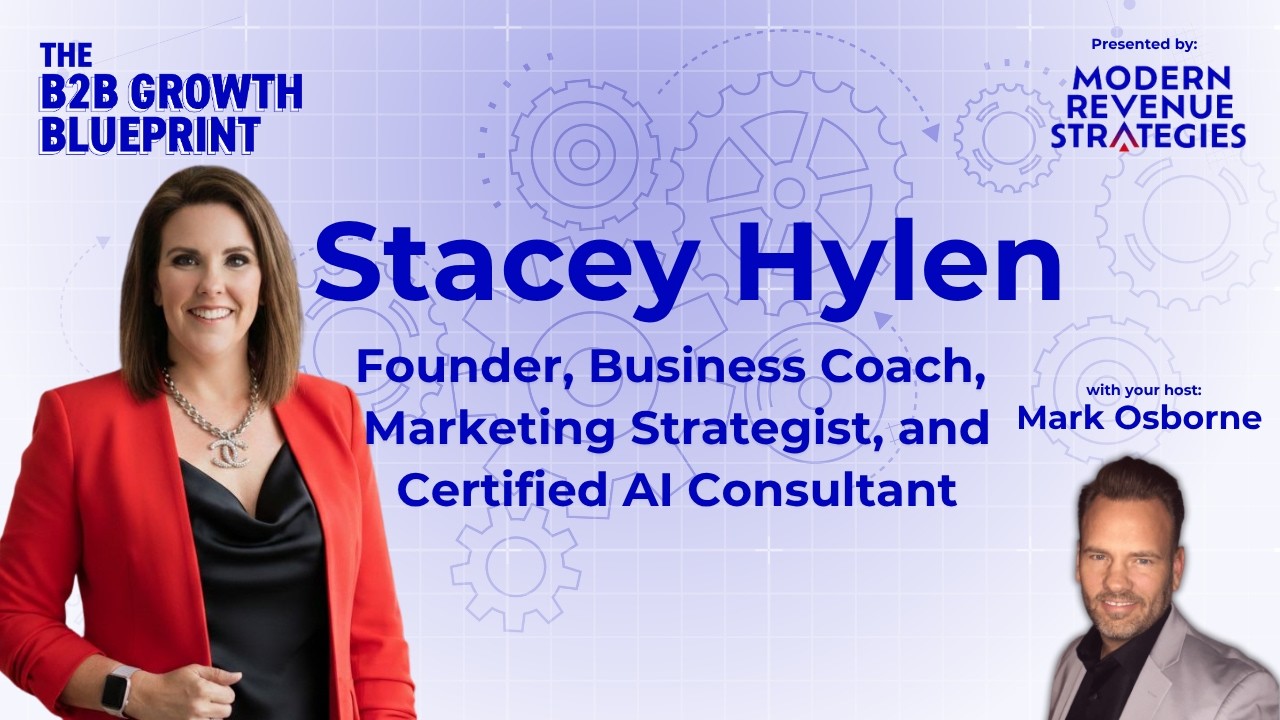
Stacey Hylen shares her "Add a Zero Without Hustle" approach to B2B growth, built after her father's death drove her to design a business that scales without burnout. She uses the Dream 100 account-based strategy and creative direct mail like magic wands and glitter to move companies from commodity to trusted advisor, plus an AI framework called SASE to embed artificial intelligence into marketing while keeping brand voice intact.
Chapters
Welcome to the B2B Growth Blueprint podcast, where we talk with entrepreneurs, founders, and leaders at B2B services, tech, and SaaS companies to learn the systems and processes they've used to create success for their business. And we'll also learn from marketing and sales experts to provide insights to help you grow your business. I'm your host, Mark Osborne. And the podcast is brought to you by Modern Revenue Strategies and their 10x ROI B2B Growth Guarantee. Schedule a free diagnostic call to learn the fastest path to double your B2B revenues in just 90 days.
Hello and welcome to another episode of the B2B Growth Blueprint Podcast. I'm your host, Mark Osborne. Today I'm very excited to welcome my guest, Stacy Hyland. Now I'm going to read Stacy's bio to make sure I get this right. She's done a lot of stuff. She's an internationally recognized business coach, speaker, marketing strategist, and certified AI consultant. She was named International Coach of the Year in 2016. She helps 6 to 8-figure entrepreneurs with powerful marketing and sales strategies to get more clients, more profit, and more time off to enjoy who and what they love. She's author of the soon-to-be-published book Hidden Profits: More Clients, More Cash. She's the creator of several popular programs, including the Hidden Profit System, Become a Magnet: Attracting Your Perfect Clients, and Selling with Confidence: Getting a Yes Without Being Pushy. She actually served as Vice President of Consulting and Senior Coach for Chet Holmes and Anthony Robbins' world-renowned Business Mastery Program. She's been featured and quoted in CNN, Inc., MSN Money, Fox Business, and Entrepreneur Magazine, and many other media outlets throughout North America. So, Stacy, welcome to the show.
Thanks, Mark. I'm excited to be here.
Yeah, absolutely. So you've got, you know, quite the illustrious background. Why don't you sort of tell the story to our audience of sort of the twists and turns of your career and how it brought you to where you are today?
Yeah, so it actually started with, with my dad dying. And so my dad died when he was only 56, you know, and as I get older, I'm like, holy crap, that's so young.
Yeah.
And so when my dad died, I had been in sales and, you know, I was excellent at sales. I was always in the top 5 people, top 10 in a major company. And when he died so quickly, he had a lot of regrets and it made me really sit back and say like, okay, what the heck do I wanna do with my life? And that's really informed how I've done the whole Add a Zero Without Hustle because I didn't want to have my business be run in a way that I couldn't have time with my family, not be able to do the things that I wanted to do with my life and have a lot of regrets. So when that happened, I spent a lot of time thinking like, what is it that I want to do? And in my last sales job, I was selling to salon owners and I was selling high-ticket equipment. And what we would do is we would go in there with a very consultative sales message. And I would look at their business, their numbers, their sales strategies. And I had a client that increased her sales 200% working with me. And I was like, this is what I want to do instead of like sales. So I started going and getting training and coaching, getting— and then I, I've invested tens of thousands, maybe hundreds of thousands in sales training, marketing training, all of that. And so that's how I started in coaching was I realized that I was able to see the things in the businesses that would help them get the results that they wanted in their business. And so that's how I got started.
That's amazing. Well, and I know you bring a lot of really interesting stories and insight from having worked with Tony Robbins and Chet Holmes. And one of the things that, you know, I work with clients on, and you and I have talked about this before, is the concept of the Dream 100, which is something that, you know, Chet's kind of famous for and has certainly impacted the way a lot of businesses go to market. And, you know, Certainly, I've used it a lot. Tell us a little bit about sort of your experience of learning that, you know, from the source and how you've applied it in working with businesses.
Yeah. Oh my gosh, I was, I was really in the right place at the right time because Chet Holmes was working with companies. He was charging between $30,000 and $50,000 a month to work with people. And he knew that for his business, he needed to have somebody to coach his clients that didn't have a $30,000 budget to start, you know, per month. So he brought me in. I was the I was the second person that he brought in. And so I was literally mentored by Chet himself, right? And to learn the Dream 100 from the master. And so every Monday we'd be on the phone and he would teach us the Dream 100. I used to hear his voice in my head over and over again. And the Dream 100 is a process that you look at who are the companies that could make the biggest bang for the buck, right? Like the whales that you want to go after. So you want to create a list.
You got one of them, it would be like a dream come true.
Exactly.
And it would change your business dramatically, right? And so what he had done is he was working for a law magazine. And when he was working for this law magazine, his company was at the bottom every year. And, you know, Chet did not like being at the bottom. So he was, he was marketing to a list of about 2,000 companies to try to sell advertising in the magazine, and it wasn't working. So one day he was looking at his competitors' law magazines and he realized something. that when he flipped through them, that there was always like the people that had the inside of the front cover, the back cover, the inside of the back cover, the people that bought the big one-page ads, and they were in there every single month. And he was like, okay, I'm going after all of these people where there's these people here, the smaller subset that would spend money easily.
Yeah.
So he put a list together of 168 companies and he marketed to them every single month. Now, a lot of times people think like, did Dream 100 is just putting people on the list and marketing to them, but you have to be more strategic than that. So one of the things that you wanna look at is what is your strategic positioning that you're gonna approach these people with? What are their pains? What are their wants? And then talk to them through those, those filters of what they want. And so he would send them a lumpy item. I have a lumpy item here. So this is like a magic wand, right?
Wow.
So, um, we've, we've sent these, these lumpy items Every month to these people on the Dream 100 list. And so in the first case of the Dream 100, he sent it for six months with zero, zero response.
Yep.
And then in the sixth month, after the sixth month, he got like 24 clients. And then from then on, his company was number one. It kept doubling in size year after year. And this was a company owned by Charlie Munger, who was Warren Buffett's partner in Berkshire Hathaway. And Charlie Munger brought him into his office and said, "Jett." He's like, I've never seen numbers like this. He's like, just tell me something. Is it legal? It's like, yeah, yeah, this is what I'm doing. And he's like, okay, keep going. And so that was how the Dream 100 got started. But he started teaching that to people. And so I started using it with my clients and I've had clients that have used it. They've gone from 6 to 8 figures by using this strategy because Companies that they could never dream of getting an appointment with, let alone a sale with, were all of a sudden picking up the phone. I'll give you an example. One of my clients is in the logistics industry. And, you know, the logistics industry is basically a commoditized industry. And I'm sure a lot of your listeners have B2B companies and it's very, you know, the RFP, like very stressful. Like you work for a year to 3 years, maybe even 5 years to get a deal if they're really, really big deals, depending on the industry. And so we started doing the Dream 100 for him. We looked at what was the strategic challenges, wants of this client, and we started putting these letters together that really hit on the difference. So instead of saying like, I'm a logistics company, let me quote you, let me quote you, which is what all of his competitors were doing, he was saying, let me look at your company and see how we can make your logistics a value add to your client, right? Not just to the logistics, to the company selling stuff. He wanted the person selling something to have their client be happy, right? Because a lot of times what was happening is, for example, you would be selling a medical device and you would spend 3 to 5 years getting this medical device in a hospital, right? Because they don't buy them every day.
Right.
And you would go to get it delivered and the thing would end up on the loading dock or it wouldn't even end up there. It would be late. They'd shut down the whole hospital, you know, section for radiology to get this piece of equipment in and it wouldn't get delivered. It would be a real hassle. And then what happens is that hospital doesn't want to buy from that company again. So that's where he was able to send these letters and really get in there with something different than, let me quote you, let me quote you. And he had won a company that's a billion-dollar company, multi-billion-dollar company that everybody would recognize if I said that. He went in there to the guy's office, and the guy was a very cranky old curmudgeon. And he said, Well, why did you take my appointment? And in this case, we had sent this pen with this fuzzy hair on it. I don't have it here at this office. And he banged it down on the table. He's like, he's like, I figured you were so persistent with these that you would, you know, be persistent with me too, to get me results. And so that's how he got into that company. This year, that, that account has been worth tens and tens of millions of dollars. This year, they just added another $4 million just from that one account. So The Dream 100 works and it's, you know, any size company can use it. You don't have to do it with 1,000 people or 100 people. You choose the size of the list that you want.
Yeah. So it's, I actually think of the Dream 100 as almost like the beginning of account-based marketing, which has become, you know, sort of the de rigueur in the B2B space of instead of, you know, broadcasting widely to the marketplace, you instead pick key customers that have the potential to really change your business. And then really learn about them and then engage with them in a meaningful way that's very customized to them. And as you say, like, we see lots of different ways to do it. You can, you know, if you have a slightly larger market, you can have more than 100. If you have a smaller market or a smaller team, you can prioritize 25 each quarter and then tackle that 100 every year. And there's lots of ways to put it into practice that really makes a big difference for businesses. Yeah.
And I would say, like, the thing is now is everybody wants instant gratification, right? And so I have a newer client that we started. We're on month 3, and they're like, well, we haven't gotten any calls yet. And I said, you're not supposed to get— like, if you get a call, that's fantastic. But this is not about, like, the very first month you send a direct response. Like, they're getting hits on their website of the page that we're sending them to. So people are opening it and they're looking at it. Sure. And so what we want to do is be top of mind when that client then has a problem that we're addressing in the letter, in the emails and the phone calls that we're sending. One of my clients, they, they had been sending it for a few months. They had a new salesperson, so they had a new list of people. And literally the salesperson is like, the CEO of the company just called me on Friday and wants to meet with me on Monday. So it's like when people are ready to go, they're, they're, they're really softened up to actually have a conversation to add value versus feeling like they're gonna be pitched or sold.
That's right. Well, and in B2B, you know, there's the statistic that we, we quote all the time, which is, you know, 95% of your target market is not in market at any given time, but you, you still need to be top of mind with them so that when they do decide to actually do something that you can help them with, you're someone that they think of. And that this is one of those key ways to do that, that really is, you know, much more focused than just buying ads that maybe people see and maybe it makes an impact and maybe it gets remembered versus really making an impact with them.
Yeah. And I think, I think the key is really to have your strategic positioning in place so that you're not just like, buy my stuff, buy my stuff with the direct response mailers. We want to be a solution I would say it's going from commodity to couture, that you become the one in the industry that can solve that problem for them, as opposed to commodity that's like, oh, just give me a quote, give me a quote. And so that takes a mindset shift. And it's funny because when I see new salespeople come on with my clients, the salespeople are always like wanting to quote, right? They're— that's their natural, like, oh, I made quotes this week, I sent out quotes. No.
Right.
No, we need to add value. We need to become a trusted advisor. We need to be a value add for the company that, that's working with us. And that's how you get an account that stays with you for 10 years. And I think this is good for your people that are looking— a percentage of your listeners are looking to exit, right? So if you have clients, like, you know, my clients get these big billion-dollar clients and then they get solid with them, right?
Yeah.
The clients have been their clients for 10 years, 15 years. That's a nice book of business that when you're looking to sell, that's very attractive to buyers. And also the fact that all of my clients, we look at that book of business and, and like the, for example, the guy that just added $4 million this year, we look at, okay, within that company, what are the other divisions that also need this solution? How can we add value? How can we, like, what other problems do they have that we can find partners to even fulfill those? challenges for them. So there's a lot of money in the clients that you have that when you go to investors that want to buy the business, it looks really, really healthy. Yeah.
So you hit on something before that I want to double-click on a little bit to just sort of expand with, you know, your, your knowledge and expertise in the space. You talked about that lumpy mailer, uh, and you showed that magic wand, uh, that is one of the things. And you talked about the, the fuzzy pen that, uh, you know, has made millions of dollars for this other client. So give our audience a little more background on this lumpy mailer and how that fits into the Stream 100 strategy.
Yeah. So the, so the difference is, is instead of just emailing where you're ending up in the inbox with, and especially now with all the cold email, you're really competing with people that they're not getting the value. So what we want to do is we want to choose things that will, again, I'm going to keep repeating, go back to the strategic objective, right? Go back to your strategic positioning. And so in this case, like if we were to send the magic wand, which has all these sparkles in it, We would say, like, you know, it's not magic what we do to help you with, with your logistics solution. It's strategy that we help get you the best routes. We have world-class communication, like all of the different things, but we tie it into whatever we're sending. So we've sent— I've even sent glitter. This was to farmers, people that were buying dirt. And we were like, you know, you can't just wish on magic fairy dust and have a better harvest next year, right? You need to have this organic fertilizer. You know, so we're getting very creative. We're having fun with it. So people actually look forward to opening things. One of our best mailers has been a football, a little mini football, like about that big. And people love that. And the sales guys have even said, like, they will— they said that they would take an appointment with us if they send— if we send like 10 more footballs because everybody's fighting over it and because they're throwing it around the office, right?
Sure.
Just silly stuff like that. Um, we've sent stress balls, we've sent, um, decks of cards. I mean, there's a million different things that you can send, but you want to get creative and tie it into what's in it for the client, not about you. It's never about you.
Um, well, and it goes back to, as you were talking about, sort of that strategic positioning and really taking the time to really understand your target audience. I was working with a company once where we did you know, sort of a Dream 100 strategy. And they were really trying to expand their footprint with media agencies. And they were, you know, an ad tech platform. And if you know much about media agencies, you know that they spend a lot of time at their desk, they skip a lot of meals. And so food is always a welcome gift. And so we were like, okay, so something with food. And then they realized that, you know, they weren't as well known in the space as their competition. And so rather than be worried about that, they turned it into a positive. And so they sent every agency on their Dream 100 list a cake with that agency's logo on it and said, we're the best, you know, technology you've never heard of. We want to make you shine. We want to put you in the spotlight.
That's awesome. And I'm sure they took pictures of it and put it up online as well.
That's right. And then they matched that with, you know, a press release about a new feature specifically for agencies and then a phone call campaign to those agencies, did you get our cake? And they were able to actually double their revenues in less than 6 months without any additional ad spend because they were way outspent by their competition.
But no, and it got their attention. That's awesome.
Yeah, by really thinking through that customer, they were able to really break out and make that impact.
I love that. So I have another example that's, it's rather strange example. So I think this would be okay. Everybody always says like, how does this apply to me? Like, I'm different. So one of my of my clients was a pizza company.
Okay.
That sold pizza to school nutrition programs, right? So B2B. And he, he had been successful, uh, owner-operator. And we're like, you know, when you call and say like, hey, do you have pizza in your school? Every single school already has a pizza solution, right? Either make it, buy it, or order it, right?
Yeah.
And so, and he was competing against huge companies like Little Caesars, Pizza Hut, you know, huge companies. And so what we did, that strategic positioning, we looked at his perfect clients, like what were their pains and concerns and wants. And what we realized is that their, their customer was judged on what was their profit in the school lunch program and what was their participation in the school lunch program. So how many students ate at the school, because if you eat at the school, you're going to get better grades because you're not hungry. So instead of calling and saying, hey, we're the pizza company, have you heard of us? We would now say, hey, we're the company that helps school nutrition programs increase their profits and participation. And all of a sudden it wasn't about pizza, it became about what they could help the prospect with. And that he actually went on to sell his company for— He called me last year right before Christmas and he sold his company and he's like, I got like, it was a bidding war. He got so much more than he ever thought he would get. It was amazing. But it was because he had this marketing in place that it was like very, and they were just like expanding across the country market by market going after their Dream 100.
That's so great. So I want to take a little bit of a left-hand turn because there's something else that you and I have chatted about a little bit that I really want our audience to to learn from. And that's that, you know, there's a lot of talk about AI in business today. And there's a lot of sort of noise around it. But I know you've spent some time actually developing a strategic framework for how to use AI in business. And I'd love for you to share a little bit about that with our audience. Tell us a little bit about that.
Yeah, so I got into AI about 4 years ago.
Mm-hmm.
When one of my mentors was like, hey, this is coming, you need to be ready for it. And I, I'm not a super techie person. And I was like, you know, I use the internet. I've been in internet marketing for 20-something years. But I, I said, you know what, I think I need to learn that. And I went and I got certified in it. But I saw a challenge with people because I do these AI assessments for companies to just see how they're using it, how they can get better at it. And so my framework is Sassy, and I developed this for thought leaders, but it's really good for any kind of category leader if you're coming at marketing from a more strategic level. So when you use AI, it's not about which platform because it's platform agnostic because the platforms are always leapfrogging over each other. I mean, we've seen a lot of that this year that like one week this one's good, the next week that one's good. So you need to have this framework that you're putting your stuff in and train your team to be using this as well. So the first thing in SASE is to be strategic.
Okay.
So what is the strategic objective of whatever you're doing on, on AI? Is it to, you know, get a client? Is it to get them to click? Is it to get them to trust you? Is it to tell a story that connects them more with the company? But you wanna have that strategic objective. Chet always used to say, you know, you could have 10 strategic objectives for every piece of content that you put out there. And so I started to think about that because people would just get on AI and say, hey, make me an email. Oh, write me this, write me that, make it better, make it longer, make it shorter. And so we first start, what is the strategic objective? The second letter A is to be authentic and to do things that attract your perfect client. So again, we're gonna feed into, like, I have custom GPTs to figure out, like, Who's your perfect client? What are their needs? What are their wants? What is the language that they're using? Because a lot of people— and AI is really well known for using like fluffy language, like, oh, you want to be a success. Okay, you want to be a success, but what does success look like? You know, success for your listeners could be, I want to have an exit in the next 5 years. Success for your clients could be that all of their sales team is using the same messaging and putting it all, entering it into their CRM and closing X number of deals each month. But you want to get really specific. Then the next letter S stands for stories. So this is where, like, what are the stories that your company has that you can infuse into your AI so it's more like you? So I was walking the dog a few months ago and I thought of this, this thing that I hadn't thought of for years. I had met this guy at the gym and we bonded over the fact that we were both immigrants. And he said, oh my gosh, you do business. I want you to come work, help me with this company that I'm opening. So, I met with him at the restaurant, he and his wife, and he had this big thing that he was planning and it looked very good. So, he's like, okay, come to my house. So, I pull up at this guy's house. Now, I know you're in LA, so you might have seen this, but I pulled up to this place. It had 17 bedrooms and bathrooms. It had a helicopter pad. It overlooked the lake.
Wow.
And it had like, you know, I don't know, 10 garages. He comes to the door with these huge Dobermans. Did I mention he was from Russia?
Okay.
So I get there, we start talking, and then he starts telling me more background information. He's like, oh yeah, I was in charge of this, and I'm not going to mention what it was, for all of Russia and all of South America. And I'm like, nobody gets all of these territories unless they're very high up there in the So I said, I said to my husband, I came home from that meeting, I'm like, no, I am not helping this client grow their business. But that's an example of a story now that I can tell is like my brush with the Russian oligarchy that I can put into an email that would be like really compelling. It's interesting. I can tie it into my Dream 100. Yes, he has money. Yes, he had a need. Yes, I could help him. Is he my perfect client? Hell no.
Go the other way. Right.
So you wanna put some stories in there and I like to use my phone. So when I'm out walking or if I'm driving on hands-free, that I like to talk to it and say, like, remember that story about the client that did that or this experience I had? So start building your story bank for both you and your sales team and your marketing team. And then the second S is for sell. So you want to make sure that there's a call to action in your thing. Now, it's not selling like a hard sell that you think. It's the— what is the call to action? Do you want them to click? Do you want them to send a message? Do you want them to forward it? Do they— you want them to— you know, do the exercise that you're sending them in the email. But you want them to do something, even if it's something very soft, not buy this. And then the last letter in Sassy is U, your own uniqueness. So you wanna fill in your uniqueness in there. So like, for example, my ChatGPT knows I have a dog named Red. He's a Vizsla. He likes to run. We like to hike. It knows I like to paddleboard, right? And so these things are kind of woven into the things that I'm doing. So you can see how if you SaaS-ify it— I had a client this last week that she's also a certified AI consultant, went through the same program as me, and I did the audit on her AI. And she sent me a message yesterday. She's like, your SASE thing made over my AI this week. She's like, I did everything in that SASE format and it's like night and day. So I would really suggest people listening Really start thinking, like, how am I using AI strategically? Is this SASE? That's gonna make a huge difference for you.
I love it. So, Stacy, you're obviously an expert in a, a lot of really interesting topics that we could talk about all day, but I gotta be mindful of your time. But before I let you go, tell us something that's on the horizon for you that you're really excited about.
Yeah. There, there's actually 2 things. So I'm redoing my mastermind. So I've been running masterminds for over 10 years. I have one mastermind that's in its 8th year. that's all founders and they've had multiple exits and keep forming new companies and having another exit. One guy just had his 3rd exit in the mastermind this last month. And so my other mastermind that's open because that one's closed, we're redoing it because I'm adding more AI into it because when I founded it, it was like there was no AI. So now I'm like, my At Zero Without the Hustle framework that I teach. has the AI integrated in it, has the custom GPTs in it, it has all of the resources that they can just take and use in their company. So that I'm very excited. I have some founding members starting, um, that I have some special bonuses for them. And then I have a book on the horizon, my Hidden Profits book, which is coming out in the new year. So that's really exciting. I think the best way for people to get in touch with me is to go to moreclientsandcash.com.
Okay.
And in that, you are going to get the hidden profits, ways that you can rapidly increase your revenue without doing more marketing. And it'll walk you through a custom GPT of how to implement that into your business, like quick wins for revenue. So that's a great way to start with it, start to play with some of the AI, you know, things that I teach. And you can always find me, Stacey Hyland, anywhere, staceyhyland.com. Awesome.
Well, Stacy, thank you so much for taking the time to join us today. I really enjoyed it. I'm sure our audience got a lot out of it.
Thanks for having me, Mark. This is a lot of fun. I, I think it's, I think it's great to come at the B2B from a much more strategic— I like the way your podcast handles it. So I appreciate that. And I hope everybody goes off and, you know, implements what they're learning.
Well, thank you. I appreciate that. Talk to you soon. Bye-bye.
Thank you for joining this episode of the B2B Growth Blueprint podcast. We hope you've gained insights to grow your business. If you enjoyed this discussion, please rate, comment, like on your favorite platform, and share to others who will find it useful. Do you know a CEO, founder, or leader at an early-stage B2B services, tech, or SaaS company who would like to be a guest and share their story? Send us a note. Let's schedule a conversation.
More from Mark

How Can You Maximize Your Business Value Before Selling? with Randy Katz Video







