Boost Your Sales with AI and Impact-Driven Strategies with Roee Hartuv
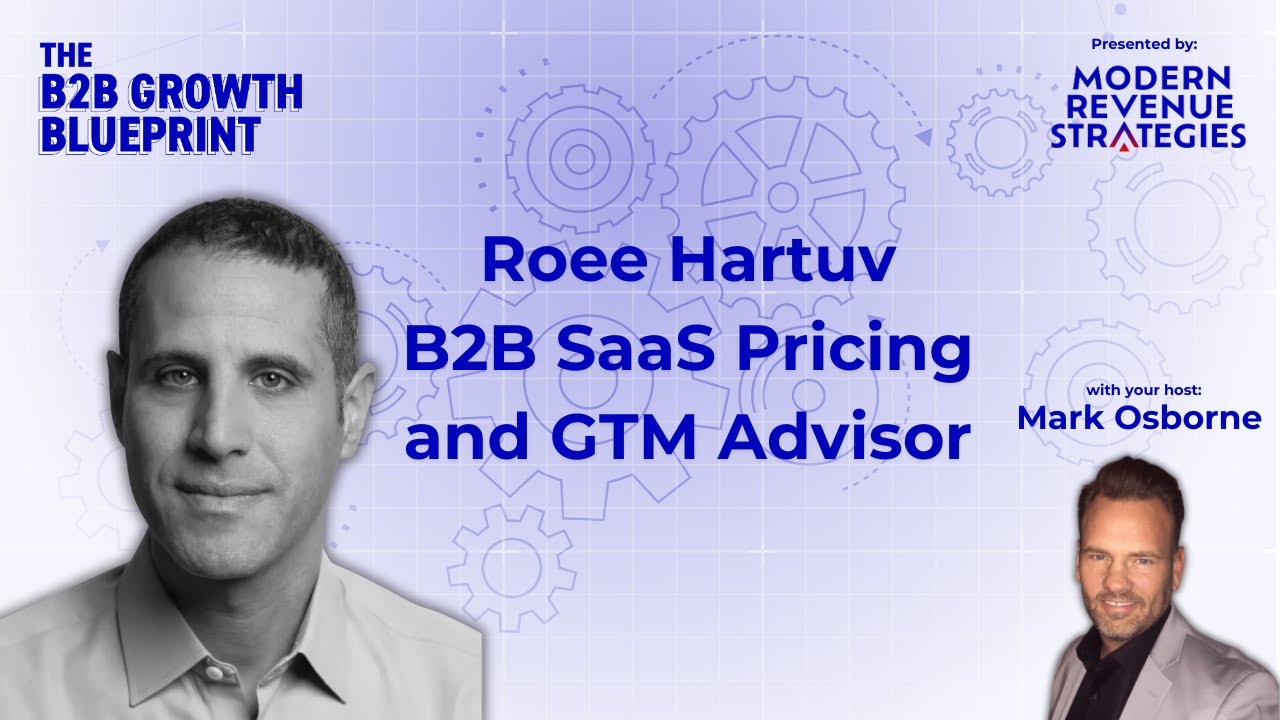
Roee Hartuv, Revenue Architect at Winning by Design, breaks down how B2B SaaS companies evolve through distinct stages, each requiring different leadership focus. He stresses that your Ideal Customer Profile must stay alive and connected to the full buyer journey, and that the "bowtie" revenue model shows most SaaS firms neglect retention and expansion while chasing new deals. AI will soon shift CRM from structured data to unstructured, letting agents automate discovery and free salespeople for high-value work.
Chapters
Welcome to the B2B Growth Blueprint podcast, where we talk with entrepreneurs, founders, and leaders at B2B services, tech, and SaaS companies to learn the systems and processes they've used to create success for their business. We'll also learn from marketing and sales experts to provide insights to help you grow your business. I'm your host, Mark Osborne, and the podcast is brought to you by Modern Revenue Strategies and their 10x ROI B2B Growth Guarantee. Schedule a free diagnostic call to learn the fastest path to double your B2B revenues in just 90 days. Hello and welcome to another episode of the B2B Growth Blueprint Podcast. I'm your host, Mark Osborne, And today I'm very excited to welcome my guest, Roey Hartuv. Now I'm gonna read his bio 'cause he's done a lot of stuff and I wanna make sure I get it right. So Roey is a revenue architect at Winning by Design, working with SaaS scale-up companies. And we're gonna talk about the difference between startup and scale-up to help them drive sustainable revenue growth. Their book, Revenue Architecture, is a great overview of their approach and something I can highly recommend. Hartuv is a B2B startup executive with more than 18 years of experience. working at high-growth SaaS companies with a penchant for accelerating business growth through optimizing sales strategies and customer success strategies. And we're going to talk about that recurring revenue and how important that is for SaaS companies. Hartuv is passionate about helping companies work towards better revenue. Previously, he held executive positions in sales and customer success at 4 different startups at various stages and segments. He's helped growth-stage startups raise capital and implemented growth strategies. Throughout his career, he's built and managed sales, customer success, and marketing teams. He holds an MBA from Tel Aviv University and a BA in computer science from the Interdisciplinary Center in Israel. Rui's based in Berlin and joining me all the way in LA. So thanks so much for staying late with me, Rui.
Thank you for having me. It's my pleasure.
So you've got such a rich bio and, you know, obviously done a lot of stuff with a lot of folks. Tell us a little bit about your story of You know, how you came from computer science to, you know, an MBA and now working, you know, in marketing and scale-ups.
Yeah. Yeah. So I did computer science, but I never coded for money in my life, right? I did that, you know, found myself very quickly or first, my first position was a client-facing role.
Okay.
And I, you know, jump on that and I've been client-facing ever since. Yeah, I think I've got, what's that, 16 years of sales experience. So I climbed my ladder from a sales engineer to an account manager all the way up to leading sales team. Yeah. And COVID hit, last company ran out of money and I was like, okay, what's next? And then a friend of mine pulled me over into the world of consulting. And right now I'm with Winning by Design, B2B recurring revenue consulting agency and training also. Yeah, based out of San Francisco. And although I'm based in Berlin, I work with a lot of very successful scale-ups and growth stage companies, mostly SaaS, but anything that is B2B recurring revenue.
So let's talk a little bit about that and, you know, people talk about a startup or a scale-up or a growth company. And, you know, certain people have different definitions of what categorizes people in different areas. I want to sort of talk about 2 things, which is one, how do you categorize it? So how do you think about it? And 2, why is it important to sort of think through that label and to sort of have a label like that from an operator's perspective as well as from a consultant or, you know, advisor's perspective?
Yeah. Yeah. Fantastic. So let's start off with seed stage companies, right? Early, very early stage companies. They're looking to find that product market fit.
Yeah. Right.
So usually you find that product market fit. If you ask investors, it's roughly $1 million in ARR, right? You know, the numbers change. And honestly, there's no real definition of what a clear definition of what product market fit. There are different variations. But let's say Seed companies, that's what they're doing, hunting down the first customers that are willing to pay for their product or services. And then you become what we define as a startup. A startup is all around finding that go-to-market fit.
Yeah.
So you found a few customers that are willing to pay, but now can we find a repeatable process in which we go to market, we find those customers or customers find us, But we actually are able to sell in a systematic, in a recurring kind of manner. So that's startup. Scale-up is all about, okay, now we need to scale. We found go-to-market fit. Now we need to scale this up. There are different ways to scale. But yeah, the most common one is let's just add more people and just scale up, scale operation. And obviously there are different ways to also focus on efficiency, etc., but maybe that's for the later stage of our conversation. Now, so that's how we define it at Winning by Design. We use a growth model, so we modeled the different stages of how companies grow. There's also grown-up companies that are either the ones that are becoming public or being bought by PEs. So this is where they need to start looking at Productivity— sorry, profitability. And there's also the enterprise. These are the Salesforce, the Microsoft of the world, the big ones that are at that 10% year-over-year growth, roughly. Why is it important to differentiate? Because at each stage you have different challenges. You need to focus on different things. So coming back to the startup and scale-up, startup, It's all around finding that go-to-market fit, finding that repeatable process. Can we reach the same type of customers, close them at roughly the same ACV, same sales process? Can we find them in the right marketing channels or the same marketing channels? Once we find that, we have a repeatable process. Once we define— we find that repeatable process, Now we can start scaling, whether it's through people or tools or automation, whatever that might be. So the focus is, yeah, as you grow, you need to focus on different things. And there's the common saying, what got you here won't get you to the next level, right? So, yeah.
Yeah, I think that's so important. And, you know, so often companies are just, you know, in the midst of it. and sort of don't have that sort of moment of realization to sort of recognize that they're now in a different sort of set of circumstances or facing different challenges. And so they need to make some adaptation to their growth. It's funny, the sort of visionary leader that's oftentimes good at getting companies to that early stage can be not so good at managing the kind of incremental change that comes through those scaling up and growth stages where it's not having a revolutionary idea every quarter. Instead, it's having an incrementally better idea every quarter and really sort of disciplining yourself to focus on those systems and improving them.
Yeah, yeah, it's fantastic, which reminds me of another thing that we usually observe. When you think of it, Companies have a power shift that happens every 2 to 3 years. Again, depends on how fast they grow. When you think of it, the first, in the first year, years, the most important discipline a company has is the product team.
Yeah.
Because you're building a product, you're building an MVP, you're building something. The focus, the resources, the priority goes to product.
Yeah.
Once you build that product, you start shipping it to customers, shipping it. Then the power shifts. There's a new leader that is priority, which is the sales team, the sales leader. They get most of the resources because, okay, not Completely not focusing on product, but we have a product and now it's time to sell.
Yeah.
And then what naturally should occur is that power shifts over to customer success. Some people say marketing. I understand marketing is always important. Yeah, it's always important, especially when you're PLG focused self-serve.
Yeah.
I was taught in business schools that sales is a function or department within marketing.
Yeah.
So marketing is always important. But let's say back to like the sales customer success, at some point we need to focus on retaining and getting our customers to impact. Not saying that again, we're not teaching product or we're not teaching the salespeople, the sales leaders, but we need to start shifting some focus on our existing customers. And then the last thing is finance, right? Because when you're gearing up to IPO, let's say that we're back in IPOs will come back at some point, then, you know, the power shifts to finance, the CFO, and they're calling the shots. So when you think of it, if a company's from that seed round all the way to that IPO, what, 10 years, 12 years, which means that every 2 to 3 years we're changing who is the most important or the priority discipline within a company. So that's Also something that we need to bear in mind.
2 great things you brought up there that I want to call out. The first, you know, sort of more generally is I love the way that you talk about customer success really being part of the revenue function. And I know that that's something that you guys spend a lot of time focusing on because we see that so often customer success has really great insights into what your customers love about you, which then makes your you know, one-to-many marketing materials so much more powerful and do such a better job of attracting those customers that are gonna wind up being long-term successful. It also does a great job of informing the sales messaging and what you say in the process that's gonna lead to happier customers that are more likely to renew and grow with you. And so having that as part of that sort of revenue ecosystem is so important and something that so often overlooked in companies. And then the other thing that you talked about, which I think is really interesting, is you hear a lot of, you know, folks talk about, you know, founder-led growth or product-led growth or sales-led growth. And it's so obvious that there should be this sort of evolution of, you know, when you're trying to find that product-market fit, maybe it's the founder out there that's, you know, really leading the charge. And then once you've got that, well, then the product needs to, or, you know, the sales team needs to go out and You know, really sort of get those initial users and talk them through it. And then, you know, the product leans more on the product itself or the customer success supporting that product. And so having that mindset of how it's going to evolve and anticipating that evolution, I think is so important for companies as they grow.
Yeah, yeah. And having done that mistake one or one and a half times in my career, joining too early as a head of sales, Yeah. My advice is for the listeners, if you're the founder, you need to prove that you can sell before you start hiring a very expensive resource as head of sales.
Yeah. Right.
So do yourself a favor, save the money, prove that you can sell yourself because obviously you built a company because you probably know the problem very well. And I always believe that the founders, even if they're not natural salespeople, are the best salespeople. So for our listeners, do yourself a favor, make sure that you are, that you prove that you can actually sell this before you start hiring very expensive salespeople.
So I'll go one step further with that. So I've heard the, you know, sort of sales is the last thing the founder should give up. As, you know, sort of a general rule of thumb. The other thing that I see, and I'd be curious to hear your thoughts on this though, is very often we see a founder, you know, has an idea for this better mousetrap, builds it. They have no enough people in the industry that they can go out and sell it. They know what's wrong with the competitors and they know what's right with their product. Then they reach a, you know, a sort of a ceiling, a revenue ceiling. And oftentimes the first thing that they do is They go hire an expensive salesperson and say, just be just like me. But that doesn't work because oftentimes it's they're missing the systems or maybe even some of the foundations of really getting crisp on that ideal customer profile, really understanding the context that brings companies to market looking for solutions like theirs, really understanding the interpersonal nuances of the champion and the decision maker and technical influencers that might be on that buying committee. And until they've done that, until they really know that buyer's journey, a salesperson kind of can't be successful because they'll never have the expertise that a CEO has who has spent 5 years or more building this business, much less maybe the 10 years they spent in the industry first. Do you see that happen with some of the companies you work with where they'll have that sort of challenge as they grow?
Yeah. So one of the things, like our most selling product is defining ICP.
Yeah.
And that's relevant for companies in early stages and later stages as well because it keeps on evolving, right? Like, yeah, you nail down your ICP, but you keep on like, I don't know what's the right, like once a year, once every 2 years revisit this. And I'm hoping that our marketing leaders that usually are responsible to define that ICP, keep on visiting. And you said exactly the right way we like to do it. Go back to customer success, test your existing customers, the ones that are renewing and expanding relatively easily. And this is the type of a profile that you want to add and define as your ICP. So that's something that you constantly need to do in terms of customer journey, the same thing, right? And especially when we're talking about that that startup and transitioning to that scale-up. Remember I talked about finding that those repeatable processes, you only end finding the same ICP, selling to the same customers. You only get there if you understand the true customer journey.
Yeah.
And again, that's usually something that marketing owns, right? But let's define the customer journey. And it's not the classical, I don't know if our listeners, it's not What I or we define as customer journey, it's not the same. Hey, you know, I don't know, 10 years ago we were all into marketing. What is the customer journey? They download it. It's part of that, but we all had like very nice visuals of they download a white paper and these are the connecting channels. It's actually the customer journey from the awareness part All the way to the renewal and expansion. What are the interactions, the key activities that they have with us? Much so, we're not only focusing on the awareness and education part, we're talking the entire customer journey. And this is something that we need to model in order to start creating those processes and systems in place to have them.
Again, great knowledge here. And you talked about, you know, the customer journey is so much bigger than the sales funnel. And that's like, that's the thing that we see so often is they just think about it through the lens of the sales funnel. They never think about, well, when do they become problem aware? And then also there's a step of they got to decide to prioritize the problem because there's, there's 10 smart things most companies could do this year. They only have the bandwidth to do 3. What leads them to make a decision to tackle the one you can help them with? And if you can, you know, help them see the ROI that they could get on tackling the problem at all, much less with you versus with a competitor, that's how you really sort of grow the overall pie. That's real demand generation, not creating just awareness, but awareness that drives demand, which is so important. And then you also talked about the ICP. And so often we see companies that they define their ICP as who we really wish was our customer. But you look at the last 2 years of billing and 80% of their revenues is coming from 20% of their customers that does not look like that. And so you need to sort of readjust yourself into the reality of who is your actual tier 1 ideal customer, the people that are actually buying from you, that are actually renewing with you. And now maybe that means you shift your product vision a little bit, you shift your go-to-market strategy a little bit because it's not the people that you wish it was. Instead, market it to the people that it actually is.
Yeah, yeah. I wanna go back to, you said prioritize. We also like to use this term and that's like a mindset that I believe we need to change. It's not, we're not selling in a SaaS recurring revenue. We're not selling the same Or in the same way we sold perpetual software. Right? When you think about it, Salesforce came back in 2006, '08, depends on whenever each of us encountered Salesforce for the first time. And I don't know if Salesforce were the first one to actually introduce that, but they were the first ones to Scale this and successfully introduce a recurring revenue business. In a recurring revenue business, you take something that, let's say, costs $1 million of software in a perpetual software model. In recurring revenue, it's a few hundred bucks per seat.
Yeah.
So, you know, I always ask this when I teach those concepts. We have a course around that and I ask how many SaaS solutions do you currently use in your company? And people come back, we got 60, we've got 80, we've got 40, but we're talking about tens of different SaaS companies.
Yeah.
So in principle, and again, I'm not talking about the high-end, you know, 8-digit kind of softwares out there. I'm talking about where most of us play, you know, $10,000, $30,000, $50,000. These type of solutions are affordable for every company. But is it up on us as marketing and sellers to make the buyer understand the priority?
That's right.
And that's the type of conversation that we need to have. And coming back to my earlier point, it's a mindset. So we need to understand it should be a priority for our customers. It's not about budget anymore. Everybody has budget to buy SaaS solutions.
That's right.
Because by itself, it has a 10x ROI, that has a 100x ROI, right? It's all about, is this a priority? Are you going with us, the competition, or are you using that money to buy something for a different department altogether? So priority, I really like that.
How do you, how do you sort of advise companies to uncover that? So, you know, let's say that they really do have a good picture of their ICP and they really know the problems that, you know, those companies in that ICP encounter. But again, there's, you know, 10 problems that that company could, you know, solve in the next year. What are ways that you've seen companies be successful at, you know, agitating that need and getting, you know, the problem they can help with prioritized in the mind of that buying committee?
Yeah. So we start off with the problem or the pain.
Yeah.
But then we lead the conversation to impact or we teach our customers to lead the conversation into impact.
Yeah.
Impact. It could be positive impact. All right. Increasing revenue, lowering the cost, but it's also negative impact.
Right.
So not taking the decision, taking a different route or sticking with the status quo. Can we make the buyer understand of the potential impact? And only this way we can create that prioritization for our customers.
Yeah, it's so interesting to hear you talk about impact in both, you know, the carrot and the stick. There's the positive that they could get or the negative that they could avoid. One of the things we like to do in building those buyer personas and even in like account-based marketing tactics is you can actually start to understand someone's internal motivation. Are they typically toward, like, are they chasing things that they want or are they away from? Are they trying to avoid things they don't want? And in fact, once you identify that, either if there's a pattern within the ICP and typical buyer personas, because in different industries you actually wind up seeing these patterns, or if you can just identify it for a specific decision maker involved in a deal that you're working on, And start to use all of your language through that lens, it becomes 10 times more persuasive and so much more effective than, you know, generic or even one that focuses all one way when people might be a mix of both.
Yeah. This is new to me and I love it. Yeah. Running away or running towards. I love that. That's—
There's also a funny thing in human, like, sort of behavioral psychology that we feel loss And I always get this ratio wrong, but it's something like 6 times worse than gain. So, I'm willing to take a bet that means that it'll mitigate my loss. I'll risk 6 times as much money as I would to get the same gain. I'll only sort of risk $1 at the chance to gain $6 versus I'll risk $6 to not lose $1.
Yeah.
Because I'm worried that I feel that loss so much stronger in my psychology.
Yeah. Daniel Kahneman wrote about this in Thinking, Fast and Slow, right?
That's right.
The pain of losing $100 is much higher than the actual gain.
The joy of gaining $100. That's right. Yeah. And even a perceived loss. So, if it's something you don't even have, But I could convince you you should have, that everyone else has. And then I can convince you that you're gonna lose it if you don't do X. That framing makes it much more persuasive in a way. It's just such an interesting thing. Yeah, go ahead.
Just to top on that, you know this coming from marketing, the superpower to uncovering pain and identifying potential impact is storytelling.
Yeah.
I think that's the superpower of salespeople. Generally speaking, every human that masters storytelling, uh, can be successful at anything. So that's a superpower for customer-facing roles, not only salespeople, customer success as well, driven by marketing. But, but this is how you, you drive the buyer to those pain and impact, negative and positive impact.
Well, and you raised such a good point there, especially, you know, your entire practice is focused on B2B and B2B SaaS, which if you think about so many folks in that space make, you know, all sorts of logic-based pitches on here's the value of it, or even if you just focus on the impact, but they fail to remember that It's a human on the other side of the screen making a decision. And humans are fundamentally emotional creatures. So they make decisions based on emotion and then they back it up with the logic that they can use to justify it. And it's the story that connects that emotion so that they can really see how those things and feel how those things are gonna translate in their business. So I think that's such an important point. One thing you talked about before that I wanna go back to, which is, You know, the recurring revenue businesses and sort of the right side of that bowtie funnel. If you think about, you know, from an anonymous person out here to, you know, recurring revenue and being one of your ideal customers out here. So often we see companies really sort of fail to recognize the importance of, you know, net recurring revenue or other metrics on that backend. They've got a leaky bucket, but all they're just focused on bringing in leads. Talk to us a little bit about, you know, how you at Winning by Design and folks think about that and advise companies as they think about that in their business.
Yeah. First of all, we look at the numbers, right? Try to identify, and this is an exercise that we do with all of our customers, how much of your current revenue is coming from, or let's say last year's revenue came from new business, new customers, existing customers that renewed and existing customers that expanded. What we usually see, and we all know that we don't behave according to that, but we all know that, that 80% of our revenue on average comes from retaining, retention, our existing customers. It's like, and again, then it based on if you have a big expansion play or—
Sure.
But let's say 15% from existing, from new customers and 5%, 10%, 15% from expansion. So we look at numbers and of course we need, again, these are the things that we know but we don't really behave and maybe we can talk about why we don't behave like this, but we know that in recurring revenue business because we took a $1 million, as I said earlier, we took a $1 million software and broke it down into a few hundreds per seat, we know that we're not making any profit on the first year. and probably not the second year. If we are okay, we're starting to be profitable on an account on the third year and so on, right? If we don't retain our clients, we're actually losing money on every client that we bring in.
Yeah.
And there's always that misalignment, sales sitting outside the ICP, overpromising, etc. Customer success. I don't know what to do with these guys. They're asking for features that we don't have. They're not in the roadmap. Product is not. And this is one of the major problems. And the root cause is when you think of it, we're— let me say that carefully. Most CROs that are responsible to overlook— we call it the bowtie, right? So the customer journey from left to right, from awareness to acquisition to onboarding, retention expansion. CROs that are responsible to oversee all that, they're usually VP of sales that got promoted to the C-level. So they're still in the mindset that growth comes from new business, which is true. But at some point you need to start shifting resources to what we call the post-sale, the right side of the bowtie because of the reasons that I stated. So yeah.
Yeah, it's a, it, And not only that, but we even see that that net recurring revenue number, that metric or measurable, however you want to call it, can be one of the fastest ways to improve your valuation. And so companies that are focused on sort of improving their valuation or improving their worth in the marketplace by putting a little bit of focus there can make a big difference in how the company is perceived. This has been such an awesome conversation. Obviously, we're both super passionate about a lot of the same topics, but I gotta be mindful of your time. But before I let you go, what's something that's on the horizon for either you or Winning by Design that, that you're excited about that's coming, coming down the pipeline?
Yeah, I think like everybody, right? It's not specifically to us. It's specifically in our industry. And yeah, probably everybody's talking about it, but, but it's AI. It's going to completely change how we sell, how we interact with our customers. Yeah, not we meaning us in the industry. That's going to completely change how we approach all this. And I'm very excited about that. I, you know, some of the ideas that I'm— everybody talks about agents that will be doing sales instead of us. But there are 2 things that I'm really excited to see. First of all, well, maybe let's focus on one. When you think of it, CRM systems require structured data.
Yeah.
We require our sales rep to summarize the meeting and then plug it into the right fields. I believe that, or, and sales process or the customer journey is linear. That's how we— there's the only way that we can present it, right? So we do discovery and then demo and then— but we know in real life it doesn't happen like that. We know that we go back and forth and we need to go back to nurture, etc. I believe that AI will allow us to completely change the CRM ecosystem from going from unstructured data, from structured data into unstructured data.
Interesting.
And that's gonna completely change how we do sales, how we do marketing, how to be customer success. And that's one element that I'm very excited. It's in the medium future. It's not immediate future. Immediate future, it's like AI agents and everything that we're talking. But yeah, I'm really excited about that and waiting to see who does that first.
Yeah, it'll be interesting. And I'm excited about, you know, the AI piece too, partly because I see that it'll create the opportunity to focus on more of what matters. And like you talked about the CRM and just being able to— here's their email address. Now an agent goes out and populates everything else, the company address, the, you know, what their organizational structure looks like, what you know, their, you know, career background, all those things that can make me better at the sort of thinking part of the job instead of me spending any time on that stuff. And like, that type of thing is sort of already here and really exciting to see that become more mainstream and become more valuable because it really facilitates both sides of the equation. The person buying gets a better experience because the Salesperson has the opportunity to be more knowledgeable about them and their needs. And likewise, the person selling has the opportunity to, you know, do a better job of, you know, speaking to the, the real return, the real benefit, the real impact that they can make for organizations.
And let me take it a step forward and connect it to what we talked earlier.
Yeah.
Do you see that AI telling you what is the right next steps giving A successful client that we already have that has the same characteristic that you're talking to the same persona type. And based on what worked for them, we'll say, hey, you don't need to spend time doing discovery. They already are educated, jump into demo. And this persona is looking for these type of things. And I also know specific company, this specific company, this is the talking points that you need to have. So yeah, very excited about all this that's going to happen very soon.
Yeah, super exciting stuff. Well, Rui, again, thank you so much for taking the time to connect today. I really enjoyed it. For those listening that, you know, want to learn more about Winning by Design or connect with you, what's the best way to get in touch?
LinkedIn.
Yeah.
Either me directly or with the company.
Yeah.
That's great.
Well, thanks again. We'll look forward to speaking with you more soon.
Thank you very much.
Thank you for joining this episode of the B2B Growth Blueprint podcast. We hope you've gained insights to grow your business. If you enjoyed this discussion, please rate, comment, like on your favorite platform, and share to others who will find it useful. Do you know a CEO, founder, or leader at an early-stage B2B services, tech, or SaaS company who would like to be a guest and share their story? Send us a note. Let's schedule a conversation.
More from Mark

How Can You Maximize Your Business Value Before Selling? with Randy Katz Video







