Building Culture That Drives Growth in Your Business with Mark Scrimenti
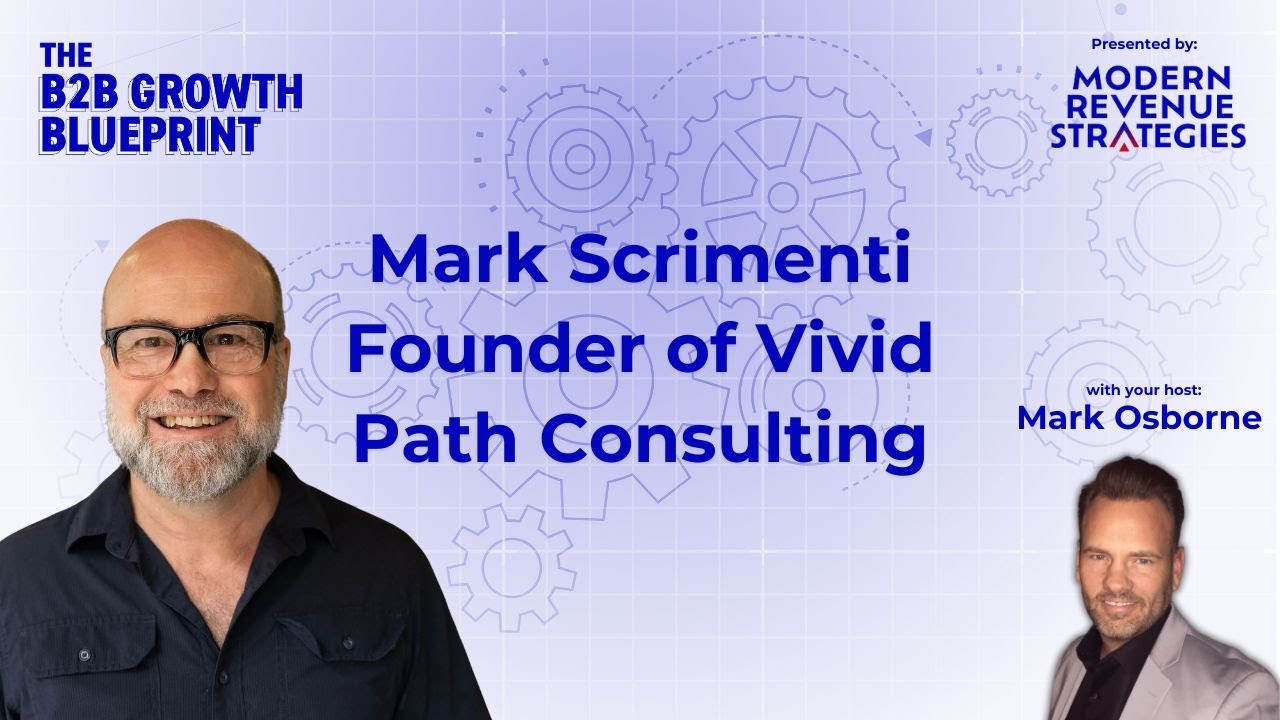
Mark Scrimenti, a fractional COO, explains how to build culture that scales. He uses the System and Soul framework to define core values and the habits that reinforce them, then helps founder-led B2B firms turn service work into software products that generate recurring revenue using AI and automation.
Chapters
Welcome to the B2B Growth Blueprint podcast, where we talk with entrepreneurs, founders, and leaders at B2B services, tech, and SaaS companies to learn the systems and processes they've used to create success for their business. We'll also learn from marketing and sales experts to provide insights to help you grow your business. I'm your host, Mark Osborne, and the podcast is brought to you by Modern Revenue Strategies and their 10X ROI B2B Growth Guarantee. Schedule a free diagnostic call to learn the fastest path to double your B2B revenues in just 90 days. Hello and welcome to another episode of the B2B Growth Blueprint podcast. I'm your host, Mark Osborne, and today I'm very excited to welcome my guest, Mark Scramenti. Now, Mark is a seasoned operations executive, fractional COO, and certified System and Soul coach who helps founder-led companies simplify complexity and achieve consistent profitable growth. Drawing from his experience scaling an e-commerce company from under $50 million to over $150 million, million in revenue. Mark applies product strategy principles to business operations, treating the business itself as a product to design, optimize, and scale. Through his company, Vivid Path, he helps professional services and SaaS companies align their people, processes, and culture while building scalable productized service models that reflect their values and deliver long-term impact. Mark, welcome to the show.
Thanks, Mark. It's great to be here.
Yeah, I'm excited about this conversation and we've had a chance to catch up on some topics. But before we dive in on some of those topics, why don't you kind of give our audience your story? Tell us a little bit about, you know, what you've done in your career and how that led you to where you are today.
Sure. Well, I've been a fractional COO and strategic operations coach for the last 5 years. And before that, I was in e-commerce. So I led operations and customer experience for an online retailer of music gear. We built all of our software in-house. We did all of our digital marketing in-house. We did everything in-house pretty much. And we saw a lot of growth during that time. That was the under $50 million, over $150 million in growth. So that's really where I got into operations, building teams. It was DIY at first. You know, you're the first scrum master, you're writing product requirements, you're writing copy and, you know, doing content strategy and so forth. And then you build a team, you find people who, for whom this is their calling, this is their passion, and they're really good at it. They're better than you are, and you hire them and you build a team around it. So we had our own product team, we had our own you know, engineering team, data science. We're strong in data science, which is great in e-commerce 'cause you got a lot of data to work with. So we did a lot of modeling that was really essential to our growth. And, but we had a call center as well. And before that, I was my, I had my own marketing agency for about 4 or 5 years. I was doing, you know, most of the work myself. It was, you know, small businesses, digital copywriting, website development. I learned to code. Before that, I was at a startup. I was at an early AI startup, like in 1998, 1999. The tech was very different back then. You know, it was similar concept, but not, you know, just nowhere near the power and scale and speed. So there was a lot of manual effort involved in indexing things, but it was a cool technology based on natural language parsing technology based on something developed for NASA that allowed astronauts to talk to robots on the space shuttle. Just, you know, fly out there to the left wing and check the aileron, you know, or not that one, but the other one, you know, that for a robot to understand language in context like that is very difficult. You know, nowadays with where we're at, it's far different. But anyway, so that's kind of my career, you know, in a nutshell. And been in tech the whole time. And really operations kind of where it all came together, the cross-functionality of it, you know, coming from sort of a general background with lots of different perspectives and then the building aspect of it, the growth aspect of it, and then quite honestly amplifying impact. I think that's what I'm, you know, what I'm doing now in working with small to mid-sized businesses, B2B professional services, SaaS and e-commerce. It's helping them really clarify their vision and realize their vision, develop a strategy around it, you know, build a team around that, and then really amplify the impact that they can make, you know, leveraging the power of business to make a positive difference in the world. That's what, that's my purpose.
Well, and so as a, you know, fractional chief operating officer and system and soul coach, You know, not everyone listening may be as familiar with System and Soul as they might be with, you know, the Entrepreneurial Operating System, EOS, or, you know, other ways of, you know, sort of running a small business. Talk to us a little bit. What is System and Soul? Tell us a little bit about that.
Yeah, good question. So you mentioned EOS, you know, it's a business operating system and it's a way for small to mid-sized businesses to have a real management framework for running a business. And it, it really distills the wisdom and best practices from businesses for, you know, for decades. And System and Soul spun out of EOS because one of the founders, you know, was an expert EOS implementer and one of the first 5 implementers, a Gino Wickman protégé. Gino Wickman's the guy who wrote the book.
Yeah.
On which, on which EOS is based. And he felt that after a few years, people tended to outgrow EOS. Some of his best clients outgrew it. It wasn't as dynamic. They didn't— it was kind of static in the toolset and could be a little bit rigid for some people. And it didn't say enough about people and culture. And I think that's the main piece. And so like with System and Soul attempts to redress that. Imbalance or what's missing there by certainly honoring and building on the process strengths of EOS, you know, structures, systems, processes, metrics, cadences, all those things are really important. But on the other side, it's people, you know, and it's, it's vision and values. It's aligning it. It's a growth mindset and, and understanding that if you're going to grow as a company, your people also have to grow with you or else you're going to outgrow them. Or if you're not growing, they may outgrow you. So how do you do that in parallel? So in System and Soul, for example, people have a personal roadmap and it's a career roadmap and you're trying to align that with your strategic roadmap. Like, how can we grow together? For as long as possible. And, you know, so leadership development, employee development, all the aspects of culture, you know, difficult conversations, radical candor. SystemSell has a lot of tools and partnerships. It's also open source and dynamic. So it's changing all the time, adding new tools. Coaches are adding tools. I have my own tools and share them with other coaches and vice versa. So That's what System and Soul is, and I'm working with founders and their leadership teams to implement this framework. It's more of a coaching facilitation engagement typically, as opposed to a fractional CEO engagement where you're doing the execution as well. Sometimes it's a combination of both. I mean, and so if a client is using EOS already and they're having success with it, I've worked with EOS multiple times and I can work within that framework. If they're not using a framework or if they're open to a new framework, I will introduce System and Soul because I just think it gives us more options and it's more flexible.
Yeah. So mentioned a couple times in there, culture. And, you know, that Soul component of that name seems to certainly sort of lend itself to that idea of culture. And it's been said, you know, culture eats strategy for breakfast.
Right. Peter Drucker.
The phrase, what it means is the best strategy in the world can be dominated by a company with a better culture. And I know that System and Soul, you know, a lot of people struggle to say, well, what is culture? How do you build a culture within an organization? And I think there's a lot of ambiguity around even how to define it, but I know System and Soul has a very Succinct and really concrete definition. Talk to us a little bit about how do you define culture within an organization?
Right. Culture is really the combination of core values, clearly defined, distinctive, meaningful core values, and organizational habits equals culture. It's really that simple equation, you know, values plus organizational habits, which bring them to life, bring the core values to life to create the kind of culture you want. So we usually look at when we're trying to define a culture, cultural attributes, we start with questions like, well, your best employees, what would you like them to say about you on Glassdoor, for example? You know, and what are some of the adjectives they might use to describe, you know, it's a collaborative culture, it's, it's, you know, it's creative. You know, we're, we're committed to, you know, challenge each other in growth, whatever, whatever that may be. You're starting there. Let's, let's identify. And some of this is gonna be existing.
Yeah.
You know, these are our existing strengths. Typically, when I'm working with a client, you know, this is what we're already good at. And you look at some of your best people too, and you look at some of their characteristics, and you abstract those into the culture too. Like, we want more of those people. So what do they have, you know, that we wanna build on? And then we'll go back to the core values. And by the way, some of them are existing, some of them may be aspirational. It's like, We're not quite this yet, but we know we want to be this and maybe we need to be this. And so we need more of this. So, you know, you'll define that. Then you go to core values and you'll look, well, what do you have if you have anything? We'll define them. It needs to be more than mere table stakes, you know, not just— hardworking is good and it's not everybody's hardworking. So that can be a core value. But, you know, some of the better core values that I've seen are phrased as statements like everybody makes the coffee. That's a core value. It's like, well, you kind of know what that means. You know, whether you're the CEO or the summer intern, you drink the last cup, you know, you make the next pot of coffee. And that says something about how we work together as a team. And then org habits are kind of in between that. It's, you know, so it'd be how do you, how do you bring these to life? I mean, everything that everyone makes a coffee could be, could be sort of an org habit, but it's more like we— they could be rituals that you do together. They can be practices or methods. In System and Soul itself, we do DAT. It's an acronym. It's define, align, and take action. So when we're problem solving, we're trying to really define what is the problem. You ask the 5 whys or whatever you need to get to the core issue. And then you're trying to summarize that in a sentence. And then you're trying to align that with your strategic goals, your objectives and key results. Especially for the quarter, but even beyond that. And, and then take action. Okay. You know, so if this thing doesn't really align with your objectives, maybe it's not something we should be talking about right now, or maybe it's not a priority. Maybe it goes back on the backlog, so to speak. And if it is, let's take action. And can we make a decision now that will move, move us forward today? Or what's the next step? And let's make sure we do that. So, you know, those are some examples.
And that makes a lot of sense on why culture like that is so powerful versus strategy, because sometimes a strategy can kind of sit in a box, right? Or, you know, sit in a folder on someone's desk. If you don't have the culture that makes that strategy really actionable, To where those daily habits are, you know, acting on those values to implement within the organization, it's a big difference.
Right. I think to maybe give another example that would be, make it clear would be, for example, being, if you want to be a data-driven organization, there's a lot of technical implications to that. You know, you have to have the infrastructure, you need to be able to test at scale and so forth. You need, You need analysis and, you know, data scientists, for example. But you also need a— it's a certain mindset. You know, it's a growth mindset. It's a willingness. It's a commitment to learning, to continuous learning, to testing, testing out our ideas, not just advocating for what we want, but actually being willing to put our ideas to test. And sometimes they don't win. And, and then that's okay. Or, or, you know, being able to take risks and make mistakes like that's okay as long as you take responsibility from that and you learn from them. You know, like these are cultural attributes that, you know, any organization that wants to grow, stay competitive, and really, I think nowadays more than ever, you know, stay ahead of the curve and the competition needs to be willing to, you know, test things out and adapt. That adaptability is so key and you can't really do that without A commitment to learning and changing and growth. And so these are all cultural attributes and you need to develop practices and operationalize them to bring them to life.
Yeah. Well, so that gets on that systems part of that operationalizing those practices. And you and I are both big fans of systems and processes. And one of the things that you and I have talked about in the past and that I think would be interesting for our audiences, you're seeing a trend similar to me that a lot of services businesses are building processes that productize their solutions. And then, you know, with this proliferation of software and technology, there's actually the opportunity to create software that underpins the services that they provide and makes those services more valuable to the customer. So the customer's willing to pay more and also create some continuity between maybe tentpole engagements. And the simple example that I like to use a lot is, you know, the accounting person that used to come in once a year and would clean up the books or maybe once a quarter and clean up the books and pay your taxes and then go away.
Right.
It was always a painful experience because You hadn't done a good job of keeping your, you know, sort of your, your books in order or your receipts together and all those things. And so the next time that accountant shows up, they go, hey, good news. I've developed a little piece of software for you that's going to suck in all this information from all your different credit cards and banking accounts. And then it's going to be nice and painless the next time we meet. And it's going to cost you $20 a month. And so now that accountant has made themselves stickier because, you know, once you get that set up, you're not likely to leave because they have made it so much easier. They've also given themselves some recurring cash flow because they get a few clients paying that $20 a month. It starts to add up and they've improved the value of their service to you all through doing something very simple that, you know, Potentially be coded in, you know, a quarter, if not a month.
Right.
Just a little bit of investment. Talk to us about, you know, some of the ways that you're seeing companies either bring in new technologies. You know, you mentioned AI early on, but whether it's new technologies like that or just, you know, old boring technologies, but just taking that mindset shift and going from, we're a services company that comes in and does an engagement to, We're a services company that leverages software to improve the experience for our customers and then creates these ongoing relationships.
Right, right. Yeah. And that's the ideal. It reminds me of, you know, Michael Gerber, The E-Myth Revisited, where he talks about, you know, you gotta think like a franchise in order to scale, even if you're not a franchisor. And the whole idea there is standardization. You know, which you should be doing anyway, whether you're, you know, planning to franchise or not, because that's how you scale. You need standard process, repeatable processes, modularized, templatized, and so forth. And so this is, this is a challenge for a lot of service-oriented businesses. I've worked a lot of service-oriented businesses that are treating every engagement almost as if they're starting from scratch, you know, and they're They're wasting time. They're missing opportunities that way. They're they're less profitable as a result. So you know it all starts with standardization, and there's there's beneath that you need to have you know consistency across your tech stack. You know data structure structured data that you know that's aligned and consistent. You know throughout the tech stack flowing and you know in alignment. So those are all some fundamental pieces, but. In terms of what you're talking about, you know, productizing services, you know, creating recurring revenue is a big part of that. As you said, finding the things that you're doing all the time and, you know, these are typically high-volume processes that can be automated. And doing that. And so whether it ends up being, you know, so I work with clients, for example, a digital design agency, and we're always looking for ways to create bigger service solutions, packages, and recurring revenue. Most agencies, I work with a lot of creative services agencies, you know, they end up getting projects, they get project work. That's their in. With a client, but they're not necessarily, you know, retaining the, you know, you wanna retain these clients long-term and you want to engage them and expand, you know, you want account penetration, account expansion. And if you're not more systematized, you miss out on those opportunities. And, you know, one thing that people tend to miss is they're having a lot, every conversation they have with a client, Every— they have an opportunity to gain strategic insight that they can build on for that client so they can be in a position to, if the project goes well, the initial project, you know, expand the options for that client. You know, you've proven your value and at the same time you're learning what would be most useful and helpful. And there may be some strategic components to that as well as tactical, and you're building on that over time. And you're making sure that you know they're aware of these opportunities and and and that you can deliver them. This is sort of like on the way to you know productizing services in terms of using technology. You know, like AI is is is everywhere and and is essential to this process, and it's wonderful because it really accelerates what you can do in this regard when it comes to. Standardizing processes, for example. You can, you know, really just, you can crawl a body of data, whether it's, you know, your email inbox or something, and really have it figure out what are some, you know, structures here, what are some repeating patterns or solutions, common solutions to common problems that we're seeing, and just let's flesh out an outline that way. And then you can, you know, it's so easy to automate these things or to build and build software, for example, or an agent that will do them for you now. And so, you know, my, my clients, I'm moving all my clients in that direction if they're not already there. I'm working with a legal accelerator that everything is doing backend, back office, agentic AI automation. So, you know, intake, starting from intake to using like N8N, which is a native AI automation platform. You know, it's pretty, it's like a no-code solution, you know, where you can just create these flowcharts that, you know, it's like, you know, that move workflows along automatically from system to system. So, and some of these things, if they're robust enough and common enough, you can then start to package. And if you're not, if it's not software as a service per se, it's like, well, I've got an out-of-the-box solution for that. So the more, you know, that you can think like a product, you know, as opposed to a service, the better. So, you know, it's kind of, that's the parallel with the, the, my, you know, just think like a, you're a product company. And that's a tough switch because it's for services, um, that, that means there's, there's a change in mindset. There's, there's, uh, investment involved. You know, you may not see an immediate return on some of this work. You may need to spend a little money to make money in this regard, but I think it's absolutely the way to go and it's certainly the way to scale.
Okay. Well, and you talked about that mindset, which is, you know, a lot of services businesses are in the mindset of yes, and like, right, whatever the client says, yes. And like, they'll do whatever the client asks, even if they know it's maybe not the best thing for the client to do.
Right.
Or if they know it's not where they are in their zone of genius, where they're not their best. And so they just sort of want to say yes to everything, which is one of those real obstacles to productizing things.
Right.
And then the other thing that you hit on that's worth sort of noting is this idea of sort of modularization. And I've seen companies that are, you know, really expert service providers that provide a very consultative service, but in the process of listening to their clients to understand their clients' needs, they're able to say they need one of Module A.
Yes.
And they need one of Module B, one of Module F, but version 2. And they have standardized their delivery. But they're very concentrated in listening for what the client wants, and then they come back with what sounds like the most customized solution on earth, but it's actually just a blending of ingredients. It's like Taco Bell. It's the same beans, rice, and meat, right? Cheese that, you know, off the, off the, the line that makes it 100 different, you know, things, um, that feels very custom.
Yeah.
But the idea that they've modularized it first, which enables them to do that.
Right, exactly. Yeah. And that's the primary work of productizing, I think, is standardizing those things that you do, deliverables, processes.
And then having the guts to say no when it's something that you can do or not something that you can do efficiently or Not something that you're going to do better than someone else.
Yeah, that's like the strategy discipline, you know, that's that sort of, you know, define, align, try. That's the align piece. Like, does this align with where we want to go? Because it might be tempting and it might be short-term cash, but it's going to distract you from where you need to go and what we've committed to doing. And you need to make that hard decision.
Someone said once, and I can't remember who, that strategy is what you choose not to do.
Yeah.
And it's sort of saying yes to everything is not a strategy.
Right.
Where you define the edges of what you won't do, that really defines that strategy.
And to me, that starts with a strategic roadmap. You know, and that's another thing that I do with System and Soul. It may be a starting point, but it's a one-page strategic roadmap. Where you're really defining the playing field that you wanna, that you're playing in. That may be obvious, you know, like if you're in marketing, but sometimes you need to niche. And then what differentiates you within that playing space? You know, so really, who are you? You know, your identity. And then, you know, what are you trying to accomplish? You know, longer term, like what's your big, hairy, audacious goal? you know, by when, you know, we want to be the number one, you know, call for, you know, top 500 CEOs when it comes to marketing or something like that by 2035, or we want to be a $10 million company or a $50 million company by— And then why, you know, like your because, that's the purpose piece, you know, that really is what drives people inspires them, motivates them, you know, like what's the impact that we're looking to make beyond, you know, profitability? What's the human impact? What makes us— what can we— what gives meaning to our work? You know, we're, we're going to be the best at this and, and we're going to make people's lives better in this, in this way because this is what we care about, you know, that kind of thing. And then, you know, objectives and key results, like breaking that down. Okay. If you want to be here in 10 years, like 3 years, 1 year, and this quarter, what are your top priorities, uh, initiatives for working on the business versus working in the business, to reference Michael Gerber again? Um, because that is another thing— people get stuck in the weeds of the day-to-day operation and they're not, um, they're not carving out time to, to build the capability for scale. And that's, that's You know, what we focus on. It doesn't happen without that deliberate focus.
Yeah. Well, Mark, you're obviously an expert in a lot of really interesting areas and we could talk all day, but I gotta be mindful of your time. But before I let you go, so the work that you do is, you know, Fractional CMO and with System and Soul coaching, like who do you work with and what are the types of problems you help them solve? Give us the pitch a little bit.
Yeah. I work with founder CEOs of B2B professional services, SaaS, and e-commerce companies, law offices, creative services companies, you know, marketing agencies, SEO, brand strategy. I've worked with manufacturing as well, and I'm helping them to build smart, adaptable systems and healthy growth cultures at scale. So, you know, we talked about the cultural component of growth and scale, as well as the systems piece. I'm typically $5 to $50 million in revenue is an ideal spot. I've gone lower, like $2, you know, and certainly worked with bigger companies. And, you know, minimum of probably 20 people, could be 10, you know, on the low end, 20 to 250 or more. And, you know, these are founder-led businesses. They've got a leadership team in place. They're probably missing a few pieces. They may or may not know that, or they might have some of the right people in the wrong seats, or they may not have defined the seats yet. So there's usually an organizational design component of what I do, but really trying to align their, you know, org structure with their business model, figuring out you know, again, what that business model is and optimizing it. Also looking for opportunities for innovation and building in some of the systems and processes for innovation and then really helping them execute. So either, either that's on the— as a fractional CEO where I'm— people may be reporting to me and I'm responsible for executing the strategy as well as developing it or teaching the team how to do it themselves. That's more of the facilitation model. Uh, for example, as a System and Soul coach where I'm implementing the framework and meeting with them. I've done it. It can be full-day sessions, um, could be 6 or 7 sessions a year with, you know, plenty of interaction in between, or I can split those into smaller pieces. I've done that. I've done it completely remotely, you know, over, uh, with 2-hour, like, you know, uh, 12 2-hour sessions, you know, just to get get it up and running. So it's very flexible and adaptable in that respect. Awesome.
And what's the best way for folks to get in touch with you?
I'd say LinkedIn, just my name, Marcus Crementi, on LinkedIn, and, or my website, it's vividpathconsulting.com. You can reach me there and there's a, you know, contact me form there. So I do free consultations, I'm happy to talk to anybody who might be interested in learning more and seeing if I can help them.
Awesome. Well, Mark, thank you so much for joining us today. I really enjoyed our conversation.
Oh, you're welcome. Thank you, Marc. It's been, it's been really nice to talk with you.
Talk to you soon.
Okay. Bye-bye.
Thank you for joining this episode of the B2B Growth Blueprint Podcast. We hope you've gained insights to grow your business. If you enjoyed this discussion, please rate, comment, like on your favorite platform, and share to others who will find it useful. Do you know a CEO, founder, or leader at an early-stage B2B services, tech, or SaaS company who would like to be a guest and share their story? Send us a note. Let's schedule a conversation.
More from Mark

How Can You Maximize Your Business Value Before Selling? with Randy Katz Video







