Digital Marketing Strategies for Entrepreneurs with Volker Jaeckel
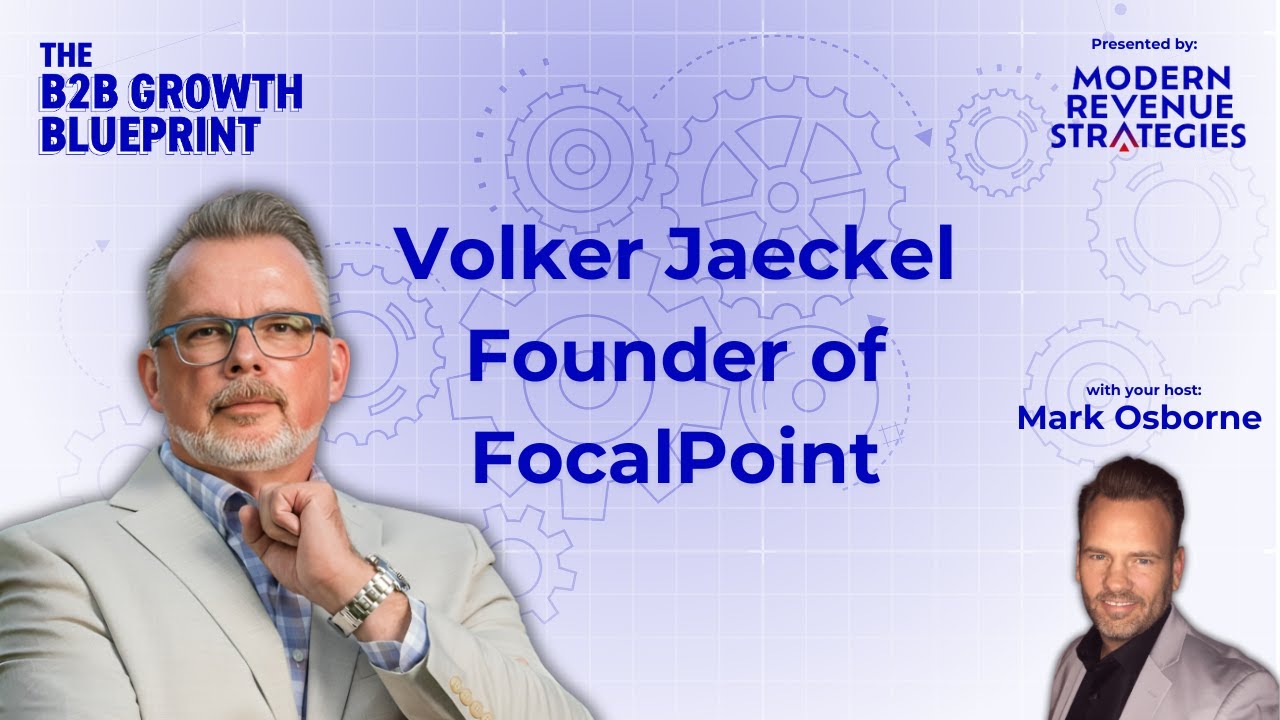
Mark Osborne talks with Volker Jaeckel about digital marketing for B2B sales, from video and lead processes to buyer personas and decision timing. Volker is working on a co-authored book with Joe Foster and launching a 12-week entrepreneurial coaching program.
Chapters
Welcome to the B2B Growth Blueprint podcast, where we talk with entrepreneurs, founders, and leaders at B2B services, tech, and SaaS companies to learn the systems and processes they've used to create success for their business. We'll also learn from marketing and sales experts to provide insights to help you grow your business. I'm your host, Mark Osborne, and the podcast is brought to you by Modern Revenue Strategies and their 10X ROI B2B Growth Guarantee. Schedule a free diagnostic call to learn the fastest path to double your B2B revenues in just 90 days. Hello and welcome to another episode of the B2B Growth Blueprint Podcast. I'm your host, Mark Osborne, and today I'm very excited to welcome my guest, Volker Jekyll, or Vijay. He's an award-winning digital marketing executive and thought leader with a distinguished 40-year business career. He's a founder and owner of Focal Point and has expanded his expertise to include roles as a business executive coach, a DISC behavioral analyst, and a sales trainer. He's recognized as a top 50 most influential marketing professional worldwide and a top 10 US e-commerce director by Digital Dealer Magazine. He's a featured speaker at industry events, the author of numerous influential articles, and the writer of The Digital Dealership: A Battle-Worn Roadmap to Online Success, which was one of the first books on digital marketing for the automotive industry. He serves as a fractional CMO, playing a pivotal role in positioning companies for rapid growth and industry leadership. In addition to his extensive business experience, Vijay has awarded a coaching affiliate seat for the School of Entrepreneurship and the Entrepreneurial Resource Center. So Vijay, Hey, welcome to the show.
Thank you very much. I'm glad to be here.
Well, I'm really happy to have you and really enjoyed our chance to catch up a little bit, you know, prior to the show. You've got such an interesting story and, you know, such a sort of exotic accent. Tell us a little bit about your background, how you got from where you were to where you are.
Well, yeah, the accent is always funny because people say, what is your accent about? And I said, I have an accent. So it's always, it's a very good icebreaker. And I know it's not from South Boston or Northern Jersey, whatever it is, it is German. So just a couple of months before September 11th, I actually immigrated as a 37-year-old to the United States. Reason was not— I was not politically chased. It was really about the love I found at the time. And even so, that is already done. But the point is, I came to America and for love and wanted to, as a little kid, I always said I live one day in America. So came to America, landed in Detroit, had 2 boxes of books, German sales and marketing books in Germany. And I had a suitcase and $1,000 in my pocket. And then September 11th attack occurred. And even so, I had lined up a consulting job this was canceled because of September 11th.
Wow.
So now I was sitting there, I said, okay, well, I wanted to get married. It was a 90 Day Fiancé visa approach and I wanted to do something. And I had, of course, recalled all my English from high school time because, you know, when you're living a good time of your life in Germany, You have to recall everything. What, how was it again in school English? So everybody made fun of me about my accent. And I decided early on, I said, guys, I will show you a hook. I said, I will be in front of people speaking and I get paid for it on a stage. I will write a book in English and it will be good received. And I will be on the COVID of a magazine. So I had really high ambitions, crazy, and had goals. Everybody said I am crazy. But that is pretty much my story, how it all started. And, um, yeah, the history shows that I was able to do it. And when you would like to know how I did it, I can also certainly talk about that.
Yeah, absolutely. Well, that, you know, it sort of begs the question. So What has been, you know, for lack of a better phrase, your key to success?
Yeah, yeah. Key to success is definitely my grit, my tenacity. And I love the quote which Sir Winston Churchill said in the Second World War in front of his old college, in front of students, to never, never Never give up, never give in, right? So, and, and that was my mantra. I always lived like this, and it was really coming to fruition when I came to America. As I mentioned, I was early on just tingling around, didn't know what to do really in America because with no college degree in America and then an immigrant and then September 11th, you were somehow in a back corner already, you know. I don't know what to do. So my wife at this time was a breadwinner, and I said, no, that cannot go on like this. We had a baby, Nicholas, and unfortunately Nicholas passed away when he was 4 months old. And that is where my tenacity, my grit, and never give up mentality came in. At this point when that happened, I said, okay, I have to be there for my, for the rest of the family because of my son passing, and I have to be the stronghold. And so I decided to make out of my weakness. And that is what I encourage everybody to look at who's listening. Look at your weaknesses, which you maybe can turn into strength. The weakness was my accent, or sometimes people say, what did you say? And I had to repeat myself. And I said, I have this German accent. This is my weakness. Why don't I do it as a strength? And I called a car dealership up in Michigan, in Okemos. And the Okemos car dealership was Williams Auto World. And Wayne Williams Sr. was the owner. And I called him up and I said, Mr. Williams, I think it makes sense to have a German guy with a German accent selling your German cars.
Okay.
And he was laughing, right? And smiling like you. And, and I felt the authenticity automatically came with me. And he said, well, did you ever sell cars? And I said, no, but I promise you I will be the best. So here I am sitting on a floor, sales floor. People around me, my colleagues were betting on me $40 that I last not longer than 3 weeks because car dealerships are, it's cutthroat. It's tough business. And I didn't know what I was buying into. And I said, okay, well, I show you a hook and there comes the tenacity and the grit. And I was in 8 months from New York to Wisconsin, top 20 in sales. And for BMW, I was top BMW consultant. I was top Mercedes, top Porsche consultant. And that was my starting of my career where I said, wait a moment, there is something else coming up and it's called the internet customer in 2003, 2004. Mercedes-Benz received the headquarters in New York at this time. customers on their website made a lead form submission. The lead form was then printed out and per fax sent to the dealerships like us in Michigan, say, hey, we have your customer, he's interested in car X. And everybody said, what is that? I don't want that. These are not customers. They only want the best price. I said, no, no, give it to me, give it to me. So I created processes around it, marketing initiative. I started early on with a flip cam. You know, everybody has now a camera on their phone, but the Flip Cam was the first cigarette lighter size camera. And I did videos and sent it over to the customers. And that suddenly brought me even higher and higher and higher. And people say, hey, can you also do that for our entire dealership, for service, for parts? So I created processes, marketing capacities, and that was the first step into my next step where I said, I want to be on a cover of a magazine because I saw there was a digital dealer magazine for the dealer world. And I said, why are these guys on this cover? I can do better. And I pitched them and they said, wow, you have a story there. And I was on the COVID of a magazine. So that was the second goal reached, right? And then after the COVID of a magazine, It was such a success that headhunters called me. There was a SaaS company in Seattle, Washington, and it was Cobalt. This time Cobalt, and now it's CDK Global, still an automotive giant. And they said, we want to hire you as a digital marketing ambassador. You are traveling around the nation and speaking in front of people, talking about the gospel of digital marketing to, A, make a liaison between our customers, our company, and the OEM, also Cadillac, Chevy, Ford, etc. And all the 3 goals suddenly came to fruition, which then allowed me to write a book about digital marketing. Long story short.
Wow, that's quite a story. Quite a story. And I think that you've now sort of leveraged that to kind of give back as you're doing some work with Cal State. Is that right? Tell us a little bit about that.
Right. Yeah. Cal State San Bernardino campus in California has also an arm which is the School of Entrepreneurship. And School of Entrepreneurship is trying to, here in our community, Riverside County is a really big county in California, to help entrepreneurs, young entrepreneurs, also medium-aged entrepreneurs to find the right resources. So it's not just financing or business plan writing, etc., but it's also about Who else is there in the community who can help our young entrepreneurs or new entrepreneurs to get in the right direction? And I met the dean in a ribbon-cutting ceremony, and he talked about— he talked with me and learned about my story, and he said, I need a guy like this in GRID. And so he said, why don't you apply for an affiliate? Propose a course and Maybe we, we hire you. And yeah, I did it. And I just opened up actually doors here at my coaching company here in Southern California just a couple of months earlier. And so I did that. And suddenly I get a letter and they said, hey, we are welcoming you. And they gave me a nice stipend to do the courses. And so now I'm teaching entrepreneurs on communication breakthrough strategies. what to do, how to speak to customers, how to interact, how to go back and forth, how to build teams and how to speak with your teams. That is my course, is what I'm offering right now.
Wow, that's really interesting. Well, and such a sort of great fulfillment of your goal of becoming an influential communicator that you're now actually teaching a course on influential communication. And, and I think that that probably, uh, builds some of your experience with sort of the DiSC profile and being a behavioral analyst. Tell us a little bit about, you know, what are the, uh, you know, most, most common challenges as you're working with entrepreneurs to help them become better communicators? What are some of the most common things that you see that, uh, entrepreneurs need to work on in their communication strategies?
Yeah. So, uh, DiSC is for me not completely new because before I had a life in America, I had a life in Germany. I was, as I mentioned, 37. I was a consultant and coach and trainer for Brian Tracy as well as an institute who were really focusing on DiSC analysis, also behavioral assessments and profiling.
Uh-huh.
And, um, that is where I picked up And, and, and that helped me from the past and now applying it to the future here in, in California. So DiSC and the most problems, or most people have learned when we were little kids. Think about it. When we were smaller kids or teenagers, we, we heard sometimes Grandma Annie or Aunt Maggie saying, you have to speak to people like you know, um, you would like to speak to. And that was called the Golden Rule, right? The Golden Rule was a long time, and it's still everywhere, you know, that people say, well, speak to people like you would like to be spoken to, right? But there is an issue with it because the Platinum Rule, which is a step higher, actually teaches speak to people like they would like to be spoken to. And that is what I see in a lot of entrepreneurship, in a lot of owners and a lot of makers, right, who want to better their lives, their communities with their companies, that they are still thinking, well, I would like to be spoken like, do this, then they possibly do that too. And that is where the issue is when we are learning.
And that is part of the DISC, which will actually The, you know, the Platinum Rule is speaking to others the way they want to be spoken to. Yeah, take it from there.
So, okay, spoken to. And I see that now with a lot of entrepreneurs. Um, they have teams or smaller teams or they have customers and they wanna convey a message and they convey the message like they would like to receive it, right? But forgetting that the other side is actually a different DISC profile. It's a different color because they're speaking in colors, right? So when you are, let's say, a high D type, a very dominant type, and you're speaking to somebody who is soft and grounded and likes family, and you're coming too harsh over, this green person, also on the opposite of the spectrum, will shut down, right?
Yeah.
And you are wondering, why is she not— what would make sense? Why is she not getting it? Or why is he not getting it? And, and that's what I'm trying to teach my intrapreneurs in school or in my courses which I'm offering, that we have to start learning to accept and respect the other end and figure out how we both, without letting ourselves down, how we both coming to the same nominator, right? So that's what my coaching element is, and, and it's very successfully received. get quite a bit 5 stars left and right because people come back and not just for business. I had just a couple of days, of course, ago and I had a debrief on the DiSC profile, which they also get handed out too. And now there was a couple, think about the magnitude. I'm just not, you know, helping entrepreneurs, I'm helping humans. And that is always my biggest goal. You know, that was always my, and I light up when I talk about it. I love to see people advancing suddenly because I came out of nothing and did it. They can do too.
That's so interesting, especially just to hear you talk about, you know, the sort of the idea of building empathy with potential customers or, you know, potential teammates. And, you know, so often we see in building either marketing messaging or sales messaging when we're working with companies that They assume that their customers are just like them, which is almost definitely not true. Even when people come from the same industry, the customers oftentimes have different sort of profiles than the entrepreneurs or the makers, the, you know, sort of leaders. And one of the ways that we really help them, you know, sort of overcome that sort of lack of empathy is to really build out Alright, let's really think through the sort of buyer personas of the different decision maker or influencer or champion that you might be working with. And not only to think through, like, how are they different from a personality perspective, but like, what are their personal and professional wins? So beyond sort of the logic of why this is a good business decision into sort of the emotion of why is this a good decision for them as a person? really helps to sort of open the eyes of companies as they think about the right messaging that's really gonna connect and really sort of create that persuasive relationship.
Yeah, well, you have to put some work in, right? Because it's very easy for marketing to make just like we always did in all the years, push marketing. And then social media came around, which was pull marketing, right? And now we are again on the next threshold, you know, in influencer marketing with user-generated content. TikTok, etc., etc. So we really sometimes, honestly, it sounds cumbersome, but normally when you have a message or a why, like Simon Sinek is doing so well with, but when you have figured out your why, your why has still at least 4 different paths how you can explain the why to a red person, to a yellow person, to a blue person or a green person. When you are able to create 4 different personas about your why, you will succeed because now you have automatically 100% covered instead of only one person covered, right? So that's the idea behind it.
Yeah, there's even one of the things that we do oftentimes when we're helping to profile like decision makers or champions is not only like DiSC profile, which is a great tool, but we even think through sort of like what their Persuasion modes are, and one of the things that we see is that certain people, they just take a certain amount of time to make a decision. They're not going to make any decision of a certain size in less than two weeks. Other decisions of a certain size, it's going to take them six weeks. Other decisions, it's going to take like ninety days, or so others might be just three days. But they, in their mind, until that time has elapsed, they haven't given it the time that it needs for making a good decision. And so, if you put all of your upfront communicate, all your really persuasive. Communication upfront, well, then someone else is gonna be the last, you know, influencer to come in there and impact them at the end of their decision cycle. And then you're gonna sort of lose the opportunity. Likewise, other people are more sort of like number of examples. So I need to see 3 examples of success or talk to 3 different, you know, references or see 3 different case studies. Again, If you do them all up front, then, but, you know, they haven't hit that time sequence that they have, then you're not gonna sort of, you know, really hit their decision mode and their convincer mode that they go through as they evaluate and make decisions.
Absolutely. Yeah, it's like how you eat an elephant, right? In pieces, tiny pieces.
That's right. With ketchup.
I always say one bite at a time. With ketchup too.
Yeah. So as you're working with entrepreneurs that, you know, are coming to you on, you know, sort of these communication challenges, what's, you know, sort of the best piece of advice that you would have, you know, for anyone who's either thinking about how they can be better communicators in their business or just other aspects of their business as you, you know, have such insight into what entrepreneurs are facing today? Yeah.
So the best advice is, and it sounds maybe a little bit clunky. But the point is, think back when you were a kid, how easy life was, right? When you became a teenager, it got really difficult, right? But when you were a kid, let's say when you remember the times, maybe 6, 7, 8 years old, when you went with your grandpa to a zoo or whatever, how easy was life? How good was life? Because you were receptive to new things, right? You wanted to soak in, you were a sponge. And when you would allow yourself as an adult to become again a sponge where you soak in whatever is getting thrown onto you— water, right? Whatever comes towards you, you suck it in, you wring it, and the substance left in the sponge is the gold. When you learn that and you show your vulnerability and say, you know what? I didn't— I wasn't fed the wisdom with my spoon or with mother's milk. I have to be open to learn and just see what's out there. When we are starting learning that as humankind again and being not so front center, I'm right, I'm left, whatever it is, right? You see in the political field right now, it's awful. Just be— let other people speak, let other people think and believe what they believe, but open up. And that is what Entrepreneurs sometimes say they have this pressure. Maybe the bank is breathing in their neck, right? Because the next payment comes out of the bank. I didn't make any revenue yet. Be open. Be open to new ideas and venues where you say, you know what, I heard about it, but I never thought about it. Not thinking any longer. Do it, right? Just like Nike says, just do it. It doesn't hurt you. You maybe Waste 90 minutes to find out what it's really about and be open what can be done with it at the outcome. That's what I would say is my biggest advice.
That's a great piece of advice. I think I've heard the phrase before of like, have a beginner's mind. Yeah, sort of approach everything as if without preconceived notions, without sort of expectations and sort of let it unfold for you.
Absolutely.
It's a, it's a, it's easy to say but hard to do.
It is. And believe me, I'm a high D and I am very strong-headed, you know, and, but people sometimes believe me when I say, hey, I'm a high D, but I'm an introvert, which is contrary, right? But I love to speak in front of people. I like to speak to people. I like to present. I like to help, right? And I'm very calm. And people say, you are high D, really? I thought you would be yellow, like an inspirational guy because I'm a marketing guy.
Sure.
But this is what you learn, how you adapt. You're a chameleon. You will be a chameleon when you bring it to a science, down to the science and say, okay, I look into your office and I know exactly, oh, there's a blue person sitting. Okay, just numbers, give them case studies and straight direct, right? Don't touch him. Don't be asking about family. This is what I learned through my years. And think about what could do that for an entrepreneur when you go out and try to acquire a new customer and you know already, I need to have my conversation mincing a different way instead of going this way. I do it a little nuance there and suddenly customers say, okay, come on in. That's what it is.
Yeah. And that's that platinum rule. Speak to them in the way that they want to be spoken to, not the way that you want to speak to them.
Absolutely right.
And that's, that's how you, you get what you want out of the conversation instead of driving forward with what you want to say. So, What's something that's on the horizon that's, that's exciting for you, Vijay?
Yeah, a couple of things. One very exciting thing is I just had an interview with Joe Foster. Joe Foster is a very beautiful spirit-minded person. And some people know the name. Joe Foster is actually the co-founder of the sporting goods company Reebok. Okay, and Joe is in England. I'm in California. We hooked up over Zoom. And we interviewed each other, and I'm co-authoring with him the book Survive and Save. Was the internet broken down?
Yeah, it was. So start over. So you connected with Joe Foster?
Yeah. So I connected with Joe Foster. He in England, I'm in California time, so 8 hours behind. And we spoke about, you know, how we can help each other and work with each other. And he's such an open mind and he invited me to be a co-author for his next book, which is called How to Survive and Thrive Edition 2, which will be actually released in the next, I would say, possible 3, 4 weeks. So it's ready to drop. So that's an exciting thing. I will be in my second book then, kind of. As a co-author, I'm really excited about that. And then the next step, what I want to plan is for next year, a very good coaching friend of mine, a seasoned, seasoned guy, like a veteran, very good guy, also with Focal Point. He is in Vancouver, Canada, and we are setting up an entrepreneurial growth course, which is like a 12-week program, includes the DiSC profile, which will be debriefed by me. So I will help the people who are doing this profile while, what it really can do for them. And we are doing a very step-by-step, week-by-week, 12 courses how entrepreneurs can funnel their energy to the main things, what they need to focus on instead to jump left and right and up and down like we all do as entrepreneurs. We are getting guilty as charged here too sometimes, but we are bringing it down to a level where everybody easily can understand it and step by step Again, how to eat an elephant with ketchup or mustard and in pieces. So that's what we will do.
That's great. Well, Vijay, I really enjoyed our conversation. It was so great to have you on the show. For folks that have been listening and are, you know, would love to sort of learn more about, you know, what you do and how to work with you, how can they get in touch with you?
Yeah, there's several ways. Of course, you can, I always like to be connected also on LinkedIn. You know, which is my, my first name, Volker, V-O-L-K-E-R hyphen J-A-E-C-K-E-L, Volker-Jaeckel. Or you can go on my Focal Point Coaching website, which is vj.focalpointcoaching.com.
Fantastic. Well, Vijay, thanks so much for joining us on the show today. I really enjoyed our conversation.
Me too. It was great. Thank you so much.
Talk to you soon.
Thank you. Bye-bye.
Thank you for joining this episode of the B2B Growth Blueprint podcast. We hope you've gained insights to grow your business. If you enjoyed this discussion, please rate, comment, like on your favorite platform, and share to others who will find it useful. Do you know a CEO, founder, or leader at an early stage B2B services, tech, or SaaS company who would like to be a guest and share their story, send us a note. Let's schedule a conversation.
More from Mark

How Can You Maximize Your Business Value Before Selling? with Randy Katz Video







