From Chaos to Predictable Growth: The SaaS Framework Top Teams Use with Vanessa Goolsby
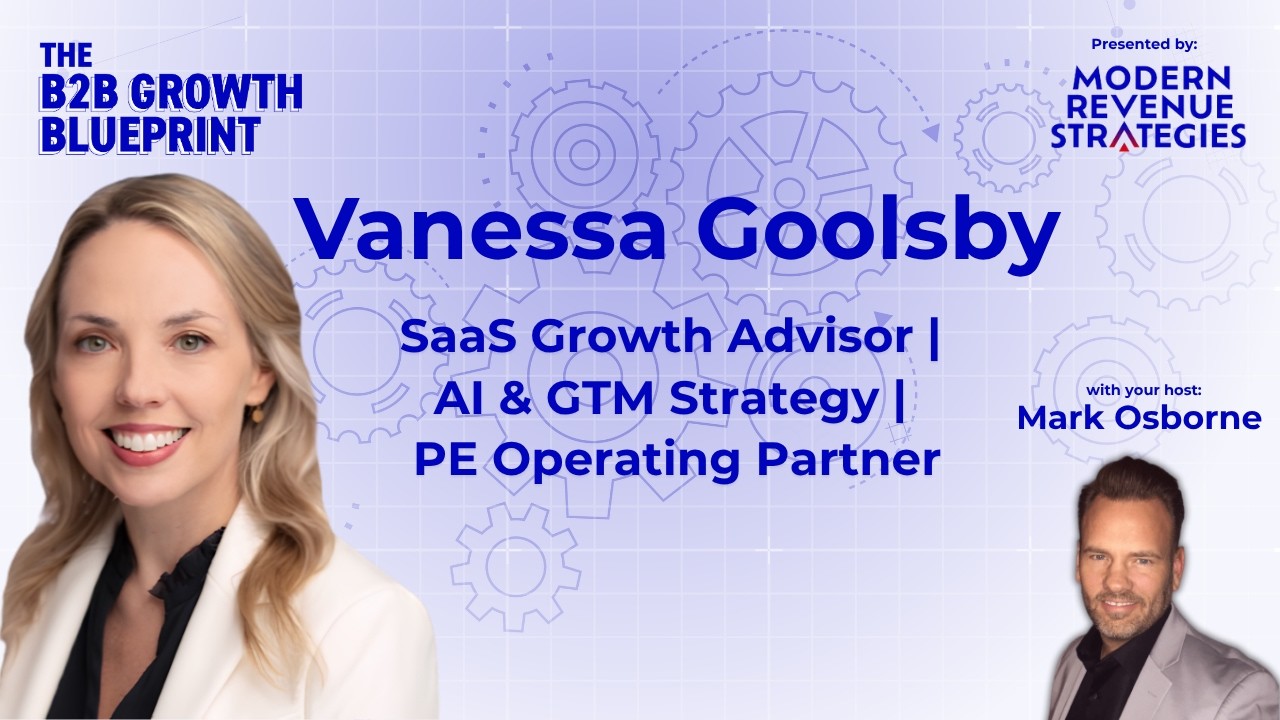
Vanessa Goolsby, a growth advisor for PE-backed SaaS companies, breaks down the four-decision framework from her book The $100 Million Push: defining your Ideal Customer Profile, setting lead quality SLAs, building a contribution model for resource allocation, and aligning OKRs to the PE hold period. She shows how misalignment happens, like moving upmarket without the product to support it, and walks through her 30/60/90-day audit and execution process.
Chapters
Welcome to the B2B Growth Blueprint podcast, where we talk with entrepreneurs, founders, and leaders at B2B services, tech, and SaaS companies to learn the systems and processes they've used to create success for their business. We'll also learn from marketing and sales experts to provide insights to help you grow your business. I'm your host, Mark Osborne, and the podcast is brought to you by Modern Revenue Strategies and their 10x ROI B2B Growth Guarantee. Schedule a free diagnostic call to learn the fastest path to double your B2B revenues in just 90 days. Hello and welcome to another episode of the B2B Growth Blueprint Podcast. I'm your host, Mark Osborne. Hi, I'm Mark Osborne, and today I'm very excited to welcome my guest, Vanessa Goolsby. Now, Vanessa is a growth advisor who specializes in scaling private equity-backed middle market software companies. She's a 7-year veteran as an operating partner to private equity firms and portfolio SaaS CEOs. She's helped more than 100 middle market software companies drive growth, execute go-to-market turnarounds, and deliver investor returns through sharper commercial execution. Prior to advising, she was a former operator leading product and commercial teams for 18 years at brands like Travelocity and the Financial Times. Her book, The $100 Million Push: The 4 Decisions PE-Backed SaaS CEOs Make to Deliver Growth in 100 Days, distills the framework that she's developed over decades in the trenches Codifying the sequence behind the big 4 decisions that enable CEOs to scale with speed, clarity, and confidence. So Vanessa, welcome to the show.
Oh, thanks for having me, Mark. I'm excited to be here.
Absolutely. So before we dive into some of these topics and, uh, the things that we're going to talk about, give our audience a little bit of a picture of sort of your background and the twists and turns of your career that brought you to where you are today.
Yeah, happy to. So I've spent the past 7 years as an operating partner with 2 kind of flagship investment firms. And in that time, I kind of learned how to take what I had learned tactically in the trenches and turn it into things like frameworks and ways of like teaching teams and processes that can be repeated and scaled.
Mm-hmm.
I couldn't have done that though without having that first 18 years of, like, in-the-trenches experience. So kind of working my way up through multiple teams around product, marketing, commercial, former GM, all this stuff, right? And so my background is really marrying those 2 ideas, like how to be tactical, what's realistic for a team to take on, and then also how to stay strategic, like how— what is the future that we're trying to walk towards? And like, how do we build that bridge?
So I want to kind of dive right in to some of your insights. And, you know, the title of the book is, you know, very intriguing around these 4 decisions that actually drive scalable growth. Let's not hold everyone in suspense. Tell us, tell us what those decisions are.
Yeah, you know, I think one of the biggest ahas I had becoming a consultant and starting to really work across companies at scale was how important the sequence was of certain activities. Over time, there were just really 4 big moves that if a company or a CEO hadn't done this or hadn't brought the right people along in the journey, we would see it come out in terms of a plateau of growth, churn, the big milestones we're trying to achieve. Those Those 4 decisions come down to the first being, and so these are in order. So the first is, who do we target? And I high-level that as the ICP or the ideal customer profile.
Yeah.
I certainly didn't come up with this approach or this method, but it is so critical of a starting point because it's the decision that a team makes around who's gonna be the right buyer for us in this next growth phase. And you will grow out of that growth phase. And then you will have to kind of identify again who that ICP is going to be. But once the team commits to that, it gives product something to build a roadmap against. It gives sales somebody to build territories against, and it gives marketing somebody to message to.
Yeah.
So everybody, it just inherently aligns all of your core functions, all of your core buyer-focused functions in terms of like how to grow and scale. So our first, we first start to target, we first start with who do we target? Then once we know who we're gonna target, we move into how do we turn those targets into opportunities? And I high-level this as the SLA decision. And SLAs traditionally, like when I mention SLAs to sales and marketing teams, they are thinking immediately around, oh, like what's my time to first contact? Like how long will I hold onto the lead? But when I'm talking about an SLA, I'm really blowing it out to be a little bit more around the lead quality and lead management process as a whole. It's kind of everything. that your marketing or your partner channel or your outbound group would need to have understood and committed to across the teams for the handoffs in order to turn— to have some confidence that when they send a lead or a contact or referral into the sales process, that it's going to convert into an opportunity or be recycled timely so that we can keep that conversation going at the appropriate level.
Right.
Our second decision is really around that, like, RevOps piece. that SLA piece. The third decision, once we understand who we're gonna target and we understand how we're gonna turn those targets into opportunities, then we're ready to be a little bit more strategic and pull up and invite the CFO in and discuss where are we gonna invest to go get more of these targets? So now that we have some confidence, some predictability built into our conversion rates, now we're ready to set some real targets around, well, how much headcount do I need in outbound? If I'm now, I have some confidence in terms of what those convert. What is my marketing budget going to be? Is this the year I turn on channel partners? You're not really able to truly make those kinds of big committed decisions with dollars until you've kind of walked through the first 2 decisions. So this 3rd decision, I call it contribution, but it's essentially a contribution model that covers for new and expansion, for the revenue drivers of both of those. Like, what are our pipeline sources going to be and how much investment do we need to put into those in order to meet our deliverables? Bookings or our revenue target. Those are the first 3 decisions. We've got who do we target, that's our ICP. We've got how do we turn those targets into opportunities, that's our SLA. We answer the question, where do we invest to go get more of those targets this year, that's our contribution. Then finally, we ask ourselves, this is really where the CEO fully takes the driver's seat, and we ask ourselves, how are we now going to do this over the long term? So I specialize in PE-backed companies. So I'm going to talk a little bit about the investment side here.
Yeah.
But for CEOs who are PE-backed, there are real exit targets that they need to hit throughout the hold period. And so that hold period is really kind of a crystallized sense of time that they need to create, and they need to establish objectives that their whole team can follow through over over 2, 3, 5, usually no more than 5, 7 years. And so having that understood and codified and understanding how are we going to do that, that's our final decision. So how do we do this over the long term? It's really, for me, is that hold period that you have with your current investor. And I high-level this as OKRs, again, or also known as objectives and key results, an approach I did not invent, but is so So helpful in this whole process.
Yeah, I love that. And I also love that it's very strategic. And you talk about, you know, sort of bringing in finance as part of the decision-making because the contribution that these customers make towards that bottom line is something for the company to make as part of a strategic decision rather than just marketing sort of off in a silo. And oftentimes, We see that there are silos that emerge and you and I have talked about the fact that oftentimes sales and marketing aren't perfectly aligned because marketing might be taking one message to the marketplace, but they're not perfectly aligned to that ICP that sales knows does a better job of converting, or it's not saying the same thing that sales knows would really convert. And then likewise, there's this sort of adversarial relationship between finance and the marketing and sales where they're fighting for resources instead of treating it as sort of the company resources. Talk to us a little bit about what you've seen as, you know, where does some of this misalignment come from and how have you seen companies successfully create better alignment that delivers the outcomes that they're really looking for?
Sure, you know, I'll talk about a client I'm working with right now. So we've got a company who has identified their ICP targets by company size. So you can think of it as like SMB, mid-market, enterprise, right?
Right.
And I'm speaking with the sales managers and, and I'm finding that, oh, you know, well, how, you know, I see that you're really hitting your quota attainment, you're doing really well, right, with your SMB and most of your mid-market, but you're really kind of struggling with enterprise. What, you What's going on there? And the answer is, well, the truth is, is we don't really have the features to satisfy that market. But we have targets, right? So I had to create a whole territory around enterprise. So I have reps.
Yeah.
We try and sell, we get them on the phone. And for those that we're even able to close, we find that they either can't implement or they turn right away or they never start, they never become a user. And so like that natural misalignment, right? about realistically what's probably happened, right? What probably happened is there's a, you know, you've taken some investment and now you've got like a 30% year-on-year growth target that you need to go hit. And you know what you can get from what you do today. And so now you're naturally thinking, well, maybe we're going to move upmarket. But the idea of moving upmarket is not a sales play, right? It actually has to start with product, right?
Right.
And so When we run through, so the way that we solve this kind of issue is we do what I would step number 1, right? Like, let's go back to our ideal customer profile. This is taking who we know we can sell today and looking at where are the green shoots for our next available account or segment or firmographic or segment, ICP segment.
Sure.
And when you do that exercise in like a data-backed way, so taking your CRM data and you're looking for, you know, what's our highest propensity to buy, meaning we have great close rates, shortest sales cycle, highest deal size, lowest churn, right? So you're taking all of these like data points and you're wrapping them up into your different ICP categories. So you might do it by SMB, mid-market and enterprise. And you might say, actually, there's still so much wood to chop in mid-market. What we really need to focus on is an aggressive roadmap this year to just finish out our mid-market feature set and put more of our reps on that and try and build up the volume. Meanwhile, we can have a long-term roadmap on enterprise features that unlocks that ability. So sales can't really sell something that doesn't quite exist yet in the market. And those little align— this is just one example. There's a lot of examples that are not product-related.
Yeah.
But those little misalignments start oftentimes top-down. Like, they start from a strategic session. You know, maybe they had like a 2-day session with everyone and there was like a great idea, right? And that's fantastic. Like, I always start with gut. The way that I work is I start with an audit and I interview basically everyone that you'll let me talk to. And we're surfacing ideas and like, what works and what do you think the competitors are doing well? And what, you know, if you had to reimagine it, what would it look like today? Like, we start with gut, but then we have to validate it with data. Like, it's really at this stage— so I play in middle market software, so like $10 and up, basically $10 million and up. And at this stage, you should have enough data points to at least point you in the next logical step. When you try and jump too many steps ahead, what ends up happening is you run out of runway. I'm just going to keep running on metaphors. So you run out of the ability to see around the corners because you're kind of in a place where you don't have any data, you don't have gut anymore, and now you're just kind of running a little bit blind.
Yeah. Well, and also, you and I have talked about this in the past, that there's a really strategic role that the CEO plays in bringing together that alignment. Talk to us a little bit about that sort of unique role that the CEO plays in creating that alignment across those different organizations, I'll tell you, this could be like an entire podcast session for me because this was really the impetus behind writing this book.
At this growth stage, the CEO plays a very specific role, and it's not exactly the same role that you play over 100. So, and it's not the same role that you necessarily play under 10, right? So, but at this stage, when you're getting to 100, the CEO plays an incredibly important role. I almost called this book something around like CEO-led growth, but I didn't. necessarily want to go that broadly. What I wanted— like, what the CEO does in a PE-backed business here is they are the only person in the organization that can connect the execution that's happening on their team to the investor's expectations and the value creation plan that they need to deliver to their investors. They're the only one empowered to do that. The CRO, oftentimes this what I have seen time and again is the trap that they fall into is there's so many fires that they're focused on. And maybe product is, maybe they were a co-founder and like they were a product, you know, a product person. So they're delegating commercial, or maybe they hire a CRO that looks really great, right? And has like the perfect bullseye background, right? To lead like sales and marketing for their organization. And so they delegate the commercial aspect. But what ends up happening is once they delegate and they really take their hands off of the wheel, so to speak, in terms of directing the priorities and the execution of the commercial teams, they're divorcing that execution immediately from what's happening at the investor level. So then they go into the board and the CR— it's on the CRO to kind of start to explain how is commercial— like, Why aren't we hitting this adjacent market? Why are we down here? What is happening here? And for the CRO, oftentimes they haven't seen the value creation plan. They haven't seen the investment thesis. They don't know what the exit targets are. And they're thinking, oh, if you need growth, I'm gonna go hire 10 more reps, right?
Right.
So it's like, there's just a different altitude that these 2 executives fly in. And it's really the CEO's role to guide their team through this like hold period to meet those investor expectations. And that's actually why the number 4 Decision is this OKR decision, because that's really what it is. It's like, it's almost like a CEO project management tool. It's like, great, now you know how your business is running and you can articulate that. Now, what are the priorities going to be to go do more of it?
Well, and this also comes back to what you were talking about before, which is, you know, trying to move upmarket when the product isn't ready. The CMO, the sales leader, the chief revenue officer, They can't march into the product team's cubicle and be like, guys, we've got this revenue target with enterprise and we don't even have the basic features that they're expecting. You need to start building that. They just can't do that. But the CEO can. And that's such where that alignment comes from. And I've definitely seen where CEOs will, as you say, kind of abdicate that responsibility to a marketing person. How are we going to hit these revenue targets?
Right.
And they're like, well, we'll come up with a plan, but if we can't support that plan, or if we don't have the financial resources to invest in, you know, as you say, you know, bring commercializing it and all those things, it really requires all of that to really come together. And the CEO is kind of the only person that can do that in companies and is, you know, that's what their job is. Like, that's, that's what they're there for.
Yeah, I'll tell you the first, so the first 2 chapters of the book are really trying, I try to ground the CEO in terms of like what the expectations are of them when being PE-backed, because frankly, it's not a conversation that is typically very direct. So it's kind of like they kind of have to figure it out over time.
Right.
And in those 2 chapters, I suggest oftentimes, I mean, I work with a lot of firms now, which I'm really lucky to have this, these relationships. And what I find is that oftentimes investors keep a lot of, a lot of like the diligence findings, the growth thesis, even sometimes the value creation plan very close to the chest. And it's like they're having these conversations in the— they're like seeding these conversations in the board meeting, but they maybe, they maybe never shared the market study, right, with the CEO.
Right.
They maybe never shared the value creation plan with— or the exit targets. Like, what's the bait? Like, they— your investor has a base case set of metrics that they expect you to meet.
Right.
And they may never have shared that with you, but it exists, and you're being judged against— like, you're being scored against it. And so the first couple of chapters of the book is like, how do you have this relationship with the investor where they are also part of the team and you can surface and bring in this kind of intelligence? Because this is intelligence This is frankly the reason why a lot of CEOs take investment is so that you have this access to pattern recognition, market research, diligence. It's just, it's giving the CEO scale on a far more strategic front. And so not only is it the CEO's role to bring that strategic viewpoint in and use it to direct the team, It's, it's also like they are the only people who are in the position to do that. So when it doesn't happen, it's a miss for everybody.
Yeah, great stuff. So let's pivot a little bit to the other player that is so important. And, you know, oftentimes when people are focused on the revenue aspects of the business, marketing, sales, those systems, they forget about the importance of the relationship between that Part of the house and CFO. And I know that you've got some real, you know, some real thinking there about the role that the CFO plays in driving revenue growth and hitting forecasts. Talk to us about that a little bit. Tell us a little bit.
Yeah, absolutely. So, so this actually relates to the 3rd decision under contribution, which is where do we invest, right, to get more of our targets. And what I have found, and again, This book is written to go to the first $100 million. And so we're really dealing with— we're dealing with a very specific point in time. Over $100 million, these are not necessarily the same answers. The steps are the same, but the scale and the play and the roles that people play are different. So going up to $100 million in this idea of like the contribution decision, so we understand the stages, we understand we're doing really a bottoms-up here. It took me years. I was running this contribution model for almost 5 years before it occurred to me that the CFO should actually be owning this process. Because oftentimes what I would find in board meetings is CFOs are really great at articulating the data. They can tell you, I see it on the page, I did the math, I understand that my FP&A is elbow deep into all of this. But what they where they hesitate and where they're challenged is then what and why and how. And that conversation can't happen like, oh, we're gonna have that in the next session, right?
Right.
They need to be over the data in a way that they understand the implications. They understand how these are indicators. And so this, the way that I position the contribution model is It brings the CFO in as the champion, sure, but they set the target. So they're coming in immediately to say, like, these are the new targets, these are the expansion targets. Sometimes they don't even necessarily have that. They're just like, here's our big number, and then the rest we workshop. And it's like, okay, well, how much in each segment, et cetera, et cetera. In this process of workshopping the contribution model with the CFO in charge, what we're inevitably doing is upskilling that CFO to be able to articulate back the growth story and tie it back to the revenue. So now when the CFO has to make changes mid-year or there's an ask from the investor, they have the context to be able to manipulate the— manipulate is not the right word— recalculate the numbers and make decisions based on the budget with that context. Oftentimes they're kept so— they're either kept completely out of the loop in terms of like why some of these decisions were made, why sales is asking for this many more heads, why marketing needs this budget, why CS needs this new tool. They're kept out of the reasons why. And they're just kind of like asked like cold to give us this budget, give us these heads, buy us this tool. And so how are they supposed to be able to like, with any meaning, set up a forecast, manage a budget without having that sort of context? So this process brings them in to give them that context. And then the secret sauce is then we ask the CFO to manage this model with those leaders monthly.
Yeah.
So they come back together every month and they say, did you hit this target? Marketing, did inbound hit the target? No? Okay, who around the table is gonna be able to make up for the shortfall? Is there something partners can do? Can we do a little bit more outbound? So now we're starting to react in real time. And the CEO is not, the CEO's busy. So, in this way, we've created for the CEO a fantastic proxy, the correct proxy to help stay at that executive level and be kind of like a second set of eyes with that value creation plan, with that board-level insight to act as kind of governance across a neutral facilitator governance across all of the functions who might be vying a little bit, that might need to do a little horse trading as they progress through the year.
Well, and the thing that I always see is so transformative is when the mindset of a team switches from, you know, each little fiefdom trying to grab as much budget as they can and keep as much budget as they can and, you know, sort of adversarial with each other and with the CFO. Instead, once they all start to really think about like, this is the company's money.
Yes.
How do we steward this in a way that's going to maximize the outcomes for the company? And especially at companies that have to report to the street or something where they need to show, a CMO or revenue leader that can hold back some budget to be used in those end-of-year sort of flexibility or buybacks or dropping some money to the bottom line instead of spending it on ads, having that flexibility because you've saved that in your planning. gives you so much more credibility with that CFO that then, you know, when you need— when you say, look, we've really hit on something that's going, if we poured some more gas on this, it would really explode. That's when you've got the credibility to use it rather than, you know, having that sort of adversarial and thinking about it as your budget, not the company's budget.
I'll tell you, of all of the— so the way that I run these decisions when I'm working with a team is I often start with a workshop because that's how we surface that gut, right? Like, you've hired these people, they're experts, they've been doing this role, whether at your company or somewhere else, oftentimes for 10+ years.
Yeah.
And so we want that, we need that experience, right? We need to surface that all together in the room, and then we validate with data. So every one of these has like a validation layer on the back of that. Contribution modeling is maybe the most tense Every time people come in almost ready to like defend, they see it as like a defending their territory kind of conversation. And when I was an operating partner and I would run these, uh, these kinds of workshops, I would always say to the CEO, this is where you need a third party. Like, you need the operating partner to come in and do this because you can't— like, you can't delegate the CRO or the head of sales to go run this across sales, marketing, customer success because They're too close to it. They're also trying to like look good. And it's a very vulnerable conversation. You're saying, okay, it looks like if I do the math, it looks like you're gonna need to drive, you know, 1,000 leads this month. Can you do that?
Right.
And here you are amongst all your peers and you're like, yes. Right? And that's a very, like, it's a very vulnerable conversation. So it's very sensitive. And it's, but it is a conversation that can be very transformative for the team for exactly what you're saying. which is when they start to see this less as defending their territory and more of just like an investment exercise. Like, okay, then where would, if I had another $100K, where would I put it? What will I actually get out of it? So when we run this workshop, we do it with a big Excel. It was already like calculated, ready to go.
Yeah.
We just put in the inputs. And those lights turn right on. Like, oh, at this rate, that's impossible. Like, no, we can't do that. Or look at all this wood we can chop. Like, oh yeah, I could do that for days. Like, why aren't we lighting up partners? Right? For example. So, so those conversations, then they become a team. Right now we don't have like all these leaders. We have a group of leaders. Like we have a set of one team working together just in terms of hitting that one target. So we always start with like, what's our one target? And then we start to divvy it up.
Yeah. Well, Vanessa, you're obviously an expert in a lot of really interesting topics and we could talk all day, but I gotta leave.
We could talk all day.
But before I let you go, like, give us the pitch. Like, you know, who exactly do you work with and how do you help them? What are the benefits they get from working with you?
Sure. So, um, my specialization is middle market software for PE-backed companies. And so I tend to get brought in either through an operating partner who just kind of wants to throw me at like a trigger event. So I'm often brought in, you know, for a 100-day plan. I'm brought in, uh, you know, on the back of like M&A when you need to integrate your go-to-market teams. Or I might be brought in mid-hold when there might be some kind of plateau in growth, and you're just kind of like, I need to figure out what's going on. So I tend to get brought in at those points, either through the operating partner or through the CEO. And we start— we generally start with an audit, and that audit is 2 to 4 weeks of like me interviewing everyone you'll let me talk to. I look at a bunch of data, and then I come back to you with some recommendations and then a project plan that's very specific. It's like week by week what we— how I would go close this. And it's usually either a 30, 60, or 90-day plan, um, usually not more than 90 days. We try to— like, my part of my value prop is speed to execution. So the idea is to move very quickly and like mitigate risk along the way. And then from there, we either execute or the team can take it and execute it themselves.
That's awesome. So what's the best way to get in touch?
Yeah, so I have a website. I'm so happy it just finally launched. It's vanessagoolsby.com. I'm also on LinkedIn, and either way are great. I have a Calendly on my website, so I'm pretty easy to book with once you, once you can find vanessagoolsby.com.
Fantastic. Well, Vanessa, thank you so much for joining us today. I really enjoyed the conversation. I'm sure our audience learned a lot.
Oh, thanks, Mark. It was so much fun.
Thank you for joining this episode of the B2C Growth Blueprint podcast. We hope you've gained insights to grow your business. If you enjoyed this discussion, please rate, comment, like on your favorite platform, and share to others who will find it useful. Do you know a CEO, founder, or leader at an early-stage B2B services, tech, or SaaS company who would like to be a guest and share their story? Send us a note. Let's schedule a conversation.
Thank you, Mark.
More from Mark

How Can You Maximize Your Business Value Before Selling? with Randy Katz Video







