From Founder to Fortune – The Sales Blueprint for Scaling Your Business with Glenn Poulos
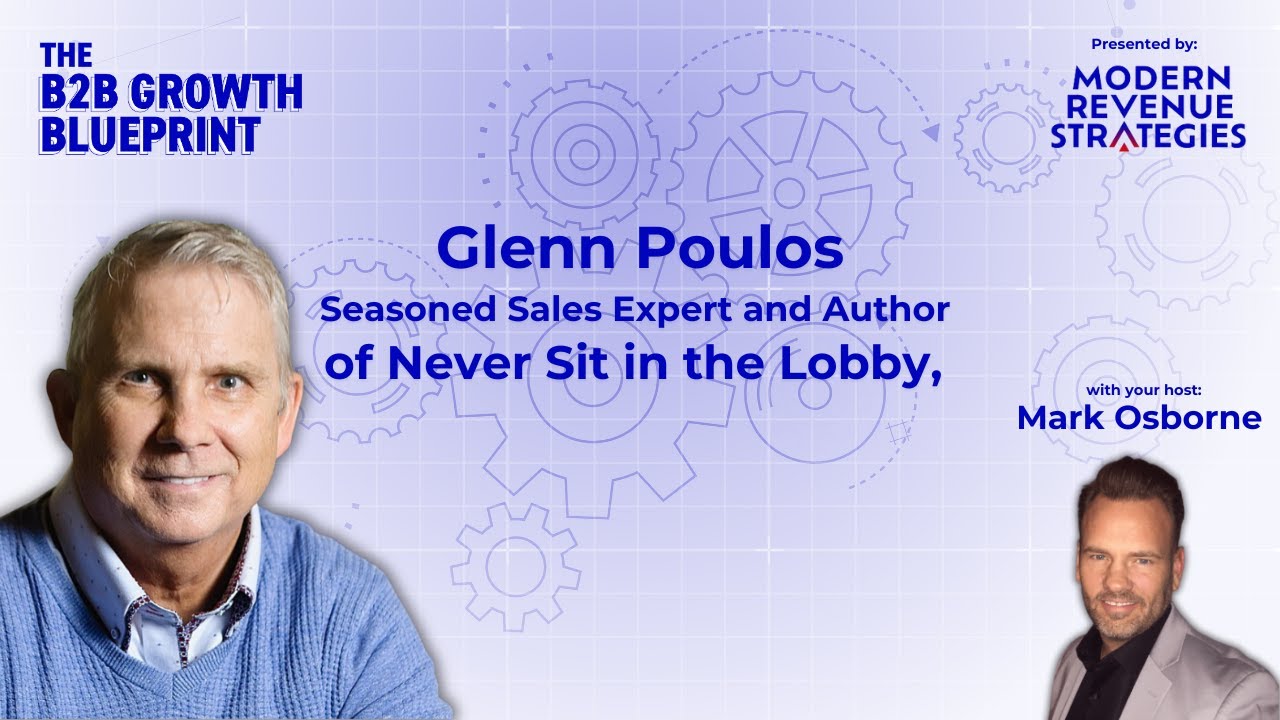
Glenn Poulos, who co-founded GAP Wireless and sold it in 2022, shares sales rules from his book Never Sit in the Lobby: 57 Winning Sales Factors. He identifies why B2B companies stall: relying too much on word-of-mouth, skipping structured sales processes, and ignoring customer churn. The fix is building multi-channel lead pipelines and staying front-of-customer.
Chapters
Welcome to the B2B Growth Blueprint podcast, where we talk with entrepreneurs, founders, and leaders at B2B services, tech, and SaaS companies to learn the systems and processes they've used to create success for their business. We'll also learn from marketing and sales experts to provide insights to help you grow your business. I'm your host, Mark Osborne, and the podcast is brought to you by Modern Revenue strategies and their 10x ROI B2B Growth Guarantee. Schedule a free diagnostic call to learn the fastest path to double your B2B revenues in just 90 days. Hello and welcome to another episode of the B2B Growth Blueprint Podcast. I'm your host, Mark Osborne, and today I'm very excited to welcome my guest, Glen Poulos. Now I'm going to read Glen's bio to make sure I get this right. He has recently retired as the Executive Vice President and General Manager of NWS and the co-founder of Gap Wireless Inc., where he spent his career at the intersection of sales, marketing, and business leadership. But don't worry, he's not sitting on the beach anymore. He's got a proven track record of driving growth in the telecom and tech distribution industries. And Glenn is also the author of Never Sit in the Lobby: 57 Winning Sales Factors to Grow a Business and build a career. And now that he's retired from that previous position, he's embarked on a new journey exploring new opportunities in areas such as AI automation and electric power generation. So, Glenn, welcome to the show.
Hey, Mark, thanks so much for having me.
So you're at a really interesting inflection point in your career. Why don't you tell us a little bit of your story of kind of how you got here and maybe where you're going next?
Yeah. So I started GAP Wireless with a partner in 2007 and we grew it for 15 years and that brought us to 2022. And that was actually a serendipitously great year to sell a business. And we sold the business not knowing as much until later. But yeah, 2022, we sold the business to NWS and our name changed to NWS and we became part of a much bigger company. I took on a role as EVP in the bigger entity and then I worked right up until about 3 weeks shy of a 3-year stint with the private equity. And then on New Year's Eve of 2024, a few weeks back, I retired from that business and left the business in their capable hands, having learned many new things working for private equity versus yourself, right?
Right.
Which we may or may not touch on. But yeah, and Yeah. And so, and I was living in Canada, although the company was North American. I was Canadian, you know, based in Toronto. But I acquired my E-2 visa and I moved to Florida on January 6th. And I've been here ever since. A little half snowbird, if you know that term, you know, half transplant or whatever. So I'll be here for the better part of the year, but also back in Canada in the warmer months. But working on some new ventures, which happy to talk about as well.
So yeah, so tell us a little bit about what you're focused on going forward.
Yeah, so I bought a small distributor company in Florida, which was not competitive with my former employer because when you sell your business, there's quite a multi-page don't compete with me kind of agreement, which is highly enforceable. So just to be sure I wasn't doing anything wrong, I I even switched countries and I moved from Canada to the US. So—
Not only US, but it's very southern US. You're all the way—
Southern US. Yeah, yeah. As far as I could go almost. So, but it's still the same kind of business. So distributing electronic instruments, electronic equipment, but to a different market this time to the power generation industry.
Okay.
So the small company, there's about 6 salespeople and we call on the utilities, the investor-owned utilities, publicly owned utilities, and we sell them equipment that tests the transformers, the battery banks, and some of the distribution network that they use to deliver power to our homes. And I'm also dabbling in some AI things which are much more grassroots at the moment, we'll call it, you know, just feeling my way around and keeping some options open. But I do have bought myself a new day job, which is how I got the visa to move to the US.
Sure.
And so that's what I'm doing now.
Interesting. So you spent a lot of your career really working within this B2B sales space, you know, selling, you know, sort of probably highly technical solutions for, you know, really large companies. Is that what you talk about in your book? Tell us a little bit about what's in the book.
Yeah. So a lot of the examples in the book sort of weigh, kind of lean heavily on the stuff that I was selling. But because it's kind of esoteric as well, like it's kind of the equipment that engineers use to, you know, measure dBs and watts and gigahertz and volts and amps and things like that, right? But, and also mobile wireless solutions as well. But so some of the stories have been evolved to include more relatable sort of products, printers, tow motors, software, you know, and to get, you know, just so I can appeal to a broader audience. But most of the lessons I learned them selling Selling measurement solutions and network equipment to large carriers and large electronic companies, you know, that are building electronic products and things like that. So—
Interesting. Well, and I'm sure through the course of the book and coming on podcasts like this, you've had a chance to, you know, work with companies and see, you know, companies that have sort of hit that wall of revenue. And we talk about this a lot on the show of Oftentimes, people will found a company and they get their first few initial clients, and then that spreads to some others, and maybe they get some word-of-mouth referral. But almost inevitably, companies hit a wall of growth, and then they sort of start looking around for solutions, which tends to be what we talk about on this show. But tell us about some of the challenges you've seen companies encounter of kind of hitting that wall of growth, what some of those causes of that wall are that you've seen.
Yeah. And you kind of, my first suggestion, my first comment would be, you just said it a second ago, was kind of the word of mouth. And that's kind of relying too much on referrals or word of mouth instead of proactively generating leads where there's got, you've got some sort of a momentum of excitement that, you know, when you first start out and, you know, 2 friends and they know 2 friends and, you know, they kind of tell each other and, you know, it's like, wow, this is like, you know, let's say shooting fish in a barrel or whatever they say, right? But that kind of dries up and actually quicker than one might imagine. And so, but some people feel or they're slow to react to the fact that they're, that that's their main source of new opportunities and they need to start looking at other things, right? So not expanding their lead sources, sticking to one channel instead of diversifying, you know, checking out their social media, doing— how are they— are they properly SEO'd? What about partnerships, uh, Google Ads, you know, uh, lead generation, BDRs, SDRs, those kinds of things? Um, because, you know, you can build the better mousetrap, um, and some will march to your door, but, um, it's only a rare, uh, a few that invite— invent the Pet Rock. And even that runs its course pretty quickly, right? And so you need a series of, you know, mechanisms that you're using to generate leads, right? And with that, you also need to make sure that you have a structured sales process. Like a lot of times people, they're maybe, you know, a widget specialist. They've come up with the next best mousetrap, you know, kind of thing. And but it won't sell itself. They need a sales process. And it takes discipline to sort of sit down and structure your pipeline, your follow-up systems, how you're gonna deploy CRM, what you're gonna measure, how you're gonna measure it, and how you're going to adapt and evolve relative to your competitors, making sure that your business doesn't stagnate or sort of stay the same. And those are some of the real lowest of low-hanging fruits of what can happen. But there's more, right? I mean, so yeah.
So you touch on such a great topic, which is this idea that good ideas don't sell themselves, unfortunately. And so many, you know, sort of especially technical founders that like they come from a technical background and they know why their product is superior and they sort of think, well, my customers are like me. So as soon as they understand just how it's technically superior to other offerings in the Marketplace, they'll get it and they'll buy. But unfortunately, that's just not really true.
Right.
And because most of the time their customers really aren't as much like them as they think, and they need to be sort of explained to in different ways. And beyond sort of the features of the product that make it superior, they need to understand the benefits that they're going to get from it and how those benefits are unique as compared to others. What are the, you know, sort of the 3 biggest gaps that you see companies, you know, that you've worked with or, you know, advised that when they come to you and they're like, you know, Glenn, you're a sales expert, we've hit this wall with sales. When you start to unpack those conversations, what are the most common things that you see that folks have either failed to do or did incorrectly that led them to that? Sort of stagnation?
Yeah. Yeah, I'm gonna answer that, but I wanna throw in a little tidbit just for the audience because you're kind of at one of my most central sort of tenets of when people ask me about business and I don't wanna lose the opportunity to mention. And it's, to me, it's so self-evident. And also, if you watch the faces of people on like Shark Tank or on shows like that where they ask them like, how many have you sold already kind of thing, you know, when they're approaching them with their idea, right? And, or, you know, how many customers do you have? But the biggest problem that a lot of people have and that they don't place enough emphasis on is the importance of having the customers first, right? Like honestly, like you can go on any, like go on Alibaba, you can find millions upon millions of products, right? Like finding a great mousetrap is easy. And I know, yes, you're developing maybe a new product that's got the latest and greatest. I commend you on it and that's great. But it's really about who are you gonna sell it to? And that's the mistake that so many people make is they have one or two, of course, you know, low-hanging fruit that they're grabbing after, but they really don't have any sustainable set of customers. And that's really where a lot of the failure comes in is not having a sustained source of revenue, right? So some of the other sort of gotchas that people ask me about are things around like just at the high level and then we can dig into each one, sort of operational bottlenecks, inefficient processes, struggling to delegate to people, too much, what do you call it, dependency on the founder. So founder dependency and inability to scale because of that, you know, and then customer or market misalignments is often a problem, you know, that I see people and then of course, one of the big ones is pricing and profitability. What is your gross margin, right? And there's a story in the book about like, if you can't see the gross margin, that's because it isn't there and you're broke, right? Like, yeah, and people are like, oh, we'll make money eventually or whatever. Right.
Right.
And no, if there's no gross margin, there's no business, right? Yeah. And I learned that the hard way and which is why I'm giggling and while I tell it and while I say that, right? And sometimes we're blinded by, you know, by the latest and greatest sort of product or something, you know, and but if you can't build it at a profitable price and generate gross margin to pay your overheads and your salaries and other things and then profits, of course, then you don't have a business. So, right. Yeah. So those are some of the things that people bring up a lot and, you know, yeah. So anyways, I'll let you ask your next question or dig in on any one of those topics you might want to or what. Yeah.
So you raise a really interesting one that we see a lot, which is around the customer. And if you remember back a few years, maybe a little more than a decade or so, when sort of The Lean Startup and the sort of agile sort of business landscaping became really popular, there was a strategy, or maybe it's really more of a tactic, but I found it to be really insightful and something that I still think about from time to time, which was they would encourage people to sort of like Come up with what, what do you think that it's gonna do? Like, what's the, what's this thing that you're gonna build? What's it gonna do? And then who do you think it's gonna be valuable for? All right, now go talk to those folks. And so, you know, I've worked with companies that are still in this kind of minimum viable product stage where they'll put up a landing page that just talks about be the first to try this new solution that delivers this great result for these people. And if you're interested, interested in a behind-the-scenes look, give us your email address here. And then they build a list of potential customers that they talk to and have actual conversations on, would you want it to do this or this, and sort of run prototyping ideas by. So these folks are actually sort of helping them co-create the product before they've ever written the first line of code.
Right.
Or bought the first product that they're then going to add a service along with or whatever it might be. Then they've got a built-in customer base that they can then market to. Not only that, then they've got a set of folks that have purchased so they can then build, you know, an ideal customer profile off of that to really sort of start to expand. So often we see companies that, A, they haven't really validated that there's a market for what they have in mind, and B, even if there is a market because— You know, they worked in an industry, had some contacts, so some folks bought it. They didn't take the time to really understand the customer. They've been sort of navel-gazing, as we say, thinking about, you know, what do we want to make? What's interesting to us? What do we think that people want? But they don't spend the time to really understand the marketplace. What are some of the tools that you've seen be really valuable for companies in, you know, really better understanding their customers and really getting that core insight that makes them successful.
Yeah. Well, and you very succinctly hit on a lot of the problems and about not understanding the customers, targeting the wrong customers. Your product market fit is not correct, right? You don't have it properly positioned. Your messaging's wrong. And you're ignoring, and a big one is often ignoring the market trends and how your competitors are shifting to respond to you in the market, right?
Right.
So some of the, I mean, some of the fixes and the most common ones are, you know, get and stay in front of your customers, right? Like talk to your best customers, stay in front of them. And one of the sort of like the subtext of my book is how to get, act, and stay in front of your customers and be a pleasure to do business with always. That's really what the book's all about, right? And so for me, it's all about being in front of the customers. Sometimes it's virtually, but when I say it, I literally mean get in front of the customers, talk to them, be there, and look at the mouse pad and the coffee mug that's on their desk to see if they're— if it's from a competitor, right? Or, you know, maybe their screensavers or you know, the pens and the t-shirts they're wearing and all the kinds of stuff like that. And, you know, and who came before you, right? Because you might realize that there's formidable competitors at play that you can't see over Zoom, right?
Right.
And so you can maybe do parts of the demos, maybe virtually and things like that, but you've got to get in the car, you got to get on a plane and fly and see those key customers. What do they love? What do they hate? What frustrates them? Stuff like that, right? And then, you know, you have to kind of define who your product benefits the most and define that as your target customer profile, right?
Yeah.
And you may have a product that's great, but it's not for everybody, right? And so, you know, it might be for SMB, small-medium businesses from 150 to 1,500 people, $25 million to $150 million in size. And outside of that, you don't resonate. You're either too expensive for the low end or you're not, you know, corporate or enterprise enough for the bigger Coca-Colas of the world or something like that, right? You can also, you know, you wanna be testing and adapting your messaging constantly on what message are you sending. And you said it at the very beginning of this segment about, you know, oh, like fill out this form and learn all the great reasons why you should buy my thing, you know, or yeah, I can't remember exactly what you said, but basically it was like there's nothing there for the customer to resonate with at all, right? And then look at your customers that are churning, right? And like who's coming and who's going. But of course, why are they leaving? Who's leaving and why are they leaving? And then of course, look at your competitors and the strategies, the ones that took your churn, of course, and why and what are they doing, right? And how can you adapt? And those are some of the most actionable fixes that you can You can, you know, when you're trying to align your product with your customer.
So you hit on something that's so often overlooked, which is this concept that the market's always changing. And so oftentimes we'll see companies that, you know, we're like, do you have a really good understanding of your customer? Yeah, and they pull out like an ideal customer profile that's really robust and it's got Firmographic things like, you know, describing the size of the company and where they're located, and technographic, like they use this type of software, and even maybe sort of the context of like, well, they're growing, and so they're looking for a solution that'll help them grow, and that's how we help them. And then, you know, really detailed things around the personas of their buyers, etc., etc. But they built it 10 years ago, uh, when they were just launching. And they forget that the moment that they launched and started to, you know, take some market share, the market adapted to them. Their best competitors started to adapt. They started to shape what customers were looking for. Their competitors maybe started to create some cleavages around what they are positioned as what you should be looking for and really start to shape the marketplace. And so, if that doesn't sort of evolve and live, They're really sort of, they're stuck in the past or they're stuck with that past standpoint. And marketing and sales is such a sort of strategic opportunity for insight for companies if they incorporate what is being learned in the marketplace into who are we focusing on, what are we creating for them that delivers value, how is that value evolving? One of the things that we really love to do is to encourage clients to have, you know, sort of ongoing interviews that are not just, you know, are you happy? But is, you know, kind of gets into, well, what else are you looking for? You know, what else, what other solutions in the marketplace? Have you seen any? And you don't have to call them competitors. You can call them, you know, complementary or, you know, substitute-type products. Have you seen anything else in the marketplace that's interesting for you? So that you've got this sort of constant flow of information and insight, which then shapes the long-term planning for the organization. What other sort of tools have you seen companies use that can keep them, you know, adapting to changes?
Well, one thing I want to leverage off of what you just said and is that about knowing the customer and things like that is that the— and adapting and is that— and there's a chapter in my book on it, shameless plug. But basically, about where the best way to sell to your customer is actually to step outside of yourself for a minute and put yourself in the customer's shoes and figure out what do they do? Like, what do they literally put in a box or on a software, on a disc or whatever and ship to their customers? Like, literally, what do they sell and who do they sell it to? And through that process of figuring out what they make, You know, whether it's steel girders or tow motors or a SaaS solution or whatever, it doesn't matter. You're going to learn what's important to them. And only through that process can you then learn how to adapt your messaging and really what you're trying to do in a way. And again, there's some actionable and sort of examples of how I did it in my career of finding customers for my customers. And that creates an incredible sort of reciprocity sort of action where they want to try to instill more of that behavior in you. And they do that by wanting to perpetuate the relationship by buying something from you, right? But also at the same time, you're learning to adapt your product to the true needs of them because you're learning what they really, really need, right? And, um, and so most people are just, they kind of get, they kind of get stuck on, well, you know, I sell like LPs that go on a turntable and, you know, and so I want you to buy a record player kind of thing, you know what I mean?
Right.
But, but everybody else is using cassettes and CDs and then MP3s, you know, now people just stream it all. Like, who would have thought, right? And, um, Like, you know, the physical media, it's really even evaporated in the last 20 years. And, um, and so, uh, you know, you might have the greatest turntable, and I mean, yeah, there's 1 in 100,000 audiophiles, you know, people that would need a turntable with, you know, shock mounting, you know, um, Bang Olufsen things, speakers and things and whatever. But everyone else, they're just going on Spotify or Apple Music and they're downloading You know, and so that's, you know, that's a real good example of how the market has adapted and failure to evolve can be deadly, right? Yeah, for sure.
Well, you're obviously a real expert on these topics and there are things that, you know, I'm passionate about and we could talk about all day, but I gotta be mindful of your time. But before I let you go, I'm really curious to sort of hear, tell me the story of the title of your book. Never Sit in the Lobby. What's that all about?
So yeah, so that's, yeah, my title, I can't even remember it anymore, but it was shot down by the editor as being awful. And she came back and she said, you know, why don't you pick one of your most memorable chapters? And one of the most memorable ones is Never Sit in the Lobby. And it's part of a little pack of this little you know, it just comes off the tongue really, really quickly. And one of the rules is never sit in the lobby.
Okay.
People are like, what do you mean never sit in the lobby? And it's like, should I sit in my car? And I'm like, no, you should stand in the lobby and you should only be there when you're expected. So you show up 2 minutes early, you announce yourself, and then do not get distracted. Do not sit down, do not flip through magazines or go on your phone. Don't be calling anyone. Don't be looking at the plaques on the wall. Just be waiting for the person to come in and present themselves in the lobby. And then you immediately deploy the— and so when they walk out, you're standing up, you can shake their hands, say hello, and then you deploy the next rule, which is always have something in your hand and something in your mind. And so, and then that gives you something to hand over. It could be on that day, it might be donuts, it might be a pen, it might be a coffee mug, it might be a quote. Because they asked for pricing on something. So you're dropping it off, might be literature. They were inquiring when you saw them last about product. You said, hey, I'm here today visiting so-and-so. I just wanted to drop this off. And, you know, and again, you're always standing. You're never— because the reason why is because everything else is a bad look. You always want to be putting your best foot forward. And if you're distracted and the person walks in and says, are you Glenn? And you're on the phone chatting with your wife about milk and bread, Grocery items. It's just not a good look, right? And so, and then again, there's a litany of other little rules that follow in that portion of the book. And so that's how the title evolved to be Never Sit in the Lobby.
That's great. I love that. It'll definitely stick with me. I've had some instances of things that have gone wrong in the lobby. Yeah, when I show up for sales calls. And I like the idea of always, always stand with something in your hand and something in your mind. That's a great, great quote to leave with. So for our audience that's been listening and they want to hear more about these 57 winning sales factors to grow a business, build a career, what's the best way for them to engage with you, Glenn?
So yeah, so if they want to engage with me, the best way is to go probably on LinkedIn. You can connect with me there. I'm very, very active on LinkedIn on a daily basis. And I like to meet new people, look for ways to collaborate. You can also go to my website. There's some downloads and links to the book and all that stuff. But again, if they want to collaborate or communicate, LinkedIn is probably the best way. And it's just my name, just LinkedIn and then just type in my name and it should come right up. And awesome. Yeah.
Well, Glenn, thank you so much for taking the time to join us today.
Thank you.
All right, we'll talk to you soon.
Thanks, Mark. Have a nice day.
Thank you for joining this episode of the B2B Growth Blueprint podcast. We hope you've gained insights to grow your business. If you enjoyed this discussion, please rate, comment, like on your favorite platform and share it others who will find it useful. Do you know a CEO, founder, or leader at an early-stage B2B services, tech, or SaaS company who would like to be a guest and share their story? Send us a note. Let's schedule a conversation.
More from Mark

How Can You Maximize Your Business Value Before Selling? with Randy Katz Video







