From Referrals to Repeatable Growth: Strategies with Jakob Kirschner, CEO of Peak Advisory
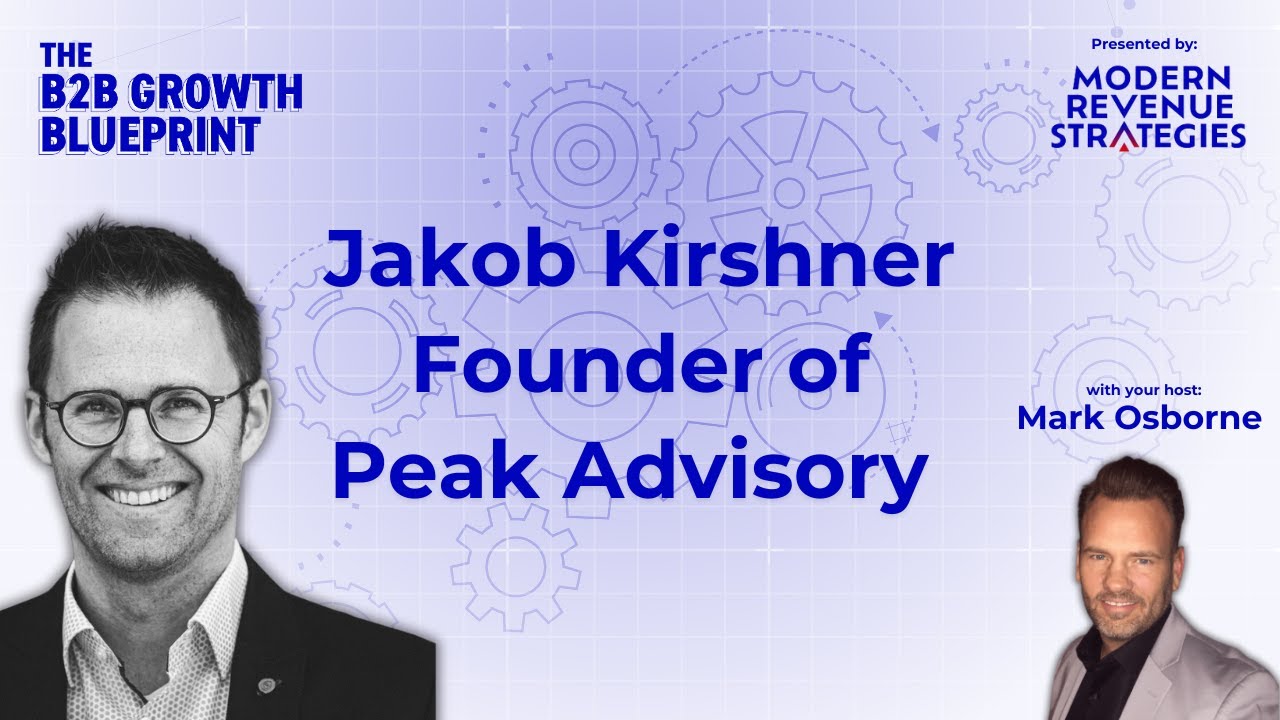
Jakob Kirschner, CEO of Peak Advisory, talks with Mark Osborne about moving B2B businesses beyond referral-based growth. He explains why fractional CFO work beats traditional accounting, and covers cash-flow forecasting, margin optimization, and preparing for exit.
Chapters
Welcome to the B2B Growth Blueprint podcast, where we talk with entrepreneurs, founders, and leaders at B2B services, tech, and SaaS companies to learn the systems and processes they've used to create success for their business. We'll also learn from marketing and sales experts to provide insights to help you grow your business. I'm your host, Mark Osborne, and the podcast is brought to you by Modern Revenue strategies and their 10x ROI B2B growth guarantee. Schedule a free diagnostic call to learn the fastest path to double your B2B revenues in just 90 days. Hello and welcome to another episode of the B2B Growth Blueprint podcast. I'm your host, Mark Osborne. Today I'm very excited to welcome my guest, Jacob Kirshner. Now I'm going to read Jacob's bio to make sure I get this right. He started his career in physical education before transitioning into the business world. He holds a BA in finance, accounting, and taxation from the University of Applied Science in Germany and has extensive experience as a corporate controller for international manufacturing companies. Over the years, he's provided strategic financial guidance to leadership teams, helping make them more informed on decisions from everything from long-term planning to complex project work. His early career was shaped by a variety of experiences, including working in construction, which gave him a practical understanding of the industry where he frequently advises. And he's worked with companies and teams around the world in places like Brazil, China, South Korea, Mexico, and various European countries, developing expertise in navigating diverse accounting systems, different tax rules, and cultural differences. He's also trained as a life coach and has taught parenting classes, reflecting his ability to coach and guide others in personal and professional contexts. And when he's not sort of wrist-deep in financial reports or Excel spreadsheets, you'll find him out hiking or mountain biking on the Colorado trails where he lives. So, Jacob, welcome.
Thank you. It's great to be here.
Yeah. So, I'm super excited to chat with you. You know, oftentimes, You know, sort of finance is the language of business and it's one of those sort of fundamental building blocks that, you know, companies need in order to be successful as they grow. And I'm curious, you know, a lot of folks within the finance space, they do different things. So, you know, tell us about your journey and sort of your path and really what you focus on within your practice.
Well, you've read my bio and I was quite impressed by it. Sounds interesting. I would love to meet that guy. Well, as I said, like, I started off my career doing all sorts of stuff, and I didn't really get serious about my career until I had kids, and I knew, like, okay, I've got to provide for my family and everything. So, I went to university, got that finance degree, and I worked for manufacturing companies of different types. Like, one of the companies I worked with was more small stuff, like small products. Another one was huge machinery projects. And yeah, I just loved talking to all those non-financial guys in the company and it's like usually engineers or salespeople and, you know, you have to talk to them in a way that they actually understand what you're saying because not everybody speaks the finance language, right? And, but I felt like I want to increase my impact and that's when I decided to start Peak Advisory, a fractional CFO firm. And what we do is we talk to business owners and help them understand their finances better so they can make better decisions.
Gotcha. And I know you and I have chatted a little bit in the past. And you have a real focus within that sort of finances being different from sort of a backwards-looking accounting or bookkeeping, but instead more of a forward-looking kind of advisory. Talk to us about the difference between those 2 things for maybe those that are a little less, you know, financially literate.
Absolutely. Yeah. So bookkeepers and accountants, CPAs, they're trained to look back, like they record what happened in the past. And it's really important to have these skill sets and to have these people on your team. But the thing is, the goals, the plans that you have for your business, they live all in the future. And you kind of have to have somebody who helps you to use the information that the rearview mirror people, that they provide, and you have to interpret it and then map out a path towards your goals, towards your dreams. And that's where I come in. I help you to make sense out of the numbers. And we go through it, we analyze it and use it to make good decisions for the future.
So I'm curious, what are some of the sort of mistakes that you see people make when they're only using that rearview picture of their finances and their accounting and they're missing that forward-looking view? What are some of the pitfalls that happen there?
Yeah, I mean, in reality, if you're just getting the reports from your bookkeeper, most likely you're not that interested in them because you don't really know what they mean. And I mean, you're probably really good at providing a service or selling a product, but you're not a finance professional, so it's totally fine to not really know what they mean. And so what happens is usually you're not using the wealth of information that those statements provide to make your decisions, but rather you go by gut feeling. And if you go by gut feeling, then there's a whole bunch of mistakes that you can make. For example, you look at your bank statement as the sole guidance and you think, oh, I have $100,000 in the account, I can buy that new truck, I can pay cash for it. And all of a sudden next month or the month after, you have a surprise tax bill and you didn't realize it that That's going to come up. And so it's really, you're kind of blind in the fog without any good forecasting. So that's what I'm best at. We, I have a cash flow forecast that we work on with the business owners, and that's really where the music is playing because that allows you to plan different scenarios for your business and be prepared for taking the right steps.
Yeah, so that's interesting. You talked about, you know, looking at the bank account and using that as the calculus for what you can do. And you and I chatted a little bit before on, you know, this common challenge that companies have as they're growing too fast, which is, you know, they chase deal after deal after deal. And especially in professional services where, you know, once you win the deal, you have to sort of staff up to service it. And then you don't realize that it's going to take maybe 90 days for that client to pay. And in the meantime, you have to be able to float all of the folks that are delivering for that client. That can be a real challenge if you haven't thought through that and don't have a plan in place for that. What are some of the other mistakes that you see people make when they're just sort of growing really fast and not thinking about that forward forecast?
Yeah, I mean, what you mentioned is absolutely true, and it happens again and again. Like, you just you're not prepared for the time it takes to go through big projects to finish them well. And so that's pretty common that all of a sudden you're in a cash flow crunch, you don't know how to do payroll and that kind of stuff. And so I think along with that, you know, you have those different levels of business leadership. So when you first start off, you're totally focused on sales.
You're all—
it's all about top line. You want to make sales as much as possible, and you don't even think about anything else. And eventually you get to this place where you may be in a difficult position with your cash, and then you start looking at the projects that you do and you evaluate which of those projects are actually profitable, like which are the good projects, which are the bad projects, what is my margins on it, do I even make profit on some of the projects? And I guess the next step would be if you start looking at cash. So you start looking forward, and just like you mentioned, you have a new project coming up, and before you even bid on the project, you kind of simulate it. Okay, how long would that project take? What is my payroll until completion of the project? Because maybe if it's a big project, you have to take all your people to work on that. big project that has a lot of prestige, and then you can't do smaller projects that provide the cash in that you need for payroll and office rent and whatnot. And so once you're in that position, then you really have to start planning ahead. You have to have a forecast in place, a cash flow forecast that you really can see the different, you know, help me here. I'm lacking the word. Yeah, the scenarios. Exactly. Yeah.
That said, yeah, it's funny how you talk about, you know, sort of the mindset of the operator evolving over time because at the beginning, you know, if they've got a pulse and a checkbook, it's a great customer, bring them in.
Exactly.
But then, but what we see oftentimes is that as companies grow, they start to really refine that ideal customer profile, not only to be, you know, who do we like working with, What are the projects that, you know, we can deliver easily and, you know, sort of potentially is more profit, but also things like who are the customers that like or that tend to pay on time or that tend to, you know, pay faster or that we get better margins off of or, you know, all of these things that really sort of evolve over time as you grow. And I think it's the companies that sort of fail to evolve and instead keep that anyone with a pulse and a checkbook is our ideal customer. That mindset really limits their growth later because they're distracted by everyone instead of focusing in on their best fit customers.
Absolutely.
Yeah. And what are some of the other evolutions that you see? So you talked about this sort of business evolution from, you know, just top line revenue growth to then moving to more, you know, sort of profitability and kind of margin. What are some of those other future stages that you see folks go through as they evolve in their business?
I mean, I already mentioned it, like profit is not enough. You also have to have the cash in the business because just because you make a profit, it's once you have the project delivered, you have invoiced it, then it's still like, how long is it going to take until I get the money back? Is the customer going to pay at all? I mean, sometimes it happens, you don't get paid. And so that's definitely the next level, but there's another level on top is that I call it the master stage. Once you actually look at the value of your business, you look at the balance sheet, you look at the business as a whole, and that's usually when you have an exit strategy in place. When you think like, okay, I want to retire in maybe 5 years or 10 years, how much money do I need when I do my exit? So you start working on your business as the product actually. You want to sell your business eventually. So you start putting processes in place and you just look really closely to margins, profit and stuff. So you have a good product to offer once it's time to sell it.
Yeah, I've always heard it said that, you know, you, when you buy a house, they say that you make money when you buy, not when you sell. And oftentimes with a business and sort of even planning that exit or the enterprise value, You make the money while you're building it, not when you're selling it, because if you're building it with processes and systems that someone else could come in and, you know, operate effectively, that's a sellable, profitable business versus if you're just kind of, you know, running around, you know, taking any client that you can, some that don't pay on time, some that don't pay ever. That's a lot harder business to sell.
Absolutely. And I mean, you have to keep in mind when you sell a business, it's the way you get to the price is it's multiple of your earnings, right?
Wow.
And so every dollar that you make more in your business, that you're more profitable, that pays off like 3, 4 times when you sell it. So it really, really pays off when you start looking at your margins, like how can I improve my gross margin just by 1%, 2%? It has a big impact on the bottom line and that's the kind of mindset that you need to have if you want to grow your business successfully. Like you look at Gross margin, you look at your overhead. How can I keep my overhead low? How can I increase my gross margin? And then just net profit—that's really important. And if you got that down and you have some good processes in place, then you have a great business that anyone, anybody wants to buy.
So you hit on some key areas there of you know sort of like gross margin and profitability. And you know I'm sure a lot of the folks that are listening have you know been in this you know sort of. Fast growth phase and they're now starting to think about, yeah, I do need to kind of wrap my arms around, you know, some of these things. What are some kind of actionable things that people can do today to start to get a better financial foundation in their business? You know, maybe they've, maybe they've already got some of that historical backwards-looking, you know, tracking and data and tax stuff in place. And they're now starting to think about how do I get more strategic with my finances? What, what are some good things for them to think about, you know, as first steps, things that they can, you know, kind of start doing today?
Yeah, that's a good point. I think step 1 is definitely to look at your data quality, all that rearview mirror stuff, the regular bookkeeping. You have to have good quality because the data quality you put in here into your forecasts and stuff, that's the same quality you get out of it. And A lot of small businesses, they try to save on money for bookkeeping and accounting, and it's not a good place to save because a good business, it has to stand on several legs, and one leg of it is good accounting data, good financial data. So it's not good to just train your office assistant and tell her to do the bookkeeping. You really want to have a professional in place, and maybe it was okay for the beginning stages of your business. But now that you want to grow and want to have your business more on a professional level, then you really should invest in a good quality person that does the bookkeeping. So either in-house or external, but you have to have good data. And once you have that and that step is in place, then I really recommend doing a forecast, a cash flow forecast. And I mean, you don't have to do step 1 first and then do step 2. You can do both at the same time. I guess they're equally important. But cash flow forecast, it's really easy, really simple actually. So you start with the starting balance of your bank account for any given periods. It could be a day, it could be a week or a month, and then you just list everything that's cash into your business. For example, a customer pays the invoice and it's not the time that you send them the invoice, but it's actually when you expect them to pay.
Right.
And then you list all the expenses, cash out. And again, it's not when you receive the invoice from your supplier, but it's when you're planning to pay for the invoice. And that's the basics. And you can go by your income statement and kind of take the lines and put them in the forecast. And then you just have to make sure there's a few other cash out Items that that you can't find on the income statement. For example, your draws, your like the money you take out for yourself, and also if you have loans and you pay back on the loans, that also you can't see on the income statement. So you have to add that manually to the forecast, and then just be diligent about it. Make it a habit to depending on the financial health of your company. If you're not in good shape, then it's probably a good idea to do it daily just to know okay what's coming up tomorrow, the day after tomorrow. Do I need to call? Paul to pay Peter, right? Just to make sure that you always have enough cash. But once you're in better health, then it's enough to do it weekly or even monthly. But you have to make it a habit to update it with every new piece of information that you get and use it. And the beauty of cash flow forecasts is that you can use it as a simulation for any business decision that you have. So if you're thinking about adding a crew to your business, then you can see, okay, what do I What does it take to have, I don't know, two, three more people get the tools, get the van? Or what happens if I increase my my my revenue by twenty percent? Obviously, I'm going to have more accounts receivable as well. And then you can always see the the influence on your on your cash. And so I just love cash flow forecasts because it's the greatest tool that you can have to to see. what happens in the future. And obviously, it's not a crystal ball. Crystal ball, is that the word? Yeah.
Right.
But it's a simulation and you don't know what's happening in the future, but if you have tried it, okay, what happens if I increase my revenue by 20%, but also what happens if it goes down by 15%, then you can see what the effects are and then you can prepare yourself to make the right decisions. So once it does happen, then you're Mentally prepared to do what's— what you have to do.
That's so interesting that you, you know, are sort of mentioning this because this same sort of evolution is one of the things that we see as companies get more mature in sort of their marketing and sales is, you know, sort of the first step is you need to be capturing data on, you know, how well are these particular campaigns performing? Because if you don't have any historical data, it's really hard to optimize.
Yeah, what gets measured can get managed, right?
That's right. Well, and then it's also, you know, one of the big stressors that we see from folks on the marketing sales side is just sort of not knowing what are, you know, what are my revenues going to be next month or next quarter. And it kind of starts by, well, what were they last, you know, month? What were they last from this campaign that you ran before when you got 100 leads that led to 20 proposals that, you know, led to 5 clients in contracting. What did that lead to in terms of new revenues? Just kind of writing those things down and getting them on paper, even if it's not 100% perfect, is such a better starting point than, well, let me think, and sort of reflecting back.
And it really ties it together, like why you need the rearview mirror people, because you need to have data as a starting point and then you can use the data to look out at the the front window and make your decisions based on that.
That's right. Yeah, the best predictions of the future are the past. And so the best way to use that is to sort of make a trend line from it. And then you can start to be a lot smarter in your business. So for those of our audience that are listening and they're thinking, you know, wow, I have just been looking in the rearview mirror, I really could benefit From, you know, looking in, you know, looking forward. Tell us a little more about, you know, sort of your service, your company, and, you know, who you typically work with and the types of things you do for them.
Absolutely. So I call myself a fractional CFO. I mean, every big company has their own CFO. And the thing is, for smaller companies, there's usually not enough work for a CFO, for a full-time CFO. And also, there's not enough money for a full-time CFO.
Sure.
So the fractional model means that you can hire a part of my time, and what I offer is I have different packages, and the most common package is a monthly package where we have a monthly CFO call where we go over the CFO report. I analyze all your numbers and point out the things that are important to watch out for, and then we have the cash flow forecast, which is really the meat of every call where we go into all the goals, the plans that the business owner has, and then we discuss it and see like what strategies, what steps can we take to get closer to that goal. And yeah, I mean, I usually start with a, with a just discovery call where we get to know each other, find out if it's a good fit or not, and then we take it from there.
Awesome. And so for those that are listening, what's the best way for them to get in touch with you and engage?
The best way is to get on my website, www.peakadvisory.us. There's a contact form and with, I think, with a Calendly link, and then you could just schedule something.
That's fantastic. Well, Jacob, thank you so much for taking the time to join us today. It's my pleasure. Before I let you go though, tell us something that's on the horizon for you that you're excited about for you or your business.
Well, I'm growing right now. I'm still a one-man show. I'm looking forward to hire my first employee anytime down the road. I don't know how long it's going to take, but I have my plans, my goals. I go over them every morning, and I want to make it big someday.
That's awesome. Well, I'm sure it's on the horizon for you as you've got that forward-looking focus. So, Jakob, thanks so much for joining us today.
It was my pleasure. Thank you for having me.
All right, talk to you soon.
Bye.
Thank you for joining this episode of the B2B Growth Blueprint podcast. We hope you've gained insights to grow your business. If you enjoyed this discussion, please rate, comment, like on your favorite platform, and share to others who will find it useful. Do you know a CEO, founder, or leader at an early-stage B2B services, tech, Or SaaS company who would like to be a guest and share their story, send us a note. Let's schedule a conversation. Thank you.
More from Mark

How Can You Maximize Your Business Value Before Selling? with Randy Katz Video







