Growing Isn’t Scaling: The CEO Mistakes That Stall Business Growth with Karen Posey
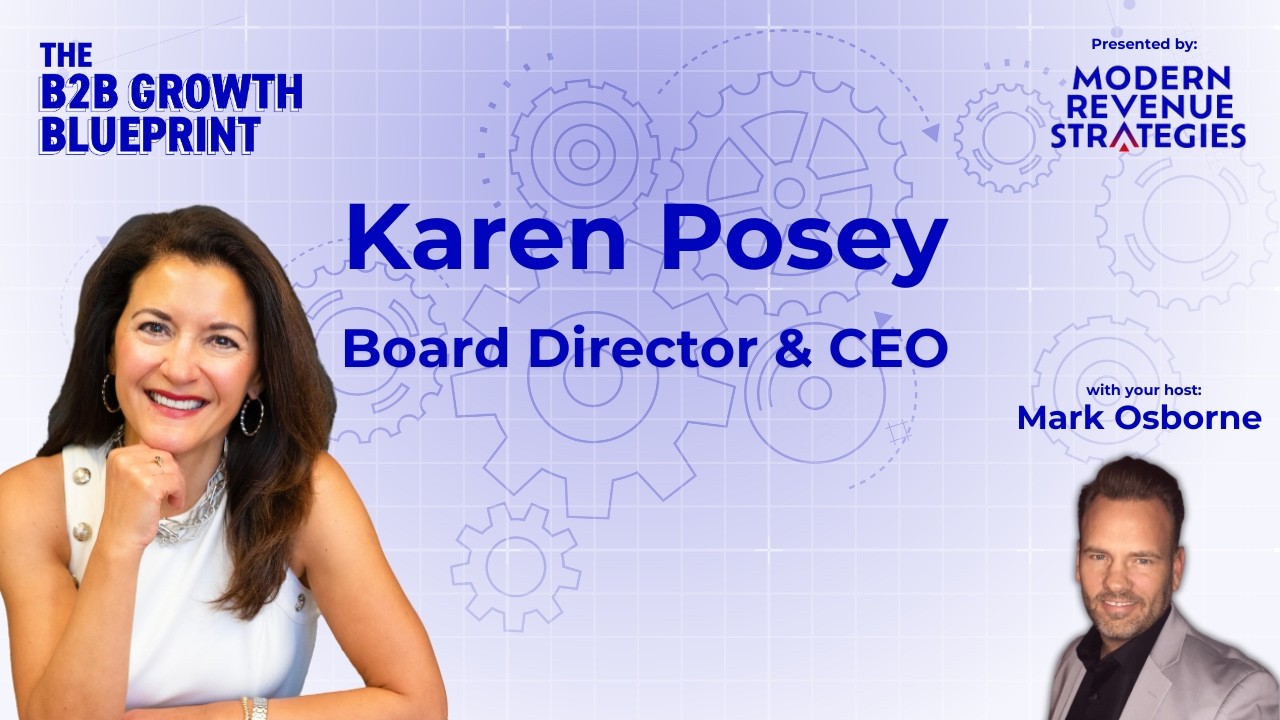
Karen Posey talks with Mark Osborne about what separates growing from scaling. She identifies six things only a CEO can do: vision clarity, building the first team, stakeholder engagement, organizational design, personal effectiveness, and board engagement. Decision velocity is the key difference between growth and scaling.
Chapters
Welcome to the B2B Growth Blueprint podcast, where we talk with entrepreneurs, founders, and leaders at B2B services, tech, and SaaS companies to learn the systems and processes they've used to create success for their business. We'll also learn from marketing and sales experts, uh, to provide insights to help you grow your business. I'm your host, Mark Osborne, and the podcast is brought to you by Modern Revenue Strategies and their 10x ROI B2B Growth Guarantee. Schedule a free diagnostic call to learn the fastest path to double your B2B revenues in just 90 days. Hello and welcome to another episode of the B2B Growth Blueprint Podcast. I'm your host, Mark Osborne, and today I'm very excited to welcome my guest, Karen Posey. Now I'm going to read Karen's bio to make sure I get this right. She traded 70-hour corporate weeks for boardrooms and breakthroughs. She has decades of experience guiding Fortune 500s and mid-market CEOs, and she cuts through the complexity with the precision of a strategist and the intuition of a trusted advisor. She helps leaders align, accelerate, and sleep at night as CEO and managing partner of KP Strategies and an active board member, Karen partners with executives to remove the obstacles that hinder innovation, execution, and sustainable growth. Known for bringing clarity to chaos and candor with compassion, she's a Vistage-certified speaker and sought-after advisor across healthcare, medtech technology, digital infrastructure, and defense technology. She's passionate about wellness and grounded in purpose, and she's actually as comfortable scaling a 14er For those of you that don't know, that's mountain climbing, as well as she is scaling a company. So, Karen, welcome to the show.
Mark, thank you so much. So excited to be here.
Absolutely. I've been looking forward to this conversation. So, before we dive into some of the meaty topics that we've got planned for today, why don't you give our audience a little bit of a picture of your background? Like, tell us the story of what brought you up some mountains and down some mountains and to where you are today.
Yes, you know, it's— I would say my career, if you look back at the roles I've had, 2 things you'll find is a little eclectic. I was in Dayton, Ohio, and, you know, I wanted to be close to family as we were raising our kids. And so a lot of times in a smaller community, you had to make lemonade out of lemons, right? And figure out how you were going to continue to grow. I will tell you, the other thing is, My friends used to always get me in trouble. I get this call, okay, Posie, I need you to talk to our CEO. I think you'd be perfect for this role. So, I would say probably my first 5 moves in my career, 4 or 5, were because friends called me and said, we need you. And so, it was a great feeling and I feel very blessed. And it really helped me, you know, honestly, being in Dayton, I had to reinvent myself 3 different times. I started in sales and sales leadership. Then, I got the call from a friend. And before I know it, I was turning around an IT infrastructure organization, a big region. And then, from there, I was called again from a friend, launched into healthcare back when EMR was just rolling out. And then, called again and I was asked to lead a wound care company. So, I've done a whole host of things. Also worked for a management consulting firm. And my last corporate role before I decided to hang up my own shingle was I was Vice President of Strategy and Consumer Experience. And so, all along the way, I would say what has led me to where I am today is because I've had to reinvent myself 3 times.
Yeah.
I know who I am. I know what I'm good at. I know what I'm not good at. And that's what I try to bring to my clients is, you know, I learned, I think, working for leading the wound care company, That's where I really learned about the 6 things that only a CEO can do. And that's how I really formulated that in my mind and really how to drive enterprise value. And that's what I bring to both CEOs and boards that I work with as I work with mid-market CEOs, helping them drive intentional growth and operational excellence.
That's awesome. So, you hit on something that we got to sort of tuck into. The 6 things that only a CEO can do.
Yes.
So, tell us what those 6 things are.
Yes, first and foremost, it is all about vision clarity.
Okay.
You know, it's one thing. I know a lot of CEOs that have great visions. But does everyone in your organization from the most entry-level position all the way up, do they know what it is? Can they say what it is? I find candidly that even the first team, which I consider the executive leadership team, is the first team. They're not even consistent on what the vision is most of the time. And if they're not consistent, that causes a whole host of issues in the organization that really impacts scalability, right? And because you can grow, but, you know, and that's another topic hopefully we'll get into, but scaling isn't growing. So growing isn't scaling, right? And so we'll talk about that in a little bit. But vision clarity is huge. The second is, and these aren't necessarily in any specific order. But the second that I think is vitally important is, as I mentioned, the first team. I'm a huge Patrick Lencioni fan. I like how he called it the first team because what that means is everybody has, you know, whether you're the CFO, the COO, CHRO, Chief Revenue Officer, you each have your functional areas. But the reason I like the term first team is because at the end of the day, You as a C-suite, your first team, that's the top priority for the organization.
Yeah.
Right? Because I just see so many organizations get in trouble. And the CEO sometimes does this not knowing, right? They spend so much time meeting with their leaders individually. But what are they doing to really build the team and make that first team truly the first team so that they're solving the biggest problems for the company? So first team, second. The 3rd is engaging stakeholders.
Okay.
You know, there are every, every business has stakeholders, key opinion leaders. What is the CEO doing to really work those relationships? Because that's the, that's the thing that only they can do, right? And I think about, for example, some of my government technology clients, you know, are you meeting with key leaders at DARPA, IRPA, your state officials, your, your federal officials? Are you working with various congressmen to help you get funding for various things? So, it doesn't matter what your business is, knowing who your key stakeholders are and working those relationships, not a one-time but ongoing, is critical.
Yeah.
So, that's the third, engaging stakeholders. Fourth is strategic enterprise value, or I'm sorry, strategic organizational alignment. Sorry about that. So that is organizational design.
Yeah.
It is culture and it is talent. And, you know, I love the mid-market because what typically got the CEO and the company where they are today isn't gonna get them to the next level, right? And so you're constantly having to look at talent and how you've designed the organization because it has to change and evolve as the company evolves and changes. And what is truly that culture. And I think culture last year was— in 2024, 2025, spent a lot of time getting CEOs to the right partners of mine, helping them more take deeper dives on culture because COVID and the pandemic really caused a lot of challenges because people went remote and how do you get them back? And just getting people back in line with what are the real values of the company and are we living those values? So that's strategic organizational design. The 4th is personal effectiveness, CEO personal effectiveness. And candidly, I've seen CEOs that have the highest personal effectiveness. And then what happens is they make an acquisition or something changes and their personal effectiveness can go in, quite frankly, Can take a deep dive. And personal effectiveness is really all about— can we pause here for a second?
Yeah.
Sorry about that.
Not at all. This is about minute 39.
Yeah, sorry about that.
Not at all.
Hopefully that won't screw you up.
Not at all. It's easy to stitch together.
Okay. So is it okay that I start again?
Yeah.
Okay. So personal effectiveness, really, you think about it, it is about the CEO. What is their— what gives them energy? What depletes their energy? First and foremost, how are they best managing their time? Because things that are depleting their energy, they've got to stop doing. And, you know, it's always— you hear the adage all the time, Mark, right? Play to your strengths.
Yeah.
Whatever your weaknesses are, have people you surround yourself with that know those weaknesses. So Personal effectiveness is really understanding what gives you energy, what depletes your energy, and surrounding yourself with people that understand that. The next is leadership model under personal effectiveness. What do you stand for? What won't you tolerate? Right? So important. And what's the legacy you want to leave for your company? Right?
Yeah.
So, that's all under leadership model. And then also under personal effectiveness, I spend a lot of time with CEOs talking about their brand. And then finally, on personal effectiveness, it's all about health and wellness, right?
Yeah.
Because you can't— this is a very demanding job and it's a very lonely job. And you've got to be able to take care of yourself. And a lot of CEOs don't do that. They sacrifice a lot for their companies and they need to really focus on, you know, their health and wellness. So that's the 5th is personal effectiveness. The 6th and final is engaging the board. Not all your listeners will probably have a board, but those that do, I find the biggest thing that CEOs struggle with is managing a board, whether it's advisory or fiduciary. It takes a lot of— it takes about 25% of their time.
Mm-hmm.
And how they effectively do that and they leverage their board. Sometimes I see CEOs treat their board as a necessary evil. But if you really lean in and invest the time, they should be your best advocates, really helping you move the needle on the strategy and executing that strategy. So that's the 6.
So much rich stuff there, and we could probably spend an hour on each of the 6. You probably have hours of training on each of them.
I do.
I do. Each of those things, but a few of them that sort of popped out to me. And one that I think is probably particularly relevant for a lot of the folks on the audience because a lot of the audience is sort of growing and scaling rapidly, either because they were at an early stage or because they're in a high-growth sort of area. And so this idea, and you and I chatted about this before, of sort of moving from being the founder to the CEO.
Yes.
And you talked in the sort of, I think it was the organizational development part about what got you here won't get you there.
Right.
You talked about sort of the CEO really needing to focus on their own internal capabilities. And that's something that, you know, people don't go through a lot. And so, oftentimes for a founder making that transition, it's the first and maybe the only time they'll ever do it if they're going to be with that company for a while. Talk to us a little bit about, you know, some of the pitfalls that you see Founders fall into? And you talked about one of them, which is not building the team instead of having these individual relationships. But what are some of those pitfalls? And then what are some, you know, kind of mechanisms they can use to safeguard themselves from falling into those traps?
Yes, I think, um, so what are the pitfalls that CEOs get into as it relates to when it's Predominantly founder-led.
That's right. As they make that transition from just being the founder and then moving to more of, we're running an enterprise here. It's not just me and the motley crew of people I could get to come on a little bit, but we've got— that's a real inflection point.
It really is. So, a couple of the pitfalls I find, and I see this happen so often, is that The transition is really hard for a CEO. And as I mentioned, what got them where they are today isn't going to get them to the next level. And so they, you know, they've had, they've been surrounded by people that quite frankly, some of them they've outgrown.
Right.
And that's really hard. And it's how do you help keep your eye on the goals of the company and how you're really driving that enterprise value and making decisions. And sometimes that means that You've got to switch out your staff. And how do you do that with dignity and letting them leave or moving them to another position or helping them leave the organization and setting them up for success somewhere else? Because they're not bad people. It's just you now need to, if you're $50 million and you want to get to $100 million, you need someone, maybe it's a COO and you need a COO that's kind of been there, done that.
Yeah.
Maybe you're getting ready, You want to get to $100 million and you know you need to do that through acquisitions. You need somebody that's been there, done that. And so, that's a big piece. And so, I find that one of the pitfalls is CEOs hold on to their existing staff too long. And it's because there's so much loyalty and I appreciate that. But also, this is where you got to make some hard decisions as a CEO. No one said this was going to be an easy job.
Yeah.
I think the other pitfall I see is that, you know, the CEO role is very lonely. And CEOs need their own— I call it the kitchen cabinet. Andrew Jackson actually coined this phrase. I can't take credit for it. But, you know, Andrew Jackson was known as one of the most political and not only political president, but also had his hand on reality that was going on at the time in the nation. Why? Because he would get a group of people, no one that reported to him, no one in his cabinet, but people that he trusted outside of government. And they would actually meet occasionally in the White House kitchen. And he would run things by them. And every CEO needs that. They need some— and it could be the board. But even there's just, you know, I think the pitfall is that CEOs, they get to a certain size and you can't tell your first team everything. You can't tell your board some things. You need someone or a group of people that you can run things by and just have that counsel. So, that's a huge pitfall that I see is CEOs get very lonely. And then the lonelier they get, I— have the 10 signs of loneliness, what, you know, there's a lot of things that happen with that. They just get very insular and that's not good for the company. So that's another pitfall I see. So both the first team and the loneliness are 2 big ones. And then I think, oh, sorry, go ahead, please.
No, no, continue.
No, I was just gonna say, and I would think the, as I think about it, the final pitfall I see, and there's a lot of additional, but It's easy also when you grow to lose sight of your vision. And all of a sudden you wake up and you've got, you know, I'll give you a great example. I led an executive retreat. The company was growing, but yet they were, as they were getting more complex, what was happening is decisions were slowing way down and they were becoming very ineffective. And so, you know, having the team really, and having the CEO really focus on that vision clarity and making sure everyone in the organization understands that so that we can make the right decisions and really focus on what are the real needle-moving things that only the CEO and the first team can do. That's what they need to be focused on. Versus, oh my gosh, what are we gonna stop doing? Right? Because they end up doing too many things.
Yeah, I've heard it said that, you know, strategy is largely defined by what you choose not to do. And I see it so often with companies that, well, we could do this and we could do this and we could do that. And so because we can, they want to, but there's just, and even if they've got you know, a larger team or they have access to venture capital that gives them the ability to hire or to invest in different areas. Just because you could doesn't mean you should.
Right.
And that ability to use, as you described, the vision as that divining rod to, you know, sort of really find that path through to what you really should be doing. And that aligns to something else that you touched on earlier, but I think is really worth digging in, which is this idea that just because you're growing, doesn't mean you're scaling. Talk to us a little bit about that because that's almost like a tongue or a riddle if you don't know what that means. But if you know, you know. Talk to us a little bit, help us unpack the difference between growing and scaling.
Yeah, you know, it really is all about driving enterprise value because you could be growing, but it's really the example I just gave where you have no decision, what I call decision velocity, right?
Yeah.
Things start slowing down as the organization gets more complex. People are confused as to where to go, what to do, what decisions, what things they should be focused on. And they're literally running from fire to fire to fire. And so, if you really, in my opinion, want to scale, It's one thing to grow, but when you really want to get enterprise, when you want to achieve enterprise value, it's all about decision velocity. And that is being very clear on your priorities, how decisions are made, and how things will get done. And that is really the work. I call it teamwork practice, working with the first team. And a lot of CEOs, when I first bring up that notion, they're like, Yeah, but I meet with them, right?
Right.
And I'm like, okay, do you meet with them individually? Yes. And that's really where I'm spending the majority of my time. And I'm like, hmm, well, something you may consider is, have you ever had an executive retreat? What work have you done as a team to, you know, and that's why those leadership retreats are so important to do team building, because if they can't work together on that first team, then what are you doing? Right? Because you're not making decisions faster. That's not— you can't scale. You cannot scale.
And that leads to something. And, you know, I try to stay away from the buzzword bingo, but there's really sort of no better word for it than synergy, which is when the whole team is operating as a unit. You develop shorthand, you develop a shared vocabulary, and decisions get made faster and more aligned because there's this sort of everyone rowing in the same direction kind of vibe to it.
Yes.
And that's what really sort of creates the, again, synergy that every new client doesn't take as long as the last client because now 2 2 is equaling You know, 6 and 8 and 10 and 12. But that doesn't come from individual conversations and individual fiefdoms or silos where each team's kind of running on their own and chugging away and they're not seeing these opportunities to create this, you know, sort of new creature.
That's right. That's exactly right.
And it's so interesting there. The other thing that you and I have chatted about, which is as companies grow in scale, You know, oftentimes, they sort of forget to listen to their customers because they—
Oh my gosh, yes.
They get a little bit of sense of, hey, when we were small and we didn't have a lot of customers to talk to, we made some bets, we had some hypotheses, and we took them to the market and they resonated. And now we've grown, we must be right all the time. And so they stop sort of taking that feedback. Tell us a little bit about some of the times that you've seen that and how that can be a stumbling block as companies grow and scale.
Yeah, it's— I see it all the time, honestly. And, you know, I do a lot of strategy work, but I've learned over the years, I've had my business 9 years, I never lead with strategy. I usually come in through operations where they've made an acquisition. It's a year later and things are still not where they'd like it to be.
Uh-huh.
So, but as I work with them on operations, I get to their strategy. And what tends to happen, Mark, is everybody's got a different perception of strategy. And I think a lot of the organizations I've seen in the mid-market, I see a lot of CEOs and their first team having an offsite and they pick a number. And they go, okay, we're gonna grow to this level. All right, now let's do the tactics. How are we gonna get there? Okay, huddle. Let's go, team. Right? Well, at the end of the day, they have no outside-in perspective. And candidly, what the shortfall is, here's the crime, is that they're thinking too small. They're thinking way too small. They don't know what their customers think of them. And so what I like to do is come in and I'm asked to do a lot of what I would consider facilitating an executive retreat, right, where they're trying to do strategy. When I do that, I ask, okay, what market intelligence? When's the last time you've done any market intelligence? When's the last time you've talked to your customers? Not at a user level, but at a decision maker level.
Yeah.
And I get, well, it's been a while. And I said, well, if we really want to You know, we really want to move the needle and come up with a real vision for the company and strategic intent. Like, where do we want to be? For example, let's fast forward. It's 2029. What do you want the headline for your company to be? Right? And the only way you can get there is going out and talking to customers. And I have partners that I'll refer my clients to that'll actually do the research to say, hey, so what do you think Company X's strengths are? What are their weaknesses? What do you think they need to stop doing? Where do you see they have opportunities? Opportunities they're not taking advantage of. I'll give you a great example. As organizations get bigger, it's really critical. It becomes more and more critical to do this. I was working with Fortune 500s at a previous management consulting firm, and one of the clients I met with a very one of the world's largest pharmaceutical companies, and they were getting ready to roll out a new product because they're in and because their salespeople said, "No, we got to do this. We got to do this." They kept hounding the Executives, we've got to do this because, you know, we, we are not in this space. So, I worked with a client. We did an advisory board of their biggest clients at a decision-maker level. And we had— we worked with them. I worked with them on their advisory board. It was an ongoing thing. You just can't be a one and done. But anyway, we got their biggest clients together at decision-maker level. We had a 90-minute session. I let the client present. Here's what we want to roll out for the first 15, 20 minutes. And then I took them into a probably hour and 15-minute session where we talked about that. And we talked about the competition, where they see them, etc. Bottom line is, when their customers came back into the room, they said, we don't see you in this space. We would never buy this from you. Right. We see number, you know, XYZ company and ABC company is number 1 and number 2. Oh my gosh, the executive sponsor, the president of the division came up at the end of the day and he hugged me and he said, do you know how much money you've saved me? It is, you know, just launching a product is, you know, over $5 million and the life cycle of this product, what we would have spent would have been over $25 million. And he said, I'm being conservative. So that's just one example of why it is so important to be in touch with your customers and to really understand, not at a user level, at a decision maker level, have that outside-in perspective because they can really help you. I love doing a Venn diagram. Excuse me. I love doing a Venn diagram where you can look at what's the market collective telling you, what is the, what's your core competencies and what's your business model and mapping that out to really see All right, what's the bullseye? What's your sweet spot? Where do you need to evolve? Where do you need to potentially partner or make an acquisition? And then what do you need to stop doing, right? Because stop doing is the hardest thing. Nobody wants to stop doing something. But you know what? You gotta say no to be able to say yes.
That's right.
You know, one of my favorite books is Fit for Growth, and it's all about being able to say no so that you can hit the gas on the things that really matter.
That's right. And it's that focus that really allows you to break through. It's a— that's why, you know, the arrow starts at the pointy part, not, not at the wide part. Well, you got to focus all of that energy on one little point, uh, and then maybe you'll cut through.
Right.
You still, still requires a lot of aim and a lot of bow strength. But, uh, then if, if you're, if you're shooting a blunt arrow, it's definitely— you don't have, don't have much opportunity. Well, Karen, you're obviously an expert in a lot of really Interesting topics, and we could spend all day, but I, I gotta be mindful of your time. But before I let you go, like, give us the pitch, like, tell our audience, like, who you work with and, and how you help them.
Yeah, I work with CEOs in the mid-market, and I help them drive intentional growth and operational excellence. So, um, and they can be in any industry. I've worked in all industries. Um, so it doesn't matter. My methodologies work for everyone. And, um, I'm also, um, focused on, uh, my passion is getting on a few paid boards. I've done a lot of nonprofits, so, um, would love to, to help companies from a broader standpoint than just consulting, really being, uh, on a board and being that high-impact board member for them. But yeah, and if I could, Mark, you know, when I'd like to, when you think of scaling, I guess I'd love for the audience to really think about 3 things, what scaling really means.
Yeah.
Do people understand your business? Or, you know, is it truly scalable? We talked about decision velocity and whatnot. But then also, is it really financeable, right? Are VCs, how are VCs, how are venture capital folks really gonna look at your business? Because they're not gonna look at it from You know, your widget. They're not. They're gonna look at your leadership team. They're gonna look at the CEO and they're gonna look at your total addressable market and a couple other factors and then they'll get to your widget. That's right.
That's such great insight. And so, Karen, for folks that are listening and, you know, wanna engage with you, what's the best way to get in touch?
They can reach out to me through our website, www.kpstrategies.net, or they're welcome to send me an email at kposi@kpstrategies.net. I know that's a, that's a mouthful. So sorry about that.
It'll be in the show notes. It'll be easy for them to find.
All right.
All right. Awesome. Well, Karen, thank you so much for taking the time to chat with us today. I really enjoyed our conversation. I'm sure our audience got a lot out of it.
I enjoyed this too, Mark. Thank you so much. It's been a pleasure.
Talk to you soon.
Talk to you soon.
Thank you for joining this episode of the B2B Growth Blueprint podcast. We hope you've gained insights to grow your business. If you enjoyed this discussion, please rate, comment, like on your favorite platform, and share to others who will find it useful. Do you know a CEO, founder, or leader at an early-stage B2B services, tech, or SaaS company who would like to be a guest and share their story, send us a note. Let's schedule a conversation.
More from Mark

How Can You Maximize Your Business Value Before Selling? with Randy Katz Video







