How a Fractional COO Helps Founders Get Unstuck ana Scale Their Business with Jim De Vico
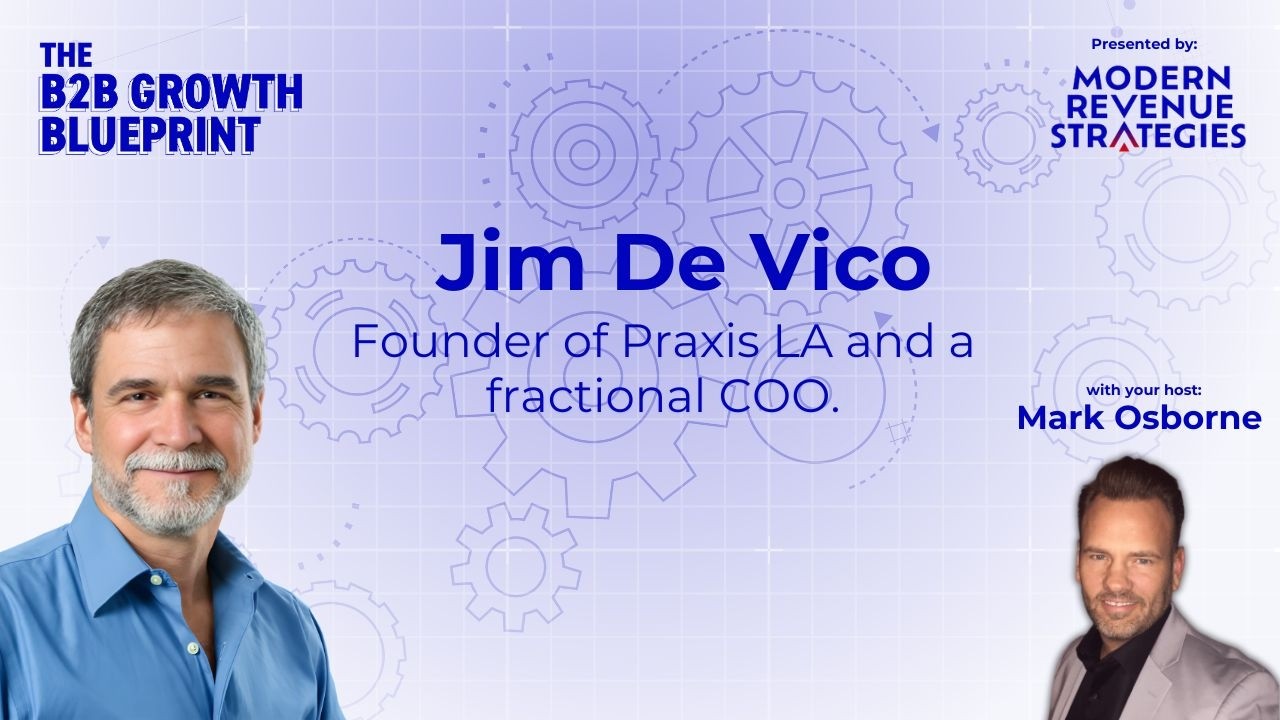
Jim De Vico, a fractional COO, helps founders stop being bottlenecks by building operating systems and processes that let them step back from day-to-day decisions. He works with tech-enabled service businesses making $2-50M in revenue, using frameworks like EOS and quarterly planning to create trust and visibility so founders can focus on growth or exit.
Chapters
Welcome to the B2B Growth Blueprint podcast, where we talk with entrepreneurs, founders, and leaders at B2B services, tech, and SaaS companies to learn the systems and processes they've used to create success for their business. And we'll also learn from marketing and sales experts to provide insights to help you grow your business. I'm your host, Mark Osborne, and the podcast is brought to you by Modern Revenue Strategies and their 10x ROI B2B Growth Guarantee. Schedule a free diagnostic call to learn the fastest path to double your B2B revenues in just 90 days. Hello and welcome to another episode of the B2B Growth Blueprint Podcast. I'm your host, Mark Osborne. Today, I'm very excited to welcome my guest, Jim Dovico. Now, Jim is the founder of Praxis LA and serves as a fractional COO, or Chief Operating Officer, who helps founders of technology-enabled services businesses with a focus on MSPs. He helps them to start working on their business instead of in it. Across nearly 4 decades, he stepped into founder-led companies and built the operating systems that let them grow twice through to acquisition as COO of WN Systems, acquired by Yardi in 2017, and as a founding partner of Computer Aged Dentist. Most recently, as COO of Consilient, an MSP and MSSP, he grew recurring revenue from roughly $60,000 to $185,000 per month and helped the company place on the 2025 Channel Partners MSP 501 list. Jim is also the founder of Senior Living Watch, a platform that monitors senior care facilities for government inspection citations. He holds a BS in mathematics and computer science from UCLA and serves on the board of A World Fit for Kids, a Los Angeles youth development nonprofit. So, Jim, welcome to the show.
Thank you, Mark. Pleasure to be here.
Yeah, I've been looking forward to this conversation. And before we dive into some of the interesting topics we've got planned, why don't you tell our audience a little bit of your story? Like, give us some background of the The twists and turns that brought you to where you are today.
Yeah, I mean, it goes pretty far back. I left UCLA, went to work at a defense contractor, and after about a year there, I remember sitting there with my boss telling me, oh yeah, you know, if you hang out for 5 more years, you could be making X a year. And I'm thinking, I don't want to be doing that in a few years. So, I connected with a couple of buddies from college. We started our own software development company. we were coding custom accounting applications for small businesses, and that quickly developed into a dental software or dental practice management system. We grew that over 9 years into the 2nd largest installed base in the country, and we ended up selling it in the mid to late '90s. And so that was a very interesting journey. One of my partners was took over all sales and the other partner did all development and I handled everything else. And that's where my roots of becoming a chief operating officer kicked in. And then, then I went to work for one of our suitors. And then I went and worked at a publishing company that imported Japanese manga in the mid-2000s.
Oh, wow.
I had the pleasure of running their Comic-Con, San Diego Comic-Con booth for them 2 years in a row. It was a 3,000-square-foot booth. We were giving away 130,000 bags for everyone's, you know, the stuff they pick up at the different booths. So that was a blast. And then in 2012, I went to work for an MSP who focused in the coworking space and executive suites, became the COO there, and have been doing that for the last 15 years.
Wow. So obviously a lot of diverse experience there, and I'm sure that you've learned lots of lessons that sort of you can blend into the practice that you have with your clients that you're working on today. One of the things that I know you talk about is sort of an inflection point that you really sort of enjoy coming into businesses when they sort of say like, I'm too busy to grow the business.
Yeah.
And sort of seeing that as sort of a really unique inflection point. Talk to us a little bit about you know, why companies get into that space and particularly through the lens of, you know, an operating officer versus an operations officer in that role of COO, because I suspect that that's some of what leads people to get to this place of being too busy to grow.
Yeah, I see myself, the title of COO is Chief Operating Officer, not operations, right? That middle O is a bit tricky sometimes. So people sometimes think, oh, you work and you do Well, every company's got different operations, but when you look at it from the operating officer perspective, you're more of like a manager of a baseball team. You've got pitchers, you got catchers, you got fielders, and you have to make sure that everybody has the right toolset to get the job done that they need to get done and that they're all playing nicely together. So, I've always looked at it from that perspective. But yeah, what I have found is that—
Yeah.
In small to mid-sized businesses, the founder or COO is often the bottleneck because they're the expert in the field. They're the ones that everybody has to make a decision through. You know, you can't spend $50 without going through them. And so, what I do is I come in and I find companies where this person can't take a vacation for 2 weeks because the company is going to come to a grinding halt and they're going to be interrupted on their vacation and their wife and kids are not going to be happy about it. So, it's—
Sure.
It's a very valuable thing that I feel like that I do in that I'll come in and I'll put systems in place to make sure that they can trust what's happening and they can get back to working on growing the business rather than solving all the day-to-day problems.
Yeah, that's so valuable. And one of the things that we see a lot too is in the marketing and sales space specifically, oftentimes we'll see companies that try to grow by just adding more stuff. And so I call it kind of tactic stacking. And then the only way to really grow with that is, well, then you got to hire more people to do that stuff or add more hours to the day to do that stuff. And so that hustling really grinds people down and distracts them. Whereas interestingly, the companies that really break through those sort of growth plateaus aren't the ones that are tacking on more stuff. It's the ones that are creating systems and processes that make them better at the few key strategic things that they need to do. Do you find that to be true as well in the work that companies are doing outside of marketing and sales?
Yeah, what you need to do if you're in the business of wanting to sell your business, so you're at that point where you're starting to think about I want to sell this thing, you have to be able to pull yourself out of running it. A company is more valuable when the person who owns it doesn't need to be there. It becomes more valuable at that point. And so, creating a process where you can remove yourself from it, i.e., take vacations, and it still runs and it can still grow without you. You're still there for the visionary pieces. You're still there to make sure that You're bringing in the ideas that can help it grow. But it's important to see that distinction between being involved with everything versus being the one who's leading.
Yeah. Do you find— one of the things that I've noticed is a lot of times founders at companies that have grown quickly, call it from $0 to $5 million over the course of a few years, They have become the bottleneck because they had the vision and then they built the, you know, sort of the way that the company operates, whether there's really operating principles behind that or just, you know, sort of tribal knowledge. They oftentimes just sort of think this is what running a successful business looks like.
Mm-hmm.
Do you find that that's the case oftentimes when you come into companies, or have they, you know, read The E-Myth and Michael Gerber and other things and sort of kind of know, I need to be separating myself from this. I just don't know how. What do you oftentimes see as you're interacting with companies?
There is a mix. So, over the last 15 years, I've been the CEO of 2 different companies and they each had their challenges. The first one, the one I mentioned earlier, I went in and there were 2 founders. One was the COO, one was the— no, one was the CTO, one was the CEO. CEO, and they were technically brilliant guys. Now, the guy who was a CTO, all the support issues, all the big important ones were going through him. And the CEO had put a stamp on, I'm gonna do the sales. You know, he had a sales guy, but the sales guy really wasn't contributing much. He was doing the majority of the sales. And I went on a sales call with him one time, and it was a big possibilities, a big prospect, right? We sit in this room, in their conference room for 2 hours. And I think they spoke for a few minutes at the beginning and he spoke, the CEO spoke for the next 2 hours. We walked out of that meeting and I said to him, how do you think that went? And he said, I think it went great. I said, well, you spoke for 2 hours. You didn't get a chance to hear what they need and what they want.
Right.
You can't do this anymore. We got to bring some professional-level training. So, I brought Sandler in. We did Sandler training. We brought in another sales rep or 2. And then, we actually— that's when we really started hitting our stride. I pulled the CEO out of doing that and then he was able to just focus on growing it. Now, at that point, then we start— he came up with this idea of developing a management system that we could run at the coworking spaces. And that eventually then led to our ability to sell the organization to Yardi. So it was an interesting, it was an interesting realization.
Yeah. So as you're talking, it's reminding me, I think it's the Dunning-Kruger effect, which is that like, if you don't know what you don't know, then you sort of assume like, well, I'm doing a good job. And somewhere along that person's career, they had come to believe that good sales is giving a razzle-dazzle presentation, whereas You and I both know good sales is actually finding out so much about your customers that you can make them really feel like it was their idea to hire you because you customized what you did.
And he was great. He had passion for it. He knew the product inside and out and he had a passion for it. And it was obvious in that call, but they were— I could see them losing it. They were just glossing over. And after 2 hours, you know, you don't want to be in a sales pitch for 2 hours.
That's right.
That's right.
Well, and like what an inefficient use of the CEO's time because not only are there so many other things of higher value that he could be doing, but also, he wasn't even really doing that great of a job in the room, although he thought he was. And he probably was invigorated by the experience because he sort of gets a rush from kind of being on that stage and doing that presentation.
And he had done the sales for the majority of the business before I arrived. I mean, this was probably a year or a year and a half into my tenure. So he had done a really good job of growing the business and getting us to that point. But there was a point where I noticed he had to step aside and let somebody else come in and do it.
That's right. So thinking about this concept of, you know, I'm too busy to grow the business, how do you think about the smaller businesses that are growing and aspiring to be able to have, you know, a COO? How do you help them think through the trade-off of spending the time on the process versus just continuing to plow the street with their face, as I sometimes will describe it? How do you help them sort of see that breakthrough and have that kind of aha moment where they can really see the value of implementing those systems that will save them the time down the road?
Well, you gotta, you gotta tell them and then you gotta show them, right? So we sit down and we talk. We, we, I, I work with the leadership first, figure out what they see as the problems. Then I'll talk to the, uh, the staff and the team and find out what issues do they have, like what, what roadblocks are they running into, how could they get their job done more efficiently. And then by putting, you know, and then having a conversation with management saying, okay, here's what I've identified in your team versus what you're saying and where are things not quite lining up. And then putting systems in place and showing them, okay, here's what we're doing. We're going to put this in place. We're going to run it this way. And then we're going to— sorry, the screen froze for a second. We're going to put systems in place. We're going to show you how things are improving. And then that then gives them the level of trust that, okay, yeah, let's continue down this path.
That's right. So that classic kind of, you show them those early wins, which then creates the motivation to continue to put the effort in so that they can really reap the benefits down the road.
Yeah. And the example of that is at this company I was talking about earlier. So the CTO who was technically brilliant, he— we had to pull him out because we couldn't get any new development done because everybody was going to him with the problems. So I put a firewall between him and the team. It was first, it was me, and I decided if we needed to have him involved. Then we promoted someone into that role so that they could then be the person who decided, someone that they trusted. And that then created the ability for him to then really innovate on the product. And again, and both of these events I'm talking about happened at around the same time in the company history, and then things just kind of exploded from there. Yeah.
So to sort of switch gears a little bit. So you and I both work with a lot of, you know, either technology companies or at least tech-enabled services and in that space. And there's a real revolution happening through AI. And, you know, one of the ways that I see it, and this very much ties into your work and building out, you know, operating systems for companies, is that They sort of see the shiny tool of an AI. Well, let's go look for, you know, I've got a hammer, let's go find some nails.
Yeah.
Whereas, and I, you know, default back to the classic triangle I think was invented in the '80s of people, process, then technology. And the order matters. And I've actually come to adapt that a little bit and say the people guide the strategy. And so then it's strategy and then driven by people that then create a process that we then can make that process run better, faster, stronger, without error, 24/7 with a technology, whether that technology is AI or automation or even just digitization as it has been. And so that's been sort of a transformation that I've seen in businesses. But also just the whole sector is seeing a lot of, you know, sort of pressure because, you know, a lot of technology sells to other businesses. Those businesses are now seeing articles that AI can replace whatever technology you currently are subscribing to or everything else.
Yeah.
Talk to us a little bit about some of your perspectives on this revolution that's happening in the space and some of the interesting trends that you think we might be looking back on 2 to 5 years from now?
Yeah. So, there's an interesting corollary or anyway, there's an interesting thing that I've seen recently, which is back in the '80s, there were 1 in 5 employees was secretarial or administrative by nature. And so, with the advent of the PC, and laptops, etc., people started doing their own memos, their own emails, their own publishing of information that the administrator used to do, or screening phone calls. You know, that's what the secretary, or what is now called assistants, were doing back then. But then all the employees started doing that themselves.
Okay.
Fast forward to today, what we're seeing is that AI is great at doing certain tasks, but it needs to be managed. You just can't, you just can't give AI a prompt and then just let it go and run and let it do its thing. I've been developing this website that you mentioned in the intro for the last few months with Claude, and all the time I'm having to stop it, correct it, telling it, no, you're not doing this right. You have to manage. So basically, employees today have to become managers.
Wow.
They have to think about the bigger picture. They have to think about what is the actual goal here and review what's the work output that's coming from AI rather than just accepting it and rubber stamping it.
Yeah, that's, that's so interesting. And I've noticed, you know, working with companies and also just, you know, in conversations with peers, the folks that are really getting sort of transformational results from their use of AI versus those that aren't, like they're sort of like, man, I don't get the hype. The folks that aren't really sort of getting the great results are the ones that sort of plug in a prompt and hope for the best and then sort of like, well, that was garbage and throw it out and then they go back to their old way of doing it.
Yeah.
Versus the way that I try to encourage people to think about it is, you know, I used to have a team of analysts, you know, going back to, you know, sort of the prior model when I worked at larger corporations and I would, give those analysts an assignment.
Right.
They would go spend a couple days working on it, and then they'd come back and present what they had. And I'd say, well, this part's good, but this part you need to shape here, here, and here. And I'd sort of coach them. It was sort of mentorship as part of that as well. And then they'd go spend a couple hours, you know, refining what I had asked. And so, you know, 3 days later, I have the output. Today, that same sort of process exists, but it happens in You know, 2 minutes.
Yes.
And then another 20 seconds to refine.
Right.
Fine. But you do need that refinement in order to actually get a valuable output and one that's differentiated because, you know, although it has access to all of the information, you know, that's out there, that means it has access to as many flat earthers as it does round earthers and is, you know, just as likely to pull in, you know, sort of bad information as it is good information.
Right.
shaping the information that it's using, how it's applying those insights.
Yeah. And one of the things that I found has helped me with working with AI is, for instance, there in— I've done EOS implementations before. I've been an EOS integrator. And in EOS, they— there's a segment called core values. And so what I did with the development with Claude is I created a core values proposition or an MD file. And I fed it into Claude and I said, okay, these are my— our core values. And often it'll come back and say, okay, we got, you know, make according to our core value of telling it like it is, here's the issue. And it comes back and it pushes back. So you gotta— you have to also train the AI to work the way it is that you want it to work.
That's right. Yeah. And that's one of the big differences I've seen between Claude, and this is getting a little tactical, but between Claude and ChatGPT is. Like, ChatGPT was immediately very intuitive, and it could remember all of our past conversations, but it drifted really—
Oh, yeah.
Badly. Whereas Claude, and specifically in Cowork, it doesn't have memory across projects unless you tell it as part of its instructions. You always need to go out to this corpus of information about the way that we work together, which is sort of a vital and crucial step that a lot of people miss. But then it's much more rigorous about adhering to those things. You just got to take the time to create those markdown files. What was that, Jim?
But it's not perfect. Like just today, it responded to me about something and I said, per my instruction MD file, you need to respond this way. And it went, oh, you're right, I missed that. So that's right, all the time. And so you have to, you have to review the output.
That's right. But it does have the benefit of, you can say, we're going to be using principles from this textbook in the way that we solve this problem. Go read that textbook. Done.
Yeah.
Now you can immediately talk with someone who's an expert in the same thing that you're an expert in and then apply it to a particular instance, which is pretty hard to do with a human analyst. Yeah, yeah, that's right.
So my sister-in-law is an author and she wrote a book called Inside Story, I think. And I said, one time I gave it a prompt and I said, we can cut this. I just thought it was interesting. I gave it a prompt. I said, write in the style of Lisa Cron a reply to this. And it did. It came back with how she would write something. And it's incredibly interesting.
Yeah, it really is. It really is. Well, And, and what I— one of the things that has sort of shook me a little bit over even just the last week is I asked it to sort of author something for me, like it was an email to a client or a memo or something. And it said, applied your style. And I was like, wow, this is terrible. Like, if this is my writing style, then I need to change my writing style. Because I just really didn't like it. And so then I was like, please reread the way that I rewrote it and tell me how it's different. And please acknowledge that and incorporate that into what you think is my style.
Yeah, yeah. It's like hearing your recorded voice for the first time.
That's right. That's right. That's a good analogy. So you talked a little bit about that you've been an EOS implementer and integrator, and you really bring a sort of a unique perspective on building, as you say, operating systems and operations within companies. Talk to us a little bit about the way that companies that are kind of trying to do this themselves or to get started in it, maybe they read Traction and they're like, that sounds interesting, but I'm not exactly sure how we can start to apply it here within our company, or maybe even You know, they oftentimes say EOS is best for companies of 6 or more people. How can smaller companies bring in some of these approaches to really building an operating discipline within the company? Give us a little bit of your perspective there.
Well, I'm not an EOS implementer. I was the integrator for an implementation that we did a couple of years ago. But, you know, If you want a flavor for it, read Wickman's book. There are certain things, like, for instance, I was at a company in the late 2000s where they actually did some of what Wickman talks about, but they didn't call it EOS. I was unaware of EOS at the time.
Uh-huh.
And so, we did things like we had— EOS has a system called ROCKS, basically quarterly goals that each person has. And then you're supposed to make progress on those each week during the quarter.
Yeah.
And so they— this company had implemented a rock system, and everyone was given a rock to work on for the quarter. And if you came to that Wednesday meeting and didn't have an update or any progress on your rock, you were ostracized. And so it was a way of keeping the team guided on On that. So that's one thing that you can pull from EOS that would help. But there's a lot in EOS specifically, like the meeting format, making sure that your meetings hit what they call a level 10 feature, where basically at the end of the meeting, each person in the meeting rates the meeting on a scale from 1 to 10, with the idea that you want to get to a 9 or a 10 on your meeting. They want to get to a 10, but they want to get to a good rating where people are consistently giving the meeting a good rating. But It's also very informative when someone says— everyone's going, oh, it's an 8, it's a 9. Someone goes, that was a 4. And you go, okay, why? Why do you think that was a 4? What happened here? And that helps then refine the meetings going forward. It's a very— it's got a lot of good pieces to it. I wouldn't recommend picking and choosing what you're going to do for EOS, but try to implement all of it. And, but those 2 are probably the biggest wins.
Yeah, that's right. Well, and one of my favorite things about it is it's got an answer for everything in that like, well, how should I run my meetings? So, it's got an answer for that. How should I think about marketing? It's got an answer for that. How should I think about my values? It's got an answer for that.
Yeah.
It doesn't go super deep on all the answers. And I always make the joke as it pertains to sort of like the revenue systems, like it's a mile wide, but only about an inch deep. And so, I go quite a bit deeper when we're building out know, sort of marketing strategy and some of those things. But at least it's got an answer and a starting point for almost everything.
Yeah.
So, Jim, you're obviously an expert in a lot of really interesting areas and we could talk all day, but I got to be mindful of your time. But before I let you go, give us the pitch. Like, who do you work with and how exactly do you help them?
I work with small to mid-sized businesses in the $2 to $50 million range. technology-based companies, MSPs. But most companies have technology of some sort or another in their flow. And I work with companies where they feel stuck. The leadership just doesn't feel like they're getting anything done or they're too wrapped up in the day-to-day. Like you said in the beginning, they're working in the business rather than on the business.
Mm-hmm.
That's when you call me. I'll help them out with figuring out where the bottlenecks are. How can we get past them? What can— what systems can we put in place that they can use to trust what's going on within the organization so that they don't have to have their hands in it all the time?
Yeah. And what's the best way to get in touch with you, Jim?
Well, you can find me at praxis.la. That's my website. I'm simply jim@praxis.la.
Awesome. Well, Jim, thank you so much for joining us today. I enjoyed our conversation and learned a lot. I'm sure our audience did as well.
Thank you, Mark. That went much faster than I thought.
Talk to you soon.
Take care. Bye-bye.
Thank you for joining this episode of the B2B Growth Blueprint podcast. We hope you've gained insights to grow your business. If you enjoyed this discussion, Please rate, comment, like on your favorite platform and share to others who will find it useful. Do you know a CEO, founder, or leader at an early-stage B2B services, tech, or SaaS company who would like to be a guest and share their story? Send us a note. Let's schedule a conversation.
More from Mark

How Can You Maximize Your Business Value Before Selling? with Randy Katz Video







