How AI Can Transform Content Marketing Strategies with Co-founder of Swell AI Cody Schneider
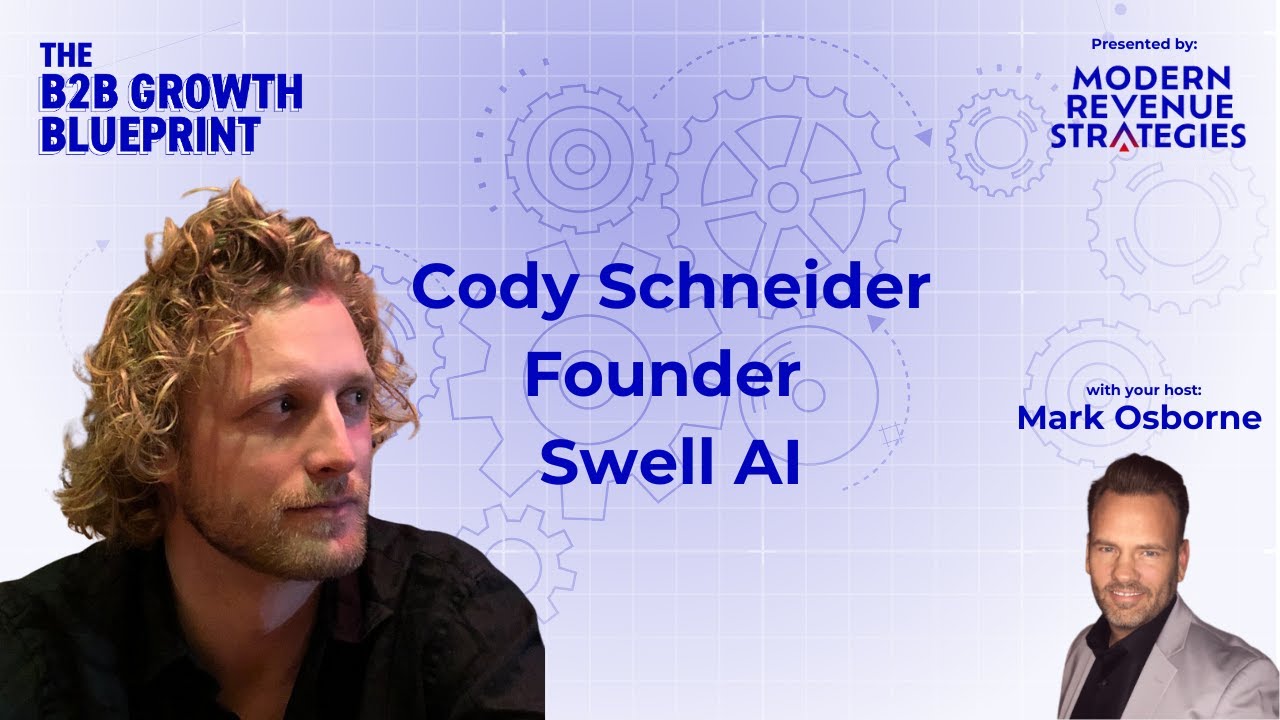
Cody Schneider, co-founder of Swell AI, discusses how to use AI to repurpose content like podcasts and webinars into clips, newsletters, and social posts. He covers building AI personas trained on your own content, automating social scheduling, and creating sales copilots and customer support chatbots for B2B teams.
Chapters
Welcome to the B2B Growth Blueprint podcast, where we talk with entrepreneurs, founders, and leaders at B2B services, tech, and SaaS companies to learn the systems and processes they've used to create success for their business. We'll also learn from marketing and sales experts, uh, to provide insights to help you grow your business. I'm your host, Mark Osborne, and the podcast is brought to you by Modern Revenue Strategies and their 10x ROI B2B Growth Guarantee. Schedule a free diagnostic call to learn the fastest path to double your B2B revenues in just 90 days. Hello and welcome to another episode of the B2B Growth Blueprint Podcast. I'm your host, Mark Osborne. And today, I'm very excited to welcome my guest. Now, I'm gonna read his bio because I wanna get it right. Cody Schneider is a serial entrepreneur and innovator in the AI-powered content marketing space. So I know there's been a lot of talk about AI and we're gonna really get into it today. We had a very exciting conversation prior to sort of launching the show. So Cody is the founder of Swell AI. He's helped numerous companies exponentially grow their businesses. By leveraging AI to automate content production workflows. He was named one of Business.com's top 25 marketers to watch, and Cody gained his experience helping startups scale from the ground up through strategic content strategy. So Cody, welcome so much to the show.
Thanks for having me, Mark. Super excited to be here.
Yeah, I'm really excited. As I was mentioning before, we've had a lot of fun conversations just sort of prepping for this. Why don't you sort of just give us in a nutshell, what do you do there at Swell?
Yeah, totally. So we're building a content repurposing engine powered by AI. What that means when you actually break it down is you provide it pillar content, think podcasts, webinars, and then we transform that into any type of media that you're looking for, whether that's clips, newsletters, show notes, etc. We're really obsessed with like workflows, marketing workflows, and how do we use AI to basically assist in the marketing workflows. that teams are already doing. And so, yeah, that's really the kind of the high level of it. Happy to go deeper on any of that though.
Yeah, absolutely. There's 2 things there I wanna double-click on. The first though is we talk on this show a lot about systems and, you know, we have a phrase around here, you know, growth systems set you free because if you've got a system in place, then you're always your best self. You don't have to worry about having a bad day or sort of doing it wrong and We also see that systems really do a good job of helping teams collaborate. And instead of it being, well, you did a bad job, it's, well, the system let us down. And so often in, especially today, and it's June 2024, in the marketing landscape today, there's so much buzz around AI, and people talk about it as if it's gonna be this cure-all magic bullet that's gonna solve every problem. But I, I love the way you talked about it being a part of a workflow. Talk to me a little bit about how you see AI fitting into existing workflows, not sort of being the, the, the end use, the end solution.
Yeah, great, great question. So I think the biggest thing, and just to totally answer this in a different way and kind of take it a whole different direction. The thing you shouldn't do is try to automate everything. So like, that is where I'm seeing companies, especially large companies, make huge mistakes. they're coming in and they're doing these massive overhauls and it's like, you know, just basically, it's the technology is too nascent for that. Where we're seeing companies be really successful is when they come in, they're like, hey, what's our current processes? Let's audit that. And what can we automate away or augment our team away, you know, with these types of tools? And that's where the most success is coming from is thinking about it in that kind of capacity. I mean, if really where we're seeing companies get the most impact is, you know, taking those systems that they already have and then saying, okay, can we automate away, you know, 80% of this so that my team has their time freed up? And a lot of it comes down to like, you know, it's like paper pushing type work. Like, for example, if you're in the real estate space, you're going in and it's like all of this documentation you need to do, et cetera. Or if you're in the sales space, maybe it's like BDR work, et cetera. But it's finding those things that AI is really good at and to kind of put a filter on this at what we see these tools being incredibly effective at. It's taking unstructured data and then structuring it. It's very capable in that sense. And as long as you provide kind of like, here's the skeleton of the output that we're looking for, here's the source file that we're providing you, the source information that we're providing you, you know, 9 times out of 10, you can, yeah, honestly, at a higher level, probably almost 100% of the time, you can get it to create that output that you're trying to do. And I think the larger thing here with all this is like, I'm trying to just convince founders and CEOs and really anybody using these tools to think about this as, hey, we're not trying to, like, I don't wanna ever chat with AI again, right? Like, my goal is to make a template, like an output, you know, that I'm trying to get generated. And then as much as I can basically allow for that output to be created and handled by the AI, right? And the analogy I use always is, Hey, we're taking raw materials, oil, and we're turning that into gasoline and aggregate and, you know, plastics and petroleum, all these different types from the same source file. These templates, that's, that's the, that's the end goal, right? That's what actually makes impact for the business is getting that marketing content output and getting that out into the public, into the real world.
Yeah, you, you raise a couple of good points there that I think is really important for our, our audience to think about. And I'd love your thoughts on this. Is that, you know, there's so much sort of noise around AI that people aren't always sort of precise with what exactly they're suggesting that you do with it. And you talked about automation and automation of a task, and that task is take a lot of unstructured data like the internet or like these certain websites or these certain sources of data and then turn that into structured information that I then can use some human-powered thought on to do something interesting. And like, that's so different than just rewrite this so that it sounds good.
Totally.
Which is, you know, a very different thing and a much more sophisticated use. And I think a lot of the, even some of the naysayers around AI right now are folks that are like, I can write an article better than AI. Well, maybe you can, But do you want to spend the 100 hours it takes to go get all those facts to assemble for the article to then spend the time writing the article versus assigning an AI agent to go do that sort of research process for you? How much faster, how much better, how many more good articles could you write if you started from there instead of starting from, you know, sort of just the blank page and all of that sort of research and unstructured data collection up front?
Totally. I mean, just to piggyback on top of that, like a concrete example of this, right? Like, and I think for most people, how they've interacted with these tools at this level is they go in and they're like, you know, write me an article or write me a blog post on hotel marketing strategies for 2024.
Sure, sure.
And it like one-shots this article out. And the first time they see it, they're like, oh my God, that was crazy. And then they actually read it and they're like, this is trash. And of course it's trash because it's like, trained off the general knowledge of the internet, right? And when you think about like, what is the average of the internet? It's pretty low. And so what actually this is really like in contrast, how you can make a great piece of content is say you go and you interview 5 of the leading hotel marketing experts on marketing strategies for 2024 and you do 30-minute conversations with each of them, you turn them into transcripts and then you put those transcripts in the context window and then you say, hey AI, okay, now write me a, you know, detailed blog post outline. about hotel marketing strategies in 2024 based off of the transcripts that I provided you. So it writes that outline and then it writes the article. And like what you're going to see is that the caliber of content that you can create from that is like, you know, you're in the top percentiles at that point. And it makes a lot of sense, right? Like that's how good content, good writing, good journalism has existed for the last 200 years. Like when you look at What's the book? How to Win Friends and Influence People, right? If you break down how they actually wrote that, he went and he hired 3 journalists. They interviewed like 300 people over the span of a 3-year period or something. And then they took all of those notes, they organized them, they built this outline, they wrote the body content. He came in and peppered his thoughts over the top of it. And that's one of the best-selling business books of all time, right? That whole process that can now be handled by these AI tools. And I think that's the contrast. That's the difference, right? And we're seeing people, you know, again, I'm just trying to show people the light of like, this is how we're seeing it be used really effectively.
Right.
And it's not getting this, you know, it's not using the general knowledge of the AI. It's using expert knowledge as the source material, creating this walled garden for the AI to work from and doing all that heavy lifting, which is the organization, which is the, you know, the combing through data, the The analysis component of it.
So that's great. Well, and I think there's even that opportunity too, because you and I were talking about this before. So let's say I want to create, and then we'll stick with your example of hotel marketing in 2024. That's not a bad example, some specific knowledge. So we go out, we interview the top 5, you know, folks that know about that. And then so now we've got this sort of source material it's gonna be high quality. How do we then make it sound like us? So let's say I have an agency that does, you know, hotel marketing, but we've got a specific spin on it. Maybe we're a little more fun or, you know, we have a tropical theme because a lot of what we do is, you know, sort of beach vacations. Is there— I think there are ways to kind of bring that in too, right?
Absolutely. Yeah. So the phase, you know, phase 1 of this is just define what we call an AI brand voice, Right? And so just like, you know, traditionally in marketing, we have a brand style guide. It's that same idea. Like, here's the fonts, colors, you know, how the logo is used, how it's not used, etc. It's just a definition of how we put media out into the world. Same thing with these AI tools. What we're seeing again, sophisticated companies start to do is they have basically, here's this AI brand voice. So a lot of the times it's like a tone style and voice of our writing style. That's based off of what we've done previously. So taking, you know, 10 different blog posts, putting that into one of these AI tools and then prompting it, hey, define the tone, style and voice of this document. It'll like in 10 minutes you can have this built out, right? Then the other piece that we're seeing be really effective is layering over a persona. So like, you know, here's Emily. Emily is this demographic. Here's the psychographic, etc. And so then all the content that gets written comes from that perspective. It comes from that person. It sounds like that person or that, you know, that entity that we just created. So that's kind of the initial version of this, the, you know, the beginner level. But what we see is it produces pretty great content, especially when you tell it to incorporate vocabulary that's from the source document. So if you're like, okay, cool, like we've got this brand style, you know, this AI brand voice, But then if I use that simultaneously by saying, hey, use the language, use the vocabulary, use that corpus of language that we've provided within the output that you generate, you're gonna see this transfer, this pullover of all of that kind of domain knowledge and expertise. It's not gonna be this bland thing, right? It's gonna use kind of the uniqueness that exists within that with whatever industry you're in. So the next layer of this, which is the more advanced version, is then fine-tuning these tools off of your back catalog of content so that the AI is basically like almost shifted over to write like you. And this is how, again, like a lot of companies, like a great example of this is Arrow Electronics. They built this like internal tool that is basically a fine-tuned version of ChatGPT, but all of their content, you know, specialists in, I mean, they're one of the most OG content marketing companies in the world that nobody knows of. And, you know, it's like, I think their market cap is like $8 billion and they just resell electronic components, right? It's crazy. But what they've done from day one is really done unbelievable content marketing to differentiate the brand different and build all that trust with their audience for a commoditized product. But for them, you know, what they do is they now have this tool so that any team member can go and interact with it. And the content is always gonna come out on brand. It's always gonna have brand style, you know, brand voice and meet that quality level that they're expecting. And so those are the different ways that we're seeing this happen. You, you don't need to go build your own model or any of this. Like a lot of the off-the-shelf ones can, can be modified at this point and pretty cost-effectively. I mean, it's getting cheaper and cheaper to do this. And so I, I think this is just going to become a standard for all organizations is they're gonna have these, these almost internal tools that they've built that their team can deploy and use for these, for these whatever marketing goals or challenges they're facing.
Yeah, I've heard of, you know, folks taking, you know, like a book that the CEO wrote and using that as sort of like source material of this is his tone of voice and this is his point of view. Now we know how the CEO talks and sounds. So If we want this article to come from the CEO, make sure that it's using that as, you know, sort of source of guidance of what that tone and voice is. And you can develop and then even say, so sound like him, but talking to this buyer. Maybe it's a more technical buyer. So he would use more technical phrases. Maybe it's more of a strategic buyer. And so he would paint more of a, you know, sort of a high-level overview. But it's really interesting to see how that's done. It occurred to me like you could sort of say like, I always want to sound like Don Draper, like, and sort of feed it all the scripts from Mad Men and it would know how Don Draper talks.
Totally, 1000%. Or, you know, any of them, like you can 100% train it in that way. And I think for every organization and company, they're already trying to teach this and train this into their, you know, their teams, right? Like, this is how we think, this is how we do this. Exactly. And we're just taking that same philosophy. We're applying it to this new technology, this new base technology. And what this does when you do it effectively is it like, it makes a 10x person a 100x person, right? Like if you have a 10x marketer and you put these tools behind them, like they suddenly get, they become superhuman, right? Like they, the outputs. And that's why you're seeing these companies right now where it's like, oh, it's 5 engineers and like 5 other people that are really good at the other aspects of the company. And, you know, they're $100 million ARR firms, right? Like, this is why the new standard has changed. And it's because when you put these tools in the hands of people that are already incredibly capable, it just makes them at a, you know, an echelon that's so much higher. And the other point of it, like, you know, the other side of that coin is when you put these tools and people that are like average, you can create a pretty good employee, right? Especially with global talent, or offshore talent, when you augment them with these tools, this is something we've done internally on our customer support side where it's like, hey, we have this internal, you know, library of knowledge that they can query against and ask it questions based off of the customer's questions that are coming in. And this does 2 things. It allows for us to write like better documentation because if there's a question it can't answer, then we know what it is. And then long term, what this turns into is the more like definitive our our internal docs are, we can then just train a chatbot on top of it. And you, I mean, everybody's seen this at this point with what's happened, happening with, I think it's like Klarna and all of these, like after, I think Afterpay was another one as well that did this where they automated a lot of their customer service and, you know, 60% of their queries. Shopify is a great example as well. But they're seeing a majority of their queries or questions that are being asked can be answered by these chatbots. Based, you know, as long as the documentation is written well and then, you know, the other things can be elevated up to these individuals and Intercom is really leaning in on this. They're like kind of, I almost see a renaissance happening for them as a company. You know, they were an AI or sorry, a venture-backed company and I think it was in 2016 when they raised their first round, but which is crazy to think about it. It's like that old, but the technology was just too early at that point to do what their vision was. It's now at that point. And you're starting to see, I mean, it basically their, their chatbot being deployed that is incredibly capable, especially when you can integrate it into your software, into your APIs, into their connectivity. And actually, it can actually solve problems for the customer without you even having to talk to them, right? Like adding credits back to an account or getting them an invoice or whatever that ends up being. So.
Yeah, I've seen some really interesting use cases in like account-based marketing. Activations where, you know, if you think about like, you know, large enterprises that might have multiple very technical products, they might have multiple different buyer personas that have different needs and objectives. And then, you know, sort of using the account-based marketing framework, they know sort of where they are in the buyer's journey based on, well, what keywords were they searching or what are they asking about? And then a salesperson can be in a live conversation and not have to be a technical expert on all 10 of these products and not have to, you know, have deep expertise in each of them or even know all of the use cases for 3 different buyer personas because they can have a copilot sitting in the call with them that says, 100%. Well, if this is an accounting person, That's at a senior VP level, and they're asking about these kind of keywords about this kind of product. That means that the way to answer that is, is around this. And so it can then feed you up the information in a way that you as the salesperson can be infinitely knowledgeable while still using all of your EQ, all of that emotional intelligence that you've built over time of navigating the conversation live, but not having to say, Well, let me go look that up for you. Or, well, let's schedule another conversation when I can bring in the technical person. But I gotta find the technical person that knows your specific use case. So they totally— instead, it's all being powered by this, you know, sort of, you know, underneath Copilot, which I think is super exciting.
100%. I mean, we're seeing this on the BDR space, like, like roles in particular. And I, I think something, you know, we were talking about earlier that I'd love to just circle back to is this idea of, like, You're trying to automate tasks and job roles, right? That is really like, it's not this strategic or universal thing. It's like, what is this low-level thing that's very tactical? That's close, you know, that action. And again, an example of this, say you're doing cold email, right? At scale, it's deploying one of these agents to respond to any of the cold emails that go out and try to get calendar, like, you know, calls scheduled as an example. It's those types of jobs or prospecting and it's just scouring LinkedIn looking for ideal, you know, like your ICP and finding those individuals. And then it goes to Apollo and hits the API and pulls their credential, you know, and provides a spreadsheet for you. Like, here's your call list.
Boom.
Like, you now, it's like you just run through it.
That's cool.
I say this though, and it's very interesting. It's these, we're sorry, like we're seeing these tools make it incredibly easy to do that type of reach out. And the conversations that I'm having with salespeople is especially when they're in these kind of like AE roles that are like what I'm hearing is that really high touch activities that are like not AI enabled are performing super well because there's so much of this kind of like spray and pray happening. So we'll see what happens from a pushback standpoint. I'm very curious to see where that goes, where it's like, oh, it's like, oh, you did a ton of research, right? Or maybe these AI tools assist with this and like did really thoughtful reach out and like, and maybe we see that perform better. But I am, I have a friend who's in the cybersecurity space and sells basically like compliance software in that world. And I mean, he was telling me that he was like, 6 months ago we were seeing kind of the spray and pray be incredibly effective. And he's like, in the last, you know, 2 months ago, I saw that it wasn't working anymore. And a month ago I just decided, hey, I'm just gonna like go really deep and really detailed and just do it all manual without any of this augmented tooling. And he's like, I'm performing way better than all of my peers currently because of that. So we'll see. Super anecdotal. I don't know what the data, like, you know, I don't have enough, a big enough data set to actually validate any of this, but just the things we're seeing from this front lines that are exciting.
So I also, though, what I have seen is The folks that are using sort of the synthesis of both are even better because like, and for example, some of the most impressive and I, you know, I get again, it's very anecdotal, but I get a lot of, you know, inbound solicitations from folks. They're almost always kind of spray and pray of you're like this. And so you probably have this need. So have a meeting with us. It's the same formula. The ones that have caught my attention are the ones that have scoured everything I've ever written online and have found something that, hey, you talk about that you really like sport fishing and you shared pictures of yourself, you know, on your recent vacation to Mexico. If you'll take a call with us, I'll give you a, you know, a gift card to a sport fishing store that cuts through, that gets me an actual meeting with someone, which They couldn't have, I know that wasn't manually done because that's an obscure fact about me. They would have had to have, you know, used some AI to find it, but they trained an AI to find those things and then call them out. Super, super interesting stuff. But again, it's all in the application. It's all in how you build a system that you then layer in that technology.
For sure. And I think the biggest thing is just like building repeatable processes, right? And like, that's the, Yeah, traditionally, like marketing is not that. I think that was the whole digital revolution. I think was that mind shift, like that was the larger occurrence. And I, so just for some background for people of why I'm, I came from the B2B world. I worked at this B2B agency that was focused on like helping, you know, Fortune 500 manufacturing companies transition into digital, right? And we're talking to people that, you know, like orgs that they're manufacturing like wood paneling, like think plywood, you know, and like shower bases and like very unsexy products. And it's like, You know, spending millions a year on these industry publications, like physical magazines being sent out, right? And so where I think, you know, how I'm thinking about all of this is how do we think about these long-term? It's almost a lifestyle choice in all reality. Like, it's like choosing, okay, I'm gonna do marketing and I'm gonna do content like for forever. And so only start things that you can kind of do indefinitely into the future. And if you can't do it, it's not gonna, you know, especially in the B2B world, like the purchasing decision time horizons are often so long that you have to be able to do this for 12+ months, a lot of it, you know, depending on the world or the, you know, the industry that you're in. And so anymore, I'm just using that as my filters. Like if I, before I even start a thing, like, do, can we do this indefinitely? And can I get team members either to own it or can we build out, you know, these AI tools to own it, whatever that ends up being? And then If the answer is no, like if this is only, you know, a one-time thing, then I'm not even trying to begin that. And I think that that's definitely a mind shift because traditionally it's like I would go and I would run a campaign, right? And like a campaign had a start and it had an end. And like now it's not like that. Like a campaign is this ongoing, indefinite, you know, kind of amorphous evolving thing. And that's how we're seeing companies, especially B2B, be extremely effective. It's just When they are thinking about it in that, in that form rather than like, cool, like we're gonna push this product. It's like, no, like we're gonna do these activities that for forever continue to push our beliefs, our philosophy to both like create demand and capture demand. So.
Yeah, that's right. Well, and also in the B2B space, it's just so nonlinear anymore and that, you know, companies are, you know, doubling back to research other potential substitutes or other potential options. And if There's an infinite number of paths that they could take.
100%.
And you can't as a human manage infinite number of paths, but a machine can. And that's the thing is when you also, I think a lot of the people that are, you know, sort of excelling in this space are ones that worked in data and analytics, you know, previously before getting into sort of AI because they know how to structure a question in a way that it can be answered with data, or they know how to structure a problem in the way that it can be answered with data. And that's what enables these AI assistance tools, automations to do it is you have to sort of structure the situation in a way that it can be enhanced, which is sort of just a mindset that not everyone has. But certainly a lot more people did than they did, you know, even 20 years ago.
100%. 100%. Yeah, I think, yeah, again, with all this, like what we're always trying to push for is just the obsession over this process component. And so with all this, I mean, we could go on for days. I won't beat a dead horse.
So, well, super interesting conversation. As you said, Cody, we gotta be mindful of time. So tell us, you know, so someone's been listening to the show and they're like, wow, this is really interesting. And I need to do a better job of taking my, you know, sort of pillar content and turning that into lots of things. There's a lot of options out there. And there's, you know, I see 1,000 ads for stuff like this anytime I go on Instagram to check out my latest fishing pictures. But what would you say is different about Swell AI and why someone might wanna work with you for this?
Yeah, I, you know, just to frame this, like you were talking about the funnel and like how people make purchasing decisions and I like, I think that actually how we just define the funnel is really broken. Like that's, you know, people don't go in the top and come out the bottom. Like what actually happens is like you make digital gravity on the internet, right? And so like, how do you make digital gravity? Like you build digital mass. And what is digital mass? Like that's content, right? And so like the more content and digital mass that I have, more gravity I have in my niche, more gravity I have in my niche, the more influence I have, like the more people I get in rotation and at different points in their rotation, they're closer to touching down and making that purchasing decision than they they are at other points. And so I think with that said, like, that's really what we're focused on as well is like, okay, how do we build this tool that like allows for companies to build this digital gravity? So in the B2B space, again, it's like, okay, we do a weekly podcast, weekly webinar, like how do we turn that into 100 different pieces of content beside, you know, from that source file, that source material on the differentiation piece like between us and competitors that, I mean, God, I mean, One of the weird kind of weirder things that happened is like we, so we started this in October of 2022. It was like right before ChatGPT dropped. And so as soon as it hit, we were positioned really well to kind of ride this wave. But I saw so many like basically just clones of the software, like come in, sign up, buy a domain, you know, and a month and a half later this thing was live and it's easier than ever to do this. But what we're really focused on and like trying to think through is you know, what's that whole process that a person is doing currently? And then how much of that can we, you know, basically automate away, you know, or take over for them? And so an example of this, we just launched social scheduling within the application yesterday. So like now you could upload a long-form piece of content. It's gonna identify viral moments, clips. It'll do, you can select portrait mode and auto cropping and it will do active speaker identification to see who's like talking. With that clip that it automatically generated for you. Captions lay over the top of it and then, you know, I click one button, it schedules out to TikTok, Instagram Reels and YouTube Shorts. And for, you know, a team, it's like, oh, and you're telling me in 20 minutes I can have my whole weeks of socials basically scheduled out. It's, you know, that's kind of the caliber or the level of it that we're seeing this go to. I think the other pieces that we're realizing is that like, What people are wanting more and more is like content marketing powered by AI, like a platform that their whole team can sit on top of. And so we're starting to see the product like pulled in that direction and really just, I mean, our wedge into this market was podcasting and like that was just like the way that we got our foothold. But where we see this going and how I'm, you know, envisioning the future is like, I think that companies are at this place now where they're we're, we, all the technology exists for them to be able to market themselves.
Yeah.
Like you just give it this back catalog of like, you know, basically your content library and you're like, my goals are this, like get it, you know, get more impressions on social, like make signups, you know, make calendar events happen, you know, get more organic traffic, whatever these marketing goals are, these North Star goals are like between connecting to like all the APIs between Google Analytics and Search Console and you know, keyword research tools and now, you know, these AI tools over the top of it, like you're gonna, we see this future where you're probably gonna see these agents that specialize in like a single act, you know, for example, they're a social media manager or maybe they're just like a social media analyst, like that is their job title. And this, when I say this is like, this is this, you know, AI powered entity that's doing this. But what it ends up being is like you just connect it to your Slack channel. And Taylor shows up and like Taylor is this AI bot that basically gets to work on analyzing your social content and saying, oh, like we see that clips like this perform better. Like let's go find more clips like that from our back catalog of content and then go and schedule those out. And so what a social media manager used to do traditionally, or what an SEO specialist used to do traditionally, or, you know, all of these roles. That's where we see all of this going and like, that's what we're excited to build about or, you know, to build and create. But I think the biggest thing right now is just like there's a stack of tools that people use in their content marketing workflow. There's millions of these out there. What we're trying to do is, you know, with that source file, that source material, how far can we get it to that fine, you know, that actually impactful thing, which is like that media exists out in the wild. And people get to interact with it, see it. How can we get it as far down that, you know, that value chain or, you know, down, down that chain of events as possible and build out all of these features that basically assist in that. So anyway, I don't know if that directly answers the question, but that's how we're approaching it.
And obviously you've got a lot of passion, a lot of expertise here. So how do folks get in touch with you?
Yeah. So I'm active on Twitter and LinkedIn. Those are kind of the 2 places. You just go to swellai.com. You can reach out as well there. We're still like a super small team. We're under 10 people. It's early stage. So you're gonna like talk directly with the founders and we try to share products on a weekly basis. So it's, for us, it's, that's kind of the things. But the one thing I'd love to leave with your audience too is like with all this stuff, I think it's like your like expert knowledge is going to become more important than ever before. And so starting to invest in that now is going to be the most critical thing to create differentiation. It's easier than ever to clone products like both physical software and physical products. But the only thing that is going to create differentiation is basically how are you positioning the product through this, the media or this content, whatever this marketing is that you're doing. And so having unique knowledge or domain knowledge that nobody else has, this is what's in really, I mean, you can see a company like a Gartner as an example, right? Like they have all this internal documentation, all these data sets that nobody else has access to. all these reports. I mean, imagine just a chatbot on top of that's like querying against it. Like you could basically almost automate like their consulting roles and this is what will probably happen, right? So, but yeah, I think that, you know, just another thing that we're more a call to action of like thinking about, because over the next 5 years, like the cost to produce mid content, like average content has gone zero, right? And so you're just gonna see more and more of that everywhere. There's gonna be no differentiation between all of this unless you have this expertise that nobody else has. And so anyway, just last thing I'd love to throw out there for people. So.
Yeah, absolutely. I mean, great thoughts and super awesome conversation, Cody. Thank you so much for joining us today.
Mark, thank you for having me. It's been awesome. I appreciate your time.
Yeah, awesome. Talk to you soon. Thank you for joining this episode of the B2B Growth Blueprint podcast. We hope you've gained insights to grow your business. If you enjoyed this discussion, please rate, comment, like on your favorite platform, and share to others who will find it useful. Do you know a CEO, founder, or leader at an early-stage B2B services, tech, or SaaS company who would like to be a guest and share their story? Send us a note. Let's schedule a conversation.
More from Mark

How Can You Maximize Your Business Value Before Selling? with Randy Katz Video







