How AI Unlocks Hidden Patterns in Recruiting & Beyond with Jordan Thompson
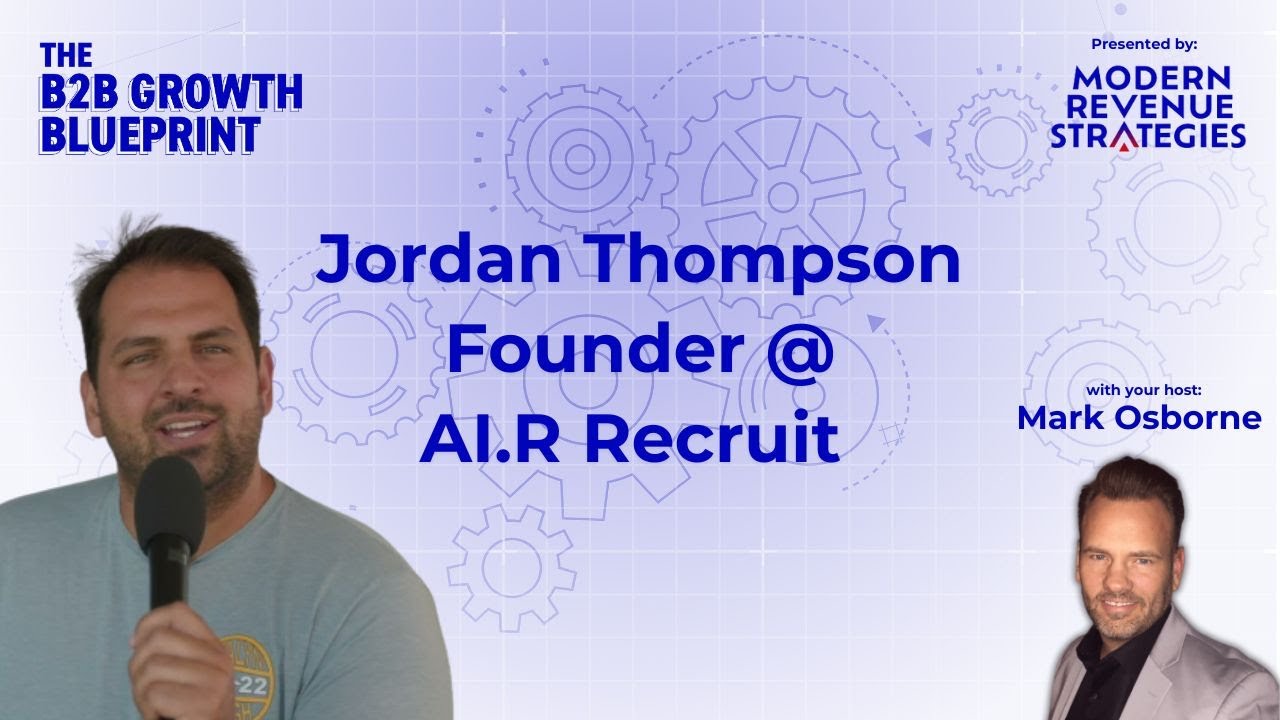
Jordan Thompson built Recruited to use AI for high-school athlete recruiting, making it more accessible. He discusses finding hidden patterns in data, the difference between sales and product fit, and how AI can spot non-obvious correlations while managing bias and transparency.
Chapters
Welcome to the B2B Growth Blueprint podcast, where we talk with entrepreneurs, founders, and leaders at B2B services, tech, and SaaS companies to learn the systems and processes they've used to create success for their business. We'll also learn from marketing and sales experts to provide insights to help you grow your business. I'm your host, Mark Osborne, and the podcast is brought to you by Modern Revenue strategies and their 10x ROI B2B growth guarantee. Schedule a free diagnostic call to learn the fastest path to double your B2B revenues in just 90 days.
Hello and welcome to another episode of the B2B Growth Blueprint podcast. I'm your host, Mark Osborne. Today, I'm very excited to welcome my guest, Jordan Thompson. Now I'm gonna read Jordan's bio to make sure I get this right. Jordan has been in the tech startup world for over a decade and helped grow 2 startups into adulthood and 1 exit, and started as employee number 7 at one of those. Since helping Talon Air— they're an electric vertical takeoff and landing aircraft company— in 2023, he's been working at TBG Ventures as a startup mentor, advisor, and consultant, working with technical founders in autonomy, clean tech, and artificial intelligence. Jordan's favorite companies to work for are those with social and accessibility benefits. Currently, he's helming his first venture as a founder, using AI to offer greater accessibility to recruiting resources for high school athletes who want to play in college and beyond. And that company is RAI, but spelled R-A-I. Recruited.com. You might want to check them out. Well, we're going to talk about that a little bit later too. But Jordan, welcome so much. So happy to have you here on the show.
Happy to be here and happy to talk shop with you. I always enjoy putting a bit of a mind meld together with like minds. And you have a lot of experience here. We have a lot of common ground, it appears, as we've been preparing for this podcast.
Yeah.
And yeah, let's dive into this.
Awesome. So you've obviously done a lot of things and seen some interesting transitions in technology space and in AI and some of these things. Why don't you tell us your story of kind of what you've done and how it led you to where you are today?
Yeah.
Going back to the beginning, I'm a first-generation Greek Angeleno, born and raised here in the Los Angeles area. Stuck around. Fight on is correct. Went to USC. I actually started out in the film industry doing logistics and operations for various television shows and a couple of movies here and there. And about a little over a decade ago, found my way into the tech startup world. And I love to joke that, you know, what's more reliable than film and television? It's tech startups, which is Absolutely false. But the difference is you do have a little bit more agency over your schedule. You can assure that you'll be home for dinner with the children a couple nights a week. And you do truly get to meet with similarly creative but brilliant minds that are working on very hard problems for society. And I love that. The first company I got to work with was a JPL spinoff company working with novelty metal alloys. You can find them, Amorphology. Another tongue twister of a name, but Amorphology. And I was working in robotics. I loved the accessibility play there, which is we were working on lowering the cost of actuators and we were allowing essentially mom-and-pop scale companies to benefit from the industrial-grade robotics that only the Fortune 500 companies could afford at the time. From there, I went into the e-mobility in Ascent Electric vertical takeoff and landing aircraft at Talon Air. We were building dual-purpose aircraft, so there were some Air Force applications. But again, the accessibility play there that I loved is the commercial side where we could give high-speed logistics to people that otherwise were in disenfranchised communities. Ground access wasn't as easy. And, you know, with the efficiencies of electric, you could then do that from the air, right? Very exciting. Now I'm doing that with AI for high school athletes. We can come back to that.
Yeah, super exciting. Super exciting. And I know that in your career, you've actually done a lot of, you know, stuff on that sort of business development selling side. And you've had some interesting, you know, sort of lessons along the way that you've learned. It wasn't sort of the typical sort of sales career. Tell us a little bit about some of what you've learned along the way and some of the sort of lessons learned and how you apply those.
Yeah, my first glorified business development role title was at Amorphology. And I came out of that straight from the film industry with some of the soft-touch people skills that turned out to be very relevant, but absolutely no idea what the proper rhythm, rigor, and routine would be, what the right systems would be. I had a great mentor. I'll shout it out to Steven Saplansky. Who showed me the ropes and was able to help me translate some of those soft skills into effective systems, something that I now fixate on and work with technical founders on. And it was, it turned out to be something very effective. Winding the clock back a little bit, before that, my first sales job, I sold term life insurance in college.
Okay.
Something that I highly recommend no college kid, unless they're extremely tough and willing to get beaten down, ever does, because nobody wants to buy life insurance from a 20-year-old. They have absolutely no interest in hearing about their ticking clock from somebody who's as vital as a college athlete. And I learned a lot there. I learned about rejection. I learned that it's not the end of the world. I learned that sometimes you're not the right person to nurture certain funnels. And I was actually able to bring on a couple people, including the manager of a local Subway, who actually, her success at selling life insurance showed me why I needed to step aside from that business and look at other ventures.
That's really interesting. Well, and I love to hear you talk about it, you know, being processed too, because so often, you know, people think of sales as an event. It's like, it's the pitch, but instead it's really, what's the lousy art of war? Like, you know, the battle's won or lost before the first sword is drawn. Like, I think about that in sales all the time because before you get to the pitch, you've either done the work that means you can win it or you haven't done the work that means you're not gonna win it. You still have to deliver on the pitch, but—
Yeah.
It's a process, not an event. But so, so interesting that you did that, you know, very transactional sale and then moving into, you know, much more, you know, sort of enterprise B2B heavy manufacturing sales. What was one of the biggest surprises you got? So having sold insurance in college and then worked in the movie industry, And then you move into, you know, sort of a B2B. And I don't exactly know what Amorphology does, but it seems like, you know, pretty established buyers, longstanding relationships, you know, probably an insular industry. What was your biggest surprise or lesson learned coming in thinking, well, I know what sales is?
Yeah, you're— first of all, you're 10 out of 10 on assumptions about Amorphology. You're right. You do. You end up in a situation where you need to nurture a relationship. Far more than a transactional direct-to-consumer, you know, add to cart, right? And going back to your Art of War reference, that's completely true, right? And, you know, strategy is going to beat tactics and there's a whole bunch of things about that. I believe that if you are a founder, if you have a company and You're a product-focused founder who's all in on getting your product sold. Let me sell this thing as fast as I can because that's when the venture capital dollars are going to flow in and I can become this resounding success. The odds are there's a decent chance you've neglected the whetstone. You've neglected working on the initial effort, which is customer discovery.
Yeah.
And that business development that sometimes comes out of customer discovery, if That product-market fit is actually there. And when you talk about the difference between selling life insurance or any insurance, a product versus selling an array of products and setting up an enduring partnership with a significant company, it has to be truly in line. Otherwise, you're going to burn calories in the wrong place. Calories And time, which are even more important than your calories because that time is money when you're on a burn rate. And, you know, just give you an example. You can make anything out of metal, right?
No.
Well, just about.
All right.
Maybe not anything. That doesn't mean every metal should make every object. And you're not going to force somebody to take your solution and convince them they have a problem. They have to have that problem first. And so if you go out there, and I lucked into doing it this way, I lucked into doing it this way because I didn't know any better. I was a young, dumb kid coming out of the film industry trying to figure out what was going on. And so when I started talking to people as a business development manager, I was really just asking customer discovery questions. I needed to know what they were doing. I had no idea.
Right.
And bringing that fresh perspective unintentionally, allowed me to realize like, hey, actually, maybe we need to make these other things out of metal, not the ones that we've been looking at here right off the bat. And being able to accept that, working with founders that are nimble, willing to pivot a bit and change everything from initial messaging in your marketing to that business development, to that sales, Note how sales is not the first thing being listed off there. That's what's going to allow you to have efficiency through your funnel, proper conversion, less churn, and you, you know, your leads won't be killing your business. Totally.
I appreciate the plug. And so for the audience, I published a book a few years ago called Are Your Leads Killing Your Business? And Jordan and I have talked about this because so often companies are just obsessed with I need more and more and more. But they oftentimes overlook the right leads. And the right leads are just, as you said, the ones that, you know, align with your product vision and your sort of long-term vision. Because in B2B, you have to be able to sort of partner together for a long time or you never get the margin out of it that you need in order to be successful. They don't get the real benefits that they get out of it, so they'll never you know, serve as a testimonial or make referrals. And in very niche industries and/or insular industries, like a lot are, without that sort of partnership in the market, you really struggle to succeed. And it's interesting that you talked about the, you know, sort of the ability of this founder to pivot and to take the feedback from the marketplace. One of the things that I see oftentimes is, you know, technical founders are, you know, for lack of a better phrase, sort of navel-gazing. Like they're looking down, they're like, what do I think the market wants? And then they make that. And that's okay to start with that hypothesis, but you then need to take the feedback from the marketplace as your salesperson's out there in the market or as your marketing team is seeing what's getting connection, as your customer success team is saying what people are really asking for, really happy with, and use that to guide strategy. What are some of the ways that you have seen companies be successful at incorporating that feedback into evolving a product vision or into pivoting to make different things out of different metals instead of maybe the original one that they had planned on?
Yeah. And sorry for watering down that example so much. You know, certain things need to remain less specific.
Sure.
But no, I can, you know, with the eVTOL company, you're perhaps your engineers who are really focused on executing want to make the highest likelihood of success, easiest aircraft that sort of fits the general envelope of what you want to demonstrate, right? Maybe they want to build something to a scale that they feel comfortable with because they're going to look good at the end of the day. I did my job. And that's another tough thing too. That's opening a whole other can of worms, which is organizational alignment. Save that for a different podcast perhaps.
Right.
In this case, if you have good founders, if you have good heads on the top of the chicken, They're going to take what you see doing that customer discovery, doing that market research, and they're going to take the abilities of their engineers and they're going to push them as far as they believe that team is comfortable doing. You present the facts for a very clear requirement of a bigger volumetric capacity or a bigger kilogram capacity or a longer range for that aircraft. And, you know, that's a pretty linear example in 3 different performance categories, but it's a real one. And I've seen a pair of founders do that really well and integrate that extremely well.
Well, and that, you know, it really sort of paints a picture of the responsibility that marketing, sales, that voice of the customer has within an organization, especially as a startup, to advocate for a product direction or a product vision. And I've certainly seen startups where the, you know, maybe the marketing leader or the sales leader isn't as, can't go toe to toe with the founder, with the engineering lead, the PhD who's got all of these credentials and has this, you know, vision for the product. And if they don't sort of go toe to toe and really advocate for what they know the market wants, then the product— we're making something that no one really wants.
Yeah, you bring up a great point, right? And I like to think that I'm sensitive to those imbalances, especially as somebody who's now owning his own thing. But you're right, there are people who are very good at business development who are a little bit more timid and reserved, and they're not going to give you that type A treatment, right? They're not gonna— or maybe they fit into the system and they respect it. And in a startup world, you end up with that disconnect for any number of reasons, right? So you do need somebody, you need a co-founder, you need somebody who has a voice, somebody on your board, an advisor who can take that critical look and play the referee or couples counselor or whatever it is so that each person who is bringing in critical element that's going to have you ultimately bring this saleable product to market, make sure that those voices are heard. And that's delicate.
Yeah, it is. Well, and also, The other dynamic too is sometimes startups will just kind of bring in like a hired gun salesperson, like, oh, this person was so successful at our big competitor, let's hire them in and they'll lead our things because they've got the Rolodex and they've done it for the guys that we want to be. But that person isn't really invested in your product. So they're like, no, whatever you want to build, I'll sell whatever you give me. But they're not necessarily in that position to bring that feedback from the marketplace.
Yeah, you're talking about a massive problem. I think that the hired gun sales, fractional sales firm, 90+% of them are gonna treat you exactly that way. There are a couple of exceptions. There are a couple of people that I really respect how they really take the time to do a deep dive on your product, and they will ask those questions, not just about your sales metrics, You know, they're not just gonna ask you for what your quarterly goals are. They're gonna ask you, okay, well, how did you come to these solutions with your marketing materials? How did you choose this ICP? Is this in fact the ideal customer profile for us to be focused on? And then I, you know, I believe that there is an opportunity for success there.
Yeah.
If you're hammering one pie chart in the top right corner of your Salesforce dashboard and nothing else, you're missing the big picture and you deserve to go work at a larger corporation. It's not a startup game for you.
That's right. That's right. It's definitely a mindset thing. So, so speaking of mindset, you, you've undergone a little bit of a shift because with TBG Ventures, for some time you've been advising companies, especially companies in the startup space. And now you're really sort of taking ownership of that as you're stepping into this sort of founder and operator role. Talk to us a little bit about that sort of experience just from a personal entrepreneurial journey. And then let's talk a little bit more about really what Recruited does.
Yeah, absolutely. So I am still active with TBG Innovators. I am being far more selective, which is a nice thing, with who I'm going to work with there. I still am on the advisory board for a couple of different companies. I still mentor with Techstars, Starburst, and the, the Turbie Startup Garage out of USC.
Oh, great.
And I love it. I love it. I love working with inspired technical founders. I think creating an environment where you can let the nerds be nerds, and I say that with a lot of love, is important, as long as every voice is getting heard, as we've just been talking about. But actually answering your question now, the pivot, if you will, I went on a handful of long coffee walk and talks with a personal mentor of mine who kept asking me why I wasn't starting my own company. And I told him honestly, I'm surrounded by brilliant people. All of the best ideas I've heard for companies, they're coming from their mouths.
Right.
And we kept working at this and I love the accessibility. I probably say that too much. I love that angle. It helps me get out of bed in the morning for what I've done for the last decade of my life. And that, and the passion of the people that I work with. But AI is changing the way we live, and that is the simplest statement anybody can say in 2025 about that technology.
Right, right.
But it's not necessarily generating accessibility to tools, and especially in certain verticals, And certain demographics are being neglected. And I was trying to figure out, how do I do that? And, you know, not literally, but basically I woke up in a cold sweat one night and I'm like, hey, in the early 2010s, I was a college recruitment counselor. I was paid thousands of dollars per kid and it came out to hundreds of dollars an hour. And I helped them get into a better university than they might have on their academic merits alone, but they deserve to leverage all that hard work that they put in. On the turf, in the pool, whatever that field was. And also to continue to compete, to go shoulder to shoulder with somebody and fight for something hard, which is what we all do at the startups. You get to do that through college too, if you get to continue playing your sport, even if it's D1, D2, D3, club, you know, you still get to carry that passion. And I also think it makes you a better employee in some ways, or at least a better fit for certain employers.
Yeah.
So I looked at that and I looked at the world of recruitment and I realized that, well, all the tools out there, they're being built for the top 3% of the athletes that are going to go on to play revenue-generating sports at the colleges, be that football being number one, basketball number two, and then baseball follows, you know, a good ways after that. All of the Olympic sports, if you will, they're getting neglected. I fear for what's going to happen in 2028 when we have to represent ourselves on court. Because all of the, with NIL, all the money is being, you know, the bandwagon, the wagons are being circled around those revenue-generating sports for the colleges.
Interesting.
And that's, it's always been true that the focus has gone to where the money is. And I'm not going to say that that's a poor business decision, but you have 97% of the athletes out there that don't have tools tailored for their needs. And I believe we figured out how to do that. with an AI backbone. And I'm really excited to roll that out.
That's very exciting. And also like really inspiring. And I have to call out like the humility that you have of, you know, I work with all these smart people and they have all these great ideas.
I love it.
I'm focusing my efforts on helping them. And that because I've seen plenty of founders who are 100% sure they've never been 1% wrong, And all they ever want to work on is their own ideas and have no interest in helping anyone else. But I love that, this vision that you have of really building a product that not only, you know, leverages cutting-edge technology, but also brings that and those tools to be more accessible for, you know, for a whole nother class of folks. So what— you have an interesting perspective on AI because, you know, A lot of people kind of sit around and pontificate on it, but they're not always building things with it. And so I'm curious your perspective on like, where do you, you know, what maybe, maybe one thing or maybe a couple things. I don't want to have to pin you down to one, but what's something that you sort of see on the horizon as to how AI will impact whether it's business or whether it's you know, the way people engage with businesses or even in the, you know, educational technology space or recruiting space. What's the thing that you think might be surprising for our audience?
Yeah, I think one of the things that's surprising is just how nuanced correlations can be or just how the level of nuance that can go into connecting a couple of different concepts. And, you know, using recruited to give an example, a coach might not realize that they've been specifically focused on recruiting lefties that are between 220 and 235 who come from a certain high school or a certain coaching style, if you will. And that DNA can be broken down for all those elements with the datasets that already exist in most cases, the same way Spotify breaks down the DNA of a song and gives you a great recommendation, right?
Yeah.
So you look at that and you say, hey, what's AI going to do in my life? Right now, AI is being adopted in the workspace in a massive way, but it's going to be truly wild, the decrease in friction for your life, whether that's your personal AI agent helping you organize a trip And choosing your mode of transportation based on preference and speed requirements. It's going to be impacting the way your tastes are dictated in a certain sense. And I do say dictated, understanding that there is risk involved there. You know, marketing dictates and the AI consumption is going to continue to do that. So let's keep an eye on that. But overall, I see the The beauty of having a sidekick who's going to help you get ahead of your next problem while still letting you be the one who does the critical thinking about it.
So you hit 2 things that I have to call out that I think are so interesting. And the first is you talked about sort of the nuance or these sort of non-obvious relationships. And I worked, I was fortunate enough to work with some really good data scientists back in the day when I was working in the marketing technology space. And, you know, we always sort of highlighted the fact that we could find these non-obvious relationships between preference for a certain product and preference for some other product that was known. And so then we could predict they're more likely than the average bear to like This brand of honey, to use a bit that bear analogy. But it's non-obvious because they like this TV show; they're gonna like this brand of honey. Who would ever thought? But it actually wound up being true consistently. And I think that the sort of the current usage of AI, which is largely sort of perceived as you know polling the audience, it's kind of like the general perception of what's in the news. It's largely trained on the internet writ large, which is full of idiots as well as smart people. And so you kind of get that middle of the bell curve style answer. But the capability is there for, especially when you're using kind of first-party datasets or, you know, data about you, for it to find these really nuanced and non-obvious relationships, which, as you say, I think is a really interesting potential future. That, you know, why is it that I'm always, you know, cranky on Thursday afternoons? Well, it's because you, you know, have an extra cup of coffee on Thursdays because you, you know, take your kids to school and you make that, you know, second stop at Starbucks. Oh, I never thought that before.
What do you know?
Who would've thought?
But it can find those non-intuitive relationships, and I think we'll be soon doing that. And so I think I agree with you. That's really exciting. And then you also talked about, you know, the role of marketing and sales. And I definitely believe this, that I actually envision a future where your personal agent will use all of your preferences, including lots of nuance, like, well, I prefer to fly this airline because I got the miles, but I'm willing to fly this other one if it's, you know, a certain percent cheaper. And I prefer to fly out of this airport because it's near where I live, But I also like this one 'cause it's easy. And so all of that different nuance, that bot will go talk to a bot representing all of those different airline travel options and they'll figure it out together and then you'll get presented a recommendation based on all your preferences.
Yeah, I think that's absolutely true and it's awesome. It's exciting. As long as you have the big red button that you could smash if you don't like what's going on, that's, Where I do think I draw the line right now, and maybe it's overly sentimental, is interpersonal conversations, right? I don't— I better not find out a week from now that this is AI Mark and that you're actually somewhere in like Tahiti enjoying the beaches. What I do think is it's being used a bit too much for those interpersonal conversations, for spamming out different materials to different people. And there's value there, But again, if you don't use your brain, and I know you do, but if we're not using our brains to do what the human brain is still significantly better to do, and it's to process all that cross-disciplinary information and actually read and appreciate the human being who's across from them, then we're going to miss There's gonna be some slippage when you figure out how to actually take something out there, and you're gonna end up force-feeding somebody a product that's not quite for them.
That's right. Yeah, well, not only that big red smash button, I don't like it, but also the transparency, because as a marketer, one of the things that I fear is the day that, you know, my bot that I've enabled gets bribed by an airline to say, just tell him this is the best option based on his preferences.
Very real.
And there's a risk there, especially if the company that makes my bot is sponsored by someone that's a shareholder in that airline and there's some, you know, cross purposes in their incentives. Like, that's the thing that I worry the most about. And I think Honestly, like we see that today in the, you know, the social media feeds that drive, you know, perceptions and preference and the ownership of those companies that drive that. And then the ownership of, you know, other companies that are creating that content. There's a lot of sort of perverse incentives happening, for lack of a better phrase.
Yeah, there is. And then even wilder beyond that is the unintentional biases, right? The ones that live below the surface that we're all guilty of. And if you're building something, your biases will tend to flow into it. And when you talk about something that AI, like AI, like recruiting even, that's going to influence so many people's lives, it's really important to take a deep, hard introspective look and make sure that you're accounting for all kinds of personas, all kinds of realities, not just your own.
Yeah. Well, Jordan, you're obviously a super smart guy and have a ton of really interesting experience, so we could talk all day, but I got to be mindful of your time. But before I let you go, you know, what's the best way for folks to get in touch with you?
Yeah, my website, tbginnovators.com. TBG is an acronym for the Big Greek. So tbginnovators.com, take a look around. If there's any questions about your business that you think I can help you answer, I will be happy to do so either formally or informally. I think I've said it enough, but I really enjoy being a part of this space and talking with founders and you're doing cool stuff.
Awesome.
Well, Jordan, thank you so much for taking the time to join us today.
My pleasure. Thank you for having me, Mark, and I look forward to continuing these conversations offline.
That's right. Talk to you soon.
Thank you for joining this episode of the B2B Growth Blueprint podcast. We hope you've gained insights to grow your business. If you enjoyed this discussion, please rate, comment, like on your favorite platform, and share to others who will find it useful. Do you know a CEO, founder, or leader at an early-stage B2B services, tech, or SaaS company who would like to be a guest and share their story? Send us a note. Let's schedule a conversation.
More from Mark

How Can You Maximize Your Business Value Before Selling? with Randy Katz Video







