How Authentic Conversations Drive B2B Business Growth with Casey Cheshire
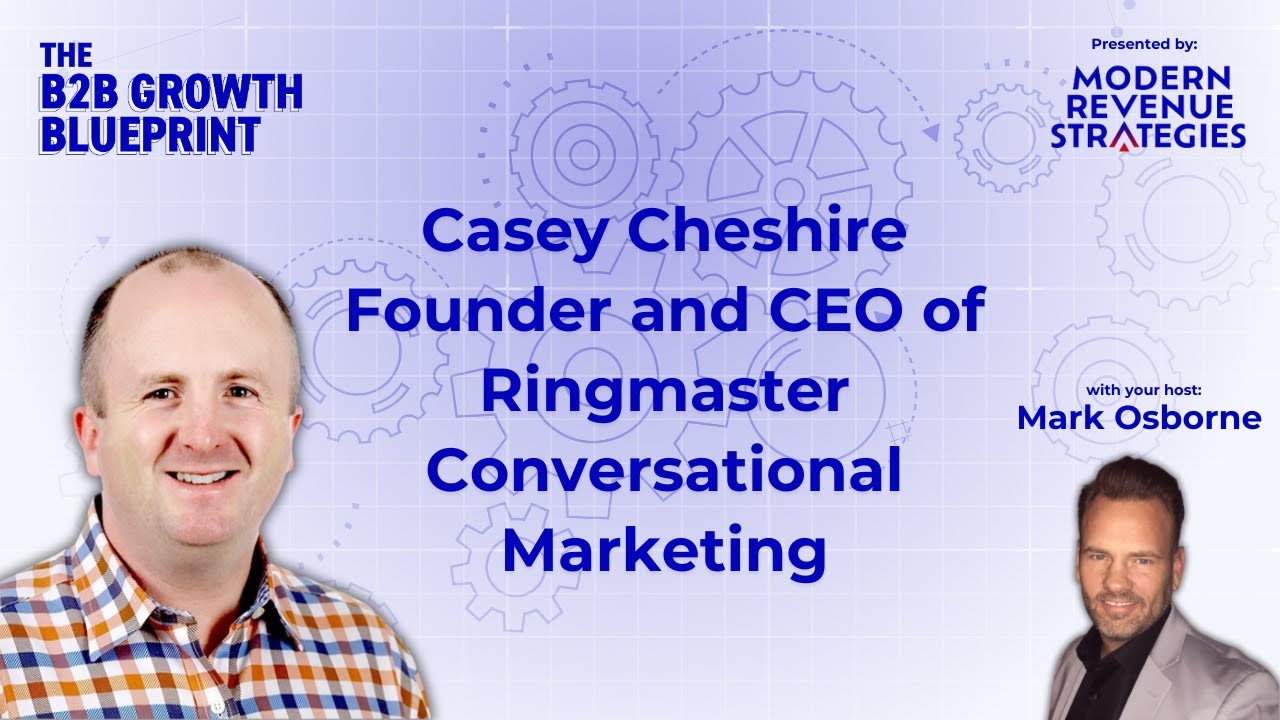
Casey Cheshire, founder of Ringmaster Conversational Marketing, argues that automated marketing tools create "disconnected marketing" that kills performance. He advocates for direct conversations and podcasting as trust-building channels that surface real buyer motivations and cut through AI noise with authenticity.
Chapters
Welcome to the B2B Growth Blueprint podcast, where we talk with entrepreneurs, founders, and leaders at B2B services, tech, and SaaS companies to learn the systems and processes they've used to create success for their business. We'll also learn from marketing and sales experts, uh, to provide insights to help you grow your business. I'm your host, Mark Osborne, and the podcast is brought to you by Modern Revenue Strategies and their 10X ROI B2B Growth Guarantee. Schedule a free diagnostic call to learn the fastest path to double your B2B revenues in just 90 days. Hello and welcome to another episode of the B2B Growth Blueprint Podcast. I'm your host, Mark Osborne. Today, I'm very excited to welcome my guest, Casey Cheshire. Now, I'm going to read Casey's bio to make sure I get this right. He's a seasoned marketer with over 2 decades of experience and the author of Marketing Automation Unleashed. It's a guide to leveraging marketing technology for business growth. As the founder and CEO of Ringmaster Conversational Marketing, which is a B2B podcasting agency, he helps businesses build authentic connections with their audiences. He has more than 500 hours spent interviewing industry leaders on podcasts like the Hardcore Marketing Show, and he delves into real-world marketing strategies and tactics. So Casey, welcome to the show.
Mark, thanks for having me. I'm, I'm stoked. This is cool. I like the show.
Thanks. Thanks so much for joining. And so we were chatting a little bit before about, you know, sort of your evolution from marketing automation to human connection. Why don't you kind of tell us that story for the audience?
Yeah, I'm a longtime B2B marketer from back in the days when we didn't even know what landing pages were, right? Back before it was fully— you had to like buy a SaaS product to get a landing page, man. Old school marketing. So all of my OG marketers, you know, who grew up on Seth Godin and, you know, all the classics. But, you know, I discovered marketing automation, Pardot specifically, when One of the tools for y'all newer people. It was like HubSpot, but it got bought by Salesforce. And, you know, I just, I spent several decades helping people get set up with email marketing and marketing automation. And it was totally cool until I realized that something was even cooler. And so I launched the podcast and I thought, well, this is pretty neat. I just did it for content. You know, I just launched a pod. Hey, no big deal. You know, it was rough. My episode 2 was pretty rough, you know, um, and but yeah, it was fun. And then I realized something. I was reconnecting with buyers that I actually had a lady, we had a great conversation, absolute badass CMO. Afterward found out that she was migrating to Pardot, and that's a tool I worked, I specialized in. Like, no kidding, this is cool, we, we can help you. Like, and we got our teams together, they scoped out a giant migration, and we made, made it happen. And I thought this was really cool. I was doing this for content, but the idea of Talking one-on-one with a future buyer, it kind of exploded my brain and I started seeing what was happening. And so fast forward, we have this company that launches podcasts for people. But really what we're here to do is combat this thing, this thing called disconnected marketing. That's my real quest is to battle disconnected marketing.
Gotcha. So You talk about sort of building more connection in place of automation. What do you define as disconnected marketing? Like, what is that thing that you're battling that you're trying to—
Yeah, you know what? When you have that awesome email campaign that worked a month ago, a year ago, works every time, you know, like the movies, and it's not— and you see the numbers go down a little bit, right? Or you have that PPC program and those numbers are just not what they used to be. Or man, LinkedIn used to crush and now it's just not. Yeah, it's when you see those declining numbers and, and especially when you know what you're doing. Like, I understand declining numbers when it's a new channel and you're experimenting. Hey, A/B testing, that's what we do in marketing. But it's if it's your go-to and you see things changing, what is that, right? And I realized, oh, I'm calling it disconnected marketing. But here's a quiz, right? So I All right, Mark, can you name 7 of your buyers by company name, right?
Yeah, sure.
Yeah, sure, right? And sometimes the logos help with that memory game. You're like, I think about my homepage, I got those logos up there, I got some pretty fun ones, you know. But then if I say, hey, can— and you probably have a cheat here because you have a podcast, right? So this is a little different. But if I were to ask someone that didn't have a podcast, hey, That same experiment, can you name 7 customers by first and last name? There's a little bit of a pause, you know?
Yeah.
And it's like that little pause or sometimes long pause, that's the difference, right? That's the disconnected marketing. And if you have that pause, you probably have these declining things going on. And if not now, you will as AI swoops in with unlimited content, with unlimited social posts. Who's even writing social posts these days?
Who—
are we just AIs talking to AIs right now, right? So that noise only makes this problem worse. And so what I realized was we— and I, I'm— look, I'm guilty. I'm number one. I'm the number one criminal in this enterprise here. I, I am the, the mafia, the ex-mafia boss of disconnected marketing. I had put so many tools in between me and the customer, and there's some great SaaS tools out there, man. I love Bard. I spent decades working with it, but It could be very easy to put these tools in between you. Why? Because then you don't really have to talk to customers. You can kind of, I don't know, just kind of hide behind the tools and they become numbers and they become names. And I know there's a bunch of talk out there about humanizing your marketing, but we don't really do it. We just put more apps in the way to help find out more, right? Oh, let's put a survey app in between. Let's put this other automation. And the challenge is that can just further disconnect you to the point where you don't actually know what's going on. And they talk about the fact that AI hallucinates, right?
Right.
Well, we can too in marketing. If we don't have all the data, we hallucinate just as bad, if not worse than AI. And this is where all those declining numbers come from. We go, oh, this is what the pain is, or this is what my prospect would totally love to see in email or in social. We think that's the case, and that might be our own bias or our own hallucination as we don't have the updated data. Yeah, like we can't do SEO from 30 years ago. What would happen? You'd get blocked. Funny story, I had a friend, hey, my, my, my whole company doesn't show up in Google anymore. Your company doesn't show up in Google? I went to their website, I scrolled down, normal website, and then I got to 3 pages of white space. I'm like, this is— I scroll over, Text, white text on a white background, 3 pages worth. They were doing some hack that was cool like 30 years ago and it's like, and Google's like, I see you and now you're banned, right? And so they had to work to get it back. Old techniques are not gonna work. And so it's just this idea of that disconnect where we put tools in the way, we start hallucinating.
So as you work with companies on, you know, kind of trying to solve this problem and to create this connection to the marketplace instead of the disconnect. Are there some ways that, you know, what are some easy ways that companies can come in or sort of the flip side of that coin? What's the biggest mistake that you see companies making as they're like, you know, everything's kind of not working as well as it once was, we're not quite as connected to our marketplace as we once were. You know, what are the mistakes that you see them making?
Yeah, we're not connected. We gotta find out We got to stop hallucinating. Cool. Good first step. Acknowledge you're hallucinating, or you might be. If you're not sure, you probably are, right? Unless you're really sure that that's exactly— and it came from their actual mouth, you might be hallucinating, right? You really don't know. And don't just bet everything on black because 50% of the time that's a terrible bet, right?
Right.
So, so what I see a common mistake being is when people say, okay, I believe you, Casey, we're hallucinating. Let's get this straight. All right, let's put a survey out there. And then I actually just 2 weeks ago, I got this survey and it was like, hey, why did you buy? What was the primary number one motivation for buying our product? There were 4 choices and absolutely none of them were why I bought the product. And there was no other, there's no D, all the above. It was just literally 4 things, probably. And it was their hallucinations creating these different categories. And they were totally hooked, man. They were off. They were on like Mars at this point. Like whatever marketing things they were smoking, they were smoking. And I'm like, guys, so automatically that survey is wrong, right? So automatically, from before they even have a respondent, it's broken. But what's crazy is they're going to get a ton of responses and they're all going to be wrong. I picked something, right?
Right.
And then eventually, like, so Now they're gonna double hallucinate thinking they have more accurate data. So the idea is you can't get around the idea of getting eyeball to eyeball with someone, right? Getting face to face, could be Zoom to Zoom, could be in person, coffee cup to coffee cup, whatever the case may be. You gotta actually talk to people.
That's so interesting. And like we see all the times that, you know, companies will, you know, use a technology tool like a survey because they, have been convinced that leveraging technology to get more data is the right solution. But so often they make that mistake of whether you call it navel-gazing or just sort of thinking about the world through your perspective and thinking about the world through your customer's perspective. And like the marketing and sales sits at this really powerful intersection of the marketplace and then the company, and they can be the voice of the customer if they get that voice.
Yeah.
Too often they're sort of creating this unnecessary distance between them and the customer by leveraging technology too much. And one of the simple ways that we recommend folks, you know, to capture this is to just do interviews with customers. And the primary place that we like to see it happen is after the sale, but before kickoff. Because like, that's when you get the most insight about what their life looked like that sent them to market, especially if you can get folks that didn't choose you. You can start to understand why, which is a little harder, but like so much really powerful insight there that you get from even just a short conversation. But that's an actual, you know, person-to-person conversation instead of a, you know, pick-from-the-list conversation.
I love that, man. That's a powerful tip. Yeah, you know what, like, I would love to sell people a podcast for sure, and we'll do everything for you. Yeah, we can talk about that later. But you know what, like, please, for the love of God, stop hallucinating. Defeat disconnected marketing and go have a conversation, right? I love it. Just get on a Zoom. And I think sometimes the problem is we get a little shy, right? If we weren't shy, we would be in sales, right? We're in revenue, but we're like, yeah, I like tech, I'm smart, I like technology, I like labs and science experiments, and I'm a little bit analytical, a little bit creative, and I don't quite fit the sales mold. I don't dress like a sales rep, so I'm a marketer, right? And, and something about it, we just need some encouragement. We need some— we need a setup, right? We need some way to chat with people and not be uncomfortable with it, like, oh, are they gonna want to talk to me? Well, I think sometimes we get confused and go Oh, oh, please join me for an hour to help me build my case study.
Right.
It's like, like, that's a take. Hey, I, I wanna, I wanna take your time for me, and maybe I'll give you a sweatshirt, maybe not. Maybe I just take your time. Is that cool? No, it's not cool. And of course they don't want to join you on that. If they do, maybe, maybe, maybe they're just really nice. But I think we get distracted by that, right? And so it's like, what's the thing to get On the phone. I love that. Just get on a call, and the timing is really great too. They have—they haven't been, you know, drank the Kool-Aid just yet. They're in that middle affirmation zone. And by the way, I've heard some great studies that say like that time is where people experience buyer's remorse. That's right. You don't know, right? They haven't kicked off yet. They've signed. They haven't kicked off. Shout out Joey Coleman saying, "Hey guys, this is the zone to watch out for." Like if you don't mind this little gap here. People are going to decide to quit you before they even kicked off. So yeah, we need to mind that time, but it's enough to just offer to get on Zoom. And I think this is where podcasting comes in handy, right? Like, yes, you could just get on a call, but the idea is, uh, people don't say no to a podcast appearance. Like, you've invited me on the show, and— or maybe I invited myself— you've accepted my invite to be like you. It's a gift from you, and I'm grateful, right? You've said Yeah, I think my audience can learn from you. Come be on my show. And I'm like, dude, this is great. Thank you so much. So you don't get— it's not like a sales call or a case study call. People are like, oh really? No, I'll be on your pod. Oh, okay, nice. And they get all nervous. What do I want to talk about? Right? So that's why a podcast can be a great mechanism to get a potential customer on a call because you start the relationship with a gift instead of being like, let me take your time and waste your time just for me. Don't worry, it'll be great. Here's your Starbucks gift card. It's like, no, let me Let me give your career a boost. Let me give you a platform for other people to listen to. I'd love for people to learn from you. And people are like, are you serious? Thank you. And so then you'll, you'll have a little mechanism for having people, and you're not, you're not lying. Let's be honest. You're not saying something and tricking them onto a sales call. Please don't do that. People sometimes do that. Don't do that. But this is genuinely offering your time and attention. Um, and it's great. I love it.
Yeah. Well, and also it's just, it's such a good way to build a, as you say, an authentic connection with someone. And that gives you a chance to, you know, kind of add some value to their life before you, before you ever have an ask. And, you know, the old adage is, you know, people do business with other people that they know, like, and trust. And it's really hard in this modern age where people are distributed, you know, not even Everyone downtown working in the same office building where you could go, you know, meet up for the after-work networking thing anymore. Now everyone's virtual. To build those know, like, and trust relationships, you have to come up with, you know, sort of clever ways that leverage that technology to do it. And podcasting is a great way to do that.
Yeah.
So you just sort of build the network of people that you know, like, and trust. And so then you know who to go to when you have a need. And likewise, you, you build that referral relationship with them as well.
There's something about the art of creation. I had this weird thing happen to me where someone I had on my podcast twice died, and I had just emailed him a week prior. And look, we're not besties. We didn't hang out. I don't think we even met in person, but I really liked him. And he, you know, he— I put a book out there and he supported the book and wrote a review. He's just a really good guy. But there's something about the When we created these positive, I was really sad afterward. And like, you know, it was almost like surprisingly sad. Like, look, I'm— anyone dies, I'm sad. But like, there's something where I was like, ah, this like hurts. And I was chatting with my wife and ChatGPT and all, all the virtual therapists, like, what is this? And it, it came back like, hey, you created something together twice. You created an art form, whether we were painting acrylics, right? We were doing— we did a podcast together. We're on stage. We're creating this. It's a two-man, two-man play we're creating here. And if to do it twice with someone, hey, you really spent some time focused. And so it's okay to, to have those feelings, but it just reminded me how much importance there is to the art of creation. Imagine having that kind of a bond with a future customer and what you could learn from them, right? I remember having coffee with a customer one time, and in 4 minutes over a cup of coffee— the coffee wasn't even done yet— I had like my My mind was blown. I knew exactly where they're coming from. I knew the 3 biggest challenges they had. I understood like that it was challenging and what they were trying to do. And it was almost like this B2B2C kind of thing. And I was like, oh my gosh, I totally get it. I see what your challenge is and I— and where I can fit into that in 4 minutes, you know. But I mean, how many discovery surveys and emails and discovery calls and I still hadn't picked that up yet. It just took a little bit of time. you know, off agenda with a cup of coffee.
Yeah, that's right. Well, and as you say, the added benefit of creating content as well. And we see so many of like folks that we work with that leverage podcasts as part of a sort of comprehensive account-based marketing program where even if they aren't talking directly to potential customers, they're talking to folks that have the potential to be influencers on that purchasing decision. And so it really sort of, it expands their network of influence and their sort of zone of genius too, because they learn things about their industry by talking to other folks in the industry that they might not normally do. And so it really sort of challenges folks to be their best selves. So tell us a little bit about, you know, Ringmaster Conversational Marketing and how you guys work with folks and doing this type of thing.
Try to make it really easy. The model is With the last company, I was running an agency, running a company. Don't have time for all the things. I really want to connect with people. I really want to learn and have conversations. Don't have time like to— and there's a lot of work, you know, I know anyone listening who has a pod knows there's this thing called pod fading, right? Pod fading is, for those listening, you know, you start a podcast, you're all excited, you realize, oh no, this is a lot of work. Oh no, initially, like my mom is listening and no one else, right? Maybe people on my team, probably not even them. And no one's listening. And it's a lot of work. You go, oh, this is not worth it. I'm done. And so the industry stats are like anywhere from like 7 to 12 pods is like the danger zone. Like people don't make it that far and they quit. So there's something like 4 or 5 million podcasts. People go, oh, after 2 million, aren't there like too many podcasts out there? No, there are 4 to 5 million podcasts. But any guesses? Actually, Mark, this is for you. Any guesses how many have been updated in the last 30 days with an— with like an episode?
No, no, no guess.
240,000-ish. That's it. That's it. Wow. Right. That's not—
so I guess that really means that there's only 240,000 podcasts.
I think so. I don't think the other ones count if they're not— that's right—
going anymore regularly.
Yeah. So, so we help with podvating, right? You don't— and also you don't look like an idiot. There's, there's something about being scrappy. I don't mind you starting ugly. I mean, I would recommend you do something rather than just stay behind all that, those apps. So do something, have a conversation, start ugly if you need to. But there is something for working with a group like ours where we're going to make you look like you've been podcasting for 400 episodes, even if this is your second.
Right.
one, right? And so that can be really helpful also, especially if you're talking to a prospect. You want to kind of look your best self, be authentic, but really look like you're squared away. So, um, so that's where we come and help out. And so not only are we helping you go from, you know, crawl to run right away, but also we're doing everything. So the— with our service, all you need to do, if this is a podcast we're running for you, is just show up. We're gonna book prep calls for you. We're gonna book the show for you and you just show up and meet these people and have these conversations, have these connection casting moments, and that's it.
That's great. Well, and what a great way to meet people rather than, you know, having to stand around at a networking event and not know who to talk to or maybe spend all of your time talking to the wrong people. Instead, you can have these sort of individual one-on-one conversations with The exact right people, which is such a more powerful way to do it.
Huge point. It's the targeting, right? People like, oh, I don't really want to like scam people and sell people. Well, if the targeting is hardcore, you can be chill on the show, right? And so if like, who is the exact decision maker of a dream client? Like, who's the one that signs and could champion this? Is it the C-whatever-O? Is it the director at this? Like, we found for some of our clients, like the exact right person at a major airline that's been dying for a solution, didn't know it existed. And before the end of the prep call, they're scheduling a demo to see the product too.
That's right.
Not because we're scamming them, but because they've been dying for help.
That's right.
And help has found them instead, right? So yeah, it like, if the targeting is good, you're just like, oh, this is what we do. They're like, you do? Like, you know, record scratch. Wait a second, tell me about— you're like, no, no, no, this is about you. This is the prep for you. They're like, no, no, no, no, I need to hear about this product because I have been, I'm like drowning over here. Tell me more about it. So it— that's how you know you found a mutual connection. You're here to just give them time and attention, you know, give them a gift, and they're like, no, no, no, no, I need to know about your thing. It's really, really going to help me. So a lot of care goes into figuring out who the right person is. But you're right, if you get them on, it's great, and you're just helping people. You know, again, not a trick, not a scam. You're just helping the people that you, you would help. And you know what's cool is you go big on this too. You know, oh, who's just a nice customer?
No, no.
Who's the one that I have no business talking to? They would never take my call. Fortune 500s, whatever the case may be, these people would blow up my quarter. These are not like week-ending deals, quarter. This is like my quarter shifted from okay to like we're going on a trip with just that one deal, right? So that's what you can use this for. And it doesn't mean everyone converts, but man, what can you do with that knowledge? You know, you still have the platforms, the marketing automation and all that, But if you're not hallucinating anymore, all of your marketing can be just amazing.
That's right. That's right. Well, and it also just helps to have the mindset of, you know, coming into these conversations with, I just want to help somebody. Oh, you know, I want to exchange some information, have some value exchange of ideas. And if there's something there, there's something there. But, uh, it really has that sort of authentic relationship building, you know, rather than just, you know, Sort of showing up and throwing up, making a pitch.
Totally.
So what's something on the horizon for you that, or your business that you're excited about in the next few months?
As I record scratch, I grab the microphone. I don't need to grab it. I'm not supposed to grab it. You know, it has all the things to take out the echo in the mic. I'm really excited. This whole concept of connect to market, right? The idea of what are the different mechanisms, the channels, the mediums, the modes that can facilitate this thing we're talking about? Like, what are the ways where we can do that? Because we know that this AI avalanche is coming of all the noise. It's already noisy.
That's right.
We have all the goofy pictures on LinkedIn and then we've got noise, right? And we don't even know who's talking anymore. So what are the ways that we can get really authentic? And this is the start, right? This is— it's going to be way worse and way noisier. So what are the ways? The way— and there's, there's probably several, but the ones that I've keyed in on podcasting, community, and partnerships. And what I'm really geeked out about right now— podcasts are fantastic, but let's say you have a weekly show. You could have a biweekly, you could have multiple. You can talk to a billion prospects in a week, totally cool. But there's a, there's a limit to that. You know, we want to get scalable. Combining podcasting with community is just Amazing. And one of the things we're like, we're doing it ourselves this quarter, and we're offering it next quarter as a service where you're doing the podcast, but we're going to invite people to join your community and your podcast, and vice versa in different ways. And maybe community first, then podcast, or podcast and community. And the community is not— the first question people tend to ask me when I say community is like, oh, what app is it on?
Right.
No app. It's a no-app community. There is no app. No, there's no Slack channel. What? It's not all LinkedIn. What? No, we meet once a month, breakout sessions, where we— and it's, guess what, never recorded. Holy crap. I mean, I, I can't miss it? No, you can't miss it. But if you do, come next month, right? And man, we just had our inaugural, uh, session for the— it's a connect-to-market community, and we're, hey, just people that are trying to help Their founders grow, swing above their weight classes with these things that connect to people. And you know what? We had a bunch of people show up and just help each other out these breakouts. Hey, I'm dealing with this issue, dealing with this issue. Someone is even like, I'm probably changing jobs. And they're like, here's a recruiter, right? All these things were happening and people were just helping each other out. No pitches, no vendors pitching, just marketers helping each other out. on this thing. And so it was cool, tons of great value. But wow, what a great mechanism to invite people to community, invite them to podcasting. And that's just 2 of the 3. So that's what I'm excited about is rolling out communities to all these podcasts.
That's great. That's great. And I love that concept of like building a real community that's not just asynchronously go post something on the LinkedIn group every once in a blue moon when you're trying to sell something, but instead like an actual community of people helping Yeah, it's so exciting.
I mean, it was just, it was unbelievable. And it's happening every month. And this is just, and this is for myself, right? This is, we're like, people ask, how do you get customers? We get, we use our own, we drink our own Monster, we drink our own champagne, right? Like, we, we say this stuff, but we use the stuff to connect with customers too. So podcasting community is how we're connecting directly with our ideal customer. And it's been fantastic.
Awesome. So for those in our audience that are listening and they're like, I, I do believe that I need to have more of a connection to my marketplace, and I do believe podcasting and community could be a way of doing that. And maybe they'd like to learn a little more about how you could help them. What's the best way for them to get in touch with you, Casey?
Totally easy, right? Let's get rid of all the barriers. casey@ringmaster.com. C-A-S-E-Y ringmaster.com. That's it. Just email me. That's cool. Um, you can check out our website, of course. You can chat with me there if you'd prefer that. We have a little chat thing. My cute little face pops up. I'm like, hey, what's up? You can chat there, right? Email me. And listen, like, I am just all about helping, right? I'm on this mission to connect, right? We're just— we're here to just— human-to-human connection is just what I'm all about. It just— it's magical. I love the feeling. Um, it's great when you put it into a business context. So I'm just here to help people connect. So if I can help someone listening to this with just some ideas, want to brainstorm, I love getting on like a call with like a box, and I mean a box of Expo markers, and just let's figure out what we call this thing. The name is really important. The, you know, the imagery, the artwork, there's all sorts of things that the questions, the order of the questions is really important. You know, if I can just throw some knowledge at you, I'm happy to do that. Whether your company's hiring us or not, just happy to help out the marketing community. And once you see it in action, it just, it's amazing. So yeah, let me know how I can help. Also, my pod too, check that out, The Hardcore Marketing Show. If you like this show, you'll like that show. I'm going to tell my folks to come check this show. We're going to get you on it too, man.
Yeah.
We just smash myths. You know, I just can't handle bullshit and we just destroy it. And so, it's a lot of fun, but also, it's the model of the kind of show that we will help build for you if you're listening to this. And so, go listen to that show and you'll hear what kind of show we help create for you. But a lot of fun podcasting.
Awesome. Well, Casey, thanks so much for taking the time to join us today. I really enjoyed our conversation.
Dude, you're a natural. What do you have, like 2,000 episodes at this point?
Not quite, but we're getting there. I'm past 12.
It feels like it.
So, dang, I made it into the— and I definitely updated more than one in the last 30 days. So, right, I'm in that small group of 240,000. But Casey, thanks again for joining us. We'll definitely have your email address there in the show notes so that folks can get in touch with you and learn more about Ringmaster.
Heck yeah, man. And if you're listening to this, hey, this is an awesome pod. Mark does this for free. He's hooking you up. Definitely go give it a rating, little Spotify, it literally takes 5 seconds. Just hit that thing, give a little magic. If you don't give it 5, I won't talk to you if you email me. So make it happen.
Thanks, Casey. I appreciate that. Talk to you soon.
See you guys.
Thank you for joining this episode of the B2B Growth Blueprint podcast. We hope you've gained insights to grow your business. If you enjoyed discussion, please rate, comment, like on your favorite platform, and share to others who will find it useful. Do you know a CEO, founder, or leader at an early-stage B2B services, tech, or SaaS company who would like to be a guest and share their story? Send us a note. Let's schedule a conversation.
More from Mark

How Can You Maximize Your Business Value Before Selling? with Randy Katz Video







