How Can a Career Shift from Banking Lead to Thriving Global Consulting Business with Daniel Feiman
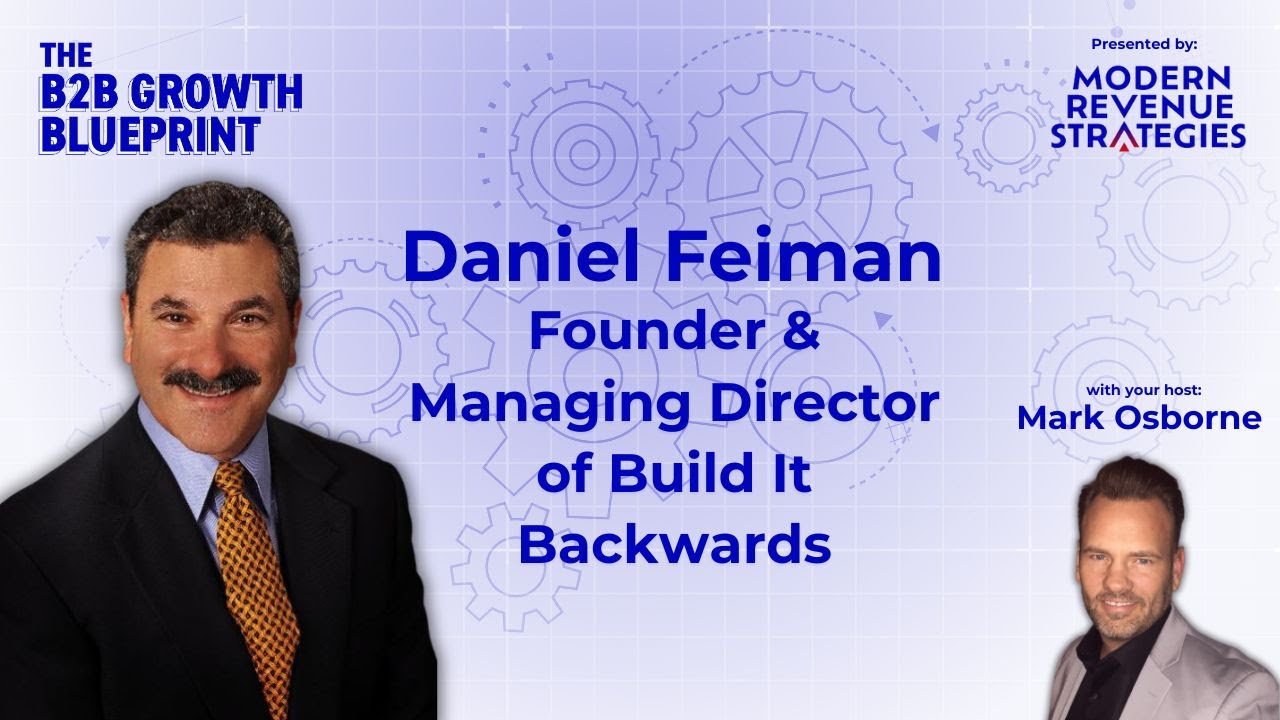
Daniel Feiman left commercial banking to start Build It Backwards, a consulting firm focused on strategy, succession planning, leadership development, and finance. His core method: reverse-engineer from a long-term vision to near-term milestones. He works with companies of $5-100 million in revenue, arguing that a written plan, even imperfect, beats waiting for a perfect one.
Chapters
Welcome to the B2B Growth Blueprint podcast, where we talk with entrepreneurs, founders, and leaders at B2B services, tech, and SaaS companies to learn the systems and processes they've used to create success for their business. We'll also learn from marketing and sales experts to provide insights to help you grow your business. I'm your host, Mark Osborne, and the podcast is brought to you by Modern Revenue strategies and their 10x ROI B2B growth guarantee. Schedule a free diagnostic call to learn the fastest path to double your B2B revenues in just 90 days. Hello and welcome to another episode of the B2B Growth Blueprint podcast. I'm your host, Mark Osborne. Today I'm very excited to welcome my guest and actually my neighbor right down the street from me, Daniel Feynman. Daniel is the founder and managing director of Build It Backwards, which is a consulting and training firm based right here in Redondo Beach, California. He specializes in strategy, finance, leadership, and succession planning and has advised organizations across 30 countries in industries ranging from aerospace and consumer products to oil and gas and technology. His clients include global leaders such as Apple, Dell, Hilton, Credit Suisse, as well as governments and universities around the world. A published author 4 times over, he's an educator, a media contributor. He's taught at UCLA Extension for over 25 years and was a visiting professor at the University of Huddersfield in the UK. He's among the less than 1% of consultants worldwide that have been awarded the Certified Management Consultant, or CMC, designation. So, I'm very excited for this conversation, Daniel. Welcome to the show.
Thanks very much, Marc. I'm really looking forward to this.
So, you've obviously got a really diverse background and done a lot of things in a lot of different spaces. Why don't you give our audience a little bit of a background of sort of tell your story of what brought you to where you are today?
Well, I guess I started off fairly young. I was 12 years old when I had my first real job and 13 when I tried to start my first real company. Which failed miserably, but I was 13 years old. My actual real working background is 6 years in manufacturing.
Okay.
Back in those days, 6 years in marketing before I was recruited by a bank president to become a banker. And I worked in both commercial, traditional, and non-traditional banking till the point that I became frustrated with the system. That's when I left, which was almost 30 years ago now, to start my own firm. And the whole reason we started this was to make a sustainable difference with clients where I couldn't do that in the corporate world as I viewed it then.
Yeah. Well, so that begs the question, what was it about that corporate environment that was so challenging for you?
I think the restrictions and part of it was commercial banking, as you probably well know, is a regulated industry. And periodically you'd get one set of guidelines from the federal regulators and a different set of guidelines from the state regulators at some et cetera, plus the bank's own internal guidelines really hamstrung us, or me particularly, from doing what I thought was in the client's best interest. You know, we hear about different wealth managers that are fiduciaries versus the other type, and a fiduciary has to do what's in the client's best interest.
Right.
I felt that's what I wanted to do. So that was the real impetus to leave, take that leap of faith. Start my own firm, which scared the heck out of me because I was brought up in the world where you get a good job, keep your head down, get your gold watch.
Right, right.
I was always afraid to take my— take myself seriously, I guess, when you talk about starting a firm. My wife absolutely believed in me. One night over dinner, she said, you can do better on your own than you can for them. And thank goodness, between her support And financially, we were strong enough at that point to be able to do it. Did I make a mistake or 2 or 12? Gosh, yes. But one of the things I tell people now, and this came up recently, my worst day in consulting was still better than my best day as a banker.
Well, that's a good place to be. It's like the phrase, you know, today's a little bit better than yesterday. If every day— if that's true every day, then you're on the right track. So, tell us a little bit about sort of your practice, how that's evolved since you started it and, and where it is today and where you spend your time?
Well, most consultants, um, and in this country a consultant is anybody that hangs out their own shingle. It is different in different parts of the world, but I really didn't know where I wanted to focus or specialize initially. And as I worked with clients and as I saw problems that really resonated with me, that's how it evolved into the 4 areas that we focus on. You know, strategy and succession are very much aligned. And I'm a big believer that you don't need a perfect plan. In fact, a perfect plan doesn't exist. What you need is a plan. And the difference in all the literature, and I'm sure you've seen this yourself, but all the literature supports that any plan that is executed is better than the perfect plan we're waiting for.
Yeah.
In fact, that probably goes back— Eisenhower's quoted several different things that I believe the actual quote was, an average A garbage plan violently executed beats a perfect plan every time. And I've seen this time and time again. So, we really put our efforts into developing a system, a process, if you will, for strategic planning. And we did the same thing when we started to work with organizations and focused on succession. But I have to be careful when I use that term.
Yeah.
Succession planning to some people is exit planning, is retirement. And that certainly does work in some situations. In fact, I sit on the board of the Orange County chapter of the Exit Planning Institute, and they use succession primarily to mean exit planning, which we don't do, but we collaborate with exit planners specifically. Succession, as we see it, is holistic. It's for the entire organization. It's how you prepare your organization for long-term success. And most firms don't do this. So if you look at where you want to be as an organization in 5, 10, 20 years and say, all right, what is the future org chart going to look like? How do we prepare the organization regardless of who's in what seats today? So if you identify, assess, and develop key individuals, you build your bench strength, if you will. You're always prepared for whatever happens. And an example came up not long ago. I had a conversation with a client that said, I really don't know if I want to grow or if I want to diversify or if I want to retire. I'm— I really don't know.
Yeah.
And I said, well, if you're not here, what's going to happen in the organization? And he just froze for a second. I said, would you like to future-proof your organization? And he looked at me and he waited and he said, yes, but how?
Yeah.
Well, if we put a leadership development program together, that's really a succession plan for the organization, then we can put a transition plan in place for you personally so you can achieve your personal objectives. That will allow the organization to succeed regardless of what happens in the marketplace. whether we've got a recession or a boom time, whether there are market opportunities or you just have to huddle down, whether we have 2008 again or 2020 again, COVID.
Right.
What happens, you're going to be agile. You're going to be resilient. And that's a result of developing this succession planning model I have, which we've instilled in over 100 organizations across the country and a couple in Europe. So, that's how things have evolved based on what's going on with my clients.
That's great. Well, and I love this idea of— and as you're talking, I'm thinking about the connection between the word success and succession and really sort of planning for success and this idea that it's not necessarily an exit, but it gives you the option to prepare for retirement or to sell to some third party or to bring in recapitalization or or whatever it might be. And so often, like I've heard the phrase many times that quality of choices or quality of choices comes from quantity of options. And so, if you haven't taken the time to develop multiple options for yourself, well, then you only take the one you got and that might not be the best option. And so, but if you do take the time to plan and think through different things that could happen or that you want to happen and be, uh, sort of, uh, intentful about, uh, where that plan takes you, then you have a lot more options and you're prepared for many more eventualities.
Completely agree.
Yeah. And, and I, I love that quote, uh, from Eisenhower. Uh, and I think when we were chatting earlier, you said another one, which was, plans are worthless, but planning is essential. I think you also attributed Eisenhower. I love that one too.
Yeah, as do I. And I've become a firm believer that it's the process of planning where we're required to ask and answer critical questions that we really learn and grow as an organization. And I've done the same thing in my firm, and that's really how we have evolved the way we have. When I work with clients that just want to get to the end result, I go, Well, wait a minute. What are you trying to achieve? Let's— I mean, the reason we call the organization Build It Backwards, it wasn't the first choice for the name of the firm. In fact, it wasn't my firm name initially. My advisory board kept pushing me to use that as the name of the firm because that's the way we work.
Okay.
What's your ideal horizon for you personally and your organization? You know, which effectively your vision, perfect world somewhere down the road. If we can be clear on that, if you know how you want to make a difference in the world, what you want this organization to accomplish, what you want to contribute, let's put that up on the wall, whether it's painted on the wall, whiteboard, flip chart, whatever it is. And in order to achieve that, then you reverse engineer. You come back to today. You literally build it backwards. So you have a 20-year vision. What does the organization need to look like in 10 years to be on track? I mean, specific goals that are measurable with actions tied to them and owners of responsibility. And from 10 years to 5, 5 to 1, and then you can get very specific, very tactical, but in a manner that leads you to the path you're trying to achieve. That process Is critically important. But yes, the plans themselves, the short-term thing, they're going to be surprises. There are going to be hiccups. You're going to make changes. All of that is fine as long as you keep that long-term horizon. You're focused on that. The adjustments you make can move you closer and closer to that. And that, Mark, is the biggest difference between the average firm that's struggling to stay alive and those that thrive. Because they've got a process, they've got metrics, they've got a vision.
Yeah. Well, you're reminding me of some other quotes, but that have some sort of interesting application. And the first is, you know, in the military, there's this concept of a command objective, which is like, you know, take the top of that hill or, you know, secure this bridge or take out that bridge or, you know, take out that hill. And you know, sort of the commanding officer is charged with, this is what you've got to accomplish and you've got a plan. But as Mike Tyson says, everyone has a plan until they get hit in the mouth. And in the military, they say, you know, all plans go out the window once you make contact with the enemy. And the same thing is true in business. And I love this concept of the process of creating the plan allows you to then adapt to changing conditions as you work towards that command objective of taking the top of that hill. And it's so interesting to see, like, I've had some leaders that I've worked with at companies that are like, what's the point in planning? Because who knows what's going to happen next month, next quarter? Things are so crazy and volatile in the landscape right now. What's the sense of making a plan? And then you've captured it right there, which is just the process of thinking through what you want to do. And how you expect to get there makes you much more able to adapt to those changing market conditions when you do get hit in the mouth. When your plan doesn't go as smoothly as you want, you're able to respond in a way that's much more coherent and aligns with your end goals rather than just, oh, now you're grasping at straws.
Absolutely agree. And I'm smiling when you use that Tyson quote because when I was in the service, I did box. And I will tell you, That no matter how you go into a bout, when you get hit in the mouth, it does— it stings.
That's right.
And unless you have prepared, unless you have gone through the alternatives in your mind, and in many cases written down alternatives and reactions and situations, it goes back to the 5 Ps, which I love. Proper planning prevents poor performance.
Yeah, that's right.
So, when an organization says, we want to be good, we want to accomplish X, we want to go here. Great. Let's figure out how. Recognize, as you say, situations are going to evolve. It's a very fluid world. So, you have to be agile. People Organizations who are agile, who are flexible, but have a plan always can get back to their core. And I mean, do you think that Apple or Google or Hilton Hotels operate without a plan?
That's right.
The reason that they're leading organizations is they do planning and they are flexible. If they just responded on a day-to-day basis to today's fires, There's no way they would be the way they are today.
That's right. I read an interesting quote from Harvard Business Review that says that companies with a written marketing plan— I love that you talked about, you know, writing it down. Not, don't just let it, you know, I got a plan. Is it written down? And what the Harvard Business Review saw was a company with a written marketing plan experienced 200% greater results than a company without a written marketing plan, regardless of the quality quality of that marketing plan. So literally just writing it down, uh, is a, you know, huge break. And so many times we work with, you know, founders at fast-moving companies that are like, again, you know, what's the point of planning? Well, I, I don't have time to write it down. Uh, and I oftentimes say, you don't have time not to, uh, because what it's going to cost you to not have it. The other thing that we see too is sort of creating a culture of collaboration. When something's written down and you can put it on a board, or you can look at it on a piece of paper, you can get shoulder to shoulder with it and collaborate and make it better. Whereas if it only lives between one person's ears, they have to explain it every time, and then it becomes almost adversarial on, you know, I'm picking on your plan instead of we're collaborating on the plan. And just that act of writing it down is so important. And you talked a little bit before, and I want to dive deeper into this, about the sort of the idea of collaboration or sort of organization-wide planning and the fact that it's not just that owner, it's not just that CEO, it's not just that leadership team that's important for this. Talk to us a little bit about what you see as important elements for planning for success within organizations as it pertains to Who's involved?
Great. Well, and thank you for that softball question. I'm 100% aligned with you when it comes to writing things down, first of all. Because whether we're talking about the executive team or leadership team or entire organization, when you write things down, we all are looking at the same words at the same time. That requires clarification.
Yeah.
Hopefully moving to consensus. But what's in your head, and you know what it is, and what's in my head, and I know what it is, we both know we're 100% aligned. Well, now we write down separately what we're thinking and we put those 2 pieces of paper next to each other. They're not the same.
That's right.
That opens up the dialogue, which leads to one of the most important elements of success in any organization— communication. The most common complaint I've heard in organizations I've worked with in my entire career is we have poor communication. We have no communication. We have an open-door policy, but nobody dare ever go across that threshold. So, it's critical as we're creating the plan to document it, to have everybody look at the same words at the same time.
Yeah.
And then, to communicate it throughout the entire organization because most people, the vast majority of people, in spite of a lot of negatives that we've heard, Want to be part of a winner, want to be part of success. Give me your expectations. Tell me what you want me to do. Tell me where we're going. And I'm happy to be part of getting us there.
Right.
I mean, employees at every level in almost every organization, that's what they want. Be clear on what you want me to do, how you're going to measure it, what success looks like. And we can work on that together. And some of my most gratifying engagements have been when I have the privilege of not only collaborating with a leadership team, but collaborating with other professionals to benefit the organization. It's something that I have preached since we opened our doors, which is, Mark, if you're my client, I'm your business concierge. Whatever you need, Whatever service, whatever product, let me know because I've developed a database of people that I know, like, and trust across the board. I can probably make a phone call and get you an accountant, get you a valuation expert, get you someone with experience in intellectual property and Eastern Europe disputes, which I've actually done before for clients. So, You and I work on a client together. We're going to help each other. 1 1 3. With all due respect to the accountants that may be listening, this is where we can actually multiply value. And I was leading a group that I put together, my Level 1 group yesterday. And we realized that out of the 15 of us on the call, 4 of us shared a client. And I had brought in one of the other people who then brought in somebody else who brought in someone else. All with different specialties because that's what the client needed. The client is much better off for it and is very appreciative of the fact that they were able to trust the recommendations that came in. And that's just part of the value that we like to bring to clients.
Yeah, well, and it's that, it's that ability to collaborate. And what I find that really opens the door is sort of that sort of systems thinking. and process thinking. And, you know, especially in the marketing and sales space, there are some of the, you know, sort of evangelists in the desert that kind of, I'm never held down by process, you know, the creative moment strikes me. And I'm always like, then how is it repeatable? You know what I mean? Hemingway has a great quote since we've been having a lot of quotes is, you know, I only write when inspiration strikes me and it strikes me every day between 9 AM and 5 PM. And like he was known for just really disciplining himself to, you know, sit down and create a process for being creative. And I find that, you know, in the marketing and sales space, there is a lot of sort of creative magic that happens, but it's enabled by a process that sort of sets it up so that it ensures success. Whereas the people that are like, I just sort of kind of put some things on the wall until it hits me. Like you're not gonna be able to collaborate with other people because they can't inform your process and you can't plug into theirs because you're waiting for lightning to strike. And that's not a repeatable or scalable thing.
Was it Vin Scully that used to say luck is the residue of design?
Oh no, but I like that. I think it's one of the Greek philosophers says that Luck is when preparation meets opportunity.
Exactly.
But that preparation piece was important in order to have that luck. And there's another Hemingway quote that I love. Old Man and the Sea is one of my favorite books. And he says, it's better to be lucky, but I'd rather be exact because it really is better to get lucky and like have the fish appear in front of you. But You can control being exact and having all the knots tied right and all the lures ready and every— all your equipment in working order, being in the right place at the right time, and all the things that you can control. So one thing that I— you touched on earlier that I don't want to leave, which is the idea of, you know, sort of leadership development and that being important as part of succession planning. You know, how do companies that you see that are successful bring that in to sort of that succession planning piece?
Well, the best examples are certainly companies that I have worked with because I've seen it from the inside. There's a 5-phase process, which is actually what we wrote about in our last book. There are 5 phases in the overall process. And the idea is that you, you start off by getting prepared, then you have the initial phase, and there are supporting templates that are flexible enough that you use the ones you want and you ignore the other ones.
Right.
But it is a sequence of steps because in every organization, if we want to optimize— and most organizations do— What we want to do, what we need to do, is to identify leaders beyond who we have. The biggest difference between an entrepreneurial organization and a professionally managed organization that almost always does better is the entrepreneur recognizes their own limitations and the fact that God only gave us 24 hours a day each. So, you can't work 30.
Right.
So, you can leverage your time and leverage your success With other key people. So, if you can identify those that are ready, willing, and able to take on more responsibility and then assess their current skill set against the ideal for a given position, you develop a gap analysis. Then, that gap analysis then can lead to a formal development plan, an individual development plan. Let's say, Marc, You and I have half a dozen people who we've identified. We've put through this process. We can create their individual development plans together. That happens to be the, if you will, roadmap to the future. That's really a career path. Then we can start to say, all right, for you, an individual, here's step 1, step 2, step 3, so you can take on more responsibility. as you're ready and as the need creates. But also, we can then codify that. We can put that into a system to lay out a sequence of steps for others who might aspire to this. And I'll give you a very quick example. There's a fairly large regional accounting firm that engaged me to come in and build effectively a career path for them. So you come out of college, You go to work for the accounting firm even before you pass the CPA exam. Here's the things you need to master to get to the next level, and then here's the things you need to master to get to the second level. And that's across half a dozen different disciplines. So it's very clear to anyone, well, if I want to move up, this is all I need to do. What that leads to— and this surprises a lot of people, but we've seen this and been able to measure it— Having a career path, giving opportunities, challenging people to do more— in other words, creating tomorrow's leaders— leads to higher productivity, lower turnover, higher employees' satisfaction, and an increased bottom line. I don't know any firm that doesn't want an increased bottom line.
That's right.
So it's worth the investment because it pays dividends.
That's right. Well, and you, you raised such an important point, which is, you know, sort of career pathing is not just for large corporations. Like, even, you know, small companies that, you know, have those vital employees that they're like, I don't know what I'd do without, you know, so-and-so. They know where all the bodies are buried. They, you know, know how everything works. But have you taken the time to think about what do they get out of this other than the paycheck? Over the next 2 weeks, like, because people want that long-term planning and that, you know, succession that is out there. And so if you're not thinking about that, they are, and they might be thinking about leaving. And so that's a real big vulnerability that most companies don't think through, especially smaller companies that are just kind of, you know, taking it as they can and, you know, You know, moving fast and trying not to break too many things.
Very, very true.
Well, Daniel, you're obviously an expert in tons of interesting topics that we could spend all day on, but I gotta be mindful of your time. But before I let you go, you know, for folks that have been listening and, you know, love what they're hearing about, you know, your approach to sort of consulting your clients and helping them build and grow, talk to us a little bit about, you know, give us the pitch, like who do you work with? Who should reach out?
And thank you for that, Marc. We generally work with clients whose annual revenue is between $5 and $100 million, what's typically referred to as SMEs or small and medium enterprises. Although we have certainly, as you said in the intro, I've worked with some global companies. Those are more the exceptions than the rule. And I've worked with some much smaller companies, but that's really the sweet spot. Other than retail and hospitality, We've worked with almost every other industry, and I'm looking at my whiteboard up here— law firms, aerospace manufacturers, alfalfa seed farms, and almost anything in between.
Okay.
And the easiest way for folks to get ahold of me is either my name, Daniel Feynman, @builditbackwards, or builditbackwards.com. Those are the easiest ways. And yes, all 4 of our books are available on Amazon, Barnes Noble, etc. And I always tell people, if you want to have an initial phone call, we don't charge for that initial consultation. Let's sit down and have a phone call, see if what you need is what I can provide. And if what you need isn't, then I probably know somebody that I'm happy to introduce you to, like Marc for marketing.
Well, Daniel, thank you so much for joining us today. I've really enjoyed our conversation. And I know our audience has gotten a lot out of it.
Very good. Thanks very much for the opportunity, Mark, and I'll see you around the block.
That's right. See you soon.
Take care.
Thank you for joining this episode of the B2B Growth Blueprint podcast. We hope you've gained insights to grow your business. If you enjoyed this discussion, please rate, comment, like on your favorite platform, and share it others who will find it useful. Do you know a CEO, founder, or leader at an early-stage B2B services, tech, or SaaS company who would like to be a guest and share their story? Send us a note. Let's schedule a conversation.
More from Mark

How Can You Maximize Your Business Value Before Selling? with Randy Katz Video







