How Can Productizing Services Drive Scalable Growth for Modern Businesses with Ryan Caracciolo
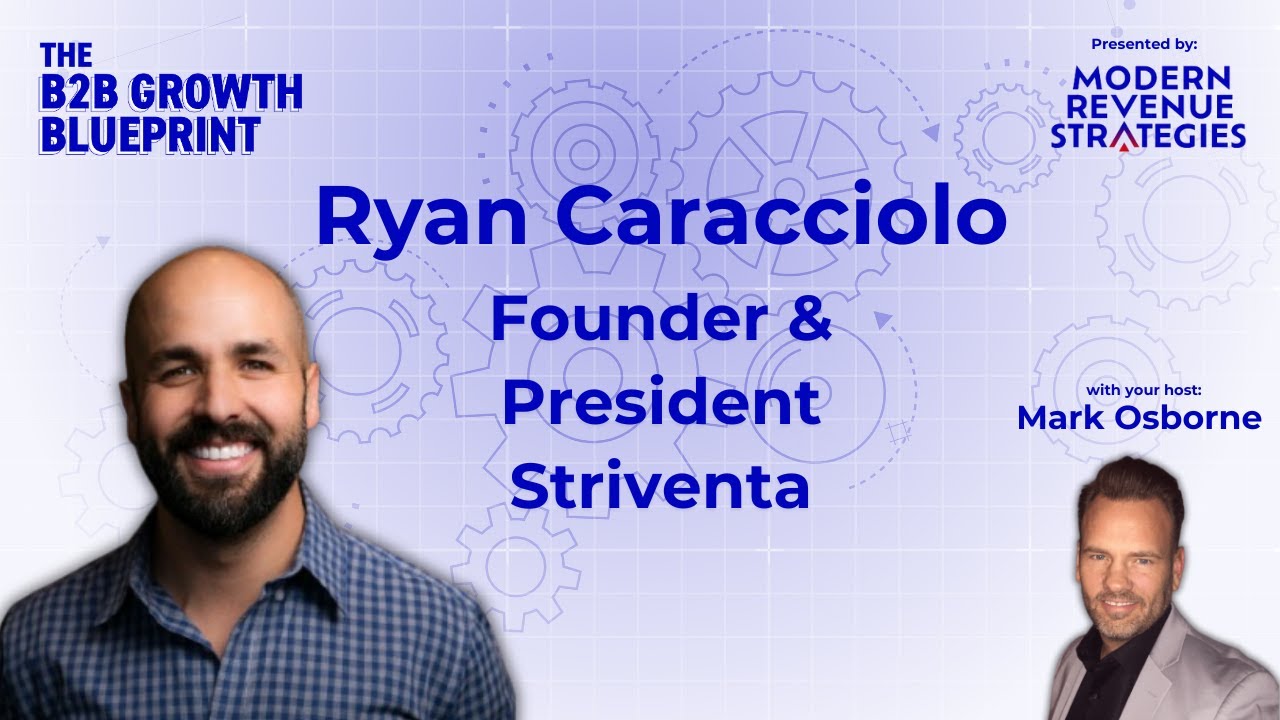
Ryan Caracciolo, founder of Striventa, explains how to turn custom agency services into a scalable product. He converted Hyperdrive WP, a web development service, into a growth-focused WordPress product, and discusses how SEO and AI are changing lead quality and search.
Chapters
Welcome to the B2B Growth Blueprint podcast, where we talk with entrepreneurs, founders, and leaders at B2B services, tech, and SaaS companies to learn the systems and processes they've used to create success for their business. We'll also learn from marketing and sales experts, uh, to provide insights to help you grow your business. I'm your host, Mark Osborne, and the podcast is brought to you by Modern Revenue Strategies and their 10x ROI B2B Growth Guarantee. Schedule a free diagnostic call to learn the fastest path to double your B2B revenues in just 90 days. Hello and welcome to another episode of the B2B Growth Blueprint Podcast. I'm your host, Mark Osborne, and today I'm very excited to welcome my guest, Ryan Caracciolo. Now, Ryan is the founder and CEO of Striventa, a business growth agency built for companies that want more than just marketing and sales tactics. They want momentum with an ROI attached. With over a decade of experience, Ryan helps businesses grow through clear strategy, smart systems, and relentless execution. Ryan also launched Hyperdrive WP, which is a high-performance website platform that gets businesses live in as little as 30 days with a site built to rank, convert, and scale. His work blends strategy with execution to turn big ideas into business momentum. So Ryan, welcome to the show.
Hey, thanks for having me, Mark. Appreciate that intro.
Yeah, absolutely. So before we get into Hyperdrive WP and some of the other specifics of what you do, why don't you give our audience a little bit of background And sort of your story and journey of what brought you to where you are today.
Yeah, happy to. Well, first off, I'll start with the origins of Striventa. The name was striving to invent, you know, we put an A on the end of it because if we didn't, it sounded like a toothpaste. So a little bit of genius and goof there, I guess. All good ideas have a little bit of both, right? But before that, I was actually in sales. So I was in healthcare sales, business to business referral relationships in the pain field, right? And so I started there, you know, visiting 20 to 30 offices a day, building relationships, and then worked for an agency for a little bit on the marketing end and realized, you know, early on, okay, the marketing side was held to different KPIs than I was as a salesperson. Isn't it all the same return on investment we're striving for, right? And so that's kind of when the idea occurred. This was before to like any sort of major sweeping online, you know, items were being done. And so I think there was some opportunity that I saw there in that space specific to healthcare. You know, my wife's a nurse. I've always been in and around healthcare. I've loved it, but more so from the business side. And so I think that's really what spurred that off. And so yeah, I started Striventa on an IKEA desk and a laptop, you know, in the side room to our garage. And, you know, Like every business owner opened up shop and thought the calls would come flooding in. And yeah, and even though I was responsible for business growth and I knew it was a false pretense to get my hopes up like that, I still fell prey to the entrepreneurial trap of, hey, the shop's open, shouldn't people want to do business? Right?
Right, right.
And so it was a fun learning experience for sure. You know, fast forward now, 12 years later, been in business and just been so blessed with the partners we've had, the clients we've had, the employees, the staff. It's been one fun run. And so now we're kind of moving into the productization of some of our services as well. So that's a fun evolution. But yeah, that's kind of where it all started.
That's so great and so interesting to hear how that's evolved. And I think you've also really sort of niched down into working with very specific types of clients. Isn't that right?
Correct. Yeah. So a lot of our clients, you know, reside in the healthcare space. I would say real estate, luxury real estate is another space, and then any services, based items. So, you know, not so much in the startup world, although I do love working with startups and we have. Those are always fun to work with, especially the ideas are rolling. But our mainstay portfolio is certainly healthcare, real estate, and the business services world, which we love. You know, it's all about relationships, as you know, that's what business is. And so we feel like, at least in our job, we're helping real people solve you know, real problems. It's not a $10 widget we're trying to help a company sell. There's nothing wrong with that, but I just think for us, especially with the inbound marketing methodology and approach that we subscribe to, you know, education and being a resource, inbound marketing leads, how to generate them, I think it's very conducive to those spaces, you know, legal markets as well, lawyer offices, things like that.
Yeah. So you alluded to this earlier, but I wanna come back to it, which is this sort of productization of your services. And this is actually something that we see is happening a lot, which is, you know, companies that maybe at one time had like a tentpole sort of delivery of, you know, we deliver this engagement and then we go away and maybe they call us back in a year and we do it again or do something similar or different. More and more companies are taking advantage of the proliferation of software and of engineers and you know, cloud hosting and all of those capabilities to build, you know, sort of software that enhances the services that they deliver. And I think you've done something similar with HyperDrive WP. Is that right?
Yeah, that's correct. So HyperDrive WP was really spawned from, you know, my developer and I getting together saying, okay, early on, we need a website framework that can actually rank, right? There's, there's a ton out there. And we've all heard of them. There's builders on WordPress, there's themers on WordPress, there's Squarespace, Wix, there's custom frameworks. And there's pros and cons of everything. And so for us, we've always, especially with our partners, you know, the ones that entrust us to grow their business month to month and year to year, we had to build the best. And so what we did was WordPress, the Genesis framework was always a favorite of ours and how it reported from an SEO standpoint to Google. And so we stripped out the spine of that framework early on as we were kind of testing out some things and quickly found out, especially with the evolution of WordPress, that we were able just to go straight native blocks. We still spent a considerable amount of time, you know, building in on the backend a page builder experience without the page builder bloat, because clients, you know, wanted to go in and log changes on their own. You know, they don't need us to update their bio pages, right? And so that's where the evolution really started, was, you know, watching the results over the last decade of our partners continue to grow. Yes, we poured in content and SEO and local SEO and all the things, but at the core of it, we would have websites that weren't on our framework that we still took on because we knew we could help them grow, but the results weren't happening as fast.
Interesting.
Yeah, the timelines were a bit longer and we had a lot of data kind of really backing this up to make this call to then say, okay, well, let's figure out a way to actually turn this custom WordPress, you know, build that we've done for, you know, almost a decade now into a product, meaning how can I offer the same quality but with a convenient experience? And so that's where my lead developer and I, you know, put our heads together and thought, okay, from a development standpoint, what are the pros and cons? From a business growth standpoint, what are the pros and cons? And, you know, how do we come together on this? And so that's what really kind of started the conversation. So it's not just a product that we thought would be like a cool thing. It's really rooted in like business growth and indexing well on Google first. And so this whole process around it is, okay, business owners, they don't want to spend another 90 to 120 days redesigning, redeveloping a site. Business needs to be agile. And so, you know, on top of all the framework benefits, what we do is we basically take an existing site and within 30 days, we've gotten it down to 7 days for some, but within 30 days, we actually put them on our framework, you know, do a design lift. Wow. Design refresh. We keep all the content URLs, everything intact. We do a lateral transfer because I don't want to mess with any rankings on the go. But time and time again, just by doing a lateral transfer, we actually index about 10 to 15% more keywords within the first 3 to 4 weeks, um, just by doing nothing but our framework. And so then on top of that, then you can pour in content SEO, local SEO, all the things, right? And that's where it gets fun. But we had just had seen these results pour in even from clients who are not helping on a consistent basis. So that's when we knew, okay, we have something here, we need to market it more because I think business owners are yearning for solutions where, you know, they need something cheaper to launch with than a custom site, but they also want to manage it, but also needs to grow and scale with them, right? There's a lot of things to accomplish. And so that's where ours, I think, really fits a lot of those niches well.
Yeah. And so I'm curious how, you know, the big thing within, you know, ranking and SEO today is, you know, fitting in within sort of the answer engines. What do you call that? ChatGPT or whichever your favorite is. How do you see that evolving? How, you know, websites are trying to rank for certain keywords versus, you know, create content that gets surfaced into those engines? And how do you think websites fit within that in the future?
Yeah, great question. It's actually one we've gotten a lot, especially with the evolution since January of AI. I always use January as the landmark, not that it wasn't around before January, but if you could have seen the backend AI that we had to deal with on Google My Business and Google Ads flagging everything false flagging everything because they started to incorporate AI. It was bad. And so I didn't have a whole lot of hope in AI then last year, but fast forward to January, the space has just been totally rocked. And so the interesting part though is that I think, and this isn't just our pitch, but I do believe that websites will actually become more valuable. The reason why I say that is because those engines still need to pull data in. They still need to crawl and rank from somewhere. Now, a lot of the AI engines though, like ChatGPT or Grok, they pull in outside resources like Social media status, influence, engagement, brand building opportunities like the certifications from the BBB, from reviews. So they're pulling in a more holistic approach, you know, beyond the website. But that website is not going away. And so a lot of our clients, you know, it was fun to watch those new AI overviews come out because, as you know, the AI overviews in Google Search, right, came out a while ago before AI really took off and website traffic started catapulting because people could see their answers and move on. But I think it's understanding the difference between like a top funnel search term and a bottom funnel, meaning bottom funnel, meaning I want to do business with a company, a commercial intent or transactional intent versus educational. So a lot of our clients actually, as soon as that update hit, we got to see a ton of our AI overview searches increase, which was awesome to get those rankings and to know, okay, website traffic certainly has shifted, but we've actually seen a more qualified lead come out of all of this. I know that's an unpopular opinion to say, but at least in our services that we provide for our clients that we provide, we're seeing much more qualified leads if your content is dialed in and ranking well, more so than ever, because what is happening is you're weeding out a lot of the lookie-loos that want quick answers. And in our field with healthcare, lawyers, real estate, where, okay, if I'm ready to make a buying decision, ready to become a new patient, those bottom funnel terms are much different than the top funnel educational. And so by focusing on that, I think we've been able to navigate a lot of the AI changes with meaningful quality lead impact, but it certainly hasn't come without its you know, growing and learning areas. And who knows? This has only been, what, 7 months now since January where I just kind of have a landmark of saying AI has really taken off well. So who knows? Next year, hold— I know, you know, Google's kind of state of the year, I call it. They released their update for ads where you could, you know, they showed an example where you take a picture of a t-shirt on the ground from your phone, you upload, you say, I want this t-shirt on a 35-year-old female in New York City, and Boom, ad spins up. And so I think we're getting to a place where assets and tactics are going to be more approachable than ever. But again, what is it rooted in? What's your foundation built in to actually rank and provide those indexing properly and those terms properly? And then who are you targeting and why? What problems are you solving and why? I think it's just forcing everybody to be less fluff. There was the age of blogs, people went crazy on blogs years ago to just get everything ranking. I think what you're seeing is just a continued refinement and pruning. So if companies are prepared for that, great. And if not, you know, that's where it's, that's where it's gonna hurt them. But I don't think the website conversation is actually lessening. I think it's actually increasing the need for a solid foundation that reports well.
That's interesting. Well, it's also interesting to hear you talk about, you know, solid foundation. And it's funny, and I know that you've been, you've been in this for a while. And so I'm sure you've seen this too, that there's a whole generation of you know, marketers that, you know, for really most of their career, they've just been sort of lifted by first mover advantage. You know, they were the first to even think about structuring their website in such a way that it could rank for a search engine. And then once people started using search engines to find things, they got this, you know, influx of traffic. And so they were like, wow, you know, what a, what a smart thing to do. That really wasn't a strategy. That was a tactic. Uh, and then they were the first to, you know, buy paid ads once paid ads were available. And, you know, other people were like, oh, why would I pay for that traffic? I get it for free from organic. Well, turns out that that was a smart thing to do too. But again, it wasn't really a strategy, it was a tactic. Uh, and, and now there's so many tactics out there, uh, that you really requires that strategy to ground them and, and to sort of focus your efforts on, well, what are the tactics that are gonna move the needle for us? And you need strategy in order to do that.
Yeah, 100% agreed with that, you know, and that's where we see a lot of businesses falter the most is good intentions, but you're putting a toe in the water of everything, right? Just looking at social media alone, you know, Facebook, Instagram, X, LinkedIn, TikTok, then if you even wanna get into Rumble and Truth and, you know, go crazy on all the platforms, right? Now you're putting a toe in the water instead of just owning one, building an ROI model around it, and then moving on. I think what we saw was just like this crazy age of adoption where social was flooding the markets. Everybody's adopting everything. And again, now we're seeing refinement. You have certain users on Facebook versus certain people on Twitter versus certain people that love TikTok. And so I think it's forcing companies to take a deep look at who are my ideal customers and why specifically, why are they ideal customers? And then how do I communicate to them in ways that they need help and not in inside baseball knowledge that I know? And answering those questions, I think, helps develop that start of that solid strategy, which then acts as a North Star. But you're talking to somebody who runs an agency that thrives in the unsexy and loves blocking and tackling, right? I'm not going to pitch an idea that's a unicorn idea that's like, oh, you're going to get a million views. And because the reality is, is like, That's never how business goes when you're actually looking to grow it and move the needle. Sure, spurts can happen. You could take a shot down the field, but blocking and tackling is where we thrive, and I make no bones about it. And so that speaks to having a solid audit strategy, North Star. Everybody's bought into that because I need to make sure our client sales teams are messaging the same way that the marketing campaigns are messaging. And oh, by the way, if you don't service them well, now it's a 1-star review and all that's for naught. So Everything is holistic, everything's connected, and companies think that they can be siloed are the ones that unfortunately are gonna be missing out. That's right.
Well, and I know that you have a big emphasis on this of the integration between marketing and sales and having that sort of holistic approach. And, you know, if you think about that, you know, call it go-to-market as a, you know, a unified structure. And, you know, we see companies that are like, well, we want to test this and then test this and then test this and then test this and then take the winner. And that sounds good on paper because on paper you have infinite sheets of paper you could write down another sort of plan with. But in reality, you only have so many hours in the day, you've only got so many resources that you can apply, and every new go-to-market motion is a dilution of what is likely to win. And so if you make a strategic bet on I really think this is the go-to-market motion that's gonna win. Figure that out, not distract yourself with 10 other things, that toe in the water idea that you were mentioning before. And then once you figure out that one go-to-market motion really well, that actually creates a moat between you and your competitors who haven't figured it out as well.
Right.
And makes you, gives you a much more defensible position because it takes time to figure out those go-to-market motions really well. And once you have it, that's a differentiating asset for you in the marketplace.
100%. And I love that you touched on the A/B testing because that comes up a lot, right? Common example is Google Ads, right? Okay. Based on your landscape, based on the geography, you know, we don't charge a percentage for managing ads because I want clients to be able to flex up and flex down as they need to with their raw ad spend. So I don't have a pony in the race outside of these businesses winning, right? And so we give them recommendations like, okay, you need to at least be at $20,000 a month for what you're doing in your area. And they said, okay, well, let's A/B test it. Okay, well, you can't just do 10 and 10, you have to do 20 and 20, right? And I think sometimes that's the shell shock of, you know, wanting to do all these different tests. There's nothing wrong with it, but for us, you know, we get really granular and we like to focus on just doing it right at a granular mode for an evergreen purpose and then stacking that way. It's not that I'm opposed to testing, but when you have a finite budget of $20,000 a month or $30,000 a month or whatever the case is, if you're not willing to double it for the sake of testing, you're just going to be watering it down. And then the tests aren't even accurate. That's the biggest part is these tests aren't accurate because now you're using tests that are only competing at half the rate. So really, is it effective or are you just playing the penny slots? And so these are just hard realities that we all have to agree to. And I think that's You know why I love marketing with sales is because it's not a conversation of oh the leads suck, and it's like oh no your closers suck. No, it's it's a conversation of okay how are the leads coming in? How engaged are they? Do they fit the criteria of what an ideal customer is? Yes or no? Because when all that works together, it's beautiful. You know, and that's not a pie in the sky dream. It just takes a lot of work to get there, and most people don't want to put in the work. They just oh I just want to make the phones ring. Okay, well who's picking up the phone at 10 p.m.?
That's right.
Like, so it's having those hard conversations and working through all of that that I enjoy the most.
Yeah. Well, so you and I have talked about this idea of the integration between marketing and sales, and I love you just referenced, you know, who's making the phones ring at 10 PM. Once many years ago, I had a client that had a very large budget in, you know, paid search and We noticed that they would spend the vast majority of their ad budget for some of their best keywords between midnight on the, you know, week, you know, Sunday at midnight because they had their budgets, you know, locked by the week and they would unleash a new tranche of budget Sunday at midnight. So between midnight and 6 AM, they'd spend the vast majority of their budget on—
Oh no.
We're like, how do you know how well that keyword's doing? Because No one's answering the phones at that time. And so, they were getting calls that were just not being answered because, you know, of all those just sort of not thinking through the unintended consequences of not doing it right at a very granular level, as you say. But talk to me a little bit about how you create that dovetailing, that interwoven, that collaborative relationship between marketing and sales, which can sometimes be contentious. How do you approach that?
Yeah, it sometimes can be contentious. You know, with the right partners though, and their hearts and their minds are in the right spot at the table and we give ourselves to the data, that's where it gets beautiful. And so for us, like call tracking metrics or CallRail are 2 very prominent, you know, sources we recommend for tracking phone calls because it saves recording, it saves the original source data. You know, form fills that come in, you know, you can track original source data as well on it. Chats, of course, you can track original source data. So as you can see, I like to focus on the original source data because that shares a lot about, you know, how people are utilizing search or other services to come to the table. Once they get to the table, though, you know, aligning marketing and sales is a very simple conversation of, hey guys, all these phone calls are being recorded. And it's not to question you. It's not to because I want to do your job. If I wanted to do your job, I wouldn't be running this agency. I'd apply for your sales job, right? But we're going to listen to them because I need to make sure these leads are dialed in as well. And furthermore, you probably have a lot of tools that you need from a sales enablement standpoint that you're currently not getting. And so I typically have those conversations and level the playing field real quick, you know. And I think that's where the collaboration comes into play is hey sales. You you need automation. You need tools. You need design flyers. You need event flyers. You need all these things, and most of the time they're only getting about 60 or 70 percent of it. Not because the company doesn't want to give it to them, but sometimes they're not articulating what they need, right? Or maybe they don't know what they need. Like in HubSpot, for instance, you can do automated task management. So when a lead comes in, that phone call is made. I can have an automated task, you know, pop on their calendar three days later just as a follow-up task, right? Like little things where you're getting rid of these Post-it notes everywhere. Maybe I just dated myself by using the word Post-it note. But you know what I'm saying? So you look at all the granular components of what marketing and sales are, you know, doing individually and you're saying, okay, how can we empower each other? Because when you have that data at the table, that's where it becomes the playing field is leveled, meaning like ad extensions on Google Ads. Most of the time ad extension sources are terrible and it's one of those things where you have to do it to start to test out because the clicks are so cheap, you know, and sometimes you can strike it well enough. But when you can show them, hey, every time you get a call in from organic search, it's a 5-minute call, it's dialed in, they've been on the site versus an ad extension, it's a 30-second, oh, I called the wrong place. So when you can expose a sales team to the actual marketing analytics of how things are coming in, it actually, like a lot of our best information comes from sales members because, and my background's in sales, so maybe I'm a little biased, but they have to take a huge message and synthesize it to a 15-second You know, let's start to build relationship, right? And so a lot of times I think it can be contentious, but if you take the approach of data first and then, you know, how are we going to build this relationship? Because in marketing, I can't do what you're doing in sales. I can't build a relationship. I have to use content. Okay, so how does that content build relationship for a handoff to sales to continue that relationship? And so again, as you can see, I think navigating the waters isn't always as simple as I'm making it out to be because people have opinions and all these things. But if we can focus it around We're here to serve first. We're here to build relationships. We're here to give ourselves to the data. Nobody can dispute that.
Yeah. Well, Ryan, you're obviously an expert in a lot of topics that I'm passionate about, and we could talk all day about all these things, but I gotta be mindful of your time. But before I let you go, like, what's something on the horizon that you, that you're really excited about?
Yeah, great question. I'm really excited about Hyperdrive WP. The, the platform has just been a game changer. From a business owner standpoint, they love it because they're getting results quicker. From a marketing director standpoint, they're getting a website that they can grow internally with, with the team. From a sales standpoint, they're getting better conversions. So for us, I think Hyperdrive WP checks all the right boxes, not just from like an individual KPI standpoint of, oh, this site looks beautiful or it's fast, but it also converts exceedingly well and actually grows year over year. And so we're really pushing that as hard as we can, because I do think it's disrupting the market in a positive way. It's taking the price of what you'd pay for a theme, because it's around that same price point for a custom theme design, you know, on a builder, but you're getting a full-fledged, you know, growth framework behind it. And so I think for us, that's the biggest thing I'm passionate about on the horizon, especially with AI and all the conversations we've had. I think websites continue to become more and more valuable at a foundational level if done well. But that's what I'm most excited about on the horizon. You know, for the foreseeable future, who knows, AI could shake it up tomorrow. Google can come out with an algorithm update, you know, that makes us all change up what we're doing. They can redefine the football field, but I gotta put in the end zone no matter what. So right now, Hyperdrive WP is that, is that mix.
That's awesome. Well, so for our audience that's been listening and would like to learn more about Hyperdrive WP or the work that you do there at Striventa, What's the best way for them to get in touch with you?
Yeah, so hyperdrivewp.com is our website that shows transparent pricing, flat rate pricing, case studies, you know, all the accoutrements there. Striventa.com has, you know, helpful resources around business growth and our services on kind of that approach, more the consulting level. Also on Striventa, for anybody listening, if you scroll down on the homepage, there is a free cookie call to action. Yes, it's a terrible dad joke. You're accepting our online cookies, but we will still deliver real cookies to your doorstep. So you have to accept our cookies in person too. And they're really good cookies. So for me, it's just about, again, serving first. And, and we get texts in from people that actually request the cookies. And they're like, I didn't think I'd actually get them in. Why not? You requested it. Like, this is what we do. So that's always fun too. So even if we're not a good fit, you know, chances are if you're coming to our website, you need some resources or help. That's fine. Sometimes you just need a cookie to get you through the day. You know, that's how it goes. Awesome.
Well, thank you so much for taking the time to join us and hopefully our audience will get a chance to get out and get some of those cookies.
Yeah, thanks, Mark. Appreciate it.
Talk to you soon. Thank you for joining this episode of the B2B Growth Blueprint podcast. We hope you've gained insights to grow your business. If you enjoyed this discussion, Please rate, comment, like on your favorite platform, and share to others who will find it useful. Do you know a CEO, founder, or leader at an early-stage B2B services, tech, or SaaS company who would like to be a guest and share their story? Send us a note. Let's schedule a conversation.
More from Mark

How Can You Maximize Your Business Value Before Selling? with Randy Katz Video







