How Can Sales and Marketing Integration Drive Business Growth Greg Davis
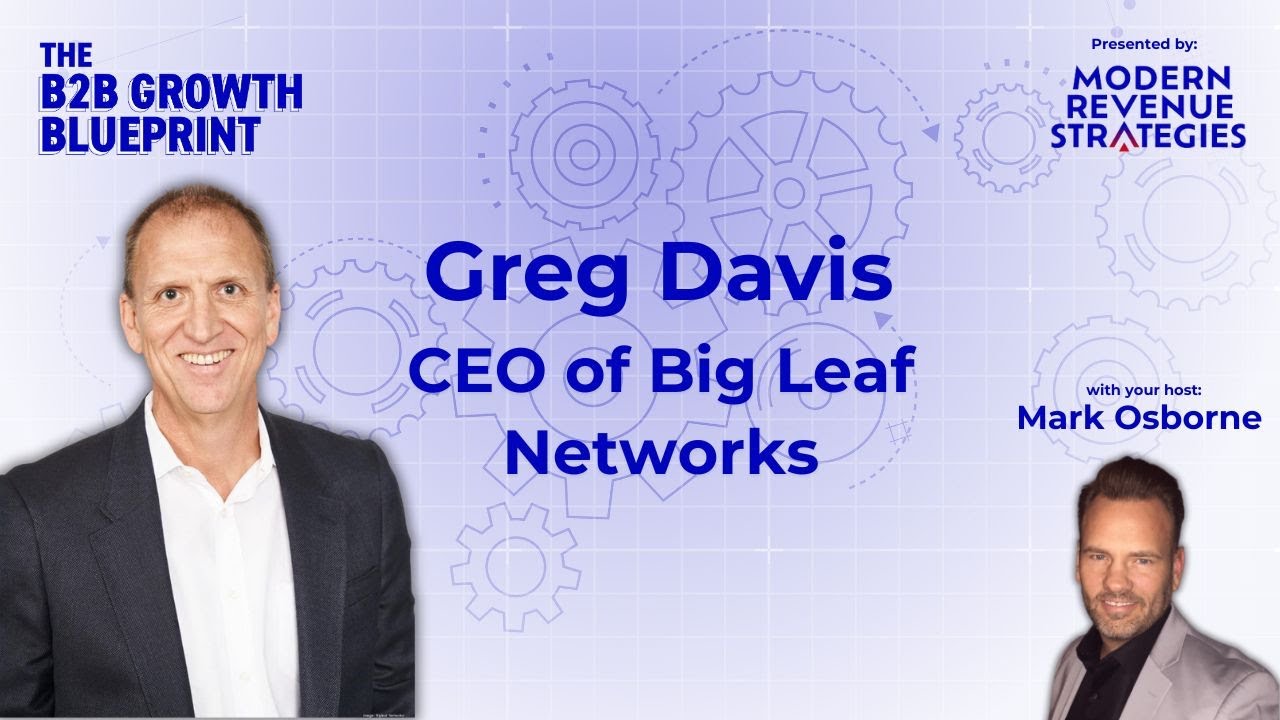
Greg Davis, CEO of BigLeaf Networks, explains how integrating marketing, sales, and customer success under one leader drives growth. He runs weekly cross-functional meetings on deals and pricing, and is launching an 800-series 5G router certified on all three major carriers to serve customers with 3,000+ locations.
Chapters
Welcome to the B2B Growth Blueprint podcast, where we talk with entrepreneurs, founders, and leaders at B2B services, tech, and SaaS companies to learn the systems and processes they've used to create success for their business. We'll also learn from marketing and sales experts to provide insights to help you grow your business. I'm your host, Mark Osborne, and the podcast is brought to you by Modern Revenue Strategies and their 10x ROI B2B Growth Guarantee. Schedule a free diagnostic call to learn the fastest path to double your B2B revenues in just 90 days. Hello and welcome to another episode of the B2B Growth Blueprint Podcast. I'm your host, Mark Osborne. Today, I'm very excited to welcome my guest, Greg Davis. Greg is the CEO of BigLeaf Networks. He has over 25 years of experience scaling tech businesses past the $100 million revenue mark, driving strategic acquisitions, and leading BigLeaf Networks in a competitive SaaS and SD-WAN market. He has fantastic actionable insights on scaling B2B SaaS companies with a focus on sustainable long-term growth, leadership strategies for CEOs navigating product-market fit and expansion, and the challenges and solutions of building predictable revenue in tech and technology-enabled companies. So, Greg, welcome to the show.
Hey, thanks, Mark. Great to be here. I love this topic, uh, love the format of the show. So thanks for having me.
Yeah, thanks for coming on. So you've obviously got a lot of experience and done a lot of things. Before we dive into some of these specific topics, why don't you kind of tell us your story? How did you get from there to here?
One step at a time.
That's right.
So I grew up, my family had a business. I grew up with an operations background. And so from the time I could walk until the year 2000, headed into a kitchen to be a chef, to work in family restaurant businesses. And that was my thing. And that's like my father, my father's father. And this had gone on for years. And what, what the restaurant business did for me and what that situation did for me is it gave me a lot of responsibility because, you know, my dad owned the place, if you will. It gave me a lot of responsibility early and it taught me things about operational discipline. And so for the first, you know, from night— well, really from high school, which would have been, say, you know, 1983, '84, all the way to 2000. That's what I was focused on, being the best I could be at running a restaurant. And if you know anything about running a restaurant, it's the operational discipline element of that. So things— it's a very particular business, and there's a big difference for a server showing up at 11 versus 10 minutes after 11. So, you know, through that, and it's a tough business and it's a bit of a dangerous business at times.
Sure.
In 1999, I made the decision to move out of the industry and into sales. It was a bit of a long story and I'll give you the short version, but I found myself in a highly competitive sales process, you know, in a community that I thought everyone loved me in. And it was, we were, I was trying to take my catering business and get an institutional contract for skyboxes in SEC stadiums.
Okay.
Was it, you know, I was just a young punk, if you will. Well, we got—
You're an LSU grad, right?
That's correct. And LSU was building skyboxes and I had a catering business and I was like, well, if somebody's gonna do— and all my customers were going to this or buying the skyboxes, right? My customers were the wealthy crowd in Baton Rouge. And so And I had friends that had catering businesses and you had institutional players and LSU had a board. And all of a sudden I find myself in a highly competitive situation against Aramark, against a lot of other big competitors and people that were, you know, smiling in front of me were working behind the scenes to make damn sure that I didn't win. And I loved everything about it. And my brother and I Made a couple of judo moves and we won. And to this day, that catering business. So all of the LSU skyboxes for the stadium and, and the baseball stadium are all run through my brother's catering business. And it's a, I mean, you can imagine this is a huge operation.
Sure, sure.
And so I was kind of, I was, I was hooked and I had the opportunity to get into technology sales, an industry and a business that I loved and it was kind of an extension of my personality. And I got into individual contributor tech sales focused in networking and wide area network connectivity. And I didn't know anything. However, I had kind of figured out through the sales process that, you know, that through this competitive thing that it is a process. And the skills that I had developed over my years running a restaurant and being an operator you know, could be applied to these kinds of things at scale. So my first instinct was I'm gonna go sell big catering jobs. And then I realized there's a lot of money in that. And that's what got me, got me into tech. So—
Sure.
I, I, I basically applied the skills that I'd learned in the business coupled with some advice that I didn't know at the time what were some folks that were, you know, highly respected and very good, you know, salespeople sort of nationally. One guy was Don Briggs and the other one was my brother. He was a bigwig at Cisco Systems early on. And so I was getting some, I was getting some pretty good advice. And so I moved to Houston and that led me into the world of PE-backed software and executive management, which is, which is where I am today. And so the practice on it, and really I sort of cut my teeth and cut my teeth and started with that at a business called VeriCenter, which was a managed hosting business. And what I quickly, you know, learned both about the operations of a software business or services business is you know, there is some sort of kitchen, there is some sort of expedite point, there is some sort of customer acquisition scenario, there's upselling, there's attention to detail, there's communication and how all this works. And so when I began to apply that same logic to a managed hosting company, tickets come in, people need all days, how many tickets, how many Windows tickets do we have open, those kinds of things.
Right.
So I started applying, you know, rather than sort of have this new career, I sort of blended them together and that, that You know, that, that worked, that worked very well for me. And, and essentially, that's, you know, what I'm doing today. So, you know, over the years, along with a long list of people that are, you know, probably too long to mention, you know, I've scaled and managed 3 businesses and about $1.6, $1.7 billion in transaction value since, since 2000.
Wow, that's great.
So, yeah, and it's, I'm, I'm fortunate. I've had, there's been some, I've had some great people around me and I've had a lot of opportunity and I try to pay that back. You know, I try, one of the things I try to do when I go into businesses, find, find the people, you know, where I was back in 2000 and give them the opportunity, people that are probably smarter than they realize and giving them the opportunity to, you know, some of the opportunities that I have, which is to take practical experience and apply it to something that's maybe, you know, sort of beyond your skill set a bit. And so that's, you know, that, that, that's kind of what I've done over the last 20 years. In all cases, kind of regardless of what my role has been in these businesses, and I've run sales, I was a VP of sales, I was an EVP of sales. I ran a sales and marketing function. I was the chief operations officer for a business. I'm a CEO. And so I've, and in all cases, I've been, you know, kind of board level and at the executive level. And again, that's, you know, guys like Gray Hall and Dave Colasanti, who's still on the board of directors for my business today, gave me that opportunity. And then I did with it the best, the best that I could. In all these businesses, regardless of what my role has been, my focus has really been, as I said, on the customer acquisition and customer retention side.
Yeah.
And as I was telling you earlier, I'm fascinated by the changing nature of the head of sales role.
Yeah.
You know, I think about, you know, when I got started, the VP of sales was king. You know, that was the role and it was all relationship-based. It, you know, the field was dominated by field software. You know, trust was a function of how much time you spent, things like dinners and golf outings. And it was really Relationships were the differentiator. And then, you know, and that was sort of where we were until about '05 when, you know, the emergence of CRM, things started to change. You know, by the way, Joe Ferrara, Goldmine, I'm like, I'm listening to that podcast going, oh, this is awesome. I too was a Goldmine user.
That's right. Yeah, I remember.
And then, you know, and then, and then, and then sometime around, as I was telling you earlier, sometime around '05, '06, '07, you begin to saw the emergence of the CRO role. And I think what, you know, and I've picked on that role for years. I think it was a mechanism that private equity used to not get sideways with the founders of businesses, but to demote their VP of sales, their buddy that they grew up with. And so they create this role and they go out and they hire people that were really good sellers and they're gonna give them marketing and sales and we're gonna have a single revenue stream. And then they harness them with operational churn. And you're like, wait, what? Explain this to me. And so I've beat on that role forever. I think it's a passive move to not make tough decisions. And then it's, generally speaking, ends up being watered down. Now, that changed over the years, but that's certainly kind of certain— certainly the way that it started.
So let's push on that a little bit.
Yeah, sure.
So as someone that, you know, I'm personally very much invested in the belief that marketing without good sales is, you know, sort of marketing for marketing's sake. Sales that isn't feeding back into marketing isn't getting sort of the best that they can get out of it. When those 2 departments are siloed from each other or set up in an antagonistic way, it's not sort of the best outcome. And then to sort of add to that, you really get that exponential curve of revenue growth from retention and expansion revenue, which isn't possible without sort of the customer success function being integrated with marketing and sales so that you're attracting the right customers that actually have the potential to stay with you and stay a long time. So from a philosophical standpoint, having all 3 of those revenue-impacting departments rolling up under one one leader creates potentially more alignment and more integration across those systems. Talk to me a little bit about why you think that's not the right way to go.
Blake Saleh at Proofpoint is a freak of nature.
Okay.
There's 10 or 15 of those in the country. There's just not a lot of folks that are going to be really— not that I've seen, and certainly not in the realm of $20 million to $50 million software.
Yeah.
The, you know, when you start talking about— and Blake's at Proofpoint, he's an awesome guy— there's others. When you start talking about that kind of scale, that's different than where I am, Mark. What I'm talking about is in your, you know, $20 to $100 million growth PE stage, the chance that you're going to pull a resource in that is from the outside through a retained search that isn't one or the other, you know, either a customer success guru or—
They come from a certain background and have that expertise, but not the full breadth.
That's exactly right. I think the role, the concept that you said, this is vertically integrating the revenue model. I'm all in on that. It's, I think the 2 people that are mainly responsible for that are in the way that I think about things in the world that I am, are the CEO and the chief marketing officer. And so I would tell you that my emphasis— and I, look, I came out of sales. I've lived in these sort of sales versus marketing roles.
Sure.
I've spent 15 years breaking down those. But over the course of that, as the market has changed and as the buying habits have changed and as the tooling has changed and we've sort of moved into this platform world, then I think it's— I think the The things that you talk about, which is a lot of the product-led selling and getting into churn management or, you know, retention, upsells, new products. I think it's more product marketing and more marketing related than it is than what you would burden with your, you know, new acquis— your new customer acquisition team.
Interesting.
Again, I'm operating in a smaller segment of the market than enterprise. I run a business that's you know, in the $30 million range. And so, we don't, in a tight credit market, and a lot of these businesses are breakeven, slightly positive, you know, I can't afford to go find a jack of all trades that's highly experienced at running a customer success function that understands contract lifecycle management tools, the stacks that support customer success and sales and marketing. I mean, come on.
Yeah.
You know, you might find it in a sales operator, but I don't think that's not really the tip of the spear for your customer acquisition. So I think the, you know, I'll give you the punchline for where my head is. You know, I think the, it's the shortest, fastest path into the contemporary chief revenue officer runs through the marketing team. That's my position. And so this is—
Interesting.
You could make the case that this entire podcast is designed for me to persuade Lori Stout to take the Chief Revenue Officer role at Bigleaf at some point in time. Don't tell her that.
Well, if she has a Google alert set for her name, it's bound to pop up.
And I can, and I can, you know, I can back, I can sort of back that up. We can get into that a little bit later, maybe in the conversation. But I think that, go back to this concept of platform, you know, I think this is a, the skills have changed. You know, you just think about, we talk about the transfer of, the transfer of enthusiasm, you know.
Right.
Yeah. And I think in, in, in the world that we live in today, in the platform-driven world, it, the CRO becomes an architect of delivering trust and an architect of delivering these things. It's about building gravity more so than it is about pushing deals. And so, and that's more of a marketing skill set.
I tend to agree with that. I'm curious, you talked about, you know, this vertical integration of marketing, sales, customer success, all the revenue. I call it the revenue team or revenue processes that In your mind that lives between the marketing officer and the CEO. I'm curious which of the sort of elements of that fit with under the CEO's sort of ownership in your mind.
Yeah, so I probably didn't word that correctly.
Okay.
What I was trying to say is it's between the CEO and the leader of revenue. And I think the leader of revenue in the world that I live in is more likely the marketer. If you had to pick 2, product marketing and the marketer, I would lean on the marketer. So the way that we run, but cautious not to drag the marketer into operational churn either. So the bit of, I believe that we're in a transition.
Okay.
And you think about the things that we are automating around at the top of the funnel, the BDR functions and those kinds of things. So We're in a technology transition. So I think the, the, in some cases, the organizational structure, at least in my case, may be in somewhat of a, of an evolutionary period as well. But the way that I run things today is I have the customer success function reports directly into me, the marketer reports directly into me, and sales reports directly into me. If I establish a single person, we got larger, I like being hands-on. I'm sort of elbows deep in this transition. As we get larger, then I probably would evolve that into putting the chief mark— hiring, you know, VP of marketing, putting the chief marketing officer on top and then, and building the organization that way. And I don't think the sales leader would disagree with any of that.
Yeah. So not to ask you to reveal too much, but in your current structure, how much do that— so you've got the marketing, sales and customer success, you know, recurring retention revenue. and expansion revenue, all reporting to the CEO. How much do they collaborate, engage with each other across those lines versus the CEO, you as the CEO being the conduit for insights from one to the other?
Yeah, I'm generally never the conduit.
Okay.
That I try not to ever get myself in that situation. So we, you know, a little bit tactical, we meet weekly and we—
As a combined revenue team.
Yep. And we just call it, we add product to it and call it commercial.
Yeah.
So it's a commercial function. And then that, that there's 2 of those sessions are about deals, if you will.
Yeah.
And a deal could be a stuck transaction in a renewal. something gnarly or something, something juicy and, and good. And then the, the alternating weeks, then the other weeks we are, we do win-loss review and pricing. And that's kind of our pricing, pricing committee. And so that group met today, as a matter of fact, that, that group meets on a, on a weekly basis. And I'm, what I'm trying to do is to keep gum off of their shoe, if you will, in the form of of I don't want anyone getting bogged down in operational issues as it relates to our existing customer base. We have phenomenally low churn here so that, you know, I'm, I want to keep, you know, keep that gum off, if you will. But mainly what I'm trying to do is draw a tight, tight alignment and connectivity between product and marketing and sales, obviously, just like I have my whole life and everyone else.
Well, and I see when companies do it right, which certainly sounds like you're doing it right, it becomes such a strategic sort of nexus of information because you've got customer success serving as the voice of the actual customer, marketing serving as the voice of where the market is heading, sales giving you that frontline heartbeat as to what's actually working, which then guides— the strategic direction of the company, where you are building new features that deliver specific benefits as to why are we doing it for this segment of the marketplace that is going this direction, and are we forsaking any segment of our current customer base, and how is this actually hitting the ground in sort of the activation across the sales. And so when done right, that that this revenue commercial function, as you call it, can be such a strategic insight. But so oftentimes I see companies that they either, you know, it's all between the ears of the CEO and they do a lot of navel-gazing about what do I think the market wants. And then they build that and then convince marketing to go create demand for a thing that they built instead of providing feedback on where the demand is. Convince sales to talk them into it and then customer success to, you know, cover a multitude of sins of deals that have been sold that could never be fulfilled.
Yeah, I don't, we don't, our product is very easy to install. So we don't really have a backlog and that kind of thing. Most of our customer success activity is service adds or potentially downgrades or, you know, those kinds of things. What, what we're trying to do, and, and, you know, my sales leader is a guy named Tam Vu. Lori Stout runs marketing, and we're, we're, you know, we're, we're a pretty tight, tight group. What, you know, what we're trying to do is get ourselves in position to accommodate, you know, the world today, if you will. So we're not, you know, this concept that we're managing the funnel, you know, that, that it's, it's the, there's fracture in the funnel. People are coming and going. The buyers are leading the process. So what we're trying to build And again, this really isn't a, you know, a traditional sales thing. What, you know, where we are is these buyers are out there. You know, we cannot, you know, again, we need to transfer enthusiasm. We want to transfer trust and we want to transfer our value proposition. Very easy to do in hand-to-hand combat sales, but that's not available. Neither the customers want that, nor do we have the ability to do that or the form to do that. So that's highly fragmented. So what we need, marketing, is we need optics into where people are as they self-service and they go through the buyer's journey. And then we need to be in position, the contemporary CRO, to understand when to jump in and save that buyer and when to shut the hell up and stay out of it.
And let them, let them go through their own process.
Yeah. And so when I say that the role has changed, that's not a, You know, I've always looked for sort of, you know, I call it pin your ears back, tighten your belt, blood and guts salespeople, like drive, drive, drive. And that's not the world that we're living in. And that's not what, that's not what, what this is. And so when we think about, you know, who's really good at, you know, managing to orchestration, who's really good at, at, you know, you think about podcasts. This is a great way for you and I to get to know one another. And it's also a way for people to assess our credibility, if you will. And that's not a traditional sales thing. I suspect you have a marketing background. Yeah, that's right.
Yeah.
And so, and so, and again, so all this just kind of keeps reinforcing my— we're moving, the buyer has changed, the concept has changed, and the, and so the role needs to evolve as well. And I say the role, I use the CRO. It's the, it's the head, it's the, the person responsible for driving revenue inside the business.
Right.
And, and so, you know, to a large degree, Mark, I'm trying to figure this out myself.
Yeah.
You know, I don't, you know, sort of naturally think like a growth marketer. I think like a growth seller. You know, I service demand probably more so just sort of at the core, I service demand more so than I create it. And speaking of me as sort of a legacy CRO type, if you will. And so I'm looking at, okay, that's, that, I just don't think that that's, that's where we get the juice in the 2025 market. And there's another thing. And that, and that, that's, again, I told you I was fascinated by the topic and I am.
So I want to shift gears a little bit, but it actually very much aligns with this in that, you know, you've you have a unique perspective of you've helped multiple companies get to $100 million, puts them in the top 1% of all companies. And so you've seen the sort of the revenue roadblocks that companies encounter on this path from $5 million a year to $20 million a year. And working with private equity that's very much focused on breaking through those revenue roadblocks, And then I'm also curious because we've tapped on this, so I'm blending a few different threads together here, that we're at an inflection point where things are changing. And so I'm curious from your perspective of what has worked historically as companies try to break through some of those regular, you know, to be expected roadblocks from that 5 to 20 path. And where do you see that changing? And, you know, as we go forward in a new world where, you know, it's not plowing the street with your face salespeople that make the difference, it's the orchestrators, it's the operations that bring these things together. Talk to me a little bit about your perspective there.
Well, I think the resourcing of today's kind of sales process Is, is, is pretty thin. In other words, finding— so, so what do we need? We need a creative resource that's more than operational. We need somebody that can create content, somebody that can educate people and convert them. We need someone that understands GTM, but we also need someone that kind of understands the human psychology and narrative flow and those sorts of things.
That's right.
You know, we need someone that's comfortable kind of working cross-function. that can handle, you know, sort of live moments with automation. And that's kind of— we talked about the agentic AI versus the podcast. So we're doing the same thing, enthusiasm, value, and trust. Just the sequence of events and how we do that is different. So, you know, interviews, you know, panel talks, you know, whatever, whatever it is. And so it's this—
Right.
The— we are preconditioned to go out In particular when our back's against the wall. And a lot of people's backs have been against the wall. I mean, you know, you go back to, to, from 2022, '23, 2023 to today in the world of, you know, small to medium-sized PE-backed software businesses, it's been hairy, right?
And so the end of free money, like, yeah, growth at all costs went out the window.
Well, and, and, and free value too. You know, you rub 2 nickels together and people You know, it's like, come on. So, so, so, so you have these people, you know, you have people like me, if you will, that have this high appetite for growth and things, you know, things might be thin. And so their natural tendency is, I need a hard-nosed closer.
Right.
And so I think back to the point, the struggle is going to be patience, the patience to understand and educate yourself on What's the motion today? What's the resourcing required to put ourselves in the best position to accommodate today's buyer? And then developing, in some cases you can hire that talent. I mentioned before, these resources are thin, but mainly one needs to develop that talent. And so what's your starting point for development? I think development under the marketing organization, depending on, you know, what your culture is. But developing under the marketer or marketing organization is a much smoother process.
Interesting.
Today, I would, 10 years ago, Greg would punch 2025 Greg in the face for saying that. But I think it's true. I think it's very, it's very much true. So I think that's, that's, you know, that's sort of an internal struggle that I think, you know, folks that businesses like us are gonna have to sort out. It's coupled with incredible leverage for those that understand how to harness the tools and the capability of the modern, the modern marketing and sales organization. You know, you have to be very careful about where you're, where you place your bets for resource reasons. But, you know, do your homework and place those bets. Hire folks like you to come in and help you kind of get things, get things sort of in a tight pattern because you're, you know, again, it's, it's the calorie burn today better provide yield or, you know, it's just money's tight. And so, and I do that and look, I tap into the guy, you know, to some degree I think I know everything. I tap into the consulting world all the time and I'm doing that right now even when money's tight.
Well, and it's interesting though, like even, you know, as you're describing it, You know, the— I think that there's a whole generation of marketers and salespeople that sort of chased the next thing for a while and had a lot of success, but never really had to think through a strategic lens or even a lens of building process and systems. And I think that's one of those inflection points that we're at right now is you have to be able to bring the a lens of systems thinking in order to orchestrate and do all those things and figure out how to leverage the technology. But if you're not strategic about, you know, the psychology that's involved in the process of decision-making that your customer is going through and really knowing their inner monologue so that you can impact that in meaningful ways, which is fundamental to sort of marketing strategy, that positioning, Then all of the knowledge of software in the world and tactics isn't that valuable. You have to— it's that synthesis of all those things that really becomes valuable in today's landscape.
Yeah, and you need to broaden the aperture, if you will, back to the lens thing, broaden the aperture and sort of hop out of the box a bit.
So this is—
I think this is fascinating, blows my mind. And we have a portfolio company inside of Updata Which is the PE firm that, that, that, it's our lead investor. And these are folks I've— this is the second deal that I've done with, with, with, with Updata. We have folks inside the portfolio that are driving revenue through, through platforms like Reddit or Quora, where people are jabber-jawing about this, that, or the other thing. And you have, you know, some folks in Timbuktu that are going in and saying, hey, have you thought about Bigleaf Networks?
That's, that's right.
You know, and that, that's for me, that's so out of the box thinking to anything that, that, that, you know, that I've done over the years. And that's what I think is so fascinating about today's world.
Right. Well, but, but again, it all comes from a strategic lens of who is our customer? What do they care about? So now we, and then we can understand the, you know, where they live once we know them, and then we can know what to say to them once we know what they care about. And then it's tactical execution.
Yeah, that's exactly right. And that kind of ties into what you were asking around product market fit, if you will, for PE firms. So I think the— and the— I have a lot of friends that are in private equity and that I've worked with over the years. And, you know, so I don't want to diss on the group. I love these guys. And I think what they do is amazing for businesses in particular, you know, these growth capital companies. Allow people to go on and create, you know, tens of millions of dollars in wealth and take businesses exponentially beyond anything that they could have ever dreamed of. Now, the entrepreneur may not be the, you know, Yertle the Turtle for the whole time. A lot of that changes. But from a company perspective, these folks do amazing things. And I am the luckiest guy in the world when it comes to the PE sponsors that I work with today. I'm— and I've worked with a bunch. But they— but there's a lot of mistakes that are made in that world. And one is, you know, it's all about growth. One of the reasons I appreciate the private equity world is that it's not— the rules aren't complicated. We're working toward a transparent set of goals, and, and, and that never changes. It's— we're in the world of value creation, which is a combination of a lot of things. But in most cases, and certainly where I come in, I'm not an innovator and I'm not a founder. I'm an operator, if you will.
Right.
And so when I come in, I'm— it's It's we need to scale and we need to, you know, we need to produce cash and kind of run the business. So when I think about, about, you know, what's required to do that, well, product market fit. We need something that's repeatable. We need something that's scalable and we need something that's predictable. And that's it. And so I think that notion when a PE firm comes into a deal, like a lot of times when I'm coming into the business, it's the PE firm's been in it for a couple of years. So, you know, but day 1, it's that, that needs to get established, and they have the ability to do that. And a lot of the companies that they purchase don't necessarily have the ability. So getting that set and working with these businesses to do that, I think that's a, that's, that's an area where most folks punch below their weight in that category. The other thing, and this frustrates me, and I've talked about this for years. So we're going through Think, think about what's underfoot today. So years ago, we're gonna use Marketo or we're gonna use HubSpot or we're gonna do this, that, or the other. Well, I don't know, some are using this, some are using that. We're gonna use, you know, heaven forbid, NetSuite CRM versus Salesforce versus this, that, or the other.
Right.
And there's, and there's all of these, these, these intellectual cycles and buying patterns and cost and maintenance that goes into building these tech stacks, 80% of which have the same functionality across the businesses over and over and over again. So, you know, what I've been sort of screaming from the top of the whatever is, why does everyone need to reinvent the wheel? Why do we need to go through this? You know, talk about repeatable and scalable. Why don't we pick a platform and make that make sense? And I think there's lots of opportunities out there for, you know, for that. I think there's certainly plenty of tools. Yeah. And they're trying to strike the right balance. PE firms don't want to go in and start telling folks, You know, how to run their business and what to do and what tools to use and those kinds of things. But they should, they have all the information.
Well, and that's, you know, so often we sort of see that you just sort of bring the playbook of here's the way to do it instead of, well, how are you doing it today? Like, you could, you can get into analysis paralysis of is it this or is it that? Well, they're all fundamentally the same. So let's just make a choice and move on.
That's right. And then when you get into the PE folks with highly starched underwear like Tony Rocco and some of those other folks, they get Vista, they get all of that sorted out. Yeah, that's right. But on the mid-market growth capital side, you know, folks are freestyling and that just doesn't make any sense. Yeah, it's the opposite.
Greg, you are a wealth of knowledge and we're obviously both passionate about a lot of these topics so we could talk all day, but I got to be mindful of your time. But before I let you go, why don't you tell us something that's Uh, on the horizon for you that you're excited about, either for Bigleaf or for you personally? What, what's, what's something that's coming around the, coming around the bend?
Uh, well, so I have plenty to be excited about personally. My wife and I just celebrated our 30th wedding anniversary.
Congratulations.
Which is, is kind of cool and freaky, if you will. Like, you know, I'm getting older. So, uh, uh, empty nest, you know. So I personally, things for me Probably have never been any better. Uh, the, the, the, um, professionally, I, you know, I have fallen in love with this business. You know, we, we, I was in, I was doing, I was in POS and payments. Uh, it was a deal I did before this called Hunger Rush that we sold to Corsair Capital in '22. And, you know, my customers were highly distributed businesses, lots and lots of locations like Hungry Howie's. Where are you? Where are you located, Mark?
I'm in LA.
Okay. Uh, I forget who our pizza folks were in LA, but, uh, I had to learn how to work with cauliflower crust.
Sure, sure.
Which is a long word. Uh, so anyway, so when I was doing those and the market started to move to online ordering, so I got in, I got into a payments and online ordering deal right before the pandemic. So the timing, yeah, the timing of that was fortunate. And when we got into it, that all these endpoints, just think of people, you know, sports clubs, pizza places, people that have a lot of locations and software began to dominate cloud-based POS software or online ordering loyalty and those kinds, those kinds of things. And that sparked my interest in what, what Bigleaf was doing because they solved the connectivity problem for those endpoints. And I was, happened to be joining their board of directors. And so the business was not necessarily positioned exactly right to go service that part of the market. They lacked a wireless element, a 5G element, and a more efficient, faster path to market. And so, you know, we started working in the first quarter of 2023 toward executing a strategy that takes us into Starlink, 5G, and then into that realm. And so in January, we launched our 800 series router, which has dual radios and does 5G connections. And then we're certified that That router is certified on all 3 major wireless carriers, which we just wrapped up this week. So through podcast, which is— and so this business traditionally sold to customers that had 3, 4, and 5 sites.
That's right. Yeah.
And so as we start to shift and sort of engage on some of the things we're talking about today, Lori has started to run these podcasts. And as we're running these podcasts, we're getting engaged with customers that have 3,000. And these are people that, you know, these are businesses that you've heard of that have 2,000, 3,000 sites, and they're totally digging our value prop and our time to market. So I'm, you know, I've gone from, I'm gonna roll up my sleeves and sort of do a turnaround on a business and get it to profitability and thread the needle. Of you know we were an SVD customer when I got here, like yeah, which we fortunately got out of early on. Although I don't think that was that big of a deal, but stressful. But you know I'm gonna go operate this thing into into a better place and then find someone to run the business, sell the business, whatever it may be. And that's kind of turned into you know I think we have a game-changing product here that could do a lot of good for a lot of people for a long time in terms of giving. You know, distribution endpoints, access to the economies that are available to them in the cloud and the, and the, and access to, to running their business in a more efficient way and access to a broader market and those kind of things. So I'm, I'm, I'm stoked about where we are and mainly driven by the topics that we're talking about today. I think sorting this out, figuring this out and gaining velocity in this new world in this platform-driven world is, is very cool.
Yeah, for sure. Well, Greg, thank you again for coming on. For folks that want to get in touch with you or Bigleaf Networks, what's the best way for them to reach out?
Yeah, I'm easy to find. I'm on our website, bigleaf.net. I am, I'm on LinkedIn. And my email address is gdavis@bigleaf.net.
Awesome. Well, Greg, thanks again so much for taking the time to join us today.
Awesome. Thanks, Mark. Nice to meet you.
Talk to you soon. Thank you for joining this episode of the B2B Growth Blueprint Podcast. We hope you've gained insights to grow your business. If you enjoyed this discussion, please rate, comment, like on your favorite platform and share to others who will find it useful. Do you know a CEO, founder, or leader at an early stage B2B services, tech, or SaaS company who would like to be a guest and share their story, send us a note. Let's schedule a conversation.
More from Mark

How Can You Maximize Your Business Value Before Selling? with Randy Katz Video







