How Content Marketing Drives IdeaScale’s Growth with Nick Jain
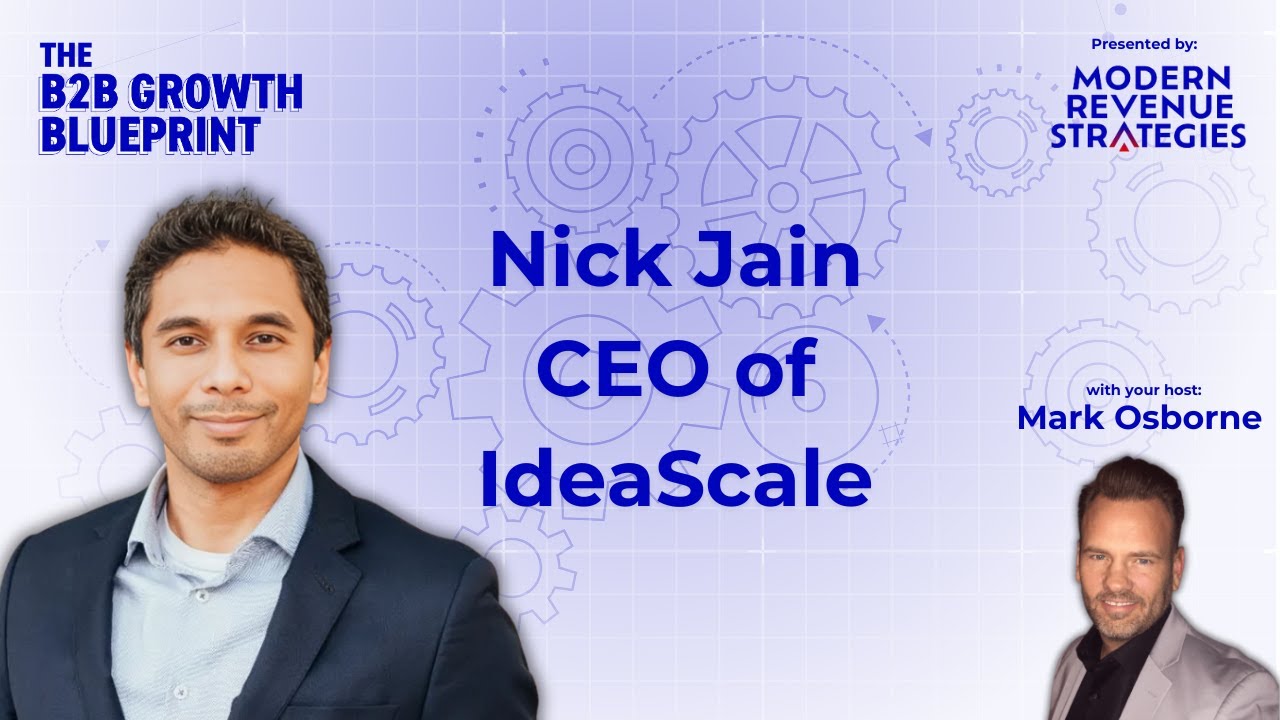
Nick Jain, CEO of IdeaScale, discusses how the company uses content and SEO to drive growth in their idea management platform. He covers measuring long B2B sales cycles, cross-functional metrics, and their approach to hiring content contributors.
Chapters
Welcome to the B2B Growth Blueprint podcast, where we talk with entrepreneurs, founders, and leaders at B2B services, tech, and SaaS companies to learn the systems and processes they've used to create success for their business. We'll also learn from marketing and sales experts to provide insights to help you grow your business. I'm your host, Mark Osborne, and the podcast is brought to you by Modern Revenue Strategies and their 10X ROI B2B Growth Guarantee. Schedule a free diagnostic call to learn the fastest path to double your B2B revenues in just 90 days. Hello and welcome to another episode of the B2B Growth Blueprint Podcast. I am your host, Mark Osborne, And today I'm very excited to welcome my guest, Nick Jay. Now I'm gonna read his bio to make sure I get it right. Nick is the CEO of IdeaScale, the world's largest innovation SaaS company. IdeaScale helps large complex organizations like Pfizer, the US Postal Service, Doctors Without Borders to innovate faster, better, and more systematically. And you know, we love systems here on the show. So we're gonna talk about some of that. Nick is an evangelist for generative AI, and he championed the use of large language models at IdeaScale well before the AI hype cycle began. Outside of work, Nick enjoys poker, running, listening to battle rap, and traveling. He's also an avid reader, currently tackling Moby Dick and Milton's Paradise Lost. Nick graduated at the top of his class from Harvard Business School and has led companies in radically different industries. including trucking, men's fashion, and software. So Nick, welcome to the show.
Thank you so much for having me, Mark, and for the wonderfully kind introduction.
Yeah, I'm super excited for this conversation and, you know, can't wait to catch, you know, catch up with you. But you've got such a diverse sort of background and, you know, all the things you've done. Tell us a little bit about your story about, you know, how you got to where you are today and what you really do there at IdeaScale.
Sure. So I started my career in academia. I was studying mathematics and physics. That's what my degree was in. I worked in research for a little while, and then I realized, look, I love the mathematic side of things. I love being quantitative, but I'm also super competitive and extroverted. And where does somebody who likes math, is extroverted and competitive go but to Wall Street? So I went and worked on Wall Street for about 10 years as a professional investor doing multibillion-dollar private equity and hedge fund deals. Really fun, learned a lot. And then one day I kind of got a very random call saying, hey, Nick, how would you like to co-run a $100 million revenue trucking company? And when you get that call, you know, when you get that call or opportunity knocks, you, you say yes, right?
Yeah.
So that was about 5 years ago. And, um, since then, I'm now on company 3. I'm now a, what I call a professional CEO. So either private equity firms or founders hire me to run and transform companies that are ready for that next stage of growth or success. So as you mentioned, I've done it now for a $100 million revenue trucking company, which is heavy trucks, warehouse moving around the country, then a small shoe startup, and now I'm really excited to be at IdeaScale, which is one of the largest innovation software companies on the planet.
Wow. So tell us a little more about IdeaScale so we get a sense of, you know, what you do on a day-to-day basis right now.
Sure. So IdeaScale has been around about 15 years, and what our software does is it helps large organizations innovate. So it does 3 things really well. Number one, it helps you collect ideas from all sorts of people. So imagine ideas as silly as what snacks you want in the lunchroom to as ideas as serious as what should our, you know, what should the part for our next rocket ship be, or what should our new product line be, or what should our new marketing strategy be. It helps you collect all of those ideas from your entire ecosystem. And your ecosystem could be your employees, could be your customers, could be your shareholders, whoever cares about and interacts with your product, your organization. So number one, helps you collect those ideas. Number 2, it helps you figure out which ideas are good versus bad. And it can do so both kind of quantitatively, like through an upvoting and downvoting social system, as well as more analytically through kind of metrics and AI and stuff like that. Because let's face it, some ideas are good and not all ideas are good. There are bad ideas in the world and there's good ideas and there's great ideas. Number 3, it helps you take ideas from an idea into reality. Let's go actually implement it and turn this into the real world. That's what our software does and we've been doing it 15 years and we've had the pleasure of serving a lot of illustrious organizations along the way.
That's awesome. So you've got such a sort of broad background. I'd love to, you know, kind of dive into some of your experience and working in different B2B companies. And one of the things that, you know, in B2B, we see that, you know, sort of trust and credibility is key to success, whether it's, you know, building the credibility that the trucks will arrive on time, or if it's building the credibility that this, you know, idea software is going to facilitate the outcomes and the transformation that companies are looking for. And I know one of the key ways that companies do that is through creating content. And I know that's been a successful strategy for you in the past. Talk to us a little bit about how you've sort of approached content marketing for building that credibility and trust and how you've been effective with that. Perfect.
Yeah. So I have a pretty cool story to tell for IdeaScale there. So 2 years ago, IdeaScale had no marketing function, whatever, no paid digital advertising, no blog, no social media, etc. And as we thought about building a marketing presence as we were scaling up, we, we looked at kind of the different options. And ultimately, we landed on let's be really good at content marketing and SEO. And there's, there's different ways to approach, right? The thing that we did and has done really well for us, actually extraordinarily well. I have 10 times more organic web traffic than my next 9 competitors combined on a right. So and my competitors are all over the world, right? So I'm doing you know, getting more organic traffic than all of them combined by a lot. And the way we did that is we took a kind of different approach towards organic marketing, towards content marketing, which is we created a blog. And our blog is simply the best information resource on the internet for good innovation best practices. Okay. And so not on none of our blog articles don't say here's 5 ways to use IdeaScale, or they're not thinly veiled advertising, right? A lot of organizations Their blogs are, or their content marketing is just, hey, here's a, here's an advertisement for our software, our service, uh, where, and we're pretending it's useful. Our content is actually just objective, good content. It doesn't mention IdeaScale anywhere. It doesn't even say software. It is just really good. If you are an innovation professional, our blog, like the best place on the planet. And you know, if you've, uh, on search results, it'll be Google's algorithm smart. It figures out what is good content versus fake advertising.
Mm-hmm.
Um, and Google's algorithm puts us up there with Wikipedia, Harvard Business Review, and McKinsey. In terms of the best spots on the internet for innovation professionals. So that's what we've done extraordinarily well. And then we translate that into trust because look, here's guys who are actually giving us good content. They're delivering us value to the consumers of our content. And we hope that does 2 things. Number one, it establishes credibility that we actually know what we're talking about in this domain of expertise. And number two, we hope that results in gratitude that, hey, when those customers are eventually ready to purchase some sort of innovation software, they remember that, hey, IdeaScale are the guys who gave us all this great stuff, didn't ask us for anything in return, and expressed that gratitude by making us their first call. Now, that may not always happen, but it happens often enough that we are— we think it's an enormously successful strategy for us.
Oh, for sure. And that's such a best practice. And one of the things that, you know, just as you said, so many companies fall into the trap of turning— of, you know, essentially thinly veiled advertisements disguised or named content. They're not even really disguised. It's, you know, sort of right out there in the open. One of the strategies that we've seen for companies that are trying to do the same thing that, that you're doing of, you know, creating the best place on the internet for content around a topic is that they'll actually go out and recruit, you know, sort of thought leaders and best-in-class thinkers and best-in-class content creators, even from outside their company, and have them come in and do a guest post. Maybe it's even folks that might be affiliated with substitutes or potentially, you know, sort of competitive solutions. Is that how you're approaching it, or how are you creating this great content? Or did you just go out and hire the best, you know, sort of content creators in your category?
So, so both, both. So first, when we started with this blog, we actually, thankfully, again, we've been doing this for 15 years, so we are really good at, or we understand innovation, both the theory, the academics, the research, the practices. So first of all, the first kind of 90% of content was really created by us taking what was already in our heads and what we talked about to clients on a daily basis and sticking it on, you know, digital piece of paper on a blog and, you know, making it fancy with images and stuff like that. We, you know, the only external help we hired there was really on the graphics and making it pretty side of things, right? But that was an internally led effort. And then we actually— and that's been extraordinarily successful. In fact, that's still the majority of our content today. Like 98% of our content is still like self-written. And so, but We actually then said, look, there's areas where we don't have expertise where somebody has credibility, and sometimes they are a frenemy or a competitor, and that's okay. We've actually enabled anybody to contribute to our blog. It could be a direct competitor, although no direct competitors wanted to contribute, but they are sometimes consulting firms who offer software, who offer consulting firm that is sometimes complementary and sometimes competitive. It's a replacement for us. A substitute is the academic term. Sometimes it's academics, sometimes it's people who just run cool businesses. We've— the only 2 restrictions we've put on them are, number one, the content has to be relevant to innovation professionals. So, you know, don't write about, let's say, marketing expertise. That's great. HubSpot's blog is a much better place to do that than ours. So number one, the content has to be relevant and high quality. And number two, Again, it can't be thinly veiled advertising. You can stick a plug for your own organization and your author bio can be a plug for your own organization or services, but the actual content of the article has to be objective, real good content. So yes, we do have external experts. I have professors from Columbia Business School. There's the International Standards Organization, the guys who write how big a USB plug should be or how big a Coke bottle should be. We have one of the experts who wrote the ISO standards for innovation best practices being an out there. In fact, he's a speaker at our webinar next week as well. Um, so yeah, our— we, again, 98% of our content is self-written, but we have allowed— we have actually opened the doors. Anyone can contribute articles. They just have to be high-quality content, and they again can't be thinly veiled advertising. They are welcome to make a commercial plug for themselves at the end of the article or in their own bios, but the actual article has to be, you know, real content.
That's great.
Well, and again, such a great way to offer If any of your listeners think they have something to contribute, they can become contributors immediately. There's no bureaucracy there.
Great invitation. Great invitation. Well, and so I know with your background in math and, you know, being sort of a quantitative person, I'm certain that you sort of approach marketing activities like content marketing, like this organic traffic that you're getting from ranking well with, well, what's the payoff? And very often in B2B where you've got sort of a long consideration cycle, people don't just wake up in the morning and decide today I'm gonna go buy an innovation platform. They might have a long time of just thinking about it, then budgeting it, and then, you know, ultimately moving into sort of a decision cycle. So sometimes that can be hard to measure. But I know that you've implemented a lot of sort of digital analytics to, you know, sort of help with that. Talk to us a little bit about, you know, how you've, you know, built that measurement loop, that feedback loop so that you can know that you're getting a return on your investment in this really robust content program.
Yeah, firstly, yeah, look, I've got a math background and I fundamentally believe if you can't measure it, it's not real. And you point out some really real problems with B2B marketing with long sales cycles. It's really hard to determine sometimes what If you know what effect activity A has on the eventual commercial outcome, which is selling new customer or retaining customer. Almost all of the tools and mathematics that are developed are really for extremely high sample size B to C, and I've done that when I was selling shoes. That was way easier because I had millions of data points. You know, almost every day I get all sorts of when you have millions of data points and fast-moving transactions, you can do all sorts of cool math. Unfortunately, that doesn't work in the B to in the B to B world. But I would start by saying, look, just because it's hard doesn't. it's not worth doing. And even if you can do it imperfectly, it is still better than nothing. And the analogy is, look, if you're walking around dark in a cave, you're still going to squint and try and see something. You're not just going to close your eyes and walk around blind, right?
Yeah.
So yes, it is difficult, but you need to do what you can with the information or data you have and structure your processes and data in a way that you get some. And I'll give a— that's the theory, right? Don't squint. At least try to see a little bit. Don't just say like, it's too hard and I'm not going to do it, because that's really bad at running anything in life. Especially business. So here's a couple practical pieces of advice. Number one, focus on what activities are at least somewhat measurable versus not measurable at all. So there's lots of things people do that they say, ah, it's— I'll never be able to measure it. And that's bad because you don't even know if it's bad for you, right? Like that activity could actually not just be neutral, but it could be negative for you. So focus on activities that are at least somewhat measurable. Number 2, sometimes you have to make assumptions that you, you won't be able to test for a year. So an example is, look, if I think I'm going to get 100 visitors into my website and I'm just starting my marketing campaign today, I don't know, they may— that sales cycle for me is any, you know, let's say 3 to 12 months. I won't know whether that those 100 visitors, what their conversion rate into paying customers is for 12 months. So I have to start with an assumption. I'll say, okay, 5% of them, and I'm going to base that on industry benchmarks. I'm going to go ask ChatGPT or Gemini, hey, what is a normal B2C conversion for, you know, SaaS, which is my industry. Gemini will say it's about 5% conversion from an interested prospect to an ultimate seller within 12 months. I'll stick in 5% in my Excel model. And then look, a year later, we'll go back and measure it. But for the first 12 months, I had to, quote unquote, not run blind, but I made a squinty guess that, hey, it's going to be about 5% because that's what's normal. But it may turn out in my business case that's 10% or 20%, or it may turn out it's 1%. And if we realize that it's 1% a year later, And 1% is just not good enough to warrant doing the activity, we shut it off. But you had to have made some, what's, what are called a priori assumptions in order to go do something. And then just like any scientist, you evaluate the, the results at the end of the experiment. And it's okay to run year-long experiments because the alternative is walking around entirely blind. And that's a really bad outcome for businesses.
Yeah, it's, it's such a, such a great sort of mantra to at least have some sort of benchmark that you put, even if it's, you know, sticking your finger up to see which way the wind's going.
That's okay. That's okay.
Yeah, that's right. That's right.
Better than, it's better than like, you know, cutting off your fingers, closing your eyes and wandering around blind with headphones on. That's, that's really bad leadership.
That's right. Well, and we talk a lot about, you know, creating systems. And one of the things that is, you know, sort of vital for a system is that there's some sort of feedback Even if it takes a year to get that feedback, even if you're starting blind and you don't know whether it's good, bad, or indifferent, making some assumption, plugging it in, and then looking at what those results are on a timetable that does make sense gives you some place to start. And it also starts to create a place that people can collaborate to sort of hypothesize on, well, how do we make it better? You know, we, we started, we wanted a 5% conversion from everyone that downloaded this, you know, content or viewed this page to, you know, having a conversation with us. It was, it was actually only 3%. Well, what could we do to, to make it better? Or do we cut bait and run? Like, but if you don't have anything in place and you're just sort of doing it, then you, you kind of have no way of sort of measuring if it's actually making an impact or not.
Which, by the way, the funny thing is a lot of marketing unfortunately is done that way, including at large companies where they, you know, don't measure it and they don't have that feedback cycle. I think there was— I forget whether it was Coke or Pepsi. It was one of the major CPG companies. Like in the late 1990s, they got a new CMO in place, a chief marketing officer. And this person went back and looked at their spend and said, like, actually, now that I look at it, about 30%, which was like hundreds of millions of dollars, had, you know, negative ROI. And just, you know, the person just slashed the budget. And not to save money, but it was like, I'm gonna take that $300 million and go spend it on stuff that actually makes a difference for my organization. It was just funny. There's such a transformation from a brand and marketing is entirely measurable to this more analytical approach. And that's a transformation the entire business world is continuing to go through, especially in marketing, where an emphasis on kind of what you call feedback loops, what I call kind of analytics and metricization that's happening in marketing. It's so important because like, Like a lot of the, you know, the Mad Men era of marketing was bad practices in retrospect.
That's right. Well, so you bring up a funny story. Once upon a time, I was building an analytical model to measure the effectiveness of advertising for a very large consumer company. I won't say who, but, you know, they brought in their agency that has, you know, won tons of awards for the work that they do. And, you know, it's a household name. And so As we were building this model, we sort of, we asked, you know, how do you measure the effectiveness of your ads today? And the agency was like, I kind of walk around the company campus and ask people if they've seen the new commercial and if they liked it. And I was like, of the executives, like, you don't even like survey, you know, potential consumers or look at sales. Did sales go up? Did, you know, are you getting buzz or publicity? He's like, nope, just walk around to the executives and see if they've seen the commercial and if they like it. I was like, okay, well, we're gonna, we're gonna put some So little, little stronger metrics around your solution than that. But that leads to another interesting topic, which is, you know, around sort of measuring effectiveness. And, and how do you kind of incentivize companies or the individuals within companies to make sure that they're doing the things that you care about? So you don't want advertising that's out there with a negative return on investment. Likewise, you want to make sure that, you know, your salespeople and marketing people are working on the things that are going to have the results that you want within a long sales cycle. Sometimes that can be challenging. What are ways that you've sort of tackled that in organizations where you've worked?
Sure. So as a basic principle, people can't do what they don't know how to do, right? And as silly as that sounds, a lot of, you know, marketing salespeople have not been taught the skills of how to make ROI-positive decisions, right? Which is okay. Right? That's their boss. It's not their fault. It's their bosses and mentors and education's fault. So the very first thing we try and deal with at IdeaScale is making sure people know how to make, you know, know the theory of how to make good decisions in the first place. We teach them, hey, here is how you make an ROI-positive decision on marketing. Here's how you make a good ROI-positive decision on whether to go to a sales conference or not, to use that discretionary budget you as a salesperson may have. That's method number one. If you first teach people like, hey, here is how you make a good decision because it is incorrect to assume that people have been taught that or taught that correctly, unfortunately. So that's number one, we teach people how to do it. Number 2 is you obviously tie people's incentive structures to whatever, to making the right business decisions and achieving the right business outcomes. So for sales, it's obvious, like how much stuff did you sell? For marketing, it's actually kind of obvious too, how many good leads did you generate? And the good thing is because marketing is effectively sorry, because sales is effectively the customer of marketing, right? The product of marketing is leads that sales is effectively buying. Sales can be reasonably effective at judging, objectively judging, is the marketing team performing or not? Because if it's not, like, sales will be the first to raise their hand saying marketing is not giving us leads or useful leads, right? So there's a nice kind of check and balance system set there where, like, yes, you're providing marketing a budget. Yes, you're teaching them how to make good decisions. And yes, you're evaluating them in and of themselves, like, in and of themselves based on the metrics. But then you can also just go qualitative with sales and ask them, hey, are you guys getting good leads or not? So the way we've kind of incentivized or like done this well, and I'm not saying we're perfect, it's like number one, we've taught people how to make good decisions and we've analytically walked them through it. Number 2, where appropriate, we've hired people who actually have these skills to like do construct the structures or do the measurements. At this organization, we don't have a data scientist, but when I was running the shoe company, or the men's fashion company, we definitely had a data scientist whose job was to do the analytics because those analytics were too complex for the average marketing or salesperson. And then thirdly, we have created— we evaluate— sorry, we've tied incentives, and that could be promotions, compensation, pats on back, to the actual metrics that people— that are valuable to the organization.
Yeah, that's so key. And I love the idea of teaching people how to make good decisions. And like, it's so funny, like, as you said it, like, it was almost an aha of there's just this assumption that, well, of course, people know, but very often they come with different backgrounds or the way that they do it might not be the sort of the same way that the other people in the company do. But when you create alignment that people are using the same criteria for evaluation and against the same metrics instead bringing in their own perspective, which their own perspective can be valuable and maybe incorporate that into the company way. But having a company way is so important. And I also love this idea of, you know, having these, you know, very clear metrics. Very often we see that you get better alignment and you talked about this, that, you know, sales is the customer of marketing. I love that analogy. Oftentimes, especially in SaaS businesses where, you know, renewals are so important and upsells are so important. And sort of account management or customer success is almost the, you know, the customer of sales because they can't renew something if sales makes, you know, a promise that can't be delivered or, you know, sort of sets it up for failure before it's ever sold. One of the things that we try to do is create sort of a scorecard where there's metrics around, you know, the volume of leads that are coming in and but also metrics around the volume of leads that are closed by sales and then also metrics around The volume of those closed deals that are renewed or upsold, and then when you bring marketing, sales, and customer success together on a regular cadence to look at all of the metrics, it creates a lot of accountability between them. Where marketing won't be throwing terrible leads over the wall at sales if they've got to you know look at them face to face on a regular cadence and sort of justify why they're doing it the same way. Sales won't sell deals that can't be renewed if they got to look at the customer success folks on a regular basis and be part of a team. Do you do that sort of shared metrics, or do you mostly just sort of have like the accountability on the metrics between teams?
Sure. So what you just described is basically my, the, my literally every morning HubSpot dashboard, right? It has how many leads are coming in, where, and then like 2 or 3 graphs for how are sales progressing, and then the renewal stats, which are obviously critical for for, for SaaS companies and probably, you know, renewing customers, you know, as Michael Scott even incorrectly said in the back in the office, renewals are actually kind of important for any business, whether paper or SaaS. The, the cool thing is I'm the CEO of the company. My CEO dashboard is accessible to completely anyone in the company, right? Whether an engineer or salesperson. So they can— there is full data transparency at IdeaScale for pretty much everything, right? Whether that's having engineering or sales or marketing. So there is, you know, I do not think we are actively saying sales, you need to hold marketing accountable or marketing that you need to hold renew, you know, the CSMs accountable for renewing those customers that you, you know, work really hard to get in the door. But the data transparency is there. So anybody can very easily go figure out like, you know, which department or which individual is doing or not doing their job effectively. And that cuts towards me too. Like, you know, whatever metrics I'm being evaluated on are very transparently available to a lot of folks too. So they can see whether Nick is, you know, hanging out, you know, or actually doing real work. And that's something— and we've been talking about marketing and sales, by the way, being kind of customers of one another. But the same is true, you know, for engineering. As my engineering head likes to point out, is the customer of the product design team. The product design team needs to write some specs, make it beautiful, and then put it over the wall. And if it's junk, then the engineering team is like, bought a bad product. Or, you know, bought bad product, their product being the product specs.
Yeah. Wow, that's really interesting. I love that idea of transparency too, because one of the things that we see so often is when you create systems that have transparent metrics that, you know, sort of people, you know, can look at as an objective standard of, you know, are we doing what we said, set out to do as a company? It actually creates a lot more freedom and a lot more sort of collaboration and creativity becomes— because it becomes less about, well, Nick's not doing a good job, but instead, well, if the metrics aren't moving the way that we want them to, what's the system that we collectively designed to move those metrics? How can we collectively improve that system to get different outcomes that we care about? And we actually see that having those scorecards, having that sort of objective standard Creates more collaboration and less finger-pointing of, well, you did a bad job. Instead, it's, well, you followed the system, but the system let us down.
Yeah, exactly. Internally, just as a— I can't speak to other organizations' culture, but I, you know, very rarely— I've never seen, at least at IdeaScale, that like somebody said, you know, Joe did a bad job or Mary did a bad job. It's like, okay, you know, Mary or Joe are struggling, and these are made-up names. I don't think we have any Marys or Joes. But let's figure out how to solve them. It's an opportunity to go help someone or to go help a department rather than to point fingers and say you That's right.
That's right. So this is a super interesting conversation and you're obviously very passionate, very knowledgeable. We could talk all day, but I gotta be mindful of your time. Tell us something that, you know, before we go that you're excited about that's on the horizon for either you personally or with IdeaScale.
Sure, I'll give 2 things. Number one, personally, I'm about to be a father for the first time. So that's happening 4 weeks from now. That's gonna be kind of a cool life experience. The closet back there is rapidly filling up with baby stuff. And then on a professional basis, IdeaScale is about to go through a massive transformation. A year ago, we were basically a one-product company, best in class at the product we've done for the last 15 years, obviously with evolution in the product over time. Now we're starting to be a multi-module company where customers have the ability to buy our whiteboarding product, our task manager product, our core idea management product. And that's obviously not only good for us as a business because we generate more revenue streams, but it's actually something that our customers have been demanding. They want it as they've gotten more sophisticated. They don't just want an idea management platform, they want something that can handle their entire innovation process beginning to end. And I think we weren't able to do that before, but we're increasingly able to do that. So that's something that's really cool, both from a business point of view as well as like it's something our customers have actively demanded for. And I'm so excited to be able to offer that, I think a month from now. All these are our modules start launching a month from now.
Wow. So you're having 2 births at the same time, birth of new products.
I don't have to deal with the products, thankfully. We have a wonderful product engineering team and a marketing sales team that will— actually, even for the birth of my own child, I practically won't have to do that much, just hold my wife's hand.
Well, very exciting stuff, and congratulations on both fronts. It's obviously a very exciting time for you, Nick. So, you know, for those that have been listening and they're thinking about, wow, you know, I love the way Nick thinks about innovation and the idea of, you know, sort of building innovation within our company and, you know, sort of enabling, you know, innovation to come from anywhere and the best ideas to rise up. How can they get in touch with you or IdeaScale to learn more about, you know, potentially how they could put your products to work for them?
Sure. So for the company, our website is ideascale.com, spelled like that above my shoulder. Our software is completely free for organizations or teams less than 100 people. So highly— and not a trial, it's like just completely free. Go use it, go enjoy it. Your data is yours. If you don't like it, you can download your data, delete it, and it's always yours. So highly encourage people to use it. Obviously, if you're a large organization, would love if you became a paying customer, but entirely free for teams less than 100 people. Secondly is if you want to get in touch with me personally, the best way is through LinkedIn. My name is Nick Jain. I respond to 100% of messages, so feel free to DM me.
Awesome. Well, Nick, thank you so much for the time today. I've really enjoyed our conversation.
Thank you so much for having me on your show, Mark, and for being a wonderful host.
All right, we'll talk to you soon. Thank you for joining this episode of the B2B Growth Blueprint podcast. We hope you've gained insights to grow your business. If you enjoyed this discussion, please rate, comment, like on your favorite platform. form and share to others who will find it useful. Do you know a CEO, founder, or leader at an early-stage B2B services, tech, or SaaS company who would like to be a guest and share their story? Send us a note. Let's schedule a conversation.
More from Mark

How Can You Maximize Your Business Value Before Selling? with Randy Katz Video







