How Do Company Values Shape Culture and Legacy with CHRIS NAJERA
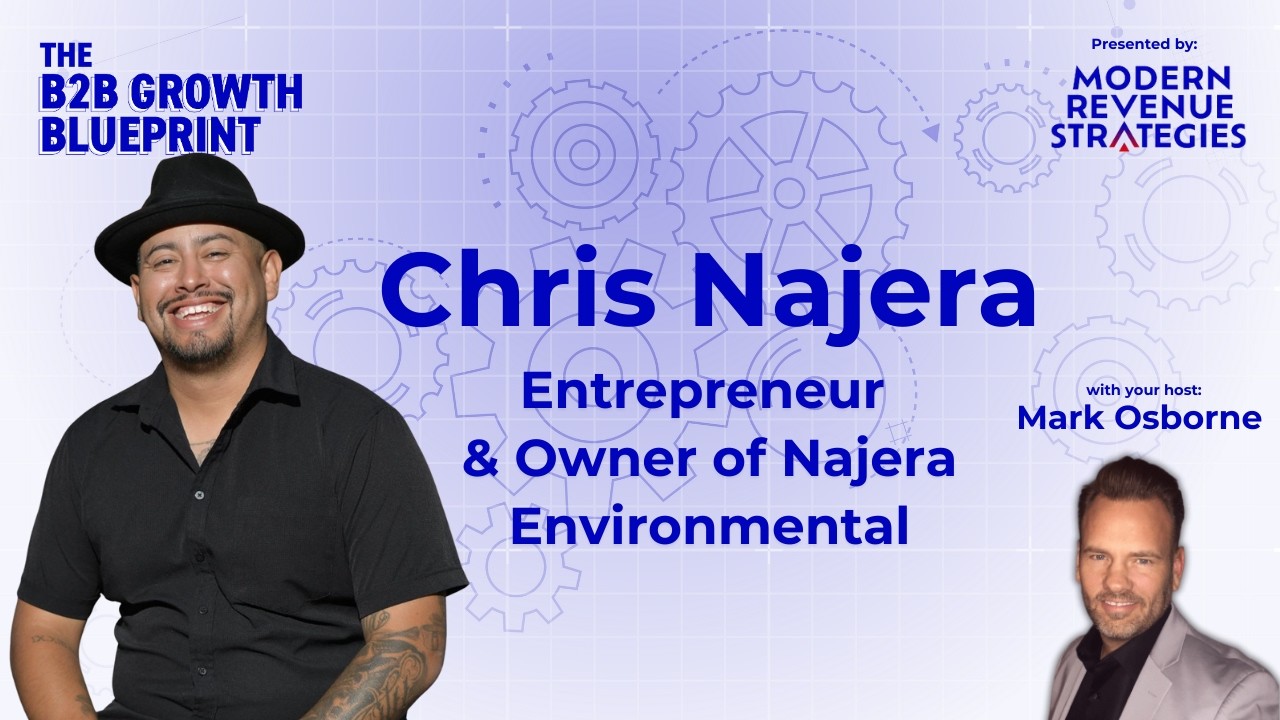
Chris Najera launched his restoration company in 2020 after his father's death, growing to 45 employees across four California counties. He built the business on values like teamwork and legacy, turning down acquisition offers to preserve his father's name and create career paths for staff.
Chapters
Welcome to the B2B Growth Blueprint podcast, where we talk with entrepreneurs, founders, and leaders at B2B services, tech, and SaaS companies to learn the systems and processes they've used to create success for their business. And we'll also learn from marketing and sales experts to provide insights to help you grow your business. I'm your host, Mark Osborne. And the podcast is brought to you by Modern Revenue Strategies and their 10x ROI B2B Growth Guarantee. Schedule a free diagnostic call to learn the fastest path to double your B2B revenues in just 90 days. Hello and welcome to another episode of the B2B Growth Blueprint Podcast. I'm your host, Mark Osborne, and today I'm very excited to welcome my guest, Chris Najera. Now, Chris has over 18 years of experience in the restoration industry. He's the founder of Najera Environmental, also known as One Stop Restoration. He honed his skills in a family-owned business alongside his father from 2006 to 2019, when he tragically lost his partner and mentor. In 2020, he established Najera Environmental, which proudly serves clients across Los Angeles, Orange County, the Inland Empire, and San Diego. We're going to talk a little bit about those geographic differences later. Chris is married and a dedicated father of 4, committed to both his family and his mission to provide exceptional environmental and restoration services. So Chris, welcome to the show.
Hey, Mark, thank you so much for having me. I'm excited, man.
So I want to sort of, you know, give our audience a little bit of background and To sort of bring that bio to life, why don't you tell us your story a little bit of how you got into the business and what brought you to where you are today?
Oh, yeah. So, I got started in the business at a very young age. My dad had me as a worker when I was 16, 17, working in this industry, and pretty much my whole entire life. In 2006, he started an environmental company doing asbestos removal, reconstruction, mold. And I got involved as a worker, cheap labor for him, very cheap labor. He's all like, if you want a roof over your head, you got to come in and put in that work. So I got a lot of knowledge in the field. I started off as a worker, same thing as he did. I had my uncles working in the industry as well. And then in 2007, right after high school, I got more inserted into the business. And I took a deeper dive in, learned sales, which I fell in love with. It was easy for me. I love selling. I love the the obstacles it comes with. And a little bit by a little bit, my mom got me more involved. My dad's health was not the best, and she asked me to step in a little bit, and I did. I believe from 2012 to 2019, I pretty much helped run the operations. We grew that pretty well. And unfortunately, in 2019, my dad had a heart attack. which we lost them, and that was a hard hit.
Yeah.
Growing up, I didn't have the best relationship with my father. What brought us very close was working together. So for me, mentally, it hit me big. I was done. I didn't want to start another business. Mentally, I was drained. I didn't think I could have another partner, you know, so I went off. worked for about a little bit less than a year with another company. And one thing that kind of sparked me was being told what I'm capable of and what I wasn't.
Hmm.
And that didn't align very well with me. And sitting down, talking to my kids and my family, they're like, look, Chris, I know losing your dad was big, but What you should do to give back what he taught you was all the knowledge. You got to keep his legacy alive. And that's why we end up naming the company Najera Environmental, was because the last name that we carry, which it will remind us the main reason why we do this. And me and my dad always were on a mission to create career opportunities. It wasn't so much about collecting collecting the money wasn't so much about being greedy. It was more about helping our community out and offering them a growth, an outlet to do more. And fast forward now, we have about 3 offices in California from the Inland Empire, helps Orange County to San Diego to LA, about 45+ employees.
Wow.
And we continue to grow every year, you know, and we've been very blessed. We've been very great.
So we were chatting a little bit before about that growth and how that brings its own kind of challenges to it. And, you know, as you're very hands-on with, you know, working with teams of people that, you know, might be specific to a certain location or some of the nuances that go with moving from one market to another, Right. For folks outside of Southern California, they might think all of Southern California is the same. But those of us that live here know they're actually very different communities. Talk to us a little bit about some of the challenges and how you adapted to those challenges of growth, of moving into new markets. And what were some of the things, maybe surprises that you weren't expecting, and then some of the ways that you adapted to that?
Some of the challenges, I think, is finding good employees, good technicians that are hungry. One of our core values is growth.
Yeah.
Anybody that comes in here, they got to have that hunger, they got to have that drive. And to be honest, it's hiring people in the Inland Empire, Los Angeles, even Orange County, you could see the difference of people's ambition. Some people get comfortable, and being comfortable to me, I tell everybody, it's a disease. Nowadays, people are stuck in their phone. They're just social media. They don't want to work. They're out there on the clock being on their phone. And I think that's the hardest challenges for us is finding the right ambition people, them being hungry. As well too, it's having the right manager in place to oversee that, especially a different branch, because I'm out here in Riverside. So for me to go out there in San Diego, me to go out there at LA when I'm still running multiple areas out here, that's the difficult part. It's learning how to let go of responsibilities for others to manage.
That sort of delegation and elevation challenge is something that a lot of, you know, entrepreneurs struggle with. What were maybe some, you know, ways that you used to kind of identify, you know, how to let, how to let go, or maybe some ways that made it easier to empower folks to, you know, run other projects as you were growing?
Having a system in place, you know, I think that's huge. For me, to be honest, like I said, it's a family-owned business. We were not taught how to run a multimillion-dollar business. It was just go out there, work, work, and work. It's never like, hey, you got to do this first. You got to follow this plan. No one gave me a plan. And I think just sitting with other business owners, other people that I conversate with, they share their ideas. They give me their feedback. I'm like, oh, let me implement this. So I continue to be a sponge.
Right. Yeah.
For myself is never stop learning. You always got to keep learning, keep being that sponge, soak all that in to where you got to share whatever's being shared with you and implement that to grow your business. For a minute, I was just very tunnel vision and very stuck in one way. And I think that's when I hit a wall at one point in my career was like, Man, it's this late night calls, not having freedom with your family, your wife, your kids. It caught to me. It got to me to where I was like, man, I need help. And as a man, we're not taught, especially in our community, we're not taught to ask for help. We're always taught like, hey, your pride, your ego, you got this. And I think that was a very important lesson for me to learn is It's okay to ask for help. It's okay out there to go out there and have others help you. You know, so the biggest investment that I have done in the last couple of years, invest in coaching.
Yeah.
You know, business sales coach. We have other coaches that come and trade every division to where it's learn how to delegate stuff and make my job easy.
So you raised 2 such great points there. And the first is about, you know, sort of building those systems because, you know, we talk all the time that like systems set you free. It's like once you have that system that like sets a floor that, you know, you won't fall below and it gives you the ability to delegate to other folks. But so oftentimes people are like, no, no, I don't want to take the time to do that. I've got my own way, but That's just, you really can't scale past that. And then I love the idea of hiring an expert. And in the same way that you would encourage your clients, don't try to do this restoration project on your own, hire an expert to come in and do it for you. The same thing is true in different aspects of your business. And so many times I see business owners that are like, oh, hiring a coach or bringing in an expert that could really help me with this.
Yeah.
You know, I can figure it out on my own. But what we see, and I tell the story all the time, the weekend I decided I was going to paint my own bathroom, I spent a bunch of time watching a bunch of YouTube videos, went out and bought a bunch of expensive equipment, spent all my time doing it, made a mess, and then had to hire a professional to come fix it for me. If I had just hired that professional to start with, Would have saved all that time trying to learn, all that frustration trying to do, and all that cost that I spent on equipment. But even more so, it's that lost opportunity cost, that time that you would have lost on that. So, I'm curious, what's been one of the biggest takeaways that you got as you started to work with some kind of outside experts? Like, what are some of the things that really made an impact in your business?
The results.
Yeah.
The results, the sales, the closing ratio.
Yeah.
The retention on employees, bigger. And the education on these employees, it's got a lot better. Since we do offer a lot of the services in here, I cross-train a lot of my employees to where one division is slow, we keep them busy with the other one. You know, so so we with the system that we have our training here in in in in our corporate office is really really good, which allows a lot of my employees to go ahead and start thinking about making a career out of it versus just a job. Yeah.
Well, so you hit on something there that I think is also interesting.
Yeah.
In your business, oftentimes you're kind of responding. to uncertainty. Like, restoration work can, you know, be in response to fires or floods or other emergencies that happen. But you've talked about being very system-oriented. How do you take the uncertainty of the restoration business and build systems around that to create structure? What are some of the ways you've done that?
Training. A lot of training. A lot of education. Because every emergency is different.
Okay.
You can never plan what's coming, you know, but you could do as best as you can to train your people on how to respond and how to react quick, you know, and also to rely on each other. Teamwork, it's another big one, is being able to have your team trust in each other to be able to help you on those time of needs of responding to certain emergency jobs to where if It might be a little bit too much. Working as a team, it's huge. And that's another core value is teamwork that we implemented within our company because especially in this industry, you don't know what you're going to get tonight, tomorrow, next year. But one thing for sure that we strive big on is it doesn't matter what we're going to go through, is we have each other to help each other out.
That's really good. And I love that, like, you know, you have your values on the wall behind you, but you don't have to look at them to know that that's part of your business because it really comes through. And so often, you know, you talk to someone and they couldn't tell you what their values were. They'd have to go look them up. They'd have to go find the plaque on the wall where it's— you, it's very clearly part of the organization and the lifeblood there. You mentioned that, you know, sort of the community aspect of the business and the legacy of your father and the work that he'd done has been really important to you. And I know that, you know, a lot of folks that get into, you know, the businesses that they're in, they get in thinking, I'm going to make a bunch of money and then I'm going to sell it so that I can, you know, have a big payday. And I know that you've gotten offers on your business, but you've made a different choice, and for some really sort of meaningful reasons about what you want the future of your business to be. Tell us a little bit about that.
Yeah, we made a decision not that long ago. We've been approached a few times, you know, giving us the opportunity to sell, but My family and I, we sat down and we discussed what is it that we really want. Yes, you could have this millions of dollars, but God forbid something happens to me tomorrow, I don't take that with me.
Right.
But me coming in from a worker standpoint in this field and family to where the ones that make this business are my employees.
Yeah.
Without them, we ain't nothing. So my wife and my kids, we decided to keep my dad's legacy going and keep it going because sometimes when you do sell, and I've seen it with other restoration companies lately to where it's not the same. It might be the same for a year, 2 years, but next thing you know, people are getting kicked out. They're changing the culture. They're changing the values. And that's something I don't want to see here, because it started off with starting this company as keeping his legacy alive and building something that it's meaningful to our employees. So my vision here is, yeah, continue to grow, continue to open up offices across California and going to other states throughout the years, but giving the career opportunities for my employees to be able to run their own office, to be able to be a project manager or a branch manager or a senior estimator is create career opportunities. We spend more time that we do at work than we do with our own spouses and kids.
Yeah.
Unfortunately, we work more than what we do at home spending time with our family and kids to where I look at it, I'm not your boss, I'm your coach. I'm going to coach you how to be successful. Because no one gave us that opportunity at a young age. If someone gave that opportunity to each one of us, imagine how much more better everybody's lifestyle would be. You know, and the way I look at it, if you're doing better, you're doing great, the business is going to do great. Yeah.
Well, and that makes it so easy to focus on those priorities when you know what that outcome is. And that, you know, early on you talked about You know, the way that you adapt to, you know, these changing environments is training. But that training is also what enables people to take advantage of the opportunities that exist.
Correct.
Creating those systems is what enables you to, you know, delegate so that they can then elevate what they're doing, both from their perspective as well as helping the company grow.
Yes, definitely. No, it's huge. It's big.
Have there been other You know, sort of unforeseen benefits from making that shift in how you approach, you know, sort of the future of the business?
There's been some challenges. Um, not everybody— everybody, everybody thinks they could, they could be the best that they can, you know. Everybody, you give them an opportunity to where, hey, I could give you guys an opportunity to run your own branch, your own office, everybody thinks they could do it until the work comes with it. And then not everybody's built for it mentally. So a lot of times, you know, some people are not educating themselves. They're not reading. So what I what I learned to do this last year actually is create teams of of individuals that are busting their butts off. They they do show that they're coachable. Well, give them some books to read. Give them some extra training outside of the working days for those individuals that want because they only know what they know. You know, anybody says. If somebody could tell you, hey, I'll give you an office if you bust your butt off, but that's easier said than done. You got to go through people skills. You got to go through with objections. You got to deal with the mental toughness, dealing with your spouse at home and your kids like, oh, you're never home. Because we get through that. Business owners, we go through those. It's not always pretty. It's a lot of work in the back end, but a lot of sacrifices that you got to put in. And most— and one important thing is, one of those is giving time away from your family, not giving that time to your family. That's the hardest part because your biggest support system might be telling you like, oh, you're working for what? They don't see your vision. And that was, that was one of the biggest obstacles that I dealt with throughout my career was my wife wanting to spend time with me more, my kids, you know, but nobody knew what I was capable of, save for myself. So that's one challenge is that I talked to a lot of my technicians or my office managers is, gonna go through this, but let me prepare this for you. You've got to be mentally tough. You, you got to prove them wrong, because if everybody did what I'm telling them to do, it, it's not going to be as easy that they think. You know, they're going to go through obstacles, right?
So interesting that you talk about that coachability, uh, as, you know, one of the key drivers. I've seen a lot of research that, you know, so many companies, they think, well, I need to hire for like Domain expertise, you know. So some, they worked for another restoration company before, they worked for, you know, a similar business or, you know, similar type of thing. But so often the real driver of success is not that, you know, domain expertise or even like a credential, like a certain degree or a certain certification. It's that coachability.
Yes. No, it's big. Um, I have hired different types. Um, I try hiring the expert in this department, um, and then I hire somebody that's hungry, ambitious, that has less experience. Yeah. But when I hired this person who was less experienced, more hungry and ambitious, their level of skills went up here by being coachable. And this person stood right here because they just got stuck right here based on their expertise and what they know. They always thought it was right. You know, that's why for me is I, I tell somebody, I always tell my employees is you're coachable. That's all I need. If you're coachable, I'll do magic with you. Yeah. Yeah. And we, we've done some magic with a few people.
I bet. I bet. Well, Chris, you obviously have a really inspiring story, and we could talk all day, but I got to be mindful of your time. But before I let you go, for our audience that's listening to this, finding it to be an inspiring story, what's the best way for them to get in touch with you?
The best way is go ahead and find me on LinkedIn. Christopher Najera. You guys can find me through there. I'm on Instagram too, Chris Najera 89. Facebook too, under my name, Christopher Najera. You guys can find me through there.
Awesome. Well, Chris, thank you so much for taking the time to join us today. I really got a lot out of it. I'm sure our audience did too.
No, thank you, Mark. I really do appreciate it. Really do.
All right. Talk to you soon.
All right. Talk to you soon.
Thank you for joining this episode of the B2B Growth Blueprint podcast. We hope you've gained insights to grow your business. If you enjoyed this discussion, please rate, comment, like on your favorite platform, And share to others who will find it useful. Do you know a CEO, founder, or leader at an early-stage B2B services, tech, or SaaS company who would like to be a guest and share their story? Send us a note. Let's schedule a conversation.
R.
More from Mark

How Can You Maximize Your Business Value Before Selling? with Randy Katz Video







