How Do Leadership and Culture Influence Business Valuation with Thor Legvold
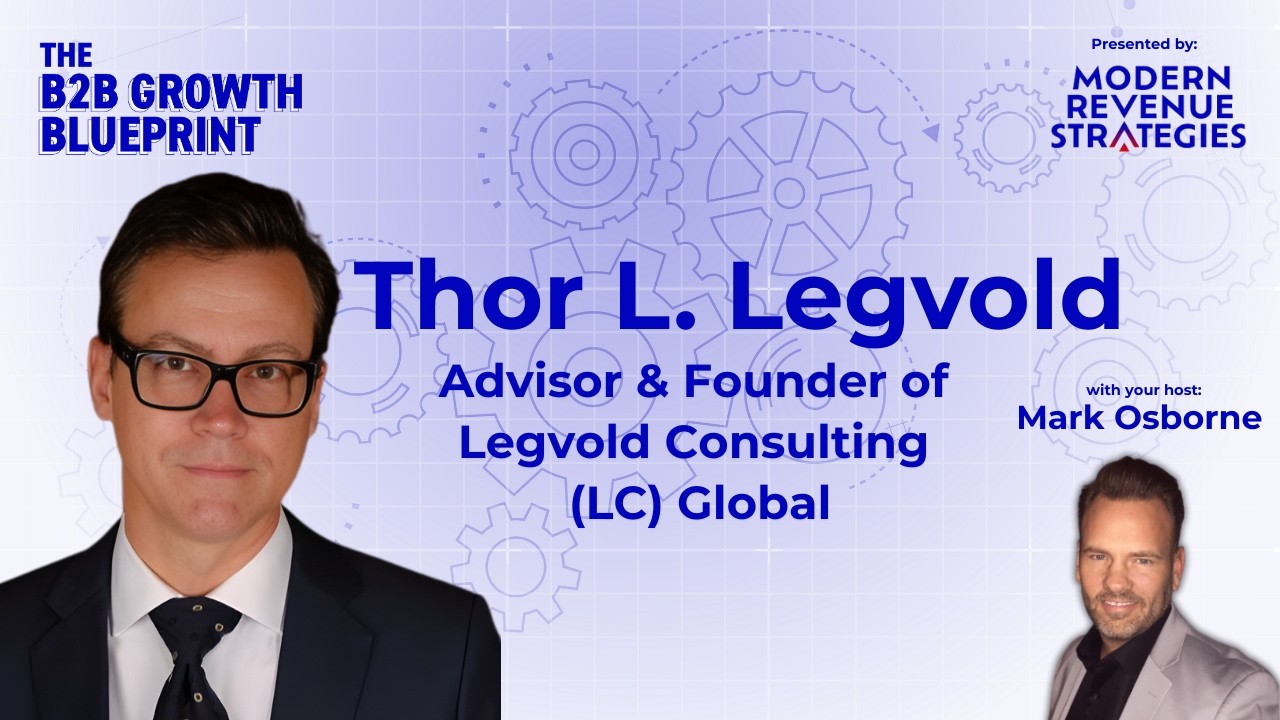
Dr. Tor Legvold, a leadership advisor with 25+ years in transformations and M&A, explains why intangible assets like culture and people account for 80%+ of company valuation. He shares Nordic leadership principles and concrete tools like cultural due-diligence questionnaires and team assessments to strengthen businesses before and after deals.
Chapters
Welcome to the B2B Growth Blueprint podcast, where we talk with entrepreneurs, founders, and leaders at B2B services, tech, and SaaS companies to learn the systems and processes they've used to create success for their business. And we'll also learn from marketing and sales experts to provide insights to help you grow your business. I'm your host, Mark Osborne. And the podcast is brought to you by Modern Revenue Strategies and their 10x ROI B2B Growth Guarantee. Schedule a free diagnostic call to learn the fastest path to double your B2B revenues in just 90 days. Hello and welcome to another episode of the B2B Growth Blueprint Podcast. I'm your host, Mark Osborne. Today I'm very excited to welcome my guest, Dr. Tor Legvold. Now, Dr. Legvold is a global leadership advisor and founder of LC Global, where culture, leadership, technology, and psychology intersect to help organizations perform in complex international environments. He brings 25+ years of experience advising executives and leadership teams across Fortune 500, mid-market startups, and the public sector. He's lived and worked across multiple countries, speaks several languages, and specializes in aligning people and strategy when the stakes are high and the margin for error is thin. His work includes rescuing a failed global energy project in Asia, saving hundreds of millions of dollars by realigning fractured international teams, guiding US companies into high-context markets like China, and leading post-acquisition cultural integrations that restored morale, productivity, and regulatory compliance. When global strategy breaks down, it's usually not the plan, it's the people. And Tor is the person organizations call when that problem gets expensive. So welcome to the show.
Thank you. I'm excited to be here.
Yeah, absolutely. So obviously done a lot of things spanning a lot of different locales. Why don't you give our audience a little bit of a story of What your twists and turns have looked like and how it brought you to where you are today.
Sure. I mean, you've covered a lot already. So it always sounds more impressive coming from someone else. But so I started my career after grad school doing large-scale organizational transformation. So I was working for a public sector company that was going to downsize from 30,000 to 20,000 employees and privatize at the same time. It was the post office. in another country. And that was a huge job. So I was part of a team of 12, 15 organizational psychologists across the country that worked together to support leadership and the employees in the organization as we walked through this very complicated process.
Yeah.
And then over time, kept working with large organizations, started working with smaller scale, started working with teams. I love working with teams of people and just seeing when I, when you get everyone aligned and everyone's on the same page and we're pulling in the same direction, it is just incredible what we can accomplish. So I started working out with teams and then into leadership development, working with individual executives. Um, moved here to America in 2018 and started focusing a little bit more on executive coaching, but I really love the, the systems, working with large organizations. So started doing that again, um, and a lot of cross-cultural things since I've always had a foot in multiple countries. Um, And I kind of fell into a job to— funny story I can save for another time— fell into a job with an AI tech startup out of Europe that recognized they needed to establish themselves here if they were going to be successful and grew that company from 3 or 4 people when I started to over 20 when I left at the end of last year.
Wow.
And we moved in the Gartner Magic Quadrant from a challenger to a leader in the space, which was really good to see the dedication and the work that we all put in all across the the company to make that transformation.
Wow.
Yeah. So now I'm based in Los Angeles and I'm back to doing what I love, which is consulting, helping people be more effective, work better together, have fun doing it and doing something great together. That's why we're all here.
That's right. That's right. Well, it's so, it's interesting. So you mentioned, you know, that you're in LA like myself and we actually met at an Exit Planning Institute event and So oftentimes when people are thinking about, you know, a business preparing for exit, they're thinking about, oh, well, how do we cut costs? You know, burn the furniture to keep from turning on the heat. Or how do we drive some top-line revenue? One of the reasons people call me sometimes, or really that EBITDA.
Yeah.
And how we build those marketing and sales systems that grow. But one thing that you and I really resonated on in our conversation was this idea that culture and leadership can actually be a value multiplier. when it comes to valuing a business and building that enterprise value. Talk to us a little bit about how you see that these sort of topics of culture and leadership as it pertains to M&A and in that valuation phase for a business.
Absolutely. Yeah. So my assumption and my experience is that founders, they want their business to grow, right? They want to outperform their competitors. They love building things. They love seeing the results of their efforts. And once they start getting towards an exit or an acquisition, say they wanna buy something else and grow, right? You know, they want, they want a great price, they want a great valuation, but they also wanna take care of their people. They wanna make sure that they're treated well. You know, they want their legacy if they've done something very unique to continue and to grow under the new ownership. And as you pointed out, the most common ways to increase valuation is to either cut costs, you know, reducing their spend, consolidating things, or increasing revenue.
Right.
More sales, more marketing, changing the pricing up. There's a third option that I find often is, especially in the mid-market, because the bigger players obviously often recognize this, but it's through using the leadership and the culture as levers. And I found through 25 years of consulting across the world that the really successful companies, they focus less on the financials. They don't ignore them, of course. But they focus a lot more on the people and the culture. And that's where the value comes from because all those, all those, all those numbers are driven by people, right? The people drive the numbers.
Yeah.
So when we look at Patagonia, Netflix, Trader Joe's, Salesforce, Nvidia, SAIC, Costco, Apple, and so on and so on, those are all companies that use these approaches by, yes, they're paying attention to financials, they have sophisticated people in place, but they're supporting their people, they're building a culture. You know, people who work at Netflix are there because they believe in something or Patagonia or Apple, not just to get a paycheck.
Yeah.
So, and I find again, back to that alignment piece, when you pull alignment together and get everyone on the same page working towards the same North Star, that is so powerful. And it creates an organization that is not only effective and shows good top and bottom lines because that's where those results come from. But also it creates a workforce that has an inherent resilience. So when you do sell or acquire another company, you'll find that it's probably easier to integrate because the people are more used to that kind of situation in the sense that they're empowered. They know, I know what to do, right? And I understand my role. I understand why we're here. I understand what we're here to do together. And I understand that we're doing this together as a team, not just one person or another, and everyone else is just here to fill a role.
Yeah.
So, and, you know, I did some research a few years ago. Deloitte actually did a survey.
Okay.
And they looked into kind of the effects of leadership. And they found that the second most important factor And they asked around the world. Second most cited factor in valuations, right? How much is a company worth? Most of the companies said their last financial report, 60%. 45%, number 2, said the senior leadership team effectiveness.
Wow.
And 80% of those said that, you know, we'll pay a premium if the company has a great leadership team that's really working well together. And another 80% said, you know what, we'd probably just pass if the leadership team was dysfunctional or even just ineffective. It— because an effective leadership team de-risks the investment.
Yeah. So it's so interesting to hear you say that. And they— if you look at the Fortune 500 companies and their current valuations, as much as 80% or more of the value of a company comes from intangible capital. which is, you know, very oftentimes things like the culture that you've created, the people that you have, the relationships that you've built with customers, the processes. But even those processes are largely informed by the culture that you've created and all those things. And so it's not surprising that it would be even kind of a close number 2 in terms of what drives the value and certainly a deal breaker. for a lot of companies that, you know, if they saw that there wasn't that intangible capital there around the culture and the social norms, that it could really, you know, derail an opportunity.
Yeah, and I love what you just said, and I want to emphasize that because I think what you just said is really, really important, is that especially— and this is especially relevant in the mid-market and lower market— there are very rarely written down institutional knowledge. All the institutional knowledge is with the people, the employees who are there.
Yeah.
If you go to Apple, everything is written down, every process, every procedure, every, everything is documented. They even have, you know, they worked with Steve Jobs before he passed to really set up an Apple school, how we think about things, how we approach leadership, all of that. Most companies in the mid-market don't have any of that. And if you are then dependent on these employees to be able to carry you through a transition, You know, you better make sure that you retain them for the first, that they don't jump ship or find, you know, when people get into situations where uncertainty is a big factor, we tend to kind of regress. We tend to seek certainty. And if you are one of the top performers in your company, you probably have a standing offer or 2 with a competitor who, you know, calls you every 6 months or whatever. Hey, you don't wanna come over and we'll give you a better, a better, you know, kind of overall compensation package or better, Whatever flexibility. So that's also, you know, you go, you're going into a situation where there's a lot of uncertainty. So I saw actually one of your podcast guests mention that documenting processes is a great way to solidify a lot of those values and those, that institutional knowledge that otherwise could disappear or get lost. And I think that's a great, great idea. And what you pointed out is absolutely an important factor.
Yeah. So you've talked a lot about, and, you know, we were just sort of talking about, you know, culture and how that fits into processes and all these things. And I know that you have a very sort of specific point of view on how culture works when it's really working well. And you were telling me about, you know, sort of this idea of Nordic leadership and some of the principles that come from some of the Nordic countries.
Yeah.
countries are kind of like the Mediterranean diet for organizations. Unpack that for us a little bit. Share that with our audience so they really get an understanding of what that means.
Yeah. So as I'm sure many of your audience has noticed, as have I after living here a few years, I'm like, it's kind of weird that some of the best companies, the most successful companies in the world are based here and are leading on the leading edge of management, leadership, culture, all of these things we're talking about. doing great things for, for their customers, for society, for, you know, for their shareholders. But there's a whole bunch of companies that aren't doing all of those things. And it was interesting to me because we keep seeing Scandinavian countries at the top of the Global Happiness Report, the top of productivity charts of high motivation, high employee engagement, very low turnover, high levels of innovation. I was thinking, you know, we're capitalist societies. I hear sometimes people, oh, it's all socialism or— no, it's capitalist society, market-driven, just like here. Yes, there are some cultural differences. I'll admit that. But by and large, I spent a lot of time researching and reflecting. We run things a little bit differently. We follow a set of principles that I've identified, seven principles, and I call them the seven principles of Nordic leadership because there there there are differences between the countries, but they're pretty common. And I find companies here that also use them, and they typically outperform their competitors, interestingly enough. And when I did this this exercise, it spent some time again really kind of. Digging deep and reflecting, it occurred to me that I use these all the time. I've used them throughout my career when I'm working with leaders with organizational change. Um, so yeah, it's like they're not unique principles that only apply in the Scandinavian countries, by no means. These are well-documented, well-researched, foundational, uh, practices that we know have great results. We have almost 100 years of management research Um, uh, um, in, in journals, you know, in practice, not just in the US but also around the world. And there's an interesting number that came out from Gartner, uh, a while ago. 82% of leaders around the world have no formal leadership training.
Wow.
And to me, I mean, leadership is a skill like any other skill. If you're gonna be good at marketing, you study marketing and you practice. If you're gonna be a good sales— if you're gonna be a police officer, you learn how to drive a car, you learn how to operate a weapon, you learn how to de-escalate situation, you know. So leadership is a skill, but we don't seem to think of it like that often. So we put someone who is a top performer in whatever role they're in as a leader and say, well, now you're a leader. Well, now we're asking them to use skills they don't necessarily have, you know.
The top—
oh, you're our top salesman 3 years in a row.
Right.
Now you can be the head of sales. But that entails you are going to be doing something very different than what has given you all the success.
That's right.
So I think really empowering leaders and that's part of this is empowering your people, setting up the company for success. And again, I'm big on alignment. So I like to work with the leadership team, get them aligned because even if you have strong individuals, if they're not all pulling together, they are by definition pulling apart. So once they're pulling together, then we take a second step and we say, well, let's look at the culture. and the structure of the organization. Is it actually serving the business needs and the strategy of the company? So as a very obvious example, say you have a company that's based on innovation, a young company, maybe 50, 60 employees, and the founder had some really good ideas and a good network, sold a few, patented a few ideas, sold a few ideas, and now has all these people working who are supporting, but he has to make the ideas. He doesn't want anyone else. You know, and maybe there's 4 or 5 levels in the organization. The more levels you have, the harder it is to innovate and the harder it is to find that great connection between the parties. If you look at NVIDIA as a kind of opposite, Justin Huang, he has, I think, 36, last count, 36 direct reports. And most of their meetings are on the floor with the entire company or most of the company present. And say, hey, this is our next 6 weeks.
Wow.
This is, this is what the market looks like. Everything is shared, everything's transparent, and the part, the decision-making is participatory. Everyone is included. How is this going to affect you guys over there at the fab? How is this gonna affect marketing? What's gonna happen with our collaboration with OpenAI if we do this? So that everyone kind of gets to have a voice. It doesn't mean everyone gets to say, it doesn't, everyone doesn't get to decide, but everyone gets an input and is able to be heard. And that's also one of these, one of these principles of Nordic leadership is allowing people to be heard. Again, not that everyone's gonna get their way, but it really helps enhance buy-in. And it also helps people understand why are we here and what are we doing? And why is it important that we're doing it this way? Oh, right. We had that town hall and it's because if we do it this other way, we're exposing the company to undue risk, for example, or whatever it might be.
So you've, you've been weaving some of these in, I can tell from what you're describing. But, you know, are there some, you know, specific principles that you want to call out and sort of name? Or maybe there are some kind of, you know, 2 to 3 practices that, you know, a founder or entrepreneur that's listening, like, what could they do to start to incorporate some of this into, into their business and, and build the culture with their team?
Yeah. Yeah. The, the primary 3 that everything else is built on are really simple. First is equality or fairness.
Okay.
So we're all in this together. We're all in the same boat. If there's a hole in the boat, it affects all of us. So we all need to be working together. And it also means that people feel like they're being treated fairly, right? If you, if you join a company and they say, well, we're, we're at the very bottom of the market as far as pay goes, but it'll be a great experience for you. So maybe, but what is the, you know, it should be good for everyone. There should be an element of fairness in things.
Yeah.
Second is companies that are values-based and purpose-driven. We are here for a reason. Patagonia is an amazing example of that. They, and there's a lot of research to support this, they outperform all their competitors easily. So because if you say, Hey, everyone's gotta work overtime another weekend. If there's a clear purpose, yeah, we're doing something so important. You know, we're gonna put a man on the moon or we're going to launch this new product that's gonna change everyone's lives. That's one thing. But if it's so that, well, there's no real clarity in it, I think the boss mentioned something about buying a boat or something, I don't know. It creates a very different environment.
Yeah.
You know, and these sound like very banal examples, but you would be shocked at some of the examples I've heard and seen. And the third one that I would point out is delegation and empowerment, and that participatory decision-making is part of it. But that's one of the things that we do a lot in the Nordic countries is we delegate and we empower our employees. We want them to come up and to come up and to grow and to add responsibility and get more responsibility and more pay. But they're doing more and more of the work. One question I love asking, especially founders, but also, you know, business owners, I was at an event in Beverly Hills a few weeks ago and talking about a few of these leadership issues. And I said, how many of you can go on a vacation, say 2 or 3 weeks with your family and trust that everything is just gonna go smoothly? Because if you're not, you should, you, if you are not putting yourself in a position where you are the strategist who is looking big picture and making, you know, the big connections and everything and then empowering your team to execute on that. If you're in the weeds doing all this day to day because you're— you can't go anywhere without everything falling apart, you have a problem. You have a real leadership problem. And I'm sure you've seen this as well.
Well, and that brings it back full circle to the idea of, you know, evaluation and this, you know, the value of the enterprise and the potential for merger acquisition or recapitalization. If there's, you know, so much owner dependence that they can't go on vacation, that really scares off, you You know, all of the best buyers, partly not necessarily 'cause it scares them off, but just they have better options available to them. And so it really limits that buyer pool. And, you know, there's a lot of evidence that, you know, multiple offers really drives the value of an enterprise. And so if you're just sort of limited to only the people who, you know, kind of can't do anything better, then you're not gonna get the maximum value for that organization.
Absolutely. And what you're outlining also is it goes, I think, also to historical kind of, I think we're in a paradigm change because the whole command and control way of managing, you know, when I read online, especially a few years ago, there was a lot of stuff about wearing little monitors and seeing how often you're on the screen and how often you get up and have a break. I was like, if you don't trust your employees, you have a bigger problem than—
That's right.
And, you know, Netflix, they're one, Their main message to new employees, do what you think is best for the company.
Yeah.
You're an adult and adults are treated like adults. Costco, you know, Costco has a, has a really strong sense of ethics. You know, obey the law, take care of your members or our members, you know, Costco's members, take care of the employees, respect our suppliers, right? Fairness and equality, take care of your shareholders. Richard Branson has a really good explanation of the same, same kind of principle. Says if you treat your employees as well as you can, pay them as well as you can, help them, you know, educate and improve and grow in their roles, take on more responsibility, they will take care of your customers because they're the ones who are meeting the customers. And guess what the customers take care of?
You.
Shareholders. Yeah, you. And it's a circle. It's like, it's more like farming or gardening, right? You can't just go straight to the money. You have to actually do a few other things and it's a chain and you have to feed that chain and you have to understand where you can influence it. to get the max results. And that's where I come working with the leadership and the culture.
I love that. Well, and also that kind of delegate motion really depends on having those processes yet again, or what limit that, you know, sort of owner dependence when you have those processes.
Yeah.
One of the things I love about it is, and I don't know where this phrase came from, I'm certain I'm stealing it from somewhere, but the idea of to to delegate and then elevate. Because in fact, when you set a process that creates sort of a baseline level of quality, and then you delegate that to other folks, you enable them to bring new creative ideas on how to improve this, how to improve the outcomes.
Exactly.
That if you, as the business owner or entrepreneur, tightly holding on to everything and not allowing other folks to bring in, Well, then you're limited to the best idea you can come up with. Whereas when you enable other folks, you can bring so much more brainpower into it.
Exactly. Which is why I tell people delegate responsibility, not tasks. You know, if I tell you, you know, Mark, I want you to go out front and I want you to sweep the— and I want you to hold the broom like this and do exactly like that. Nobody likes to be told exactly. And obviously there are some situations in a restaurant, Certain policies and procedures need to be followed. Absolutely. But the more you give people an opportunity to inject their own personality, their own creativity, their own ownership, oh, you get so much more motivation, engagement, productivity, and innovation, as you pointed out, which is super important. It's like, hey, what if we did it this way?
Right?
Yeah, let's try that. That's amazing. You know, and, and, and we all go back always to the same, the same statistic. Everyone, oh, 70 to 90% of deals, you know, fail, they don't fail. It's just that you end up with 2 companies that never get along and they don't— you don't realize the value that was inherent in all those forecasts and all that valuation and all that work ahead of time. And the 2 top factors, guess what those are? Leadership and culture. Yeah, leadership and culture always goes back to the same things. There's an interesting Bain report from last year and they were— their summary was basically it's really incredible how how sophisticated M&A has become with the forecasts, with the valuation, with the quality of earnings, EBITDA, all of these different things just really gotten very fine-tuned. And then they say, except for the leadership and culture, there's still so much to be done and there's— we're still so far behind on that side of the deal. And that's the side of the deal. If the people aren't on board, you have issues.
Yeah.
There's a quote or a slide or I don't know that I use often when I'm working with, with organizations and leadership. And it's Q times A equals E. I think it's from Six Sigma originally, but I'm not Sigma certified. But, but it's basically the quality of the solution. So this is for change management. So however the quality of the solution, we have bought the very best CRM in the entire world. It's better than anything. Times the acceptance, A.
Wow.
If the people who are gonna be using it aren't on board with it, aren't interested, don't see the benefit, don't understand why it's going to help them, and is equal to the effect or the, the success of the change. And if you don't have that A down, 90% of the initiatives that fail, transformational or change initiatives that fail, come down to there was not enough buy-in from the people. They didn't work. No, but this is what we're going to do. The boss has made it as— Oh, well, that's great. Boss can do whatever he wants. I'm gonna— there's another job. The labor pool is shrinking. I don't know if people recognize that, but the labor pool, especially for skilled, qualified labor, is shrinking. So it's going to be harder and harder as we move forward through time to find really good qualified employees. So take care of the ones you have is one of my, one of my pieces of advice.
Well, Tor, you're obviously an expert in a lot of really interesting topics, and we could talk about it all day, but I got to be mindful of your time. But before I let you go, Like, who exactly do you work with? What do you help them with?
You know, I get a few, a number of questions around the same area often. And, you know, what industries do I work in? Any industry that has people.
Okay.
So obviously you have to have, there has to be enough employees that it makes sense. You know, if there's 5 people, I have worked with startups as well, but typically I go in where there's, where there's 40, 50, 60 employees and up. And I've worked with Global 100s and, and yeah, really big companies and really small ones. I love working with family firms and founder firms. And when it comes to the timing, that's another thing people say. So when should I pull you? When should I bring you in? I said, well, invariably I'm called in too late.
Sure.
Almost always. What do we do? What do we do? So, you know, there are a few things that I suggest. One is anytime you're looking to either sell or buy or evaluate, do a management audit and a cultural due diligence. Doesn't take a lot of time. It's not super expensive or anything, and it gives you so much information and insight into how the management is functioning, what the culture is. And I focus a lot on cross-border deals, but even domestically, it's as important. It's just we think, oh, we're all speaking the same language. It can't be that big of a difference or a deal.
Right.
But if one company is doing things one way and another is doing them completely opposite, you're gonna have a huge crash when those 2 companies are trying to be brought together.
Yeah.
So what I suggest across the board, I do a, I do a team assessment, takes 20 minutes. The, the leader goes electronically, the leadership team, each of them fill it out on their own. I get the results, can go through, and it gives amazing insight into where their strengths are, where their gaps are, how they're functioning as a team, if they're really on fire or if they're kind of uncertain and not really doing anything, or if they're having a great time together and love to be on the golf course, but they don't really get much done, you know, or if they're driven, like just being whipped, but are they out of fear or out of just, I just want my bonus and I don't really care about what we're doing? Really important factors to understand both in the valuation, but also when you start planning out the integration, because in my opinion, the— and experience, The integration needs to be planned out at the due diligence stage. That's when you should be collecting all the information and saying, okay, these are the different IT systems, these are the different CRMs, these are the HR bonus pack and compensation packages. Oh, these are our key processes, these are our different cultures, this is how our leadership operates and functions. Let's look at that too.
Yeah.
So those are things I really recommend is just— and a management audit. Is nice because it looks at the team. You know, we're not calling out individuals. We're just saying, how does a team function as a team? Because that's where the real value is often missed.
Yeah. And where that synergy really lies.
Yes.
So for those that are listening and want to get a slice of this for themselves, what's the best way for them to get in touch with you?
Best way is go to the website, send me an email or a call. It's legvoldconsulting.com. You probably want to spell it out for people because it's a long and complicated last name. It's Norwegian.
L-E-G-V-O-L-D. And we'll have that in the show notes. For folks as well.
Appreciate it.
Absolutely. Well, Thor, thank you again for joining us. I really enjoyed our conversation. I know our audience got a lot out of it too.
Thank you. This has been awesome. I so appreciate you. Such great questions and insights you've come with as well. So I really appreciate it.
Thanks. Talk to you soon.
Yep. Bye-bye.
Thank you for joining this episode of the B2B Growth Blueprint podcast. We hope you've gained insights to grow your business. If you enjoyed this discussion, Please rate, comment, like on your favorite platform and share to others who will find it useful. Do you know a CEO, founder, or leader at an early-stage B2B services, tech, or SaaS company who would like to be a guest and share their story? Send us a note. Let's schedule a conversation.
More from Mark

How Can You Maximize Your Business Value Before Selling? with Randy Katz Video







