How Does the MEDICC Framework Improve Sales with David Weiss
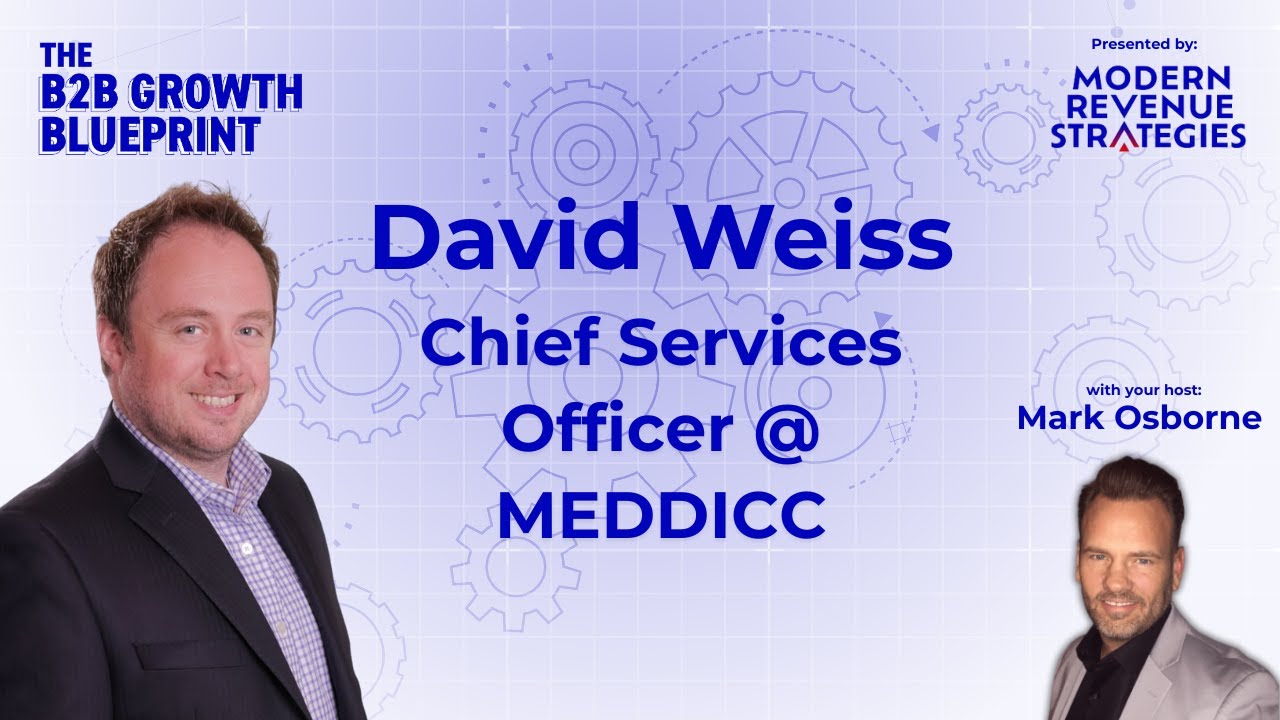
David Weiss, Chief Services Officer at MEDIC, walks through the MEDDIC sales framework and how to actually use it. The conversation covers operationalizing it through documentation and coaching, founder-to-sales transitions, and hiring mistakes early-stage B2B teams make.
Chapters
Welcome to the B2B Growth Blueprint podcast, where we talk with entrepreneurs, founders, and leaders at B2B services, tech, and SaaS companies to learn the systems and processes they've used to create success for their business. We'll also learn from marketing and sales experts to provide insights to help you grow your business. I'm your host, Mark Osborne, and the podcast is brought to you by Modern Revenue strategies and their 10x ROI B2B growth guarantee. Schedule a free diagnostic call to learn the fastest path to double your B2B revenues in just 90 days. Hello and welcome to another episode of the B2B Growth Blueprint podcast. I'm your host, Mark Osborne. Today I'm very excited to welcome my guest, David Weiss. Now, I'm going to read David's bio to make sure I get this right.
You could shorten it. It's a long bio.
Well, we'll get the highlights at least.
All right.
David is the Chief Services Officer at MEDIC. And if you don't know what MEDIC is, we're going to give a little bit of an explanation. He helps organizations customize the MEDIC framework to their unique environment. He trains leaders to embed it into their operating system and delivers deep-dive workshops to help teams master each of the MEDIC elements. He's an accomplished salesperson, leader, and strategist with 20 years of experience in the technology consulting and professional services space. Prior to joining Medic, he was CRO of The Sales Collective, a sales think tank that helped companies assess their people, build scalable sales processes, train their teams, and hire future top performers. He's also the founder of DealDoc, which is a mobile application designed to help salespeople identify risks and their opportunities, and take targeted actions to move deals forward. Earlier in his career, he held senior executive positions at leading technology companies like Seismic, Outreach, ADP, responsible for driving growth there. He's a recognized thought leader in the sales industry, has been featured in publications and podcasts like Sales Hacker, Crunchbase, Top 1 FM, and one of the foremost experts in the MEDDIC sales methodology. Holds a Bachelor of Science in Psychology with a focus in business marketing from the Rochester Institute of Technology and serves as a strategic advisor to several tech startups. So David, welcome to the show.
Mark, thanks for having me. And I need to shorten the bio because when the bio takes the whole podcast, you have a problem. But anyways, it's good to be here.
Well, I'm excited for this conversation and you and I have had a chance to chat about some of these topics. But before we dive in on some of those topics specifically, kind of tell your story of evolution, how your path brought you to where you are today.
I mean, we've already bored the audience enough with the bio, but no. So I've been in sales and sales leadership for the last 20 years. I started out and, you know, just like with a lot of folks, SMB, more transactional type selling, then, you know, progressed into, you know, enterprise selling and then into, you know, enterprise sales leadership and then leader of leaders and all those things. I think the last handful of years is really where And I'm really proud of my career, but where it really came into like critical focus for me. So I spent 6 years in senior leadership at ADP, learned a lot. I like to think that, you know, anyone who spends, you know, 5, 6 years at companies like ADP or Salesforce or SAP or whatnot, it's kind of like, you know, the Harvard of, you know, the sales professional world. Like you learn a lot about professional selling and leadership. And I had a lot of fun there. But what I learned about myself and one of the reasons I transitioned out is, you know, my ethos, my like purpose in living is I get out of bed every day just to help the sales community sell better. And so that's why I transitioned to Outreach, which, you know, helps, you know, companies, you know, better set meetings and, you know, technology to help salespeople sell more productively and effectively. Seismic, help enablement teams and salespeople sell more product— more productively and effectively. And then after all that, I was like, okay, I'm gonna now just like start a sales training company and help people build all the systems. And so I spent a handful of years working with early stage founders, you know, $1 to $10 million B2B in professional services and tech and manufacturing, essentially build like all the systems and whatnot to help them scale. And that eventually led me even deeper into the journey of just doing what I love to do because the overarching theme of the last 10, 15 years of my life has been Medic. Medic is a way that salespeople and go-to-market teams look at deals and identify both a common language to communicate about opportunities, but also to see gaps and risk. And then, you know, through a color coding methodology that I've, you know, evolved over time, be able to see the level of risk and the level of gap and then a system of action running plays to close those things. And so that's what I help people with now. But Like I said, the whole purpose of everything I've been doing and doing now is really just, I just want to help salespeople and organizations sell better. And so, yeah, that's me.
That's awesome. And so for our audience that isn't as familiar, MEDDIC is actually an acronym. An acronym. Yeah. But it's M-E-D-D-I-C-C.
Yeah. I mean, D-D-I-C-C or there's MEDDIC, M-E-D-D-P-I-C-C. The really fast version is, you know, I'll share what the letters mean. I want everyone to think about these are the, what I'm about to share. It's the building blocks of all deals. Every deal you work, I don't care how big or how small or B2B or B2C or whatever. It is the foundation and it's why I love it so much is it's really truly the building blocks of all deals, which gives you a common language, common framework, objectivity to look at every opportunity and then figure out where you may be missing something, gap, risk. And then when you understand that through common language, you can then have a system of action that you can, is repeatable and scalable because you can see things the same way and communicate the same way. lots of people. So anyways, M is metrics. That's what you use to build the financial business case. E is your economic buyer. That's the person who controls budget or has budget that they can deploy. Your first D is decision criteria. So that's like your wishlist, what you want in your future state solution that hopefully aligns to what whoever is selling to you can offer. The other D is decision process. So how are you going to buy the thing? P is for more complex sales. It's the paper process. It's more like legal side of things. The I is the implication of pain. So that's just not just like, what's the problem, but what does the problem like deeply mean in the outcomes of that thing? The first C is your champions. That's who's selling for you when you are not there. That's been tested, that has access to power and a vested interest in your success. And the final C is competition, internal, external. Who am I competing against? MEDD, PICC, or MEDD ICC, however you want to look at it. Like I just mentioned, building blocks of all deals, you figure out those components, you figure out where you have risk in those components, you de-risk those areas, you win more.
Yeah. And I love the framework. I've had the benefit of some training in it and I worked with organizations that use it. And it provides such a really holistic and robust approach to, you know, and I think of sales as more of kind of change, like leading change management. Because very often, you know, when you're selling something to a company, it's not so much that you're convincing them of how to do it. It's that you are clearing the path for them, both emotionally, organizationally, and then, you know, sort of economically to move from one state to a new state that's going to have improved outcomes for them. But oftentimes, the actual person that you're working with at the client forgets Oh, man, I gotta run this through legal. I never even thought about that. But if you are following this, you know, sort of process and you get to that P, you're like, now don't forget, you're going to need to get this approved internally. What do your processes look like to do that? You can actually help guide them through their change management and really facilitate the transaction for them in a way that's not arm twisting. But instead just sort of facilitating change.
Yeah, it's a really astute way of looking at it. I mean, ultimately sales is about helping someone understand the value and as they're understanding the value, they're evaluating the risk. And so there's a really interesting equation of risk and value. And if there's high value and low risk or, you know, or value exceeds risk, then people are often willing to make a change. And so much of it is just like shepherding through that change management to figure out those things and how to, you know, make those things happen. Then as you get bigger and bigger deals, you start getting into executive priorities and you start getting into like, even though there's low risk and high value, there's other things that have higher value and, you know, whatever degree of risk associated with it. So we're gonna prioritize that. So there again, change management and executive priority management comes into play. But regardless, yeah, your job as sales— as a salesperson is to help shepherd positive change.
That's right. Well, and so let's, let's take a little bit of a lens here because, you know, you've worked with ADP and, you know, very large, you know, structured organizations with a lot of bureaucracy, but also a lot of sales expertise, as you said, sort of like the Harvard of sales, Harvard School of Sales. But I know you've also worked with a lot of, you know, early-stage companies that, you know, sort of 1 to 20 or 2 to 20 kind of range where Oftentimes it's the founder has been, you know, in the trenches because they know everything that's right about their products. They just built it. They know everything that's wrong about the competition because they probably used to work there. They had some industry expertise and they've got a Rolodex of contacts. So they've been out there in the trenches slugging away, making deals happen. Maybe they don't have the benefit of sales training and things like MEDDIC, and it might seem intimidating to them to think about bringing in a more formalized sales process, whatever that is. What do you see as, you know, give us a little bit of your insight as you've seen, you know, founders successfully transition from they're carrying the bag, they're carrying all of it, to then, you know, as you say, letting go of the vine, uh, from traction or, you know, other, uh, places and really kind of starting to delegate. How do you see those successful transitions happen? Yeah.
And so there's systems, there's trust, there's process, there's a lot of things that go into that. But I think the people that have done it most successfully, in my mind, really have done 2 things really, really well. One of them is that they've built a team that they trust and that they truly let people do the work. And that doesn't necessarily mean they're gonna do the work how you would do the work. They may do it better, they may do it worse, but ultimately they're responsible for that outcome. And you need to be judging them on the outcome that they're driving, not necessarily how they go about doing it. Um, all that really matters is we win as a team, how we get to winning, it doesn't need to necessarily be your way. And so, uh, that's where I've seen a lot of, you know, early stage founders fail is like, They're like, I want to, I want to delegate. I'm delegating. I'm hiring good people. And they hire them and they're like, we, I want you to go do this thing. And then they're like, well, I wouldn't do it that way. So, well, you delegated it. It's no longer yours. Like, let it go. Um, let the other person and then let them do it and allow them to fail. Maybe give them some guidance if they need it. Uh, but, you know, hire someone good and get out of their way and judge them based on the outcome that they eventually generate. Not how they got there. So I think that's that to me is one really big piece of advice because I've seen a lot of dysfunction happen in organizations where leaders have been like, "I don't want to be part of this. I'm out of this. It's yours." And then they parachute in, you know, once a month, shit all over everything.
That's right.
Offer no advice whatsoever. That's right. Like it's just not how I would have done it. And then they fly the fuck away. And it's just like congratulations. You just destroyed a bunch of work that you said you didn't want to be part of, and you didn't even understand the context that got us to the point that we did to be able to even. judge it properly. And like, if you're doing that, like, holy, like, your team's gonna turn over, they're gonna fucking hate you, and you're gonna make no progress. But yeah.
Well, well, and you hit on something that I think is, is really sort of vital. And I know that you've seen this because we've talked about it, which is, you know, the founder is like, all right, I gotta remove myself from sales. And so they go hire, you know, their competitor's best salesperson. And then they say, now go. But they're oftentimes missing the process and the reason why that person was successful at that other organization was, well, for starters, they were the leaders in the industry, so they had a steady flow of leads coming to them, and they had a well-defined process to manage those leads and opportunities, and they thrived within that system, but they didn't create that system.
Right.
And they're not suited to creating a system for you. And so then, when the CEO comes back in, parachutes in, as you say, well, what are you doing? Well, that's different than what I would do. The reason that it creates that conflict is because they didn't define, well, here's what a good process looks like. And so then, they can parachute in and say, are you following the process? Is it working? Well, I'm following it, but I've made some tweaks to it and it's making some improvements or You know, some differences, but having that, you know, sort of defined process as a starting point is so important and a step that so many companies miss on that journey from transitioning from founder-led to, you know, marketing and sales-led growth.
Yeah, no, absolutely. I mean, the biggest mistake you can often make is, if you're a small company, is hiring the, you know, VP of something from your really, really large competitor because what that really, really large competitor has is years of, of building all the systems and all the structure. Uh, they have the brand behind you. And by the way, you're— the 10, 15 years your competitor spent building a brand has a lot of, a lot of value and a lot of pain that came with it, and a lot of lessons and a lot of learnings that you are going to have to go through. Can you accelerate it a little bit? Sure. But, you know, in an early-stage company, brand recognition is one of the most important things because brand equals trust. And so once I trust you, because I recognize you, my job selling is significantly easier than building that from scratch. And that takes a tremendous amount of effort and consistency and repetition and time. And so you need to not expect your early leader to come in and be able to, you know, shortcut all of those things. Like those things take time. So one, if you're going to hire somebody like that, make sure they're, you know, an in-the-trenches doer. Not a sitting in a spreadsheet delegator. They need to be a doer. And they also need to be given the appropriate amount of resources and time to do it. And that's one of the other big points of failure that I often see is they'll hire someone and they'll be like, you didn't quadruple the size of my company in 6 months. You're fired. I'm going to go find someone that can. And it's like, No one was gonna do that. Your expectation was completely miscalibrated. Like, you know, stop. Anyways, I think you had something to say there and then I'll comment on the process piece.
Oh no, that you're exactly aligned. The only other thing that occurred to me too is that, you know, oftentimes people that have thrived in, you know, those market-leading companies, they don't, they aren't even sort of aware of all of the steps that need to be done to build that credibility and trust. For a new entrant or for a, uh, you know, sort of challenger brand, uh, in the space. And so they're like, well, I can just show up and pitch and then they're gonna buy and then they're gonna negotiate on price with me. Like, that's just their assumption of how the sales process works when no, you have to do a lot more sort of, you know, brand building on a, in a knife fight, uh, because your previous company was doing it with artillery, uh, that, that you were sort of unaware of.
Exactly right. And then the other thing does come back to your comment around process. But so like, let's just contrast this. This is what most founders that I know do. They hire a VP, they hire a salesperson, they set up a bunch of meetings for them to, for those people to watch them do the thing.
Right.
And then They can, or they set up a meeting to tell the person how to do the thing.
Right.
And I just wanna like really like line in the sand. People do not learn that way. If we all learn that way, we'd all be professional golfers because we watched a shitload of golf.
Okay?
We would all be really, really good at boxing because we watched a ton of boxing fights. Like, watch me do this is not a sales strategy. It is not a training strategy. It doesn't scale. It does not work.
Yeah.
So what does? Deep documentation. Get everything outta your brain and write it all down and write it down and codify it in a way that can be digested by another human in an easily searchable, findable way. So some people call this a sales process. You can call it whatever you want, but you need to be documenting things like who's our ideal customer and why, and what segments do we serve and why, and who do we sell to and what problems do we we solve and how do we solve them and what are the outcomes that we've delivered for other people in solving them. We need to be documenting our messaging. We need to be documenting what a first meeting looks like and the questions we ask. We need to be documenting our value proposition. We need to be documenting the objections that we get and how we handle them. We need to be documenting who we compete with and why we win and why we lose and what our differentiators are. You need to be documenting the, the steps and stages and actions in the process and how to execute them Well, and that not only is written, but that's also, you know, show someone through a video of you doing the thing and someone— so someone can read the text, watch the text, and then that you still haven't taught them anything.
That's right.
Okay, then you need to actually watch them do it and allow them to fail and create a safe place for coaching. And then over time, through repetition, they will eventually learn. But is it It takes people anywhere from 30 to 90 days to learn a new behavior and skill. And that's with everything that I just mentioned. There's things called adult learning theory. There's things called the Ebbinghaus forgetting curve. Both of those things point to 90% of information not reinforced is forgotten within 30 days. 90%. If you aren't doing everything I'm saying, forget about it. Like, no one's going to remember anything.
So, I've heard it said. Now, you have such an expertise in this area. So, I love your perspective on it that sales training as a concept is oftentimes misguided for a lot of those things that you just said. So, you do training for a week. You train them how to do everything from soup to nuts and they retain a little bit of it. And maybe everyone gets a little bit better for a couple of weeks and then, Regression to the mean. They come back to doing exactly what they had done before. Muscle memory kicks in and they're back versus the more successful approach is sales coaching where you define a process that's well documented that they can research. And then, you pick a part of that process and you coach people on how to do that successfully over time until they have embedded it and it's become the new muscle memory. And then you pick another part of that sales process and you do that same continuous coaching over that. What are your thoughts on that? What do you see as someone that works within somewhat of an academic environment teaching people a new approach or instilling that, doing some training? Talk to us about what you see there.
Yeah. So, it's not and/or, it's both. So, one, just because you've trained someone doesn't mean you've trained them. Doesn't mean they actually know how to do the thing unless it's like super easy. If your training is like, press these 4 buttons in this order.
Yeah.
Maybe. Okay, maybe. Like, you could train someone to be a cashier by like showing them the buttons to press that. Like, maybe. Okay, they probably still— you probably still should watch them push the buttons and make sure they can do it right. I'd still recommend that. But anything that has any degree of complexity or foreignness to someone. They need to understand the theory. So like, why, why are we doing this? What's, what's the value in it? What are we going to be doing? And how do I do it? Okay, that's training. And then they need to have that training then tailored to their world. So one of the, one of the reasons why sales training fails is because most training is highly generic. And so it's a big umbrella, but that umbrella was never brought a level deeper to say, okay, now that we've trained you on this thing, here's exactly how that fits into our process and our world and our messaging and our product and our, the problems we solve for our people and all of those things. So it normally stops at that top level. So you're not You need to do top level, then you need to do one layer below that. Once that happens, then you need to enter a coaching protocol that is reinforcement. And that's often where you pick one element, you work on that one element until you see the behavior change happen, which again will likely take anywhere from 30 to 90 days of consistent every single day freaking reinforcement. And then you move on to the next element, next element, next element of whatever behavior you want to change. And that's where, that's what I think. Most people screw up.
Yeah.
There's how children learn and there's how adults learn. How children learn is you can often tell a child something and they will have a high degree of retention of that thing. One, because they're thirsty, they want the information, but they also have zero context of the world. Adults, on the other hand, have lots of context of the world. They have lots of learned failure. They have lots of learned trauma. They have lots of things that they have found to be successful because they've gotten to a certain place in their life. You hired an individual because of— you thought they didn't suck. Like, you didn't hire your salesperson because you're like, nah, this person sucks. I can't wait to change everything about them. You hired them because you're like, ah, I see something in them. They're probably pretty good.
Yeah.
But let me train them. But that probably pretty good came with a lot of learning before. And so what happens is you train them. they are uncomfortable with the new behavior because everyone's always uncomfortable with the new behavior. They try it once and they're like, it doesn't work as well as the way I naturally do it, so I'm going to throw it away. And so that's the classic mistake. What I challenge people with, knowing all of everything I just said, is stop focusing on training and start focusing on behavior change observation. And do not stop until you notice the behavior change. And that is when you can move on to the next behavior you want to change. And once you reframe your mind behavior transformation and change instead of training, then often you start getting the results you're looking for.
That's right. Well, you hit on something that I think is also really key, which is you talked about, you know, you have this one thing and the way that we sort of see it is, you know, what's the metrics that you're gonna impact, whether it's a volume or a conversion rate or amount of time that it takes to move that throughput. And so, You train a behavioral change, coach behavioral change that's going to impact those metrics. Then once you actually see the change in the metrics, that's when you know it's been incorporated. And then you move to the next. But I think it's important to think about, well, how do you prioritize this? And one of the ways that we see companies do that really successfully is not only to map out your process, and then once it's mapped out, You can identify these, you know, what we call moments that matter. So, from this transition to this transition, there's a big drop-off there. We're behind benchmarks of what other companies do. That's something that is a priority, and let's do that first. Not chronologically. You don't start with, well, let's make sure we do a good job of initial credentialing calls or credibility boosters, and then let's make sure we do a good job with discovery, and then let's make sure we do a good job with demonstrations. Or instead of going chronologically, think, you know, where are those gaps, those moments that matter, that could make the biggest impact on your overall throughput, and move through in that order. Makes such a bigger difference.
Well, yeah, and so, so much of what you just described is we need to improve our win rates. We're gonna do training to improve our win rates. We did the training. I'm gonna now look at win rates for the next six months, and they didn't improve.
That's right.
So the training didn't work, and it's like, well, no. What what did we do after the training?
Right.
And and that's that's really the the place that it falls down. And you know how I always recommend again to people is like you want to break down these things into just little pieces. So like. We need to improve our discovery. Well, what goes into a discovery meeting?
Right.
And it's not like, it's not like, well, we need to improve the meeting. It's like, well, no, what goes into a discovery meeting is the first 5 minutes of building rapport. Then it's, you know, the 10 to 15 minutes of questions I'm gonna ask and second and third level peeling the onion questions I'm gonna ask on those questions and how to do that. Then it's the, okay, based on what we learn, What am I now gonna tell this person around how we can solve it and the matrix around that? And then based on that, you know, what are the next steps that need to typically be painted? And I didn't even mention the agenda that gets set at the beginning. And it's like, you really think about all of those little pieces. It's like, cool. Discovery is not, we need to get better at discovery. Discovery is, we need to get better at all those little pieces that make up that thing, then put it all back together. Then be able to execute it in sequential order the right way. And okay, great. Now we need to do that repeatedly. Okay, great. Now we can move on to the next thing. And unless you're going to that level of granularity, like you're just essentially telling people to sell better.
That's right. Yeah. Go sell something. Well, and you hit on something that, you know, I emphasize to people all the time, which is sales is a process, not an event. Like so many people have in their mind that Like sales is you show up to that one meeting and you wow everyone with your jazz hands. Uh, and then at the end they sign the contract and that's sales. And, and I try to tell people all the time that, you know, however, whatever analogy you want to use, there's the, I think Art of War, he says, you know, the battle's won or lost before the single, before the first sword is drawn. Uh, and, and, and I oftentimes say that in sales is like, if you're expecting the presentation To win the deal, that means you haven't done the work upfront that would have been necessary to win the deal. You would have— it's all about that preparation. And then there's some stat that, you know, 70% of salespeople say they don't do enough preparation, but 70% of success in a meeting is the preparation that was done. And so, you know, so often that, you know, we need to get better at discovery. Well, what are you doing prior to the meeting to make sure that it's a good discovery meeting? Oh, nothing. We're just making sure we show up with our questions. Well, then maybe that might be one of the things that you should add to that process to really improve it.
One of my favorite quotes of all time is, chance favors the prepared mind. Yeah, Louis Pasteur said that. And it's that it all goes about— we create our own luck, we create our own chance. And it's through the, to your point, the proper preparation before the thing happens.
Yeah. Plan, you know, failure to plan is planning to fail, or, you know, prior planning prevents piss-poor performance. That's right. And then what is it?
You know, luck was drummed into me in my fraternity days. I had to repeat that statement 10,000 times.
And the, you know, luck is when preparation meets opportunity. Yeah, all of those things, but they all come back to It's what you do that sets up the thing that, you know, really sort of leads to the success. But you're obviously an expert in tons of super interesting areas that we could spend all day talking about, but I got to be mindful of your time. But before we go, like, tell us something that's on the horizon for you that you're sort of excited about or that has you interested.
Oh man, you know, I did just start at Matic, so like, Building that side of the business is really, really exciting for me. I've built sales training companies in the past and service-based organizations in the past, and I've got such a deep love for medic that both of those things right now are colliding. So that's super exciting for me. My son, he starts middle school in a week. So getting him ready for that is really exciting. We're planning New Year's in London this year. So that's gonna be really, really cool.
Oh, wow.
You know, doing everything required to do that. Yeah, so that's a little bit of work, a little bit of professional, but those are, those are things I'm probably, you know, most excited about.
That's awesome. So, David, I've really enjoyed our conversation. I'm sure our audience has gotten a lot out of it. For those listening that are like, I really want to learn more about sort of this, some of this expertise that David has, a little more about Medic, what's the best way for them to get in touch with you?
Yeah, LinkedIn always. Email is a, is a, you know, a black hole pit these days. So don't, don't try and email me. But drop me a note on LinkedIn. Just connect with me. I respond to like 95-98% of LinkedIn notes. The only ones I don't respond to is like if you meet me, you're like, hi David, I'd like to sell you this thing. I'm like, oh, please. But outside of that, I will respond to you if you're thoughtful about like the thing you're looking for.
Awesome. Well, David, thank you so much for taking the time to join us today. I really enjoyed our conversation.
I know our audience Mark, thanks for having me, and everyone, thanks for listening to me.
All right, talk to you soon.
Bye.
Thank you for joining this episode of the B2B Growth Blueprint podcast. We hope you've gained insights to grow your business. If you enjoyed this discussion, please rate, comment, like on your favorite platform, and share to others who will find it useful. Do you know a CEO, founder, or leader at an early-stage B2B services, tech, or SaaS company who would like to be a guest and share their story, send us a note. Let's schedule a conversation.
More from Mark

How Can You Maximize Your Business Value Before Selling? with Randy Katz Video







