How Premonio’s Data System Optimizes Revenue Growth with Johannes Hoech
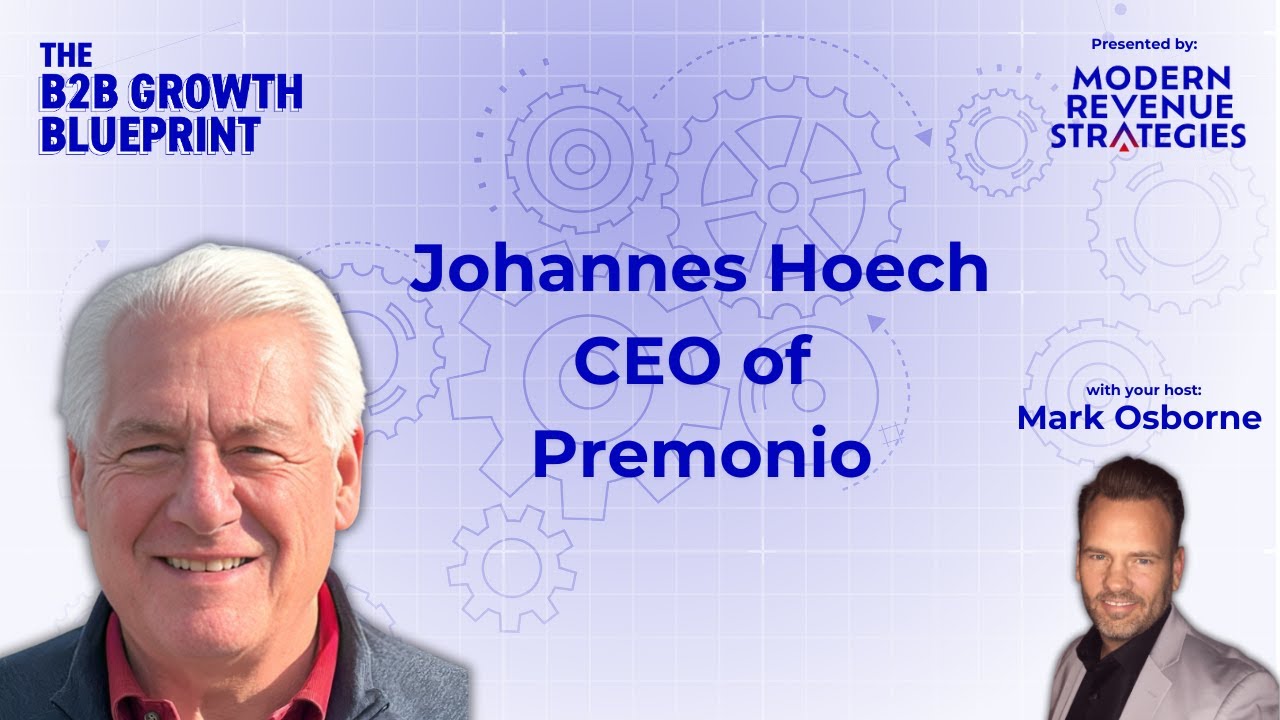
Johannes Hoech built Premonio, a predictive analytics platform that models revenue outcomes without historical data, using a GPS-like navigation approach instead of trend extrapolation. The system links every sales activity to revenue impact and lets founders run simulations: hire this person, see the revenue effect. Hoech identifies four reasons B2B startups fail: no product-market fit, undefined ICP, unclear differentiation, and weak messaging.
Chapters
Welcome to the B2B Growth Blueprint podcast, where we talk with entrepreneurs, founders, and leaders at B2B services, tech, and SaaS companies to learn the systems and processes they've used to create success for their business. We'll also learn from marketing and sales experts, uh, to provide insights to help you grow your business. I'm your host, Mark Osborne, and the podcast is brought to you by Modern Revenue Strategies and their 10x ROI B2B Growth Guarantee. Schedule a free diagnostic call to learn the fastest path to double your B2B revenues in just 90 days. Hello and welcome to another episode of the B2B Growth Blueprint Podcast. I'm your host, Mark Osborne, and today I'm very excited to welcome my guest, Johannes Hirsch. Now I'm going to read Johannes's bio to make sure I get this right. He's a seasoned technology executive with over 30 years of experience in leadership roles across various industries. Currently the CEO and founder of Promonio, they're a predictive revenue optimizing system for B2B startups. So we're going to talk about what that means to be a predictive optimizing system, especially for startups that maybe don't always have good data. So some really interesting topics there. Throughout his career, Johannes has held positions as CMO, COO, and VP of Product Management at companies including Spirion, White Hat Security, and Intuit. He has a strong background in marketing, product management, and operations, and a track record of driving growth and innovation. He holds degrees in naval architecture from UC Berkeley and an MBA from the MIT Sloan School of Management. So, Johannes, welcome to the show.
Thank you. Thanks for having me. I'm super excited to be here.
Yeah, me too. I've been looking forward to our conversation. So tell us a little bit of your story. How you've, you've obviously done a lot of things in both operations and product management as well as marketing, and now you're doing sort of revenue operations. Tell us your story of how you kind of got there.
Uh, yeah, I— well, it's a typical immigrant story. Back in the sort of 1700s. I came over here with $700 in my pocket and made my way up. I love this country, a great place. And my first college was actually a community college. And I sat down with the advisor and he said, what do you want to do with your life? I didn't know what I was going to do.
Sure.
And I said, I don't know, you know, I could be— my dad was a musician. My uncles are all engineers. He says, well, hmm, Where are you from? Is it near the Rhine River? Oh, okay. Do they have ships there? Yeah, they have ships there. Berkeley has a naval architecture program. That is how my career choice was made. Now, the reason I'm telling that story is 40 years later, those chickens actually came home to roost. So I launched my career in naval architecture, which is ship design. Back in those days, most of the shipbuilding was moving to Asia, so I wasn't going to launch my career into a disappearing field and decided to retool, get an MBA, went to MIT. From there, went to McKinsey for a while, and then from there I've been in Silicon Valley since 1990. And then sort of increasingly responsible roles. And towards the end, I had pretty sizable budgets and I was obviously always under scrutiny by the board and the CFO and, you know, the executives. Because I was, besides development, I was the guy that was shoveling money out the window. And so they had to, we had to figure out how to justify it. And I began to realize that a lot of the tools that were available were really fundamentally broken. You know, the investors would come in and say, we want you to accelerate your growth rate from 20% to 30%. The CFO would run his or her model, hand it off to the CEO, or the CEO had another model, hand it off to the CRO who had his own forecast. Back in those days, they were still all called SVPs and EVPs. CROs didn't exist.
Sure.
And, you know, the round trip to get back to the investor on what it would take to do that would take a month. And by the way, it was fraught with error. And then that's when I started pioneering this approach where what if we modeled all of this in one cohesive, holistic model? And this is where the Naval Architecture Pass comes in that does not require prior data. Most companies don't have good data, or if you're a raw startup in a disruptive field, there is no data by definition. So how do you actually use analytics?
Right.
And so I remember my Naval Architecture classes and realized it's actually a navigation problem. And navigation meaning you navigate into a target and you course correct as you go there, similar to how your car's GPS finds a target or, you know, the rocket lands on the moon. Versus you're extrapolating from the past, which is what most analytics packages do. You know, you know Monday was here, Tuesday here, Wednesday here, so Thursday must be here. Well, if you don't have data for Monday, Tuesday, Wednesday, you can't extrapolate Thursday. And that led to then the development of some analytical approaches. And then at some point I decided that, gee, I've done a lot of things in my life, but I've never started a software business. So 5 years ago I decided to start a software business. software business. And here we are, we're doing really well. We've had a great year. We've been on average growing 35% since 2019 when I launched it. And we're actually going out for fundraising. I have my first commitment. So I'm hoping having the first one in, we'll get the second and the third and the fourth.
Yeah.
And so it's super exciting and the approach is actually starting to work. So that's a little bit my my story and why the naval architecture piece was actually relevant.
Very interesting. So you're taking all of that background and implementing it in Promonio, and I think what you said is that Promonio is really designed to create analytical models for folks that don't have all of that, you know, sort of historical data in order to make those predictions. Is that right? Tell us a little bit more about what Promonio really does and what the solution is.
Yeah. So think of it like, if I use an analogy, think of it like a flight simulator for your company or for you. And in our case, we focus more on the revenue generating side. So we don't model the entire company. And if you have that flight simulator and the flight simulator is reasonably flexible, so you can say, oh, it's a prop plane, it's a jet plane, it's 4 engines, 1 engine, it flies fast, it doesn't fly fast. You can do all those things, and then you can begin to see where you can model scenarios. You can model strategies. What if I hire 3 more sales reps? What if I, instead of hiring 3 sales reps, I hire 1 sales rep and 2 BDRs? What if I spend a lot of money on marketing and so forth? And you can do that essentially in a piece of software rather than doing it real life, which is what most companies are doing. And then that's how people get fired, and they don't really have results until a quarter or 2 later.
Yeah.
You can know results within 2 or 3 weeks at most. So you can diagnose very quickly. You also lay the foundation for good, clean revenue operations, but you're only correcting the data that you really need. You're collecting the data that you need, not this whole data bazaar that all of these various functional apps spit out. And so it actually drives a fair amount of efficiency, if you will, because you're not tracking everything you could. You're just tracking the stuff you need. And the other piece that it does, it actually integrates the 3 major functions: sales, marketing, and finance, so that you can figure out how many dollars do I spend for each of my lead sources to get how many dollars of revenue. Kind of a yield calculation, if you will. Yeah. And that usually makes people's eyes perk up because once you do that and you have all that digitized, you can do things like forward-looking CAC optimization because the investor comes in and says your CAC is at 8 and I need you to bring it down to 6. You can do this paper airplane or software airplane model modeling or scenario modeling that I talked about and you can figure out what operational activities do I need to undertake so that I can hit that CAC target? And you'll know all your intervening KPIs so that I know next week, the week after, the week after, whether I'm track— on track to hit these targets.
That's great.
If you don't digitize your company, you don't have the flexibility to do all that, and you also don't benefit from You know, eventually when you correct— collect the correct data, the ability to be very quickly course correcting.
That's really interesting. And I love the way you described it as sort of this course correction because you can start with essentially a model with some assumptions in it that then gives you a path. And I know that the model that you've built is based on a lot of, you know, really strong inputs. So you can sort of benefit from all of these other companies that have gone before you, that have done similar things and seen similar types of results. But as you capture data on what the real-world reality is, it can very quickly adapt to, well, we thought that you'd get this many leads in this amount of time based on this activity, but you got more because your offer is more compelling, or you got fewer because you're less differentiated in the marketplace. And so then it immediately adjusts all of that downstream, uh, projection. Is that right?
Yeah, that's exactly right. I mean, you can basically pressure test assumptions. You can do it all the way down to the campaign level like you talked about. I can have one campaign that says, oh, Primonio costs less than the other alternatives, and the other campaign is Primonio gives you better quality than the other alternatives, say. So now I have 2 campaigns. One is around cost savings, one is around quality improvements. I'll know very quickly whether or not they perform. Early funnel, you can track things like click-through rates. Mid-funnel, you can track things like, am I getting the demo, or a subsequent meeting. Late funnel, you can track, uh, closure rates and things like that. So it's a good, uh, diagnostic tool both for what's broken with the status quo, which is right now I would say 80% of the market really have a status quo that's not working all that well. So you need to diagnose pretty quickly what's, what's broken. But then you also want to have this early warning system so that as, as I launch my corrective strategy Am I actually getting towards goal? Am I on track to hit goal or not? And you want to know that, you know, I want to know whether I make Q1 on January 15th, not on April 2nd. And that's the, the, the one of the purposes of this or one of the differences of this approach.
That's so great. Well, and it also, you know, sort of brings the wisdom of people that have done it before and sort of all of that sort of historical background. I heard a really great analogy the other day of, Very often when folks are there in the cybersecurity space and they want to grow to, you know, from $5 million to $10 million, and so they go out and do an exhaustive search for a CRO, a chief revenue officer, that's taken a cybersecurity firm from $5 million to $10 million. But the fact of the matter is, when they were doing it, there was all this private equity flowing into cybersecurity. And so, you know, it was a very different context. And someone used the example of What, you want to have him, you know, tell you how he picked the right lottery numbers before? Because that's not going to work this time. You know, whatever strategy he used to pick the right lottery tickets before doesn't work.
Yeah.
So instead, this is almost like you pick a number and then you see if that's the number that came up on the lottery drawing and you can adjust strategy midstream and actually adapt to it rather than just being reliant on one person who did it in a completely different environment.
Yeah, no, you're locking onto it better than I can. I mean, it's, it's one thing is you do benefit once you do this and you have a lot of these companies digitized, you get a fair amount of benchmark data and it's normalized benchmark data. So for example, we work with PE firms who are using it to do cross-portfolio company comparisons because everybody's on a standardized set of metrics. But the other piece is, and this is a subtle point that you're homing in on, that a lot of people don't get right up front. You know, when you launch a startup, you're really venturing out into the unknown. You know, you have a thesis and you think it's going to work and you have confidence. You wouldn't put your energy into it if you didn't believe in it. But you don't really know, especially as the market is changing. And so then the name of the game is really very quick experimentation, you know. So you have to, to some extent, be willing to challenge your own assumptions and then course correct until you iterate your way into the target. And that's the fundamental crux, you know, the fundamental problem that a lot of startups need to solve but don't solve at a high enough clock rate. You know, they're doing it too slowly. They course correct once a quarter or once a year instead of once a month or once a week.
Right.
And that, I think, is a key piece of the difference. And, you know, that's one of the benefits of having— a lot of talk is around a data-driven organization. And that's one of the benefits about being data-driven in that. But you have to be willing to listen to the evidence versus, oh, go after this market because I say so. And then, you know, you're gonna have to live with your sins later on.
Well, and, you know, from an academic perspective, you know, I've been through the entrepreneurship courses and getting my MBA, which I'm sure you did as well. And, you know, it's basically like Get out Excel and, you know, build a projection of what you think is going to happen. But very often it's kind of what you hope or what you wish would happen and what you can say with a straight face without blushing too much as you try to get investment. But it's not really based on a lot of fact or grounding, whereas this gives all of that grounding and then the ability to iterate as you get data that indicates that, well, we thought it was going to turn into this, but it's not.
Right.
And so we can now adapt a lot faster.
Yeah, it's interesting that you mentioned that because again, the status quo or the sort of established practice in most organizations is that it's a bunch of spreadsheets. The typical CRO forecast is either they take a list of opportunities and rank them high, medium, low, multiply out the probabilities, and that's the forecast.
That's right.
Or the simpler version is I got 10 sales guys, they have a million-dollar quota. Yeah, I think they'll hit 80% of their quota. Forecast is $800,000. How do you know? And, you know, half the marketing people don't even do a forecast, a quantitative forecast. And so what we do is we pull all of that into a cloud app. So everybody is on the same dataset and uses the same system and uses the same assumptions. And so if the CRO says, I'm going to lower my pricing, it'll ripple through to the accounting system. And or, you know, if you need to make up lower prices with higher volume, it'll ripple through to the marketing team because they now need to up their pipeline generation. Without having all of that in an integrated cloud-based system, it takes too long for all those iterations to work their way through the system. And then, you know, you got the unpleasant board meeting on January 15th where you have to explain why Q4 didn't work out. Versus, you know, you know already in November what you're going to be doing or in October what you're going to be doing.
Well, and it even sort of, you know, creates an opportunity because another problem that exists and it's a better problem, but it's still a problem is, you know, sort of this rapid growth where you don't recognize that you've got such a, you know, rich, robust pipeline that's actually going to deliver so much work. that you're going to then need to either expand the software capabilities or hire customer success team folks to deliver against. And so you go through this, you know, sort of roller coaster ride of, you know, when you have this feast, if you can't deliver well against those customers, then you've lost the opportunity for all of the residual income that could come from those customers, all the reputational impact in the marketplace that comes from you falling down with those customers.
Mm-hmm.
Whereas if you had this really accurate forecasting, it allows you to do a much better job of saying, we're gonna need more folks. It's worth investing in a line of credit or in getting some funding to bring in CS folks so they can be trained up and ready to roll because we're actually growing at this unexpected pace.
Yeah, yeah, violent agreement. And In order to make it happen, what you just talked about, what we do and what needs to be done— I mean, anybody once would want to do that, would do the same thing. And that is you have to mathematically link activities. How many calls do I make? How many emails do I send? How many customer service requests do I respond to revenue?
Yeah.
And this is where the bodies are buried. It's the rare organization that actually has that mathematical linkage so that you can say— and then you can do scenarios both directions. You can come in and say, I want to take my revenue from $10 million to $12 million. How does that ripple back into the associated operating operational metrics and task metrics that I need to hit? Or I can say, oh gee, you know, I'm going to hire 2 more sales reps and they can send out, you know, 500 emails each and make 50 calls a day each. How does that ripple forward into my updated revenue projection?
That's right.
If you don't have tasks and activities mathematically connected to revenue, you can't do either direction of those simulations with a high degree of confidence because you have a causality established. It's not just a correlation. Yeah. Does that make sense? Yeah.
Well, yeah, and it closes that loop instead of it just being this happened and then, you know, you have the outcome that happened. Instead, you're learning of what's likely to happen. So now I can adjust, right, uh, to, you know, add more volume or to find another source of leads or whatever it might be.
Yeah, no, I might, if it's okay, I might change the topic a little bit because we've been talking about, I call it the signs of revenue. And there's a lot of talk around being data-driven, being analytical and so forth. And here's a funny irony. When I started my career, I started in product marketing and marketing. I actually worked for a branding agency in the '90s. I mean, I was all the way on the right end of things. As my career went on, I went to the left-brain end, and now I'm coming back. And here's why I'm coming back. Let's assume we run a company together and we measure all the numbers and we dial it all in and everything is running, you know, we have beautiful, clean, crisp data that's meaningful. The vast majority of the companies that we do this for, and we've had, you know, several dozen customers, uh, at this point especially in the current market, when by the time you've collected all the data, you diagnose the issue, it boils down to 4 things. They didn't get product market fit. They didn't get their ICP defined. They didn't figure out what the differentiation is in a way that's compelling. And they didn't then translate that into compelling messaging that gets people excited to act.
Yeah.
And so the funny irony is you sort of have to make this journey through all this data science to come back to what are basically traditional right-brained Yeah. Go-to-market activities where you need to sort of resonate with somebody's interest and somebody's demand and know how to connect. But this time you're there because the data tells you, not because, you know, that's what you thought would work. And so it's a funny irony that, you know, after all the data is done, you're actually back to, you know, brand marketing and messaging and things, right? Competitive analysis and those kinds of things.
It's so funny, like, you know, when I— there are, there's an entire generation of marketers out there that have been very successful, but just by chasing, you know, sort of the next big thing. So if you think about, you know, late '90s, the first folks to optimize their website for search engines suddenly got all of this free traffic. And so had a, you know, windfall of customers that none of their competitors were getting, had a lot of success. So whoever was in charge of marketing that said to do that looked like a genius. And then they're like, well, maybe we'll pay for some of that traffic. So they moved into paid search and spent some time learning how to optimize that or hired an agency to help them do it. Again, looked like geniuses, but really they were just kind of arbitraging or being the first mover. Same thing was true. And, you know, now advertising on Facebook or LinkedIn or whatever it might be, the new niche platform for their channel.
Mm-hmm.
But today there's such a proliferation of the next thing that you could do.
Mm-hmm.
That it's a much more challenging choice of, well, what should I do? And so it comes back to this kind of strategy that there's an entire generation of marketers that have never learned that strategy of, well, start by understanding who your customer is, then understand the competitive landscape so that you can find out what's unique about you Turn that into messaging that you can then take to any of those different places to play. It's so interesting that that's almost the data and the technology is bringing us back to these fundamentals.
Yeah, yeah, I, you said it way better than I could, but I would add 2 more headwinds to that and they are actually very much sort of 2020s and on. Headwinds. One is what I call the TikTok phenomenon, and the other one is what you already alluded to, which is the oversaturation of inbound messages. Yeah, uh, for example, 5 years ago I did, you know, made a lot of progress helping companies get on LinkedIn and basically drive demand using LinkedIn. 5 years ago it worked like a spinning top. Nowadays it does not work anymore because people are, you know, look at your inbox lately, you get these, you know, messages. Oh, here's my Calendly link. And sure, why would I want to get on your Calendly? But, uh, the second— so what you have is kind of this proliferation of these digital outbound techniques, and there's just companies that are dialing it up to 11. They're sending out emails by the busload, and they're sending out these LinkedIn messages, and people have kind of dialed down their willingness to even read them.
That's right.
And the second one is the, what I call the TikTok phenomenon. I think societies are moving, and this is not just here in the US, you know, attention spans are getting shorter and shorter and people want to get more and more stimulated. They don't necessarily want to sit down and go through a 20-page PowerPoint deck and really think about it. And then I'll call you back the next day whether or not they're interested. They'll decide it on the spot. Yeah, and talk about something that we could talk about is the limbic tickle, which is the, you know, you really have to figure out how to get somebody viscerally excited and interested. You know, the first 3 seconds buy the next 10 seconds, and the 10 seconds buy the 30 seconds, and the 30 seconds maybe buys you the 3-minute conversation, right? And, you know, people make very quick decisions, and if you don't pass those hurdles, you're out. And so then that gets back to what we were just talking about, the 4th element, you know, messaging. there's this additional headwind where you really have to figure out how to grab somebody's attention, but do it on that foundation of differentiation's clear, the ICP needs are clear and so forth. And that's really hard. And I would say 10, 20 years ago it was easier. Nowadays, because of these factors, it's a lot harder.
Yeah, for sure. Wow. So this is all super interesting stuff and we could, we could spend all day talking about it, but I gotta be mindful of your time. But You know, before we let you go, tell us something that's on the horizon for Promonia that you're excited about.
Well, I personally am super excited because we, like I said, we have our first committed investor and so far we've been self-funded. You know, I'm doing this the old-fashioned way. We got product market fit first before we started going out and funding the product development. But now we're funding the product development and that's super exciting. And the other piece I think I'm just excited about as hell is this whole AI influx. And I'm not trying to spread AI pixie dust, not at all. I'm quite the opposite. I'm sort of an old, you know, dyed-in-the-wool pragmatist. But there's just a disruptive speed of tools coming in that are really changing the way sales and marketing can be done. And I think that's just super exciting. So both of those for me and with Promonio, You know, we're trying to obviously harness both the investment as well as, uh, this technological shift. That's— those are great opportunities. So 2025 is going to be a great year.
Yeah, but I think it comes back to though, just as we said before, like the tool by itself isn't the solution. It's understanding how to apply that tool based in these, uh, foundational strategies. That's really the key. And yeah, yeah, yeah, yeah, very wise to call that out. So for our audience that you know, has been listening and is like, wow, I really wish I had more of a data-driven framework for decision-making, but I don't have all that historical data I need. How can they get in touch with you to learn more about Premonio?
Well, I mean, obviously one is LinkedIn, the other one is our website, premonio.com. The third one is they can, you know, obviously contact you. And if I'm nice to you, you'll actually pass them on to me.
Absolutely.
Yeah. So I think, you know, There's, there's plenty of ways to find us.
Well, fantastic.
I respond personally very quickly, so it's not like things are getting lost in the ether somewhere. So. Gotcha.
Well, Johannes, thank you so much for taking the time to join us on a lot of really interesting concepts. I appreciate you sharing that with our audience.
Yeah, thank you. Thanks for having me. It's super exciting.
All right. Thank you for joining this episode of the B2B Growth Blueprint podcast. We hope you've gained insights to grow your business. If you enjoyed this discussion, please rate, comment, like on your favorite platform, and share to others who will find it useful. Do you know a CEO, founder, or leader at an early-stage B2B services, tech, or SaaS company who would like to be a guest and share their story? Send us a note. Let's schedule a conversation.
More from Mark

How Can You Maximize Your Business Value Before Selling? with Randy Katz Video







