How Sustainability Drives Business Growth with Mark Sait
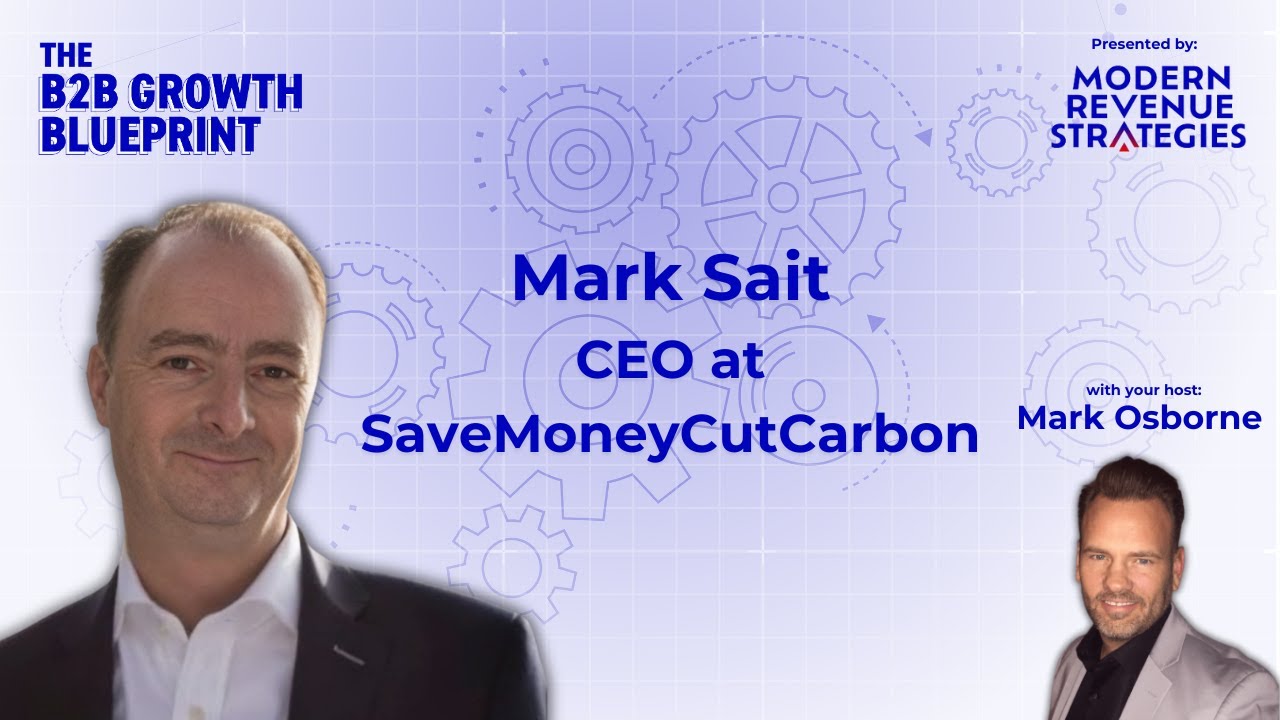
Mark Sait built Save Money Cut Carbon into a $10 million business by creating a digital marketplace that breaks down utility bills and connects building owners with sustainability solutions. His Impact Partner Program leverages trusted brands like banks to reach enterprise customers, though selling to large regulated organizations requires years of relationship building and navigating complex procurement.
Chapters
Welcome to the B2B Growth Blueprint podcast, where we talk with entrepreneurs, founders, and leaders at B2B services, tech, and SaaS companies to learn the systems and processes they've used to create success for their business. We'll also learn from marketing and sales experts to provide insights to help you grow your business. I'm your host, Mark Osborne, and the podcast is brought to you by Modern Revenue Strategies and their 10X ROI B2B Growth Guarantee. Schedule a free diagnostic call to learn the fastest path to double your B2B revenues in just 90 days. Hello and welcome to another episode of the B2B Growth Blueprint Podcast. My name is Mark Osborne. I am your host, and today I am very excited to welcome my guest, Mark Sait. Mark Sait is the founder and CEO of Save Money Cut Carbon. Mark is a disruptive entrepreneur with significant experience in business which move new technologies into the mainstream. Save Money Cut Carbon is his latest venture founded in 2012. The company has enjoyed rapid growth and is recognized as the TripAdvisor for sustainability. It is also the first recipient of investment from Barclays as part of their Sustainable Impact Capital Initiative funding. He is known as the go-to person for commentary on the UK sustainability and carbon reduction markets and regularly contributes to the BBC, TalkRadio, and across print media. Save Money Cut Carbon is a digital aggregator providing a unique marketplace focused on sustainability. It offers cost-effective products and solutions to businesses and consumers seeking to reduce their carbon footprint and be more sustainable. Mark, welcome to the show.
That's great. It's great to be talking to you.
So that's a whole lot of stuff. And I know you've actually had quite a journey to kind of get here with Save Money Cut Carbon. Tell us more about, you know, sort of your path and your journey and what you do.
Yeah, so my path originally was many, many years ago, I was an engineering officer in the Royal Navy. So I'm a bit of an engineer trade. And when I came out, I started studying business and marketing, and that's where I got onto my entrepreneurial journey. Um, so I built some smaller business or involved in the building of smaller businesses, and they were sold. I did 10 years in the kind of corporate world, which, if I'm being honest, I didn't really fit in. I think I was disruptive there as much as I have been, uh, when I, when I wasn't there. And then I came out and was involved in founding one of the largest, um, broadband suppliers into the hotel industry. So if you've ever been into one of the big hotels years ago and been charged to connect your laptop and get your email, that was us. And that was a really kind of fast-growing business. And then Sabre Cut Carbon really came out of that. I left that, the broadband business, did some amazing roles around the world looking at being COO, CEO of kind of businesses that were growing startup. I was not a big environmentalist, if I'm being transparent. I used to kind of fly backwards and forwards to LA from the UK probably every couple of weeks working on that. And it was when I was in LA, I started to learn a little bit about the hole in the ozone layer, about this carbon thing. And this was probably 15 years ago. And, you know, I started to get a bit of an interest in it, um, and I heard a speech out there one day and they were talking about, you know, in 15 years' time— so they're probably looking forward to 2019 maybe— we'd be rioting in the streets over this, this, this thing called carbon. And I thought, wow, that's really fascinating. If you kind of think back before COVID what was probably happening. And they also— we were talking about a view that in 10 years after that, so let's go out to 2030, we'll have conflict around the world around water shortages, not around oil. And I think that's coming to us as well, particularly, you know, if you're West Coast of the States and things now, water is, is a real challenge. Um, so I came back to the UK and I got really fascinated in it. I went out to the hotel industry actually because I had great contacts there because of my broadband business.
Right.
And I said, look, here, I'm gonna start something else. This is a new one. Carbon, is it true? I was even asking silly questions like, well, is it maybe just in America, carbon? I don't know, maybe it's just in Los Angeles. Uh, and it was really coming over the horizon. And I remember talking to a 200-bedroom hotel in London and I said to the guy, you know, what's your energy bill? And he said, oh, it's, you know, it's about £50,000. And I wrote down £50,000 a year. Went, no, no, a month. And I was like, oh my gosh. So Safely Cut Carbon was really built out of that, around that customer need. And what we found was businesses know what their energy bill is, know what their water bill is, but they don't know how it breaks down in their, in their building. So how much of that electricity bill is lighting versus motors versus pumps? How much of that water goes on showers versus taps? Once you start to break that down, you can start to work out how you can reduce that. And in reducing that consumption, you can start to then reduce the carbon emissions and the carbon footprint associated with that. The next challenge, put the customer in the middle of our thinking, and I've learned that the hard way over many, many years, was if you're a customer, you want to do this, you want to get all the information in one place. So what you don't want is multiple suppliers. I want to get the solar company, then the water company, then all those kinds of different things, because that's just busy. And if you think about Amazon at the top of the tree, you know, they just put everything in one place and make it quick to get. So we built something called building-centric search. We mapped energy, water, and touchpoints to, um, a building types, or hotel or school or whatever, which allowed myself as an engineer originally, but now my assessors, to enter the building and use our software platform to show you everything you can do in there. And then you can, like a shopping list, you can chop it up by investment or by payback. And that's kind of how savemoneycut.com was born. Fast forward now, we are, you know, quite, uh, kind of, uh, leading the, the process in the UK with 1,500 to 2,000 projects completed in schools, hospitals, still hotels. Um, and we got that, you know, we got the business from an idea around a kitchen table with a glass of wine to, you know, about $10 million turnover. But it's been a bumpy ride, you know, it's been a very difficult ride on this one. And we had COVID right in the middle. So, you know, you talk about problems for CEOs, we were there profitable. Wow, we've made it. And COVID wiped out 85% of our turnover because our biggest customers were hotels, schools, and hospitals. So it's been a journey. Wow.
Well, and I think it's so interesting and you and I have talked about this that it's not just about, you know, making money and it's not just about sort of doing good, but it's about how to, you know, sort of do good while doing well. And I think that's such sort of an inspiring vision for many businesses that it doesn't just have to be about one or the other. And in fact, there's actually a great blend in the way that you approach it. And obviously, Going from, you know, $0 to $10 million is quite the journey. And, you know, sort of this idea of customer acquisition is something that, you know, is central to, you know, all types of businesses. And so all of the entrepreneurs, founders, and operators listening are, you know, probably have that top of mind or wondering like, how did you go from that, you know, $0 to $10 million? And there's oftentimes this sort of you know, kind of fallacy of, well, I've got product market fit. Now all I gotta do is like get an outside investment and go spend a bunch of money and I'll have, you know, infinite number of customers. But you've been around the block a couple of times and you've seen that that's not necessarily true. Tell us a little bit about your perspective.
Yeah, I think that is a great question. And it's probably the, it's the real kind of central thinking point of anyone that's trying to grow a business, you know, beyond maybe a great lifestyle business. But even if you're doing a lifestyle business, you still need to think about how you acquire those customers. And you're right, I have been around the, around the block where I've raised the millions and millions and millions of pounds and we've spent it on the marketing department and it was great fun and all that sort of stuff. But it can also be quite difficult to track, it can also be quite difficult to, to manage, and it can get out of hand quite, quite easily. So with Save Money Cut Carbon, trying not to fall into that trap, you're exactly that. You know, we got to a situation where we had some great customers— large hotel groups, schools, uh, hospitals, And they've been working with us for years and years. They love what we were doing. And this was when, you know, if you took 100 people off the street and started talking about carbon reduction, sustainability, there was a small number of people that got it. Where now, with environmental social governance, pretty every every boardroom in the in the world has got it, and it's quite high up on the agenda. So I think you've got two things going on. You've got that journey as an entrepreneur. I call it you know kind of pioneers take the arrows and settlers take the land. But if you take too many arrows in the first 5 years, you can, you can run out of blood and steam to get there. So we were very mindful of that. I was very mindful of that here. And we did nearly fall for that. You know, we came out of COVID and we were talking to the big investment houses about what would it look like if we put $50 million in. And we went and worked with the biggest ad agency, which was very expensive and very exciting. And they designed our adverts and we were getting carried away with TV. And I think that plays to the entrepreneur's ego, I think, a little bit. It's like, wow, we're going to be on TV, we're going to be on radio, we're going to be big on social media. We're not going to be doing a little bit on LinkedIn or a little bit on Google. We're going to be spending, you know, buckets of money. But it's really dangerous. And there's lots of businesses out there in the UK and around the world that have gone and, you know, spent $100 million a year on marketing and TV campaigns and had a whale of a time doing it and sponsoring all the sports events. And then, you know, a year later they've only generated $10 million of sales and the investors lose interest really quickly. So when we came into the market to have those conversations It was painful, but it was actually lucky that a few of those businesses, and I'm not gonna name them, had been through that cycle. And if you went in front of an investor and said the word marketing or media, they immediately kind of shut their door and told you to go away quickly. So we had to really sit down and think about how do we acquire customers? Because like all entrepreneurs, you've got this fit as you talked about and you go, God, you know, we'd be there if we just had another 1,000 customers or another 10,000 customers, whatever it might be. So that customer acquisition cost is really, really important. Most people, I think, lean into the Google and my view do that with a Google paid search. It works, but really the only winner is Google, um, you know, the search companies. Um, though, so from our point of view, we started to look at, well, who would need what we do? Who's very big and who would need what we could do? We could solve their problem and maybe their customer's problem. And in our answer, we'd built this 50 or 60 people, we'd built 50 suppliers, we'd done 2,000 projects, had all this data, we had our platforms, we'd really nailed how to do everything from solar, EV charging, all that sort of everything you could ever imagine in building to reduce its engine water carbon. So we started looking around and think, actually, is our customer the next hotel, or is our customer a large bank who has to reduce the carbon emissions for their own net zero in all of their customers? So if you take a banker's example, we created something called the Impact Partner Program, where in a way we actually get paid for our platform and our solutions to go and talk to our perfect customer, which in that situation is being introduced by that bank to the finance director, who would normally take us a long time to go and talk to. We'd have to work our way up. So that thinking was quite an eye-opener for me. And I, you know, at my age, you kind of look back and go, oh gosh, I wish I thought of that earlier in some of my previous businesses. But that's where we, we got to. So in our situation, we, we reversed our business a little bit. We kind of put it in a box that was an— I describe it as an out-of-the-box solution for any large organization that's got business clients or suppliers. Because, um, you know, Scope 1, Scope 2, 3, um, science-based admissions sit as much in supply chain as they might in your customers, understanding what that driver was for them. So banks, it's all about the financed assets sitting in their Scope 3. Supply chain is about someone like a large bank said, if you want to be a supplier to us, you've got to reduce your emissions. And then walking into those organizations that had big net zero targets and going, actually, you could go and build all this. You're a bank or you're a large property group. You've got that. But actually, we've done all that hard work over the last 6, 7 years. We've got all the data and we could be up and running with you in a month. Now, that was the theory, but that That model that acquires customers, whether that be virally, whether that be through a large— I call them trusted voices. Think, if you're an entrepreneur, think who has trusted voices because customer acquisition is building trust. I've never heard of your brand. Who the hell are you? What do you do? That's what costs the money where you might not like, but you trust your bank because that's where you keep your money. You might not like your landlord, but they own the building. You might not like your insurance company, but you trust them.
Yeah.
So finding large trusted brands that can give you a Trojan horse, I suppose, in a way to the customers. But you've got to find something that works for the customer, works for that partnership, and works for your business as a whole. So in our situation, we're walking into, say, a bank. We are helping them with their net zero. We're helping their customers, their retention of their customers by adding more value. We help their customers reduce their energy, water, and carbon. We put the data of that back into the bank, which is great. We get more customers and the planet wins. So you can see how we joined our dots up. Yeah. You know, so you've got to get that circle. It's a flywheel. And if any one of those don't really join up, then you're in a situation where somebody's getting more out of the partnership than another. And then often that ends in tears or ends in tragedy. But you're 100% right. You know, there are so many businesses I've been involved in, so many entrepreneurs I speak to that just are trying to crack that. If I just had more customers, we'd be there.
Right. Well, and what's interesting is, What you describe is actually very similar to what we see other, you know, entrepreneurs go through, which is, you know, they work in an industry and so they have a Rolodex and they have an idea for a better mousetrap. And so they go build it and they know what's wrong with the competitors because they used to work there and they know what's right about theirs because they just built it. And so they grow it to a certain level by, you know, running through that Rolodex, which sounds like maybe what you did with the hotel group.
Yep.
And then they're like, I just need more of them, but outside of my Rolodex. But really, the breakthrough comes from taking the time to actually think through that customer journey and that ideal customer profile and find those inflection points where you can connect with them. And through you taking the time to do that, you recognize, well, actually there's a whole other segment that we could go after. this banking segment that becomes, that creates this network effect. And that's the thing that so oftentimes, you know, entrepreneurs are like, I already know my customer, I already know their journey, and they don't want to take the time to really sit down and think about it and maybe take some outside-in thinking. And so that's so insightful that you did that and that it's really led to, you know, sort of that next stage of success for you. So I think that's really interesting. I imagine though shifting from you know hotels to banks is a little bit of a of a difference in sort of the size of the customer that you're working with, and you and I have chatted a little bit about you know sort of what it's like to work with these really large customers that have you know large regulatory challenges and things like that in the B2B space. Talk to us a little bit about how that impacted your business and and how you You know, sort of went to market?
Yeah, I think so. You know, we're just talking a minute ago about finding this giant that can open the doors to all of your customers. I think there's a couple of things that come out of our learnings there a little bit is sometimes your customer, who thought your customer was your customer. So in our situation, we thought our customer was end user and that was great up to a certain level. And you talked about using the black book. So it's quite easy to reach out to existing contacts. But when you're trying to get cold call, if you like, on the new ones, that takes a lot more effort. It's a lot more difficult. You can have the door shut in your face many, many more times. It's quite easy to ring up your mate that you used to work work with and go, hey, I've got a better mousetrap here. Do you want to have a look at it? And that's where often I think the businesses hit a bit of a glass ceiling. And that's kind of what they talk about with the valleys of death, where you can kind of get up to $1 million, then how to get from $1 million to $5 million.
Yeah.
And there's a continual set of changing there in how you go after your customer, but also your staff and your being. The change in mindset we had was actually if our customer isn't the individual schools or hospitals or hotels, and they still are our customers, But actually our customer is a large bank or the biggest property owner in the world or whatever it might be. That's a different skill set. It's a different approach. I've learned the hard way that however long you think it's gonna take, it takes 3 times as long and twice as much money because they are giants and they move very slowly. And that can kill a business because before you kind of, you went and spoke to the hotel, you probably knew if you're gonna do something within a month and off you go. Where with one of our banks, we've been working nearly 5 years from the initial conversations to get to where we are now, where, you know, we've got strong relationships across what is, you know, 85,000 people or whatever it might be, or, or building all the time. So it's really, really difficult, I think, to move that. And I think the dangers in it is, one, you might go and have that first meeting with the— I'm going to stick with the bank, but it could be a bank, large property company, could be, could be the large distributor, whatever it is. You meet someone that really gets what you're doing. That is not a deal. And we made that mistake at the beginning. You know, we went in and saw some very senior people in, in a particular bank, and they were like, I love this, this is going to be great, sign this NDA, sign the massive. We didn't even realize actually it's not one bank, it's 5 banks that are all differently ring-fenced, although they have the same name. So that's a different thing. And we— it's very easy to go back to investors and go, you never guess what, we've signed up big name A or B, and then it doesn't happen and it, and it takes ages. And then investors and, or your own team start to lose motivation and so on and so forth. And it's like putting all your money on that massive great horse because it's the brand that everybody wants on their, on their, on the piece. So there's a real danger there in, in, on that side. So my advice there is it takes 3 times as long and twice as much money because while you're supporting that journey, they're probably not paying you and they're probably not even selling your product. You're doing it all for free effectively. And they're asking you to change this and change that and review this and review that and come to a meeting every week to discuss it further and introduce you to a new team and a new team and this team and that team. And then you get all that going and then that person leaves and then you've got to start the journey again and all that sort of stuff. So I think you've got that going on. Particularly in regulated businesses, financial services, healthcare, that sort of stuff. You have to be really, really careful because you can get heavily engaged and then actually it's the regulatory bit that can trip you up because you're just not big enough to have, you know, that amount of compliance officers or all the stuff that they need. The other bit we learned is get procurement, their procurement involved early because you can spend 2 or 3 years talking to the marketing department, get really excited, and then procurement getting at the end and go, how big are you? Oh, I'm sorry, we can't work with you. Um, and that's another thing you have to be kind of really careful of. So I think you've got that going on, and then you've also got in your own business, if you do succeed with that, your business will start to scale very rapidly too. Because one of, one of these giants, if you get through all of that and it comes good, the amount of millions of customers they can bring to you— like, you know, we were sitting as a business, you know, handling our 50 customers a month or whatever we were handling. You're going to do with a big bank, you know, the— I have a view on saving the planet that the 5 big banks in the UK or the banks in America, they could touch every business. You don't need central government. They could educate touch every single business because everyone has to have a business bank account, but they can bring you millions of customers. And if they turn on that gas tap too soon, it can be like a tsunami. It can just sink you. We're in that interesting phase at the moment where on one of our partnerships, we forecast 100 what we call carbon mentor calls. So that's where a bank or large organizations introduced us as a service for a carbon mentor. We expected to get to 100 by September '25, and we've reached 100 already in October this year. So that causes process problems, system problems, resource problems, hire problems. They're great problems to have, but you need to be mindful that if you nail your big dream, be careful that it doesn't kind of roll down the hill and squash you. Yeah.
So there's 2 great things that you brought up there that I think are so worth pointing out. And the first is, you know, sort of a lot of times you sort of have this hope or this, you want to believe that This one good meeting is actually, it's gonna turn into this giant contract. And so you want to go out and tell everyone about it, but you're sort of not lifting up the rock that you're afraid might have the scorpion underneath it because you don't want to find out there's a scorpion underneath it. You don't want to talk to procurement because maybe they'll say no and squash your dreams. But really, that's the only way.
You know that early.
Yeah, you get, it's, you know, what is Fail fast or, you know, eat the frog. Do the thing that could kill you as fast as possible.
Because ultimately, if you're gonna work with a large organization, it's gonna come through a pretty well-structured procurement system. Okay. And even if someone, even if you've got the chief executive of that organization loves you, they still have to go through the procurement process. And if the procurement process wants you to be a certain size or a certain shape or a certain reach or a certain geography, or we've had it before where people go, well, you're only really in the UK, aren't you? We need a global provider. All of those things you have to be careful of. And my lesson for myself actually is it's so easy as you're building the business, you want good news, you want to share that with investors or your own self or your partner or children, whoever it might be, that you go, oh my God, this is amazing. We've just been called. You have to be so careful in shouting that from the hilltop too early because the feeling of when it doesn't come good or it comes good a lot later is really deflating and can be deflating to you as a CEO and an entrepreneur where you thought you had I think the other thing also is, I mean, everybody knows this, but don't put all your things in one box. Don't go, we don't need the little customers anymore because we've got this massive, because not until it's well proven. And from our experience, we're lucky now because we've got a range of impact partners starting to come, smaller ones, big ones, but you don't want your business to be hung on 2 or 3 major partners because That's great, but if they decide to switch you off or turn you off, or there's somebody else with a slightly shinier version in 2 years' time, your business can go up very quickly and come back down. So just keeping your feet on the ground about retaining the customer, owning the customer. Our partnership's quite nice because, you know, we might get introduced, but then we're talking to those customers directly. So in our partnership model, a bank or someone might introduce us, but it's the customer reaches out to us and the bank just pays for the first part of our journey and then our customer commercially engages with us and then we put the data back into the bank at the end or the property company or the big group or the franchise piece. But it's, yeah, that's it. I always think it's amazing how many, you know, overnight successes that we talk about on podcasts and things actually took 15 years.
That's right. That's right.
Yeah.
Every overnight success is 8 years in the making, they used to say.
Yeah.
But the other thing that occurred to me as you were talking about that is, you know, as you move from, you know, a certain size to that next size, there's a need to sort of kind of shift gears. And I know, you know, a lot of the books out there will say, you know, the founder, the entrepreneur has a certain set of skills, but, you know, they're like a leader and a visionary. Whereas once you get to this next stage, maybe they need to step back and then bring in a manager who's more of, you know, less of a visionary, more of, you know, just kind of gets things done. But I think you have a slightly different take on sort of that and through your experience of moving from one size to the next size. Talk to us about that a little bit.
Yeah, I do. And I wouldn't like to say it's right or wrong. It's just my experience. So I've raised quite a lot of investment money into these sort of businesses over my career or been involved in that sort of stuff and exactly that. So the investors come in, particularly if they're very large investors, you know, they could be large investment banks and that sort of stuff. And the books and the MBAs and the staff say, right, you know, you've got this strong entrepreneur. What you now need to do is bring in the managers. So if you go and take the senior vice president of marketing from that big brand over there or the operations person from that big brand over there, pay them loads of money. Those people are kind of always had that little itch to go and run their own business but never been big and brave enough to do so. So they're always somewhere in their career want to go, God, I'd love to work in a startup. Look at the options and all that sort of stuff. So they come across Um, and often they are smart, but they're really smart because they've got that big brand on the business card. You know, it's easier to be the head of marketing or the head of sales if you've got a 100-year-old brand on your business card and you can walk in and say, hey, I'm Coca-Cola, or I'm whatever it might be. From my experience, what then tends to happen is you step back as the founder entrepreneur because you get accused of like, you mustn't micromanage, you've got to let these people go and do what they need to do. Even sometimes when you're looking in going, that's not right. But, or maybe they're the experts, maybe they know what they're doing, I don't know. Um, and I think what I've tended and I've experienced personally is the business costs go up dramatically because you bring in all these people on salaries that you've never paid yourself. You think, oh my God, look at that salary, I'd love— I've been bootstrapping for 5 years, look at that salary and the big options. And they, of course, they want a company car and a pension and all those things that come with a big company, and you, you stretch your business to do all of that. So often your costs go up quite dramatically very fast because you go and hire all these people, investors going, go on, buy, you bring these people in. What actually then happens is often your turnover starts to fall and your customer satisfaction falls because those customers that loved you, they love the fact that you would take the call on a Saturday morning, you'd go that extra mile. They start to walk away and suddenly you look in and I had this, it's like, well, hang on a minute, that customer I built over 5 or 6 years, they've just left us. Or they're not, oh, they're talking to us, but they're not doing anything with us. And so your turnover goes down, your costs go up dramatically, your burn goes up. Board gets angry. Sometimes they fire the CEO and get a proper CEO, which is even worse. And the business moves into what I call managerial stroke bureaucratic mode. So you start acting like a big business when you're not a big business. You might be 50 people or 100 people, and you start going, you start looking at, spend more time looking at spreadsheets than you do talking to customers. There's a warning sign for me. Okay. And it goes very short-termist, you know, some accountant or investor saying, well, you had a bad month there, let's shut that bit down or shut this bit down or grow this bit. So I, I've actually gone the other way, and I think there's a different mode. I think there's founder mode, which is we've all experienced that, where it's in our house, we're running around doing everything, multiple hats. I then think you move into being a generalist and you start to grow your team into specialists. So instead of wearing 10 hats, try and wear 5 hats, and then 2 hats, and 3 hats, which you need for scale. But I, as an entrepreneur, as a CEO founder, I've got this kind of what I call accelerated founder mode. Mode, which is instead of stepping back, you step in and you're— I think Steve Jobs and some of these people did this on a massive scale. You're all over every inch of the detail all the time, and you have to take the punches about your micromanaging, or you shouldn't be doing that, or the book says you shouldn't be doing that. But that's when the business needs you most, because as you move 0 to 1 million, 1 million to 5, 5 to 15, 15 to 50, you're actually building a new business each time. So you could look at it as like, I'm coming in as the new entrepreneurial CEO and I'm going to give it that energy I had on day 1. So I've fallen foul of that. In fact, I say Sabreney Cut Carbon did exactly that, where we brought in some very big, very smart people, and they were lovely people and they were great people, um, and big investors sitting around our table. Often those investors coming from, you know, one of our investors is a trillion-pound bank, so they have a different view of it, um, and it's a real danger. So I'm, I'm back, not at the coalface, but I'm back out this week meeting people, meeting customers at the exhibition stand, aligning the, the, the marketing that I'm not happy with, the perfectness of it and all that sort of stuff. And I call that kind of, I call it accelerator founder mode that you wanna be all over even more because as you've got 60 people, 100 people, 500 people, that's where it goes wrong. Equally, my view is you wanna get them working themselves. So the whole idea is you get them going to your standards, to your thing, and then you wanna withdraw because you've gotta scale the business. And I call that guardrails. What you wanna try and do is put down some very clear messaging and then kind of guardrails. So guys, I want you to work on your own. I want you to work to these standards in this way with this passion, but within these guide rails. And then as CEO, you kind of look in and go, why, why have you suddenly gone off that way? Or you just suddenly need to hush them back in. But yeah, I've, I've learned that the hard way. And I think most people, you read all the books like, I'll start my business and get it to a million dollars. That is so tough. And it is really, really tough. But the real tough bit, in my view, is the kind of the moving from builder to scaler and how you go from $5 million to $50 million to $100 million. And if you look at the stats in the States or here year, you know, you— I think you've got more chance of winning the lottery than you have of getting your business from a startup to $100 million. And all we see is the Amazons and the Googles and, oh my God, oh, shut up, they went to a trillion. That is not the norm. And that, that heavy lifting bit at the end is really hard work, from my experience. It really is hard work. And that's why I think many people end up having a lifestyle business where they settle at $5 million turnover. No, nice, nice business, but they try and go and then they just— it just— the boulder just rolls down the hill and crushes you.
Yeah. Well, and what we see is that so often that key to that expansion is the ability to build processes that can then sort of baseline what good looks like and then you can start to make it great. Because if, you know, you're scrambling to make it good all the time and it all lives between one person's ears or there's only one small team that can, you know, sort of bring the insight, That makes it challenging. Whereas once you define the processes, then you can start to bring in some external expertise. Maybe it's not a full-time, highly paid executive. Maybe it's a fractional or maybe it's just an outside consultant. Bring in some good ideas to improve your processes to then help you get to that next stage without taking your eye off the ball.
Yeah, yeah. I think, I mean, I'm not saying don't hire those people. I think they are. But I think my experience is hire them because they've got amazing experience in a certain sector, or, you know, they are that CTO that's done it before, or whatever it might be. Um, but you've gotta, you know, you've got to get the right culture and get them, get them to kind of fit. We've just gone through this exercise where we now have a new, uh, independent chair, uh, person, a lady actually, who's been absolutely super. Um, so, you know, the other problem we've had is like when your chair is an investor, or which often happens, your whole board ends up being investors, you know. So having an independent chair is part of that growing up process. And she's come in and said to all of my team, I want you to write a 3-line job description of what you do I've had mine rejected a couple of times because it's really difficult when you're doing lots of things. You know, I wrote my first three-liner and it was like a page long, and she said, "There's a great example." And one of my colleagues wrote it with ChatGPT, and she said, "No, no, you're missing the purpose. It's not. Don't write it with AI. Write it yourself. I want you to think about what your role should be." So I think that's you know that's where you should be bringing people in that can challenge your thinking and start to do that. And then I think it's really about starting to move. Move from the people running the business as you scale up to the processes and systems running the business and the people running the processes and systems because that gives you consistency. And I describe that to my team as the McDonald's methodology. I describe that, you know, as one example and there's lots of examples, other burgers are available. But, you know, McDonald's have mastered how to make a cheeseburger at a process level because you can pretty much go to any McDonald's in the world and order a cheeseburger and it comes out pretty much same, okay? And they can probably take a student or somebody quite young, put them in the kitchen, after 30 minutes they can make a cheeseburger. Where if you took 100 students and said there's a load of ingredients, make cheeseburgers, you get 100 different cheeseburgers. So you've got to get it to that level, but with the same— with the right standard and the right culture, without becoming this kind of manager-led business bureaucracy, short-termism. So it's a very fine balance between keeping that— the very energy that that, in our situation, an impact partner, that agile, God, you guys can move faster than we can because we're a giant bank or property company.
Right.
And also playing the game of being a big business too when you're working with those sorts of people. So it's a real tightrope, I think, and it's really difficult. And I think it's infinite purpose. I don't think there's ever a— I describe it the valleys of death with my team. And like you get in the bottom of one and you have to work hard and you push out to the next one, you just go to the next one, which is even deeper and even bigger. You know, but that is the journey and you can't really avoid it. But if you can recognize it, you can see where you are. And one of the mistakes I've made is I could only— I've made mistakes even in Sabre Cut Carbon over the last 18 months. I'm only recognizing it at the end. And now with hindsight, it's obvious to me that this is what was going on. Okay. And it's obvious to me why that hit our margin or hit our numbers in a particular sector or why we had culture issues as we grew rapidly. You know, we've acquired businesses that takes a lot of thinking and effort when you bring 2 businesses together.
Yeah.
So that from my kind of experience, the more CEOs, entrepreneurs can listen to this sort of stuff, not necessarily to the people that have built the trillion-pound business because like I bet you if they had a couple of beers, they'd go, actually, we were in the right place at the right time and off it went. It's often the people that have got it wrong you want to listen to, to listen to that advice or those that have got it wrong and then managed to get it right. And I put myself, you know, my career is not a straight line, it's a squiggly line. It's been all over the place. But yeah, it's It's tough and you have to, you probably get more training actually to go and work in a McDonald's than you do to be a CEO of a founder entrepreneurial business in time. So I, you know, people say to me, how do you do all of this and how do you keep it? Like, you have to actually train for it. I think it goes right back to my military training. No matter what age you are, you have to be kind of fit and on it to be a CEO of a scaling or an entrepreneurial business. It's really, really tough.
Yeah.
But exciting.
You've got so much great experience and we could talk all day and learn from you. So thank you so much for taking the time to share some, some of your insight with our audience. But before we go, tell us about something that's on the horizon for Save Money Cut Carbon that you're really excited about.
Well, I think a couple of things really. I think, you know, our Impact Partner Program, which was our magic moment of customer acquisition, is now really starting to take off quicker than we expected, aligned to the market coming right. So the other thing we found was like 10 years ago, as I said, when I'm talking about carbon, everyone's like, what is he talking about? But now suddenly every business is on the radar. And we found that was quite a tough thing where, you know, you get a lot of people go, he's crazy, what is he talking about? And I'm sure lots of entrepreneurs, you know, you get told that, and then suddenly when you're big, everyone goes, I know you're going to make it, what a great idea. Um, so on the horizon for us is we need to go and raise more money for scale. But now, because we have proven it, we've got all of these massive impact partners signing up far quicker than we expected, and the down is, is coming a lot faster. So we're in that exact phase where we now need to start spending money, just as we were becoming, you know, EBITDA positive and break-even, to now go up to the next, next ratchet. So I think that's a big exciting challenge for us, is how do we find investment houses that want to go to the next level with us, can understand what we're doing, and can, can see that. We're also getting pulled and pushed like, well, hang on a minute, if you do this really successfully in the UK for a UK bank or property company— I was asked this yesterday on stage, you know, uh, what about outside of the UK? Because, you know, climate change is not something that's limited to the UK. Uh, you know, how can you do that? So, you know, then you've got to sit down again like we did with customer acquisition and think, which bits of this business is transferable into other countries? How would we do that? Am I the right person to do that? I've done the, the running between the countries and it's really, really hard work. And there might be, you know, a different person. So I think our 2 big opportunities are how we really scale up our impact partners and have the, the resource in the business to do that really properly, because the opportunity is great for us and great for the planet. And then how do we take that, you know, when I'm thinking about my my legacy, if that's the way I describe it, or my vision for Save Money Cut Carbon. You mentioned right at the beginning, you're doing well by doing good. I call it kind of, you know, building value out of values, which is maybe what we didn't do in businesses before. You know, I want to touch as many buildings, big and small. You know, we look after massive buildings, but I love it when we do a tiny little school or charity or something like that, you know. And I think our Impact Partner Program is the way for us to do that. So there are kind of a couple of big opportunities. How do we raise the money to really scale our business and do lots of good? How do we look at it outside of the UK? And then, you know, how does that migrate into, you know, looking at us and our customers and going, we did our bit for the planet, whether you believe in the save money bit or you believe in the cut carbon bit or you believe in both. That's why we called our company Save Money Cut Carbon because, you know, we think the two are interlinked. That's the vision.
That's amazing. Well, so for our audience that's been listening to this and inspired by what you've said, how can they get in touch with you?
Well, I think 2 sides, you know, savemoneycutcarbon.com, our kind of name is our promise really. It says what we do on the tin. So very happy to reach out on that. There's lots of contact forms they can write in, it gets to me. And, you know, I'm pretty big on LinkedIn. We're sharing some of this content, particularly around sustainability. So they can find me at, you know, Mark Sater at LinkedIn. So yeah, I'm happy to talk about sustainability. If I'm not the right man, I've got a super team that are. And also, So I kind of, as you can maybe pick up, love sharing my journey because it's always easier to look into someone else's business and go, hey, you should do that, that, that, and that. And I know I've needed that when I'm on the inside. So if we can share a bit of our, not, we built a trillion-pound business and it was uber successful and we raised loads of money and we've never had a problem ever. It's about all those bumps in the road and those challenges and how we've dealt with them. And then we can't remove them, but if you know where they are and you could recognize them early, it can help you with your mental health, your business, your team. The whole lot. So happy to share my bumpy journey.
Awesome. Well, Mark, thank you so much for taking the time to connect with us today. Look forward to chatting with you more soon.
It's great. It's been a pleasure. Thank you.
Thank you for joining this episode of the B2B Growth Blueprint podcast. We hope you've gained insights to grow your business. If you enjoyed this discussion, please rate, comment, like, on your favorite platform and share to others who will find it useful. Do you know a CEO, founder, or leader at an early-stage B2B services, tech, or SaaS company who would like to be a guest and share their story? Send us a note. Let's schedule a conversation.
Thank you.
More from Mark

How Can You Maximize Your Business Value Before Selling? with Randy Katz Video







