How to Build Brand Authority in B2B Tech with Loreta Tarozaite
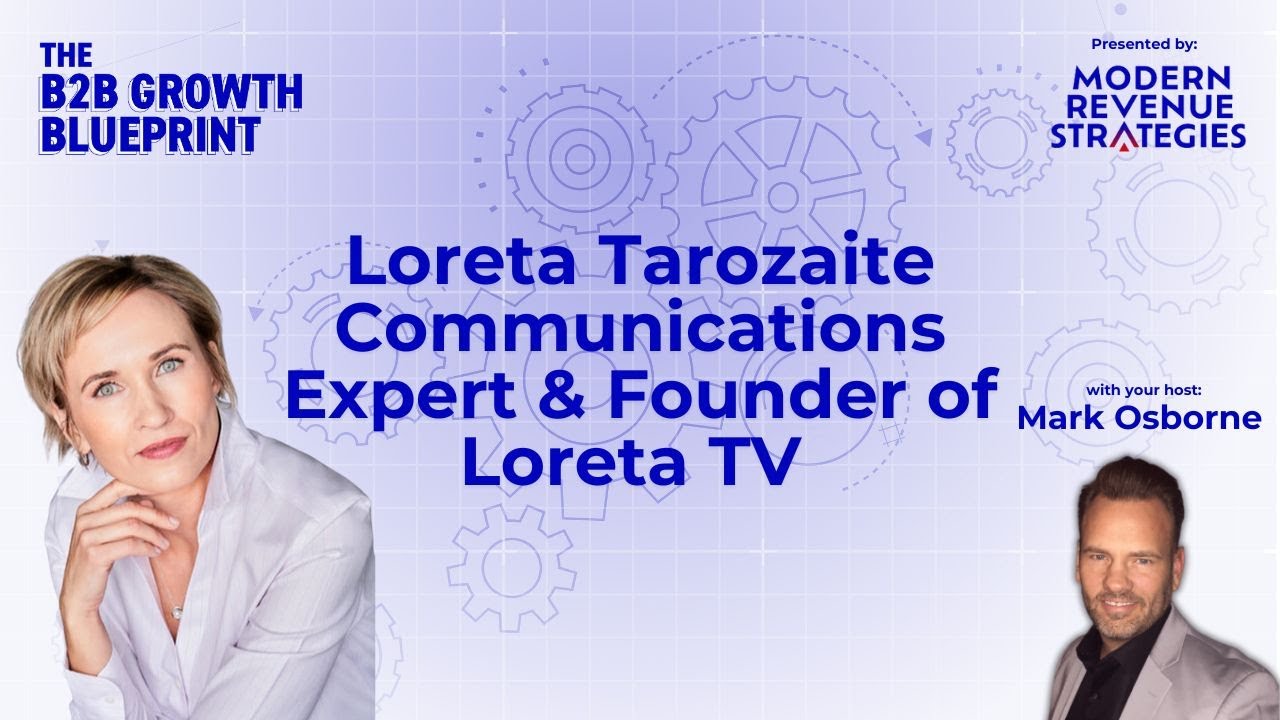
Mark Osborne interviews Loreta Tarozaite, founder of Loretta Today, on building brand authority for B2B tech companies. They discuss the "3 Ps" framework: people, process, and presence. Tarozaite covers internal communication tactics like town halls and executive updates, plus the difference between strategic communications and demand generation.
Chapters
Welcome to the B2B Growth Blueprint podcast, where we talk with entrepreneurs, founders, and leaders at B2B services, tech, and SaaS companies to learn the systems and processes they've used to create success for their business. We'll also learn from marketing and sales experts to provide insights to help you grow your business. I'm your host, Mark Osborne, and the podcast is brought to you by Modern Revenue strategies and their 10x ROI B2B growth guarantee. Schedule a free diagnostic call to learn the fastest path to double your B2B revenues in just 90 days. Hello and welcome to another episode of the B2B Growth Blueprint podcast. I'm your host, Mark Osborne, and today I'm very excited to welcome my guest, Loretta Tyro Zaita. I think I'm pronouncing that correctly.
Yes, very.
Loretta is a strategic communications consultant and founder of Loretta Today, specializing in guiding B2B technology companies and investors through pivotal growth phases like IPOs and acquisitions. She has over 20 years of experience in TV journalism, corporate marketing, and executive communications, and she excels in transforming chaotic marketing functions into streamlined operations that align with business objectives. After relocating from Lithuania to Silicon Valley, she identified a key challenge for tech executives, which was effective communication and brand humanization. Today, she's based in Las Vegas, and she helps organizations enhance their communication strategies, streamline processes, and elevate their brand presence, ensuring they thrive through transitions and achieve their goals of visibility, authority, and impact. So Loretta, welcome to the show.
Thank you, Mark. Thank you for having me.
Yeah, I'm super excited for this conversation. So you've got a really sort of rich and diverse background from Lithuania to Silicon Valley, now in Vegas. Why don't you kind of tell us your story? How'd you get to where you are today?
Yeah, so the journey was long, you know, for the past 20 years, all the way from Lithuania to here. Uh, but yeah, I was a news anchor and news reporter back in Lithuania. So everything that I do right now actually stems from that background. At the core of it is information sharing and communication. I almost have this like professional bug that wherever I go and hear something interesting, I feel the need to inform others about that. So I always carry my phone with me, a little, lovely microphone, just in case I could get a chance to interview somebody on the spot and get that knowledge, you know, right there, right now. It's just something in me that feels the need of sharing the knowledge around. So, Once I moved from Lithuania to Silicon Valley, you know, I couldn't quite know back then where my journalism skills could be applied. It took a while of discovery and sort of networking and other people noticing and telling me what I was good at. And at that time, 2009, 2010 is when YouTube was up and coming. So, so they, you know, some of the people were saying, hey, Loretta, why don't you get into that market? You know, you, you know, you understand the video, you understand the, the information, you know, through that type of medium. So why don't you try it out? So I thought, okay, I don't know what that means, you know, but I will try it out. So that's how I started my Loretta TV as a video producer. So, you know, through that process of investigating and figuring out where that journalism skill fits, I understood very quickly that where I excelled was really back to that information helping people communicate clearly when they deliver their, their story, when they deliver their, you know, business message through video as a medium, right? Because when you're in television and when you're on national news program, you have to really be aware of the time limitations, airtime limitations, right? So everything that you say or do on air has to be condensed, like straight to the point. So that skill kind of translated into business storytelling. And then over obviously the, the, the, the, the years in working in corporate and being part of larger marketing and communication teams, you know, that knowledge translated into, into executive communication program support, you know, broader corporate branding initiative support. And that's how that, that knowledge base, you know, continued building. And obviously I sought a lot of knowledge myself and attended a lot of, you know, educational and informational, you know, conferences to build upon that video experience. So that's kind of the premise. And then Loretta Today, you know, was born out of, out of that need again to transform. Loretta TV was my starting point, and Loretta Today is today. You know, everything that we do right now has to be today and current, you know.
Yes.
So, so that's, that's my story.
That's awesome. That's such an interesting story and like such a unique sort of background that you bring to your perspective on marketing and communications. And it certainly makes sense. And you and I were chatting a little bit before the show about, you know, sort of the role of kind of strategic communications within marketing and a lot of sort of early stage companies that are just focused on, you know, give me leads, you know, I need more sales. They don't think about sort of strategic communications, but it's actually a very well sort of refined role in larger, more successful companies that a lot of, you know, sort of early stage companies kind of overlook. Why don't you tell us a little bit about, like, what's the difference between sort of strategic marcom marketing communications versus, you know, demand generation marketing or lead gen marketing that a lot of companies have sort of front and center in their mind all the time? Maybe they don't think about this other piece as much. Tell us more about that.
Yes. So the way I look at marketing and communications in general, there are 2 elements, right? Communications and marketing. So communications to me is the story, the message, and that is external and internal, you know. And then marketing is the vehicle or tactics, how we get that story out, you know.
Wow.
So lead generation, is part of marketing tactics under the big umbrella of marketing is part of marketing tactics. Yes, in the early stage companies, the most important thing when they start, you know, even in my business, in your business, we are all in need of that lead generation, right? How do I get more customers? How do I get the buy-in into my programs or into my services or into my products, right? How can I sell more, more, more, more, more, right? So that's where that lead generation program is very important because you want to assess if your product is a fit in the market. You know, you want to prove to your investors that it works so that you could get more funding.
Yeah.
So lead generation will always exist in different stages of the organization, in my opinion. It just will change where the focus will be within that lead generation concept. So as the company grows and let's say in an accelerated growth stage or as the investments, you know, funnel in for that show the trust, you know, that, okay, investors are trusting you. Now you have to prove further that you can sustain that growth and you can sustain, you know, the market share with whatever you're selling. That's where, you know, people start losing traction of what becomes important because you can't really rely on lead generation that much anymore. Yes, it will continue, but then you have to start thinking about brand authority building, your own founder or CEO presence build out in the market. You have to start thinking broader. about the company and its presence externally, but not forget that internal, you know, communication is also important because as a company grows, the teams also grow. So as the teams grow, things become more chaotic.
Right.
So there's, if there's no processes in place, then you can't really efficiently execute on things, right? If you don't have the right resources, people or budgetary resources in place, then you're not moving as fast. Right? So everything is interconnected and in the end it all affects that presence, right? If you're not moving fast, well, you're using time on that presence, right? So there's a marketing and communications as an umbrella is obviously in very established companies, it's a big organization, right? But as smaller companies start growing, they have to gradually get into that point in order to be more streamlined and more strategic in how they now appear to the market.
Yeah. Well, and that's such a great point because so often companies in early stage, you know, maybe they're a challenger brand, but most likely they're sort of a niche brand within, you know, a category. And I'll, I'll make up a category like, you know, customer relationship management, you know, so that software that does that type of thing. So Salesforce is out there convincing everyone in the world that you need a customer relationship management platform. And then these other companies can kind of ride those coattails, but they'll never become sort of a category leader until they start to have their own sort of point of view and their own messaging around that. And so it's very interesting to see companies that sort of, you know, rise to a certain point where they've been harvesting the demand that's been created by someone else. And then they're like, How come we're not growing anymore? And the answer is because we've, you've sort of reached the end of where you can take what you're currently doing. Now, if you wanna grow to that next stage, you really gotta start shaping the market so that you are, you know, expanding the market in a, in a direction that more aligns with either your niche or your core capabilities. And so is that the type of thing that you help companies do is to understand that sort of overall market messaging infrastructure?
You know what I help? I help companies in transition and leaders in transition to understand the value that a well-organized mechanism inside, how well-organized mechanism inside affects the external, you know, activities, right? Even customer experience that you pointed out, you know, let's say, well, what's the point of having amazing customer experience if, let's say, by the time they reach signing a PO, you know, the process there is all cumbersome and clunky and there's no right way of doing things quick, then it kind of just kills everything else you've been doing. So you have to really think through every single layer. And again, I work within the 3 Ps, people, process, presence. That's kind of what I help companies fix. And I do very deep dive into, okay, understanding where the business is right now. What are they struggling? What are the tools they're using? What are the— how does the information flow internally? Are cross-functional teams communicating with each other or not? You know, what is sales doing? Are they doing sales and marketing and, you know, social media? You know, are they doing 3 people's jobs? And because of that, they're not quite sure what the message is. So I look at these 3 Ps, evaluate the company, and then I say, okay, based on where you want your business to be, we need to fix these broken links, you know, and here's what I propose. Let's agree. Is it phase 1, you know, approach? If we're doing, let's assume we need to implement new processes in place, right? So by implementing new processes, we're gonna fix XYZ problems, right? But in order to implement processes, we have to train new people so that they do adopt the process. Adopting the process, a new process is very, very difficult, you know, for people.
People don't love change.
No. And, you know, the moment you introduce new tools, how to do things, it's, you really have to manage that change as well. It's, you're transforming how you do business inside because in the end you want Everything to just flow smoother. Right? So, and I lost the, the, the trail of thought, what I wanted to say. But, but the point—
You were talking about how you help companies transform across these 3 Ps.
Correct.
So you've got the, the process one where you help them, you know, be better connected and, and interconnected. And the people one, which is sort of training the people not only in how to communicate better, but also how to use these new processes. Talk to us a little more about that, that 3rd P, that presence. What do you mean by that?
Yes. So, so presence, it's what, what's in the end, you know, people can call it, let's say when we think about the brands, right? Why do we resonate with some brands? It's because they have a very strong presence. Their message is clear. Their visuals are very impactful, right? They, their leaders are, you know, delivering powerful keynotes with really clear and concise visual storytelling, right? So this leaves a brand impression, and that presence when the company is growing is not understood well by those, you know, either founders because they've never been coached, you know, they were just focused on building the product, or, you know, the CEOs who were brought in to run that company further, right?
Right.
So in that inflection point is when you have to start thinking about building brand equity. So it's not about the product anymore. It's about that brand equity. You know, you want to be more and more out there to be recognized as a brand. But in order to be recognized as a brand, you have to fix a lot of things. You know, you have to make sure that your branding actually is cohesive. It's not disjointed across all the touchpoints of communication, including customer experience. You know, if you're, say, if you're a salesperson and you're having a conversation with a customer, you know, your PowerPoint and your storytelling has to match what that customer experiences in the external world when they research you. So that presence is important. And, and when I say presence, it's also important for the leaders to understand that internally that presence is equally important because you have to be available for your teams as the team grows. You have to be available for your teams to lead them, for them to trust you and believe in, in that same mission. So the communication becomes important by leaders to the growing teams so that nothing is lost in translation. Everybody kind of understands what the business goals are, what are we trying to achieve? And there's this buy-in into, into that new mission, not new mission, but growing mission, I guess.
Yeah. So that's something that I've kind of personally witnessed, experienced, seen as companies grow really fast. You know, they go from the founder and just a few people to maybe the founder in a room full of people to, Maybe the founder and a floor full of people. And it gets harder and harder for that presence from the founder and that vision, that mission to get communicated. And so it loses some of that feel, some of that momentum that it has. Knowing that that's a challenge that companies have as they grow, what are some of the, you know, sort of strategies that you use to help companies maintain that presence Especially internally and keeping teams motivated, aligned, and moving forward?
Yes. So one of the things, and honestly, that's where the biggest coaching happens when it comes to leadership team. I'm kind of, I'm, you know, almost stepping in as an advisor and, you know, leading them through that process of their own because they don't quite understand the importance of it. But it does require the buy-in from the leadership to understand that their time to communicate to the team will affect the results of that team's performance. So you have to have, you know, you have to start implementing regular check-ins on a broader scale. When I say check-ins, right, maybe it's a town hall, you know, maybe you start doing these sort of quarterly updates. Let's start with quarterly, right? So that people see, okay, here are our financial results. Because imagine if the company is growing, somebody who is close to marketing communications program kind of understands the pulse of the business better because everything that this function does has to align to business. But somebody who is, let's say, down the chain, I don't know, let's say if it's a manufacturing of sorts, you know, company, you know, down the chain, they're just building a product, they're continuing to build, they don't quite follow what the brand is doing. And, you know, it's just marketing fluff. You know, we're engineers, we just need to focus, you know, on something amazing and innovative. So, that becomes a huge disconnect, right? Because some people are closer to understanding where the company's heading, and some people are just in that same sort of mindset. We're just building something. We don't know why, or maybe they do, but maybe it's old mindset, right? So, having that more cohesive communication coming from the leadership team, you know, on financials, on business goals, on focus areas moving forward, you know, is one of the tactics that one can use, right? Having open forums, you know, again, as the company grows, there's a lot of broken telephone situation happening as well. You know, one department heard one thing, another department understood a different way. Some people start having conversations, nobody knows what the reality is. So you have to have those open forums where people could ask questions of the leadership team, open, honest questions, you know, maybe delivering video communication like that, or, you know, sort of executive newsletters of the month. Things like that internally make a huge impact because people then feel like they are aware of what's going on and they are not feeling out of the loop, you know, about the business. I actually, before this podcast, I was looking up some data and stats. Let me just read through it, but there was one that actually hit the core with me. It says, I'm gonna read it off the side because I don't remember the numbers normally, but it says, a Gallup study found that 74% of employees feel they're missing out on company news due to ineffective internal communication.
That's huge.
74%. So that's why that disconnect happens. It's like, well, yeah, yeah, yeah, it's happening, it's happening, but why? Why things are happening, right? So as a company grows, leaders need to understand that it will require them also to change how they operate. You know, they will have to start valuing, you know, their time in allocating their time to communicate, to share information, to be more present internally as well as externally. So that's where it becomes important, you know, to have the right systems in place, the right people in place so that they can start driving the initiatives and executing while they can continue being innovative and also be present and not present, but participate in initiatives like, you know, PR, speaking engagements more and more, right? But what ties back, you know, the presence to the company itself?
So you hit on something that Again resonates with me, and I really wanna tap into your expertise here. So a lot of companies, as they grow, they start to make an effort to, to do more communication. So they do these town halls, but they also start to get more guarded about what they share. And they start to, you know, there's the old thing, like, you know, they, they treat us like mushrooms. They keep us in the dark and, you know, feed us crap. And, and I'm wondering your perspective I know why, you know, leaders, CEOs, the C-suite is like, we don't want to share everything because we don't want to either scare off people that aren't used to the, you know, tumultuous nature of an early stage company, or we don't want, you know, and then maybe they leave, or, or we don't want them to, you know, spread it out on the street versus there's another train of thought that's, well, that's, you know, real authenticity. The people that are working for the company are on board for the ride. That's part of why they're there and they can be trusted. What have you seen as the sort of the balance there? Would you advise people, companies to lean one way or the other? Like, is it safer to give more of a manicured expression of what's happening, or is more transparency worth the potential risks?
It's a very fine line to walk, honestly, Mark. And like, it's, and to me, it's very situational, you know, it's, it's, for example, if the company is public, obviously you can't really share everything, right? And maybe some information is under NDA. If you talk to customers, some of the information is under NDA because you don't want to quite disclose certain, you know, products coming out.
Right.
So if the company is already public, so that reputation management becomes very important, right? You can't, to your point, control, you know, what the employees may take out of the borders of the building. You know, you can't really control that. So normally executives work with advisors, either communication, you know, people or people who understand the business, right? They have allies. who can kind of sense how information might be perceived. And to me, it's all about sensing. Is it risky to disclose right now? Maybe the time is not right now. Maybe, you know, in a month or so when we have a little bit more traction and we sort things out, you know, let's do it then. So it's kind of assessing the pulse of the company almost, you know?
Mm-hmm.
And from there figuring out what is the right time to share something that is sensitive. Now, something that is not sensitive, obviously where the business is going, that doesn't impact anything. But sensitive information, I would take caution for sure. If let's say the, especially the company does not have legal department who reviews things, and a lot of growing companies don't have legal departments, you know, they might have maybe legal consultants, you know, external consultants, but not necessarily in-house. So anything that could damage the reputation or could, you know, expose the business, to competitors too soon, you know, I would advise not sharing. But let's say—
Communication is your advice.
Yes, but let's say, you know, how do you humanize people? How do you humanize leaders, right? Humanization to me is one of the most important things, you know, how can you make these leaders be more approachable? It's when they can share these struggles that, you know, we've been having in the business, right? Instead of hiding that there are struggles, you just say, well, we're struggling, Market is down, and here are the reasons why. You kind of tie it back to the business and your own sort of human way of saying, I'm worried. Well, I'm worried right now, you know, but that has to kind of go across all, all the market, right? That again, the pulse. What's the pulse right now? What's going on? You know? Yeah.
Well, you've obviously got a ton of expertise, and, uh, we could talk about this all day, but I got to be mindful of your time. But I, I do want to sort of hear from you, like, What are some things that are on the horizon for you and Loretta today that, that you're working on that you're really excited about?
Yeah, I am really excited about reshaping a little bit of my business and how I do things. And I call myself Chief Communications Architect, you know, where I go in into the, and, and align with, you know, CEOs and, and founders and business leaders and really help them navigate that communication and marketing chaos that they deal with. Because you have to understand that in order for this function to be successfully implemented, they have to have a general in place who can help them, you know, implement it, right? Or interview the people, you know, for the right roles because again, it requires a specific skill. And in my career, I've done so many things myself that I know exactly what each role is requiring. And I'm very good at spotting, you know, what kind of resources we might need. And I'm very resourceful in finding those resources. So that's kind of an exciting thing for me to kind of reshape into more advisory role and, and be there for those leaders to navigate the chaos so that they don't have to think about it. They can think about business, they can think about new innovations. They don't have to deal with all of that. There's gonna be a person and a program in place that will help them, you know, get there.
That is exciting. So for our audience that's listening and they're like, well, we really are at that place where we need more process and we need some help with getting our people they're doing what they need to do so we can really be present within our strategic marketing communications. How should they get in touch with you?
Oh, uh, you can find me on LinkedIn, and also you can get in touch with me and book a, a consultation or, or just a chat with me through my website, loretta.today. Loretta with one, one T, and it's .today. Um, so that's how you can get in touch with me. Actually, on my website, I still have a presence checklist that people can download. It's still a free resource, you know, but it's going to be one of the assessment tools that I will use moving forward, you know, when I work with a company. So if you want to assess where your presence is within the organizational or executive level, you can download it there and sort of go through that process and assess what your score is. That will give you a good indication where you're at and what kind of gaps we can actually fix.
That's such a great resource. Thanks so much for sharing that. And Obviously, it gives, uh, folks a great place to start where they can look at that and, and do that checklist. And then if they see they've got some need, they can reach out to you. I'm sure you've got expert advice to help them through.
Yes. Thank you so much, Mark. Thank you.
Yeah. Thanks so much for joining us. I really enjoyed our conversation today, Loretta.
Likewise.
Talk to you soon. Thank you for joining this episode of the B2B Growth Blueprint podcast. We hope you've gained insights to grow your business. If you enjoyed this discussion, please rate, comment, like on your favorite platform, and share to others who will find it useful. Do you know a CEO, founder, or leader at an early-stage B2B services, tech, or SaaS company who would like to be a guest and share their story? Send us a note. Let's schedule a conversation.
More from Mark

How Can You Maximize Your Business Value Before Selling? with Randy Katz Video







