How to Forecast Cash Flow and Avoid Financial Surprises With David Safeer
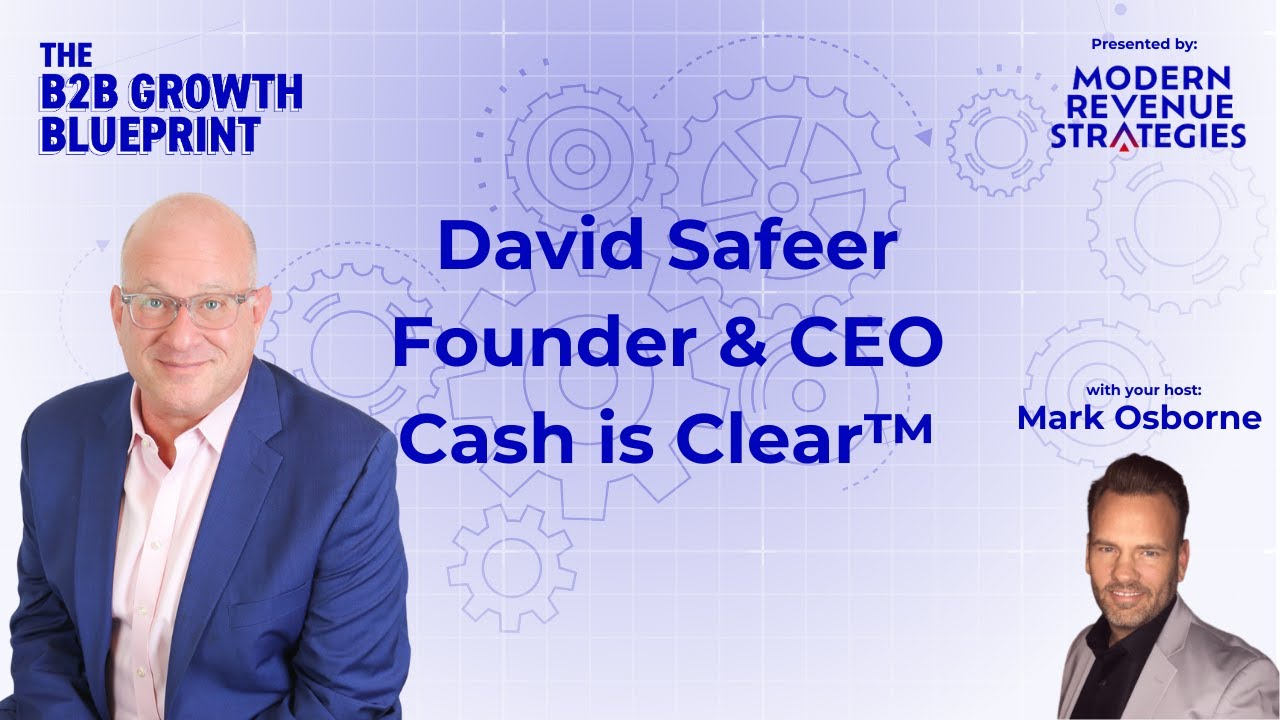
David Safir explains how B2B companies can forecast cash flow and avoid financial surprises using a 13-week cash-flow model. He covers identifying unprofitable clients, tying incentives to margin instead of revenue, and aligning sales forecasts with actual cash needs.
Chapters
Welcome to the B2B Growth Blueprint podcast, where we talk with entrepreneurs, founders, and leaders at B2B services, tech, and SaaS companies to learn the systems and processes they've used to create success for their business. We'll also learn from marketing and sales experts, uh, to provide insights to help you grow your business. I'm your host, Mark Osborne, and the podcast is brought to you by Modern Revenue Strategies and their 10x ROI B2B Growth Guarantee. Schedule a free diagnostic call to learn the fastest path to double your B2B revenues in just 90 days. Hello and welcome to another episode of the B2B Growth Blueprint Podcast. I'm your host, Mark Osborne. And today I'm very excited to welcome my guest, David Safir. Now I'm gonna read David's bio to make sure I get everything right. David Safir is a globally recognized expert in cash flow and profit maximization, and we're gonna talk about what cash flow and profit maximization means for you and your business. He is the founder of the Cash Is Clear Learning Systems. It educates and advises accountants and CFOs on cash flow and profit maximization strategies for their clients. His work has impacted hundreds of businesses with revenues from $1 million to $20 million in over 40 different countries. So David, thanks so much for joining us.
I'm really excited to be here, Mark.
Awesome. So David, tell us a little bit about, you know, your journey. Like, how did you get here to Cash Is Clear? And, you know, what do you really do on a day-to-day basis?
You know, I was so excited when I saw that this is B2B. My entire career has been B2B. I've worked of really large B2B companies. And for me, that's where the market's all about. I mean, there's so much business that's B2B, but all the consumer people get all the fame and glory. So it's great to be here.
That's right.
And so what happened was I was in really big companies. One of the companies I worked for was a Fortune 15 when I started working for it. And I worked, well, some of the companies people would recognize are Morgan Stanley, Dell, Kodak. And I transitioned into doing some consulting work on the side. People would hear about, hey David, help me out. I was a general manager, which meant I often lost responsibility, never worried about cash flow.
Sure.
But as I looked at what people were asking me about, whether it's sales or marketing or operations, It was all coming down to one thing, which is cash flow profitability, but not accounting profitability. It was having money in the bank so they could spend it and invest. So that's how I got to where I am. And then people started saying, David, how do you do what you're doing? And I started documenting it, and now I'm teaching other people how to do cash flow and profit advisory.
That's great. Well, so it's so funny, there's a phrase that I've heard thrown around a lot and probably heard it that, you know, cash flow is like feeding the alligator. The alligator is gonna eat. So if you don't feed it, it'll eat you. And oftentimes I've worked with companies that, you know, they feel like the alligator of their business is eating them because they haven't, you know, sort of managed their cash flow or their profitability around that. You made a comment when we were chatting earlier that it can actually be easier to run out of money when you're growing quickly than when you're not. Tell us a little bit about your experience there and how you've witnessed that.
It's interesting because people think, especially there's all these sales gurus and improve your cash flow, sell more, right? Okay, time out. If you have an info product that is zero cost, SaaS companies to a certain extent, Have very, very low cost for adding one more client.
Sure.
But most of us either have to increase our manpower or we have to increase cost of goods sold. If you're a manufacturer, you get a big order, you've gotta buy inventory and you have to hold it, and then you have to pay and you might not deliver for a while. So you're actually generally increasing your expenses, whether in manufacturing or you're in a service company, before you get paid. And there's often a gap of weeks, and sometimes it's months. I had a client, we did a calculation, worked for the government, government contractor, said you're going to get this, you're going to get this contract, right? Beautiful contract. We figured out it would take them approximately 6 months from when they started spending money until they got their first payment from the government.
Wow.
And it would take over a year to break even on cash flow, and they needed, they needed a lot of cash to buy into this contract. They had no idea, and if they had taken it blindly, it would have been about 3 months in that they would have said, what Did we get ourselves into?
That's so, you bring up such a great example. And like, there's, there used to be this adage that like, you know, the best thing and worst thing that can happen to your company is to get Coca-Cola as a client. So I worked in, I lived in Atlanta for a number of years and worked in marketing and advertising space. And that sort of phrase would float around. The best thing and worst thing that can happen to you is to get Coca-Cola as a client because The best thing is, just as you described, you now have this giant contract that, you know, might even be, you know, years in length because they make long-term commitments. But they have very strict payment terms. They're not going to pay you any faster than they pay anyone else. They expect you to, you know, hold on to that accounts receivable while they reconcile all of it. And so if you don't have your cash flow in place and really understand how all of that impacts your business, It could actually, you know, drive your business under the ground. It's also interesting that you talked about, you know, the idea of, you know, sell more and then, you know, that's gonna lead to more profitability. You know, we see so often that companies are so obsessed with, well, I just need, I need more clients, I need more leads, and they don't think about the quality of those leads. And, you know, we've actually identified like there's 3 types of clients that'll actually kill your business. You don't want any of them. They're the ones that are you know, constantly looking for discounts and they, you know, shave all the profitability out of it. You'd rather not have that client. The ones that don't really believe in your solution or product, so they want tons of customization. And so they make you build something just for them, not what the rest of the marketplace wants. You don't want that client. And then those that sort of churn and burn, they burn you out by making you either, you know, slash prices or customize, and then they churn out before ever creating any profitability. You don't want those clients either. That leaky bucket is just gonna burn out your team and keep you from being profitable. So it's so interesting that you call out that growth isn't always the path to profitability.
It's not. And can I add a 4th client that will kill you?
Yeah, yeah.
One of your prior guests talked about products that are unprofitable and oftentimes it's invisible. It's the clients that unknowingly are buying the unprofitable products Only. Yeah, because it's the right product for them and they're actually killing your business. They might not have any of those other issues that you're talking about. They're friendly, they're great, they pay on time just by the nature of what they're buying. And so, yeah, I've got a fun article called, uh, Fire Your Loser Clients, and loser means you're losing money. Yeah, absolutely. It's one of the fastest ways to improve cash flow is identifying who they are and either turning them around to be profitable or just saying, sorry, we can't do business with you anymore.
Yeah, well, and so often, so especially on the marketing and sales sides of things, people are so obsessed with, again, you know, more volume or just larger size. I want to close more deals. We actually spend a lot of time working with folks on what we call activation systems, activating your existing clients for faster renewals, larger upsells, more referrals and testimonials. And so many companies sort of fail to think about revenues after that first contract and to really sort of manage that process so that they're doing an analysis of, you know, who are our tier 1 customers, those 20% that generate 80% of our revenues. And what do we need to do to get that other 80% of customers generating more? How profitable are they? Could we get a faster renewal that, you know, might put them into profitability? Could we get an upsell of either organic growth or just kind of increasing our rates in order to put them into higher profitability and just creating some systems around that that allow them to think through on a regular basis? Maybe it's quarterly, maybe it's only month or annually. But they actually take the time to think about, do I— are all of these clients really good clients?
Can I ask you a quick question?
Yeah.
Have you ever had a client or suggested that they stop paying salespeople on revenue and start paying them on margin contribution? And if you have, how's it worked out? Yeah.
So margin contribution, I have definitely done that with sales teams that we've managed. It's a little challenging to get salespeople to buy that because they control very little about the margin. And so very often it's better to incentivize salespeople more to sell certain products that the company does a good job on maintaining good margin on because a lot of good salespeople would be like, I can sell it and then, you know, Jill down the road or Joe down the road, you know, takes the client out to expensive dinners and plays golf with them all the time and puts that against the profitability of the account. And I'm not— and then it's not margin, so then I don't get paid on it. But we definitely have done a lot of incentive plans where we incentivize them for specific products.
The other thing— That ends up being a proxy, right?
That's right.
So that's beautiful. That to me is one of the ways you get away from the chase the dollar and you chase the profit, you know, stop chasing sales and you start as a company, even if the salespeople don't realize what they're doing. It's okay.
Well, and one of the things that we do a lot that helps with this a little bit is we like to build a revenue team. So both marketing, sales, and customer success on the same team. And then all of the sort of company's revenue metrics are on that team scorecard. So The renewals, upsell, profitability of ongoing clients. That, and when you have regular meetings of that team, makes it really hard for a salesperson to sell a deal that they know is never gonna be profitable or would be impossible to renew when they gotta look at that, you know, customer success leader on a regular basis and keep a straight face with them. And so it creates a lot more sort of harmonious work environment when everyone's on the same team and at least looks at the same metrics, if not has, you know, some component of their compensation tied to metrics from across that revenue team.
Wow, that's great.
So one of the things that we were talking about a little bit before that I want to kick back into is this idea that, you know, if you, if you're not measuring it, then that's sort of what opens the opportunity for failure. Like if you don't know that your clients aren't profitable, And one of the key ways to do that is, you know, sort of building systems. You know, it's a system that you look at your client profitability every quarter or every year. Like, that's a simple system, but that is a system that it, you know, comes up on the calendar and you do it. And you were sharing some interesting diagrams with me before, talking about the fact that a lot of companies, you know, they start with really informal systems. And then as they start to grow, they, they kind of outgrow those informal systems, and then they hit this sort of cash wall because they didn't anticipate that they'd need cash to fund doing the work for Coca-Cola or the government or whomever it might be once they get this big account, you know, this big deal that they were so excited about. How do you guide companies in thinking through when's the right time to implement Some of these formal structures on cash flow and profitability?
That is a tough question because most people who have that aha moment, I need help, it's because they're already in trouble and they're growing quickly. They're growing faster than they really realize. Well, let's just step back and say, okay, somebody's not at that point. My take on it is Cash flow should be fundamental to your business.
Yeah.
And you don't wait. As a matter of fact, it's more important— and this is heretical, you might get accountants just screaming at me— it's more important than accounting. Only reason you need to do accounting as a small business is to file your taxes. You can do it once a year. You can do your accounting. Why? Because for a small business, what's the most important is what was in the bank last week, what's in the bank this week, what's going to be in the bank next week. And accounting at best tracks history. It won't tell you the future. At worst, it's completely misleading small business owners Because of this weird thing called accrual. Sorry, this is all blasphemy for an accountant. I'm not an accountant. I've taken accounting. I know how to do accounting, but I can tell you, when I get a client— and Wally comes to mind— who looks at me and he's almost in tears. And this is a tough guy. He sells power tools. He sells chainsaws. Right? This is not a clothing boutique. He looks me in the eyes and hands me his financials and says, David, I don't understand. My accountant told me I made $250,000 last year on $2 million in sales, which is pretty good. That's after paying him and everybody else.
Especially for heavy, uh, heavy merchandise like that.
Yeah. Yeah. And he said, But I don't have enough money to make payroll in 2 weeks. And I said, well, what did your accountant say when you talked to him? And he said, my accountant doesn't know how to explain it to me.
Yeah.
That is tragic, which is why I say if you have cash flow systems in place, you'll understand why you don't have cash in the bank and you'll understand $250,000 in profit has nothing to do how much money is in the bank. So that's what I would suggest is make it fundamental. One of your key audiences, if I'm not mistaken, is SaaS. SaaS companies are great because it's all about their subscription subscribers. They're tracking this every month, what's coming in. They know approximately how long they stay. And so they know it because that's how their business works. Constantly. Most other businesses don't have that structure automatically built in that they're tracking their cash coming in and what's going out and the timing. They're doing accounting.
Yeah, well, and we do work with a lot of professional services firms that, just as you say, like, they have to either increase staff or, you know, deliver and then wait for payment. And so that, that cash flow can be really important. So For our audience that maybe they're more of an operator or, you know, the visionary, less of the, you know, implementation person. Maybe they've got somebody that handles their, the financial part of their business for them. Maybe it's an outsourced CFO or an outsourced accountant that kind of they think is doing CFO stuff. What's one thing, or maybe it's a couple things, but what's something that they can do today That'll put them in better control, better visibility into their actual cash flow to save them from that problem that, you know, Wally ran into where generated, you know, $2 million. But now he can't make payroll next week. There's probably, you know, a thing or two that if he had been paying attention to, he never would have run into that. What's that? What should they be asking that finance person for? In order to make sure that they don't get caught that way?
Ask for a 13-week cash flow model. Okay. And they should know what it is. And if they don't, they should learn it.
But let me guess, is that forecasting our cash flow for the next 13 weeks?
It's forecasting 13 weeks into the future. It is a standard model that banks use when Unfortunately, they use it when companies are in trouble.
Sure.
They should be using them to get a loan and they don't. That's a different story, different day. So it is basically what's your beginning balance today?
Yeah.
What are all the— not your accounting revenue, right? Accounting revenue is when it ships. We're talking about when you're going to get paid.
Yeah.
What's going to come in this week? What are the expenses going out then? This week, and, and then your ending balance is next week's beginning, and you replicate it 13 times. Simple math— addition, subtraction, no multiplication, no division— over time. Conceptually, it's very easy. Technically, it's very easy.
Yeah.
On the other hand, if you don't know what you're doing and you're not used to forecasting, it gets scary. People don't want to forecast. They don't want to be wrong. And I tell them, don't worry, guarantee you, you will be wrong. You will not accurately predict every single week. What you're looking for is the big dips. You're looking for the big bulges, right? When your bank account balance goes up, great, save some of it. When it goes down, use the savings and you manipulate and you manage your cash flow.
Yeah.
That's the— and it all starts with a 13-week cash flow model. And people say, I've got a monthly budget. And then my response is, you get paid once a month and do you pay all your bills the next day? Because if not, guess what?
That's right.
Sometimes your dues, your bills are all due at the beginning of the month and you get paid at the end of the month and you're in a big red hole in the middle of the month. That's why you want week-to-week cash flow.
Yeah, that's totally true. Well, in building sales systems for folks, that's one of the key things that we do is create that stability and accuracy in sales forecasting. And that's one of the big things that you get from having systems in place, because if you don't have systems, you're like, ah, I've got some opportunities out there, or I've got some interesting conversations, or Waiting to hear back on this proposal, but if you haven't been tracking it over time and you don't know well what's your typical close percentage, what's your typical time at each stage of the sales process, you know what's likely to be your final negotiated rate because you typically pitch this thing and it closes at this price point. If you don't, if you aren't tracking those things, then it's impossible to know. And then if you don't know, it's impossible to forecast that cat or. that top level of the cash flow to have that 13-week overall cash flow.
Absolutely. And so what you're talking about is music to my ears. It's one of the hardest things I have to deal with is teaching people how to do it. Um, but then you have to take one more step because generally, though, many of the cases you might be talking about invoicing.
Yeah, that's right.
Exactly right. And so then you got to take the next step is What is the average time to get an invoice paid? Large companies, you want to know that particular company, how long do they pay? I had one client, cannabis industry, 17 different amount of time it took to get money in the bank.
Wow.
Because of the way they just grandfathered everybody in, and it was everything from cash on delivery Literal cash to 90 days receivable. Here's the strange thing. They didn't deposit the cash that day. They did it once a week. So they sat on $50,000 plus or minus in a safe, and then they had an armored car pick it up once a week and drop it off. So it was actually slower than—
That's right.
The other payment methods. So getting paid by cash for them took more time And EFT.
Wow.
Yes. Yeah.
Well, yeah, these are such important things that you're talking about, and I'm sure, you know, some of our audiences has heard some interesting things. For folks that are interested in learning more about, you know, working with you, David, and, uh, you know, sort of what your company does, how can they get in touch with you?
Well, first of all, I'd love to talk to anybody. If you are a small business owner and you're going, wow, I've got cash flow needs, Contact me. It's david@davidsafir.com. I've got a website, davidsafir.com, and it's also the same website that if you are an accountant, you are another professional, financial professional, advanced bookkeepers, and financial planners. A lot of financial professionals want to be proactive. That's where you can find information about my Cash Flow Advisory Certification Program. It's davidsaphir.com.
That's great, David. So tell us before we go, what's something that's on the horizon for you that you're excited about with, with your business?
On the horizon is— I mentioned, did I mention that I have 220 strategies to impact cash flow?
No.
I've— yeah, that's how many I've identified. Now, I didn't make them up. I'm just collecting them.
Uh-huh.
And I've been able to document them on a spreadsheet that's available to my Cash Flow Advisory members that are learning. And I am starting to work on a software implementation so that people can find and say, this is the situation I'm in, I want strategies to improve. It's easy to say You should improve your cash flow. It's hard to actually figure out what to do in your particular circumstances. So I'm hoping in the next 6 months they have an MVP SaaS product, minimum viable product. Yeah, yeah, yeah, yeah.
Very exciting. I'm sure that'll bring a lot of value to a lot of folks. Well, David, thanks so much for joining us today. I've really enjoyed our conversation.
Thank you, and it's been a great conversation, Marc.
Talk to you soon. Thank you for joining this episode of the B2B Growth Blueprint podcast. We hope you've gained insights to grow your business. If you enjoyed this discussion, please rate, comment, like on your favorite platform, and share to others who will find it useful. Do you know a CEO, founder or leader at an early-stage B2B services, tech, or SaaS company who would like to be a guest and share their story, send us a note. Let's schedule a conversation.
More from Mark

How Can You Maximize Your Business Value Before Selling? with Randy Katz Video







