How to Scale a Robotics Startup Without VC Funding with Anand Lalwani
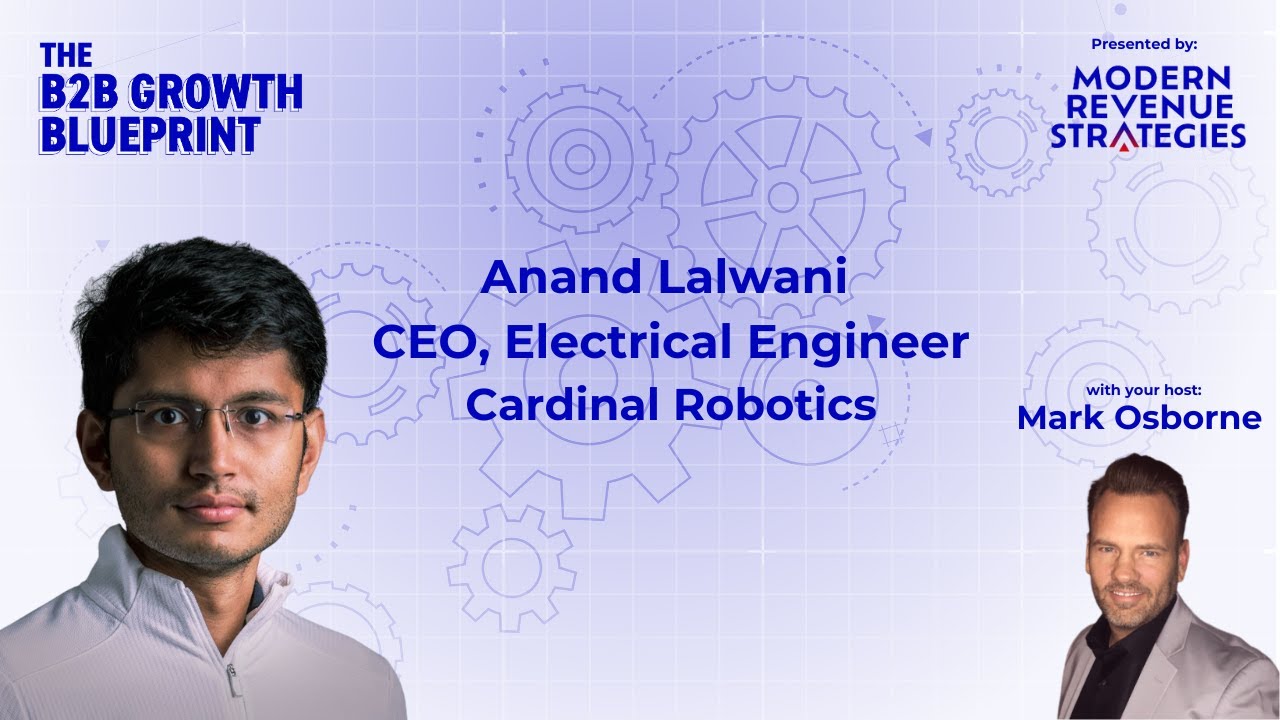
Anand Lalwani built Cardinal Robotics into a hardware company doing $10 million annual contracts per customer without VC money. He uses a 5% lease model through international financing, a network of 2,600 technicians across 160 cities, and partnerships with janitorial and hospital distributors to scale.
Chapters
Welcome to the B2B Growth Blueprint podcast, where we talk with entrepreneurs, founders, and leaders at B2B services, tech, and SaaS companies to learn the systems and processes they've used to create success for their business. We'll also learn from marketing and sales experts to provide insights to help you grow your business. I'm your host, Mark Osborne, and the podcast is brought to you by Modern Revenue Strategies and their 10x ROI B2B Growth Guarantee. Schedule a free diagnostic call to learn the fastest path to double your B2B revenues in just 90 days. Hello and welcome to another episode of the B2B Growth Blueprint Podcast. I am your host, Mark Osborne. And today I'm very excited to welcome our guest, and I'm gonna read his bio to make sure I get it right. Anand Lalwani is the CEO and founder of Cardinal Robotics. Now, Anand is a PhD from Stanford. He's also a graduate instructor at Stanford currently in product management, and this is his 3rd company, and he has not too shabby of a track record. His first company he sold to Target. You've probably heard of them. His second, he sold You might have heard of them as well. And he's really passionate about what he's doing there at Cardinal Robotics, and that's helping frontline workforce become robot operators. He has a really interesting sort of passion for how this makes society better while at the same time creating a really successful company. So Anand, thanks so much for joining us today.
Thank you, Mark. It's a pleasure to be here.
So I'm really excited to talk to you, and some of the things we were chatting about and prepping for this We covered a lot of really interesting things, but to start, tell us a little bit more about Cardinal Robotics. What exactly do you guys do? Who do you do it for?
Yeah, certainly. So we are the go-to robotic solution provider for large enterprises across various different industries, be it hospitality companies such as Disney, medical companies such as Stanford Hospital, or even in the janitorial workforce and office spaces like Thermo Fisher Equipment Wakefield. They come to us and we help them figure out what robots to get, how do you deploy them, how do you maintain them, how do you drive true ROI for them. We didn't start off like this, but that is what we do today.
So it's a very futuristic kind of idea of bringing, you know, Robot Rosie into the workforce. But as an entrepreneur, the idea of, you know, Manufacturing robots, you gotta, you know, get all of that capital up front to make 'em, and then you gotta service 'em, and, you know, all these different things. That sounds like a really complex business to run. You obviously have a lot of expertise in this area. Tell us how you've tackled that for Cardinal.
Certainly. So our origin story was during the pandemic, we saw a large number of janitors literally die by the hundreds on a weekly basis 'cause they were on the front lines disinfecting without PPE, without vaccines, without beds available in hospitals. So we developed one of the first UVC robots in the country. Now there are a plethora, there are a large number of them, but we were one of the first. And our job, our goal was how do you make their life slightly better?
Yeah.
And my PhD is tied heavily to the world of robotics. It's in electrical engineering and I enjoyed it. The engineer in me was very happy, but what we realized is The difficulty is not so much in building the robot. It's a hard problem, but everything else that comes afterwards, everything that you talk about in your podcasts is so much more important. It's how do you sell these robots? How do you find distribution? How do you find financing? How do you scale up your servicing orgs? Because these robots will break down. There's not a single robot today in enterprise that won't. Question is, how quickly can you get it repaired and how cheaply can you get it repaired? We spent most of our time doing exactly this. We spent most of our time figuring out how do you do sales, how do you finance these, because we were not venture-backed, how do you actually figure out servicing of these. We had a large number of our technicians flying around last minute going from client side to client side, and it was absurd amount of bills we had to pay for this. Yeah. So we had to tackle each problem individually, all in mind keeping that, hey, At the end of the day, the client needs to be happy. The client needs to be taken care of. Target was our first customer. Stanford Hospital was our second customer. These are large accounts. These are large clients. You need to keep them happy.
Right.
So how do you do so? And in the process of building out this entire ecosystem of partners to be able to do so, our clients were incredibly pleased with us, not only just for our robots. They started asking us, Can we do this for other robots? I would walk client sites with their directors of EVS, and they would point out that, hey, you see that machine there? That is a scrubbing robot we bought 4 years ago, and it has done nothing but charge. And the reason for that is because we don't know how to operate it, or it broke down and we could not find someone to come and fix it, and it was $100,000 down the drain.
Wow.
And I was like, that is, that was very pervasive. They started asking us, can we help them on all of these other fronts? And that's how our business model evolved for us to do what we are doing. And I'm incredibly grateful to the partners that we have that have helped build out this entire ecosystem with us and been able to allow us to operate in a profitable manner. If you look at robotic companies out there, especially from a VC perspective, from a venture capitalist perspective, There aren't very good exits. You can't really think about any robotic company today on top of mind. Boston Dynamics, those guys used to make far more money on YouTube than they actually did selling robots until recently. No one made money there. iRobot, same thing. Their stock price rock bottom. Amazon acquisition fell through. The biggest challenge these robotic companies face are exactly what I told you: distribution, sales, financing, servicing. When we were a manufacturer, we so dearly wanted somebody to take care of these 4 things so we could focus on building a really good robot. But sadly, that did not exist, and therefore we had to become the person that we wished would exist.
But the way that you were describing it earlier, instead of sort of, you know, taking all those things in-house and, you know, As a, you know, product management professor, I'm sure I don't have to tell you what is in my MBA class. They always said you want to own as little as possible, but that, but extract as much value along the way. And what you were describing was that although you saw the need, you know, for someone to fill this role, you recognize that you didn't have to do it yourself. You could in fact build an ecosystem of partners. Tell us how you've done that in those areas of You know, the financing piece and then the manufacturing and servicing.
Yeah, certainly. So we can go piece by piece. I would say the most important one is financing out of all of this. Robots are expensive. Nobody's gonna tell you they're cheap. And over time, we built out specific solutions. We actually now offer these solutions to other hardware companies overall because we have spent so much time building this out in-house. It's kind of like the AWS model.
Yeah.
Where Amazon built out the servers for themselves, realized they have overcapacity, they offer it to everybody else. That's what we are doing at this point. And we are just trying to help other hardware companies, robotic companies survive. So the way we have done this has been spending a lot of time understanding how the world of finance truly operates. My CFO is an expert in this and he spent time figuring out that, okay, we have these contracts, which are non-cancelable. The world of robots, people buy on a month-to-month basis. So they're buying on a subscription or a lease or a rental because that's how they're used to paying for their human costs, their OpEx costs.
Right.
And a lot of folks don't have CapEx budgets. Capital budgets are allocated once a year. Operational budgets can happen any time of the year if you're below a specific threshold. So if you're not hitting that one time of the year when somebody's looking to buy for it, The other 11 months, you're just waiting and waiting and waiting, which is— yeah, that sucks up all of the time that you have on the sales cycle.
That's right.
So to get into the operational budgets of your client side, you need to be able to sell on a month-by-month basis. So if you're selling your robot or a widget or whatever piece of hardware for, say, $1,000 a month and you have a 3-year contract, that's $36,000 as your total contract value. Now, more on average, that piece of machinery, that piece of robot, that piece of hardware will cost you anywhere between $15,000 to $20,000 to even build, manufacture, sell, the total cost involved. So it takes you about a year to year and a half to recoup the value of your product, which means we were in position, and that was, that was exactly us. We were in a position where we were on the verge of getting a 150-unit order. I think that's great. I was incredibly happy. Sweet. That's our, one of our first large orders. But if we got that order of 150 units, we would have to file bankruptcy because I did not have the capital to finance it.
Right.
And it just became crazy. We went out, we spoke to all these debt lenders. We spoke to Silicon Valley Bank before they went under and afterwards as well. We spoke to Gamber Road, we spoke to all the other people and they were saying, okay, sure, we will give you the debt capital to do so. But interest rates were north of 15 to 20%. Yeah, that's my entire margin there.
That's right.
Okay, that's not sustainable, right? So how do you solve this? So we spent a lot of time with outside the US financing institutions, international financing institutions in Japan and Ireland and China, and over a lot of drinks with a lot of VP of Sales, understanding what really drives them. What KPIs and metrics they have to hit. We uncovered a way to reverse engineer these contracts. We fundamentally changed the way any hardware, any robot, that contract is written altogether so that we pass on the liability that you're not underwriting Cardinal Robotics, but you're actually underwriting Target. You're actually underwriting Disney. So when we spoke with these Japanese VP of sales bankers sitting in Tokyo, Saying that, hey, would you like to underwrite Bank of America? They're a client of ours. They're like, hell yes, we would love to, but we have no access to them.
Right.
Like, okay, you guys are operating at a 1% interest rate, federal interest rate in Japan. So you have very low cost of capital. You have exposure to the US already. You have capital deployed over there. I will find a way for you to be able to underwrite my end customer, which is Bank of America. And if I can get them to sign those documents, will you upfront that entire total contract value minus your interest rate to us today? And we did this, we did this successfully multiple times, and we proved that this can actually work. And then they gave us a lot more dry powder. So now we are coming in at around 5% discount rates.
Yeah.
If you look at the federal interest rate right now, it's around 8.5%, 9%. We are significantly below that. And that has enabled us to scale and scale rapidly. So that's one such aspect where understanding the way it works, understanding who is liable at the end of the day, for them to underwrite Disney for tens of millions of dollars, they can do it in a heartbeat without thinking about it. For them to underwrite a smaller company like Cardinal Robotics for tens of millions of dollars will give everybody a lot of heartburn. They will ask for personal guarantees. They will ask to underwrite our assets. It becomes crazy. So that is one of the things that we had to do to reverse engineer.
Yeah.
Outside of financing, then comes the world of servicing. So congratulations, you have now figured out how to finance these robots. The robots are out in the field. The robots are breaking down. Every time the robot breaks down, the client calls you. The client is upset. You understand, you appreciate. But now you need to fix it. And for us, we sell nationwide in the entire contiguous United States. We are in almost every single state at this point. So how do you fix this and fix this at scale? So we have been able to partner and set up partnerships with multiple companies where we have gotten access to 2,600 technicians in over 160 cities. So we have a technician literally in Few miles from every single client of ours, not on our payroll. They're all 1099s, but they're all certified, they're all insured, they're all trained, they all have the right tools, and they can show up on site and do 80 to 90% of all of the fixing that's required for that particular machine. If the machine is broken down, within an hour, within 2 hours, they can fix whatever the basic aspects require, and they show up the same day. That's amazing.
Amazing.
And I no longer have to fly technicians out. I no longer have to pay for hotels. I no longer have to pay for the Ubers or the car rentals. And last-minute flights, if you have ever booked, they are incredibly expensive.
That's right.
But at the same time, being able to have this entire group of technicians, most of them were mechanics, most of them have worked on cars, most of them worked on other systems, but showing them that, hey, the future is going to be Robotic. Let me train you. Let me certify you on how you can go. If you could take care of that Mustang, you can go take care of my robot. No problems. I just need to make sure you understand how it works. You have the right parts, you have the right SOP, and you have the ability to do a video call with my servicing team.
That's amazing. Well, and one of the things that is so, so clear from your approach and that we preach about, you know, so often is that it's all, you know, clearly built on systems, that it's not, Well, we're gonna figure it out as we go with, you know, sort of paying for all of these technicians. Instead, you built a system for how do we create an ecosystem that scales where we find qualified individuals, upskill them to where they can, you know, sort of fill this and tapping into an existing ecosystem through partnerships rather than trying to build it from scratch, which is so much more expensive. And also, you know, not only is it expensive and so it eats into your runway, but it takes time.
Yeah.
Which then, you know, is a blocker and makes it harder for you to build your moat and build your wall and sort of your presence in the marketplace, which is super, super clever. So, you know, my mindset, I typically am working in sort of the sales and marketing and the revenue systems. So I'm super curious, like, how have you done this, you know, for, you know, growing those contracts? And obviously there's not a million people in the world that are, you know, making robots for for companies, but there are more than a few. So how did you, you know, sort of create the traction and get the scale when it came to, you know, sort of getting into some of these larger accounts and approaching the sort of go-to-market strategy?
No, definitely. So again, it depends on which stage of the company you ask me. So when we initially started out, a lot of it was based on personal relationships I had from of my previous startups.
Yep.
And that's typically where everybody starts off.
That's right.
Who do you know? They trust you more than they trust your product. Your company didn't exist a month ago, so they're only trusting you because they actually know you as a person. And that's how you got started off. And that's where Target and Stanford Hospital were fantastic first set of clients. And then you build on top of that track record, on top of that reputation. But as you go into industries, as you get mature, You need to learn to segment. You need to know that not every industry operates the same way. The same way a small hotel customer buys is not the same way a janitorial customer buys, and it's definitely not the same way a hospital system buys.
That's right.
So understanding who your ICPs are, understanding what pressure points they have, and understanding the go-to-market strategy for each segment became very important. And we are still figuring out the playbooks. We are still in the nascent market. The robotics market is not half as mature as, say, SaaS or janitorial distribution.
Sure.
So we don't have existing playbooks to rely on, and a lot of it is, hey, we are honestly just figuring it out as we go. But that being said, yeah, learning from the best. Um, in the 3 markets that we are dominant, we are in the BSC world, that's the janitorial world. Then it comes to the world of medical hospital systems And then it comes to the world of hospitality. So your hotels, casinos, your resorts, etc. And then the robots we sell and upsell and cross-sell are all in the world of vacuuming, scrubbing, food delivery, disinfecting, material handling, getting into food automation soon. And our core mandate as a company, and this is something I tell every single employee of ours, I tell every single client of ours. Is that we are going to have a total of 100 customers and that's it.
That's it?
Only 100? Yeah, we are not interested in more than that. The 101st to the 10,000th customer, that somebody else could take care of. But the 100 biggest logos that we can capture, we want to be able to get because again, we are in a new market.
Yeah.
We want to provide value and immense value to the point where we can then charge $10 million per year.
Yeah.
And make sure that we are providing at least 5 to 10x more value per customer per year to justify. And if I'm charging $10 million per year per client and I have 100 clients, we are making $1 billion in revenue.
That's right.
Pretty sizable. And we are very happy with it. So that is the goal. That is the mandate that also allows us to then be very laser-focused. As to who do we go after?
Yeah.
Who do we want as customers? And we tell our customers that, hey, you're gonna be one of 100. You're gonna have my personal cell phone number. You're gonna have the CEO's cell phone number. Anything goes wrong, yes, you'll have an account executive whose throat you can strangle. You can call me up at 2:00 AM and I will pick up your call. I will be there and I will make sure you are taken care of. And you can't do that. That's the reason we want 100 customers.
That's right.
I will not be able to sustainably do that if I had 10,000 clients, and that's fine. There are other people who are really good at being able to do so. Uh, so segmentation became important. Understanding the go-to-market in each became important. So when it comes to the world of janitorial, we have some of the largest janitorial companies. Their C-suites are advisory board members of ours. And more importantly, what we typically do is we help them win contracts. So there's one incredibly large publicly traded janitorial company. We helped them win a nationwide $60 million per year contract with their end customer in 140 locations. And we were a large part of that using our robots. So when you help this senior—
Building that connection, building that ecosystem.
Yeah. Building that ecosystem, adding value outside of just selling your product. Yeah. So helping them win a $60 million per year contract. Making that senior director incredibly happy. Like, holy cow, I went from having few sites to now having every single site nationwide.
Right.
And then that allows you to grow with them in every single site nationwide. So that became very important in the world of medical hospital sales. My goodness, those are the most painful I have ever had to go through. If you ever see somebody with a lot of gray hair and they're very young, there's a—
They work in there.
That's right.
Hospital administration.
Oh my goodness. Like, it's painful. It's just outright painful. And it got to the point where I was like, okay, this is not sustainable. There is no way I can set up a workforce to go after this. There's no way I can personally go after this because it's so relationship-driven. The cycles are just too long. So what we did is we tapped into networks of existing distributors, people who were selling surgical supplies to surgeons. people who were selling other equipment to these hospitals already. And we had more or less like on a territory-by-territory distribution, about 12 of them, very senior, each carried an 8-figure book of business. And they were very happy, very sustainable.
Right.
And we showed them that, hey, listen, these are the machineries that we have. We are saving Stanford Hospital north of 50 hours of labor every single day. They love us. We have been able to upsell and cross-sell, and we will give you a very healthy commission. And all you have to do is do a warm introduction, gauge their interest, and help us close this account. We will handle everything afterwards, and we will take care of that entire system. And that really helped leveraging their existing relationships, making it commission only so we are not burning capital in that process. And showing them that this can actually scale and this can work and standing by that and having referenceable clients.
Yeah.
So that really, really helped. Uh, in the world of hospitality, that was more traditional sales, hiring sales guys and then making sure that they have the right connections, they have the right contacts, giving them their territories, and then helping them go and unlock their deals and helping them go and close them. So that is how we segmented the 3 markets. That's how we have been able to grow in all 3. Um, I love whenever clients talk to each other and they are like cooperative but competitive, and there's a lot of FOMO that you can build off of. So if you have a huge concentration of clients in one place and they are all basically competing against each other, and you get one and then you make the other one feel like they're being left behind.
How can I compete unless I have this? Yeah, that's right.
Exactly. So those became incredibly important.
Well, and these are such insightful strategies, but it comes back to the sort of overall strategy of focus, which is when you can set a limit of we're only gonna have 100, and then you can say, and we're gonna focus on these 3 industries, and then you can get really specific and understand those industries and have a customized and tailored approach for each. You didn't try to apply the same you know, sales approach or the same marketing approach or even the same positioning across each one. And so often, you know, companies, especially early stage, they're like, I don't wanna limit myself to, you know, only servicing, you know, this type of customer and this type of market. But so often the real strategies for success come by implementing those limitations because that's where you get creative. That's where you really carve a niche out instead of just selecting an issue, you make a niche. That you can really, you know, sort of own. And that even comes all the way down to, you know, sort of like the personal level because you can not just understand your ideal customer profile by different lines of business, but you can really understand the buyer personas and their personal and professional motivations. And we were talking earlier and you talked about one of the key metrics that you use for success that I thought was so interesting. Tell us a little bit about that.
So the only KPI that I truly care about, and I make sure that every single person in my company cares about, is how many people have we got promoted, either in our vendors, our suppliers, our ecosystem partners, and most importantly, our clients.
Yeah.
How many directors became senior directors? How many janitors became managers? How many VPs became EVs? That is what gets us excited, because at the end of the day, you're selling to a human being, and no decision is rational. All decisions are emotional.
That's right.
They buy from you because they trust you. And in the B2B world, every single person cares about 2 things, is what I've learned: how do you get promoted and how do you not get fired?
That's right.
Okay, it just boils down to that. It doesn't matter the industry. It could be in medical, it could be in Territorial, it could be in space. You can distill it to these 2 fundamental aspects. And the way you understand that is by you take them out for drinks, you have— you finish a bottle, 2 bottles of wine, and build that relationship, build the rapport, build the trust. And we have outrightly asked so many of our clients that, hey, what are your KPIs? What are your metrics? Even the procurement— Yeah.
Yeah.
The people who often people hate are the procurement folks. They love us because we go in and we're like, okay, these are the numbers you are currently needing to hit. Let's, let me help you hit those numbers. You need to show this much in savings. Sweet. I will help you find those savings. If not in my product, in somebody else's product through the ecosystem that we have.
Yeah.
And once we are able to enable you to do so, you become our biggest champions.
That's right.
Once you make one director a senior director, All the other directors in that organization see that. And not only do we do that, we also then go out of their way to make sure the CEO of your organization recognizes that, hey, John in this particular role did this, and that is why he became senior director. We bring him in, we applaud them. The janitors, we give out certificates. We, to the extent we can, get the SVPs and VPs to come out Midnight hand out certificates and call them robot operators. We bring back pride into their work, and we show them that by aligning with Cardinal, we are helping them progress in their trajectories and achieving their goals and their dreams. And that is why our clients come to us more than any other reason.
That that's amazing. Well, and it's such a classic you know sort of marketing best practice to make your customers the hero of the story instead of you being the hero. Really, you're the You know, you're the Obi-Wan to their Luke Skywalker. You're enabling them to become the hero that they want to be, which is so, so powerful. So this is all such great stuff. What's something that's on the horizon for Cardinal Robotics that you're really excited about?
Well, our biggest thing is we spent an absurd amount of time building the ecosystems that allowed us to scale. And instead of now competing with all these other robot manufacturers, We would rather enable them and let them tap into the models that truly work, be it our financing models, be it our servicing models, our sales and distribution models, that, hey, let's work together. The market is massive. It's a multi-trillion dollar market. There are going to be a lot of large players. I don't have the time, bandwidth, energy to sit and compete against you.
Right.
I would rather work with you and both of us together go and win our respective markets and help each other. And let me enable you. I have access to a lot more capital than I need. I have access to a lot more technicians than I need. And I have a lot of clients who have a lot of different asks. So don't come and compete against me. Rather, look at me as your best friend who can help you achieve your goals. And we can all make money together along the way.
Really be— really becoming that keystone player to build out the ecosystem for robotics, because obviously, like, such a powerful and inspiring vision of, you know, saving lives is how it all began. And now it's, you know, sort of making lives better, which is just, you know, really the promise of the future that the Jetsons promised us on the TV commercials and/or cartoons in the '50s.
For me, it comes down from a perspective of empathy. Like, honestly, I have been a founder who ran a robotics company where we were manufacturing. I know how hard it is. I know the challenges we face, and I have a ton of empathy for anybody in the hardware space building hardware, trying to do B2B sales, trying to scale these systems. And that's like, let me help you. I'm not here to make a quick buck off of you. I'm not here to shoot you down. If you're building a good product that your client really wants, let us help take care of everything else so you can focus on investing your resources in building a really good product. And that just makes it easier for everyone. The software world has it a lot easier. I'm actually very jealous of that.
I bet.
And VCs understand that. VCs are like, great, you have one piece of code and you can sell it to 10 different people and there is no cost, there's no additional cost involved.
Right, right.
Software doesn't have it that easy. So how can I help make that level playing field slightly more equitable for the world of hardware?
So interesting. Well, we could talk all day, but I gotta be respectful of your time. And Anand, thank you so much for joining us. For folks that wanna get in touch with you, what's the best way to connect?
Yeah, so 2. One, you could either email me. So it's my first name, anand@cardinalrobot.com.
Okay.
So that's an easy, quick, and dirty way, or just LinkedIn DM me. That's how you got in touch with me, Mark. And I am— yeah, my LinkedIn is open. Come find me. And if you're building anything that people want, let me know. Or if you need a robot in your organization, hit us up.
Fantastic. Well, thank you again so much for joining us. It's been such an interesting conversation. Very insightful. Thanks again.
My pleasure.
Thank you for joining this episode of the B2B Growth Blueprint podcast. We hope you've gained insights to grow your business. If you enjoyed this discussion, please rate, comment, like on your favorite platform, and share to others who will find it useful. Do you know a CEO, founder, or leader at an early-stage B2B services, tech, or SaaS company who would like to be a guest and share their story? Send us a note. Let's schedule a conversation.
More from Mark

How Can You Maximize Your Business Value Before Selling? with Randy Katz Video







