Is AI the new “wonder drug” for your B2B business? Hear from Dr. Baker from the Business Hospital
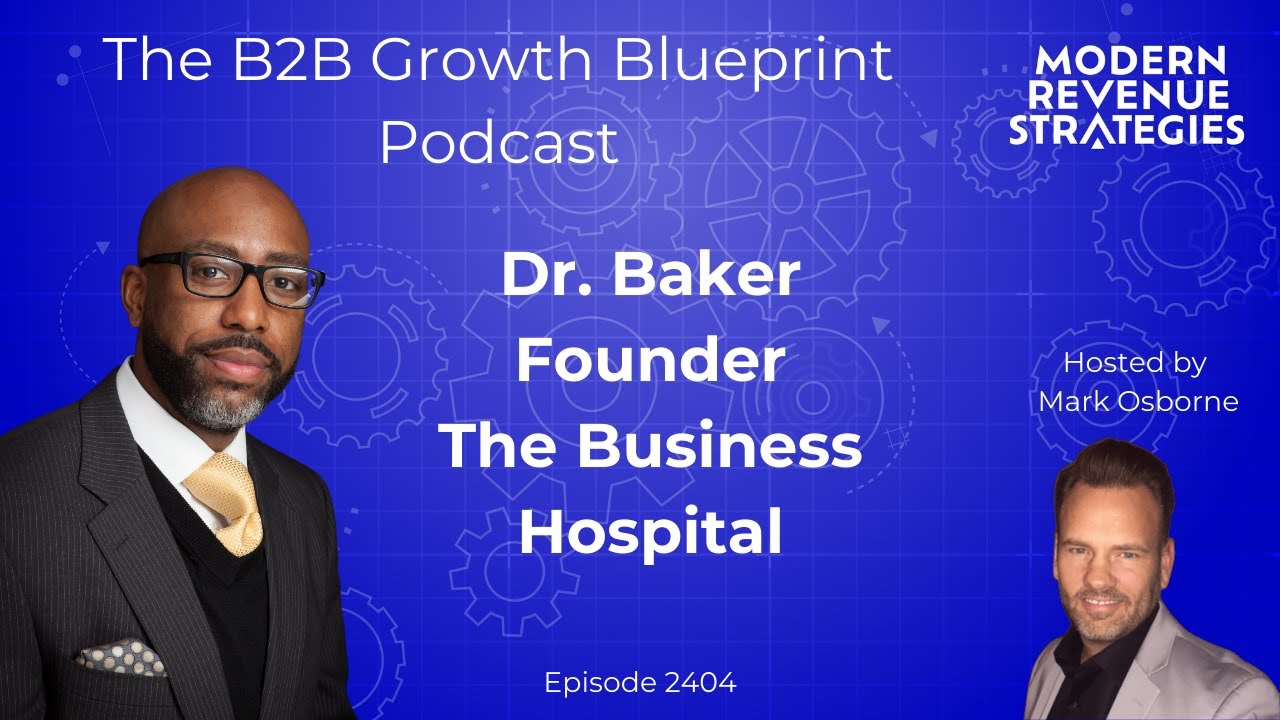
Dr. Baker, founder of the Business Hospital, treats companies like patients using standardized diagnostics to assess health. He warns AI will reshape business processes faster than humans can adapt, requiring guardrails and authenticity verification to prevent chaos from deepfakes.
Chapters
Welcome to the B2B Growth Blueprint podcast, where we talk with entrepreneurs, founders, and leaders at B2B services, tech, and SaaS companies to learn the systems and processes they've used to create success for their business. We'll also learn from marketing and sales experts, uh, to provide insights to help you grow your business. I'm your host, Mark Osborne, and the podcast is brought to you by Modern Revenue Strategies and their 10X ROI B2B Growth Guarantee. Schedule a free diagnostic call to learn the fastest path to double your B2B revenues in just 90 days. Hello and welcome to another episode of the B2B Growth Blueprint Podcast, where we talk with entrepreneurs, founders, and leaders at early stage B2B services, tech, and SaaS companies to learn the systems and processes they've used to create success for their business. And we also speak, uh, with the experts that have helped these countless businesses grow through strategies and tactics for success. And today I am excited to welcome one of those experts. Uh, today we have Dr. Baker. He is a doctor in business administration with a focus on organizational leadership And he's actually completing his second PhD in artificial intelligence. We're going to talk about AI and what that means, you know, for businesses later today. Dr. Baker is a 6-time author and a number one bestseller with textbooks on how to launch a business, how to make good business decisions, as well as other topics. He invented the trademarked Business Health Index and the Investment Health Index that he uses to treat thousands of businesses and helping them diagnose and find ways to sort of prescribe solutions to grow their business. So, Dr. Baker from the Business Hospital, thanks so much. Welcome to the show.
Thanks so much for having me, Mark. I appreciate it and really like the fact that you are out here helping businesses one business at a time through your podcast.
Well, thank you. So, the really interesting sort of background, you've published multiple books, this Business Health Index, Investment Health Index, the Business Hospital. Tell us about the Business Hospital and the work that you do there.
Yeah, absolutely. About 7 and a half years ago, I decided that I would create an entity that would go and obviously consult and help. It was the original thought. But as I was talking to my team members, we really got confused when it came to how does someone differentiate who they should call for assistance? You've got the large ones like Ernst Young and BCG, but the average person can't get access to them. Even if you were to Google them and call them, you wouldn't really make any progress. And I said, well, how does a micro or boutique business or a mom-and-pop shop figure out where to get help and could they afford it? So in our dialogue, we said, well, I know that if I had a dog or a cat and something was wrong, you would take them to the vet. And I know that as a parent, if the school calls me, no matter what it was, You know, your child is unresponsive, there was a shooting, anything, you would just go to the hospital. If you cut your hand in the kitchen, you would just go to the hospital. And so with that, that's kind of how the Business Hospital was birthed. We looked at the fact that the health of our nation, we are a capitalistic society, everything about us is commerce. We are 10 times the size of any other country in gross domestic product, even though China is significantly larger than us. everything we do in the US is predicated on our business and methodology of business. And I said, well, what's the health of that? And that's how we essentially birthed the Business Hospital. So we look at businesses identically as to how a medical physician would look at your body. And so with that, we know if you're white, Black, male, female, from, you know, Uganda all the way to California, Your blood level is your blood level, cholesterol is cholesterol, heart rate is heart rate. So my mentality was, how do I standardize business health treatment to where if I have a barbershop, if I have an apparel company, if I own a cleaners, if I'm a tech company, is there a standard method of looking at my business? And essentially, that's what we offer is treatment to that business with standard care.
That's great. That's great. And obviously you've helped lots of different businesses. Our audience today is focused on sort of B2B services. And so you've built your own business in providing B2B services and technology and, you know, sort of SaaS. And I know that you've helped lots of other B2B companies. And so as we think about some of these topics today, we'll focus in on that specifically and even more so, You know, there's a specific dynamic that I know a lot of our audience is struggling with, and that's the dynamic of, you know, B2B companies that are chasing large contracts. They're typically dealing with, you know, a lot of, you know, sort of people on the buying committee. So there might be an actual decision maker as well as a champion, as well as different influencers, technical influencers, all on the buying side. And when there's lots of people, that means lots of time. And so sort of long sales cycles. And so that has its own sort of unique dynamic. And I know our audience will be really interested in your insights as it pertains to sort of navigating those dynamics. So when you're working with businesses that have that kind of dynamic, what are some of the, you know, most important vital signs that you use to sort of diagnose how healthy they are or prescriptions that you use to sort of, you know, help them improve when they're dealing with those types of challenges?
Absolutely. I think you hit the nail on the head with the various aspects of B2B work inherently inside the Business Hospital. Every one of our patients is a business. So we are only B2B and we've helped 1,100 businesses to date. But for 2024, our goal is 7,000 businesses in this one calendar year. So that's a lot of B2Bs. that we gotta be really good at converting. And I, I tell that part of the story because we built this business one-to-one and we built it one-to-one in 14 countries on 5 continents. And so that became something for me that says, okay, we have something, but what does that really mean that we have something? And so I wanna answer some of your questions very pointedly, but from a macro standpoint is that we have the experience and we teach businesses how to either control your market, how to venture into other markets, how to understand the different cycles within those markets. And not all of them are the same, which means that the mentality of the business owner has to be focused. So I want to go back to a few things that you pointed out. When you talk about long cycles, because not every business-to-business dealing is a long cycle, even if you're dealing with large corporations, that still does not determine if it's a long cycle. So let me give you 2 examples.
Sure.
Let's say you're going to work with a conglomerate, a large business. And just for definition and baseline sake, small business is $50 million and less, 500 employees or less. So anything above that number, we're going to consider medium to large business. Well, from there, you could be working with someone that really likes you. They, they know your work that you've done. They know your product or your service, and they have the unilateral ability to sign off on something that you're gonna do as long as it doesn't exceed $500 grand, $800 grand, whatever that number is. That board and that communal, uh, authority that's been appointed inside that company says that this individualized person can make that decision. Well, that gets bogged down if you don't know that person and you don't have a great relationship with that person. So you're gonna have to be smart in your business dealings to determine How many of those people do I know? Do I know 2 or do I know 202? Now, if you don't know a bunch of them, all of your sales cycle and all of your business development efforts is going to be pushed into relationship building with those individuals. The problem is there is no Yellow Pages to tell you who can behave that way. So you're really just essentially throwing darts in the dark. Other entities have multiple boards. So let's say that you're looking to, to go to that same company, or you're looking to go to some organization, and they've got a board of directors, but they've got an individualized director, and they have another party that's connected to what they're doing, and they have to sign off on it. Well, you could be talking 8, 9, 10 months before you even get a maybe. And you're like, what is all of this? And how do I navigate that? But when you're engaging in that, you also have to understand, all right, if I'm gonna put this into my, my, my business development plans, now I've gotta have a secondary or a tertiary unless this is secondary and tertiary. So I'm gonna give you a color example.
Sure.
We do a lot of work with municipalities. And so those municipalities will say, hey, can you come in and let us subsidize treatment for our whole county? So they might have 2,000 businesses in a particular county and they're gonna earmark tax dollars in order to subsidize that treatment. Well, in certain counties, we're dealing with a mayor, we're dealing with a county commissioner. There might be 4 county commissioners. There might also be an organization which is economic development. So now all of a sudden you have to convert at every single one of those levels, and that payoff at the end of that can't be small because the amount of hours, the amount of time that you put into there is gonna drain your resources while you're waiting for that payday. But on the flip side, when things are quick, those paydays may not be large enough. So yeah, we turned them over quickly enough, but that $10,000 or $20,000 that we received, we're going to burn through that really quickly. But we're still going to have to charge out for the services. So therefore, we're going to have to supplement that with something else. What I like to say is, and this is cliché, so this is not revolutionary, but it is very much a science and it's very much an art. And it all is based on the individuals and what it is that they're offering. But what I find out of our patients is that most of them are uncertain about how to position themselves, how to articulate their offerings, and how to differentiate in a way that makes them useful. It's not so much about the cycle or their targets, it's more about them and how they articulate themselves to the world.
That's right. Well, and in fact, we see very often that when a company has a really strong, differentiated positioning strategy that every one of their interactions is, you know, 10 times more powerful because, you know, if they're dealing with people from different parts of an organization, you, you described a really complex landscape with municipalities. But when there's a consistent story, then they're building that trust and credibility in a really powerful way with everyone across. Those different parts of the organization.
But then, you know, that gets tough though, you know, Mark, not to cut you off, but you're saying something that's really important because not everyone has a differentiator. And you're like, yes, they do. No, they don't. If I just have white t-shirts or I make pizza or I'm a construction company, I do what everyone else does. So now do I have to invent something that's unrecognizable or unwanted in the market? And the answer is no. It's still going to come down to how you articulate your positioning. How you built your eminence, and then how do you connect that with what you're trying to convert? And that part is very difficult because you might just be a commodity. You might just be another one, but that doesn't mean you don't belong in the race.
Have you seen— have you not seen commodities like, well, we'll use the white t-shirt example, find some aspect about the way they deliver white t-shirts or who they service well Or the, you know, the components of their product or the way that they deliver that product. Have you not seen that companies can find some differentiation within that, even if it's a seemingly commoditized product?
Well, most of the time it has nothing to do with their point of differentiation. It's the fact that someone's not listening. And so most people, and I don't want to be inflammatory to your audience, but I do like to be honest, are garbage listeners. And they're just selfish people. And you say, why are you saying that? Because if you are talking to a company about what you have, at any level, they have opened the door to say something's wrong.
Right.
Now you have to listen to ask what's wrong. So let's say we got 2 white t-shirt companies. But I don't like the customer service of the one white t-shirt company. I get tired of dealing with Nancy. She's a pain in the butt. She doesn't send the remittance slips on time. We always got to track down the product. They've sent stuff in other places. It's no longer about what you offer. It's about how you offer it.
That's right.
Differentiator. It could be we're looking to create another location right in your geographic area. I'm trying to explain that to you, but you keep cutting me off trying to tell me how different you are. But really, because you're in my area and I can see you face to face, that's a point of differentiation that I'm willing to sever one relationship and give you the business now. So it could be anything literally, but we have to be listening for it and we have to probe appropriately and we have to understand the model of the entity that we're looking and desiring to work with.
Yeah, for sure. Well, and that it's that ability to understand what's unique about your company, like you have really good customer success, like you serve a specific geographic area, and then to be able to listen intelligently enough and to build enough empathy with the challenges of your customer that you can match your unique capabilities to their unique needs to really create differentiation in a seemingly commoditized marketplace.
If you're truly listening, and you said something that I don't want any of your listeners to ignore, and you talked about having that empathetic ear. If you were truly listening and a company told you what they needed and/or wanted, And you could not do it, but you could direct them in a way that where it would benefit them even though it doesn't benefit you. That is a seed that will sprout like Johnny and the Beanstalk at some time in the future.
That's right.
But it's truly listening. And which is why I said we're really garbage at it because we don't— we try to fit something in there because we want the dollars right now, which means that you didn't plan appropriately ahead of time.
That's right. That's right. That's really interesting. So I know that you've seen, you know, lots of companies move from, you know, very early stage to sort of the next tier. And, you know, a lot in the B2B space, a lot of times we see, you know, someone works in an industry for 5 to 10 years, they have an idea for a bigger, better mousetrap, they found a company to build and deliver that, and they know enough about the the, you know, the customers of that landscape because they've serviced those customers as part of their career that, you know, they've got a Rolodex, they can go out and, you know, talk to people. They know enough about their product because they built it and then how it's different and better than the competitors because they've sold against or worked at those competitors. And they get that first sort of, you know, product market fit that way by going out and using their network. What have you seen be some of those successful strategies for companies that are trying to move beyond that? You know, you talked about it as sort of one-to-one, you know, you've got a relationship, you have a conversation, you make a sale, and then, and you're talking about, you know, your company going to 7,000, you know, different customers that you're gonna service in the next year. How do you create that scale and move beyond? What are some successful strategies you've seen?
They're the exact same strategies that existed since the world was created and caveman started doing stuff.
Okay.
Working really hard. It's being everywhere and exploring. And it's not resting on your laurels of what you think you know. So in this instance, and I know I didn't give like, what you got to do is this new technique that you never heard of. It's not that. It's you literally have to be in front of individuals and people, which means that whether it's you, whether it's some team that you hired, you got to be, you got to be in the game, you got to be in the stadium. And what we find is that most business owners are—they're just not at the game. They haven't—they're not there. They want to be there, but they aren't, and they'd rather send some form of push communication. So they're okay with a post. They're okay with one email. They're okay with a flyer, if you will. But they really aren't there. They're absent. Next, it's you got to do all the things. So one thing that we work with with our patients is that we look at their sales cycle, and then we revamp those sales cycle, and they need to know if they have a. Uh, a 4-step process, if they have a 12-step process, they really have to define that. But here's what I— where I'm going with this is that let's say you have a 7-step sales cycle process, but you're doing 4 of them, you're not doing the other 3, or you're doing some combination of all of them. You have not put into place the muscle memory of saying, we gotta be at this event, we gotta make this phone call, we gotta have 9 touchpoints for every single contact. They're not doing all the stuff, junk, and things. They start to really fizzle out and dissolve after doing 2 and 3 of them, which means that their entire operation is incomplete. You would be shocked how many businesses that when you ask them, how consistently do you do this task? Well, we did it once this month and we really didn't revisit it again since October because we were busy doing these other things that didn't match what it was that you said you needed to do for success. That is the most common.
That's a great takeaway is that, that need for discipline. And so it's not just about defining a good process, but then disciplining yourself to deliver against that process.
Well, let me help you with that, Mark. I'm in agreement with you, but I'm gonna change the vocabulary some.
Sure. Yeah.
If you do anything with discipline, it will not work. You are going to fail. Everything has to be done out of desire.
Okay.
I'm gonna tell you a real funny story. I'm not a gamer, and I've got a buddy of mine in the automotive industry that says, man, you got to buy this football game, man. You got to play John Madden. We can play online. We can do all of it. Get you a PS5 or whatever it was. And I said, you know what? I'm gonna do it. I want to engage with him. I want to spend more time with him. He wants me to play. I'm a sports guy. What the hey? It took so much discipline to play the video game. Because I'm like, hey, honey, I got to kind of go in this basement and kind of cut this game on and try to learn the buttons so I can try to play. And after like 3 days, I was like, I can't get that done.
Sure.
However, I'm a pro cornhole player now. It takes no discipline for me to go outside raining, cold, whatever, to practice 300 to 400 shots on my cornhole. Why? Because the desire is there. So I'm using myself as the example that discipline will only take you as far as something else that competes with your attention. But if you desire a thing, you're a slave to the thing at that point, and you become amazing at it. So now we're questioning who are in these positions that we have to force to do their job, or do you have the right people in the position that desire it, can't imagine not operating that way? Those are the people that'll get all the functions done.
That's a really great perspective. Um, you, you said something earlier when we were talking about, you know, how companies, uh, you know, sort of find the scale and move beyond just sort of their personal network. And you said, you know, it's the same things that, you know, the cavemen have always done is, you know, getting out there and getting into it. And I noticed in as part of your bio that you're, you know, you're working on a PhD in artificial intelligence, which a lot of people see as sort of this newfangled cure-all or, you know, wonder drug. We'll keep with the, with the health analogies for you there. How do you, you know, as you think about artificial intelligence, particularly as it pertains to marketing sales, which is, you know, kind of the focus of this podcast, how do you see it fitting in? What's your predictions for the future there?
Yeah, you got a couple of things. Me getting a second PhD is me explaining how we don't rest on laurels of what we know. A lot of people said, Doc, you're already a doctor. Why would you go be a doctor times 2? Well, they said that when I was already certified in finance and was a number one author, and they said, why'd you go get a doctorate? Or was already a business owner. So you got these scenarios where I look at that and say, you always have to explore new lands. Artificial intelligence will help us explore new lands. It's going to force a lot of people to be left behind because it's going to move so fast that it's going to move past the rate that people can even fathom. And it's going to force new behaviors that hasn't even been created yet. That's problematic for us as a society and for us as business owners. And if you can go back to the email, and I'm sure you knew people that was, I don't have an email account, ain't gonna get an email account, and they really fought against that. And then with the internet, and I don't want to put files in the cloud, I'd rather just have paper. That took a long time for people to really come across that threshold. Well, there'll be things that In one quarter will work one way, another quarter will work completely different because of AI. It's going to move that fast. And so as I view the future, it's not replacing people. That's not the case. It will replace how we behave and it will replace how business is done in a lot of areas. So you'll have to be more cognitively based. And that will be difficult for a lot of individuals who want to actually— and for lack of terms, just a person that wants to swing the hammer. There'll be less hammer swinging and there'll be more thoughts that have to go into a thing, which means you have to retrain how you exist, what you thought you knew, where you gathered your resources, where you spent your time. And we have to be prepared for that. So you're talking about running a business, trying not to cave in that business while also dumping a bunch of nuances and new additives of our society that you don't even quite understand. That is a recipe for chaos.
Yeah. Well, and one of the ways that we've seen companies be successful with it is to not get distracted by, you know, sort of the shiny object of AI as a cure-all, but instead to think through, as you described earlier, the systems and processes that'll actually help them, you know, accomplish the objectives that they're trying to accomplish and then layering in technology, whether that technology is artificial intelligence or, or some other technology or some other source of data or even layering in, you know, additional manpower. Uh, it starts with that system. Uh, and then you can layer on the things that make that system, you know, run faster, more consistently, 24 hours a day, whatever it might be to really sort of maximize the success that—
See, Mark, you talked about distractions and business owners are distracted. People are distracted. You know, you've got a scenario where they say, how do you accomplish things? Well, our phones beat us up daily. Our attention spans have been minimal, minimalized and diminished. Well, now we can't determine what's real versus what isn't. Before, you would say, let me see something, and you could believe it because you saw it. You can no longer believe what you see anymore. So then you can say, well, let me hear that. You hear it and you can't tell the difference. So now a business owner is going to search for information and they're going to have a difficult time Saying, is this real? Is it not real? How do I differentiate? How do I source? And so as it relates to my personal chase, is that my PhD is governing general practice use of AI and how to safeguard that to make it healthy for all people. So I'm a part of a movement that says, how do we put guardrails on? What are the mechanisms? And essentially, what is this constitution that the artificial intelligence will be governed by. But from a humanistic standpoint, everything attracts attention. So let me just paint a different picture. If you are struggling in your business and you're trying to find a solution and you go to say, okay, I just ran into 8 things that I could possibly try to grow my business, how do you know what's what?
Right.
How do you know what's authentic and genuine to what you do or what's a deepfake or, or an or? And that becomes problematic. The distractions will increase. Yeah, absolutely.
So when I— it will— we're sort of running towards the end of the time, but I want to give you a chance to, you know, sort of share some, some good takeaways for our audience. I know, you know, I know some doctors, you know, that are health doctors or medical doctors, and, you know, they, they always have some sort of evergreen advice. You know, move more, exercise more, drink more water. That's—
it's good for everybody at any, at any So the number one thing on that, and I appreciate this, is one is have a system. But system is an acronym for save yourself time, energy, and money. So if you do anything as a business owner, I don't care if it's answering your emails, setting up events, going to meetings, all of it should have a system. And some people think, well, are you making systems for the sake of making systems? It's no. You make them once, you abide by them, and then you tweak them as more information becomes available. So that's number one, is have a system. And it can't be my system is the lack of a system. Laissez-faire won't get you anywhere. And I would say number 2 is that you got to focus and write out all your resources. Now, when I say resources, money is one of them, but your network is another. How much bandwidth and time you have is another. How much information that you have access to is another. So you'd want to write down in my, in my circle of things that I can control, How large are my resources? And then start looking for the resources you don't have so that you can supplement that with others that share your passion and desire and understand what you're doing. So therefore they can catapult you forward. So have a system and understand exactly how many resources you have access to collectively.
That's great. An apple a day keeps the doctor away. A system a day, uh, keeps the, uh, keeps the creditors away. Dr. Baker, this has been great. Thank you so much for joining us. I know our audience will have gained a lot of insights from you. If anyone wants to engage with you or learn more about The Business Hospital, how do they get in touch with you?
Really simple. thebusinesshospital.com. Even if you put in a Google search and put in The Business Hospital, nothing else comes up but between us and a few other medical physician places. But you will find us, thebusinesshospital.com. We answer all emails within a 30-minute span. So if you email us at info@thebusinesshospital.com, you can find us.
Fantastic. Dr. Baker, thanks so much.
Thank you so much, Mark. I appreciate it.
Thank you for joining this episode of the B2B Growth Blueprint podcast. We hope you've gained insights to grow your business. If you enjoyed this discussion, please rate, comment, like on your favorite platform. And share to others who will find it useful. Do you know a CEO, founder, or leader at an early-stage B2B services, tech, or SaaS company who would like to be a guest and share their story? Send us a note. Let's schedule a conversation.
More from Mark

How Can You Maximize Your Business Value Before Selling? with Randy Katz Video







