Mastering Business Exits: Proven Strategies from Neil Isaacs
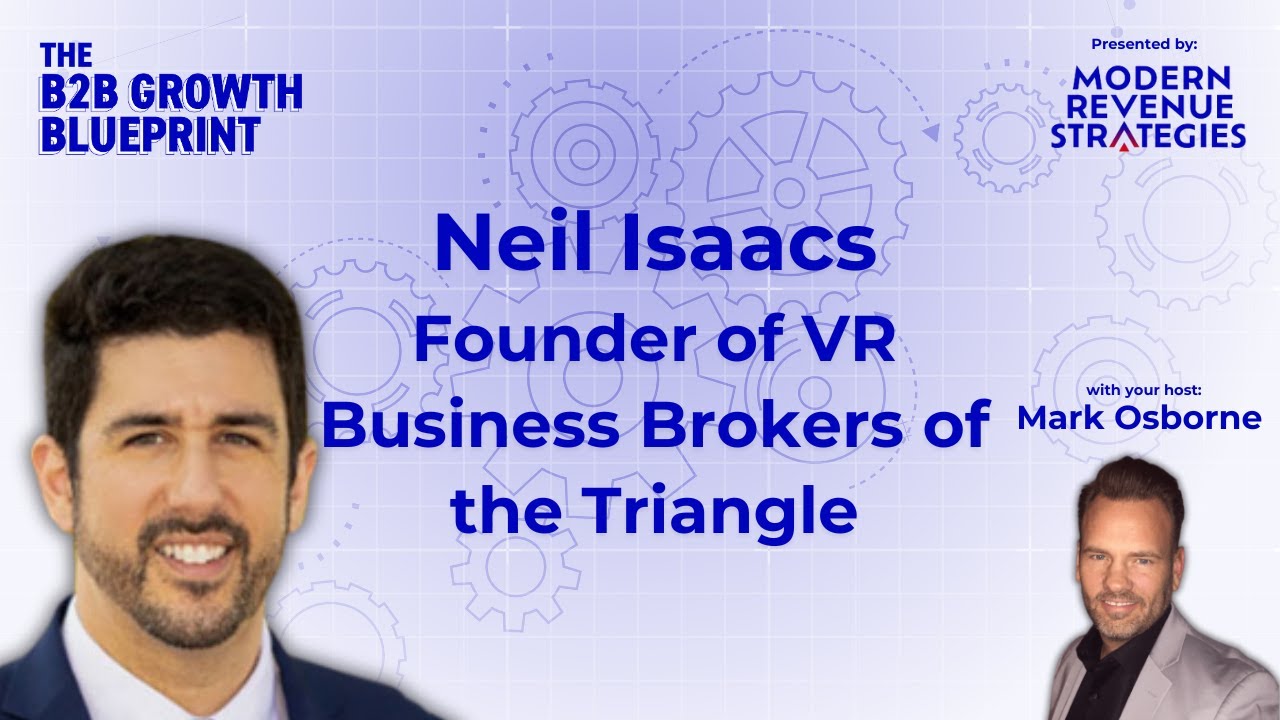
Neil Isaacs, a certified business intermediary, explains how to prepare a business for sale. Most owners have their entire wealth tied up in the company, so de-risking through customer diversification and documentation matters. Psychological barriers to letting go and outdated marketing are the biggest obstacles legacy owners face.
Chapters
Welcome to the B2B Growth Blueprint podcast, where we talk with entrepreneurs, founders, and leaders at B2B services, tech, and SaaS companies to learn the systems and processes they've used to create success for their business. We'll also learn from marketing and sales experts to provide insights to help you grow your business. I'm your host, Mark Osborne, and the podcast is brought to you by Modern Revenue strategies and their 10x ROI B2B growth guarantee. Schedule a free diagnostic call to learn the fastest path to double your B2B revenues in just 90 days. Hello and welcome to another episode of the B2B Growth Blueprint podcast. I'm your host, Mark Osborne. Today I'm very excited to welcome my guest, Neil Isaacs. Now I'm going to read Neil's bio to make sure I get this right. Because he's done a lot of stuff. Neil Isaac is an MBA, a Master Certified Business Intermediary, and a Certified Exit Planning Advisor. He's a seasoned business intermediary and managing partner of VR Business Brokers in Raleigh, North Carolina. Over the past decade, Neil has personally sold nearly 100 businesses, leading a team dedicated to helping owners navigate the complex process of valuation and sale with clarity and integrity. With deep roots in both the local and national business community, Neal serves on multiple boards, including the International Business Brokers Association, the Better Business Bureau of Eastern North Carolina, and his local Chamber of Commerce. He's also a past president of the Carolina-Virginia Business Brokers Association and an active contributor to the Exit Planning Institute and the Exit Planning Exchange. Known for putting owners first, Neal begins every engagement by asking one question: What does success look like for you? From there, he builds a plan rooted in experience, empathy, and execution. If you're considering a business exit or advising someone who is, Neal's insights are worth hearing. So, Neal, welcome to the show.
Mark, thank you so much for having me. I really appreciate the opportunity to chat with you today.
Yeah, I've been looking forward to this conversation. So, you've obviously done a lot of stuff, uh, over that time. Why don't you kind of give our audience a little bit of background. Give us the story of what brought you to where you are today.
Absolutely happy to share that. I'll give you the, hopefully, the 2-minute version. I was born at a very young age in Tallahassee, Florida. I grew up in Birmingham, Alabama, and I worked at a local pet store. And I really loved that world that this business owner had created. And I ended up getting a bio sci degree and My first job after college was in a, uh, Ripley's Aquarium of the Smokies. I was a shark diver. I swam in a football-sized aquarium with, with live sharks, and that was, that was what I did, uh, for a living. So that was really fun and didn't pay much.
Okay.
And eventually I found a pet store for sale in Raleigh, North Carolina. It was more of a fish Store, and I bought it as an asset sale. I was 25 years old, didn't really know what I was doing, but I got into it, and I sold Nemo and Dory for a living. And I doubled the size of the business. You know, I learned all the basics of running a small business, and then I got burnt out, and I wanted to do something else, and I wanted to do it without my employees knowing, my landlord knowing. I didn't know what I was doing, so I met an intermediary. At that time, a business broker. I ended up selling that business. I kind of did the Job Year Program for a little while before I landed my first real corporate job was at Time Warner Cable Media.
Okay.
I sold advertising. So, that was when I learned to do the B2B thing. And finally, close to a decade ago is when I said, you know what? That business ownership thing is great and I'd love to help people in my situation. And that's when I became a business broker. Here we are a decade later and loving every minute of it.
That's fantastic. Well, and I think it's so interesting that you have such a diverse background, and I suspect that that actually makes you really adept at helping folks navigate lots of different contexts, because I suspect you have a certain number of buyers that are coming into the market having left a corporate environment and looking to, you know, sort of buy a business and have that experience. Likewise, you've got these, you know, business owners that maybe have had a similar kind of retail experience to what you had that are looking for that next step. And you can kind of offer that guidance and insight on what it was like for you to go through that transition to something else. So, it really makes you well suited to sit at that spot in the middle.
Business brokerage is the hardest and most fun job you'll ever find. You wear so many hats. To your point, you're judging buyers, you're figuring out who's— you're a matchmaker. Is the person that when you describe leaving corporate, we call them corporate refugees. Is this corporate refugee going to leave his W-2 and take the risk of buying this business, or is he just unhappy today? So you're really getting into the heads of people. You're doing the finance piece of figuring out, does this business make money? Is it sustainable? So, you wear a lot of different hats when you're doing these deals, and it is a lot of fun every day.
Yeah. Well, I bet. And, you know, you're working with people at what could be a really great inflection point in their life, both for those that are starting a new experience or those that are sort of exiting something that has been successful for them and they're sort of harvesting some of that reward that they've created over time.
It means everything to the business owner who's selling. Their business is often more valuable than their car, their home. It's probably their most valuable asset. They may have spent more time with their business than their spouse. And so, often, there's an identity crisis that's happening at the same time they're selling the business. And we're well aware of that, that it's more than just the numbers. It's their livelihood. It's their identity. And we're— add psychologist to that list of things that we're doing in addition to finance and understanding the legal piece and being a matchmaker. All that's very important. And you're right, the other side, the buy side, they're making big moves too. And we get to ride shotgun while these people, very smart people, are making some of the most important decisions of their life. It is so much fun.
That's interesting. I read a stat the other day that for most small business owners in America, and small meaning up to $50 million, $100 million. So, even fairly large but not the giant corporations. 70% or more of their personal wealth is actually tied into their business versus those corporate folks that have been steadily investing in their 401 over time. And so, their wealth is kind of diversified. Business owners have been steadily reinvesting into the business every time they had additional money because— Oftentimes entrepreneurs feel like no one can grow their capital better than me. Why would I give my money to some other company that's trying to grow their business? I'm going to give it to myself and continue to bet on myself, which is, you know, very different sort of perspective. And so that makes that sale so important, not only for their sort of financial future, but also just that feeling of accomplishment.
Yeah, yeah, you said it really well. And it's true. Most entrepreneurs are risk-takers and they want to bet on themselves. And they do believe their own internal rate of return is going to beat what they can do in the market. But that does often lead them to a concentration issue where their liquidity is tied to their business. And if it doesn't go the way they're planning, it could jeopardize their retirement.
That's right. Well, and that's one of the things that both of us kind of address in that you know, 70% of businesses that try to sell don't sell.
Yeah.
And so oftentimes, I'm sure you're working with your clients trying to help them de-risk for the buyer. And I oftentimes am working with companies preparing for exit to, you know, help them protect the value that they've already created from a marketing and sales perspective and then also de-risk it for the buyer. And I know a topic that comes up a lot is this sort of idea of customer concentration, which for those that are listening that may not be familiar with that term, it's, you know, if 80% or more of your revenues come from 1 or 2 customers because you've had a few like very large stable customers you've served for a long time, well, that's really risky for a buyer because they're like, well, maybe all of that is your relationship with that other company. And once you leave and that relationship's gone, they're going to go. And then fundamentally the business Doesn't exist anymore.
Yeah.
And one of the things that you and I talked about is that it's not just sort of this historical customer concentration that scares buyers, but even sort of the context of sort of marketing concentration, just where those new leads are coming from. Talk to us a little bit about what you see when you're working with buyers who are looking at businesses and some of the things that give them pause When they look at sort of sources of revenue, sources of leads, things like that.
Yeah, it's interesting. And I share my story about how I sold advertising before as a business broker. And this was the first time I saw this was actually not when I was a business broker. It was when I was in advertising and we would talk to law firms about where their business comes from. And some of them were 100% relying on the campaigns they were buying from us and others did almost no campaign. Paid campaign because they got all of their business from referrals. Yeah, and now that I'm on this side of it and I'm a business owner, I advise other business owners. I see why people stop spending money on advertising once they start to get referrals because it's it's easier to to deal with with that type of stuff. But anytime you start to see all of the leads coming from one place, in the case of referrals, it's easiest for the current owner. It's the hardest thing for the next owner because those referrals. likely will go away when the owner goes away. It's a relationship-based thing, and relationships don't really transfer as well as a, hey, here's a button we push and leads come in.
That's right.
We give money to Google and leads come back. You know, nobody likes to spend money, but if you look at all the different options that you have to attract new clients, it's nice if there's a blend and you understand where the, where the new clients are coming from. It's not bad if part of it is driven by the owner. Ideally, none of it would be driven by the owner for maximum transferability. But anytime you see large pockets that are owner-dependent in marketing and any other aspects, it's something that owners want to address for the transferability of the business.
Yeah, for sure. And one of the easy ways that we see companies do that, that is really just sort of formalizing, well, what does your referral program look like? Like, like so many businesses that get a significant portion of their leads from referrals, they get it just because of their reputation and because they've been around a long time. The owner's a big personality. He's out in the marketplace. And just by turning that instead of an owner-dependent mechanism into a, well, we ask for referrals at these specific times in the course of the engagement. We do it in these specific ways. We encourage referrals through these specific activities that aren't just the owner's big personality that can codify and really, you know, sort of standardize what can be a good source of referrals and then really de-risks it for the buyer because this new buyer can see, oh, I can see how that system would continue to work even if the owner wasn't there and really turn something that It sounds like you're talking about policies and procedures there, Mark. That's right.
That everybody wants. Oh, there's a book for this.
That's structural capital.
That's right. Yeah, that's the secret sauce of the business and we have it documented. And it doesn't matter who's behind the wheel, this car is going to keep driving.
That's right.
Yeah, you could do that even with marketing. Where do our leads come from? You can systematize anything if you study how it's working now. You make tweaks to make sure it's efficient and repeatable, and then you document them and just keep revisiting them to make sure it's still working. Because as you, I don't have to tell you, but marketing changes all the time. So, you know, Google just changed something. Now it's, it's all AI search. Maybe the campaigns you did before don't work anymore. So document it and just keep iterating and make sure your, your current processes are the best.
That's right. Well, and one of the ways that we help companies do that is start by kind of assessing the gaps. You know, where are you not best in class? And then start by just getting basic level of documentation. Protect that value you've already created because you already have a process that's just not written down.
Yeah.
And so then, you know, document it and then uplevel that process to make it best in class so that it's not just documented, but it's one of the best. That's one of the fastest and easiest ways to really de-risk the sale for the buyer and then make it a lot more attractive and something that so many people overlook because they think it's going to be harder than it is to do that kind of documentation. You talked about this rapidly changing nature of marketing though, and I think that's interesting. You know, talk to us a little bit about some of the challenges you've seen with, you know, Today, there's so many new, you know, TikTok and whatever the next thing, you know, marketing for AI answer engines, or whatever the next thing is that's probably coming in the next 30 seconds that I haven't thought of. The conversational AI you and I were chatting about when we started the call. How do you see, you know, an older generation of business owners that maybe, you know, aren't users of some of the new technology but know that their customers are. What are some successful strategies that you've seen them use to sort of embrace some of these things so that their businesses don't look like they're stuck in the past to a buyer that doesn't want to buy something that they then feel like they got to overhaul in order to bring it up into the new decade?
Well, I do work with a lot of of boomers, retiring baby boomers. Yeah. And we meet owners that have substantial companies, millions and millions of dollars a year going through their business, and they don't even have a website.
Wow.
Start, start with a website, even if you don't really— or some business owners say, well, we just— the nature of our business, we're not retail. We don't need to attract, attract people through our website, even if That's the case. There's still value in having a website for the purposes of explaining what you do. If someone wants to buy you, it's one of your properties. So start with a website. I know that sounds simple, but it's amazing how often we see that, or we see the 1990s website. And I'm sure you, you can imagine what those look like. You can tell the year they started, they built a website and hadn't changed it.
Haven't touched it since.
Yeah. But the other, that's just top level. That's the That's the front door. But other avenues are, you know, social media is still huge. And if we're talking about a baby boomer, they don't need to be doing their social media. They need to outsource that. One of the most successful cases of this that I saw is we transacted a women's clothing resale franchise. And the owner, he was Not, not a boomer. He was probably in his 30s, but he had women working at the store. It was all women, and because of women's clothes, and they were like in their 20s, and he had given the social media responsibility to them as part of their job. Part of their hourly pay was not just helping customers, but creating social media. And who better to post about? You know the latest styles. It wasn't this 30-year-old dude. It was women who were excited to work there. They got to try stuff on and do the walk and, and do the poses. This is their demo. They knew it best. So that example just highlights letting go of a process. You could look at that as risky because here this owner gave his brand to his employees. And what if they posted something nonsensical? That could happen.
Sure.
But more likely not having social media. Or being out of touch and not using the platform appropriately, that's the more likely outcome of not delegating that down to the people that are best fit to do it. So, you know, that's a good example of delegating and understanding who the demo is and having them help get the work done.
That's right. Well, and that has multiple different benefits. For starters, delegating it means it's not dependent on the owner so that new buyer can be like, Well, it's a system that runs without the owner, so I don't need him for that to be successful. Secondarily, it's someone that is, you know, by delegating it to these younger employees that are actively involved with the platform, you get a better outcome from it too. So, there's lots of different things there. It's interesting to think about that. And we've seen companies where the owner delegates things, but then micromanages on top of it. So, you know, they'll put the employees in charge of, you know, running their Instagram posts, but then, well, you got to run all of them by me before they go live. And then, oh, I don't really like that one. This one doesn't make any sense to me. I don't understand why you're doing a dance with your hands. And they sort of stand in the way of that delegation, which isn't really delegation.
I can tell you that in my advertising days, you know, over a decade ago, there were people that ran campaigns and spent tens of thousands of dollars and against the advice of their account executive, ran them on channels that they watched when we were like, that's not your demo. Like, you're not your customer.
That's right. Yeah.
Why are we putting this on ESPN? Well, I watch ESPN. It's the same thing.
Yep, that's exactly right. That's exactly right. That's so interesting. And what do you think some of those, you know, sort of psychological barriers are for owners as they think about letting control? Do you think Some of it gets into sort of that personal legacy of the business, and as they're preparing for sale, they're starting to worry about letting some of that go? Or do you think it's just, you know, they've always been kind of micromanagers because no one is as responsible with their investment as they are? And so, they struggle to think that someone else could care as much as they do. What are some of the things you see?
Well, we talked a little bit about how important the business is for them. And when we meet owners, you mentioned it, I say, what does success look like for you? It's an open question for a reason. I don't ask how much money do you want to make? What, you know, what do you want to happen with your employees? Because when I ask that question, what does success look like to you? I'm— it's kind of like a volley, a volley of a ball. When the ball comes back, they're either going to say, Give me $1 million and I'm out of here, or they're going to say, I want to make sure my employees have jobs, or who knows where they're going to go. But typically, the money is super important.
Yeah.
Right? And it's not even the dollar amount. It's the sweat. It's all the hard work. It's the consideration for the late nights. Brokers have a different way of calculating the most probable sale price, but for owners, it's just I want money because I worked for it. And they do deserve that. But the other piece of it is they want to make sure their team is taken care of. Think about the fact that they probably hand-selected everybody on their team if they haven't delegated that down. They often, if they've been in business 20, 30 years, they know their kids. They feel a sense of responsibility for the team if it's a sizable business. They can't do it themselves and they've depended on their team. So, that's kind of what we listen for. And it's funny because they always worry about, is everyone going to get fired? I don't want them to fire everybody.
Right.
Like, trust me, they're buying it mainly for the team. You know, the team is a big part of it. So, we work through all that stuff. So, it's kind of an internal thing. Is the owner ready? And then there's this external thing. Is the business ready? Is it at a stage that's going to accomplish the owner's goals and reach that success that they're looking for?
Yeah. So you set up something that sort of reminds me, you know, you talked about sort of the 3 legs of the stool, the kind of personal aspect, the business aspect, and then the financial aspect that's important to that owner. And that comes from, you know, the training from the Exit Planning Institute. And both you and I have done that Certified Exit Planning Advisor certification.
Yeah.
And we were talking earlier about sort of the value of sort of a shared dialogue. You and I have both spent some time studying the Entrepreneurial Operating System or EOS for those that are listening. And as you're sort of quarterbacking or sitting in between multiple deals or multiple different sort of teams that are evaluating this, How valuable is that sort of shared language that comes from some of these industry certifications or some of these different approaches to managing a business or managing the process of a business sale? Have you seen that be valuable in the process?
It's huge. And, you know, you probably, if you're listening, you're probably hearing it right now. You're a marketing guy. I'm a business guy. And we're having a discussion about Shared challenges that business owners have in both of these these avenues. So if if we can communicate in a shared dialogue, then we can operate better as a team. And it does come down to team building. I'll give you an example. I talked with an owner the other day, and he would like to retire in the next few years. He would like his a member of his family to take over. That person's in the business. I don't know their age, but he's looking at I need to get out. I would love to keep it in the family. I don't know if my family member is ready to take it over. And I'm thinking, well, I'm a transaction agent. Like, when he's ready, if the price works for him, that's when I can really do my work and do a third-party sale if that's the best thing. If he wants to keep it internal, now we need to do some visionary things.
That's right.
Is the family member ready? Does he or she even want the business?
Right.
Does he or she even have the skills? So, I knew exactly who to call and it was an EOS person who has these conversations that aren't even about the transaction. It's about the vision of the company, about how they— about the org chart. And I was able to make that connection, fellow CEPA. And the person that I'm referring felt very comfortable because when he talked with the person I'm referring, he's using the same Lingo that I'm using, he understands that it's a part of the seller team just got bigger.
That's right.
There's another person. Hopefully his CPA speaks the same language and his financial advisor, so that when we talk about will this will this asset allocation be enough, then he can use that language with with his other members of his team. So it using this shared language helps clients. Because we're all rowing in the same direction. Everybody understands they're part of this puzzle, and we can just serve better together.
That's right. Well, and it's a methodology that really puts the focus on the client so that they get the optimal outcome, and it's less self-serving than other approaches. It's just like, how do I make money out of this deal as an advisor? And instead, it's, how do I ensure that my client has the best outcome against all 3 legs of that stool, that personal outcome, that business, as well as that sort of financial outcome.
Absolutely.
You're obviously an expert in lots of areas that we're both passionate about. We could talk about all day long, but I got to be mindful of your time. But tell us a little bit about your practice specifically, like, who do you work with? Who should reach out? And what are the types of things that you help folks with?
Yeah, I referenced the retiring boomer a couple of times. We serve all types. I serve people like I was, which I call the young hustler, is the person—
Oh.
I sold my business when I was 30. I wasn't ready to retire. I was leaping from one lily pad to the next. We serve owners that are in between businesses, serial entrepreneurs. they want to move or whatever. But we— I really enjoy most serving retiring owners. I think it's more meaningful for them. It's so important. We talked about this final sale of the business. They're not going into another business. They're not going to have another big deal. And so it has to go perfectly. There's less time to correct if something goes wrong. But we serve anyone. Service businesses are really hot right now.
Yeah.
So, you know, plumbing, electrical, HVAC, we sell Schools, we sell restaurants, we serve any business owner that is profitable and appreciates some guidance. If they're looking, if they don't know what it's worth, we can help with evaluation. And if they need representation, then we can be that Sherpa to get them there. It's interesting because I'm kind of an anti-business broker in some ways in that if somebody calls and says, this happens a lot, hey, I got a buyer. Okay. They're, they're, they're willing to pay me what I want. Can you help me? I'll say, well, if they really have the money that, that if you checked out that they have the money and you like the deal structure, let's check the deal structure. You actually don't need an attorney. I'm sorry, you don't need a business broker. You just need an attorney. Let me connect you with, with an attorney. So we're listening for, do you need our help? Do you need a guide through this? crazy adventure of selling a business because it gets pretty wild sometimes. If you want to create a competitive market for your business in a confidential format, that's what we do best.
Well, and it also sounds like you, again, take a really client-focused view that you're not just thinking about the transaction, whereas some business brokers are really just trying to get as many listings as they can get without really taking the time to educate their clients on how to maximize the process. For their benefit.
It is a different model. Yeah, there's different strategies in business brokering, but we're pretty selective about what we take that you mentioned it. 75% of businesses on BizBuySell, which is the world's largest Main Street listing site, do not sell. Some research suggests it's 80%. So, 5 people list their business and one of them is successful. I mean, that's— those are atrocious odds. That's primarily driven by overpricing, ignoring some red flags. So, we want to do all that work upfront to avoid that from happening. Our closing ratio is much higher, but we carry less businesses because we're just saying no to the ones that we know are going to be on the wrong side of that equation.
Yeah, I bet. Well, Neal, for folks that have been listening and, you know, maybe are interested in, you know, contacting an intermediary for either buying or selling, like, what's the best way to connect with you?
Yeah, I'm easy to find on LinkedIn, and I'm a— I'm on YouTube. I am the Raleigh Business Broker. It's kind of the handle that I go on. So if you just look up Neil Isaacs on either one of those, you'll find more than enough information about me. And I, you know, I'll talk to any business owner. I get a lot of calls from owners that have questions. I get a lot of calls from business brokers or people that are curious about business brokerage. I love having those conversations. So reach out to me and We'll see if we can chat.
Fantastic. Well, Neil, thanks so much for making the time to connect today. I've really enjoyed our conversation.
Thank you, Mark. Appreciate you having me today.
All right, talk to you soon. Thank you for joining this episode of the B2B Growth Blueprint podcast. We hope you've gained insights to grow your business. If you enjoyed this discussion, please rate, comment, like on your favorite platform, and share to others who will find it useful. Do you know a CEO, founder, or leader at an early-stage B2B services, tech, or SaaS company who would like to be a guest and share their story? Send us a note. Let's schedule a conversation.
More from Mark

How Can You Maximize Your Business Value Before Selling? with Randy Katz Video







