Mastering the Art of B2B Storytelling
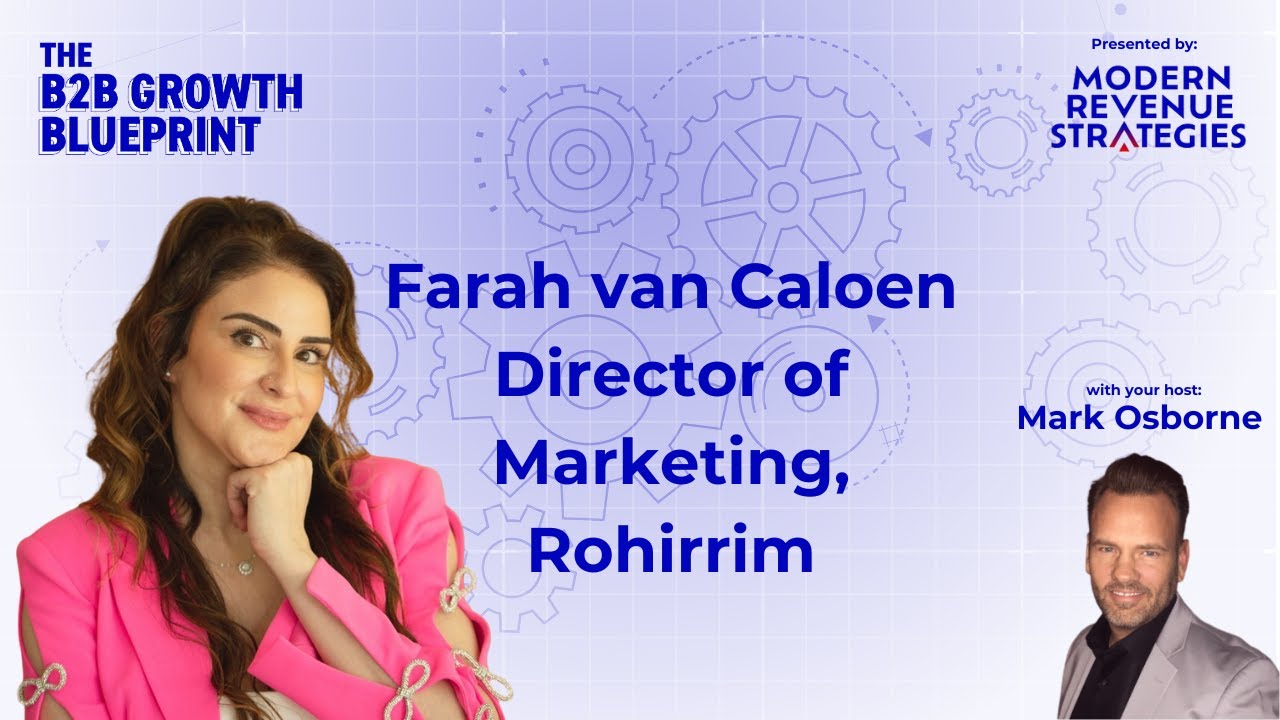
Farrah Van Caloon, who moved from agencies like Leo Burnett to B2B SaaS, explains why emotional storytelling matters in B2B marketing. She points to Siemens's platform relaunch video, which got 6 million organic views, and argues that strong brand positioning drives product-led growth by building awareness and trust before the free trial.
Chapters
Welcome to the B2B Growth Blueprint podcast, where we talk with entrepreneurs, founders, and leaders at B2B services, tech, and SaaS companies to learn the systems and processes they've used to create success for their business. We'll also learn from marketing and sales experts to provide insights to help you grow your business. I'm your host, Mark Osborne, and the podcast is brought to you by Modern Revenue Strategies and their 10X ROI B2B Growth Guarantee. Schedule a free diagnostic call to learn the fastest path to double your B2B revenues in just 90 days. Hello and welcome to another episode of the B2B Growth Blueprint Podcast. I'm your host, Mark Osborne, And today I'm very excited to welcome my guest. We had a really interesting conversation even just before we got going. Farrah Van Caloon is a creative marketing leader with a lot of success delivering real-world results both in the B2C and the B2B space. She has a really unique perspective of having worked at some of the world's largest advertising agencies like Leo Burnett, Publicis, M&C Saatchi, and then pivoting from those B and C advertising space the B2B SaaS marketing space. So we're going to talk about that intersection a lot today and how that's led to some viral success for her and a really creative approach. So after spending a decade working on award-winning campaigns for B2C, Farrah brought those winning strategies in the B2B SaaS world where she spent the second half of her career continuing to prove the power of her unique approach of blending B2C tactics with the B2B SaaS go-to-market strategy. So Farrah, welcome to the show.
Thanks for the intro, Mark. Happy to be here.
Yeah. So I'm really excited for this conversation tonight. I have a little bit of a similar background. Tell us about your story.
So basically, you know, like you said, I graduated from college and I immediately started working for ad agencies. I got very lucky. I was able to work for Leo Burnett and M&C Saatchi and Publicis. All over the world. I worked in London, Dubai, US, and then I worked on some really large fun accounts. We did a lot of really great campaigns. And then about 10 years, maybe at the 10-year mark, I was like, okay, I'm ready to do something different. I don't know if anyone who's listened to this podcast knows how stressful B2C agency world is. I like gave me an ulcer. So I was like, okay, I'm ready to pivot to something just a little bit slower paced. So I started exploring the B2B SaaS world, and I have to say my last manager, my last company really took a gamble on me. You know, I was a proven marketer. I had a lot of experience in marketing. It was just very different from the profile of the person they would normally hire, but they really liked me. They liked my energy. I talked to, I think, 7, 8 people at the company, and we just had a really good connection, really good chemistry. So they ended up hiring me in sort of a leadership B2B role. And then pretty immediately, it became obvious to me and them that my background in B2C will actually be really helpful in this role. One of the first things I did, probably like my first week, well, they really did drop me in the deep end. Like within my first week of starting, they're like, all right, we're launching our first self-serve product. It's the first in the company's history. We're launching it in 2 months and go. So it was like a lot of figuring it out on my own the first few weeks. But one of the first things I did was we're like, okay, we're launching a digital marketing campaign. We're gonna drive leads. So this is a self-serve product. So actually a lot of, you know, our traffic and revenue is gonna come from digital marketing.
Yeah.
So I wrote a brief. Provided a mood board, and I sent all of that to our creative team. And then they came back with ads that people at the company would have probably been like, oh, this looks great. But for me, I was like, no, this is not gonna work. And this is not a dig at their work. They're a really talented team, but they're just used to, like, you know, like, sift pictures, like sift stock photos. Really muted colors, you know, and it just wasn't the vibe that I was used to. So I kept pushing boundaries, kept trying to change things, and we got to a really good place, actually. So yeah, so that was just like my first sort of success story at Cvent. And then from there, I just kept pushing boundaries and tried to implement like more and more of, you know, the B2C strategies that I spent so many years working on.
That's so interesting. Yeah, you know, we think all the time about, you know, B2B buyers are people too, and they're subject to the same irrationalities that all people are, the same sort of emotional ploys. That's why one of the things that we really emphasize in the work that we do with clients is not only, you know, sort of building out an ideal customer profile that describes the type of companies you want to work with, But really building, you know, the personas of the different members of the buying committee and getting beyond just what's their title, but really like what's their personal win? Why should— what are they going to get personally out of engaging with, you know, you as a solution provider or you as a technology solution, whatever it might be, and really thinking through their mindset of like what are the psychological problems that they're, you know, hoping to, you know, you know, gain from or overcome and gain from working with your thing. So it's so smart of you to sort of bring those strategies in as you're kind of building this out and really getting into that. One of the things that starts to lead to, and I know that you've got a lot of experience in this, and is sort of the idea of brand strategy. And a lot of, you know, B2B companies they sort of feel like we don't have brands, we have products or solutions. Maybe it's, you know, sort of professional services. They might not have a product, but they have a solution. And they're like that we don't have a brand, we have a solution. How do you think about, you know, sort of brand strategy in the B2B space coming from that B2C world?
Yeah. So I'm just gonna go back a little bit. So when you say, like, you know, we're selling to, like, B2B buyers, our people too, like, yeah, it's business to business. But at the end of the day, the people we're selling to are literally people. They're, you know, like at my last job, they were event planners, they were marketers, you know, they were operation leaders. So they're people and they have their preferences and they have their needs and they want all of that to be met. So it's a very similar environment to a B2C environment. So I feel like it's kind of a misconception to say that, oh, it's just like enterprise to enterprise. But just speaking about brand building, I think, and we're seeing this more and more now, A lot of people are looking to connect with a brand even in the B2B world. So it's becoming increasingly important for companies to show what their brand stands for, show not just what they do, but why they do it and how they're helping people. Because like a lot of times, you know, companies are competing in a very competitive space. Like right now in this day and age, there's very few companies that are truly Creating something that's never been created before. There's always similar products. There's always adjacent products. So sometimes it just comes down to when I use this product, do I feel cool? Do I feel powerful? How does this brand make me feel? And you know, honestly, like in some categories, like some of the categories I've worked in, the product there's very minimal differentiation between them. It really does come come down to that emotional bond that you feel with the product and the brand.
Yeah, that's so true. Well, and especially like if you look at, you know, the evolution of companies and sort of, and even the evolution of kind of brand strategy and building brand personalities as markets become more mature, that becomes harder and harder to differentiate by the product itself. And so the products risk being commoditized and the way that they fought that traditionally in the B2C space is, well, let's build more of a personality around it, or let's bring forward our brand ideals and what we care about and what we stand for. And I think that a lot of the B2B space is now maturing into that space where they need to differentiate and the product itself, it's very hard. And so the only way to keep from being commoditized is to take some of these lessons from B2C and build a brand personality to build some, your your, you know, your brand ideals into the experience of working with the brand. And also, I think there's an interesting— and I think this has been an evolution of the last probably 20 years, but it's probably accelerated in the last 10— of there are a lot more B2B solutions that are designed to appeal to either the solopreneur or the small business, and where it really is, you know, an individual. that's making this decision to engage with a B2B solution, whether it's a product or professional service, whatever it might be. And so a lot of those lessons from, you know, B2C are really much more applicable in B2B than they have been in the past. So as you think about, like, you know, brand building in B2B or sort of brand strategy, what does that mean to you? How do you see successful companies that you've worked with or even others that, you know, you're observing as you're kind of building this thesis. How do companies do that right? What are you seeing?
So just using this as an example, I don't know if you remember a couple of years ago, ClickUp had a Super Bowl ad. I don't know if you remember that, but they had like literally in the middle of the Super Bowl during the halftime show, they played, you know, one of their TV ads. It was, it was pretty funny. It was like, I think it was a play on the founding fathers, something like that. But that was my first time seeing a B2B company advertise during the Super Bowl. And I thought that was a really creative approach. And, you know, ClickUp has had a really rapid growth. They're in a saturated market. There's a lot of project management tools. I can't, you know, it's very hard to link growth to a specific campaign, but I feel like that helped establish the brand as a fun, creative, cool type of brand. But just going back to what you were saying about, you know, products that sell to solopreneurs or entrepreneurs. Sometimes it doesn't even have to be a solopreneur. Like if you look at the growth of Slack and Zoom, for example, their growth strategy was to appeal to one person at a company who will then invite another person to use the product because they thought it's a really cool product. And then next thing you know, you have 10, 20, 30, 40 people within an organization using that product and then it gets adopted on an enterprise level.
Yeah.
So even those companies, they were talking to individuals. They weren't selling directly to the buying committee. But to me, when I think about like brand building for B2B companies, I really, I think it all comes down to the why. Like, why are we different? Why are we doing this? Why, like, how are we helping people? So it's more, it's less about like, what do we do? What is our product? It's more about like the why and the how. And I like, I have a pretty good example of that. So at Siemens, And the past, I think like 2, 3 years ago, we were kind of relaunching our platform. So it was, I think it was like the first or second time in the company's history where we were rebuilding the platform from scratch, just modernizing it, making it more intuitive, more user-friendly. And at the time, it was like, if you talk to the product managers or like the engineers at the time, it was this like huge complex project. Hundreds of moving pieces, like, and I was like, okay, but how do we tell the story of that? Like, people don't care that you spend 2,000 hours like building this product or, you know, that like, you know, you like a team of 20 engineers or like 30 UX designers worked on it. People want to understand how it's going to help them, what it means for them.
Yeah.
So I really like, it was really hard to get to the core of that story and really understand what's going to resonate with our audience. And I kept interviewing people, like talking to engineers, UX designers, product managers, trying to like in my head organize that story and find like the golden nugget. And then eventually I did find that and I created a video. I think it was a 2-minute video that basically tells the story of our platform relaunch, why we're doing it, how our evolution happened over the past 20 years that led us to this point. Point and what we're doing at this point in time to help our customers. It's all about what we're doing for our customers. And then I thought it told a really emotional story, honestly, for us, for our employees at the company. When we watched it, we felt proud. We felt it was a little bit emotional. But then also when our users saw that video, they also felt proud to be part of this company and part of the journey of this company. All that to say, the video ended up going viral without any paid promotions. We have over 6 million views on that.
6 million views without any paid promotion.
Without any paid promotion.
For a product launch video.
That's correct. For a B2B product launch video. So we've had 6 million views. Probably at least 30 of them are me. But, you know, the rest is Yeah, they're just organic views. And I really think that's just a great example of how, you know, you need to connect with individuals.
Well, and you're so smart to sort of bring it all back to it's about storytelling. And so often, like, that's one of the sort of pieces of the brand strategy or brand building that B2B companies sort of miss out on is they just wanna talk about the features, whereas If you can create a story that shows how those features deliver benefits in the life of the customer, then that gets really compelling and it taps into all of those sort of emotional elements that then, you know, guide that decision-making and guide that preference.
I have a funny story on that one.
Yeah, go for it.
So one of the things I did at Stevens was redo our, like, main sales deck that our sales teams use across, like, across the org for new business, you know, like, like new business demos or, you know, upsell cross-sell opportunities. And I redid the deck and it's probably seen by at least 10,000 people a year.
Okay.
But one of the things that I did was like, I don't want to mention a single product name or a single feature name in this entire deck. And I didn't. Nobody cares what the name of the product is. Nobody cares what the name of the feature is. What they care about is what is it going to do for me? So I literally created this. It was like, I don't know, like 45, 40 to 50 slide deck, which is too much. But, you know, people keep piling on. But without mentioning the product name or the feature name, or maybe just in passing, but the whole deck was about what we're gonna do for you.
That, that's so perfect that there's a, I don't know if you know the, the StoryBrand folks or if you've, if you've done any stuff with them, but they talk about that, you know, essentially you don't want to talk about features. Even talking about benefits is sort of less so. You more want to tell the story of transformation. Like, where were they? What was the problem that they were experiencing? What was their journey to find a solve or work for it? And then what did that ultimately deliver in their life? And then that story of transformation creates an opportunity for your potential buyers to see themselves. Yeah, that's the problem I'm having. Yeah, those are the other things I've tried. Whoa, that's the, the future that could be possible for me like that. That's much more inspiring than just, and we have this new catchy name for this product that does the same thing as 5 other products in the marketplace. So that, that's really interesting.
Yep. Absolutely.
You mentioned something earlier that I want to come back to, which was you talked about like Slack and some of these, you know, that had sort of like the freemium model and that sort of led to this, you know, modern idea of kind of product-led growth. And I know you're actually certified in product-led growth and I've had conversations with other folks that really lean in on that idea and oftentimes they're even more distancing themselves from the idea of a brand. Like, because they're like, we have a product, not a brand. We have a product, and that's what drives the growth. It's not the brand, it's the product. How do you reconcile those 2 ideas, knowing that you strongly believe in a brand strategy and, and sort of the emotional aspects, but you're also certified in product-led growth, and, uh, you're sort of a believer in that? How do you mesh those 2 concepts together?
So I'm on the polar opposite end of those people that you talk to, because I feel like with product-led growth, brand is even more important than traditional, like, sales-led motions.
Okay.
So for a couple of reasons. One, with product-led growth, you don't have a sales army picking up the phone and calling people and trying to sell them the product. You want people to come to your website. You want people to come to your product and to sign up for it. And the easiest way to do that is to create awareness of your brand, not just your product, but for your brand and make it appealing enough for people to want to go to your website and explore your products.
Yeah.
So that's the number one is for demand generation. And then number 2, with product-led growth, it's more of a B2C buying behavior. So it's like B2C2B, right? You're a business selling to a consumer who will eventually bring you into their organization and then that goes back to B2B. And those individuals, you know, like, if you look at a lot of products, a lot of categories of products, honestly, like, for 2 very similar, 2, 3 very similar products, sometimes it comes down to like, oh, instead of 5 users, you get 7 users, or instead of like, you know, 100 megabytes storage, you get 120 megabytes storage. So it comes down to really like granular details in the differentiation. Cool.
Yeah.
So what ends up moving the needle for those buyers is the brand. Is, do I connect with this brand? Is this an old, like, stodgy brand that I don't want to associate myself with? Or is this a cool brand that I think is going places? Am I going to be cool among my peers, you know, when I tell them I discovered this, like, really cool brand, this really cool product? So I really think, like, within the PLG world, that the brand is actually more important than sales-led motions.
Interesting. And that makes a lot of sense the way you lay it out. And especially when you think about the idea of, you know, if you think about the 4 Ps of, you know, sort of marketing strategy, one of those is people. And so when you've got a sales team that can go embody your brand and how they bring it to market, then you can lean in on, you know, that P and you don't have to lean in as much on the product sort of representing the brand. But in a product-led growth, when you don't have that sort of army of salespeople out there with a similar kind of pitch and a similar kind of deck to really tell that story, the product itself has to, you know, really sort of embody that.
So people— sorry, just the thing that people don't think about, like, yes, in product-led growth, the product is supposed to sell itself. The product's supposed to be so good and intuitive that people fall in love with it and they want to use it. But How do you get people to even try the products?
That's right.
How do you get them to the product to begin with? And that's through brand advertising. That's through demand gen efforts that lean on the brand.
Yeah, that, that, that couldn't have said it better. Like, that's, that's exactly it. And rather than just out there talking about the features, you gotta really talk about the experience of, of what it's like to go through that transformation with the brand. That's really interesting. So what other sort of trends In the B2B SaaS marketing sales space, are you seeing that are kind of interesting to you that are, that are getting your attention?
So definitely the focus, the bigger focus on brand building and brand stories. I was really surprised to see like really big companies having TikTok accounts and creating like TikTok videos and some user-generated content on TikTok. And obviously the purpose of that is to appeal to that demographic, to appear to be like a cooler, more fun, more approachable brand. So definitely leaning more into brand building. The other thing is coming to the realization that you're selling to people, not just companies. And then the other thing is within the people that you're selling to, there's gonna be different personas with different needs. And how do you talk to each persona? Within that journey, so you know you have the user, and with the user you want to talk about how this product is going to make their lives better. But then, for example, if you go to the executive buyer, what they want to know is how this is going to help increase their revenue, reduce their costs. Like how is it going to help their bottom line? So really understanding who you're selling to, and it's always more than one people, right? The user, buyer, influencer, and and understanding how to cater your message to each one of those. Individuals, those personas. And then what else do I see in the B2B SaaS world? I think one other thing that I'm seeing is even companies that traditionally had a very strong B2B, like sales-led motion, are now leaning more into PLG strategies, even if they don't go full-on freemium or full-on, you know, free trial. They're adopting some of the PLG approach. And for example, by creating simulations, by creating sandbox environments that people can try, by creating, you know, those, you know, those like product walkthroughs, right? So really leaning into the PLG, some PLG elements. And the reason for that is, I think, is because there's more and more research coming out that says B2B buyers want to try the product just like B2C buyers do. I mean, with B2C buyers, like, You always wanna experiment with something before you put down your credit card. And it's becoming more and more true and for B2B buyers.
Yeah, that's definitely true. And it's interesting, you talked about, you know, building out those personas and then having different content for them. The other thing that we see, you know, really accelerate even sales-led motions is by identifying those different personas, Knowing the different, you know, sort of messaging that you need to have, and then even finding the different channels or delivery methods. Whereas, you know, like we encourage people to play around with the idea of, well, you know, do a Loom sort of screen share walkthrough that you share maybe with the technical buyer because they care about seeing sort of the insides and the guts of the, you know, sort of the product itself, or, you know, do more of a kind of presentation YouTube video for the executive buyer because they really just care about sort of that story of transformation. And then, you know, do more of like a hands-on, you know, one-on-one kind of demo Zoom call with the, you know, with the ultimate end user because they want to be able to ask questions about it. They don't want to go as deep and it's technical as maybe the other buyer and they also aren't as, you know, They need to go a little deeper than, you know, sort of a more produced video can. But by having those different assets attached to the different decision makers and then delivered through different mediums that they prefer, you can do a really good job of connecting those different stories to those different influencers.
Yeah, absolutely. You, like, with looking at the buying committee or, you know, the different personas, you not only want to customize the tactic but also the channel because those people live in different places. Like, I know in previous worlds, like, my users were on Instagram and TikTok, but the buyers, the people who held the budget, were more on LinkedIn, more on, like, certain blogs, you know, that are more geared towards executives. So it's not just, like, the tactic or the medium. It's also the channel that you're using to deliver that message or deliver that, you know, like, is it video, whatever asset.
Yeah, that's right. So, Farrah, I gotta be sort of cognizant of the time. We could talk all day. We're always really passionate about these topics. But I know you're starting to do more blogging and put out more thought leadership on, I think, LinkedIn. Is that where— how can people get in touch with you?
Yeah, I'd love to get in touch with people on LinkedIn. So you can find me on LinkedIn. My name is Farrah Van Kaloen. Please follow me.
How do you spell Kaloen?
It's C-A-L-O-E-N, like Nancy.
Got it.
Yep. Please connect with me. I've been posting more regularly on LinkedIn, more of my journey from B2C to B2B. And I just started a new role and I'm building up the marketing function from scratch. So I'm documenting some of my journey there. So please follow me. And then if you wanna have a one-to-one conversation, I'm very chatty and always up to having a conversation about marketing. So please feel free to message me. I'd love to talk to more people.
Fantastic. So Farrah, thanks so much for joining. I've certainly enjoyed it.
For having me, Mark. This was so much fun.
Yeah, I'm sure our audience got a lot out of it. So thanks again for joining.
Thank you.
Thank you for joining this episode of the B2B Growth Blueprint podcast. We hope you've gained insights to grow your business. If you enjoyed this discussion, please rate, Comment, like on your favorite platform, and share to others who will find it useful. Do you know a CEO, founder, or leader at an early-stage B2B services, tech, or SaaS company who would like to be a guest and share their story? Send us a note. Let's schedule a conversation.
More from Mark

How Can You Maximize Your Business Value Before Selling? with Randy Katz Video







