Positioning Secrets: Turning Survey Data into Marketing Gold with Bruce Wiseman
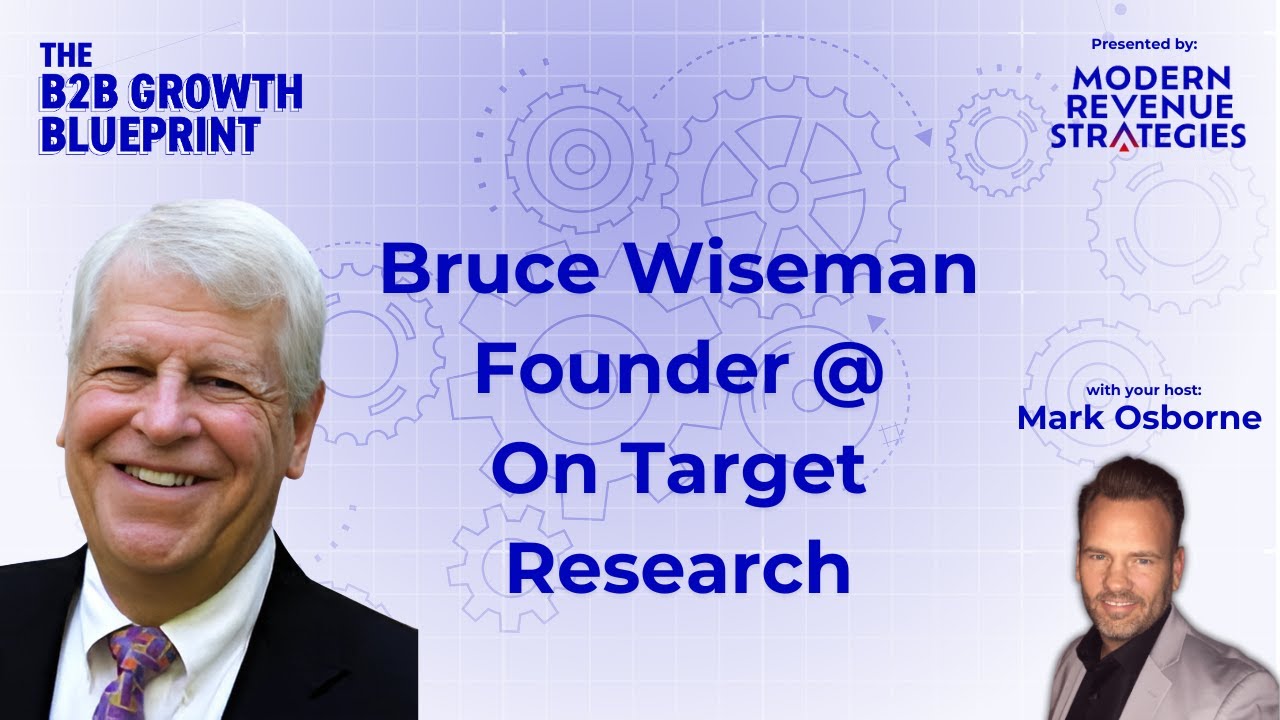
In this episode of the B2B Growth Blueprint podcast, host Mark Osborne interviews Bruce Wiseman, a former academic turned Hollywood business manager, market‑research entrepreneur, and author. Wiseman outlines his unique two‑step positioning process: first, a "button" survey that identifies the most frequently mentioned attribute (the button) from open‑ended questions; second, a positioning survey that maps that button to a vivid metaphor or object that resonates with the target audience. He illustrates the method with several case studies, including a startup selling inmate phone systems that discovered decision‑makers wanted an "indestructible" product, which they linked to a tank in marketing, driving revenue from zero to $30 million in three years. Wiseman also shares low‑cost survey options for $2‑$20 million companies—online questionnaires, phone interviews, and intercept surveys at industry events—showing they can fit modest marketing budgets. Throughout, he emphasizes a universal truth: you cannot know what customers value until you ask them, and many firms err by assuming they know. The conversation also touches on Wiseman’s current creative work, including a thriller series under the pen name John Truman Wolfe and a monthly financial newsletter. The episode blends practical positioning tactics with anecdotes from diverse industries, offering actionable insights for B2B marketers and founders.
Chapters
Welcome to the B2B Growth Blueprint podcast, where we talk with entrepreneurs, founders, and leaders at B2B services, tech, and SaaS companies to learn the systems and processes they've used to create success for their business. We'll also learn from marketing and sales experts to provide insights to help you grow your business. I'm your host, Mark Osborne, and the podcast is brought to you by Modern Revenue Strategies and their 10x ROI B2B Growth Guarantee. Schedule a free diagnostic call to learn the fastest path to double your B2B revenues in just 90 days. And using strategic positions and tactical branding programs within their specific industries. His clients have included world-class multi-billion-dollar brands such as Saatchi Saatchi, Hitachi Consulting, units of Marriott, Hilton, and Holiday Inn, as well as businesses in virtually every industry sector. He has a master's degree with honors from San Jose State University and is the former chairman of the Department of History of John F. Kennedy University. Mr. Weissman and his wife live with their German Shepherd in the mountains north of Los Angeles. So Bruce, welcome to the show.
Well, thanks so much for having me, Mark. It's a pleasure.
So I've been looking forward to this conversation and really enjoyed our previous dialogue as we were sort of getting ready for the show. But I skimmed very quickly through what's obviously an illustrious career spanning lots of different angles, and I didn't even touch on your work in Hollywood. Why don't you give our audience a little bit of a picture of kind of where you've been and how you got to where you are today?
Geez, does my bio talk about our Hollywood company? Well, I, as you mentioned, I did graduate work at San Jose State University, and then I taught there for a while. Western American history, and then I was gonna get my PhD at Cal. But my dad, who had a large, well-known furniture and appliance company, came down and talked me into coming up because he said he was going to retire. And I kind of felt obligated. So I left my academic career and went to work for my dad, who never retired, you know, never retired. And I left his employ After about 5 years. And despite the academic background, I was teaching at night. But because I was working in finance for my dad, I got a job at a bank in the San Francisco area. And then I spent some years there, became a senior credit officer, and then left banking and I, I was doing consulting for, um, an educational institution, and a large book publisher asked me to help them promote a book, which I was happy to do. But then they wanted me to do some surveys, and this was not a piece of management technology that I had any idea of. This was, I don't know, in the '80s. And so I dove into the subject, and long story short, I created a market research and survey company. And I did that along with— you may, since you mentioned Hollywood, I had along with a financial management company in Hollywood. My partner and I were business managers. That's a technical term in LA and And New York business managers handle the business and financial affairs of entertainers. So, right, our clients were actors, actresses, producers, directors, rock stars. And, uh, I did that for about 25 years and then, uh, retired. I, I was doing both that company and my market research company, uh, parallel to different staffs, different, obviously very different products for the entertainers. Of course, you know, things like accounting, tax, investing, that kind of stuff. But the market research work grew and grew. And so when I retired from the business management company, I continued with the research and I started writing. And as you noted, I've got a bunch of books up on Amazon, fiction and nonfiction. And so I still write. I still write. My wife and I moved, as you mentioned there at the end, to— we're in a mountain community north of Los Angeles, Mark. We're 6,000 feet up. The air is pristine, the views are stunning, and there's wildlife everywhere.
That sounds awesome.
The community is full of bears and And other, other, other wildlife. So, um, I am, uh, I continue to write, mostly fiction now. Uh, with the other hat, I have a financial newsletter that I publish and, um, and I write. And there you go.
So you've got such an eclectic background. I do want to sort of zoom in on one area of specific expertise because it's an area of sort of specific passion for me and also aligns well with, you know, sort of things that our audience tends to be interested in. And that's around sort of positioning. And you talked about that, you know, you've had the benefit of knowing, you know, Al Ries, one of the, you know, the godfather of positioning, as you were saying, with the book Positioning: The Battle for Your Mind, written with Jack Trout. And you talked about that, you know, positioning is really sort of part of a 2-step process which requires this, you You know, kind of survey and kind of insight in order to then get at the positioning. Why don't you share with us a little bit of what that process looks like that you've seen work so well over the years?
Well, thanks for that question. It is a 2-step process, and a lot of people take a shot at positioning these days. Most large corporations that have a budget, they position with Uh, celebrities. Uh, yeah, uh, positioning in a nutshell, uh, positions— puts your product, uh, along with something that is already in the mind of your public. That's why position— well, that's why celebrities work well. But we do it as a 2-step process, uh, Mark, as you mentioned. Uh, first we do a survey to get Buttons. Now, the word button is a, you know, well-used word in the sales and marketing world, but a button to us is a technical word. It means the answer given the most number of times to a survey question.
Okay.
So if I ask 100 people who drive cars, what's the most important factor in buying an automobile tire, and 70 of them say durability, I've got a button, and if I use that word in my marketing material, whatever it is, maybe my website, email marketing, regular marketing, I'll get a much bigger, better response. Why? Of course, because we already asked the public, and that's what they— that's what they think. So that's step 1. We, we do surveys to get key buttons from the public who we, who our clients, who we, who we, who they're looking to reach. So, and we get buttons.
Now, I'm curious, a quick question on that. So when you're searching for those buttons, are you prompting the audience with a hypothesis of the things you think that they care about? Or are you more opening it up for them to insert to you the things that they care about?
Very, very good question. And it's the second for sure. We, we don't lead them. We want what's in the mind of the public because then when we're advertising, we can parallel what's in their mind. So we don't, you know, we don't offer, uh, things to check, you know, good, bad, excellent. Um, we ask open-ended questions.
Yeah.
So, you know, what do they think? So let me get— let me Once we get a button, we go back with a second survey. So it works this way. I'll give you an example of a client we did a while back. This is a company. This guy came to us. He was selling or wanted to be selling. He was just starting a new business, telecom equipment to the correctional industry. These are phones for inmate use.
Sure.
Unfortunately, in this country, it's a huge business. Um, um, it's a multi-billion dollar business, and the big guys were in there, um, you know, AT&T, Verizon, and so forth. Um, and but he was sure he, he had a, you know, a good take on it. So first we do the first survey we do, we survey sheriffs and wardens across the United States.
Mhm.
What is it that they want from an inmate phone system? The key button that came out of that research— there were a few, but the key button that stood out was they wanted the phone system to be indestructible.
Yeah.
Now that's something we wouldn't have guessed at because— but come to find out, these guys line up for the phone, and if it breaks down, fights break out. It's a mess. They hated it. So indestructible. So that's the survey for the button.
Okay.
We then go back with a positioning survey and we ask the same public, not necessarily the same people, but the same public, uh, what object or activity represents indestructible to you?
Okay.
The answer was a tank, right? So this information now goes to the client, their, their marketing and, and PR people. Design a whole campaign based around the indestructible tank phone.
Yeah.
And, and this little startup company went from $0 to $30 million a year in 3 years. They became the largest provider of inmate phone systems, independent provider in the country.
Because they were saying exactly, they were saying exactly to those decision makers what mattered the most and in the language that they used to do it. So it exactly resonated with them.
Exactly. We, yeah, I mean, it goes back to your earlier question. We want the answer to the question out of the mind of the public. I don't want to feed them. I want them to tell me.
So that sounds like a really robust process. And I've been fortunate to, you know, work on some really large-scale brand strategy work in the past and It can be a lot in terms of that, you know, sort of all the effort that goes in and then fielding the surveys. And but you talked about this company, you know, starting at zero. And, you know, a lot of our audience doesn't have an infinite budget for market research to, you know, find these buttons and then to refine the language to use in highlighting these buttons to their marketplace. What are some strategies that you've seen work or some, you know, sort of low-cost ways that founders at companies in that, you know, kind of $2 to $20 million range can use to get some of these same insights that can help them break through?
You know, Mark, it's not as expensive as one might think. I mean, I suppose there are, I don't know, big political research companies that charge a lot of money, but it's not expensive. Now, there are different ways you can survey.
Yeah.
These days, of course, in the last couple of decades, we can do online surveys.
Yeah.
Reasonably inexpensive. We do phone surveys in some cases if we can't reach a public via the internet. You know, if we're trying to reach left-handed golfers in Houston, Right. We might have to go to the phone. So that's a second way we can survey. It's a little more expensive than online. And then ultimately, or ultimately is probably the wrong adjective, but another way that we can survey is intercept surveys. That means face-to-face surveys. So we had a company some years ago, we were doing surveys for a medical device for orthopedic surgeons.
Okay.
And orthopedic surgeons are difficult to get on the phone.
I bet they spend a lot of time in surgery.
So, exactly. So I flew a team out to Las Vegas because there was a big convention of orthopedic surgeons and okay, good face-to-face surveys there. So the answer to your question is more and more these days, We can do it online. It's not really expensive. It can certainly fit into the budget of a marketing budget of a company in the, you know, whatever, $10 to $20 million range, even less. I mean, I've got some small, smaller companies. And once they get a button, if they, you know, once they have this, they now know Exactly what their public thinks about, what their public thinks is valuable about what it is that they sell or what they don't like about it. So it really, that data then really helps the marketing people.
Well, and, you know, I sort of posed it as a little bit of a straw man argument because what I have seen, and I'm sure you've seen this too, is, you know, the research really sort of grounds the strategy. And the strategy is what determines how effective every dollar thereafter is spent. And I use the analogy sometimes of, and I'm not a big golfer, but it's pretty easy to visualize that a little bit of degree of difference when you hit the golf ball off the tee is a big difference down the fairway in terms of how close you are to the target. And so, by taking the time to invest in that survey and that research upfront to really know what matters, then you can get a lot more effort or a lot more lift from all of your other marketing and sales activities that really makes it an efficient investment, even if it does seem like, you know, something that not a lot of people are doing.
Well, obviously, I couldn't agree with you more, and it is the foundation, as you note, really the foundation of a good marketing program. What is it that your, your public thinks, uh, is great about what it is that you sell? Some people, uh, you know, CEOs, some people, CEOs have a good idea of that, but some don't, or they think it's this, but the wording is not exactly right on the money. Uh, so when you hone it down to exactly what's coming out of the mind of the public, you've really got a wonderful foundation for a marketing program.
Yeah. So, given all of your sort of background and expertise in this space, and you've worked with companies both large and small from startups to Wall Street, are there common things that you see that sort of comes out either like universal truths that tend to come out from the different audiences and the different sectors that you work in or common mistakes that you see companies make when they're coming to you, approaching it, and they're like, hey, we need to do X. And you're like, you don't need to do that. You instead should do Y because of this, this, and this. What are some sort of common themes that you've seen?
Well, it's a good question. Unfortunately, I don't know if that's the right word, but unfortunately, a lot of businesses think they know what the public wants, and they create marketing programs or PR programs around that, and they're often off a little bit. Sometimes they're off a lot. Sometimes they don't have a clue. I did some In the early '90s, I was in Moscow after— right after the fall of the Soviet Union and gave a talk to a college that was opening there, a business college. And a member of the Ministry of Internal Affairs was in the office. That's the Russian national police. It's like the FBI there. Long story short, there was this lieutenant colonel, and he asked me to Come to their headquarters, and I met with some senior people there. And long story short, a lot to that story. But a long story short is this guy was having recruit problems. The guy we met with, Colonel Stanislav Pilov, was having recruit problems because you know the communists had been. Beating people over the head with a nightstick for 70 years. All of a sudden, this has changed. And so he asked if we could do surveys to help him recruit. And so I said yes. And we so I surveyed Russian police to find out what is it that prompted them to join the ministry? Why did they become cops? And I'm thinking, you know, protect Mother Russia. What you know. Words to that effect. And the answer, Mark, was free transportation on the Metro.
Huh.
Because they had— they didn't have any cars, so they all traveled on the Metro. I make this point only to show, you know, how unusual an answer might come back from a survey. Um, others, um, might be promoting a particular aspect of what they do, but they don't word it right. Um, and, and, and the audience will reject it if you don't, uh, if you don't kind of parallel their mind. Or said in a more positive way, the, the closer you can parallel to what they're thinking, the, the better they're going to respond.
That's right.
So the answer to your question is, as a universal truth, you don't know until you survey. And, and I found that true. We've been doing this over 25 years. And, you know, you don't know until you ask them.
Interesting. So consistently you see folks get surprised, even folks that have been doing it a long time and are experts in their marketplace.
Absolutely. We did it. We did a research project for a big— you mentioned Wall Street. This was a big Wall Street company, very prestigious, and in their marketplace were a leader. And the chairman came up with a new technique, a technical technique, and he wanted it surveyed. And he had a name for it. Okay. And so we surveyed the people that we surveyed were merger lawyers and CPAs. They hated it. They just hated the name that this guy had. I'd never seen a response like this. So, you know, we sent the information up and he, the chairman didn't budge. He had it fixed in his mind. This is what they wanted. So he sent us— we did the first survey in New York, then he sent us to Philly and then to Houston. And after 3 or 4 of these, he finally got it. My point is that even management of big companies, you know, they can have a fixed idea, but if it's not the idea that's in the mind of the public, it's, you know, It's a waste of money.
Yeah. Well, and what a great lesson that, you know, it's the— it's what the customer thinks that matters, not what you think that they should think.
Exactly. Exactly. Well said. Yeah.
So you're obviously an expert in, uh, some really interesting, you know, places where we could spend all day talking, but I got to be mindful of your time. But before I let you go, so you mentioned that you're still writing. What are you working on right now, or what's something that's coming out soon that we can keep an eye on?
Well, I'm not sure this is the best answer for your audience. You know, you have to like thrillers. I've got this Tom McKenna detective thriller series, and I'm writing the 5th in that series.
Okay.
It's, you know, my bestseller was about the global financial crisis, and it's, you know, it's, it's fine. I, I can, I can write, but it's, it's, it's a stale subject when compared to being able to create, you know, what my private eye is going to do. I can just make it up and, and And have fun with it. So I'm, I'm, I'm writing some fiction as we speak. I write a monthly newsletter, financial newsletter, and I write articles on marketing regularly. I'm just finishing one up as, as we speak, as a matter of fact. So, you know, based on the insanity that's going on in Los Angeles these days.
Sure.
Uh, so, um, anyway, um, that, you know, that's what I'm writing. I, you know, if somebody's interested in that, they can go to, to Amazon and put in John Truman Wolfe. Uh, name?
Yeah, John Truman Wolfe.
When, when I started writing, I was doing a lot of work, uh, in Washington. I was testifying before some government committees, and I thought it was would be better to have a, you know, a different name.
Yeah.
And so I picked my grandfather's name. John was my grandfather, tough old guy. Anyway, so that's what I'm writing now.
Well, fantastic. Well, I will definitely be heading over to Amazon to check out some of those and certainly signing up for that newsletter. But Bruce, thank you so much for joining us today. I really enjoyed our conversation.
Well, it's my pleasure. It's very kind of you to have me. I enjoyed it.
Talk to you soon. Thank you for joining this episode of the B2B Growth Blueprint podcast. We hope you've gained insights to grow your business. If you enjoyed this discussion, please rate, comment, like on your favorite platform, and share to others who will find it useful. Do you know a CEO, founder, or leader at an early-stage B2B services, tech, or SaaS company who would like to be a guest and share their story, send us a note. Let's schedule a conversation.
More from Mark

How Can You Maximize Your Business Value Before Selling? with Randy Katz Video







