Scaling Your Business: From Early Stage to Long-Term Growth with Joe Ort
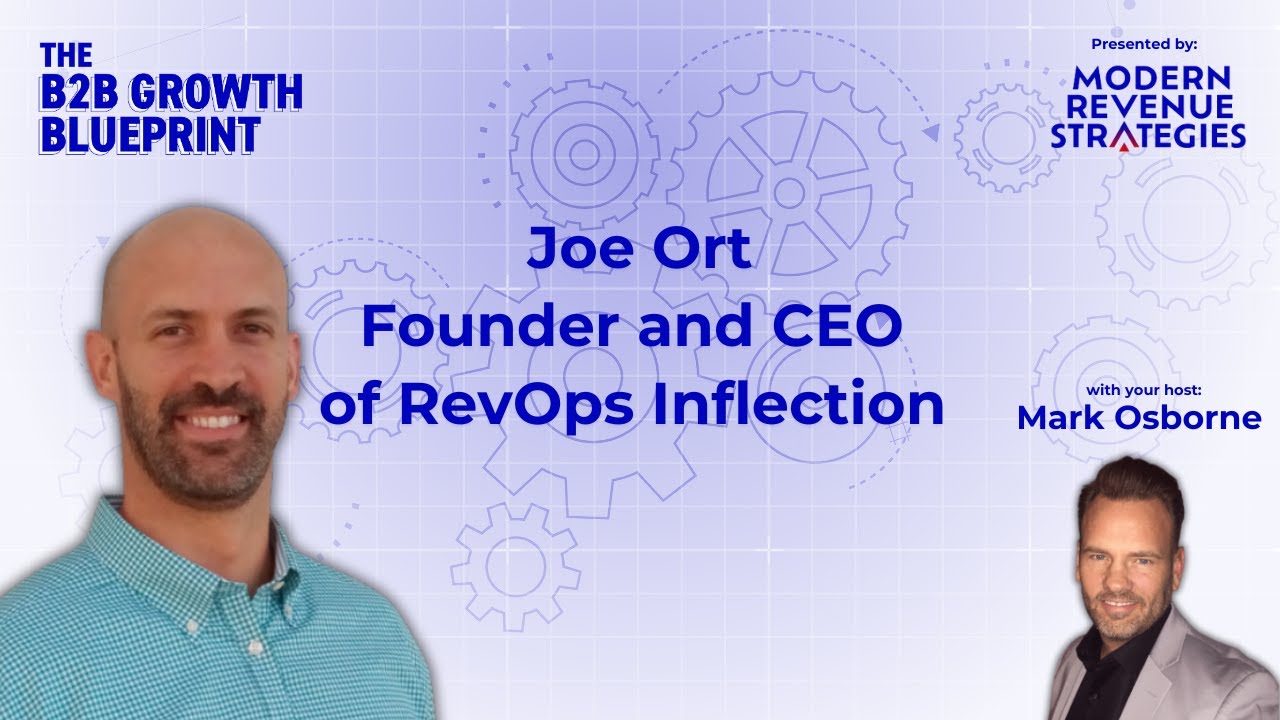
Joe Ort, founder of RevOps Inflection, talks about scaling B2B/SaaS companies. He explains why RevOps is more than CRM reporting, how the bowtie model replaces the old funnel, and why you should nail your ICP and document processes before buying expensive tools.
Chapters
Welcome to the B2B Growth Blueprint podcast, where we talk with entrepreneurs, founders, and leaders at B2B services, tech, and SaaS companies to learn the systems and processes they've used to create success for their business. We'll also learn from marketing and sales experts to provide insights to help you grow your business. I'm your host, Mark Osborne, and the podcast is brought to you by Modern Revenue strategies and their 10x ROI B2B growth guarantee. Schedule a free diagnostic call to learn the fastest path to double your B2B revenues in just 90 days. Hello and welcome to another episode of the B2B Growth Blueprint podcast. I'm your host, Mark Osborne, and today I'm very excited to welcome my guest, Joe Ort. Joe is a true architect of growth in the B2B SaaS space with over 15 years of experience helping companies scale from $10 million to over $100 million in revenue. He's been instrumental in aligning sales, marketing, and customer success for maximum impact. What really sets Joe apart is not just his extensive operating background, but also his experience working with PE or private equity-backed companies And for PE leadership, giving him a unique 360-degree view of what drives value and sustainable growth. He's also started his career at Serious Decisions, where he was at the forefront of researching best practices for high-performing organizations. Please welcome the founder and CEO of RevOps Inflection, Joe Ort. Joe, welcome to the show.
Thanks for having me, Mark.
Yeah, I've been really looking forward to this conversation, but before we dive into some of the topics that you and I have been talking about, why don't you give our audience a bit of a background of kind of how you, how you navigated your career and what brought you to where you are today?
Yeah, I think most RevOps people will tell you they fell into the role. It's not something that you say, this is what I want to be when I grow up. It was a similar thing for myself. I started in B2B with Sirius Decisions. And if you're not familiar with Sirius Decisions, they were doing research into what the best performing B2B sales, marketing, and product organizations were doing and really started early 2000s. And they started the waterfall. If you're familiar with the lead funnel and MQL through SQLs and all those, that's the company that started it and the benchmark data and the research that they were producing. So I got started in basically as an SDR and customer success role there for a few months. And then I sold our advisory services for a couple of years. And you're selling to senior-level sales, marketing, and product leaders at large organizations. And, you know, just getting over the course of the first couple of years of doing that, working with a lot of sales leaders, being a salesperson myself, reading our research, hearing our analysts talk to these executives, I just got interested in the sales operations side of it. And I just approached our founder at the time. I said, hey, you know, what if I took over sales operations for us? We were relatively small at the time, about $10 million in revenue. And he said, yeah, I think your skill set matches for what that is. And the following fiscal year, I started going into operations, picking up the CRM admin work, starting to get in deeper into the analysis. And then we eventually had some PE investment within our organization, brought a new CFO on, and just having that lens of the business from a CFO standpoint, reporting to him for a couple of years. Just really ignited my desire to stay within operations. Eventually started seeing the evolution of sales ops into RevOps, and I've spent the last number of years working with various PE-backed organizations in their revenue operations. So it's been a lot of fun. The space has changed a ton since I got started. There's new, new models such as you have the funnel, but you also now have the, you know, the winning by design bowtie. So there's a lot of innovation happening in the space and it's a great time to be here.
That's such an interesting story and it's really interesting to hear your personal story is almost like the microcosm of the kind of whole industry shift of, you know, moving from, you know, just selling in a traditional kind of funnel perspective to enabling that with technology and data and all the things that RevOps does today. So, it's so interesting to see how your career sort of mirrored that evolution within the industry. For our audience that may not be as familiar with the term RevOps or revenue operations or sales ops, give us a little bit— you're an expert in the space, so give us a little bit of an expert's definition of what's the difference between RevOps versus having a CRM and having good data on your customer and good pipeline reporting. Like, what really is the difference between just those basic things and what RevOps has evolved to today?
Yeah, to me, the simple definition is, and I like to put everything on charts and everything gets modeled because that was the Serious Decisions way. But there's, you know, 2 axes. You've got productivity being the combination of efficiency and effectiveness, and that's going to go across multiple parts of the organization. So how do we get to be more efficient? with our resources, with our spend from a marketing standpoint, with how our salespeople are spending their time? And then how do we increase our effectiveness of those things as well? So it doesn't make sense to do more bad sales calls. How do we do more better sales calls? So it's those— the intersection between efficiency and effectiveness. We want that arrow to be going up and to the right. And there's all kinds of ways to apply that within a go-to-market organization, from marketing spend and which campaigns are we doing? How do we target the right accounts and the right contacts? From a salesperson's perspective, how are we making sure that we get them the tools that they need to be effective or efficient with their time? How do we get them the training and enablement they need right in time when they need to? So thinking about it from not just do I have fields in my Salesforce instance as a CRM admin, it's not just the reporting aspect of it. It's thinking holistically about how do we most effectively run our revenue engine to grow profitably and try to continue to grow and accelerate that growth.
Yeah, and the sort of proliferation of all of these tools and all these data sources can oftentimes be overwhelming for, you know, whether it's the CEO that's leading growth, you know, for early stage company or even, you know, a revenue or sales leader within a company to make sense of all of that. And I love this model and I know that you are really big on using frameworks. for decision-making to evaluate, you know, does this particular tool help us achieve what it is that we're trying to achieve? Does this particular dataset make us more productive either through increased efficiency or increased effectiveness? So I really love that framework. Speaking of frameworks, you mentioned something before, which the Winning by Design, you know, revenue architecture. I'm a certified revenue architect myself and brand ambassador for them. I'm curious how you've seen that approach approach change what people think about from revenue operations as it goes beyond that first stage of the initial close to thinking about recurring impact and expansion and renewal revenue beyond just that acquisition revenue? Has that been a wide-scale change within organizations that you're working with or something that's still evolving?
Yeah, thanks. People are still coming around to it. You look at organizations have— and it's a part of the evolution, right? Sales operations focus on sales, marketing operations focus on marketing. CS operations eventually came on to focus on the expansion and renewal side of the business. And, you know, that's kind of the one part of the evolution going into revenue operations as you are trying to look at this from a holistic standpoint. So I think there's still a lot of movement to be made in terms of the adoption of that viewpoint because models are still being driven. Vendors are still very much driven to this is the area that I focus on. I'm in a sales engagement platform. I help your sellers get meetings. That's a targeted type of a thing. So it's very much in still an evolutionary stage where I don't think that it's fully adopted. But if your high-performing organizations are doing the stuff right, they have the right targeting, that they're getting the right customers in the door, and get the right customers in the door means that they're going to stay with you a long time and they're going to spend more money with you. So the bowtie model definitely helps expand upon that. But it's, you know, it's one of those things where we didn't really have that in the initial, the initial funnel that sales, that Serious Decisions rolled out back in 2006. The world has changed. The way that you should measure your organization has changed. And it's totally different. You talk about some of the vendors, you think of the, the initial, you know, martech landscape map from way back in the early 2010s and how it could fit on a slide. There's so many vendors out there now, you can't even tell, you know, who's, who's what on these slides anymore. There's just such a proliferation of the tools that can help you with all these different things. But again, the, the architecture of how you look at the business is definitely changing in SaaS businesses. And you don't want to be winning a bunch of deals and then watching it fall out the door. That's just gonna crush your CAC. There's just gonna be so many other issues down the stream. So the revenue architecture model is definitely the way to go.
Yeah, I, so I love what you brought up about, you know, the, for our listeners that may be familiar with like the, the MarTech conference, and they, they publish the, you know, the landscape of you know, all the companies in martech. And as you were saying, in the 2010s, there were like 150 logos on that sheet. And I think last year there were over 10,000. Uh, and, and it's been interesting, and this is a little bit of a, of a rabbit chasing a rabbit, but, uh, you know, there's a whole generation of marketers that they really sort of made their play by kind of arbitraging being first mover to adopt a new technology of like, The first folks to optimize their websites for search engine traffic got a windfall of traffic from people who were looking for that as consumers moved online. And then some of those same people, the first ones to buy AdWords ads, saw that windfall. So much so that there's like an entire generation of marketers that have never had to think through strategy of what really drives productivity. Effectiveness and efficiency. They've just been, well, the first to adopt a new tool or the first to move to a new platform. And it's worked so well for them. They've had a long career based on that. And it's interesting now as there's such a proliferation of options that it's impossible to, you know, winnow through them to see, well, where even would I need to be the first to go there? Or how even would I adapt that if you don't have that strategic background and if you don't have that Sort of process-driven approach, which, which has been just such an interesting evolution over the last several years.
Yeah, totally agree. And AI obviously changes everything.
And that's right. Yeah. Now it's yet another level. Well, because not only is it a whole nother ring of new tools, but also each tool is impacted and the systems and processes that leverage those tools. So keeping the AI topic on the side, because I find oftentimes that what AI does is it helps things be more effective and more efficient, like a lot of technology does. But as companies are moving from this sort of heroics of like a founder that is leading the marketing and sales efforts, and they kind of get to where they're the bottleneck and they're like, well, In order to break that bottleneck, I'll just hire a sales leader and they'll be exactly like me, and then we'll double our revenues. You and I both know that that doesn't work, but for a lot of our audience, that might be what they're thinking. Talk to us a little bit about why that doesn't work and what, what you've seen as some of the challenges to companies doing that and what may be a more effective approach is.
Yeah, based on my experience, and I've seen a lot of these types of companies, the, the hope and goal is that, hey, we bring on, you know, a VP of sales and they're going to come in, they're going to be a player coach, they're going to do their own selling. They also are going to hire some people under them and we're going to eventually see all this great growth. I think one of the things that you miss is you as a founder know everything about your business, you know everything about the product, you know everything about the market. You're bringing somebody on board that doesn't have that same brain, and there's that mind melding that needs to happen where the expectation is, hey, you're just— you're going to start to sell. Founder-led sales doesn't help you scale. You need to eventually be able to get that stuff out of your brain and into a sales organization. How do you do that? It's you've got to start documenting things. What is your process? How do you communicate certain things in terms of the value? How do you overcome objections? All those things that you just do naturally. You need to get those things out. You need to document them. You need to take people through what that process is. Otherwise, they're just— you're going to be looking at them like, oh, they don't know what they're doing. Well, they don't know that this is how you've done things and how you've been successful and how you're eventually going to scale the organization is going to be a little bit different as well. That person that's going to take you from 0 to 1 from a sales organization might not be the same person that's going to take you from 10 to 100 sales reps. It's different skill sets in terms of what you're looking for from a salesperson. So, you know, a couple of things I've seen issues. You hire a very senior person that's, you know, one of those dashboard drivers of large organizations, think that they're gonna come in and be able to do what you're looking for them to do. Doesn't work that way. That's, that's not their— they haven't been in the field and, and, you know, basically doing that hand-to-hand fighting in a while. They've been looking on dashboards and trying to direct Overall sales strategy. So getting somebody in place that can go and be that sales rep, that's effectively what you're doing in those first couple of sellers. One of the things I think that's been successful, what I've seen is you hire in doubles. So have 2 people come in. So you have, it gets you some safety net in terms of you hire 2, one of those doesn't work, you still have somebody in place. So you're not losing that capacity. So you have that partnership, they can continue to train and enable each other working together, making sure that they're aligning on what it is that you're training them on. And it's just a big piece to like have that camaraderie. And then the other part that I would add is, do you have the pipeline to be able to support bringing on new sellers? So if you're, if you're just a bottleneck because you don't like to do it versus, hey, we have so much inbound coming in, And whether that's word of mouth stuff, whether it's you're doing some outbound marketing, making sure you have the pipeline to be able to support it. Otherwise, you're going to have, you know, a couple of people in there that are just going to be doing a bunch of cold calling. It's really tough. And that's going to obviously add to your burn from a cash standpoint. So making sure that you fully understand, hey, this is what we're doing. We're going to be very thoughtful and strategic about the type of people we're bringing in. the information that they need to be successful and start to document what those sales processes are, because that first hire is going to have to work with you and then translate what you're doing into a sales process that can be repeatable, that you can train additional sellers and begin to grow your sales organization.
That's right. Well, and it's that, it's that process documentation that really unlocks the promise of all of the RevOps technology because you can, You can buy all the greatest technologies that have all of the accolades and success stories, but they only work if they have a process that they can make run more efficiently and more effectively. And so if you haven't taken the time to document that, not only will the people not be successful, but the technologies won't really sort of bear fruit. And it really becomes really just kind of overhead. And I also loved your call out too about, you know, you got to make sure that the pipeline's there to support the sales team because, you know, hiring a senior seller from one of your competitors to then have them perform an SDR-type role of smiling and dialing is really not an effective approach. And also those kind of, you know, sales has a multi-stage process. You got to find the leads, you gotta capture and nurture the leads until they're ready to be sold to. Then you gotta sell them and guide them through that change management. And then ultimately nurture them and grow them into renewal and expansion revenue. If you hunt for one person that can do, that is excellent at all those things, that unicorn hunting gets very expensive, not only from an opportunity cost, 'cause it takes a long time to find that person, But then once you do find them, you gotta pay a lot to get 'em. Uh, and so, and oftentimes, especially for early stage companies, they aren't as super committed to you, uh, because they're high in high demand. And so it's hard to kind of get their full attention versus building the systems and processes that do a good job of finding, capturing, nurturing those leads so that they're then ready to be sold to. is a much more efficient and effective way of doing that. So, as you've worked with companies growing, you know, it can sometimes be overwhelming. And so we talk about, you know, some of the very large, you know, ABM platforms, you know, that are out there that can be hundreds of thousands of dollars a year, and they come with lots of bells and whistles of data to identify people that have intent and are out there in the marketplace and orchestration so that, you know, your email is customized based on what they read online and it's feeding out specific sales scripts to the SDRs who are then, you know, feeding specific, you know, follow-ups to the salespeople. A lot of that sounds really cool and, you know, like a tech-enabled future, but can be very daunting. to a company that's trying to grow fast, has a struggle with making that really big investment in infrastructure. Talk to us about how you've seen companies be successful in scaling and being scrappy with recognizing that we need systems and then we want to use technology to empower those systems and data to make them smarter and enrich them. But we don't want to over-engineer the solution. How do you see companies effectively wade into the pool of revenue operations without getting overhead or without getting underwater on, you know, so much overhead?
Yeah, I think you see the marketing and you're like, hey, this is how I want to do this. I have to do that thing. And there's, you know, you've seen a lot of stuff on LinkedIn or whatever. You gotta start with the basics. So it's similar with tools. We talked about it way back when marketing automation was starting at Sirius that if you have a bad process, that's just gonna help you do bad things faster. So thinking about, you know, how do you structure like the outbound piece? It's gonna be very top of the funnel. Like, who should we be targeting? What is your ideal customer profile? Who are the contacts at those types of companies that you need to be going after? What's the messaging look like? When you know what's the day in life, how do we get in touch with them? How do we get just our contact set identified initially? So a lot of the smaller companies I work with, they have you know whatever has come in over time. But what is our TAM? And you think when you're gonna start going to the PE growth guys that want to understand like what is the market for this, they're gonna do their own analysis. But if you can come and say, okay, this is we have 100,000 possible customers and in the world. We right now, that's our total addressable market. We, we can actually serve right now about 50,000 of those because we don't have integrations with X, Y, and Z. And then there's, okay, where, where do I want to be targeting from? These are who I think are the best potential prospects. So trying to really narrow down who should you be going out to, what's the messaging for them, and be ruthless with that prioritization because trying to do everything for everybody You're gonna— your messaging is gonna be off. It's gonna be too generic, and you wanna make sure that you're gonna be spending your time on the highest likelihood to close deals. So the first thing, instead of all the other stuff in terms of like, let's do all this orchestration, let's do— who is your buyer? What do they care about? How do we get their attention? Do we have the right information to be able to reach out to them, their email addresses, their phones? Because Email is just kind of going into a black hole these days.
Yeah.
So how can you get the phone numbers to be able to support that? So it's, again, trying to block out all the noise. It's going to be basic fundamentals. Let's get our, let's get our ideal customer profile documented. And you still might not even know that early on. It might be something that's evolving. Your product has changed over time. It was, our ICP initially looked like this. We've changed, made some changes to the product and now it looks like this. That's totally fine. That's part of the evolution of a business. But making sure you really truly understand what that looks like, build what that process is going to be, what is repeatable. So then you can figure out, okay, how do we start to make this more efficient? Let's go find some tools that can support this versus let me go find a big ABX platform because they can do all these things. Well, if you're targeting the right— the wrong people on the wrong accounts, you're spending all that money on ad spend on people that will never buy from you. So just making sure that you know what it is we're doing, why are we doing it. Now let me go and find it. It's people, process, then tools, right? It's not tools to come up with what the process is that your people are going to use. So making sure that you understand the priority order of that is key.
Yeah, I love that. And what I've seen companies do that's successful is, you know, almost start with whiteboarding. Like, all right, what are we trying to do? We're trying to bring these people Into this, you know, action and then have this outcome. Start to define those steps and then start to sort of capture some of the metrics around that from volume metrics and, you know, how many conversion rates, how successful are you at the sort of throughput, the time deltas that it takes to go from each stage. And once you start to put that up on the wall, then it's easy for people to collaborate and say, Wow, it seems like we've got a significant delay in time here. Is there a technology that could help us improve that? Or we're not bringing enough volume to feed this. Are there technologies that can help us do a better job of feeding that? Or our conversion rate here is low. What could we do to improve that throughput? And so often, I see companies make the mistake of, well, we just need more. And that sort of search for quantity makes things really expensive and oftentimes really inefficient. Whereas if you really understand not only the quantity but also the throughput, that's when you start to find those really breakthrough opportunities at improving the overall process. And doing it visually, you know, helps a lot more people collaborate versus just sort of talking about it, because not everyone can kind of visualize everything that's happening. And Seeing those numbers from the volumetrics, conversion rates, and time deltas at each stage really starts to open it up for folks.
Yeah, I would call that— that's a key piece. Part of the fundamentals is you have to have some systems in place when you start to do this, right? You as a sales leader, you as a founder, may be using HubSpot yourself and you've got your deals in there, but you're not really moving things through the funnel. You're the only person in there. As you go to grow and expand, You want to make sure that your CRM is capturing some of those key pieces of data as early as possible so that you can start to do some of the analysis. That's one of the things I see as missing in a lot of CRMs, especially on like the Salesforce side. If you go that route, it doesn't have some of the same data capture as you get on the HubSpot side. So how, how are deals moving through from stage to stage? How are we converting our leads? As much data as you can get, the better. Same thing on the pipeline side. Are you snapshotting your pipeline data so you can see how does that move over time? Those are things you can do and kind of set and forget in the background. Let some data, you know, get collected over time for a bit and then start to do some analysis, but make sure you're collecting it as early as possible. It's one of those things where you just do that. Otherwise, your insights are going to be delayed that much further because you don't have that history. So that's, that's one area I do think it's an important callout. You do want to whiteboard like this is what it looks like, but until you get the system to be able to track it, to be able to break it out and say, hey, this segment is not performing well, let's figure out why, or this is a problem in our sales process. You won't have the data to be able to pull those insights out.
Yeah, the phrase that I always think about, about sort of data collection and really a lot of things in business is, you know, the best time to do it is 20 years ago. Second best time is today. And so, like, you know, so many times I've been in organizations, I'm sure you've seen this too, where like, if only we had started tracking this data 6 months ago, we'd have so much better insight on what we need to be doing. And then even I've seen that, you know, then be a stumbling block to putting the elements in place to start tracking it now. It's like, well, it's really only valuable if we had it, you know, going back a year ago. Well, get started now because a year from now you'll be saying that same thing if you don't.
Yeah, and if you don't have it, you at least make a hypothesis, you start doing some testing, and then you can obviously go back and adjust. But you don't want to just put, you know, sit on your hands and say, hey, I don't have data, so I can't make a decision.
That's right.
You can make, you know, make a call on an assumption, test that hypothesis, see how it performs over time. But you can't, you have to keep moving forward, but you want to try to get as much data as you can to start. Yeah, it's not always an option though.
I heard someone say once, like, the real skill in business is making decisions without enough information to make a good decision. And so that's a lot of what we do, especially in marketing and sales where we're fundamentally making bets about the future and what's going to happen.
Yeah, we had a senior CMO advisor at Sirius back in the day, and this always stuck with me because again, the small businesses, you don't— you're working with imperfect data and, you know, go-to-market data is always messy in general. And her line was fuzzy math over time shows trends. So it doesn't have to be exact, but directionally, is this telling us something? Do we have, you know, enough information to go on to make a call and then, you know, do some tests and see how it performs from there? But yeah, fuzzy math over time, you know, it's about these numbers. It's not entirely, you know, might be 492 leads instead of 460. Directionally, is this telling us anything? So fuzzy math over time shows trends is another good one that stuck with me.
I love that. I have to chime one in too that I heard because I worked in marketing analytics for a long time where we'd be like, this particular channel is driving 38.25% of your sales. And I always coined it as confusing specificity with accuracy because it's all really fuzzy math. It's somewhere between 25 and 20, you know, 42. And 32 is our best guess today. But when you put those extra decimal points, people get really confident it must be accurate. But it's really, it's really fuzzy math. And so that's a good quote.
I call it false precision.
Yeah, the false precision. That's, that's exactly it. So you're obviously an expert in a lot of really interesting topics. And I could talk all day with you about it. But I got to be mindful of your time. But before I let you go, what's something that's on the horizon that you're sort of excited about that's, you know, coming down the pipeline for you?
Yeah, for just the market in general, the ability to start to collect the CS types of things and start to be able to, you know, add that into the top of funnel, making sure that we're— you know, it is the, again, the revenue architecture, the bowtie model. How can we leverage some of that CS type of information that we're collecting in terms of the users of our product How do we go and find additional things on the top of the funnel? I think that's going to help create a flywheel for a lot of companies. If you think of the number of users that you're adding, just that concept I think is huge, especially with the number of tools that are out there. How do you get more, more early adopters of your tool? How do you get start to get some raging fans like those types of things? I think it's really an awesome time to be in the software space. If you can find identify those people, find the lookalikes, get them. Onboard. There's so many communities out there popping up because people want to be better at their jobs. And if your tool is allowing them to do that, how can you do that and start to leverage that to generate more top-of-funnel demand? Because it's so hard right now for sellers to create pipeline, to get those things to convert through the funnel. If you can find those, those easier wins, I think that's, it's just a great opportunity to be in the market.
Yeah. Well, I'm actually very passionate about that too. And I have a number of clients in that space of getting that insight of what do customers really love about you. So that then shapes the marketing that attracts the right people, not just the volume, but really the quality. And then even guides what the salespeople should be saying to ensure that they have this consistent experience. So I love that and think that's really powerful. So Joe, for folks that have been listening to this and recognize your expertise and feel like they need a little bit of that, in how they go to market and how they, you know, bring in technology and data to drive their revenue ops, how can they get in touch with you? What's the best way to connect?
Yeah, there's— we have a ton of information on our blog as well, so check us out at www.revops@flexion.com. We have our ROI blog, which gives you a lot— there's a lot of tactical pieces in there in terms of, you know, charts to be looking at in terms of visualizing your sales organization. How should you set up renewal tracking in your CRM. So there are tactical items in there as well, but there's also, you know, learnings from someone that's been in the market for 15+ years. So, you know, we, we provide fractional RevOps services. So if you're looking for a senior advisor but can't afford for a senior OTE from a full-time employee perspective, it's a great option to leverage fractional resources so we can jump in and help out building out your comp plans, your overall fiscal planning documentation, and then obviously we're going to help with any of the CRM admin work in there as well. But, you know, it's definitely a great place to just go and learn, see some frameworks in terms of how to approach things. A lot of great information on there. Follow us on LinkedIn. I'd love to engage with you there. Awesome.
Well, Joe, thanks again for joining us today. I really enjoyed our conversation.
Yeah, great, great for being here, man. This is great.
Talk to you soon. Thank you for joining this episode of the B2B Growth Blueprint podcast. We hope you've gained insights to grow your business. If you enjoyed this discussion, please rate, comment, like on your favorite platform, and share to others who will find it useful. Do you know a CEO, founder, or leader at an early stage B2B services, tech, or SaaS company who would like to be a guest and share their story, send us a note. Let's schedule a conversation.
More from Mark

How Can You Maximize Your Business Value Before Selling? with Randy Katz Video







