Steve Ramona's Networking Secrets for Building Value
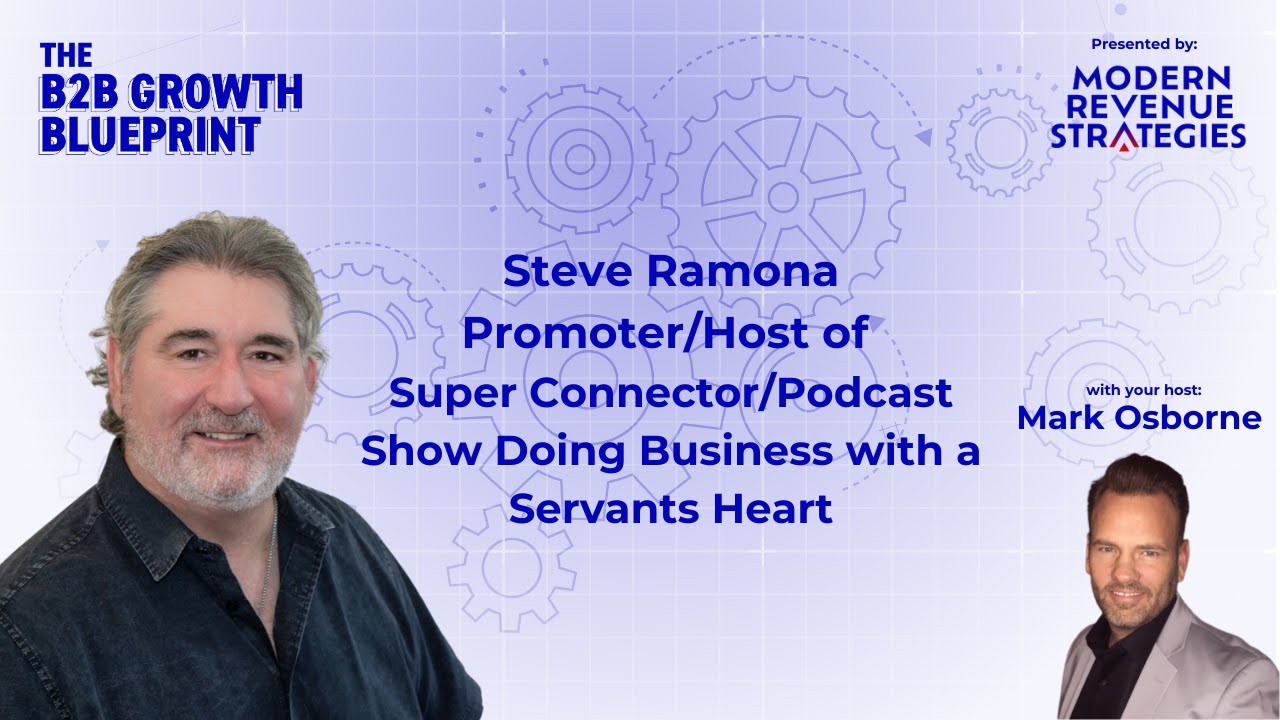
Steve Ramona, a self-described super-connector, has generated $25 million in deals through personalized introductions. He built his networking skills at an 18-year-old front-desk job and uses the ASLA principle (Ask, Shut up, Listen, Ask) to surface needs before asking for anything. He treats podcasting as a high-scale networking tool that reaches thousands and turns cold outreach into mutual branding opportunities.
Chapters
Welcome to the B2B Growth Blueprint podcast, where we talk with entrepreneurs, founders, and leaders at B2B services, tech, and SaaS companies to learn the systems and processes they've used to create success for their business. We'll also learn from marketing and sales experts to provide insights to help you grow your business. I'm your host, Mark Osborne, and the podcast is brought to you by Modern Revenue strategies and their 10x ROI B2B growth guarantee. Schedule a free diagnostic call to learn the fastest path to double your B2B revenues in just 90 days. Hello and welcome to another episode of the B2B Growth Blueprint podcast. I'm your host, Mark Osborne. Today I'm very excited to welcome my guest, Steve Ramona. Now I'm gonna read Steve's bio to make sure I get everything right. Steve is a promoter and super connector. He specializes in building partnerships through his personalized introductions. Now, these introductions might be emails that include video explanations, adding a personal touch to each connection. Steve's introductions have been incredibly successful, resulting in $25 million in deals over the past 11 years. This track record speaks volumes about the value that he brings to each of his connections. Steve has a podcast, Doing Business with a Servant's Heart, with an audience of over 40,000 people per episode and growing. He also has a TV show called Together We Serve, which has a 1.2 million monthly audience on the TV channel. Steve's shows feature CEOs, founders, presidents, and entrepreneurs with incredible stories. So I encourage you to tune in there. Steve finds great people to partner with through these shows and introduces partnerships and collaborations. So Steve, Welcome so much to the show.
Marc, thanks for having me. I'm fired up.
I'm excited to chat with you. So, uh, tell us a little more about, you know, what you do. What, what does it mean to be a super connector and promoter? Tell us about your story.
Uh, real quick, and I always say that it's usually not real quick, but at 18 years old, just graduated from high school, was going to jump into community college football. And, you know, we all need a job at 18 years old, you know, to go out. We got our summer open before school starts. And my family had launched a health club, racquetball club. So my cousin said, why don't you come work the front desk? You know, I trust you. You're my cousin. I know you. Come aboard. And what happened when I started working there was the transformation to me of building a network because I would see people, the same people 2 or 3 times a week.
Yeah.
They come in and work out. Hey, Tony. Hey, Jim. Hey, Debbie. Have a great workout. But then the conversation came to be, Came to, hey, Tony, how was your vacation in Jamaica? Hey, Debbie, how's your new granddaughter? What does that look like? I'm building relationships. I'm 18 years old talking to 40, 50, 60-year-olds. Some of these guys making millions and women making millions of dollars a year. And that led to resources and tips because it became my friends. They take me out to lunch. They come in and one great story I remember, never forget. Tony, this financial advisor came in. He called me kid, the little guy, little Italian guy. Hey kid, what's going on? I said, hey, nothing. Go have a great workout. He goes, hold on a second, flip me a book. And I catch the book and he says, see this? It's The Wealthy Barber. I want you to read it because you've been so good to me. I want to thank you for that. But what I'm going to do though next week is ask you one question. Now you better have an answer for me. So you got it. It was a small book, 60 pages. So at 18, 19, I had enough time to read it. Plus, I didn't want him on my bad side. He was Italian. I was a little— not scared, but just, I wanted to make him happy because he's my friend, right? So he did. Comes in the next Tuesday. Hey kid, did you read the book? I said, yeah. He goes, what did you learn from the book? It's the only question he asked. I said, take 10% of my income, which back then was like $3 or $4 an hour. This is 1979, '80. He says, put it into an account, don't touch it. Okay, I could do that. And I did it. And for years, you know, I kept seeing Tony remind me, no, I haven't looked at it, I haven't touched it. I keep putting money in. Good kid, good kid. And 10 years later, he'd left the club by now because he's a little older when I first met him. And I looked at the account, there was $68,000 in 10 years in there.
Wow.
Compounding, we all know savings. It was amazing to me. So I called Tony. I'd still connected to him. I said, Tony, I want to thank you. Here's what happened. He goes, kid, it's what I told you. I told you it would work. I said, hey, can I send you $1,000? This was your work. He stopped me right there. He goes, no, I'm retired. But you listen to me. If half my clients would have listened to me, they'd be millionaire billionaires. A lot of them would say no to the stuff I would tell them. Some became bankrupt, some didn't grow. The some that listened like you made millions. Now, of course, I didn't make millions, but what I learned was he was serving me because what he said, kid, somebody probably came into my life or something happened because you followed my gift. And the gift back to me was that you did exactly what I told you. So we exchanged gifts. That's what a servant heart does. You give a gift. And if you receive one, get it back. And I learned, wow, what an incredible opportunity to serve and help and bring value. The other thing I learned was your network. Now, when I left the network, the health club, I, you know, one of the members reached out to me. I wasn't working. I had no resume. I didn't know what I was going to do. 22 years at a company, you just don't know. And he said, I'm starting a restaurant. Why don't you come work for me? I said, I don't know anything about it. But I give myself great credit. I said, I'll take action. Okay. Yeah, let's do it, Jim. So what I did was I took the network of thousands of people I met over 22 years in the health club and said, hey everybody, I'm here at this new restaurant. I'm cooking. Come see me. In 6 months, we were bursting out, making money hand over fist because those people I've built a relationship wanted to come in and check in on me. And then of course they ate and they paid for the food and it was amazing. And then I started, left there 3 years later, I started my own company 3 years later. I took the restaurant network, I took the health club network, and that company became $250,000 in the bank within 6 months.
Wow.
More money than I've ever seen. Because what happens is when you build these relationships, every opportunity you have, and it could be professional or personal, people care and remember and like you because you brought value, you served them. So there's the, your network's your net worth right there.
Yeah, for sure. So, you know, we've talked about this. A lot of our audience is, you know, founders, entrepreneurs, or operators at, you know, B2B companies, maybe in early stage. And for a lot of them, their network is also their net worth because it's that ability to sort of leverage those folks. But some people aren't as maybe either as gifted naturally as you are at, you know, sort of building those networks, or maybe they've you know, sort of maxed out what they can get from their network, or, you know, they just need, you know, strategies for growing. Something tells me that you've got some good ideas on, you know, how folks can grow. And, you know, the traditional way is like join networking groups. And, you know, that can, that can be exhausting. It's not always sort of that fruitful. You know, other things are, you know, people try to automate online, and that can be a little impersonal. Talk to us about what you've seen, you know, what works today for folks building that, building those networks to build their net worth.
Going back to value, when you bring value, people remember you. I get 3 to 10 referrals almost daily for the last 18 months. So I'm meeting new people all the time. The other thing is when you meet people to grow your network, when you bring value to them, what are they going to do? Oh, you got to meet Mark Osborne. Oh my God, let me connect you with Mark. So now the referrals start coming intake instead of outtake. Outtake's the beginning because you're still building your network. And I built this principle called the ASLA principle.
Okay.
A is ask, S is shut up, L is listen, and A is ask. And here's how it would go. I'd ask you a question, Mark. Hey, what's your challenges in your business? I'd shut up. But here's the big bridge is I'd listen. I don't shut up and go, what am I having for lunch? Okay, I've got to meet Joe tomorrow. And then you tell me something. I have no idea what you said or comprehend it. So I shut up and listen and you go, I need more speaking engagements. I want to speak more. I'm like, fantastic. Let me ask you, you looking this year, next year, kind of get a little more detail. And then I come in with the thunder, I call it. You know what? I've got a couple of people that are looking for speakers. I've got this product that I think you might want to look at. And boom, because I did the ASLI, asked, shut up, listen, and asked, I was able to bring value. We cannot serve people unless we know them. If I just met you 2 minutes ago, I, and you've not said a thing, you just shut up. I wouldn't know how to serve you. Maybe make you a model because you're a handsome guy, but that's all. But that's one way. If you do that in every call, every interaction, interaction in person or virtually, especially in person, if you ask first, hey, let me know a little bit about you, the ASLA principle comes in. And then you've got the— I don't want to say you're ahead of the game, but you're able to bring value. And then guess what? When they ask you, hey, tell me a little bit about you, they're more attentive. They're like, oh my God, this guy just gave me gifts. Well, this woman just gave me gifts. This is a cool person. I'm going to listen more. It's a cool principle that really works everywhere, but in person, I'm finding even more so. The other thing is podcasting. And maybe I'm going to be controversial, and I've been fighting with this back and forth because I've been part of and run some networking groups for years. And what you find, the people listening, you probably see the same thing. The same people over and over again. And they talk business a lot, which is okay. And if you're starting out in a business or want to build a network, it's powerful. I did that January 2020. Within 6, 7 weeks, as the top sales guy in my company, I had 500 new people in my network. So it really works there. You got to be proactive, set up the one-on-ones. But a podcast like we're doing right now is a game changer. All of you that do one-on-one meetings, They're great. We learn about each other, how we can support each other, how we can serve you, and then we walk away. But when you do a podcast, it's a one-on-one that when you walk away, in my case, thousands of people get to see you. And so now I'm bringing huge value to them.
Yeah. So you're hitting on something that's really interesting. So we work with a lot of companies in building, you know, account-based marketing programs. And, you know, the principle of account-based marketing is, you know, moving away from, you know, broadcasting messages out to anonymous folks and instead identifying those, you know, that dream 100 of clients. Maybe you might have heard that phrase or, you know, sort of those clients that are most, you know, aligned with your ideal customer profile or that ICP. And then those that are indicated that they're actually in market, like maybe they're on your research, on your website researching you, or they're out, you know, reading articles about your topic, and you can get that third-party intent data from out there. You can get it from LinkedIn, which is a really easy spot. So now, you know, folks that are aligned with who look like your best customers, and, you know, folks that are actively researching solutions like you offer, what better person to reach out to and say, hey, would you like to be a guest on my podcast? Come tell us a little bit about your business and what you do, because everyone knows that people do business with others that they know, like, and trust. And so it gives you an opportunity to actually genuinely get to know them. And then if there's opportunity, you might be one of the people that they'll consider working with. The next time that they, you know, are actively evaluating solutions like yours, or you might not. But what a better way to introduce yourself through, you know, having an authentic conversation rather than just, you know, blasting a cold email to them about, hey, here's why you need to work with me because that just doesn't work.
Well, and I love that because let's take the Dream 100. Like you said, you could send an email out to Elon Musk, he's your dream 100. He's not going to answer. His team's not going to answer it. But if you mention a podcast, now he probably won't because you go through layers, but those dream 100 of people that you want to reach out, say, I'd love to have your message on my podcast. I'd love to have you guest you and promote you and highlight you. Who doesn't want that free branding?
Right.
And I'll give you a great example. Lee Steinberg, he's a sports agent. Jerry Maguire movie audience, if you remember seeing that movie, it was based on his life. He's Patrick Mahomes' agent. I reached out to him. He's my Dream 100. Perfect example. And I said, Lee, I'd love to have you on my podcast. I love what you're doing with the athletes. He said, absolutely. And 6 weeks, 3 weeks later, he was on my podcast. Now, if I reached out to him and said, hey, let's jump on a call, I want to learn more about you, he's going to go, kid, I don't have time, right? You know, talk to my admin, he'll give you all the information you want. It's so powerful. I've had billionaires on my show, founders of BNI, Roy Firestone, who's done 5,000 sports interviews for ESPN because of my network. Because— and you said something very, very awesome. That's the word. It's probably the wrong word. Not good English audience, but that's okay. I'm fired up. Is somebody may not be a fit, but here's the power of it. You meet Joe Smith, who's not a fit for you, but now you get into his network because he likes you now. And Joe goes, hey, I've got these 2 billionaires you need to meet. I'm gonna do a call.
And just as likely is that you'll know someone that he can be a fit for. And that's, you know, the thing that I loved about our very first conversation and this one too, obviously, is that it's very clear that You're coming into this, as you say, with, you know, a servant's mindset and a servant's heart. You're not coming in, what am I gonna get out of this? But instead, you, you approach every situation of how can I add value to somebody else? Because you know that it's gonna, you know, sort of pay back for you in the long, in the long run. And, and what a better way to go through life instead of trying to figure out how you're gonna elbow your way to the, to the front. Instead, you figure out how you're gonna You know, bring other people to the front and put your arms around them, and then they wind up doing the same for you.
Yeah. Locking arms. I love that, Mark. You're so smart. This guy's a great host, audience. You got a rock star here. Yeah, we lock arms. And you said something again, you're teaching me something. That's why I love being on shows, is you said servant mindset and servant heart. You can't just have a servant mindset in my mind because, yeah, I'm going to serve, but the back of my mind is like, Yeah, I serve Mark. I know he knows these 3 people. I'll get them on my show. That's why I say service heart. It's coming from a heart.
I—
we first met, I gave you as much as I could as I got to know you without any— my mindset was never, oh, Mark's gonna make me a millionaire. Mark's introduced me to— it was the only thing I was excited about is you're a podcast host as I am, and we're gonna do shows together. That was the only thing. But that's still a win-win for us. So audience always think, and you, when you work with the account, I don't care if it's B2B, B2C, or in your personal life, if you have that servant heart mindset, and that's probably the best way to say it, when you're involved with those, even when somebody's nasty to you, it's hard. I trust me, I'm Italian. It's hard to do it. Or even if, and this is something I do, that this is the biggest tip for your account people, for people in your audience. When somebody says no to you, when you have an offer and go, hey, I'd love to have you as a client, I think you're a fit, and they go, no, I'm not ready, or no, no thank you, bring them more value. Yeah, make right away, hey, by the way, Tony, hey, I appreciate you being on, whatever you say. Go, you know, I was thinking while we were talking, I need to introduce you to this guy. I think he'll help. Now, audience, I want you to think about what happens when that person leaves that meeting. When we, when we get a no, we give a no to somebody, we expect, oh my God, they're going to be pissed, negative, upset. And you come back and bring them more value. I've seen around 50, 40, 50, 40% of the time that people come back months later or weeks later and go, you know what? I'm ready. Because you left them with this value, this law of increase that's undeniable when it comes to emotions.
Yeah. Totally true. Totally true. But the thing that I see is although this is a, you know, obviously a great principle and what a better way to go through life, you can absolutely sort of maximize the effectiveness of it by taking the time to really understand, well, who is my ideal customer? Where do those people live? Where, what do they care about? And so then, you know, we've all got the same number of hours in the day. And so when you think about, well, where are you gonna spend your time? And, and, you know, just as you sort of described with, you know, sort of networking and, and those sorts of things, you could choose to join a networking group of, you know, people who are interested in X topic, or you can choose to join a networking group of people who are interested in Y topic. Obviously, pick the one that aligns with, you know, where you can add value and where your passions are in life. And then, but then Don't come to it with the perspective of what am I going to get out of these folks, but instead, what can I add to this conversation?
Yeah, absolutely. And that you just brought to— again, you should do the servant's heart. In my mind is not just networking groups, but look and research the ones that are really going to fit what you do. Don't go to a networking group if you're a lawyer, go to a networking group with a whole bunch of podcast hosts if you're not a podcast host. I mean, unless you're going to want to be. That's just not a real fit to be a guest. I mean, you can find ways to fit, but a real probability of a fit. And you said something that was very, very good about knowing your client. That's your homework before you become a servant's heart, before you go into a network group, because you got to know that. How many times have you been to a group and they go, hey, so, you know, how do you help people? I help them make a lot of money.
Right.
Well, that's everybody in my network wants to make a lot of money, or I help everybody with their health insurance to save money. It can't be so generic. It's got to be specific and nichey. So like me, people go, who do you need for your podcast? I mean, I would love to have, not need, sorry. See, communication properly. Celebrities, successful business owners, and athletes with businesses. Right away, people, and a lot of times people say, no, I don't know that because it's very nichey. That's okay. I tell them, If you ever run into them, that's great. But I'm going to give you another tip for your audience that we're working on in my mastermind with very successful people is vertical integration. Knowing who your client is and partnering up, and that's what I do, other businesses. So for example, a business coach with a mindset coach with a website developer. Well, the business coach meets somebody and they're starting their business. They don't have a website. What he does is connects them to the website guy and says, you know, you come back to me, you're not ready yet. Here, let me connect you. Well, when the guy signs up with the website guy, the website guy pays the business coach an affiliate, a commission.
Yeah.
Maybe it's $1,000, whatever that is. He gets his website done. The website guy goes, okay, now I want you to go to Steve Ramone, the business coach. and start building your mindset with your business with his coaching. So now he brings them back. I become a client. I pay him a little commission.
Yeah.
You see what's happening? We're increasing the lifetime value of your customer. And then finally, mindset is the last thing. I'm, as the business coach, it's like, okay, you've got all the systems, you got the business down. Mindset's the thing you need to work on. Go meet Debbie and get her set up. I mean, get set up with her. I built the trust, like, and all that. I always forget that with the 2 people. I brought him a great website. He's super happy now. He's come to me, he's super happy. When he goes to see Debbie, it's probably going to be, where's the link? Let me get started. Right. But we're all paying each other as this integration goes. It's incredibly powerful and incredibly, uh, revenue generating.
Well, and it's truly a service to to the client. Like you're not, it's not like you're just extracting money from them. Instead, you're adding value to them because you've sort of pre-vetted someone that you know is going to do a good job with this thing that they need and someone else that you know is going to do a good job with this thing that they need. And so it saves them the, you know, sort of energy of evaluating 10 different options and the risk of picking the wrong one and helps ensure that they're gonna have the success that that you want them to have. And then it sort of grows the whole ecosystem. So, you know, it's that growth mindset, you know, there's enough for everyone. The pie isn't shrinking, it's getting bigger as we add value to it. And so there's enough slices for everybody.
Absolutely. No, that's well said because there is. And whether every time they're referred to somebody like the website guy, what do you pay? Nothing for marketing. I just say you need to meet Tony, the website guy. He'll get you taken care of. And I've already built a relationship with him because I brought him value on that one-on-one. We've maybe met a couple times. Maybe he was on my podcast as a guest. There was so much value in building relationship tools given to him, or this person, this client. It's a no-brainer. Yeah, I'm gonna definitely meet with the guy and see what he does and see if it— And sometimes that doesn't happen. Sometimes I may just send it to a website guy and the guy won't want to work with me. He has his own But that's still, I got paid a little bit, the website guy got taken care of, we're all happy.
And well, and even if you didn't, what did it cost you? You know what I mean? Like, truthfully, just having a— all it cost you was the time to say, hey, you know what, you might, you might want to connect with so-and-so. And, you know, sharing some contact info and, you know, do unto others as you would like them to do unto you. Like, what a better way to go. What a better way.
One thing I do know, Mark, is when you do this, and it's happened to me, um, universe talks. The universe— I call it university currency, the universe, the spirit, whatever you want, ether, whatever you want to call it. When you serve people and bring them value, and you may get nothing directly from them, maybe it's a referral that comes to you, or maybe from left field, this client, the client that you've been trying to get to sign on with you, calls you out of the blue. I'm ready to go. I need you, you know, whatever it may be. To me, that's the universe. And it's happened to me over the last year and a half. My complete life has changed because of so much value I've been bringing for the last 18 months.
That's great. That's great. So tell us something that you've got sort of on the horizon that you're sort of excited about, what's coming down the pipe for you and your In your business?
Yeah. So, as my partnerships, one thing I do is I develop partnerships and I get paid for that. I'm not part of it. The other part of it, I become— I'm asked to be a partner. And I'm part of an EV charging station program. They're putting EV stations everywhere. And anybody with a parking lot, they're going to let them lease the part. You know, they're going to pay a lease to the parking lot owner. Think of malls, apartments, offices, shopping, you know, all those different— movie theater, anybody has a parking lot. It's so powerful because now that dead space of a parking lot— it's not dead. People are parking their cars and they're not making any money off that. Now think about they're using Whole Foods. So Whole Foods has like 5 or 6, I don't know how many stations, let's say it's 6 stations. Now people are going to Whole Foods first Parking their car, getting their car charged while they're going to the Whole Foods and getting their groceries. They're getting 2 things done at once within 30 minutes. Unfortunately, with gas cars, what do we do? We've been doing it for 50 years, as long as gas cars have been around. We pull up, we wait, we pull up to the tank, and we start pumping gas. That's all we— yeah, we could jump on our phone, answer an email, but there's really nothing else we can do.
Right.
So for $15, The 30 minutes we've got to pump gas. Now with EV, we can actually get you to be more multitasking and get more stuff done. So literally EV stations can save you time.
Super interesting. Super interesting. Well, and obviously there's value to the, the owner of the parking lot, value to the customer, value to the, the leasers of the stores around the parking lot. It's, it's definitely one of those win-win scenarios.
Yeah.
So Steve, for folks that have been listening and, you know, want to know how to get in touch with you and how to get a part of your network, what's the best way for them to get in touch?
You know, jump on LinkedIn. I'm always on LinkedIn. Steve Ramona, S-T-E-V-E R-A-M-O-N-A. Or you can email me. It's my first name, Steve, the letter R, my last name, 1961@gmail. Email me if you have questions, thoughts, whatever. Reach out to me and I'll make sure Mark knows that you reached out and let me help you. Let me support you. Let me serve you. Fantastic.
Steve, thanks so much for joining us today. I really enjoyed our conversation.
Thank you, Mark. It was great.
Thank you for joining this episode of the B2B Growth Blueprint podcast. We hope you've gained insights to grow your business. If you enjoyed this discussion, Please rate, comment, like on your favorite platform, and share to others who will find it useful. Do you know a CEO, founder, or leader at an early-stage B2B services, tech, or SaaS company who would like to be a guest and share their story? Send us a note. Let's schedule a conversation.
More from Mark

How Can You Maximize Your Business Value Before Selling? with Randy Katz Video







