Systems Set You Free: Build a Self-Running Business with Bradley Hamner
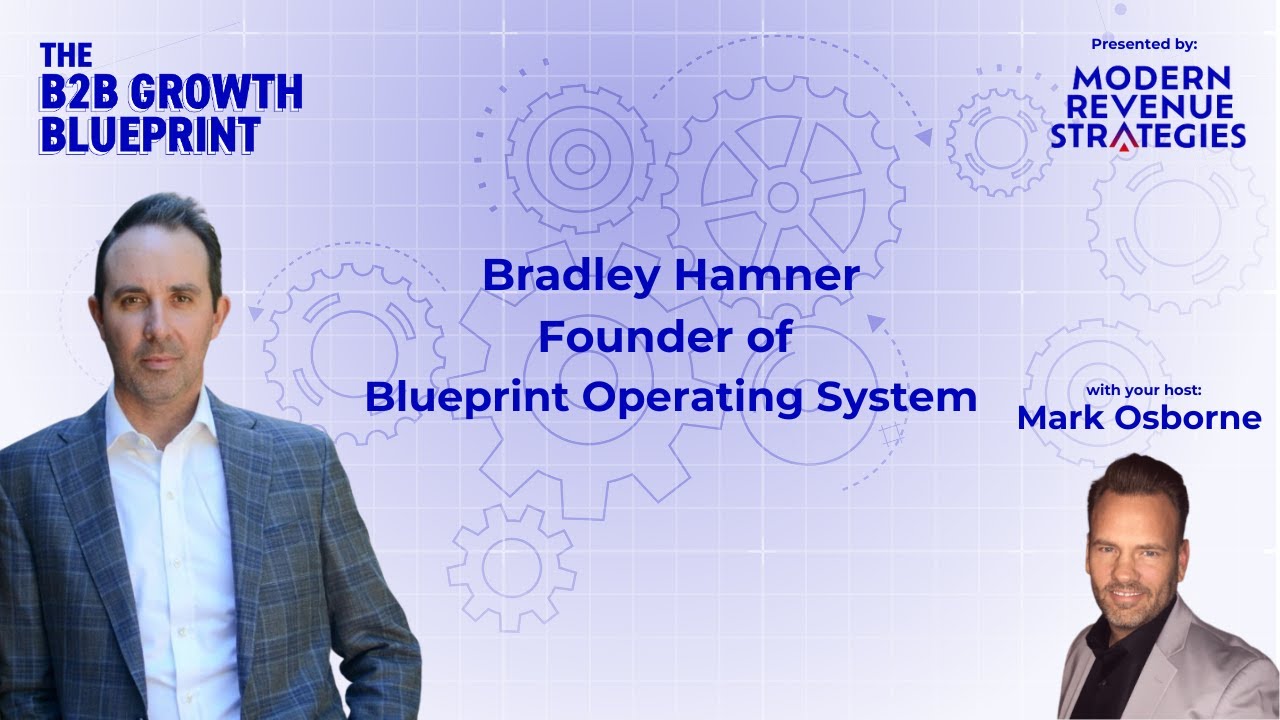
Bradley Hamner explains how founders can shift from being the business's main revenue driver to building a self-running operation through documented systems. He outlines the Blueprint Operating System, which uses weekly thinking sessions, quarterly reflections, and a 2-92 planning cadence (2-year vision, 90-day goals, 2-week sprints), plus the 3 Ds framework: do it, document it, delegate it.
Chapters
Welcome to the B2B Growth Blueprint podcast, where we talk with entrepreneurs, founders, and leaders at B2B services, tech, and SaaS companies to learn the systems and processes they've used to create success for their business. We'll also learn from marketing and sales experts to provide insights to help you grow your business. I'm your host, Mark Osborne, and the podcast is brought to you by Modern Revenue strategies and their 10x ROI B2B growth guarantee. Schedule a free diagnostic call to learn the fastest path to double your B2B revenues in just 90 days. Hello and welcome to another episode of the B2B Growth Blueprint podcast. I am your host, Mark Osborne. Today I'm very excited to welcome my guest Bradley Hamner. Bradley has launched multiple successful businesses and works with owners who are ready to move from working in the business to designing a business that runs like a well-oiled machine without them. Essentially, he's solving that rainmaker's dilemma, uh, for owners in their business. And we all probably know the skills that get most entrepreneurs to where they are today have kind of become their greatest weakness as they're running the business, uh, and Bradley calls that the rainmaker's dilemma. He's developed a simple methodology to address it, and we're going to talk about that today, as well as some of the tools that he gives owners that they need to move from a rainmaker to an architect in, in their business. Bradley has also engaged audience with his Above the Business podcast with over 4,000 downloads monthly. So, so excited to welcome Bradley to the show. Bradley, thanks so much for joining us.
Mark, it's a pleasure to be with you. Thank you so much for the opportunity. I look forward to serving your audience today.
Yeah, absolutely. So, uh, we were chatting a little bit before and, uh, we'd love to, you know, sort of share with our audience. Tell us a little bit about your sort of background story and, uh, how you got to where you are today.
Yeah, I'm going to take you back to whenever I was growing up. So my dad is, uh, in the farming business, farming operation. So they farmed around 10,000 acres annually. And so whenever you grow up in a farming family, you know what it means in the fall and in, and in the spring when it's planting and harvesting. seasons. And so I caught what it means to work hard for my dad, and I picked that up. And then in my first careers, I was in sales. And so when I started my business, I felt like I had 2 things in my quiver, so to speak. I knew how to work hard, and I felt like I knew how to sell. It's exactly what was needed to get that business off the ground from 2010, whenever I started. But the problem is, it worked until it didn't. And so ultimately, I simply ran out of time. And then in 2015, I started to have some You know, what I felt like was heart issues. Didn't know what that was. I was experiencing panic attacks, which I know unfortunately a lot of entrepreneurs have probably experienced that, and I didn't know what to do. And so ultimately, uh, I found myself in Toronto a few months later and was next to an entrepreneur, and he was sharing with me that the previous year they had done $40 million in top line and $5 million to him personally, and He said something I'd heard for years. Look, man, it's just systems and processes. And I rolled my eyes and said something smart back to him. And he said, I'll show you. And he did. And ultimately, from that day forward, everything finally changed. I finally started to realize, and first of all, in myself, an identity shift. And then I started to make the changes in the business. And that's kind of what we share with business owners to do today is to transition from being the rainmaker to becoming the architect of their business.
That's great. Well, certainly a topic that we're passionate about too. We have a phrase we throw around here that, you know, systems set you free. And, you know, that essentially allows you to kind of be your best self in your business every day without that stress of, well, you know, am I doing it exactly right? Because you've got a system that, you know, allows you to ensure that you are always showing up as your best self. And it also opens lots of other doors too. Uh, and, and I know that, uh, you know, that's something that, that you look at. Tell us a little bit about some of these systems. And I think you call it your like blueprint operating system. Is that right? Tell us a little bit about that.
Yeah, we do. So if you're going to transition from being the rainmaker to become the architect, what architects use, they use blueprints. And so obviously, you know that word really well, obviously yourself. I want to go back to something you said around systems set you free. And I'm going to double tap on that for a second because I think paradoxically, maybe even subconsciously, we got into business for some level of freedom and flexibility and income potential. Okay. I mean, that's why I left the corporate world. And in '15, I almost went back because I was so frustrated with where my personal income was and where the business was. And I was working around the clock that I was like, you know, screw this. I'm just going to go back to the corporate world.
Sure.
And so What I, when I would hear systems and structure and process and routine, it felt like I was being pinned into a corner. It felt like I was like, I don't want that. See, I got into business to, to do what I wanted to do when I wanted to do it with who I wanted to do it. So when I hear process, structure, and routine, it feels like it's restrictive to me. But what I didn't realize, again, I think this is all subconscious at the time, is that everything I wanted was on the other side of that.
Mm-hmm.
So to your point, I totally agree with you that systems set you free. And when I would hear that, I was like, intellectually, I get that, but see, I don't want a system. And so I had to realize that the team and the business was silently wanting and, and, and basically begging for us to be able to have structure and process into the business. And so I think for a lot of entrepreneurs, there's this like give or take as to why we, at least, at least at the levels, you know, that, that we work with, we're like, yeah, but that's not what I got into business to do. I wanted that freedom and flexibility.
Yeah.
Yeah.
Well, but, but ironically, again, as you say, the systems don't have to be restrictive, right? And, and one of the things that we, we talk about is sort of like the critical flow. So, you know, there's, you know, the process of taking someone from an anonymous target to a, a known, you know, prospect to, you know, active opportunity to, you know, being a customer and then your best customer. That's a pretty simple through line. And there's not a million things that you have to do in there. There's a finite number of things that have to happen. But until you define them all, you can't know what they are. And if they only live between your ears, you can't bring anyone else to help you. So then you're saddled with, you know, having to carry it all yourself. Just sort of saying, well, in order to go from here to there, I got to get some contact information.
Right.
And in order to go from here to there, I got to know, you know, what their needs are, what their timeline is for making a decision, what their budget is. If they've got a problem, I can really help. Like, very simple, or, you know, some almost even simplistic things start to define a system that then you can, you know, sort of delegate and bring other folks in to help you with those systems. It doesn't have to be like McDonald's where a dime-sized, you know, squirt of mustard exactly in the upper right-hand corner of the bun. Like, it doesn't have to be that, like, when we talk about systems, that's not what we mean. And so it's really interesting to see that evolution happen with, with customers and as you described yourself.
Yeah, no question. And I totally agree with you. And what I didn't realize for all of those years, those first 5 years of business or so, is I didn't realize to what you just mentioned was actually, it's not, it even gives me more freedom and flexibility when those things are actually in place. And so then I needed to face the monster, so to speak, which is I don't know what it looks like. I don't know what people mean by systems and processes. And so I remember one instance in particular that someone was on stage and talking, and he just kept talking about the system that they had to do this thing. And I was like, oh my gosh, I gotta get my hands on the system, right? And so I, you know, Found him afterwards and said, hey, is there any way I get a copy of that? He said, yeah, sure, sure. Email me. So I emailed him and, you know, it was like a month later, he finally sends it to me and it's a one-page. It's a one-pager. And listen, I love one-pagers, the simplicity, but I mean, it was like 10 bullet points. And I thought, there's no way this is this profound system that we're talking about. And so it felt like the Wizard of Oz. It felt like, well, somebody let me behind the curtain of like what this actually specifically looks like. Everybody talks about it, but nobody actually ever shows me. How to do it, and so when I was in Toronto and met that entrepreneur, I think there was something about the fact that I had just truly hit burnout a few months prior to that. I was really at my wit's end, and I think there was that. Plus, he he was a financial advisor, and he had built a financial advising company. And so I I guess I had it in my head of what I thought that they did in revenue, maybe half a million to a million. And so when he said forty and forty million dollars, I was like. Oh my gosh, what in the world? And then when he showed me what they actually, what their systems and processes actually look like, it was just this fundamental moment where I thought, oh, well, that's what it takes. That's actually what it looks like to have a company doing $40 million. And so forever from that point forward, the bar was raised for me to realize Okay, well, Bradley, if you want that, that's what you're going to have to give. And full transparency, I never set out the goal of getting a company to $40 million, right? That's irrelevant to the point, which is that I finally saw what it actually took and what it actually looks like to be able to do that. And so that's the path I started on. And it took me a couple of years. Let me— full transparency, like I wasn't guiding my— I was guiding myself of trying to figure it out. But instead, we finally did the work instead of putting it on the calendar and missing it, you know, like, oh, this is when I'm gonna document my systems. I finally actually started to do it and we started to see a lot of success and it built upon it on one, it built upon one another.
Yeah. Well, and I'm sure the experience of sort of authentically going through it yourself makes you that much better at connecting with, you know, entrepreneurs, owners, founders that are trying to sort of build it in their, in their business too, and that aren't looking for a generic You know, off the shelf, you know, this works for every business, whether it's, you know, finance or, you know, manufacturing. But instead, like, you've had that real authentic experience of building it so you can, you know, guide them through that experience themselves.
Yeah, for sure. Nobody, when you get started in business, I mean, I mean, I went, I went to Auburn, I got my degree in finance. I mean, I didn't go to business school per se in the sense that you know, before you start your business, they don't require you to go to small business school to learn all of these different skills. And they're going to— they don't tell you, hey, here are the challenges you're going to face in your first $300,000 in revenue.
Right.
These are the challenges you're going to face when you get to a million. And these are the challenges. Like, they don't do that. And so you're kind of swimming and trying to figure it out yourself. And it can feel really lonely at times. Um, and, and then honestly, you can kind of get conflicting answers at times.
That's right.
You can read one book and it's like, I should do this. And you read another book or listen to a podcast and it's like, oh my gosh, what actually is true? And I think that's one of the reasons why business is really hard. It's hard.
That's right. So, so tell us some of the things that you found to be true, uh, in, you know, in implementing these, you know, blueprints for, for your clients and, and at those sort of different stages.
So first I would say to the founders and owners out there, I think the first thing that I did before I even pulled up a new Google document is it is an identity shift. I think you start to actually see yourself as instead of I'm going to be the one that's going to do all of the things, how do I actually build and design the systems to make these things happen? I mean, that when you start to see yourself, and my hope is that somebody listened to this. Just if they take nothing else out of it, that they see themselves and they start to take on the hat of being the architect of the business. And so it's like, I'm going to design this and it's not going to just happen by default. This is where I really want my business to look like. This is where I want us to try to go. And I'm going to go build the systems to make that happen as opposed to I'm going to go do all of the things. And that's a, that's a fundamental shift.
Yeah.
I think the second part of that then to get tactical for people is you got to have— before you even go around even documenting what, what it is that you do, I would suggest to you that you have what we call Rembrandts in the attic. You actually have incredible assets into that business already that you've created over the years. You've got great Word documents, you've got great Excel spreadsheets, you've got great whatever other systems that you have. And so really just having a way to organize those digital files as an example, that in and of itself is incredibly valuable. And so sure, we, with our members, we talk about like, how do you actually create really well-structured documents so they're uniform across, across the organization. But more than anything, you don't want to send your team or yourself on scavenger hunts. Hey, where is that Google document or that Word document at? And where's this and where's that?
Yeah.
We've all had that experience before. And so even having a place where things are matters a tremendous amount. And so I'd encourage people to consider a, like a spring cleaning for their digital files. There's a great book called The Magic Art of Tidying Up. And so she goes in and goes into a closet in the master bedroom, takes everything out, and then goes by those pieces one at a time.
Yeah.
She either donates them or gives them away. We would consider that Archive them, just create an archive file, right, in your Google Drive, Dropbox, etc., and then go and strategically begin to place those things where they should specifically be so you can find them and as well as your team can find them. So we call that optimizing for retrieval, not for speed. So we optimize for retrieval, not for speed. So those are 2 things I would encourage people to consider as how to get started. First, see yourself as the architect. That's an identity shift. And then number 2, you already have Rembrandts in the attic. You already have things that are quality assets in the business. We just need to be able to have an organizing function so that we can actually find these things.
Yeah, that, that I love that phrase, Rembrandts in the attic. And it paints such a beautiful picture and I think it's so true. And also one of those, you know, those kind of mental blocks that people have around building systems is that they don't realize they actually already have some systems that they just haven't sort of defined. Oftentimes it's the linkage of, well, you know, at what point does it, do I pull up this document and then fill it out with the customer? All you gotta do is define that upfront. And then that, then it starts to become part of a cohesive system that they're working on and above their business. And I love that phrase that you have of You know, sort of above the business. And you, you and I were chatting a little before that, you know, the, the, the E-Myth Revisited and, and the Gerber idea of some people work in their business, some people work on their business, and you've added this next dimension of above the business. Tell us a little bit about that.
Yeah, we love, you know, love Gerber's work. I mean, I think if you've been an entrepreneur for a minute, you've, you've heard of that book or read that book several times. And so love that idea of work on, not in. I just think that there's also a third dimension, which is then how do you get at times above the business? And I would suggest that people listening to this podcast, whether they're at the gym, they're driving to or from work, they're actually listening to podcasts. They're getting above the business, right? You're not, they're not in it and they're not on it. They're actually above it. But let me give a couple other times that kind of bring it very tactical for people about when, what does it actually mean to work above the business at times? And I want to be very clear. I think that there are times that you're on, there's times you're in, and there's times you're above. There's never this place where you get to, to where you're only up in the clouds above the business, you know, living 30,000 feet all the time. I think that you, there's, you kind of shift between those dimensions. So a couple of times for above the business, I'll give you one for weekly and I'll give you one for quarterly. So one is the discipline of spending at least 60 minutes Every week thinking about the business. We think the most important thing you can actually do for your business is to spend time thinking about the business, because ultimately every idea that you've ever had has started as a vision or some idea that you've had in your head, and then you go and execute on it. And so slowing down enough to have the discipline of thinking time, go to Starbucks, go to your favorite coffee shop, certainly get away from the office and spend time thinking about The business. And then the second one is very similar, but it's quarterly. So I love the discipline of looking at your year as 4 quarters. You know, we were talking before, I'm a college football fan and college football is about to kick off this weekend and we're obviously excited about that. So, but, but looking at every quarter and spending half a day every quarter to get out of the office, and I think half a day. works and to reflect. What were the things that we did really well this quarter? Write them down. And then what are the things that I want to pull forward for us to go into the next quarter? And so we encourage our members to step away week 13 of the quarter. Every, every quarter has 13 weeks and use that 13th week as the buffer zone between, between kind of like between the past quarter going into the next quarter. And those 2 disciplines alone can really help you to to start to get above the business. And so then every other time you're working in it or on it.
Yeah, I love that. And one of the things that, you know, talking about like putting it into practice that I've seen be really helpful for folks is just to go ahead and block that 60 minutes every week at a certain time so that it happens every week and you know it's gonna happen and keep it, you know, really sacrosanct. Like don't let other stuff intrude on it. That client will be there begging for you to do something on a fast turnaround. In, in another 60 minutes. So taking the time to really sort of separate, and we find that, you know, just having that sort of set time, your brain starts to sort of look forward to it and start to mentally prepare for that creative thinking about, about the business. And what we, we talk about like a 292 framework for planning where We want to have a 2-year plan. And then we want to, you know, have sort of 90-day objectives and then 2-week sprints so that we're accomplishing against those on that sort of 2-92 framework. And so then every, you know, 2 weeks you're, you're dicing up what you're trying to get done over that 90-day period. And then every 90 days you're dicing up that 2-year plan. And then on a regular cadence, you're, you're reworking that 2-year plan, which gives you a chance to not try to eat the whole elephant at once.
Yeah.
But at the same time, it starts to show like how you're going to work your way through it. Because if you're just thinking about the next 90 days, sometimes it can be like, well, I'm never going to get to where I really want to go. Sure. And likewise, if you're not dicing that 90 days into 2 weeks, you will never get to where you want to go.
Yeah, I love that. I think that's great. I love that framework. And one thing I want to double tap on that you mentioned is It's so easy to put it on your calendar to, you know what, like, I'm gonna do, I'm gonna do my thinking time on Friday morning at 9 AM after I take the kids to school, you know, depending on where you are in your, in your life. And it's so easy to get that and see that, and the reminder pops up on your phone. You're like, ah, you know what? No, nobody's pushing on me to do it. I mean, you and I had our call today. I wasn't going to just be like, nah, never mind. I'm not gonna. I'm not going to do that. No, I've got somebody else. And so I think it's, if we can get to a place to where, and this is obviously what we talked to our members a ton about, is that when you start to just do a few for the first time, the people start to, to see the, the, the downstream effects of it.
Yeah.
And it really is one of those, we've all heard this adage of small hinge swings, big doors. And it's like, well, what is that? What does that actually look like? And I will tell you, I think Sunday night planning, planning your week out on Sunday nights for 45 minutes, that, but also spending the discipline of once a week, 60 minutes thinking time, that is, those 2 are small hinges that swing massive doors for the business. And so you've got to, whatever you have to do to be able to get yourself to commit.
Yeah.
to not breaking that commitment to you that you have to yourself. I'm telling you that I don't think there's anything more important to the business than to be able to spend that time thinking about the business.
Yeah. Well, and one of the key ways that people get there, and you and I were chatting about this a little bit before, is, you know, sort of taking the, you know, sort of the ownership as the owner of the business to delegate. some of the tasks that are using up too much of your time so that you can't afford that 60 minutes of time thinking about your business or that, you know, 45 minutes of planning out your week. Instead, you're just, you know, sort of deep into it. How do you, you know, sort of approach delegation? How do you, you know, sort of implement that in businesses so that people can find that time to build those hinges that move those big doors?
Well, it's obvious that you and I are very much aligned in frameworks and concepts, like things that we can take away, specifically frameworks of like, how do I think about this, because if I just started down a path of just talking about, you know, general best practices of delegation, my guess is everybody would be like, yeah, I've heard that before. Okay, so I'll give you 2 specifically. I'll give you one that is somewhat of a concept, but I'll give it into some really specific things. But I'm gonna give you 2 frameworks. One, we call it the 3 Ds, and the other one is permanent delegation. And we match that up against the difference between permanent delegation And boomerang delegation.
Okay.
Okay. So we'll get into what that means, but I just want to for a second seed for your listeners this idea. When you think about delegation, we actually encourage our members to put the word permanent in front of it because it's a totally different— it makes it go like, wow, okay, well, that's a lot more serious. I want the thing permanently delegated. That was an understated subconscious thing. I don't want to delegate. I just want to delegate it and I never want it coming back to me. Okay, so we'll come back to that one in a second. But 3 Ds. So do it, document it, delegate it. Do it, document it, delegate it. So let's just give an example. Sales. So I think as an example, let's say you're in that $300,000 to $1 million range.
Mm-hmm.
One of the biggest things that you have to begin to document Specifically, then delegate is like founder-led sales. My guess is if you got it to that first $300,000, it was off your back. Mine was. Mine was. And a lot of our, my audience members certainly was off their back too. So how do you then begin to do it? Well, you've done it, so you're doing it and you document it as you are doing it. See, the biggest thing that I kept thinking I was going to do is I was just going to go through the week. And then I'd get to Friday afternoon, lock myself in a dark room with a computer and coffee, and then I'm just going to document everything I did. That does not work. It just doesn't work. You don't have time for that. We tell people the time will never come. If you put that on your Google Calendar, I'm going to spend 6 hours documenting our systems, forget about it. Like, you're not going to do it. You'll miss that. You'll delete that. You'll, you know, kick it down the road. I did it.
Yeah.
For years, kicked it down the road.
Yeah.
So what we encourage people to do is to document it as you are doing it.
Yeah.
When you're on a call with someone, what did you actually say? And maybe even write it down and then immediately go to the Word document, the Google document to be able to document it. Because I don't think you can delegate something that's not documented.
Yep.
Your team, your team cannot, cannot read your mind, but they can read a document. So we call it the 3 Ds. So do it, document it, then we can begin to delegate it, which leads us into the next framework, which I mentioned a minute ago, permanent delegation versus boomerang delegation. At the end of the day, I don't want to delegate something that just ends up coming right back around and hitting me in the face. I want to Permanently delegate this thing. Okay. So we've talked about one element of that, which is, look, if you're going to permanently delegate it, it has to be documented. But I want to give— there's kind of a lot with this, but I want to give one specific thing that I will tell you is, I think, the biggest game changer when it comes to around delegation specifically to another person. Now, you and I can get into in a second talking about delegation or really kind of delegation to AI or automations.
Yeah.
But what we're talking about currently right now is around the delegation to another person. And often what our teams need is a visual representation of what it is you're delegating.
Yep.
It's a visual representation. So a lot of the things I've kind of been alluding to sounds like a lot of words on paper or in a document, and that is true. But when there is something around the visual representation, what I mean, I'm talking about, it doesn't have to be on something pretty like Miro. You know, we look, we use Miro, but you don't have to be that. It can be a whiteboard. It can be a flip chart, or it could be GoodNotes on your iPad and you're just sketching it out, or on your, you know, journal that you maybe have and you just map it out right there and put boxes and take a picture, throw it on the document. I'm telling you, that alone, it, it, it still is— well, maybe not as much anymore, but it's so surprising how deeply that cements what it is you're delegating to your team when they just see, oh, it goes from this phase to that, to that, to that. Oh, that's actually really helpful. So doing that when you're delegating something along with the written, the visual component of it helps to be able to have permanent delegation versus boomerang delegation.
Yeah, that, that's amazing. And 2 things I want to call out there that I love your framework of You know, do it, document it, delegate it, permanently delegate it. I'm, I'm definitely stealing that phrase from now on. But the idea of, you know, setting some mythical 6-hour time block where you're gonna sit down and document everything never happens. And that's totally true. In fact, one of the things that we do is we'll oftentimes sort of create a role of like a systemologist, and I'm stealing that phrase from—
Yeah.
the book Systemology, which is a great book, David Jennings in Australia. But where you just do what you do and someone looks over your shoulder and documents it for you and then gives it to you and says, did I capture it? And then you can sort of say, oh no, slight tweak here, slight tweak there. Just that idea really opens up the idea of, you know, moving into, you know, delegation Much better for especially busy entrepreneurs that I don't have time to sit and document it. Well, good. We can look over your shoulder, watch what you do, put it down, get that first draft without it taking any additional time. And then the idea of visual representations as part of that documentation, you know, something like 40% of any audience is primarily visual in the way that they interpret the world. My wife's a graphic designer and, you know, she does design work. If I give her a written checklist, that is like sending her, you know, into a forest to find, you know, truffles. Like, she, she'll get lost in that forever. Whereas just taking the time to turn that visual checklist into that visual representation of what's actually happening at each stage makes it so much stronger. And if we know that 40% of the population, that's their primary mode, you're definitely not getting the, the most of the best of most of your team if you're not taking the time to do that. And so just sort of adding that step. And likewise, if she just gives me sketches, I, you know, I'm primarily an auditory person. I want those words. That's how I navigate the world. And so time to do both really does sort of create this opportunity for success so much more.
Yeah, you, you actually hit on something I want to share is that it is both. It is the visual matched with the actual written words that allows something to mean. Like in our sales process with Blueprint, like our discovery call, you know, document that we have, I don't know, it's probably 12 pages long-ish or so.
Mm-hmm.
But on page 1, at the very bottom of it is The visual of the 10 steps that you take somebody through. And so while I said, if I ask my sales team, hey, you got to recite and memorize every word of the entire script, right? I don't think they would get maybe 50%. But if I said, what are the 10 major stages through this conversation? Well, they'd better be able to say, okay, stage 1 is this, stage 2 is this, stage 3 is this, you know, or call them steps if you want to, whatever.
Yeah.
They better know, be able to know that, and then they can match it up with the actual scripting that goes with it. So it really is the combination that I think allows you to be able to permanently delegate to another person is the, is both is be able to have the visual and the written component.
Well, and you alluded to this earlier. Once you have this documentation, uh, that allows you to delegate, you can then make the choice to delegate that to a person or potentially to a machine. And there's so much buzz in the marketplace right now around AI. And you and I were chatting before that a lot of that buzz is really sort of mistaken that it's not AI as much as it's just automation, but automation that can use much more granular levers or granular inputs to then create flows that don't have human error, don't need to sleep, can run overnight while everyone else is asleep. And really sort of makes a lot of efficiency in your business, but you can't unlock that until you've done this documentation of what you do. So I love that framework of do it, document it, delegate it. Yeah.
So right about that. And so let me share with you kind of my blend of where automation to machine and then delegation to a person.
Yeah.
I think some of this gets contextualized and very nuanced depending on the business that you're in and the number of customers that you serve. So I want to be very clear with that. Okay. So if you're in a business that is serving thousands of customers, the amount of automation you're going to have is likely far more than a business that's doing a couple million that serves 200 to 300 customers. Okay. Let's just contextualize that. As an example, when we onboard someone, we absolutely use automation to tag them in the CRM, to send them out a handful of emails that we know we want to get to them. We want to get them access to our learning management software, right? So we can put the link into that and they can register, etc. However, it is really important because of what we do. We really want them to feel seen and heard and valued as part of our community. So we intentionally architect, if I could use that, we architect it to where we put very manual things in the system to where our client success manager is personally. It's a little bit of a template, but 50% of it is absolutely very specific to Who that person is that they would have gotten from the sales team, okay? To pick that up about you know what what what what business is Mark in? How long has he been in business? What's his revenue? What are some of his challenges? Oh, he lives in LA. He loves to fish. All of these kind of things, right? We want that to actually not be automated. We want it to be human to human experience, and then we pick up the phone and call them and connect. None of that is necessarily automated. So here's what I'm saying. I think the blend, depending on the, in the business of the automation where it makes sense, but not try to automate the entire thing to where we distance ourselves from our customers too much. In fact, I think the more we go with AI, the more companies that value bringing in community and actually connection with customers.
Yeah.
And utilize the things that absolutely make sense for us to automate those. The blend of those, I think, is the best place to be able to live.
Absolutely. And the folks that get it right, that right balance, are going to be the ones that win because there will absolutely be, you know, sort of a pendulum swing of some folks going way too far into automating things and depersonalizing it. And You're gonna have to do it some just to keep up with the efficiency. That's, that's sort of mandated in order to operate. But those that go too far will definitely lose.
I'll give you, I'll give you like one very specific one that I just did actually today. So I don't always do this, but oftentimes I'll write a long-form message in our community to our members. And so I wrote one kind of going into Labor Day weekend at the time of this recording. And I was talking about just the value of stepping away from, from the business. And so I I wrote it and I copied and pasted it into ChatGPT to kind of get, um, some suggestions. And it gave me some suggestions and I read it and I thought, you know what, it's not authentically— it's, it, it— I, I mean, I had like one misspelling and maybe a sentence that could grammatically be a little bit better. But I said, you know what, I'm not going to use the ChatGPT version. I'm not, because I want it to actually be Bradley's voice, 100% Bradley's voice.
Yeah.
And, and, and, you know, maybe ChatGPT professionalizes it a little bit, but I was like, no, I don't want it to lose my voice. So That, that part of it was like looking into AI for, for a couple of things about what they would suggest I clean up. But I will tell you, I did use automation because I wrote it and then scheduled it right inside of the system. So there's some automation with that because, hey, I didn't want to send it at 5:30 in the morning whenever I'm— I was the one writing it. So I think there is the, the personalization, but also at the same time leveraging automation where you can. So when you are thinking about delegation, you had said this before we hit record, and I think it's just brilliant.
Yeah.
Is, is this something that does make sense? If I'm going to delegate it, am I going to delegate it to a machine or am I going to delegate it to a person? And which one makes the most sense for me to be able to do? And just even asking yourself the question, there's a lot of value in that because maybe it actually could be better off and could be executed better and a better experience for our customers if it does get actually delegated to a machine. But then the other could be true too, where it's like, that's right. No, No, we really want a person on this one.
Such good points. Such good points. Well, Bradley, we could talk all day. Obviously, we're both really passionate about some of the same topics, but I got to be mindful of your time. Tell us something that, you know, you're excited about that's on the horizon for you and your business.
So we just solidified the Rainmaker to Architect Journey Award. Okay. And so we are rolling out to our members the ability Uh, so when you join, we actually give you over a base, which is the award. And then there are 5 milestones that you actually are going to be able to click off and add to your award of like, what does it actually mean to become the architect of your business? And so we're really excited about this. It solidifies this idea of not just an identity shift and not just a concept. And if you don't mind, I'll take 30 seconds just Yeah, for sure. Riff through the 5 milestones real quick. But you know what it means to become the architect of your business? We think of these 5 things. Number 1, you're doing greater than $1 million in top-line revenue. 91% of small businesses in the US don't cross that milestone. So if you have, congratulations, like you're beating the odds. Number 2, you want it to be profitable and growing, and we call that one Rule of 40. So how do we balance growth and profitability as a bootstrapped entrepreneur. Like, I don't know the, the, the VC or the private equity route where you've got money. They only care about one thing, and that's growth, and that's totally fine. But as a bootstrapped entrepreneur, whenever you're in that space doing, say, $3 million or less, you care about both. You care about this thing being profitable and you care about it being growing. And so the combination of that ratio is really important. Number 3, if you're doing that, you got a business doing over a million, it's growing and it's profitable, But you're burning it all the time and you're, you're not taking enough time off. What good is it? And so we actually allocate, um, or encourage our members to consider what does it look like to take 12 weeks off in a year?
Yeah.
12 weeks off in a year. Number 4, if you've got those things, taking adequate time off, but the things you're doing in the business you hate, we encourage you, you, it's not a luxury to have an EA. It's a necessity. So we say, do you have an EA to help you buy back your time? We love the book from Dan Martell. And then number 5, you actually have installed an operating system, which is obviously a lot of what we talked about. So how do you get your hands on a set of playbooks that form a comprehensive operating system and you install that OS so that business is running outside of something other than you?
Yeah. I love that. Those are great milestones and certainly an inspiring vision, I'm sure, for our audience to, to wrap up on. So it's been super engaging for me, Bradley. For our audience that is thinking about, wow, I want to get some of that, I want to get some of that Bradley in my life and my business, how do they get in touch with you?
Oh, I appreciate that. Well, we've got a Rainmaker to Architect Starter Kit that is a mini course that has some video training along with assets from myself. So if they go to blueprintos.com/assets, blueprintos.com/assets, they can opt into the starter kit. They can go through the video training and obviously be able to download all of the, all of the assets that we have on there. And also I have on my podcast, we'll do some solos where we'll drop in templates like weekly one-to-ones, etc. So those assets are also in the starter kit for them to be able to access. On social, LinkedIn is probably the best place to connect with me personally. I'd love to, to connect with people on there and let me know that they heard about, heard about this, us on this podcast.
Fantastic. Well, Bradley, look forward to seeing you on LinkedIn and elsewhere. And thanks so much for joining us today.
Mark, appreciate it, man. You're a pro.
All right. Talk to you soon. Thank you for joining this episode of the B2B Growth Blueprint podcast. We hope you've gained insights to grow your business. If you enjoyed this discussion, please rate, comment, like on your favorite platform, and share to others who will find it useful. Do you know a CEO, founder, or leader at an early-stage B2B services, tech, or SaaS company? Who would like to be a guest and share their story? Send us a note. Let's schedule a conversation.
More from Mark

How Can You Maximize Your Business Value Before Selling? with Randy Katz Video







